
• progress_activity cloud_sync

    Reconnection to the server…

    Movim cannot talk with the server, please try again later

  • back_to_tab fullscreen tile_small dialpad mic videocam switch_camera screen_share

    mic_none No sound detected from your microphone


    • Movim Blog

      The official Movim blog https://movim.eu/

      article 117 posts • people 959 subscribers
      assignment_ind Only publishers can publish


    • Public subscriptions

    • chevron_right

      Thorsten Fröhlich

    • chevron_right

      Steven

    • chevron_right

      coopr8

    • chevron_right

      metalshadow1909

    • chevron_right

      kenu_demon

    • chevron_right

      Thorsten Fröhlich

    • chevron_right

      Steven

    • chevron_right

      coopr8

    • chevron_right

      metalshadow1909

    • chevron_right

      kenu_demon

    • chevron_right

      Thorsten Fröhlich

    • chevron_right

      Steven

    • chevron_right

      coopr8

    • chevron_right

      metalshadow1909

    • chevron_right

      kenu_demon

  • Register Login

    Movim

    movim.chatterboxtown.us


  • rss_feed
    add Follow

    Movim Blog

    people 959 subscribers • The official Movim blog https://movim.eu/

    • chevron_right

      Movim just flattened the (connections) curve !

      Timothée Jaussoin • pubsub.movim.eu / Movim • 21 October 2020 edit • 1 minute

    A few days ago I discovered that the #Eloquent database library (the one that Movim is using for a few years now) had some events that could be caught by an event listener.

    With this simple mechanism #Movim could be aware of when exactly a #SQL request is done during the execution time.

    The Movim #architecture is based on several processes that talk to each others, and each connected session (each user connected to a specific XMPP account) is having its own sub-process. The main issue with this architecture is that all those processes relies on a common database (PostgreSQL or MySQL) and each process open an unique connection to the database. See How's Movim made? Part I - The Architecture to know more about this architecture.

    When you start to have a lot of users connected on the same instance, this is opening lots of connections to the database. This is creating a congestion and can slow down the general performances.

    This simple commit ask Eloquent to close the connection after a few seconds of inactivity. Eloquent is reconnecting automatically if a new SQL request is made after the disconnection. This allows to free-up the socket resources once "we don't really need it anymore".

    And here is the result once this commit deployed on nl.movim.eu
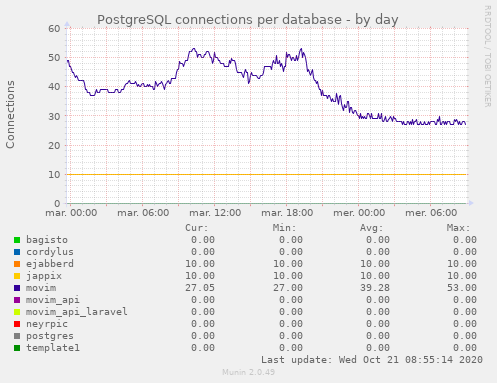
    The PostgreSQL connections curve

    • tageloquent tageloquent tageloquent tagmovim tagmovim tagmovim tagsql tagsql tagsql tagarchitecture tagarchitecture tagarchitecture tageloquent tageloquent tageloquent tagmovim tagmovim tagmovim tagsql tagsql tagsql tagarchitecture tagarchitecture tagarchitecture tageloquent tageloquent tageloquent tagmovim tagmovim tagmovim tagsql tagsql tagsql tagarchitecture tagarchitecture tagarchitecture

    • Pictures 3 image

    • visibility
    • visibility
    • visibility
    • favorite

      meta, eyome, debacle, meta, eyome, debacle, meta, eyome, debacle

    • chevron_right

      Movim just flattened the (connections) curve !

      Timothée Jaussoin • pubsub.movim.eu / Movim • 21 October 2020 edit • 1 minute

    A few days ago I discovered that the #Eloquent database library (the one that Movim is using for a few years now) had some events that could be caught by an event listener.

    With this simple mechanism #Movim could be aware of when exactly a #SQL request is done during the execution time.

    The Movim #architecture is based on several processes that talk to each others, and each connected session (each user connected to a specific XMPP account) is having its own sub-process. The main issue with this architecture is that all those processes relies on a common database (PostgreSQL or MySQL) and each process open an unique connection to the database. See How's Movim made? Part I - The Architecture to know more about this architecture.

    When you start to have a lot of users connected on the same instance, this is opening lots of connections to the database. This is creating a congestion and can slow down the general performances.

    This simple commit ask Eloquent to close the connection after a few seconds of inactivity. Eloquent is reconnecting automatically if a new SQL request is made after the disconnection. This allows to free-up the socket resources once "we don't really need it anymore".

    And here is the result once this commit deployed on nl.movim.eu

    The PostgreSQL connections curve

    • tageloquent tageloquent tageloquent tagmovim tagmovim tagmovim tagsql tagsql tagsql tagarchitecture tagarchitecture tagarchitecture tageloquent tageloquent tageloquent tagmovim tagmovim tagmovim tagsql tagsql tagsql tagarchitecture tagarchitecture tagarchitecture tageloquent tageloquent tageloquent tagmovim tagmovim tagmovim tagsql tagsql tagsql tagarchitecture tagarchitecture tagarchitecture

    • Pictures 3 image

    • visibility
    • visibility
    • visibility
    • favorite

      meta, eyome, debacle, meta, eyome, debacle, meta, eyome, debacle

    • chevron_right

      Movim just flattened the (connections) curve !

      Timothée Jaussoin • pubsub.movim.eu / Movim • 21 October 2020 edit • 1 minute

    A few days ago I discovered that the #Eloquent database library (the one that Movim is using for a few years now) had some events that could be caught by an event listener.

    With this simple mechanism #Movim could be aware of when exactly a #SQL request is done during the execution time.

    The Movim #architecture is based on several processes that talk to each others, and each connected session (each user connected to a specific XMPP account) is having its own sub-process. The main issue with this architecture is that all those processes relies on a common database (PostgreSQL or MySQL) and each process open an unique connection to the database. See How's Movim made? Part I - The Architecture to know more about this architecture.

    When you start to have a lot of users connected on the same instance, this is opening lots of connections to the database. This is creating a congestion and can slow down the general performances.

    This simple commit ask Eloquent to close the connection after a few seconds of inactivity. Eloquent is reconnecting automatically if a new SQL request is made after the disconnection. This allows to free-up the socket resources once "we don't really need it anymore".

    And here is the result once this commit deployed on nl.movim.eu

    The PostgreSQL connections curve

    • tageloquent tageloquent tageloquent tagmovim tagmovim tagmovim tagsql tagsql tagsql tagarchitecture tagarchitecture tagarchitecture tageloquent tageloquent tageloquent tagmovim tagmovim tagmovim tagsql tagsql tagsql tagarchitecture tagarchitecture tagarchitecture tageloquent tageloquent tageloquent tagmovim tagmovim tagmovim tagsql tagsql tagsql tagarchitecture tagarchitecture tagarchitecture

    • Pictures 3 image

    • visibility
    • visibility
    • visibility
    • favorite

      meta, eyome, debacle, meta, eyome, debacle, meta, eyome, debacle

  • cloud_queue

    Powered by Movim