• To chevron_right

      ISPs Fail to Dismiss Filmmakers’ Piracy Liability Lawsuits

      news.movim.eu / TorrentFreak • 6 April 2023 • 6 minutes

    pirate-flag Over the past two decades, online piracy has proven a massive challenge for the entertainment industries.

    Copyright holders have tried to go after individual pirates and pirate sites in court, but third-party intermediaries are now increasingly seen as targets as well.

    Several active lawsuits in the United States feature rightsholders accusing Internet providers of not doing enough to stop piracy. One of the main allegations is that ISPs fail to terminate the accounts of repeat infringers in ‘appropriate circumstances’ as the DMCA requires.

    These lawsuits have resulted in multi-million dollar judgments against Cox and Grande . Meanwhile, more companies at risk too, such as WideOpenWest (WOW!), which was sued by a group of smaller movie companies, including Millennium Media and Voltage Pictures.

    The filmmakers accused the Colorado-based ISP of failing to terminate the accounts of subscribers who were repeatedly flagged for sharing copyrighted material. They argue that WOW! is liable for these piracy activities and are demanding millions of dollars in damages.

    WOW! Wants ‘Troll’ Case Dismissed

    The ISP challenged the claims and filed a motion to dismiss the case. WOW! addressed the substance of the allegations and described the film companies and their anti-piracy partner Maverickeye as “copyright trolls”.

    “Plaintiffs and Maverickeye are part of a well-known web of copyright trolls. Until now, Plaintiffs’ modus operandi has been to file John Doe lawsuits in the hope of securing quick settlements and to dismiss them at the slightest resistance,” they wrote.

    Indeed, several of the plaintiff film companies have filed cases against individual file-sharers, but they have also sued hosting providers, site operators, and app developers.

    Responding to the substance of the allegations, WOW! argued that an IP address is not sufficient to prove that subscribers downloaded or shared any infringing material. And if that’s not clear, the ISP can’t be held liable either.

    Something More?

    To back this up, WOW! cites the Cobbler Nevada v. Gonzales case, where the court held that an IP-address alone is not sufficient to identify an infringer.

    In the present lawsuit, WOW argues that IP-address evidence (~30,000 piracy notices) doesn’t prove that its subscribers pirated content; it could also be someone else using the network. To build a valid case, rightsholders should have ‘something more’ than just IP-addresses.

    “Plaintiffs do not allege facts showing that any WOW subscriber committed direct copyright infringement; that WOW had knowledge of the specific alleged infringements at issue; or that WOW encouraged, induced, or profited from any alleged direct infringement,” the ISP wrote.

    “But here, Plaintiffs only identify the alleged direct infringers by IP address; there are no additional allegations demonstrating that the activity at that IP address came from a WOW subscriber, and not some other user of WOW’s network.”

    Court Refuses to Dismiss Copyright Claims

    A few days ago, Colorado District Court Judge Daniel D. Domenico ruled on the motion to dismiss and rejected most arguments. For one, the Judge doesn’t believe the “Cobbler” ruling is directly relevant here, as that was a case against an actual infringer, not an ISP.

    For this lawsuit, the provided IP-address evidence is sufficient to allege that WOW! can be held liable for the copyright infringements of its subscribers. The court doesn’t rule on the merits yet but notes that the filmmakers’ arguments are good enough to move the case forward.

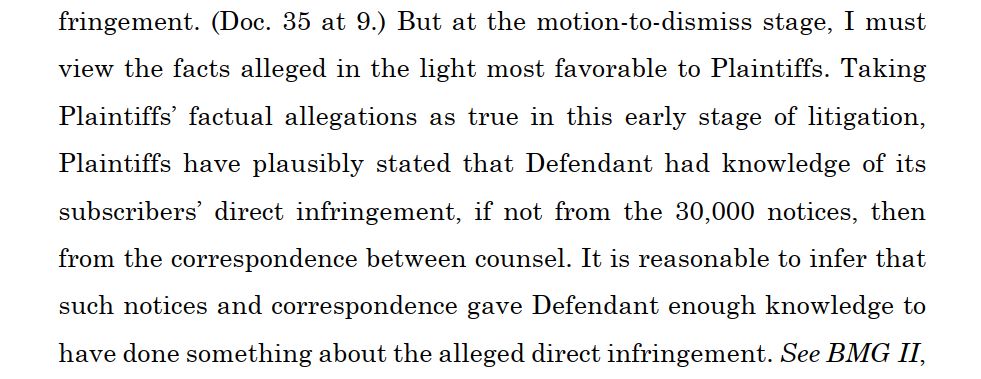
    “Taking Plaintiffs’ factual allegations as true in this early stage of litigation, Plaintiffs have plausibly stated that Defendant had knowledge of its subscribers’ direct infringement, if not from the 30,000 notices, then from the correspondence between counsel.

    “It is reasonable to infer that such notices and correspondence gave Defendant enough knowledge to have done something about the alleged direct infringement,” Judge Domenico adds.
    wow

    Ability to Stop Infringements

    The court also believes that the movie companies sufficiently plead the various copyright infringement allegations. They include contributory and vicarious copyright infringement claims.

    To allege vicarious liability, for example, the filmmakers have to plead that WOW! had the right and ability to supervise the infringing activity and had a direct financial interest in the activities of pirating subscribers. According to the court, that’s the case here.

    “Plaintiffs in this case have sufficiently pleaded that Defendant’s advertisements for high download speeds and known practice of ignoring or failing to act on notices of infringement serve as a draw for subscribers.

    “Likewise, Plaintiffs sufficiently pleaded that Defendant has the legal ability to stop and limit copyright infringement by its subscribers,” Judge Dominico writes.

    Based on these and other arguments, WOW!’s motion to dismiss the copyright infringement claims is denied,

    Grande’s Motion to Dismiss also Strands

    In addition to the WOW! case, the filmmakers also lodged a complaint against Grande Communications . Grande lost a similar case against several music companies last fall but hoped to have this lawsuit dismissed.

    The motion to dismiss is largely the same as WOW!’s, which makes sense as both parties are represented by the same attorneys. Unfortunately for Grande, the ruling on the motion to dismiss is similar as well.

    In January, a Texas federal court issued a report and recommendation, concluding that the motion to dismiss the copyright claims should be denied.

    “Plaintiffs have alleged in their pleadings that Grande has received Notices about specific infringing uses of its services, but failed to take measures to prevent such uses, and failed to investigate the piracy,” Magistrate Judge Howell wrote.

    “The undersigned finds that Plaintiffs have alleged sufficient facts to state a plausible claim of contributory copyright infringement against Grande, which is all that is required at the motion to dismiss stage.”

    District Court Judge Robert Pitman adopted the recommendation last week. This means both WOW! and Grande will have to defend themselves against the piracy liability claims.

    No Pirate Site Blocking Injunctions, Yet

    The motions to dismiss weren’t denied in their entirety, however. In both cases, the filmmakers also requested pirate site-blocking injunctions, to limit piracy activity on the Internet providers’ networks.

    In addition, the movie companies requested broad injunctions requiring the ISPs to identify pirates and suspend the accounts of subscribers who receive three unique DMCA notices in 72 hours.

    The federal courts in Texas and Colorado both granted the motions to dismiss these injunction requests, as these proposed measures are remedies, not causes of action. However, they could be reintroduced at a later stage.

    “I agree and will grant Defendant’s motion to dismiss Plaintiffs’ ‘claim’ for injunctive relief. I note, however, that dismissal of this ‘claim’ does not preclude Plaintiffs’ from seeking injunctive relief if appropriate as a remedy should they prevail on the merits of one or more of their claims,” Judge Domenico writes in the WOW! case.

    All in all, the recent orders are a win for the movie companies, as they can continue with their piracy liability claims. However, there is still a long way to go before there’s a final decision on the merits of those claims.

    A copy of Judge Domenico’s order on the motion to dismiss in the WOW! lawsuit is available here (pdf) . The recently accepted report and recommendation to largely deny Grande’s motion to dismiss can be found here (pdf) .

    From: TF , for the latest news on copyright battles, piracy and more.

    • To chevron_right

      ISPs Fail to Dismiss Filmmakers’ Piracy Liability Lawsuits

      news.movim.eu / TorrentFreak • 6 April 2023 • 6 minutes

    pirate-flag Over the past two decades, online piracy has proven a massive challenge for the entertainment industries.

    Copyright holders have tried to go after individual pirates and pirate sites in court, but third-party intermediaries are now increasingly seen as targets as well.

    Several active lawsuits in the United States feature rightsholders accusing Internet providers of not doing enough to stop piracy. One of the main allegations is that ISPs fail to terminate the accounts of repeat infringers in ‘appropriate circumstances’ as the DMCA requires.

    These lawsuits have resulted in multi-million dollar judgments against Cox and Grande . Meanwhile, more companies at risk too, such as WideOpenWest (WOW!), which was sued by a group of smaller movie companies, including Millennium Media and Voltage Pictures.

    The filmmakers accused the Colorado-based ISP of failing to terminate the accounts of subscribers who were repeatedly flagged for sharing copyrighted material. They argue that WOW! is liable for these piracy activities and are demanding millions of dollars in damages.

    WOW! Wants ‘Troll’ Case Dismissed

    The ISP challenged the claims and filed a motion to dismiss the case. WOW! addressed the substance of the allegations and described the film companies and their anti-piracy partner Maverickeye as “copyright trolls”.

    “Plaintiffs and Maverickeye are part of a well-known web of copyright trolls. Until now, Plaintiffs’ modus operandi has been to file John Doe lawsuits in the hope of securing quick settlements and to dismiss them at the slightest resistance,” they wrote.

    Indeed, several of the plaintiff film companies have filed cases against individual file-sharers, but they have also sued hosting providers, site operators, and app developers.

    Responding to the substance of the allegations, WOW! argued that an IP address is not sufficient to prove that subscribers downloaded or shared any infringing material. And if that’s not clear, the ISP can’t be held liable either.

    Something More?

    To back this up, WOW! cites the Cobbler Nevada v. Gonzales case, where the court held that an IP-address alone is not sufficient to identify an infringer.

    In the present lawsuit, WOW argues that IP-address evidence (~30,000 piracy notices) doesn’t prove that its subscribers pirated content; it could also be someone else using the network. To build a valid case, rightsholders should have ‘something more’ than just IP-addresses.

    “Plaintiffs do not allege facts showing that any WOW subscriber committed direct copyright infringement; that WOW had knowledge of the specific alleged infringements at issue; or that WOW encouraged, induced, or profited from any alleged direct infringement,” the ISP wrote.

    “But here, Plaintiffs only identify the alleged direct infringers by IP address; there are no additional allegations demonstrating that the activity at that IP address came from a WOW subscriber, and not some other user of WOW’s network.”

    Court Refuses to Dismiss Copyright Claims

    A few days ago, Colorado District Court Judge Daniel D. Domenico ruled on the motion to dismiss and rejected most arguments. For one, the Judge doesn’t believe the “Cobbler” ruling is directly relevant here, as that was a case against an actual infringer, not an ISP.

    For this lawsuit, the provided IP-address evidence is sufficient to allege that WOW! can be held liable for the copyright infringements of its subscribers. The court doesn’t rule on the merits yet but notes that the filmmakers’ arguments are good enough to move the case forward.

    “Taking Plaintiffs’ factual allegations as true in this early stage of litigation, Plaintiffs have plausibly stated that Defendant had knowledge of its subscribers’ direct infringement, if not from the 30,000 notices, then from the correspondence between counsel.

    “It is reasonable to infer that such notices and correspondence gave Defendant enough knowledge to have done something about the alleged direct infringement,” Judge Domenico adds.

    wow

    Ability to Stop Infringements

    The court also believes that the movie companies sufficiently plead the various copyright infringement allegations. They include contributory and vicarious copyright infringement claims.

    To allege vicarious liability, for example, the filmmakers have to plead that WOW! had the right and ability to supervise the infringing activity and had a direct financial interest in the activities of pirating subscribers. According to the court, that’s the case here.

    “Plaintiffs in this case have sufficiently pleaded that Defendant’s advertisements for high download speeds and known practice of ignoring or failing to act on notices of infringement serve as a draw for subscribers.

    “Likewise, Plaintiffs sufficiently pleaded that Defendant has the legal ability to stop and limit copyright infringement by its subscribers,” Judge Dominico writes.

    Based on these and other arguments, WOW!’s motion to dismiss the copyright infringement claims is denied,

    Grande’s Motion to Dismiss also Strands

    In addition to the WOW! case, the filmmakers also lodged a complaint against Grande Communications . Grande lost a similar case against several music companies last fall but hoped to have this lawsuit dismissed.

    The motion to dismiss is largely the same as WOW!’s, which makes sense as both parties are represented by the same attorneys. Unfortunately for Grande, the ruling on the motion to dismiss is similar as well.

    In January, a Texas federal court issued a report and recommendation, concluding that the motion to dismiss the copyright claims should be denied.

    “Plaintiffs have alleged in their pleadings that Grande has received Notices about specific infringing uses of its services, but failed to take measures to prevent such uses, and failed to investigate the piracy,” Magistrate Judge Howell wrote.

    “The undersigned finds that Plaintiffs have alleged sufficient facts to state a plausible claim of contributory copyright infringement against Grande, which is all that is required at the motion to dismiss stage.”

    District Court Judge Robert Pitman adopted the recommendation last week. This means both WOW! and Grande will have to defend themselves against the piracy liability claims.

    No Pirate Site Blocking Injunctions, Yet

    The motions to dismiss weren’t denied in their entirety, however. In both cases, the filmmakers also requested pirate site-blocking injunctions, to limit piracy activity on the Internet providers’ networks.

    In addition, the movie companies requested broad injunctions requiring the ISPs to identify pirates and suspend the accounts of subscribers who receive three unique DMCA notices in 72 hours.

    The federal courts in Texas and Colorado both granted the motions to dismiss these injunction requests, as these proposed measures are remedies, not causes of action. However, they could be reintroduced at a later stage.

    “I agree and will grant Defendant’s motion to dismiss Plaintiffs’ ‘claim’ for injunctive relief. I note, however, that dismissal of this ‘claim’ does not preclude Plaintiffs’ from seeking injunctive relief if appropriate as a remedy should they prevail on the merits of one or more of their claims,” Judge Domenico writes in the WOW! case.

    All in all, the recent orders are a win for the movie companies, as they can continue with their piracy liability claims. However, there is still a long way to go before there’s a final decision on the merits of those claims.

    A copy of Judge Domenico’s order on the motion to dismiss in the WOW! lawsuit is available here (pdf) . The recently accepted report and recommendation to largely deny Grande’s motion to dismiss can be found here (pdf) .

    From: TF , for the latest news on copyright battles, piracy and more.

    • To chevron_right

      ISPs Fail to Dismiss Filmmakers’ Piracy Liability Lawsuits

      news.movim.eu / TorrentFreak • 6 April 2023 • 6 minutes

    pirate-flag Over the past two decades, online piracy has proven a massive challenge for the entertainment industries.

    Copyright holders have tried to go after individual pirates and pirate sites in court, but third-party intermediaries are now increasingly seen as targets as well.

    Several active lawsuits in the United States feature rightsholders accusing Internet providers of not doing enough to stop piracy. One of the main allegations is that ISPs fail to terminate the accounts of repeat infringers in ‘appropriate circumstances’ as the DMCA requires.

    These lawsuits have resulted in multi-million dollar judgments against Cox and Grande . Meanwhile, more companies at risk too, such as WideOpenWest (WOW!), which was sued by a group of smaller movie companies, including Millennium Media and Voltage Pictures.

    The filmmakers accused the Colorado-based ISP of failing to terminate the accounts of subscribers who were repeatedly flagged for sharing copyrighted material. They argue that WOW! is liable for these piracy activities and are demanding millions of dollars in damages.

    WOW! Wants ‘Troll’ Case Dismissed

    The ISP challenged the claims and filed a motion to dismiss the case. WOW! addressed the substance of the allegations and described the film companies and their anti-piracy partner Maverickeye as “copyright trolls”.

    “Plaintiffs and Maverickeye are part of a well-known web of copyright trolls. Until now, Plaintiffs’ modus operandi has been to file John Doe lawsuits in the hope of securing quick settlements and to dismiss them at the slightest resistance,” they wrote.

    Indeed, several of the plaintiff film companies have filed cases against individual file-sharers, but they have also sued hosting providers, site operators, and app developers.

    Responding to the substance of the allegations, WOW! argued that an IP address is not sufficient to prove that subscribers downloaded or shared any infringing material. And if that’s not clear, the ISP can’t be held liable either.

    Something More?

    To back this up, WOW! cites the Cobbler Nevada v. Gonzales case, where the court held that an IP-address alone is not sufficient to identify an infringer.

    In the present lawsuit, WOW argues that IP-address evidence (~30,000 piracy notices) doesn’t prove that its subscribers pirated content; it could also be someone else using the network. To build a valid case, rightsholders should have ‘something more’ than just IP-addresses.

    “Plaintiffs do not allege facts showing that any WOW subscriber committed direct copyright infringement; that WOW had knowledge of the specific alleged infringements at issue; or that WOW encouraged, induced, or profited from any alleged direct infringement,” the ISP wrote.

    “But here, Plaintiffs only identify the alleged direct infringers by IP address; there are no additional allegations demonstrating that the activity at that IP address came from a WOW subscriber, and not some other user of WOW’s network.”

    Court Refuses to Dismiss Copyright Claims

    A few days ago, Colorado District Court Judge Daniel D. Domenico ruled on the motion to dismiss and rejected most arguments. For one, the Judge doesn’t believe the “Cobbler” ruling is directly relevant here, as that was a case against an actual infringer, not an ISP.

    For this lawsuit, the provided IP-address evidence is sufficient to allege that WOW! can be held liable for the copyright infringements of its subscribers. The court doesn’t rule on the merits yet but notes that the filmmakers’ arguments are good enough to move the case forward.

    “Taking Plaintiffs’ factual allegations as true in this early stage of litigation, Plaintiffs have plausibly stated that Defendant had knowledge of its subscribers’ direct infringement, if not from the 30,000 notices, then from the correspondence between counsel.

    “It is reasonable to infer that such notices and correspondence gave Defendant enough knowledge to have done something about the alleged direct infringement,” Judge Domenico adds.

    wow

    Ability to Stop Infringements

    The court also believes that the movie companies sufficiently plead the various copyright infringement allegations. They include contributory and vicarious copyright infringement claims.

    To allege vicarious liability, for example, the filmmakers have to plead that WOW! had the right and ability to supervise the infringing activity and had a direct financial interest in the activities of pirating subscribers. According to the court, that’s the case here.

    “Plaintiffs in this case have sufficiently pleaded that Defendant’s advertisements for high download speeds and known practice of ignoring or failing to act on notices of infringement serve as a draw for subscribers.

    “Likewise, Plaintiffs sufficiently pleaded that Defendant has the legal ability to stop and limit copyright infringement by its subscribers,” Judge Dominico writes.

    Based on these and other arguments, WOW!’s motion to dismiss the copyright infringement claims is denied,

    Grande’s Motion to Dismiss also Strands

    In addition to the WOW! case, the filmmakers also lodged a complaint against Grande Communications . Grande lost a similar case against several music companies last fall but hoped to have this lawsuit dismissed.

    The motion to dismiss is largely the same as WOW!’s, which makes sense as both parties are represented by the same attorneys. Unfortunately for Grande, the ruling on the motion to dismiss is similar as well.

    In January, a Texas federal court issued a report and recommendation, concluding that the motion to dismiss the copyright claims should be denied.

    “Plaintiffs have alleged in their pleadings that Grande has received Notices about specific infringing uses of its services, but failed to take measures to prevent such uses, and failed to investigate the piracy,” Magistrate Judge Howell wrote.

    “The undersigned finds that Plaintiffs have alleged sufficient facts to state a plausible claim of contributory copyright infringement against Grande, which is all that is required at the motion to dismiss stage.”

    District Court Judge Robert Pitman adopted the recommendation last week. This means both WOW! and Grande will have to defend themselves against the piracy liability claims.

    No Pirate Site Blocking Injunctions, Yet

    The motions to dismiss weren’t denied in their entirety, however. In both cases, the filmmakers also requested pirate site-blocking injunctions, to limit piracy activity on the Internet providers’ networks.

    In addition, the movie companies requested broad injunctions requiring the ISPs to identify pirates and suspend the accounts of subscribers who receive three unique DMCA notices in 72 hours.

    The federal courts in Texas and Colorado both granted the motions to dismiss these injunction requests, as these proposed measures are remedies, not causes of action. However, they could be reintroduced at a later stage.

    “I agree and will grant Defendant’s motion to dismiss Plaintiffs’ ‘claim’ for injunctive relief. I note, however, that dismissal of this ‘claim’ does not preclude Plaintiffs’ from seeking injunctive relief if appropriate as a remedy should they prevail on the merits of one or more of their claims,” Judge Domenico writes in the WOW! case.

    All in all, the recent orders are a win for the movie companies, as they can continue with their piracy liability claims. However, there is still a long way to go before there’s a final decision on the merits of those claims.

    A copy of Judge Domenico’s order on the motion to dismiss in the WOW! lawsuit is available here (pdf) . The recently accepted report and recommendation to largely deny Grande’s motion to dismiss can be found here (pdf) .

    From: TF , for the latest news on copyright battles, piracy and more.

    • To chevron_right

      Two Founders of Piracy Giant Zone-Telechargement Sentenced in France

      news.movim.eu / TorrentFreak • 6 April 2023 • 3 minutes

    handcuffed For those who care to remember it, November 2016 was a dark month for communities with a penchant for sharing files. Two huge sites fell in a matter of days, both courtesy of French authorities.

    When OiNK was shut down in 2007, the world’s largest dedicated music-sharing community fell with it. Few believed that a new site could fill the pig-shaped hole left behind; some insisted it would be wrong to even try.

    What.cd not only filled that hole but did so by meeting and then surpassing all expectations. Then in November 2016, as French authorities swooped, What.cd self-destructed and disappeared into history, exactly as previously promised.

    The cybercrime unit of the French military police didn’t wait for the dust to settle. Following a two-year investigation into Zone-Telechargement, the most popular pirate download portal in France at the time, police shut down the site and arrested several people, including its alleged founders.

    Operation Gervais

    Local anti-piracy groups SACEM and ALPA filed a complaint against Zone-Telechargement in 2014. The goal was to identify financial accounts, assets, advertising agencies, and the site’s hosting servers.

    In the wake of the raid, it was claimed that Zone-Telechargement generated at least 1.5 million euros in sales per year, utilizing offshore accounts in Malta, Cyprus and Belize. The site caused an estimated 75 million euros in damages to rightsholders, rightsholders said.

    The alleged founders of Zone-Telechargement were later identified as high-school buddies Thibault Ferreira and Wilfrid Duval. The pair founded the site in 2012 but had left France and were living in Andorra when the authorities shut down their site. That didn’t prevent their arrest or the seizure of luxury cars, real estate, and at least 450,000 euros.

    Fallout Zone

    Ferreira and Duval were eventually charged with offenses related to intellectual property crime, money laundering, and operating as part of an organized criminal gang. They spent the next few months in prison before being released in March 2017 with conditions, electronic tagging included.

    In the years that followed, sites claiming to be Zone-Telechargement regularly appeared to fill the vacuum, including one that was later confirmed as being operated by an anti-piracy company.

    A site with a similar look and feel as the original was shut down in 2022 after accumulating millions of visits per month. Others still in operation today are keeping the ‘ZT’ brand alive

    Judgment in France

    The men finally went on trial in France on March 13, 2023. One local report notes that between 2014 and 2016, the pair from Toulouse earned 600,000 euros each for their work on the site.

    The Toulouse Correctional Court found that a custodial sentence of 18 months each was appropriate, with 12 months of each sentence to be considered suspended. The court also handed both Ferreira and Duval a fine of 50,000 euros but due to time served back in 2017, neither will actually be sent back to prison, according to a local report.

    There are indications that the men intend to appeal. Their lawyer, Simon Cohen, suggests that while his clients were condemned for linking to pirated content hosted elsewhere, those who hosted the infringing content they linked to haven’t entered into the equation.

    “We condemned the link, but not the database itself, whereas [Ferreira and Duval] are foreign to the database,” he said.

    “They are seen as the inventors and initiators of a fraud system. They have benefited from the flaws in the system: is this reprehensible? Penalizing intelligence is a mistake, ” he continues.

    According to a French proverb, gambling has two great pleasures; the risk of winning and the risk of losing . Since the concept of ‘making available’ doesn’t rely on the identification of a supplier of pirated content, potential gambling pleasure may have been already cut exactly in half.

    From: TF , for the latest news on copyright battles, piracy and more.

    • To chevron_right

      Two Founders of Piracy Giant Zone-Telechargement Sentenced in France

      news.movim.eu / TorrentFreak • 6 April 2023 • 3 minutes

    handcuffed For those who care to remember it, November 2016 was a dark month for communities with a penchant for sharing files. Two huge sites fell in a matter of days, both courtesy of French authorities.

    When OiNK was shut down in 2007, the world’s largest dedicated music-sharing community fell with it. Few believed that a new site could fill the pig-shaped hole left behind; some insisted it would be wrong to even try.

    What.cd not only filled that hole but did so by meeting and then surpassing all expectations. Then in November 2016, as French authorities swooped, What.cd self-destructed and disappeared into history, exactly as previously promised.

    The cybercrime unit of the French military police didn’t wait for the dust to settle. Following a two-year investigation into Zone-Telechargement, the most popular pirate download portal in France at the time, police shut down the site and arrested several people, including its alleged founders.

    Operation Gervais

    Local anti-piracy groups SACEM and ALPA filed a complaint against Zone-Telechargement in 2014. The goal was to identify financial accounts, assets, advertising agencies, and the site’s hosting servers.

    In the wake of the raid, it was claimed that Zone-Telechargement generated at least 1.5 million euros in sales per year, utilizing offshore accounts in Malta, Cyprus and Belize. The site caused an estimated 75 million euros in damages to rightsholders, rightsholders said.

    The alleged founders of Zone-Telechargement were later identified as high-school buddies Thibault Ferreira and Wilfrid Duval. The pair founded the site in 2012 but had left France and were living in Andorra when the authorities shut down their site. That didn’t prevent their arrest or the seizure of luxury cars, real estate, and at least 450,000 euros.

    Fallout Zone

    Ferreira and Duval were eventually charged with offenses related to intellectual property crime, money laundering, and operating as part of an organized criminal gang. They spent the next few months in prison before being released in March 2017 with conditions, electronic tagging included.

    In the years that followed, sites claiming to be Zone-Telechargement regularly appeared to fill the vacuum, including one that was later confirmed as being operated by an anti-piracy company.

    A site with a similar look and feel as the original was shut down in 2022 after accumulating millions of visits per month. Others still in operation today are keeping the ‘ZT’ brand alive

    Judgment in France

    The men finally went on trial in France on March 13, 2023. One local report notes that between 2014 and 2016, the pair from Toulouse earned 600,000 euros each for their work on the site.

    The Toulouse Correctional Court found that a custodial sentence of 18 months each was appropriate, with 12 months of each sentence to be considered suspended. The court also handed both Ferreira and Duval a fine of 50,000 euros but due to time served back in 2017, neither will actually be sent back to prison, according to a local report.

    There are indications that the men intend to appeal. Their lawyer, Simon Cohen, suggests that while his clients were condemned for linking to pirated content hosted elsewhere, those who hosted the infringing content they linked to haven’t entered into the equation.

    “We condemned the link, but not the database itself, whereas [Ferreira and Duval] are foreign to the database,” he said.

    “They are seen as the inventors and initiators of a fraud system. They have benefited from the flaws in the system: is this reprehensible? Penalizing intelligence is a mistake, ” he continues.

    According to a French proverb, gambling has two great pleasures; the risk of winning and the risk of losing . Since the concept of ‘making available’ doesn’t rely on the identification of a supplier of pirated content, potential gambling pleasure may have been already cut exactly in half.

    From: TF , for the latest news on copyright battles, piracy and more.

    • To chevron_right

      Two Founders of Piracy Giant Zone-Telechargement Sentenced in France

      news.movim.eu / TorrentFreak • 6 April 2023 • 3 minutes

    handcuffed For those who care to remember it, November 2016 was a dark month for communities with a penchant for sharing files. Two huge sites fell in a matter of days, both courtesy of French authorities.

    When OiNK was shut down in 2007, the world’s largest dedicated music-sharing community fell with it. Few believed that a new site could fill the pig-shaped hole left behind; some insisted it would be wrong to even try.

    What.cd not only filled that hole but did so by meeting and then surpassing all expectations. Then in November 2016, as French authorities swooped, What.cd self-destructed and disappeared into history, exactly as previously promised.

    The cybercrime unit of the French military police didn’t wait for the dust to settle. Following a two-year investigation into Zone-Telechargement, the most popular pirate download portal in France at the time, police shut down the site and arrested several people, including its alleged founders.

    Operation Gervais

    Local anti-piracy groups SACEM and ALPA filed a complaint against Zone-Telechargement in 2014. The goal was to identify financial accounts, assets, advertising agencies, and the site’s hosting servers.

    In the wake of the raid, it was claimed that Zone-Telechargement generated at least 1.5 million euros in sales per year, utilizing offshore accounts in Malta, Cyprus and Belize. The site caused an estimated 75 million euros in damages to rightsholders, rightsholders said.

    The alleged founders of Zone-Telechargement were later identified as high-school buddies Thibault Ferreira and Wilfrid Duval. The pair founded the site in 2012 but had left France and were living in Andorra when the authorities shut down their site. That didn’t prevent their arrest or the seizure of luxury cars, real estate, and at least 450,000 euros.

    Fallout Zone

    Ferreira and Duval were eventually charged with offenses related to intellectual property crime, money laundering, and operating as part of an organized criminal gang. They spent the next few months in prison before being released in March 2017 with conditions, electronic tagging included.

    In the years that followed, sites claiming to be Zone-Telechargement regularly appeared to fill the vacuum, including one that was later confirmed as being operated by an anti-piracy company.

    A site with a similar look and feel as the original was shut down in 2022 after accumulating millions of visits per month. Others still in operation today are keeping the ‘ZT’ brand alive

    Judgment in France

    The men finally went on trial in France on March 13, 2023. One local report notes that between 2014 and 2016, the pair from Toulouse earned 600,000 euros each for their work on the site.

    The Toulouse Correctional Court found that a custodial sentence of 18 months each was appropriate, with 12 months of each sentence to be considered suspended. The court also handed both Ferreira and Duval a fine of 50,000 euros but due to time served back in 2017, neither will actually be sent back to prison, according to a local report.

    There are indications that the men intend to appeal. Their lawyer, Simon Cohen, suggests that while his clients were condemned for linking to pirated content hosted elsewhere, those who hosted the infringing content they linked to haven’t entered into the equation.

    “We condemned the link, but not the database itself, whereas [Ferreira and Duval] are foreign to the database,” he said.

    “They are seen as the inventors and initiators of a fraud system. They have benefited from the flaws in the system: is this reprehensible? Penalizing intelligence is a mistake, ” he continues.

    According to a French proverb, gambling has two great pleasures; the risk of winning and the risk of losing . Since the concept of ‘making available’ doesn’t rely on the identification of a supplier of pirated content, potential gambling pleasure may have been already cut exactly in half.

    From: TF , for the latest news on copyright battles, piracy and more.

    • To chevron_right

      Police Confirm FBI-Assisted Takedown of Piracy Release Group EVO

      news.movim.eu / TorrentFreak • 6 April 2023 • 3 minutes

    policia-juciadaria EVO, short for EVOLUTiON, was a high-profile P2P group whose activities stood out in recent years.

    The group released a steady stream of new movie and TV show titles and gained pirates’ admiration by leaking many screeners way ahead of their official premieres.

    For several years in a row, EVO opened the “screener season” by releasing leaked copies of upcoming films. This included Oscar contenders , but also several Netflix titles that originated from festival screenings.

    EVO was also the first to release an early Blu-Ray copy of ‘Spider-Man: No Way Home’ last year, and a high-quality copy of the blockbuster “Dune” in 2021, ahead of its official U.S. premiere.

    Like many other groups, EVO posted new releases on a regular schedule but that came to an abrupt halt last November when the group suddenly went quiet . While no explanation was given at the time, many pirates feared that the group had been busted.

    National Criminal Investigation Police Take Credit

    A few weeks ago TorrentFreak was able to confirm that this was indeed the case. Anti-piracy coalition ACE informed us that it had been working with Portuguese authorities to shut the group down and arrest its alleged leader.

    This week Portual’s Polícia Judiciária publicly confirmed that enforcement action Operation “EVO 1.2” had been carried out through UNC3T, the national cybercrime unit.

    The criminal investigation into EVO started early last year, following a complaint from Disney Enterprises, Paramount Pictures, Universal City Studios, Columbia Pictures, Warner Bros., Netflix, and Amazon. These are all members of the Motion Picture Association (MPA) and related anti-piracy coalition ACE.

    Polícia Judiciária reports that EVO’s movie and TV show leaks caused significant losses, exceeding €1,000,000. The group operated internationally, but its home base was in Portugal.

    FBI Involvement

    After documenting how the group operated, several home searches were carried out in Portugal. The authorities also located EVO’s servers in the United States. These were taken down with help from the FBI, Portugeuse police confirm.

    “In Portugal, house searches were carried out and various computer equipment was seized. Three defendants were held under suspicion of belonging to the criminal group.

    “In collaboration with the FBI, the inactivation of the criminal group’s servers was also achieved,” Polícia Judiciária adds.

    The authorities used these initial investigations to pinpoint the alleged leader of EVO, who was arrested and had his house searched in Portugal. This presumably took place last fall, around the time when the group stopped releasing new content.

    Various Criminal Charges

    According to the press release , the criminal charges include unauthorized access to the victims’ servers, computer fraud, money laundering, tax fraud, copyright infringement, and taking part in a criminal organization.

    The first interrogation of the main suspect was concluded earlier and EVO’s alleged leader was subjected to restrictive measures. Among other things, he is not allowed to communicate with the other defendants or use any computer equipment.

    The status of the other three defendants is unclear and details on the progress of the prosecution are scarce. TorrentFreak contacted the authorities to request further information, but we have yet to hear back.

    When EVO disappeared in 2022, another prominent release group called iFT also went quiet. Whether this is connected to the EVO prosecution remains unknown for now.

    Finally, it is worth noting that for the first time in decades, perhaps ever, no awards screeners leaked online before the most recent Oscars. Given EVO’s prominent role in these leaks in recent years, that’s likely no coincidence.

    From: TF , for the latest news on copyright battles, piracy and more.

    • To chevron_right

      Police Confirm FBI-Assisted Takedown of Piracy Release Group EVO

      news.movim.eu / TorrentFreak • 6 April 2023 • 3 minutes

    policia-juciadaria EVO, short for EVOLUTiON, was a high-profile P2P group whose activities stood out in recent years.

    The group released a steady stream of new movie and TV show titles and gained pirates’ admiration by leaking many screeners way ahead of their official premieres.

    For several years in a row, EVO opened the “screener season” by releasing leaked copies of upcoming films. This included Oscar contenders , but also several Netflix titles that originated from festival screenings.

    EVO was also the first to release an early Blu-Ray copy of ‘Spider-Man: No Way Home’ last year, and a high-quality copy of the blockbuster “Dune” in 2021, ahead of its official U.S. premiere.

    Like many other groups, EVO posted new releases on a regular schedule but that came to an abrupt halt last November when the group suddenly went quiet . While no explanation was given at the time, many pirates feared that the group had been busted.

    National Criminal Investigation Police Take Credit

    A few weeks ago TorrentFreak was able to confirm that this was indeed the case. Anti-piracy coalition ACE informed us that it had been working with Portuguese authorities to shut the group down and arrest its alleged leader.

    This week Portual’s Polícia Judiciária publicly confirmed that enforcement action Operation “EVO 1.2” had been carried out through UNC3T, the national cybercrime unit.

    The criminal investigation into EVO started early last year, following a complaint from Disney Enterprises, Paramount Pictures, Universal City Studios, Columbia Pictures, Warner Bros., Netflix, and Amazon. These are all members of the Motion Picture Association (MPA) and related anti-piracy coalition ACE.

    Polícia Judiciária reports that EVO’s movie and TV show leaks caused significant losses, exceeding €1,000,000. The group operated internationally, but its home base was in Portugal.

    FBI Involvement

    After documenting how the group operated, several home searches were carried out in Portugal. The authorities also located EVO’s servers in the United States. These were taken down with help from the FBI, Portugeuse police confirm.

    “In Portugal, house searches were carried out and various computer equipment was seized. Three defendants were held under suspicion of belonging to the criminal group.

    “In collaboration with the FBI, the inactivation of the criminal group’s servers was also achieved,” Polícia Judiciária adds.

    The authorities used these initial investigations to pinpoint the alleged leader of EVO, who was arrested and had his house searched in Portugal. This presumably took place last fall, around the time when the group stopped releasing new content.

    Various Criminal Charges

    According to the press release , the criminal charges include unauthorized access to the victims’ servers, computer fraud, money laundering, tax fraud, copyright infringement, and taking part in a criminal organization.

    The first interrogation of the main suspect was concluded earlier and EVO’s alleged leader was subjected to restrictive measures. Among other things, he is not allowed to communicate with the other defendants or use any computer equipment.

    The status of the other three defendants is unclear and details on the progress of the prosecution are scarce. TorrentFreak contacted the authorities to request further information, but we have yet to hear back.

    When EVO disappeared in 2022, another prominent release group called iFT also went quiet. Whether this is connected to the EVO prosecution remains unknown for now.

    Finally, it is worth noting that for the first time in decades, perhaps ever, no awards screeners leaked online before the most recent Oscars. Given EVO’s prominent role in these leaks in recent years, that’s likely no coincidence.

    From: TF , for the latest news on copyright battles, piracy and more.

    • To chevron_right

      Police Confirm FBI-Assisted Takedown of Piracy Release Group EVO

      news.movim.eu / TorrentFreak • 6 April 2023 • 3 minutes

    policia-juciadaria EVO, short for EVOLUTiON, was a high-profile P2P group whose activities stood out in recent years.

    The group released a steady stream of new movie and TV show titles and gained pirates’ admiration by leaking many screeners way ahead of their official premieres.

    For several years in a row, EVO opened the “screener season” by releasing leaked copies of upcoming films. This included Oscar contenders , but also several Netflix titles that originated from festival screenings.

    EVO was also the first to release an early Blu-Ray copy of ‘Spider-Man: No Way Home’ last year, and a high-quality copy of the blockbuster “Dune” in 2021, ahead of its official U.S. premiere.

    Like many other groups, EVO posted new releases on a regular schedule but that came to an abrupt halt last November when the group suddenly went quiet . While no explanation was given at the time, many pirates feared that the group had been busted.

    National Criminal Investigation Police Take Credit

    A few weeks ago TorrentFreak was able to confirm that this was indeed the case. Anti-piracy coalition ACE informed us that it had been working with Portuguese authorities to shut the group down and arrest its alleged leader.

    This week Portual’s Polícia Judiciária publicly confirmed that enforcement action Operation “EVO 1.2” had been carried out through UNC3T, the national cybercrime unit.

    The criminal investigation into EVO started early last year, following a complaint from Disney Enterprises, Paramount Pictures, Universal City Studios, Columbia Pictures, Warner Bros., Netflix, and Amazon. These are all members of the Motion Picture Association (MPA) and related anti-piracy coalition ACE.

    Polícia Judiciária reports that EVO’s movie and TV show leaks caused significant losses, exceeding €1,000,000. The group operated internationally, but its home base was in Portugal.

    FBI Involvement

    After documenting how the group operated, several home searches were carried out in Portugal. The authorities also located EVO’s servers in the United States. These were taken down with help from the FBI, Portugeuse police confirm.

    “In Portugal, house searches were carried out and various computer equipment was seized. Three defendants were held under suspicion of belonging to the criminal group.

    “In collaboration with the FBI, the inactivation of the criminal group’s servers was also achieved,” Polícia Judiciária adds.

    The authorities used these initial investigations to pinpoint the alleged leader of EVO, who was arrested and had his house searched in Portugal. This presumably took place last fall, around the time when the group stopped releasing new content.

    Various Criminal Charges

    According to the press release , the criminal charges include unauthorized access to the victims’ servers, computer fraud, money laundering, tax fraud, copyright infringement, and taking part in a criminal organization.

    The first interrogation of the main suspect was concluded earlier and EVO’s alleged leader was subjected to restrictive measures. Among other things, he is not allowed to communicate with the other defendants or use any computer equipment.

    The status of the other three defendants is unclear and details on the progress of the prosecution are scarce. TorrentFreak contacted the authorities to request further information, but we have yet to hear back.

    When EVO disappeared in 2022, another prominent release group called iFT also went quiet. Whether this is connected to the EVO prosecution remains unknown for now.

    Finally, it is worth noting that for the first time in decades, perhaps ever, no awards screeners leaked online before the most recent Oscars. Given EVO’s prominent role in these leaks in recent years, that’s likely no coincidence.

    From: TF , for the latest news on copyright battles, piracy and more.