• To chevron_right

      Take-Two Dismisses Claims Against Lead Defendants in GTA Mods Lawsuit

      news.movim.eu / TorrentFreak • 5 April 2023 • 3 minutes

    gta In 2021, a group of Grand Theft Auto enthusiast programmers released ‘re3’ and ‘reVC’, a pair of reverse-engineered modifications for GTA 3 and Vice City.

    These projects breathed new life into games that while still fantastic, benefited greatly from significant enhancements that helped to wind back the years. Fans loved ‘re3’ and ‘reVC’ but Take-Two and Rockstar Games most definitely did not.

    The companies’ first move was to file a DMCA notice that ordered GitHub to take the projects down . The programmers’ response came via a DMCA counternotice which restored their projects on GitHub but left them exposed to a potential legal response by Take-Two.

    Take-Two Files Copyright Lawsuit

    In September 2021, Take-Two filed a lawsuit against the programmers, claiming that the aim of the projects was to create and distribute pirated versions of GTA 3 and Vice City.

    The company’s claims included damages for “willful and malicious” copyright infringement due to the illegal copying, adaption and distribution of GTA source code and other protected content. For good measure, Take-Two also demanded damages for alleged misrepresentations in the defendants’ DMCA counternotices.

    The lawsuit listed 14 defendants, just four of which were named: Angelo Papenhoff (aap), Theo Morra, Eray Orçunus, and Adrian Graber. In their November 2021 answer to the complaint, the four men denied the copyright infringement allegations and cited fair use among other affirmative defenses.

    One Year Later, Limited Visible Progress

    The first five months of 2022 were relatively uneventful, at least based on information made available to the public. The parties did participate in an ADR (Alternative Dispute Resolution) session but according to the mediator’s report early May, the case did not settle.

    No further entries appeared on the docket until December 2022, when the parties informed the court that since disclosure and discovery in the lawsuit was likely to involve the production of confidential, proprietary, or private information, special protection from public disclosure may be warranted. The court had no problem with granting the request.

    As part of this process, Take-Two served an expert report on November 17, 2022, leaving a deadline of December 15 for Papenhoff, Morra, Orçunus, and Graber to disclose their rebuttal expert witness. What followed was a series of requests for time extensions and a note to the court on February 6, 2023, indicating that a settlement had been agreed in principle.

    Take-Two Dismisses Claims Against Four Named Defendants

    Following the news of the potential settlement, the court granted a 30-day extension until March 19. When that date disappeared into history with no further docket activity, the court issued an order for the parties to file a status report by April 3. The parties responded on the day of the deadline with a joint stipulation of dismissal.

    “In accordance with Federal Rule of Civil Procedure 41(a)(1)(A)(ii) , by and between the
    undersigned counsel for the Plaintiff, Take Two Interactive Software, Inc., and counsel for Defendants Angelo Papenhoff, Theo Morra, Eray Orçunus, and Adrian Graber that all claims asserted in the above-referenced action against the Named Defendants are dismissed with prejudice,” the parties informed the court.

    In these circumstances, the dismissal does not require the court to issue an order, since the signatures of the parties who have appeared in the case will suffice. Take-Two and the developers will bear their own costs, expenses, and attorneys’ fees.

    What prompted this meeting of minds and subsequent agreement isn’t mentioned, but for the four men, the lawsuit is over and cannot be refiled in the future.

    On Monday, the lawsuit appeared set to continue against the remaining defendants – Doe 1 (a/k/a Ash R. and ASH_735) plus Does 2 through 10 inclusive – whoever (and wherever) they might be. An update filed Tuesday clarified the position.

    “Plaintiff, Take Two Interactive Software, Inc., hereby voluntarily dismisses Defendants Doe 1 a/k/a ASH R. and ASH_735 and Does 2-10, without prejudice,” the company informed the court.

    It’s possible that a fresh lawsuit will be filed in the future but, realistically, not anytime soon.

    The joint stipulation of dismissal can be found here ( pdf )

    From: TF , for the latest news on copyright battles, piracy and more.

    • To chevron_right

      Take-Two Dismisses Claims Against Lead Defendants in GTA Mods Lawsuit

      news.movim.eu / TorrentFreak • 5 April 2023 • 3 minutes

    gta In 2021, a group of Grand Theft Auto enthusiast programmers released ‘re3’ and ‘reVC’, a pair of reverse-engineered modifications for GTA 3 and Vice City.

    These projects breathed new life into games that while still fantastic, benefited greatly from significant enhancements that helped to wind back the years. Fans loved ‘re3’ and ‘reVC’ but Take-Two and Rockstar Games most definitely did not.

    The companies’ first move was to file a DMCA notice that ordered GitHub to take the projects down . The programmers’ response came via a DMCA counternotice which restored their projects on GitHub but left them exposed to a potential legal response by Take-Two.

    Take-Two Files Copyright Lawsuit

    In September 2021, Take-Two filed a lawsuit against the programmers, claiming that the aim of the projects was to create and distribute pirated versions of GTA 3 and Vice City.

    The company’s claims included damages for “willful and malicious” copyright infringement due to the illegal copying, adaption and distribution of GTA source code and other protected content. For good measure, Take-Two also demanded damages for alleged misrepresentations in the defendants’ DMCA counternotices.

    The lawsuit listed 14 defendants, just four of which were named: Angelo Papenhoff (aap), Theo Morra, Eray Orçunus, and Adrian Graber. In their November 2021 answer to the complaint, the four men denied the copyright infringement allegations and cited fair use among other affirmative defenses.

    One Year Later, Limited Visible Progress

    The first five months of 2022 were relatively uneventful, at least based on information made available to the public. The parties did participate in an ADR (Alternative Dispute Resolution) session but according to the mediator’s report early May, the case did not settle.

    No further entries appeared on the docket until December 2022, when the parties informed the court that since disclosure and discovery in the lawsuit was likely to involve the production of confidential, proprietary, or private information, special protection from public disclosure may be warranted. The court had no problem with granting the request.

    As part of this process, Take-Two served an expert report on November 17, 2022, leaving a deadline of December 15 for Papenhoff, Morra, Orçunus, and Graber to disclose their rebuttal expert witness. What followed was a series of requests for time extensions and a note to the court on February 6, 2023, indicating that a settlement had been agreed in principle.

    Take-Two Dismisses Claims Against Four Named Defendants

    Following the news of the potential settlement, the court granted a 30-day extension until March 19. When that date disappeared into history with no further docket activity, the court issued an order for the parties to file a status report by April 3. The parties responded on the day of the deadline with a joint stipulation of dismissal.

    “In accordance with Federal Rule of Civil Procedure 41(a)(1)(A)(ii) , by and between the
    undersigned counsel for the Plaintiff, Take Two Interactive Software, Inc., and counsel for Defendants Angelo Papenhoff, Theo Morra, Eray Orçunus, and Adrian Graber that all claims asserted in the above-referenced action against the Named Defendants are dismissed with prejudice,” the parties informed the court.

    In these circumstances, the dismissal does not require the court to issue an order, since the signatures of the parties who have appeared in the case will suffice. Take-Two and the developers will bear their own costs, expenses, and attorneys’ fees.

    What prompted this meeting of minds and subsequent agreement isn’t mentioned, but for the four men, the lawsuit is over and cannot be refiled in the future.

    On Monday, the lawsuit appeared set to continue against the remaining defendants – Doe 1 (a/k/a Ash R. and ASH_735) plus Does 2 through 10 inclusive – whoever (and wherever) they might be. An update filed Tuesday clarified the position.

    “Plaintiff, Take Two Interactive Software, Inc., hereby voluntarily dismisses Defendants Doe 1 a/k/a ASH R. and ASH_735 and Does 2-10, without prejudice,” the company informed the court.

    It’s possible that a fresh lawsuit will be filed in the future but, realistically, not anytime soon.

    The joint stipulation of dismissal can be found here ( pdf )

    From: TF , for the latest news on copyright battles, piracy and more.

    • To chevron_right

      Take-Two Dismisses Claims Against Lead Defendants in GTA Mods Lawsuit

      news.movim.eu / TorrentFreak • 5 April 2023 • 3 minutes

    gta In 2021, a group of Grand Theft Auto enthusiast programmers released ‘re3’ and ‘reVC’, a pair of reverse-engineered modifications for GTA 3 and Vice City.

    These projects breathed new life into games that while still fantastic, benefited greatly from significant enhancements that helped to wind back the years. Fans loved ‘re3’ and ‘reVC’ but Take-Two and Rockstar Games most definitely did not.

    The companies’ first move was to file a DMCA notice that ordered GitHub to take the projects down . The programmers’ response came via a DMCA counternotice which restored their projects on GitHub but left them exposed to a potential legal response by Take-Two.

    Take-Two Files Copyright Lawsuit

    In September 2021, Take-Two filed a lawsuit against the programmers, claiming that the aim of the projects was to create and distribute pirated versions of GTA 3 and Vice City.

    The company’s claims included damages for “willful and malicious” copyright infringement due to the illegal copying, adaption and distribution of GTA source code and other protected content. For good measure, Take-Two also demanded damages for alleged misrepresentations in the defendants’ DMCA counternotices.

    The lawsuit listed 14 defendants, just four of which were named: Angelo Papenhoff (aap), Theo Morra, Eray Orçunus, and Adrian Graber. In their November 2021 answer to the complaint, the four men denied the copyright infringement allegations and cited fair use among other affirmative defenses.

    One Year Later, Limited Visible Progress

    The first five months of 2022 were relatively uneventful, at least based on information made available to the public. The parties did participate in an ADR (Alternative Dispute Resolution) session but according to the mediator’s report early May, the case did not settle.

    No further entries appeared on the docket until December 2022, when the parties informed the court that since disclosure and discovery in the lawsuit was likely to involve the production of confidential, proprietary, or private information, special protection from public disclosure may be warranted. The court had no problem with granting the request.

    As part of this process, Take-Two served an expert report on November 17, 2022, leaving a deadline of December 15 for Papenhoff, Morra, Orçunus, and Graber to disclose their rebuttal expert witness. What followed was a series of requests for time extensions and a note to the court on February 6, 2023, indicating that a settlement had been agreed in principle.

    Take-Two Dismisses Claims Against Four Named Defendants

    Following the news of the potential settlement, the court granted a 30-day extension until March 19. When that date disappeared into history with no further docket activity, the court issued an order for the parties to file a status report by April 3. The parties responded on the day of the deadline with a joint stipulation of dismissal.

    “In accordance with Federal Rule of Civil Procedure 41(a)(1)(A)(ii) , by and between the
    undersigned counsel for the Plaintiff, Take Two Interactive Software, Inc., and counsel for Defendants Angelo Papenhoff, Theo Morra, Eray Orçunus, and Adrian Graber that all claims asserted in the above-referenced action against the Named Defendants are dismissed with prejudice,” the parties informed the court.

    In these circumstances, the dismissal does not require the court to issue an order, since the signatures of the parties who have appeared in the case will suffice. Take-Two and the developers will bear their own costs, expenses, and attorneys’ fees.

    What prompted this meeting of minds and subsequent agreement isn’t mentioned, but for the four men, the lawsuit is over and cannot be refiled in the future.

    On Monday, the lawsuit appeared set to continue against the remaining defendants – Doe 1 (a/k/a Ash R. and ASH_735) plus Does 2 through 10 inclusive – whoever (and wherever) they might be. An update filed Tuesday clarified the position.

    “Plaintiff, Take Two Interactive Software, Inc., hereby voluntarily dismisses Defendants Doe 1 a/k/a ASH R. and ASH_735 and Does 2-10, without prejudice,” the company informed the court.

    It’s possible that a fresh lawsuit will be filed in the future but, realistically, not anytime soon.

    The joint stipulation of dismissal can be found here ( pdf )

    From: TF , for the latest news on copyright battles, piracy and more.

    • To chevron_right

      Music Labels Win Legal Battle Against Youtube-dl’s Hosting Provider

      news.movim.eu / TorrentFreak • 4 April 2023 • 4 minutes

    uberspace The major record labels don’t want the public to download music from YouTube, which is common practice for millions of people.

    To stop this, the music industry titans deployed a variety of legal tactics around the world. They obtained site-blocking orders, for example, and have taken on stream-ripping sites such as 2Conv and Yout.com directly in court.

    Youtube-dl Takedown Battle

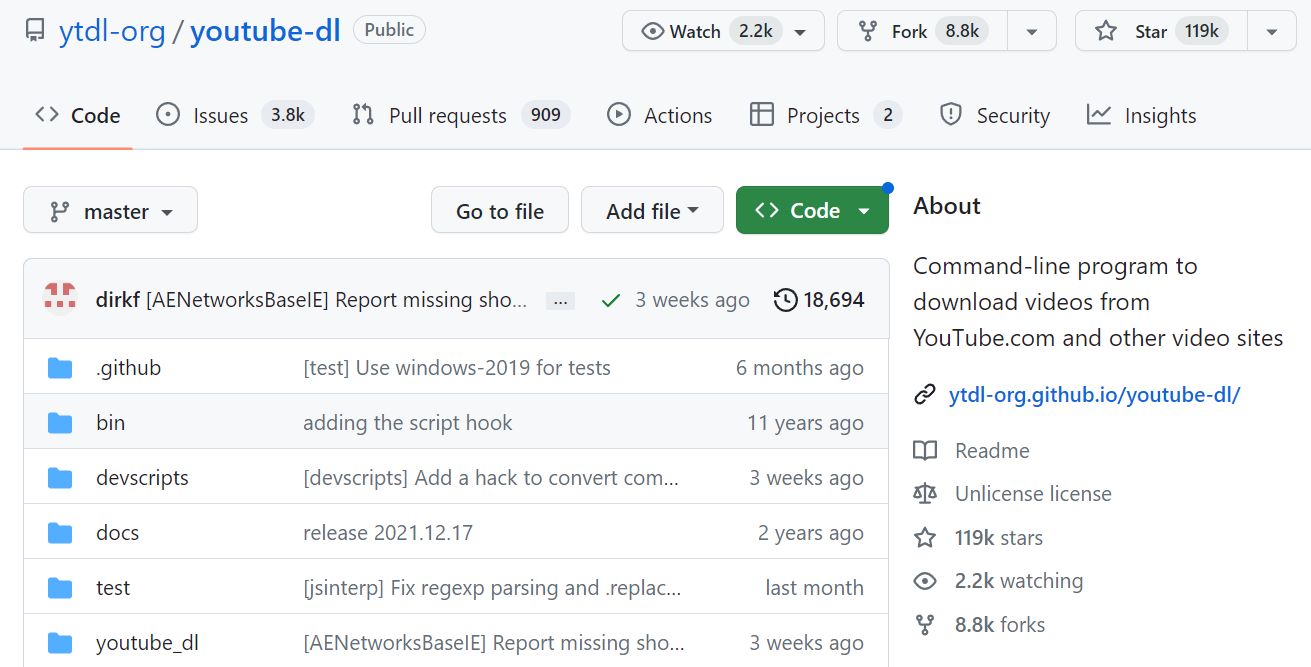
    In late 2020, the open-source software youtube-dl was added to the list of targets. The tool is used by many stream-ripping sites and was freely available on GitHub. The RIAA asked the developer platform to take youtube-dl offline , arguing that it violates the DMCA’s anti-circumvention provision.

    GitHub initially complied with the takedown request but after public outrage and involvement from digital rights groups including the EFF, the decision was eventually reversed . GitHub went on to put $1 million into a takedown defense fund .

    ytdl

    While this series of events represented a setback, the record labels didn’t back off. Instead, they set their sights on youtube-dl’s website hosting provider Uberspace .

    The RIAA had already sent cease-and-desist orders to the hosting company in 2020, before it approached GitHub. Uberspace didn’t take any action at the time; the youtube-dl website it hosted was not the host of the youtube-dl software. The website carried links to the software and that was hosted elsewhere.

    Labels Sue Uberspace in Germany

    Last year, Sony Entertainment, Warner Music Group and Universal Music escalated the matter by taking it to court in Germany. Their complaint alleged that youtube-dl aids copyright infringement by circumventing YouTube’s technical protection measures.

    The hosting company clearly disagreed and said that an overbroad lawsuit threatened freedom of information. In its defense , the company was assisted by the German Society for Civil Rights ( GFF ), which pointed out that youtube-dl has plenty of legal uses.

    “The youtube-dl software can be used for countless purposes. Journalists, scientists, law enforcement agencies and human rights organizations regularly use youtube-dl, for example for the purpose of documentation and preservation of evidence.

    “Amnesty International explicitly recommends the use of youtube-dl to document human rights violations on the Internet, as platforms such as YouTube, Facebook or Twitter remove these videos,” the defense added.

    Court Sides With Music Companies

    After hearing both sides, the district court of Hamburg ruled on the matter last week, handing a clear win to the music companies. The verdict wasn’t immediately made available to the public but the music companies were quick to claim the win in a press release, stating that Uberspace must take youtube-dl’s website offline.

    According to Frances Moore, CEO of the global music industry group IFPI, the court’s decision once again confirms that stream-ripping software is illegal.

    “YouTube-DL’s services have enabled users to stream rip and download copyrighted music without paying. The Hamburg Regional Court’s decision builds on a precedent already set in Germany and underscores once again that hosting stream-ripping software of this type is illegal.

    “We continue to work globally to address the problem of stream ripping, which is draining revenue from those who invest in and create music,” Moore adds .

    Interestingly, the open source youtube-dl code remains available on the Microsoft-owned developer platform GitHub. Whether the music companies have any plans to target the problem at this source is unknown.

    ‘Concerning Blanket Ban’

    Uberspace’s legal representative GFF informs TorrentFreak that the decision doesn’t come as a total surprise since the court already declared YouTube’s “rolling cipher” to be an effective technical protection measure in an earlier case.

    That said, the defense believes that the order, which effectively amounts to a blanket ban on youtube-dl, failed to take the software’s potentially legitimate uses into account.

    “The court did not take into account that youtube-dl also supports the download of audiovisual content from more than 1000 other websites and that is an essential tool for legal purposes such as preservation of evidence, citations in journalistic productions or artistic remixes and mash-ups,” GFF says, commenting on the verdict.

    In addition, GFF believes that the court’s decision severely restricts the hosting provider’s freedom to operate.

    “If web hosts have to delete an entire website on demand of the rightsholders even in complex situations with no legal precedent, this poses a threat to the business model of web hosts and ultimately to the free flow of information on the Internet.”

    Uberspace Will Appeal

    The recent ruling isn’t the end of the legal battle just yet. Uberspace informs TorrentFreak that it will appeal the judgment and GFF is confident that the hosting provider will ultimately prevail.

    GFF intends to release a full statement to the press tomorrow and Uberspace reserves further comment until then. The press release will likely include a redacted copy of the court order and we will update this article accordingly when that’s available.

    At the time of writing, the youtube-dl website is still online as well. The site expressly thanks Uberspace for its continued support, a message that’s likely to be updated if the order is enforced.

    From: TF , for the latest news on copyright battles, piracy and more.

    • To chevron_right

      Music Labels Win Legal Battle Against Youtube-dl’s Hosting Provider

      news.movim.eu / TorrentFreak • 4 April 2023 • 4 minutes

    uberspace The major record labels don’t want the public to download music from YouTube, which is common practice for millions of people.

    To stop this, the music industry titans deployed a variety of legal tactics around the world. They obtained site-blocking orders, for example, and have taken on stream-ripping sites such as 2Conv and Yout.com directly in court.

    Youtube-dl Takedown Battle

    In late 2020, the open-source software youtube-dl was added to the list of targets. The tool is used by many stream-ripping sites and was freely available on GitHub. The RIAA asked the developer platform to take youtube-dl offline , arguing that it violates the DMCA’s anti-circumvention provision.

    GitHub initially complied with the takedown request but after public outrage and involvement from digital rights groups including the EFF, the decision was eventually reversed . GitHub went on to put $1 million into a takedown defense fund .

    ytdl

    While this series of events represented a setback, the record labels didn’t back off. Instead, they set their sights on youtube-dl’s website hosting provider Uberspace .

    The RIAA had already sent cease-and-desist orders to the hosting company in 2020, before it approached GitHub. Uberspace didn’t take any action at the time; the youtube-dl website it hosted was not the host of the youtube-dl software. The website carried links to the software and that was hosted elsewhere.

    Labels Sue Uberspace in Germany

    Last year, Sony Entertainment, Warner Music Group and Universal Music escalated the matter by taking it to court in Germany. Their complaint alleged that youtube-dl aids copyright infringement by circumventing YouTube’s technical protection measures.

    The hosting company clearly disagreed and said that an overbroad lawsuit threatened freedom of information. In its defense , the company was assisted by the German Society for Civil Rights ( GFF ), which pointed out that youtube-dl has plenty of legal uses.

    “The youtube-dl software can be used for countless purposes. Journalists, scientists, law enforcement agencies and human rights organizations regularly use youtube-dl, for example for the purpose of documentation and preservation of evidence.

    “Amnesty International explicitly recommends the use of youtube-dl to document human rights violations on the Internet, as platforms such as YouTube, Facebook or Twitter remove these videos,” the defense added.

    Court Sides With Music Companies

    After hearing both sides, the district court of Hamburg ruled on the matter last week, handing a clear win to the music companies. The verdict wasn’t immediately made available to the public but the music companies were quick to claim the win in a press release, stating that Uberspace must take youtube-dl’s website offline.

    According to Frances Moore, CEO of the global music industry group IFPI, the court’s decision once again confirms that stream-ripping software is illegal.

    “YouTube-DL’s services have enabled users to stream rip and download copyrighted music without paying. The Hamburg Regional Court’s decision builds on a precedent already set in Germany and underscores once again that hosting stream-ripping software of this type is illegal.

    “We continue to work globally to address the problem of stream ripping, which is draining revenue from those who invest in and create music,” Moore adds .

    Interestingly, the open source youtube-dl code remains available on the Microsoft-owned developer platform GitHub. Whether the music companies have any plans to target the problem at this source is unknown.

    ‘Concerning Blanket Ban’

    Uberspace’s legal representative GFF informs TorrentFreak that the decision doesn’t come as a total surprise since the court already declared YouTube’s “rolling cipher” to be an effective technical protection measure in an earlier case.

    That said, the defense believes that the order, which effectively amounts to a blanket ban on youtube-dl, failed to take the software’s potentially legitimate uses into account.

    “The court did not take into account that youtube-dl also supports the download of audiovisual content from more than 1000 other websites and that is an essential tool for legal purposes such as preservation of evidence, citations in journalistic productions or artistic remixes and mash-ups,” GFF says, commenting on the verdict.

    In addition, GFF believes that the court’s decision severely restricts the hosting provider’s freedom to operate.

    “If web hosts have to delete an entire website on demand of the rightsholders even in complex situations with no legal precedent, this poses a threat to the business model of web hosts and ultimately to the free flow of information on the Internet.”

    Uberspace Will Appeal

    The recent ruling isn’t the end of the legal battle just yet. Uberspace informs TorrentFreak that it will appeal the judgment and GFF is confident that the hosting provider will ultimately prevail.

    GFF intends to release a full statement to the press tomorrow and Uberspace reserves further comment until then. The press release will likely include a redacted copy of the court order and we will update this article accordingly when that’s available.

    At the time of writing, the youtube-dl website is still online as well. The site expressly thanks Uberspace for its continued support, a message that’s likely to be updated if the order is enforced.

    From: TF , for the latest news on copyright battles, piracy and more.

    • To chevron_right

      Music Labels Win Legal Battle Against Youtube-dl’s Hosting Provider

      news.movim.eu / TorrentFreak • 4 April 2023 • 4 minutes

    uberspace The major record labels don’t want the public to download music from YouTube, which is common practice for millions of people.
    To stop this, the music industry titans deployed a variety of legal tactics around the world. They obtained site-blocking orders, for example, and have taken on stream-ripping sites such as 2Conv and Yout.com directly in court.

    Youtube-dl Takedown Battle

    In late 2020, the open-source software youtube-dl was added to the list of targets. The tool is used by many stream-ripping sites and was freely available on GitHub. The RIAA asked the developer platform to take youtube-dl offline , arguing that it violates the DMCA’s anti-circumvention provision.

    GitHub initially complied with the takedown request but after public outrage and involvement from digital rights groups including the EFF, the decision was eventually reversed . GitHub went on to put $1 million into a takedown defense fund .

    ytdl

    While this series of events represented a setback, the record labels didn’t back off. Instead, they set their sights on youtube-dl’s website hosting provider Uberspace .

    The RIAA had already sent cease-and-desist orders to the hosting company in 2020, before it approached GitHub. Uberspace didn’t take any action at the time; the youtube-dl website it hosted was not the host of the youtube-dl software. The website carried links to the software and that was hosted elsewhere.

    Labels Sue Uberspace in Germany

    Last year, Sony Entertainment, Warner Music Group and Universal Music escalated the matter by taking it to court in Germany. Their complaint alleged that youtube-dl aids copyright infringement by circumventing YouTube’s technical protection measures.

    The hosting company clearly disagreed and said that an overbroad lawsuit threatened freedom of information. In its defense , the company was assisted by the German Society for Civil Rights ( GFF ), which pointed out that youtube-dl has plenty of legal uses.

    “The youtube-dl software can be used for countless purposes. Journalists, scientists, law enforcement agencies and human rights organizations regularly use youtube-dl, for example for the purpose of documentation and preservation of evidence.

    “Amnesty International explicitly recommends the use of youtube-dl to document human rights violations on the Internet, as platforms such as YouTube, Facebook or Twitter remove these videos,” the defense added.

    Court Sides With Music Companies

    After hearing both sides, the district court of Hamburg ruled on the matter last week, handing a clear win to the music companies. The verdict wasn’t immediately made available to the public but the music companies were quick to claim the win in a press release, stating that Uberspace must take youtube-dl’s website offline.

    According to Frances Moore, CEO of the global music industry group IFPI, the court’s decision once again confirms that stream-ripping software is illegal.

    “YouTube-DL’s services have enabled users to stream rip and download copyrighted music without paying. The Hamburg Regional Court’s decision builds on a precedent already set in Germany and underscores once again that hosting stream-ripping software of this type is illegal.

    “We continue to work globally to address the problem of stream ripping, which is draining revenue from those who invest in and create music,” Moore adds .

    Interestingly, the open source youtube-dl code remains available on the Microsoft-owned developer platform GitHub. Whether the music companies have any plans to target the problem at this source is unknown.

    ‘Concerning Blanket Ban’

    Uberspace’s legal representative GFF informs TorrentFreak that the decision doesn’t come as a total surprise since the court already declared YouTube’s “rolling cipher” to be an effective technical protection measure in an earlier case.

    That said, the defense believes that the order, which effectively amounts to a blanket ban on youtube-dl, failed to take the software’s potentially legitimate uses into account.

    “The court did not take into account that youtube-dl also supports the download of audiovisual content from more than 1000 other websites and that is an essential tool for legal purposes such as preservation of evidence, citations in journalistic productions or artistic remixes and mash-ups,” GFF says, commenting on the verdict.

    In addition, GFF believes that the court’s decision severely restricts the hosting provider’s freedom to operate.

    “If web hosts have to delete an entire website on demand of the rightsholders even in complex situations with no legal precedent, this poses a threat to the business model of web hosts and ultimately to the free flow of information on the Internet.”

    Uberspace Will Appeal

    The recent ruling isn’t the end of the legal battle just yet. Uberspace informs TorrentFreak that it will appeal the judgment and GFF is confident that the hosting provider will ultimately prevail.

    GFF intends to release a full statement to the press tomorrow and Uberspace reserves further comment until then. The press release will likely include a redacted copy of the court order and we will update this article accordingly when that’s available.

    At the time of writing, the youtube-dl website is still online as well. The site expressly thanks Uberspace for its continued support, a message that’s likely to be updated if the order is enforced.

    From: TF , for the latest news on copyright battles, piracy and more.

    • To chevron_right

      ‘Pirate’ Site Admins Arrested in 2015, Now Acquitted For a Second Time

      news.movim.eu / TorrentFreak • 4 April 2023 • 4 minutes

    series-ly-logo In 2014, David Tardà, Andreu Caritg, and Oriol Solé were hard at work in Spain developing Tviso , a service with a goal to unify legal streaming services into a centrally-accessed discovery hub.

    Tviso was a new venture for the Spaniards, although not an entirely unfamiliar one. At the same time, the men were also the operators of Series.ly, a then-four-year-old “social television” download site that aimed to blend the benefits of free access to premium TV series and movies with a walled-garden social network of entertainment media fans.

    With a reported four million users, Series.ly was a success. It reportedly generated over 638,000 euros in the three years leading up to 2015, after which new legislation in Spain would render its activities illegal.

    Police Raid Operators of Series.ly

    Following a complaint from a local trade industry group representing U.S. rightsholders, and six months after the introduction of reformed intellectual property law in Spain, local authorities were ready to take action.

    An investigation carried out by the Anti-Piracy Group of the Central Computer Security Brigade, with assistance from the Provincial Judicial Police Brigade of Barcelona, had linked Series.ly to a company operated by Tardà, Caritg, and Solé.

    In the summer of 2015, Policía Nacional officers raided the company’s offices in search of evidence related to the operation of Series.ly. That included details of revenue generated by advertising and premium account sales to customers all over Europe, Switzerland, United States, Mexico, Chile and beyond.

    The three men were arrested and subsequently charged with intellectual property crimes. It would be another seven years before they had their day in court.

    Rightsholders Demand Four Years in Prison

    Local police labeled Tardà, Caritg, and Solé a “criminal organization”. Rightsholders represented by the Association of National Videographic Distributors and Importers (ADIVAN), described the conduct of Series.ly’s operators as straightforward theft, for which four years in prison would be an appropriate sentence.

    Still, a decision handed down by Criminal Court No. 1 of Sabadell in October 2022 found the men had committed no crimes. Before the new law came into force in Spain, linking to copyrighted content was not considered a crime. Indeed, the new law was introduced with this and other types of infringement in mind.

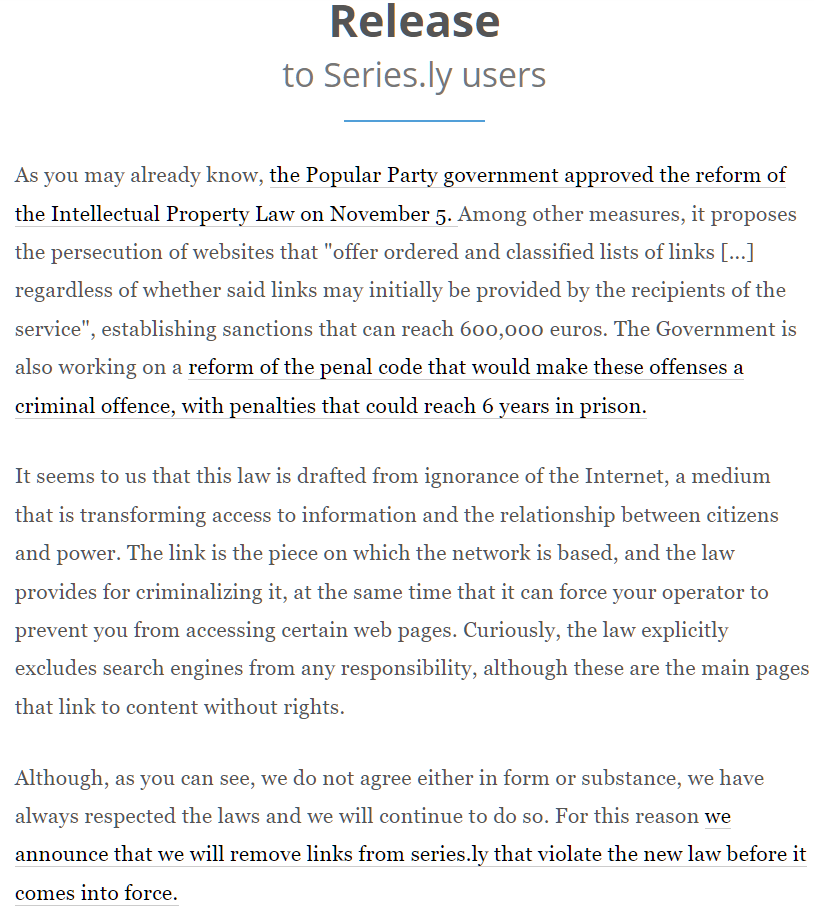
    The defendants knew all about the change in legislation. In December 2014, Series.ly announced that due to the imminent arrival of the new law, the site would continue to exist strictly as a social network. All links that would violate the new law would be removed before it came into force to ensure the site was in full compliance.

    “The fact that the legislator has expressly added the conduct [linking] that is the subject of this procedure, subsequently, indicates, as the defense stated, that, previously, said conduct was not typically criminal,” the judge noted .

    Linking to copyrighted content had been established as “a new crime” under the new legislation and there was agreement the past conduct of the defendants would fit perfectly. The problem for the prosecution was that the new law wasn’t retrospective, and when it did come into force, the defendants had already stopped linking.

    Rightsholders Appeal, Appeal Fails

    After rightsholders represented by the Association of National Videographic Distributors and Importers (ADIVAN) appealed the decision, last week the Provincial Court of Barcelona acquitted the three men once again.

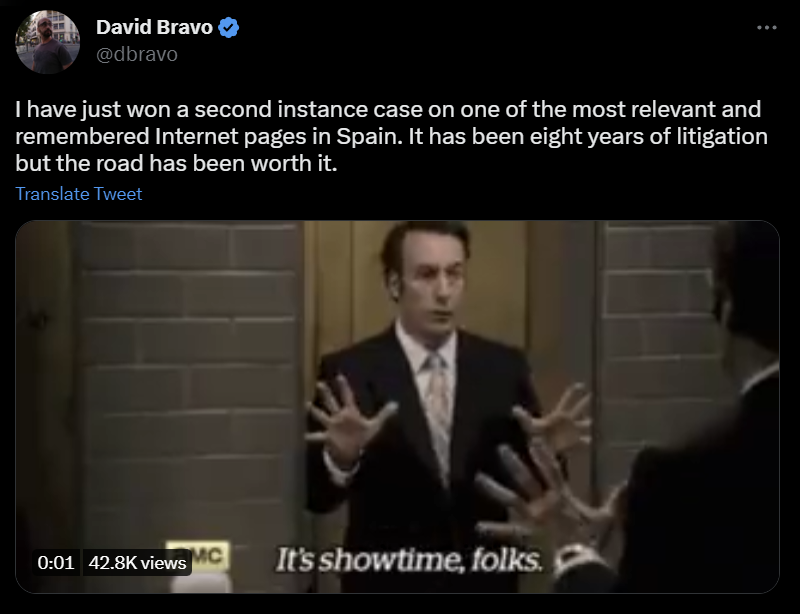
    While he didn’t mention the case directly, defense lawyer David Bravo took to Twitter on Friday to announce a big win that had been eight years in the making.

    According to Bravo, the prosecution knew there was evidence to show that Series.ly’s operators had stopped allowing links to external content, because police had obtained it during the raid in 2015.

    “It is paradoxical that the ‘enter and search’ that was so publicized in the press as a ‘blow against piracy’ has nevertheless been the main evidence for the acquittal,” Bravo told ElDiario .

    “The seized documents were legal opinions from their lawyer to maintain their activities legally, emails with the producers to eliminate the links that were reported to them, and even internal emails between the administrators who said they had to adapt to the new laws ‘however retrograde they are’.”

    Other evidence seized from the men included internal conversations about a system to reward users who linked to legal services including Netflix.

    “Not even I, as a defense counsel, could have provided more conclusive evidence,” Bravo added.

    Rightsholders May Not Give Up

    When local news outlet ElDiario requested comment from ADIVAN General Manager Santiago Mediano, he declined to comment, via a comment that made his group’s position clear.

    “We at ADIVAN have the habit of not giving an opinion on cases that have not ended, like this one,” he said.

    This implies that the Supreme Court may be asked to take on the case, but how that would help in the fight against piracy today is unclear. Two courts have already determined that the defendants stopped their activities eight years ago, so are no longer a piracy threat. Those courts also determined that the men committed no crimes.

    Yet hundreds of sites are currently doing what the defendants never did, every single day, while legal resources are spent on a case that won’t reduce piracy in any measurable way, no matter who wins.

    From: TF , for the latest news on copyright battles, piracy and more.

    • To chevron_right

      ‘Pirate’ Site Admins Arrested in 2015, Now Acquitted For a Second Time

      news.movim.eu / TorrentFreak • 4 April 2023 • 4 minutes

    series-ly-logo In 2014, David Tardà, Andreu Caritg, and Oriol Solé were hard at work in Spain developing Tviso , a service with a goal to unify legal streaming services into a centrally-accessed discovery hub.

    Tviso was a new venture for the Spaniards, although not an entirely unfamiliar one. At the same time, the men were also the operators of Series.ly, a then-four-year-old “social television” download site that aimed to blend the benefits of free access to premium TV series and movies with a walled-garden social network of entertainment media fans.

    With a reported four million users, Series.ly was a success. It reportedly generated over 638,000 euros in the three years leading up to 2015, after which new legislation in Spain would render its activities illegal.

    Police Raid Operators of Series.ly

    Following a complaint from a local trade industry group representing U.S. rightsholders, and six months after the introduction of reformed intellectual property law in Spain, local authorities were ready to take action.

    An investigation carried out by the Anti-Piracy Group of the Central Computer Security Brigade, with assistance from the Provincial Judicial Police Brigade of Barcelona, had linked Series.ly to a company operated by Tardà, Caritg, and Solé.

    In the summer of 2015, Policía Nacional officers raided the company’s offices in search of evidence related to the operation of Series.ly. That included details of revenue generated by advertising and premium account sales to customers all over Europe, Switzerland, United States, Mexico, Chile and beyond.

    The three men were arrested and subsequently charged with intellectual property crimes. It would be another seven years before they had their day in court.

    Rightsholders Demand Four Years in Prison

    Local police labeled Tardà, Caritg, and Solé a “criminal organization”. Rightsholders represented by the Association of National Videographic Distributors and Importers (ADIVAN), described the conduct of Series.ly’s operators as straightforward theft, for which four years in prison would be an appropriate sentence.

    Still, a decision handed down by Criminal Court No. 1 of Sabadell in October 2022 found the men had committed no crimes. Before the new law came into force in Spain, linking to copyrighted content was not considered a crime. Indeed, the new law was introduced with this and other types of infringement in mind.

    The defendants knew all about the change in legislation. In December 2014, Series.ly announced that due to the imminent arrival of the new law, the site would continue to exist strictly as a social network. All links that would violate the new law would be removed before it came into force to ensure the site was in full compliance.

    “The fact that the legislator has expressly added the conduct [linking] that is the subject of this procedure, subsequently, indicates, as the defense stated, that, previously, said conduct was not typically criminal,” the judge noted .

    Linking to copyrighted content had been established as “a new crime” under the new legislation and there was agreement the past conduct of the defendants would fit perfectly. The problem for the prosecution was that the new law wasn’t retrospective, and when it did come into force, the defendants had already stopped linking.

    Rightsholders Appeal, Appeal Fails

    After rightsholders represented by the Association of National Videographic Distributors and Importers (ADIVAN) appealed the decision, last week the Provincial Court of Barcelona acquitted the three men once again.

    While he didn’t mention the case directly, defense lawyer David Bravo took to Twitter on Friday to announce a big win that had been eight years in the making.

    According to Bravo, the prosecution knew there was evidence to show that Series.ly’s operators had stopped allowing links to external content, because police had obtained it during the raid in 2015.

    “It is paradoxical that the ‘enter and search’ that was so publicized in the press as a ‘blow against piracy’ has nevertheless been the main evidence for the acquittal,” Bravo told ElDiario .

    “The seized documents were legal opinions from their lawyer to maintain their activities legally, emails with the producers to eliminate the links that were reported to them, and even internal emails between the administrators who said they had to adapt to the new laws ‘however retrograde they are’.”

    Other evidence seized from the men included internal conversations about a system to reward users who linked to legal services including Netflix.

    “Not even I, as a defense counsel, could have provided more conclusive evidence,” Bravo added.

    Rightsholders May Not Give Up

    When local news outlet ElDiario requested comment from ADIVAN General Manager Santiago Mediano, he declined to comment, via a comment that made his group’s position clear.

    “We at ADIVAN have the habit of not giving an opinion on cases that have not ended, like this one,” he said.

    This implies that the Supreme Court may be asked to take on the case, but how that would help in the fight against piracy today is unclear. Two courts have already determined that the defendants stopped their activities eight years ago, so are no longer a piracy threat. Those courts also determined that the men committed no crimes.

    Yet hundreds of sites are currently doing what the defendants never did, every single day, while legal resources are spent on a case that won’t reduce piracy in any measurable way, no matter who wins.

    From: TF , for the latest news on copyright battles, piracy and more.

    • To chevron_right

      ‘Pirate’ Site Admins Arrested in 2015, Now Acquitted For a Second Time

      news.movim.eu / TorrentFreak • 4 April 2023 • 4 minutes

    series-ly-logo In 2014, David Tardà, Andreu Caritg, and Oriol Solé were hard at work in Spain developing Tviso , a service with a goal to unify legal streaming services into a centrally-accessed discovery hub.

    Tviso was a new venture for the Spaniards, although not an entirely unfamiliar one. At the same time, the men were also the operators of Series.ly, a then-four-year-old “social television” download site that aimed to blend the benefits of free access to premium TV series and movies with a walled-garden social network of entertainment media fans.

    With a reported four million users, Series.ly was a success. It reportedly generated over 638,000 euros in the three years leading up to 2015, after which new legislation in Spain would render its activities illegal.

    Police Raid Operators of Series.ly

    Following a complaint from a local trade industry group representing U.S. rightsholders, and six months after the introduction of reformed intellectual property law in Spain, local authorities were ready to take action.

    An investigation carried out by the Anti-Piracy Group of the Central Computer Security Brigade, with assistance from the Provincial Judicial Police Brigade of Barcelona, had linked Series.ly to a company operated by Tardà, Caritg, and Solé.

    In the summer of 2015, Policía Nacional officers raided the company’s offices in search of evidence related to the operation of Series.ly. That included details of revenue generated by advertising and premium account sales to customers all over Europe, Switzerland, United States, Mexico, Chile and beyond.

    The three men were arrested and subsequently charged with intellectual property crimes. It would be another seven years before they had their day in court.

    Rightsholders Demand Four Years in Prison

    Local police labeled Tardà, Caritg, and Solé a “criminal organization”. Rightsholders represented by the Association of National Videographic Distributors and Importers (ADIVAN), described the conduct of Series.ly’s operators as straightforward theft, for which four years in prison would be an appropriate sentence.

    Still, a decision handed down by Criminal Court No. 1 of Sabadell in October 2022 found the men had committed no crimes. Before the new law came into force in Spain, linking to copyrighted content was not considered a crime. Indeed, the new law was introduced with this and other types of infringement in mind.

    The defendants knew all about the change in legislation. In December 2014, Series.ly announced that due to the imminent arrival of the new law, the site would continue to exist strictly as a social network. All links that would violate the new law would be removed before it came into force to ensure the site was in full compliance.

    “The fact that the legislator has expressly added the conduct [linking] that is the subject of this procedure, subsequently, indicates, as the defense stated, that, previously, said conduct was not typically criminal,” the judge noted .

    Linking to copyrighted content had been established as “a new crime” under the new legislation and there was agreement the past conduct of the defendants would fit perfectly. The problem for the prosecution was that the new law wasn’t retrospective, and when it did come into force, the defendants had already stopped linking.

    Rightsholders Appeal, Appeal Fails

    After rightsholders represented by the Association of National Videographic Distributors and Importers (ADIVAN) appealed the decision, last week the Provincial Court of Barcelona acquitted the three men once again.

    While he didn’t mention the case directly, defense lawyer David Bravo took to Twitter on Friday to announce a big win that had been eight years in the making.

    According to Bravo, the prosecution knew there was evidence to show that Series.ly’s operators had stopped allowing links to external content, because police had obtained it during the raid in 2015.

    “It is paradoxical that the ‘enter and search’ that was so publicized in the press as a ‘blow against piracy’ has nevertheless been the main evidence for the acquittal,” Bravo told ElDiario .

    “The seized documents were legal opinions from their lawyer to maintain their activities legally, emails with the producers to eliminate the links that were reported to them, and even internal emails between the administrators who said they had to adapt to the new laws ‘however retrograde they are’.”

    Other evidence seized from the men included internal conversations about a system to reward users who linked to legal services including Netflix.

    “Not even I, as a defense counsel, could have provided more conclusive evidence,” Bravo added.

    Rightsholders May Not Give Up

    When local news outlet ElDiario requested comment from ADIVAN General Manager Santiago Mediano, he declined to comment, via a comment that made his group’s position clear.

    “We at ADIVAN have the habit of not giving an opinion on cases that have not ended, like this one,” he said.

    This implies that the Supreme Court may be asked to take on the case, but how that would help in the fight against piracy today is unclear. Two courts have already determined that the defendants stopped their activities eight years ago, so are no longer a piracy threat. Those courts also determined that the men committed no crimes.

    Yet hundreds of sites are currently doing what the defendants never did, every single day, while legal resources are spent on a case that won’t reduce piracy in any measurable way, no matter who wins.

    From: TF , for the latest news on copyright battles, piracy and more.