• To chevron_right

      Feds Seize Domain Names of Sports Streaming Site Streameast

      news.movim.eu / TorrentFreak • 19 August 2024 • 3 minutes

    seized In recent years, rightsholders of major sports events have repeatedly complained that piracy of live sports is getting out of hand.

    Ideally, they would like to see updates to current legislative frameworks, so the problem can be targeted more efficiently. Site-blocking is high on the list of preferred options, particularly in the United States.

    While ISP blocking is still a debated issue among U.S. lawmakers, the country’s enforcement authorities have a more direct option; domain name seizures. With the appropriate legal paperwork, the DoJ’s Homeland Security Investigations ( HSI ) has sporadically targeted ‘pirate’ domain names for more than a decade.

    Streameast Domain Names Seized

    This weekend, the feds appear to have carried out another round of seizures, this time targeting the pirate sports streaming website Streameast. This site, which has a strong focus on ‘American’ sports, has over 15 million monthly visitors, who were all sidelined by surprise.

    Instead of the usual homepage with links to the latest streams of sporting events, Streameast’s visitors – most of which come from the U.S. – were welcomed by a domain seizure banner.

    “This domain name has been seized by Homeland Security Investigations (HSI) pursuant to a warrant issued by the United States District Court for the Eastern District of Louisiana,” the banner reads.

    “It is unlawful to reproduce or distribute copyrighted material including sporting events, television shows, movies, music, software, or games without authorization. Individuals who do so risk criminal prosecution under Title 18.”
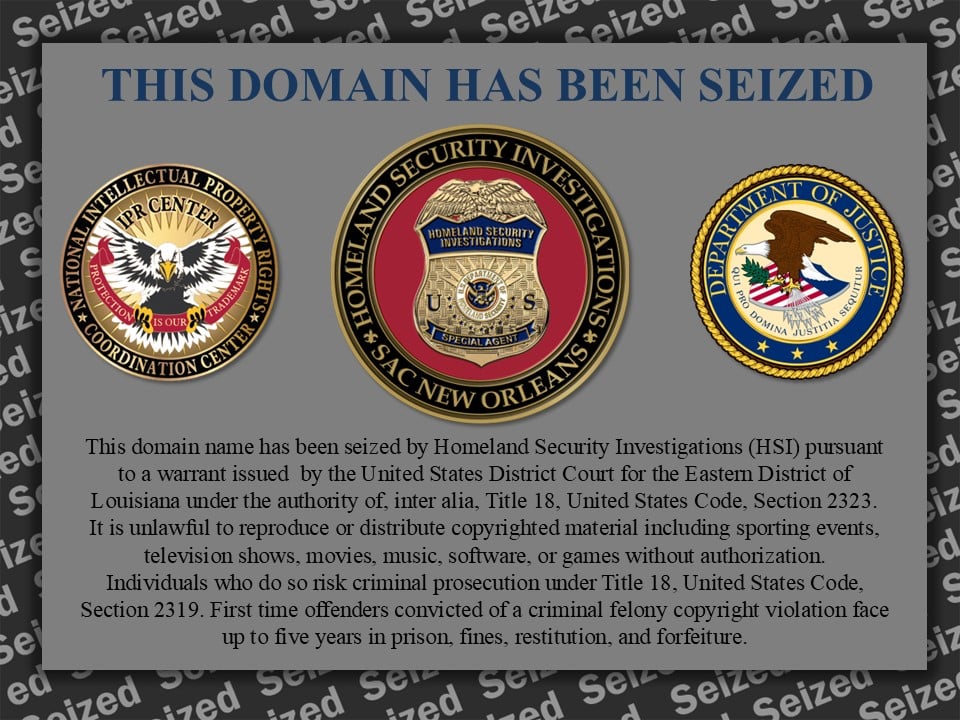
    seized banner streameast

    The seized domain names include the main one; thestreameast.to, as well as popular backup domain options such as streameast.io, streameast.xyz, and streameast.live.

    Streameast Makes ‘Instant’ Comeback

    The authorities have yet to officially confirm the action, which can typically take a few days. However, all available signs suggest that this is a legitimate law enforcement action. For example, the nameservers were all changed to “seizedservers.com”.

    Whether the seizures will be effective in shutting down the Streameast operation is up for debate, however.

    Soon after the domain seizures started to populate across DNS servers, the site’s operators informed their followers on Discord that the site has no intention of throwing in the towel. Quite the opposite, the site remains available though alternative domain names.

    “As you may know, many of our domains were seized by the US government last night. As the only free streaming site in the world that truly values user experience and quality, it was no coincidence that this happened to us,” Streameast admin ‘Quick’ writes.

    There are many fake, fraudulent, and scammy alternatives that remain online but only ‘legitimate’ Streameast domains were targeted, according to the site’s operators. While this came as a disappointment, there was a backup plan in place.

    streameast

    The Streameast team says that it has hundreds of domain names ready to deploy, some of which came into play this weekend. More domains will follow, and the team vows it will continue until ‘affordable’ sports streaming options are available for everyone.

    “They need to see that they can’t stop us this way. We own over 400 domains in total, and we will be activating and sharing most of these with you throughout the week,” they write.

    “We will never give up the fight. Our fight will continue until sports become affordable for everyone. We promise that once this is achieved, we will permanently shut down all Streameast services,” Streameast adds.

    Why, and Why Now?

    The Streameast team kept their word and in addition to streameast.co, they also activated streameast.ec, streameast.fi, streameast.ms, streameast.ph, streameast.ps, streameast.sh, and streameast.sk. These domain names may also be seized in the future, but for now, they remain online.

    streameast

    Why Streameast was singled out as a target on this particular weekend is unknown. Typically, U.S. law enforcement plans their domain seizure operations around major sporting events, as happened with the Super Bowl and the FIFA World Cup . There was a big UFC PPV event over the weekend, but those take place each month.

    With the Paris Olympics, there was a major sporting event earlier this month, but these seizures are a bit late for that.

    As far as we know, there are no indictments against people associated with the site. That said, it is still early days and more information may come out later in the week. With Streameast being as defiant as it is, we don’t expect this to be the end of the enforcement efforts.

    From: TF , for the latest news on copyright battles, piracy and more.

    • To chevron_right

      Feds Seize Domain Names of Sports Streaming Site Streameast

      news.movim.eu / TorrentFreak • 19 August 2024 • 3 minutes

    seized In recent years, rightsholders of major sports events have repeatedly complained that piracy of live sports is getting out of hand.

    Ideally, they would like to see updates to current legislative frameworks, so the problem can be targeted more efficiently. Site-blocking is high on the list of preferred options, particularly in the United States.

    While ISP blocking is still a debated issue among U.S. lawmakers, the country’s enforcement authorities have a more direct option; domain name seizures. With the appropriate legal paperwork, the DoJ’s Homeland Security Investigations ( HSI ) has sporadically targeted ‘pirate’ domain names for more than a decade.

    Streameast Domain Names Seized

    This weekend, the feds appear to have carried out another round of seizures, this time targeting the pirate sports streaming website Streameast. This site, which has a strong focus on ‘American’ sports, has over 15 million monthly visitors, who were all sidelined by surprise.

    Instead of the usual homepage with links to the latest streams of sporting events, Streameast’s visitors – most of which come from the U.S. – were welcomed by a domain seizure banner.

    “This domain name has been seized by Homeland Security Investigations (HSI) pursuant to a warrant issued by the United States District Court for the Eastern District of Louisiana,” the banner reads.

    “It is unlawful to reproduce or distribute copyrighted material including sporting events, television shows, movies, music, software, or games without authorization. Individuals who do so risk criminal prosecution under Title 18.”

    seized banner streameast

    The seized domain names include the main one; thestreameast.to, as well as popular backup domain options such as streameast.io, streameast.xyz, and streameast.live.

    Streameast Makes ‘Instant’ Comeback

    The authorities have yet to officially confirm the action, which can typically take a few days. However, all available signs suggest that this is a legitimate law enforcement action. For example, the nameservers were all changed to “seizedservers.com”.

    Whether the seizures will be effective in shutting down the Streameast operation is up for debate, however.

    Soon after the domain seizures started to populate across DNS servers, the site’s operators informed their followers on Discord that the site has no intention of throwing in the towel. Quite the opposite, the site remains available though alternative domain names.

    “As you may know, many of our domains were seized by the US government last night. As the only free streaming site in the world that truly values user experience and quality, it was no coincidence that this happened to us,” Streameast admin ‘Quick’ writes.

    There are many fake, fraudulent, and scammy alternatives that remain online but only ‘legitimate’ Streameast domains were targeted, according to the site’s operators. While this came as a disappointment, there was a backup plan in place.

    streameast

    The Streameast team says that it has hundreds of domain names ready to deploy, some of which came into play this weekend. More domains will follow, and the team vows it will continue until ‘affordable’ sports streaming options are available for everyone.

    “They need to see that they can’t stop us this way. We own over 400 domains in total, and we will be activating and sharing most of these with you throughout the week,” they write.

    “We will never give up the fight. Our fight will continue until sports become affordable for everyone. We promise that once this is achieved, we will permanently shut down all Streameast services,” Streameast adds.

    Why, and Why Now?

    The Streameast team kept their word and in addition to streameast.co, they also activated streameast.ec, streameast.fi, streameast.ms, streameast.ph, streameast.ps, streameast.sh, and streameast.sk. These domain names may also be seized in the future, but for now, they remain online.

    streameast

    Why Streameast was singled out as a target on this particular weekend is unknown. Typically, U.S. law enforcement plans their domain seizure operations around major sporting events, as happened with the Super Bowl and the FIFA World Cup . There was a big UFC PPV event over the weekend, but those take place each month.

    With the Paris Olympics, there was a major sporting event earlier this month, but these seizures are a bit late for that.

    As far as we know, there are no indictments against people associated with the site. That said, it is still early days and more information may come out later in the week. With Streameast being as defiant as it is, we don’t expect this to be the end of the enforcement efforts.

    From: TF , for the latest news on copyright battles, piracy and more.

    • To chevron_right

      Feds Seize Domain Names of Sports Streaming Site Streameast

      news.movim.eu / TorrentFreak • 19 August 2024 • 3 minutes

    seized In recent years, rightsholders of major sports events have repeatedly complained that piracy of live sports is getting out of hand.

    Ideally, they would like to see updates to current legislative frameworks, so the problem can be targeted more efficiently. Site-blocking is high on the list of preferred options, particularly in the United States.

    While ISP blocking is still a debated issue among U.S. lawmakers, the country’s enforcement authorities have a more direct option; domain name seizures. With the appropriate legal paperwork, the DoJ’s Homeland Security Investigations ( HSI ) has sporadically targeted ‘pirate’ domain names for more than a decade.

    Streameast Domain Names Seized

    This weekend, the feds appear to have carried out another round of seizures, this time targeting the pirate sports streaming website Streameast. This site, which has a strong focus on ‘American’ sports, has over 15 million monthly visitors, who were all sidelined by surprise.

    Instead of the usual homepage with links to the latest streams of sporting events, Streameast’s visitors – most of which come from the U.S. – were welcomed by a domain seizure banner.

    “This domain name has been seized by Homeland Security Investigations (HSI) pursuant to a warrant issued by the United States District Court for the Eastern District of Louisiana,” the banner reads.

    “It is unlawful to reproduce or distribute copyrighted material including sporting events, television shows, movies, music, software, or games without authorization. Individuals who do so risk criminal prosecution under Title 18.”

    seized banner streameast

    The seized domain names include the main one; thestreameast.to, as well as popular backup domain options such as streameast.io, streameast.xyz, and streameast.live.

    Streameast Makes ‘Instant’ Comeback

    The authorities have yet to officially confirm the action, which can typically take a few days. However, all available signs suggest that this is a legitimate law enforcement action. For example, the nameservers were all changed to “seizedservers.com”.

    Whether the seizures will be effective in shutting down the Streameast operation is up for debate, however.

    Soon after the domain seizures started to populate across DNS servers, the site’s operators informed their followers on Discord that the site has no intention of throwing in the towel. Quite the opposite, the site remains available though alternative domain names.

    “As you may know, many of our domains were seized by the US government last night. As the only free streaming site in the world that truly values user experience and quality, it was no coincidence that this happened to us,” Streameast admin ‘Quick’ writes.

    There are many fake, fraudulent, and scammy alternatives that remain online but only ‘legitimate’ Streameast domains were targeted, according to the site’s operators. While this came as a disappointment, there was a backup plan in place.

    streameast

    The Streameast team says that it has hundreds of domain names ready to deploy, some of which came into play this weekend. More domains will follow, and the team vows it will continue until ‘affordable’ sports streaming options are available for everyone.

    “They need to see that they can’t stop us this way. We own over 400 domains in total, and we will be activating and sharing most of these with you throughout the week,” they write.

    “We will never give up the fight. Our fight will continue until sports become affordable for everyone. We promise that once this is achieved, we will permanently shut down all Streameast services,” Streameast adds.

    Why, and Why Now?

    The Streameast team kept their word and in addition to streameast.co, they also activated streameast.ec, streameast.fi, streameast.ms, streameast.ph, streameast.ps, streameast.sh, and streameast.sk. These domain names may also be seized in the future, but for now, they remain online.

    streameast

    Why Streameast was singled out as a target on this particular weekend is unknown. Typically, U.S. law enforcement plans their domain seizure operations around major sporting events, as happened with the Super Bowl and the FIFA World Cup . There was a big UFC PPV event over the weekend, but those take place each month.

    With the Paris Olympics, there was a major sporting event earlier this month, but these seizures are a bit late for that.

    As far as we know, there are no indictments against people associated with the site. That said, it is still early days and more information may come out later in the week. With Streameast being as defiant as it is, we don’t expect this to be the end of the enforcement efforts.

    From: TF , for the latest news on copyright battles, piracy and more.

    • To chevron_right

      Radiohead ‘Leaked’ Their Own Track in 2009, Now We’re Accused of Pirating It

      news.movim.eu / TorrentFreak • 18 August 2024 • 5 minutes

    bogus notice to TF If 2009 sounds like it happened half a lifetime ago, many 30 year-olds would likely agree.

    At the time the UK government was taking advice from the entertainment industries on how to tackle surging piracy via the BitTorrent protocol.

    Presented as an entirely proportionate and reasonable response for dealing with habitual downloaders, disconnecting entire households from the internet loomed ominously on the horizon.

    Yet in 2007, the band Radiohead had ventured quite bravely in the opposite direction, arguing that piracy shouldn’t be punished and file-sharing should be embraced. When the band released the album ‘In Rainbows’ online, its price tag competed with ‘free’ on terms that even pirates could understand.

    The debate over Radiohead’s ‘pay-what-you-want’ model went global. Praised by some for allowing everyone to afford music, it faced heavy criticism from those who felt that the price devalued music, and would lead to artists – especially less successful ones – suffering the financial consequences of competing with free. Despite the polarized views, Radiohead hadn’t quite finished.

    Music Industry & Government Had it All Wrong

    In May 2009, Brian Message, a partner in Radiohead’s management company, did the unthinkable. After describing the plan to kick file-sharers (and their families) off the internet as unworkable, Message suggested a radically different approach.

    “We believe file-sharing by peer to peer should be legalized. The sharing of music where it is not for profit is a great thing for culture and music,” Message said.

    That wasn’t what the labels wanted to hear, to put it mildly. With the benefit of hindsight, legalization probably wasn’t the right solution to support what eventually followed, but anyone could see that the status quo simply wasn’t working.

    Was It Really Happening?

    In early August 2009, after Radiohead’s Thom Yorke had dropped hints about a “great idea” and a secret distribution plan, things were about to start get interesting again. Whether it was the band, people working for them, or someone else, when the yet-to-be-released Radiohead track ‘These Are My Twisted Words’ was uploaded to private torrent site What.cd, Radiohead and file-sharing were suddenly back in the news again.

    For many file-sharers, Radiohead’s approach felt like someone was actually listening; an outreach of sorts, acknowledgement from people who mattered that things needed to change. In the end, changes implemented by the music industry were a revelation. Not only did the industry prove itself wrong by successfully competing with free, it had managed to do so without resorting to brute force.

    The idea that file-sharers, fans, will only return to buying any type of content if there’s a credible threat of force, has never made sense to us here at TF. Loyal consumers are happy consumers; happy with the product, happy with the service, and happy with the price. Get any one of those wrong and consumers become unhappy; any plan to cheer them up by a) not fixing the problem and b) resorting to threats, will fail – period.

    Radiohead not only understood this better than most, the band actually dared to try something different. Less than a week after the ‘leak’ of ‘These Are My Twisted Words’ on What.cd, Radiohead’s Jonny Greenwood took to the band’s Dead Air Space blog.

    The Air Space blog, saved from extinction by the Internet Archive radiohead-blog

    In his post, Greenwood announced ‘These Are My Twisted Words’ officially for the first time. He then invited people to download it for free, including via a torrent hosted on Mininova, once one of the world’s most popular torrent sites.

    And Back to Reality

    For Mininova, the Radiohead release symbolized hope. Legal troubles with Dutch anti-piracy group BREIN meant that the site needed to change drastically or face extinction. In our 2009 article, co-founder Erik Dubbelboer celebrated Radiohead’s use of the site’s fledgling content distribution service and called on more artists to do the same.

    By November 2009, the only content that remained on Mininova was content uploaded to the new distribution service. After losing its dispute with BREIN, Mininova was ordered to delete all other content , which in time led to the site’s demise. In common with similar sites, Mininova already had a policy of responding to rightsholders’ takedown notices but when a Dutch court found that insufficient, the end was nigh.

    TorrentFreak also has a takedown policy. Our policy is to create all of our own content, obtain licenses for images where applicable, and if required, adhere to fair use norms. Because the policy works and nothing is infringing, nothing ever needs to be taken down. Unfortunately, some rightsholders and anti-piracy outfits occasionally disagree; on the plus side, on every occasion they are always wrong.

    Wrongfully Targeted Yet Again

    Around eight years ago, an industry shake-up saw Radiohead’s back catalog move from Parlophone to XL Recordings, which now operates as part of Beggars Group Digital. With assistance from anti-piracy company MUSO, attempts are now being made to purge Google’s search indexes of all links to unauthorized copies of Radiohead’s music.

    A single notice dated August 8, 2024, presented here courtesy of the Lumen Database , is huge. Weighing in at over 9,600 URLs, hidden deep inside is one of our URLs which, according to the notice, should be disappeared by Google for the remainder of eternity, for violating copyright law.

    That article contains no copyrighted material apart from our own, and doesn’t link to any infringing content either.

    Coincidentally, the same generally applies to the takedown notice itself. Despite claiming to contain close to 10,000 pirate URLs across 1,643 domains, Google’s assessment indicates that just 4.5% are actually infringing.

    Rightsholders never got to target individuals in the manner suggested 15 years ago, and that is a good thing; a very, very good thing considering the complaint detailed above. More importantly, people without internet can’t access YouTube, for example, which now generates billions of dollars in revenue for the music industry.

    Instead, the focus today is on making life difficult for pirate sites, via site-blocking measures and by generating takedown notices on an industrial scale. When it comes to the latter, all people can do is try not to get caught in the crossfire, pray occasionally, and put faith in Google to shield your own copyrighted works from being rendered unfindable.

    That’s exactly what Google did here, having done so many times before .

    From: TF , for the latest news on copyright battles, piracy and more.

    • To chevron_right

      Radiohead ‘Leaked’ Their Own Track in 2009, Now We’re Accused of Pirating It

      news.movim.eu / TorrentFreak • 18 August 2024 • 5 minutes

    bogus notice to TF If 2009 sounds like it happened half a lifetime ago, many 30 year-olds would likely agree.

    At the time the UK government was taking advice from the entertainment industries on how to tackle surging piracy via the BitTorrent protocol.

    Presented as an entirely proportionate and reasonable response for dealing with habitual downloaders, disconnecting entire households from the internet loomed ominously on the horizon.

    Yet in 2007, the band Radiohead had ventured quite bravely in the opposite direction, arguing that piracy shouldn’t be punished and file-sharing should be embraced. When the band released the album ‘In Rainbows’ online, its price tag competed with ‘free’ on terms that even pirates could understand.

    The debate over Radiohead’s ‘pay-what-you-want’ model went global. Praised by some for allowing everyone to afford music, it faced heavy criticism from those who felt that the price devalued music, and would lead to artists – especially less successful ones – suffering the financial consequences of competing with free. Despite the polarized views, Radiohead hadn’t quite finished.

    Music Industry & Government Had it All Wrong

    In May 2009, Brian Message, a partner in Radiohead’s management company, did the unthinkable. After describing the plan to kick file-sharers (and their families) off the internet as unworkable, Message suggested a radically different approach.

    “We believe file-sharing by peer to peer should be legalized. The sharing of music where it is not for profit is a great thing for culture and music,” Message said.

    That wasn’t what the labels wanted to hear, to put it mildly. With the benefit of hindsight, legalization probably wasn’t the right solution to support what eventually followed, but anyone could see that the status quo simply wasn’t working.

    Was It Really Happening?

    In early August 2009, after Radiohead’s Thom Yorke had dropped hints about a “great idea” and a secret distribution plan, things were about to start get interesting again. Whether it was the band, people working for them, or someone else, when the yet-to-be-released Radiohead track ‘These Are My Twisted Words’ was uploaded to private torrent site What.cd, Radiohead and file-sharing were suddenly back in the news again.

    For many file-sharers, Radiohead’s approach felt like someone was actually listening; an outreach of sorts, acknowledgement from people who mattered that things needed to change. In the end, changes implemented by the music industry were a revelation. Not only did the industry prove itself wrong by successfully competing with free, it had managed to do so without resorting to brute force.

    The idea that file-sharers, fans, will only return to buying any type of content if there’s a credible threat of force, has never made sense to us here at TF. Loyal consumers are happy consumers; happy with the product, happy with the service, and happy with the price. Get any one of those wrong and consumers become unhappy; any plan to cheer them up by a) not fixing the problem and b) resorting to threats, will fail – period.

    Radiohead not only understood this better than most, the band actually dared to try something different. Less than a week after the ‘leak’ of ‘These Are My Twisted Words’ on What.cd, Radiohead’s Jonny Greenwood took to the band’s Dead Air Space blog.

    The Air Space blog, saved from extinction by the Internet Archive radiohead-blog

    In his post, Greenwood announced ‘These Are My Twisted Words’ officially for the first time. He then invited people to download it for free, including via a torrent hosted on Mininova, once one of the world’s most popular torrent sites.

    And Back to Reality

    For Mininova, the Radiohead release symbolized hope. Legal troubles with Dutch anti-piracy group BREIN meant that the site needed to change drastically or face extinction. In our 2009 article, co-founder Erik Dubbelboer celebrated Radiohead’s use of the site’s fledgling content distribution service and called on more artists to do the same.

    By November 2009, the only content that remained on Mininova was content uploaded to the new distribution service. After losing its dispute with BREIN, Mininova was ordered to delete all other content , which in time led to the site’s demise. In common with similar sites, Mininova already had a policy of responding to rightsholders’ takedown notices but when a Dutch court found that insufficient, the end was nigh.

    TorrentFreak also has a takedown policy. Our policy is to create all of our own content, obtain licenses for images where applicable, and if required, adhere to fair use norms. Because the policy works and nothing is infringing, nothing ever needs to be taken down. Unfortunately, some rightsholders and anti-piracy outfits occasionally disagree; on the plus side, on every occasion they are always wrong.

    Wrongfully Targeted Yet Again

    Around eight years ago, an industry shake-up saw Radiohead’s back catalog move from Parlophone to XL Recordings, which now operates as part of Beggars Group Digital. With assistance from anti-piracy company MUSO, attempts are now being made to purge Google’s search indexes of all links to unauthorized copies of Radiohead’s music.

    A single notice dated August 8, 2024, presented here courtesy of the Lumen Database , is huge. Weighing in at over 9,600 URLs, hidden deep inside is one of our URLs which, according to the notice, should be disappeared by Google for the remainder of eternity, for violating copyright law.

    That article contains no copyrighted material apart from our own, and doesn’t link to any infringing content either.

    Coincidentally, the same generally applies to the takedown notice itself. Despite claiming to contain close to 10,000 pirate URLs across 1,643 domains, Google’s assessment indicates that just 4.5% are actually infringing.

    Rightsholders never got to target individuals in the manner suggested 15 years ago, and that is a good thing; a very, very good thing considering the complaint detailed above. More importantly, people without internet can’t access YouTube, for example, which now generates billions of dollars in revenue for the music industry.

    Instead, the focus today is on making life difficult for pirate sites, via site-blocking measures and by generating takedown notices on an industrial scale. When it comes to the latter, all people can do is try not to get caught in the crossfire, pray occasionally, and put faith in Google to shield your own copyrighted works from being rendered unfindable.

    That’s exactly what Google did here, having done so many times before .

    From: TF , for the latest news on copyright battles, piracy and more.
    • To chevron_right

      Radiohead ‘Leaked’ Their Own Track in 2009, Now We’re Accused of Pirating It

      news.movim.eu / TorrentFreak • 18 August 2024 • 5 minutes

    bogus notice to TF If 2009 sounds like it happened half a lifetime ago, many 30 year-olds would likely agree.

    At the time the UK government was taking advice from the entertainment industries on how to tackle surging piracy via the BitTorrent protocol.

    Presented as an entirely proportionate and reasonable response for dealing with habitual downloaders, disconnecting entire households from the internet loomed ominously on the horizon.

    Yet in 2007, the band Radiohead had ventured quite bravely in the opposite direction, arguing that piracy shouldn’t be punished and file-sharing should be embraced. When the band released the album ‘In Rainbows’ online, its price tag competed with ‘free’ on terms that even pirates could understand.

    The debate over Radiohead’s ‘pay-what-you-want’ model went global. Praised by some for allowing everyone to afford music, it faced heavy criticism from those who felt that the price devalued music, and would lead to artists – especially less successful ones – suffering the financial consequences of competing with free. Despite the polarized views, Radiohead hadn’t quite finished.

    Music Industry & Government Had it All Wrong

    In May 2009, Brian Message, a partner in Radiohead’s management company, did the unthinkable. After describing the plan to kick file-sharers (and their families) off the internet as unworkable, Message suggested a radically different approach.

    “We believe file-sharing by peer to peer should be legalized. The sharing of music where it is not for profit is a great thing for culture and music,” Message said.

    That wasn’t what the labels wanted to hear, to put it mildly. With the benefit of hindsight, legalization probably wasn’t the right solution to support what eventually followed, but anyone could see that the status quo simply wasn’t working.

    Was It Really Happening?

    In early August 2009, after Radiohead’s Thom Yorke had dropped hints about a “great idea” and a secret distribution plan, things were about to start get interesting again. Whether it was the band, people working for them, or someone else, when the yet-to-be-released Radiohead track ‘These Are My Twisted Words’ was uploaded to private torrent site What.cd, Radiohead and file-sharing were suddenly back in the news again.

    For many file-sharers, Radiohead’s approach felt like someone was actually listening; an outreach of sorts, acknowledgement from people who mattered that things needed to change. In the end, changes implemented by the music industry were a revelation. Not only did the industry prove itself wrong by successfully competing with free, it had managed to do so without resorting to brute force.

    The idea that file-sharers, fans, will only return to buying any type of content if there’s a credible threat of force, has never made sense to us here at TF. Loyal consumers are happy consumers; happy with the product, happy with the service, and happy with the price. Get any one of those wrong and consumers become unhappy; any plan to cheer them up by a) not fixing the problem and b) resorting to threats, will fail – period.

    Radiohead not only understood this better than most, the band actually dared to try something different. Less than a week after the ‘leak’ of ‘These Are My Twisted Words’ on What.cd, Radiohead’s Jonny Greenwood took to the band’s Dead Air Space blog.

    The Air Space blog, saved from extinction by the Internet Archive radiohead-blog

    In his post, Greenwood announced ‘These Are My Twisted Words’ officially for the first time. He then invited people to download it for free, including via a torrent hosted on Mininova, once one of the world’s most popular torrent sites.

    And Back to Reality

    For Mininova, the Radiohead release symbolized hope. Legal troubles with Dutch anti-piracy group BREIN meant that the site needed to change drastically or face extinction. In our 2009 article, co-founder Erik Dubbelboer celebrated Radiohead’s use of the site’s fledgling content distribution service and called on more artists to do the same.

    By November 2009, the only content that remained on Mininova was content uploaded to the new distribution service. After losing its dispute with BREIN, Mininova was ordered to delete all other content , which in time led to the site’s demise. In common with similar sites, Mininova already had a policy of responding to rightsholders’ takedown notices but when a Dutch court found that insufficient, the end was nigh.

    TorrentFreak also has a takedown policy. Our policy is to create all of our own content, obtain licenses for images where applicable, and if required, adhere to fair use norms. Because the policy works and nothing is infringing, nothing ever needs to be taken down. Unfortunately, some rightsholders and anti-piracy outfits occasionally disagree; on the plus side, on every occasion they are always wrong.

    Wrongfully Targeted Yet Again

    Around eight years ago, an industry shake-up saw Radiohead’s back catalog move from Parlophone to XL Recordings, which now operates as part of Beggars Group Digital. With assistance from anti-piracy company MUSO, attempts are now being made to purge Google’s search indexes of all links to unauthorized copies of Radiohead’s music.

    A single notice dated August 8, 2024, presented here courtesy of the Lumen Database , is huge. Weighing in at over 9,600 URLs, hidden deep inside is one of our URLs which, according to the notice, should be disappeared by Google for the remainder of eternity, for violating copyright law.

    That article contains no copyrighted material apart from our own, and doesn’t link to any infringing content either.

    Coincidentally, the same generally applies to the takedown notice itself. Despite claiming to contain close to 10,000 pirate URLs across 1,643 domains, Google’s assessment indicates that just 4.5% are actually infringing.

    Rightsholders never got to target individuals in the manner suggested 15 years ago, and that is a good thing; a very, very good thing considering the complaint detailed above. More importantly, people without internet can’t access YouTube, for example, which now generates billions of dollars in revenue for the music industry.

    Instead, the focus today is on making life difficult for pirate sites, via site-blocking measures and by generating takedown notices on an industrial scale. When it comes to the latter, all people can do is try not to get caught in the crossfire, pray occasionally, and put faith in Google to shield your own copyrighted works from being rendered unfindable.

    That’s exactly what Google did here, having done so many times before .

    From: TF , for the latest news on copyright battles, piracy and more.

    • To chevron_right

      NVIDIA: Copyrighted Books Are Just Statistical Correlations to Our AI Models

      news.movim.eu / TorrentFreak • 17 August 2024 • 5 minutes

    nvidia logo Over the past two years, AI developments have progressed at a rapid pace.

    This includes large language models, which are typically trained on a broad datasets of texts; the more, the better.

    When AI hit the mainstream, it became apparent that rightsholders are not always pleased that their works were used to train AI. This applies to photographers, artists, music companies, journalists, and authors, some of whom formed groups to file copyright infringement lawsuits to protect their rights.

    Book authors, in particular, complained about the use of pirated books as training material. In various lawsuits, companies including OpenAI, Microsoft, Meta, and NVIDIA are accused of using the ‘Books3’ dataset, which was scraped from the library of ‘pirate’ site Bibliotik.

    After the Books3 accusations hit mainstream news, many AI companies stopped using this source. Meanwhile, anti-piracy companies helped publishers to take the alleged rogue libraries offline to prevent further damage.

    These enforcement efforts aren’t limited to Books3 either, or the English language for that matter; earlier this week anti-piracy group BREIN reported that it helped to remove a Dutch language dataset.

    Authors sued NVIDIA

    Earlier this year, several authors sued NVIDIA over alleged copyright infringement. The class action lawsuit alleged that the company’s AI models were trained on copyrighted works and specifically mentioned Books3 data. Since this happened without permission, the rightsholders demand compensation.

    The lawsuit was followed up by a near-identical case a few weeks later, and NVIDIA plans to challenge both in court by denying the copyright infringement allegations.

    In its initial response, filed a few weeks ago , NVIDIA did not deny that it used the Books3 dataset. Like many other AI companies, it believes that the use of copyrighted data for AI training is a prime example of fair use; especially when the output of the model doesn’t reproduce copyrighted works.

    The authors clearly have a different take. They allege that NVIDIA willingly copied an archive of pirated books to train its commercial AI model, and are demanding damages for direct copyright infringement.

    Trial in Two years…?

    This week, the authors and NVIDIA filed a joint case management statement at a California court, laying out a preliminary timeline. This shows that both parties intend to take their time to properly litigate the matter.

    The authors expect that the parties need until October next year to gather facts and evidence during the discovery phase. An eventual jury trial is penciled in a full year later, November 2026.

    trial ready

    NVIDIA doesn’t have a hard trial deadline in mind but stresses that the fair use issue is key, and should be addressed early and efficiently. For starters, the company intends to file a motion for summary judgment within a year, after which both parties should have more clarity.

    Facts, Figures, and Statistical Correlations

    Aside from the timeline, NVIDIA also shared its early outlook on the case. The company believes that AI companies should be allowed to use copyrighted books to train their AI models, as these books are made up of “uncopyrightable facts and ideas” that are already in the public domain.

    The argument may seem surprising at first; the authors own copyrights and as far they’re concerned, use of pirated copies leads to liability as a direct infringer. However, NVIDIA goes on to explain that their AI models don’t see these works that way.

    AI training doesn’t involve any book reading skills, or even a basic understanding of a storyline. Instead, it simply measures statistical correlations and adds these to the model.

    “Training measures statistical correlations in the aggregate, across a vast body of data, and encodes them into the parameters of a model. Plaintiffs do not try to claim a copyright over those statistical correlations, asserting instead that the training data itself is ‘copied’ for the purposes of infringement,” NVIDIA writes.

    correlations nvidia argument

    Put differently, NVIDIA argues that its AI models don’t use the books the way humans do; neither do they reproduce them. It’s simply examining the ‘facts and ideas’ in the books, ‘transforming’ their original purpose to build a complex AI model. That qualifies as fair use, they state.

    “Plaintiffs cannot use copyright to preclude access to facts and ideas, and the highly transformative training process is protected entirely by the well-established fair-use doctrine.

    “Indeed, to accept Plaintiffs’ theory would mean that an author could copyright the rules of grammar or basic facts about the world. That has never been the law, for good reason,” NVIDIA adds.

    Fair Use Battle

    According to NVIDIA, the lawsuit boils down to two related questions. First, whether the authors’ direct infringement claim is essentially an attempt to claim copyright on facts and grammar. Second, whether making copies of the books is fair use.

    The chip company believes that it didn’t do anything wrong and cites several cases that will likely appear in its future filings. They include the Authors Guild v. Google lawsuit, where the court of appeals concluded that copying books to create a searchable database was fair use. As a result, Google Books still exists today.

    NVIDIA is not the only company that will rely on a fair use defense in response to AI-related copyright infringement claims. Many other companies are taking the same approach so whether it succeeds will prove key for the future of AI model development.

    What makes these matters more complex is that AI models and technologies have different applications; so what may be fair use in one case, could be copyright infringing in another.

    For example, earlier this week, a California federal court ruled that a copyright lawsuit filed by visual artists against DeviantArt, Midjourney, Runway AI, and Stability AI, can move forward . These defendants are also accused of copyright infringement, but the lawsuit deals with images, and image outputs instead.

    Given the parties involved and the potential damages at stake, these lawsuits will keep the courts busy for years to come. Even after the first ‘final’ verdicts come in, there will be appeals, and some questions may eventually end up at the Supreme Court.

    Meanwhile, the actions of NVIDIA and other AI companies will be closely monitored by copyright watchers. This includes recent press reports accusing NVIDIA, among others, of scraping both videos and transcripts from YouTube, to train their respective models.

    A copy of the joint case management statement in Nazemian vs. Nvidia is available here (pdf)

    From: TF , for the latest news on copyright battles, piracy and more.

    • To chevron_right

      NVIDIA: Copyrighted Books Are Just Statistical Correlations to Our AI Models

      news.movim.eu / TorrentFreak • 17 August 2024 • 5 minutes

    nvidia logo Over the past two years, AI developments have progressed at a rapid pace.

    This includes large language models, which are typically trained on a broad datasets of texts; the more, the better.

    When AI hit the mainstream, it became apparent that rightsholders are not always pleased that their works were used to train AI. This applies to photographers, artists, music companies, journalists, and authors, some of whom formed groups to file copyright infringement lawsuits to protect their rights.

    Book authors, in particular, complained about the use of pirated books as training material. In various lawsuits, companies including OpenAI, Microsoft, Meta, and NVIDIA are accused of using the ‘Books3’ dataset, which was scraped from the library of ‘pirate’ site Bibliotik.

    After the Books3 accusations hit mainstream news, many AI companies stopped using this source. Meanwhile, anti-piracy companies helped publishers to take the alleged rogue libraries offline to prevent further damage.

    These enforcement efforts aren’t limited to Books3 either, or the English language for that matter; earlier this week anti-piracy group BREIN reported that it helped to remove a Dutch language dataset.

    Authors sued NVIDIA

    Earlier this year, several authors sued NVIDIA over alleged copyright infringement. The class action lawsuit alleged that the company’s AI models were trained on copyrighted works and specifically mentioned Books3 data. Since this happened without permission, the rightsholders demand compensation.

    The lawsuit was followed up by a near-identical case a few weeks later, and NVIDIA plans to challenge both in court by denying the copyright infringement allegations.

    In its initial response, filed a few weeks ago , NVIDIA did not deny that it used the Books3 dataset. Like many other AI companies, it believes that the use of copyrighted data for AI training is a prime example of fair use; especially when the output of the model doesn’t reproduce copyrighted works.

    The authors clearly have a different take. They allege that NVIDIA willingly copied an archive of pirated books to train its commercial AI model, and are demanding damages for direct copyright infringement.

    Trial in Two years…?

    This week, the authors and NVIDIA filed a joint case management statement at a California court, laying out a preliminary timeline. This shows that both parties intend to take their time to properly litigate the matter.

    The authors expect that the parties need until October next year to gather facts and evidence during the discovery phase. An eventual jury trial is penciled in a full year later, November 2026.

    trial ready

    NVIDIA doesn’t have a hard trial deadline in mind but stresses that the fair use issue is key, and should be addressed early and efficiently. For starters, the company intends to file a motion for summary judgment within a year, after which both parties should have more clarity.

    Facts, Figures, and Statistical Correlations

    Aside from the timeline, NVIDIA also shared its early outlook on the case. The company believes that AI companies should be allowed to use copyrighted books to train their AI models, as these books are made up of “uncopyrightable facts and ideas” that are already in the public domain.

    The argument may seem surprising at first; the authors own copyrights and as far they’re concerned, use of pirated copies leads to liability as a direct infringer. However, NVIDIA goes on to explain that their AI models don’t see these works that way.

    AI training doesn’t involve any book reading skills, or even a basic understanding of a storyline. Instead, it simply measures statistical correlations and adds these to the model.

    “Training measures statistical correlations in the aggregate, across a vast body of data, and encodes them into the parameters of a model. Plaintiffs do not try to claim a copyright over those statistical correlations, asserting instead that the training data itself is ‘copied’ for the purposes of infringement,” NVIDIA writes.

    correlations nvidia argument

    Put differently, NVIDIA argues that its AI models don’t use the books the way humans do; neither do they reproduce them. It’s simply examining the ‘facts and ideas’ in the books, ‘transforming’ their original purpose to build a complex AI model. That qualifies as fair use, they state.

    “Plaintiffs cannot use copyright to preclude access to facts and ideas, and the highly transformative training process is protected entirely by the well-established fair-use doctrine.

    “Indeed, to accept Plaintiffs’ theory would mean that an author could copyright the rules of grammar or basic facts about the world. That has never been the law, for good reason,” NVIDIA adds.

    Fair Use Battle

    According to NVIDIA, the lawsuit boils down to two related questions. First, whether the authors’ direct infringement claim is essentially an attempt to claim copyright on facts and grammar. Second, whether making copies of the books is fair use.

    The chip company believes that it didn’t do anything wrong and cites several cases that will likely appear in its future filings. They include the Authors Guild v. Google lawsuit, where the court of appeals concluded that copying books to create a searchable database was fair use. As a result, Google Books still exists today.

    NVIDIA is not the only company that will rely on a fair use defense in response to AI-related copyright infringement claims. Many other companies are taking the same approach so whether it succeeds will prove key for the future of AI model development.

    What makes these matters more complex is that AI models and technologies have different applications; so what may be fair use in one case, could be copyright infringing in another.

    For example, earlier this week, a California federal court ruled that a copyright lawsuit filed by visual artists against DeviantArt, Midjourney, Runway AI, and Stability AI, can move forward . These defendants are also accused of copyright infringement, but the lawsuit deals with images, and image outputs instead.

    Given the parties involved and the potential damages at stake, these lawsuits will keep the courts busy for years to come. Even after the first ‘final’ verdicts come in, there will be appeals, and some questions may eventually end up at the Supreme Court.

    Meanwhile, the actions of NVIDIA and other AI companies will be closely monitored by copyright watchers. This includes recent press reports accusing NVIDIA, among others, of scraping both videos and transcripts from YouTube, to train their respective models.

    A copy of the joint case management statement in Nazemian vs. Nvidia is available here (pdf)

    From: TF , for the latest news on copyright battles, piracy and more.

    • To chevron_right

      NVIDIA: Copyrighted Books Are Just Statistical Correlations to Our AI Models

      news.movim.eu / TorrentFreak • 17 August 2024 • 5 minutes

    nvidia logo Over the past two years, AI developments have progressed at a rapid pace.

    This includes large language models, which are typically trained on a broad datasets of texts; the more, the better.

    When AI hit the mainstream, it became apparent that rightsholders are not always pleased that their works were used to train AI. This applies to photographers, artists, music companies, journalists, and authors, some of whom formed groups to file copyright infringement lawsuits to protect their rights.

    Book authors, in particular, complained about the use of pirated books as training material. In various lawsuits, companies including OpenAI, Microsoft, Meta, and NVIDIA are accused of using the ‘Books3’ dataset, which was scraped from the library of ‘pirate’ site Bibliotik.

    After the Books3 accusations hit mainstream news, many AI companies stopped using this source. Meanwhile, anti-piracy companies helped publishers to take the alleged rogue libraries offline to prevent further damage.

    These enforcement efforts aren’t limited to Books3 either, or the English language for that matter; earlier this week anti-piracy group BREIN reported that it helped to remove a Dutch language dataset.

    Authors sued NVIDIA

    Earlier this year, several authors sued NVIDIA over alleged copyright infringement. The class action lawsuit alleged that the company’s AI models were trained on copyrighted works and specifically mentioned Books3 data. Since this happened without permission, the rightsholders demand compensation.

    The lawsuit was followed up by a near-identical case a few weeks later, and NVIDIA plans to challenge both in court by denying the copyright infringement allegations.

    In its initial response, filed a few weeks ago , NVIDIA did not deny that it used the Books3 dataset. Like many other AI companies, it believes that the use of copyrighted data for AI training is a prime example of fair use; especially when the output of the model doesn’t reproduce copyrighted works.

    The authors clearly have a different take. They allege that NVIDIA willingly copied an archive of pirated books to train its commercial AI model, and are demanding damages for direct copyright infringement.

    Trial in Two years…?

    This week, the authors and NVIDIA filed a joint case management statement at a California court, laying out a preliminary timeline. This shows that both parties intend to take their time to properly litigate the matter.

    The authors expect that the parties need until October next year to gather facts and evidence during the discovery phase. An eventual jury trial is penciled in a full year later, November 2026.

    trial ready

    NVIDIA doesn’t have a hard trial deadline in mind but stresses that the fair use issue is key, and should be addressed early and efficiently. For starters, the company intends to file a motion for summary judgment within a year, after which both parties should have more clarity.

    Facts, Figures, and Statistical Correlations

    Aside from the timeline, NVIDIA also shared its early outlook on the case. The company believes that AI companies should be allowed to use copyrighted books to train their AI models, as these books are made up of “uncopyrightable facts and ideas” that are already in the public domain.

    The argument may seem surprising at first; the authors own copyrights and as far they’re concerned, use of pirated copies leads to liability as a direct infringer. However, NVIDIA goes on to explain that their AI models don’t see these works that way.

    AI training doesn’t involve any book reading skills, or even a basic understanding of a storyline. Instead, it simply measures statistical correlations and adds these to the model.

    “Training measures statistical correlations in the aggregate, across a vast body of data, and encodes them into the parameters of a model. Plaintiffs do not try to claim a copyright over those statistical correlations, asserting instead that the training data itself is ‘copied’ for the purposes of infringement,” NVIDIA writes.

    correlations nvidia argument

    Put differently, NVIDIA argues that its AI models don’t use the books the way humans do; neither do they reproduce them. It’s simply examining the ‘facts and ideas’ in the books, ‘transforming’ their original purpose to build a complex AI model. That qualifies as fair use, they state.

    “Plaintiffs cannot use copyright to preclude access to facts and ideas, and the highly transformative training process is protected entirely by the well-established fair-use doctrine.

    “Indeed, to accept Plaintiffs’ theory would mean that an author could copyright the rules of grammar or basic facts about the world. That has never been the law, for good reason,” NVIDIA adds.

    Fair Use Battle

    According to NVIDIA, the lawsuit boils down to two related questions. First, whether the authors’ direct infringement claim is essentially an attempt to claim copyright on facts and grammar. Second, whether making copies of the books is fair use.

    The chip company believes that it didn’t do anything wrong and cites several cases that will likely appear in its future filings. They include the Authors Guild v. Google lawsuit, where the court of appeals concluded that copying books to create a searchable database was fair use. As a result, Google Books still exists today.

    NVIDIA is not the only company that will rely on a fair use defense in response to AI-related copyright infringement claims. Many other companies are taking the same approach so whether it succeeds will prove key for the future of AI model development.

    What makes these matters more complex is that AI models and technologies have different applications; so what may be fair use in one case, could be copyright infringing in another.

    For example, earlier this week, a California federal court ruled that a copyright lawsuit filed by visual artists against DeviantArt, Midjourney, Runway AI, and Stability AI, can move forward . These defendants are also accused of copyright infringement, but the lawsuit deals with images, and image outputs instead.

    Given the parties involved and the potential damages at stake, these lawsuits will keep the courts busy for years to come. Even after the first ‘final’ verdicts come in, there will be appeals, and some questions may eventually end up at the Supreme Court.

    Meanwhile, the actions of NVIDIA and other AI companies will be closely monitored by copyright watchers. This includes recent press reports accusing NVIDIA, among others, of scraping both videos and transcripts from YouTube, to train their respective models.

    A copy of the joint case management statement in Nazemian vs. Nvidia is available here (pdf)

    From: TF , for the latest news on copyright battles, piracy and more.