• To chevron_right

      Piracy Kingpin Behind ‘Noonoo TV’ and ‘TVWiki’ Arrested in Korea

      news.movim.eu / TorrentFreak • 12 November 2024 • 3 minutes

    TVwiki Like most other countries, South Korea has a persistent piracy problem. Online streaming platforms in particular, have flourished in recent years.

    Up until a year ago, ‘Noonoo TV’ was one of the leading players. Despite welcoming millions of monthly visitors, the site shut itself down citing bandwidth costs and other ‘pressure’ .

    Noonoo & TVWIKI

    The self-imposed shutdown was unexpected but it didn’t take long before other streaming platforms filled the gap. One of these replacements was TVWIKI portal, which showed remarkable similarities with Noonoo.

    For example, the Android apps of Noonoo and TVWIKI shared code and had the same application signing key. In addition, the two portals shared the same category structure and some videos streamed on TVWIKI had a Noonoo watermark.

    TVWIKI’s rapid rise in popularity quickly made it a prime anti-piracy target, with Hollywood’s Motion Picture Association (MPA) labeling the operation a notorious piracy market.

    In a report sent to the U.S. Government, MPA wrote that TVWIKI has millions of monthly visitors, who accounted for nearly 40 million visits in August. At the time, it used the tv51.wiki domain but it regularly switched to new homes to evade Korea’s stringent blocking measures.

    “This series of domains utilizes ‘sequential domain aliasing’ to evade detection by enforcement vendors, traffic measurement bots, and evade site-blocking efforts,” MPA wrote at the time, adding that the operators are believed to be based in Korea.

    Korea Shuts Down TVWIKI, Arrests ‘Noonoo’ Operator

    TVWIKI’s reign ended abruptly this weekend, when its domain was forwarded to a shutdown notice hosted by GitHub. A message informed visitors that Korean authorities seized the domain. The site’s alleged operator, meanwhile, was arrested by a special unit of the Ministry of Culture, Sports and Tourism.

    The enforcement action appears to confirm the ties between Noonoo and TVWIKI. The takedown notice, hosted on the url ‘copyright241109.github.io/ noonoowarrant ‘, mentions that the alleged operator of TVWIKI is the same person who ran Noonoo and OKTOON, another pirate streaming portal.

    “The Ministry of Culture, Sports and Tourism’s Copyright Crime Scientific Investigation Unit arrested the operator of the illegal streaming website Noonoo TV on November 9, 2024, and seized the illegal streaming website TVWIKI and the illegal webtoon posting site OKTOON operated by the same operator,” the translated message reads.
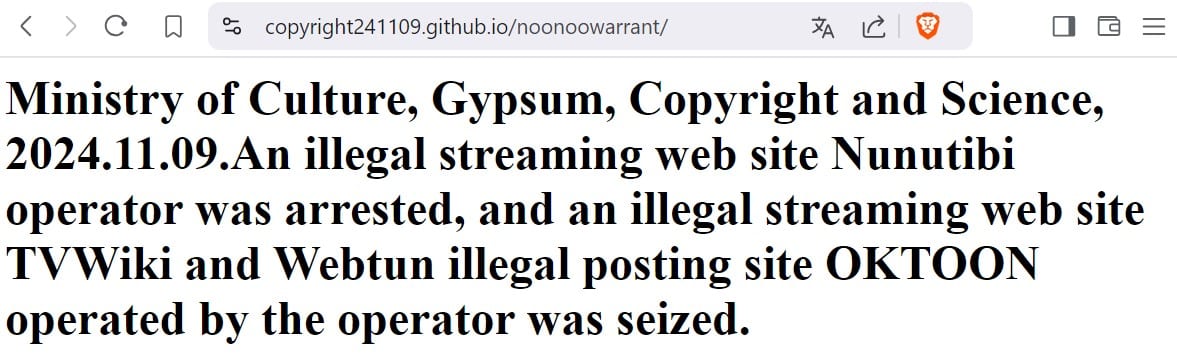
    The Shutdown Notice (translated)

    noonoo

    South Korean news outlet MBN refers to the alleged operator as “Mr. A” but no further details have been released at this point.

    The authorities link Noonoo and TVWIKI’s operator to OKTOON, a pirate site that specialized in Korean comics. OKTOON was targeted in a DMCA subpoena obtained by the Naver-owned company Webtoon in June this year, alongside 170 other domain names . Whether this action contributed to the eventual takedown of the site is unknown.

    Rumors and Replacements

    Given the evasive nature of the pirate streaming portal, some people suggested that the seizure was just a predetermined PR stunt to increase its popularity. This was partly triggered by the GitHub-hosted seizure banner.

    However, with every passing hour, reality started to sink in. The Korean authorities likely use GitHub to offload traffic to an external service. The same tactic was used after the webtoon pirate site Agitoon was shut down in August of this year.

    In a response to an inquiry from the local news outlet MK, an official from the Ministry of Culture, Sports and Tourism confirmed that the authorities are responsible.

    “It is correct that the operator was arrested on the 9th, and the notice on the site was also posted by the Ministry of Culture, Sports and Tourism,” the spokesperson responded.

    With the domain seizures and arrest, one of the largest Korean piracy operations has been rolled up. However, as is often the case, others will be eager to take over the brand, as also happened with Noonoo last year.

    From: TF , for the latest news on copyright battles, piracy and more.

    • To chevron_right

      Piracy Kingpin Behind ‘Noonoo TV’ and ‘TVWiki’ Arrested in Korea

      news.movim.eu / TorrentFreak • 12 November 2024 • 3 minutes

    TVwiki Like most other countries, South Korea has a persistent piracy problem. Online streaming platforms in particular, have flourished in recent years.

    Up until a year ago, ‘Noonoo TV’ was one of the leading players. Despite welcoming millions of monthly visitors, the site shut itself down citing bandwidth costs and other ‘pressure’ .

    Noonoo & TVWIKI

    The self-imposed shutdown was unexpected but it didn’t take long before other streaming platforms filled the gap. One of these replacements was TVWIKI portal, which showed remarkable similarities with Noonoo.

    For example, the Android apps of Noonoo and TVWIKI shared code and had the same application signing key. In addition, the two portals shared the same category structure and some videos streamed on TVWIKI had a Noonoo watermark.

    TVWIKI’s rapid rise in popularity quickly made it a prime anti-piracy target, with Hollywood’s Motion Picture Association (MPA) labeling the operation a notorious piracy market.

    In a report sent to the U.S. Government, MPA wrote that TVWIKI has millions of monthly visitors, who accounted for nearly 40 million visits in August. At the time, it used the tv51.wiki domain but it regularly switched to new homes to evade Korea’s stringent blocking measures.

    “This series of domains utilizes ‘sequential domain aliasing’ to evade detection by enforcement vendors, traffic measurement bots, and evade site-blocking efforts,” MPA wrote at the time, adding that the operators are believed to be based in Korea.

    Korea Shuts Down TVWIKI, Arrests ‘Noonoo’ Operator

    TVWIKI’s reign ended abruptly this weekend, when its domain was forwarded to a shutdown notice hosted by GitHub. A message informed visitors that Korean authorities seized the domain. The site’s alleged operator, meanwhile, was arrested by a special unit of the Ministry of Culture, Sports and Tourism.

    The enforcement action appears to confirm the ties between Noonoo and TVWIKI. The takedown notice, hosted on the url ‘copyright241109.github.io/ noonoowarrant ‘, mentions that the alleged operator of TVWIKI is the same person who ran Noonoo and OKTOON, another pirate streaming portal.

    “The Ministry of Culture, Sports and Tourism’s Copyright Crime Scientific Investigation Unit arrested the operator of the illegal streaming website Noonoo TV on November 9, 2024, and seized the illegal streaming website TVWIKI and the illegal webtoon posting site OKTOON operated by the same operator,” the translated message reads.

    The Shutdown Notice (translated)

    noonoo

    South Korean news outlet MBN refers to the alleged operator as “Mr. A” but no further details have been released at this point.

    The authorities link Noonoo and TVWIKI’s operator to OKTOON, a pirate site that specialized in Korean comics. OKTOON was targeted in a DMCA subpoena obtained by the Naver-owned company Webtoon in June this year, alongside 170 other domain names . Whether this action contributed to the eventual takedown of the site is unknown.

    Rumors and Replacements

    Given the evasive nature of the pirate streaming portal, some people suggested that the seizure was just a predetermined PR stunt to increase its popularity. This was partly triggered by the GitHub-hosted seizure banner.

    However, with every passing hour, reality started to sink in. The Korean authorities likely use GitHub to offload traffic to an external service. The same tactic was used after the webtoon pirate site Agitoon was shut down in August of this year.

    In a response to an inquiry from the local news outlet MK, an official from the Ministry of Culture, Sports and Tourism confirmed that the authorities are responsible.

    “It is correct that the operator was arrested on the 9th, and the notice on the site was also posted by the Ministry of Culture, Sports and Tourism,” the spokesperson responded.

    With the domain seizures and arrest, one of the largest Korean piracy operations has been rolled up. However, as is often the case, others will be eager to take over the brand, as also happened with Noonoo last year.

    From: TF , for the latest news on copyright battles, piracy and more.

    • To chevron_right

      Piracy Kingpin Behind ‘Noonoo TV’ and ‘TVWiki’ Arrested in Korea

      news.movim.eu / TorrentFreak • 12 November 2024 • 3 minutes

    TVwiki Like most other countries, South Korea has a persistent piracy problem. Online streaming platforms in particular, have flourished in recent years.

    Up until a year ago, ‘Noonoo TV’ was one of the leading players. Despite welcoming millions of monthly visitors, the site shut itself down citing bandwidth costs and other ‘pressure’ .

    Noonoo & TVWIKI

    The self-imposed shutdown was unexpected but it didn’t take long before other streaming platforms filled the gap. One of these replacements was TVWIKI portal, which showed remarkable similarities with Noonoo.

    For example, the Android apps of Noonoo and TVWIKI shared code and had the same application signing key. In addition, the two portals shared the same category structure and some videos streamed on TVWIKI had a Noonoo watermark.

    TVWIKI’s rapid rise in popularity quickly made it a prime anti-piracy target, with Hollywood’s Motion Picture Association (MPA) labeling the operation a notorious piracy market.

    In a report sent to the U.S. Government, MPA wrote that TVWIKI has millions of monthly visitors, who accounted for nearly 40 million visits in August. At the time, it used the tv51.wiki domain but it regularly switched to new homes to evade Korea’s stringent blocking measures.

    “This series of domains utilizes ‘sequential domain aliasing’ to evade detection by enforcement vendors, traffic measurement bots, and evade site-blocking efforts,” MPA wrote at the time, adding that the operators are believed to be based in Korea.

    Korea Shuts Down TVWIKI, Arrests ‘Noonoo’ Operator

    TVWIKI’s reign ended abruptly this weekend, when its domain was forwarded to a shutdown notice hosted by GitHub. A message informed visitors that Korean authorities seized the domain. The site’s alleged operator, meanwhile, was arrested by a special unit of the Ministry of Culture, Sports and Tourism.

    The enforcement action appears to confirm the ties between Noonoo and TVWIKI. The takedown notice, hosted on the url ‘copyright241109.github.io/ noonoowarrant ‘, mentions that the alleged operator of TVWIKI is the same person who ran Noonoo and OKTOON, another pirate streaming portal.

    “The Ministry of Culture, Sports and Tourism’s Copyright Crime Scientific Investigation Unit arrested the operator of the illegal streaming website Noonoo TV on November 9, 2024, and seized the illegal streaming website TVWIKI and the illegal webtoon posting site OKTOON operated by the same operator,” the translated message reads.

    The Shutdown Notice (translated)

    noonoo

    South Korean news outlet MBN refers to the alleged operator as “Mr. A” but no further details have been released at this point.

    The authorities link Noonoo and TVWIKI’s operator to OKTOON, a pirate site that specialized in Korean comics. OKTOON was targeted in a DMCA subpoena obtained by the Naver-owned company Webtoon in June this year, alongside 170 other domain names . Whether this action contributed to the eventual takedown of the site is unknown.

    Rumors and Replacements

    Given the evasive nature of the pirate streaming portal, some people suggested that the seizure was just a predetermined PR stunt to increase its popularity. This was partly triggered by the GitHub-hosted seizure banner.

    However, with every passing hour, reality started to sink in. The Korean authorities likely use GitHub to offload traffic to an external service. The same tactic was used after the webtoon pirate site Agitoon was shut down in August of this year.

    In a response to an inquiry from the local news outlet MK, an official from the Ministry of Culture, Sports and Tourism confirmed that the authorities are responsible.

    “It is correct that the operator was arrested on the 9th, and the notice on the site was also posted by the Ministry of Culture, Sports and Tourism,” the spokesperson responded.

    With the domain seizures and arrest, one of the largest Korean piracy operations has been rolled up. However, as is often the case, others will be eager to take over the brand, as also happened with Noonoo last year.

    From: TF , for the latest news on copyright battles, piracy and more.

    • To chevron_right

      Per-Song or Per-Album? Record Labels Challenge Court’s Piracy Damages Ruling

      news.movim.eu / TorrentFreak • 11 November 2024 • 3 minutes

    vinyl In late 2022, several of the world’s largest music companies including UMG, Warner and Sony Music prevailed in their lawsuit against Internet provider Grande Communications.
    The record labels accused the Astound-owned ISP of not doing enough to stop pirating subscribers. Specifically, they alleged that the company failed to terminate repeat infringers.

    The trial lasted more than two weeks and ended in a resounding victory for the labels. A Texas federal jury found Grande guilty of willful contributory copyright infringement, and the ISP was ordered to pay $47 million in damages to the record labels.

    $47 Million Appeal

    Grande was unhappy with the verdict and appealed. Internet providers shouldn’t be held liable for pirating customers based on third-party allegations, the company noted. This appeal was supported by several telecoms organizations which agreed that terminating accounts of suspected pirates is a drastic and overbroad remedy.

    In addition to the liability aspect, Grande also protested the damages calculations. The jury calculated the damages per song, instead of per album, which is the wrong interpretation of U.S. law according to the ISP.

    Last month, the Fifth Circuit Court of Appeals handed down a mixed order . The court confirmed that the ISP is liable for copyright infringement but upheld its concerns over damages. A new trial was issued to establish the lower damages award, on a per-album basis.

    The Court agreed that, in this instance, awarding statutory damages on a per-song basis “would make a total mockery” of Congress’ mandate. If rightsholders would like this to change, they should ask Congress to change the law.

    Record Labels Want Rehearing

    UMG, Warner, Sony and the other labels agree with the finding on liability but object to the damages calculation since this substantially lowers the $47m award.

    Last week, they filed a petition for a rehearing en banc . They argue that the Fifth Circuit’s decision on the damages’ calculation is too narrow.

    The labels note that each song that was infringed is its own “work” under the Copyright Act, and that they are entitled to damages for each individual song.

    Their argument is based on the “independent economic value” test, which asks whether the unit of expression has “independent economic value” to the copyright owner. If it does, then the copyright owner is entitled to statutory damages for the infringement of each copyrightable unit of expression.

    In this case, songs can have individual value, whether they are part of an album or not. This notion is supported by the fact that most music is consumed via digital streaming platforms, which provide access to individual songs.

    “In the digital era, streaming is the primary source of revenue and necessarily involves the commercialization of individual recordings,” the labels write.

    Piracy Changed the Music Biz

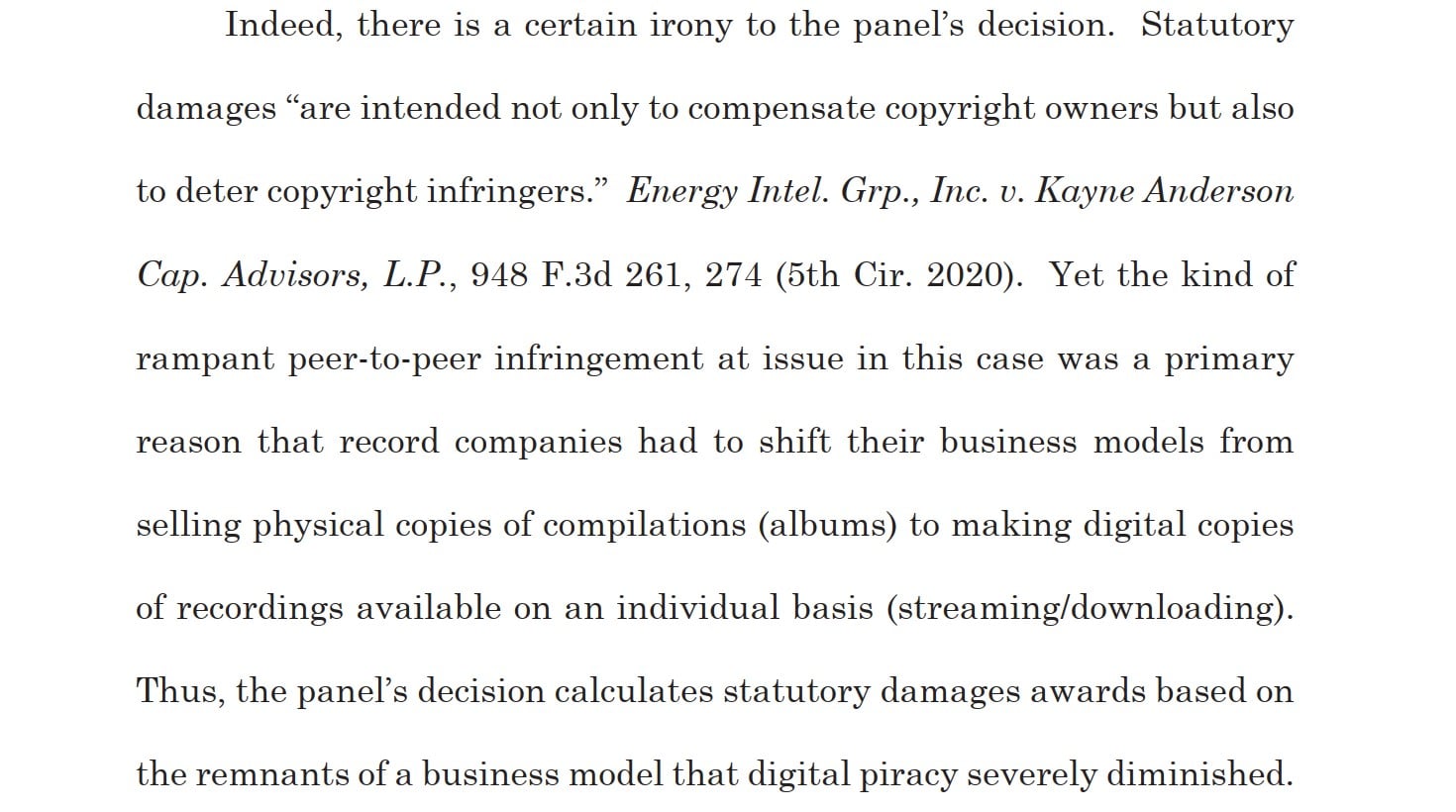
    The labels point out that there’s a certain irony in the Fifth Circuit’s decision. They note that rampant piracy was a primary reason the industry moved from selling physical albums to making individual downloads and streams available.

    This means that statutory damages, which are supposed to compensate copyright owners and deter infringers, are based on the old “album” model, which has been disrupted by online piracy.

    “Thus, the panel’s decision calculates statutory damages awards based on the remnants of a business model that digital piracy severely diminished,” the petition reads.

    irony

    One Work?

    In addition to the independent economic value test, the labels disagree with the court’s interpretation of Section 504(c)(1) of the Copyright Act, which states that all parts of a compilation constitute one work.

    The Fifth Circuit held that albums are compilations, which should therefore be seen as a single work. However, the labels believe that this narrow interpretation only applies if the alleged copyright infringement is an album.

    In this case, the labels alleged infringements of individual songs, not albums. Therefore, it should be appropriate to calculate damages per song, they argue.

    “Thus, the panel’s rule serves no purpose other than to punish copyright owners for their decision to include their standalone works on compilations in addition to commercializing them individually,” the labels write.

    This present lawsuit is based on alleged BitTorrent downloads. It’s not immediately clear whether these were only torrents for individual songs. However, the labels seem to suggest this is the case.

    All in all, the music companies argue that there is sufficient reason for a rehearing. If the current verdict stands it will significantly harm their ability to combat rampant online piracy, they conclude.

    A copy of the petition for a rehearing en banc, which was submitted at the Fifth Circuit Court of Appeals last week, is available here (pdf) .

    From: TF , for the latest news on copyright battles, piracy and more.

    • To chevron_right

      Per-Song or Per-Album? Record Labels Challenge Court’s Piracy Damages Ruling

      news.movim.eu / TorrentFreak • 11 November 2024 • 3 minutes

    vinyl In late 2022, several of the world’s largest music companies including UMG, Warner and Sony Music prevailed in their lawsuit against Internet provider Grande Communications.

    The record labels accused the Astound-owned ISP of not doing enough to stop pirating subscribers. Specifically, they alleged that the company failed to terminate repeat infringers.

    The trial lasted more than two weeks and ended in a resounding victory for the labels. A Texas federal jury found Grande guilty of willful contributory copyright infringement, and the ISP was ordered to pay $47 million in damages to the record labels.

    $47 Million Appeal

    Grande was unhappy with the verdict and appealed. Internet providers shouldn’t be held liable for pirating customers based on third-party allegations, the company noted. This appeal was supported by several telecoms organizations which agreed that terminating accounts of suspected pirates is a drastic and overbroad remedy.

    In addition to the liability aspect, Grande also protested the damages calculations. The jury calculated the damages per song, instead of per album, which is the wrong interpretation of U.S. law according to the ISP.

    Last month, the Fifth Circuit Court of Appeals handed down a mixed order . The court confirmed that the ISP is liable for copyright infringement but upheld its concerns over damages. A new trial was issued to establish the lower damages award, on a per-album basis.

    The Court agreed that, in this instance, awarding statutory damages on a per-song basis “would make a total mockery” of Congress’ mandate. If rightsholders would like this to change, they should ask Congress to change the law.

    Record Labels Want Rehearing

    UMG, Warner, Sony and the other labels agree with the finding on liability but object to the damages calculation since this substantially lowers the $47m award.

    Last week, they filed a petition for a rehearing en banc . They argue that the Fifth Circuit’s decision on the damages’ calculation is too narrow.

    The labels note that each song that was infringed is its own “work” under the Copyright Act, and that they are entitled to damages for each individual song.

    Their argument is based on the “independent economic value” test, which asks whether the unit of expression has “independent economic value” to the copyright owner. If it does, then the copyright owner is entitled to statutory damages for the infringement of each copyrightable unit of expression.

    In this case, songs can have individual value, whether they are part of an album or not. This notion is supported by the fact that most music is consumed via digital streaming platforms, which provide access to individual songs.

    “In the digital era, streaming is the primary source of revenue and necessarily involves the commercialization of individual recordings,” the labels write.

    Piracy Changed the Music Biz

    The labels point out that there’s a certain irony in the Fifth Circuit’s decision. They note that rampant piracy was a primary reason the industry moved from selling physical albums to making individual downloads and streams available.

    This means that statutory damages, which are supposed to compensate copyright owners and deter infringers, are based on the old “album” model, which has been disrupted by online piracy.

    “Thus, the panel’s decision calculates statutory damages awards based on the remnants of a business model that digital piracy severely diminished,” the petition reads.

    irony

    One Work?

    In addition to the independent economic value test, the labels disagree with the court’s interpretation of Section 504(c)(1) of the Copyright Act, which states that all parts of a compilation constitute one work.

    The Fifth Circuit held that albums are compilations, which should therefore be seen as a single work. However, the labels believe that this narrow interpretation only applies if the alleged copyright infringement is an album.

    In this case, the labels alleged infringements of individual songs, not albums. Therefore, it should be appropriate to calculate damages per song, they argue.

    “Thus, the panel’s rule serves no purpose other than to punish copyright owners for their decision to include their standalone works on compilations in addition to commercializing them individually,” the labels write.

    This present lawsuit is based on alleged BitTorrent downloads. It’s not immediately clear whether these were only torrents for individual songs. However, the labels seem to suggest this is the case.

    All in all, the music companies argue that there is sufficient reason for a rehearing. If the current verdict stands it will significantly harm their ability to combat rampant online piracy, they conclude.

    A copy of the petition for a rehearing en banc, which was submitted at the Fifth Circuit Court of Appeals last week, is available here (pdf) .

    From: TF , for the latest news on copyright battles, piracy and more.

    • To chevron_right

      Per-Song or Per-Album? Record Labels Challenge Court’s Piracy Damages Ruling

      news.movim.eu / TorrentFreak • 11 November 2024 • 3 minutes

    vinyl In late 2022, several of the world’s largest music companies including UMG, Warner and Sony Music prevailed in their lawsuit against Internet provider Grande Communications.

    The record labels accused the Astound-owned ISP of not doing enough to stop pirating subscribers. Specifically, they alleged that the company failed to terminate repeat infringers.

    The trial lasted more than two weeks and ended in a resounding victory for the labels. A Texas federal jury found Grande guilty of willful contributory copyright infringement, and the ISP was ordered to pay $47 million in damages to the record labels.

    $47 Million Appeal

    Grande was unhappy with the verdict and appealed. Internet providers shouldn’t be held liable for pirating customers based on third-party allegations, the company noted. This appeal was supported by several telecoms organizations which agreed that terminating accounts of suspected pirates is a drastic and overbroad remedy.

    In addition to the liability aspect, Grande also protested the damages calculations. The jury calculated the damages per song, instead of per album, which is the wrong interpretation of U.S. law according to the ISP.

    Last month, the Fifth Circuit Court of Appeals handed down a mixed order . The court confirmed that the ISP is liable for copyright infringement but upheld its concerns over damages. A new trial was issued to establish the lower damages award, on a per-album basis.

    The Court agreed that, in this instance, awarding statutory damages on a per-song basis “would make a total mockery” of Congress’ mandate. If rightsholders would like this to change, they should ask Congress to change the law.

    Record Labels Want Rehearing

    UMG, Warner, Sony and the other labels agree with the finding on liability but object to the damages calculation since this substantially lowers the $47m award.

    Last week, they filed a petition for a rehearing en banc . They argue that the Fifth Circuit’s decision on the damages’ calculation is too narrow.

    The labels note that each song that was infringed is its own “work” under the Copyright Act, and that they are entitled to damages for each individual song.

    Their argument is based on the “independent economic value” test, which asks whether the unit of expression has “independent economic value” to the copyright owner. If it does, then the copyright owner is entitled to statutory damages for the infringement of each copyrightable unit of expression.

    In this case, songs can have individual value, whether they are part of an album or not. This notion is supported by the fact that most music is consumed via digital streaming platforms, which provide access to individual songs.

    “In the digital era, streaming is the primary source of revenue and necessarily involves the commercialization of individual recordings,” the labels write.

    Piracy Changed the Music Biz

    The labels point out that there’s a certain irony in the Fifth Circuit’s decision. They note that rampant piracy was a primary reason the industry moved from selling physical albums to making individual downloads and streams available.

    This means that statutory damages, which are supposed to compensate copyright owners and deter infringers, are based on the old “album” model, which has been disrupted by online piracy.

    “Thus, the panel’s decision calculates statutory damages awards based on the remnants of a business model that digital piracy severely diminished,” the petition reads.

    irony

    One Work?

    In addition to the independent economic value test, the labels disagree with the court’s interpretation of Section 504(c)(1) of the Copyright Act, which states that all parts of a compilation constitute one work.

    The Fifth Circuit held that albums are compilations, which should therefore be seen as a single work. However, the labels believe that this narrow interpretation only applies if the alleged copyright infringement is an album.

    In this case, the labels alleged infringements of individual songs, not albums. Therefore, it should be appropriate to calculate damages per song, they argue.

    “Thus, the panel’s rule serves no purpose other than to punish copyright owners for their decision to include their standalone works on compilations in addition to commercializing them individually,” the labels write.

    This present lawsuit is based on alleged BitTorrent downloads. It’s not immediately clear whether these were only torrents for individual songs. However, the labels seem to suggest this is the case.

    All in all, the music companies argue that there is sufficient reason for a rehearing. If the current verdict stands it will significantly harm their ability to combat rampant online piracy, they conclude.

    A copy of the petition for a rehearing en banc, which was submitted at the Fifth Circuit Court of Appeals last week, is available here (pdf) .

    From: TF , for the latest news on copyright battles, piracy and more.

    • To chevron_right

      DAZN’s Piracy Shield ‘Smart TV’ Block Revoked After IPTV Portal Complaint

      news.movim.eu / TorrentFreak • 11 November 2024 • 6 minutes

    piracy-shield-planet-s While judicial oversight may be initially unavoidable when site-blocking is first introduced to a country, systems with less friction are strongly preferred.

    The law that supports Italy’s Piracy Shield system allows for blocking with no judicial oversight. An amendment passed quietly last year now allows rightsholders to block online resources without any input from telecoms regulator AGCOM. The system has almost no friction at the blocking stage. That comes at the cost of significant blunders, which could been prevented by proper checks and balances.

    Details of a complaint alleging more unwarranted blocking reveal an unusual situation where the interpretation of new law and its blocking boundaries appear to be determined by rightsholders alone. There’s no case law to provide guidance and any complaints are handled at a significantly slower pace than initial blocking takes place.

    DAZN Files Complaint Against Smart TV Software

    DAZN added https://tizen.smartone-iptv.com and https://lg.smartone-iptv.com to the Piracy Shield blocking platform on August 18, rendering both inaccessible in Italy. This action is based on assertions that the domains were violating its Serie A football broadcasting rights.

    According to AGCOM, DAZN’s evidence was supported by a declaration that the reported domain names are “unequivocally intended for the violation of copyright or related rights of audiovisual works,” including sporting events broadcast live.

    The regulator’s report clearly states that DAZN’s declaration was provided “under its own responsibility.” On face value that seems to indicate that no other entity is responsible when things go wrong.

    SmartOne Files Objection

    After being placed on the system, Italian ISPs blocked both resources. Two days later, on August 20, SmartOne filed a formal complaint with AGCOM to protest the blocking. An excerpt of that correspondence, translated but otherwise ‘as-is’, reads as follows;

    The domains (DNS) belong to a Smart TV application, it’s a player and entertainment application agreed and approved by so many TV manufacturers like Samsung, LG, Hisense, Toshiba, VIDAA OS and so many others.

    We don’t sell any contents and IPTV data, our domain includes the IPTV word and might cause confusion for so many parties, but we can provide any info or proof to show that we don’t offer any piracy contents or illegal contents. We hereby request to remove our domains from the block system: tizen.smartone-iptv.com, lg.smartone-iptv.com, and any other domain related to smartone- iptv.com […]

    The subdomains in the two fully qualified domain names (FQDNs) supplied by DAZN suggest that each brand is allocated its own subdomain.

    We can confirm that the subdomains androidtv, webos, foxxum, vestel and others also exist, indicating a typical setup for an app catering for different technical requirements on a per-manufacturer basis. Those FQDN subdomains are not blocked.

    smartone-tv

    In its report responding to the complaint, AGCOM refers again to DAZN’s evidence, which clearly states content being made available, in violation of DAZN’s rights.

    DAZN Insists SmartOne is a Pirate IPTV Service

    “From the checks carried out on the domain names reported through the relevant documentation attached by the reporting party, it appeared that the live broadcast of the matches of the Italian Serie A football championship were made available in violation of articles 1, paragraph 1, 12, 13, 16 and 78-bis, 78-ter, of the aforementioned law no 633/41 ,” AGCOM explains.

    On September 2, 2024, SmartOne sent counter-arguments to AGCOM for use in the complaint procedure.

    “We do not provide any content or transfer any matches or videos that are owned by any other company such as ‘Dazn’ or ‘la Società’ claims, the content operated on the program is under the user’s responsibility,” the communication reads.

    “The links https:// tizen.smartone-iptv.com and https:// lg.smartone-iptv.com are links that contain some program operating files and do not contain any link to broadcasts of the Italian League, and we are ready to provide any other clarifications or other information.”

    Nevertheless, DAZN had made its position clear and in its counter-arguments, refused to concede even an inch.

    “These FQDNs were found to be linked to IP addresses that we reported for suspicious activity. Forensic analysis […] confirmed that the detected IP addresses are unique and directly linked to the illicit IPTV broadcasts,” DAZN said in its response.

    “It is important to underline that, although Smartone-IPTV may initially appear as a simple generic player, the evidence collected and uploaded to the Piracy Shield Platform clearly indicates that it plays not only a Player role, but also an active role in the distribution of abusive content.”

    Domains Play ‘Active Role’

    Our checks on an unofficial Piracy Shield database revealed that both FQDNs were added to the blocklist on August 18, 2024, around 18:40. In both cases the main domain (smartone-iptv.com) operates via Cloudflare IP addresses, but the subdomains do not.

    smartone-1

    Each subdomain has its own IP address at hosting provider Hetzner Online which link to other domains, each with a reference to LG/Tizen. As DAZN points out, the IP addresses used are indeed unique.

    What “active role” they play in the distribution of ‘abusive’ content isn’t immediately clear but neither the IP addresses nor the domains were put on the Piracy Shield blocklist. Why that’s the case given the role they allegedly play only makes things even more unusual.

    AGCOM Considers Evidence and Renders its Decision

    AGCOM’s summing up of DAZN’s evidence and what that means for the complaint is a bit of a rollercoaster; it begins with good news for SmartOne, then cites information that suggests suspicion of illicit activity, but without sufficient confidence to act accordingly.

    The SmartOne IPTV application does not provide pre-configured streaming video content lists, but these must be uploaded by users. In particular, SmartOne IPTV implements the ‘Upload playlist’ functionality via the web with which it is possible to create lists of content and distribute them to specifically accredited SmartOne users.

    That said, the activity generally carried out by SmartOne IPTV appears to consist in a service for making available an application that allows access to IPTV channels uploaded by users, as well as making available a web control panel to manage the distribution of playlists and the related users associated with it.

    However, in this case, through the reported FQDNs, SmartOne IPTV has made available its own FQDNs tizen.smartone-iptv.com and lg.smartone-iptv.com to allow access to its server and, through the next part of the address (which determines the complete URL), to access other servers with a presumed role of gateway to illegal IPTV, enabling access to the illegal content present on a third-party server.

    Despite these allegations, AGCOM says that there’s no evidence to show that SmartOne is directly responsible for the illicit streams DAZN highlighted in its declaration.

    “In fact, the IP source of the illegal video streaming traffic, as it appears in the report, is not directly attributable to the smartone-iptv.com domain but corresponds to companies that manage gateway services, as shown by the reverse DNS query,” AGCOM notes.

    “Considering that the company SmartOne IPTV, although having, through the reported FQDNs, enabled access to illegal content present on third-party servers, does not originate said content through its own servers.”

    With that, AGCOM accepted SmartOne’s complaint of August 20 and revoked the blocking orders against tizen.smartone-iptv.com and lg.smartone-iptv.com.

    A Big Win With a Bigger Caveat

    After finding no evidence to directly link SmartOne with the illegal streams mentioned in DAZN’s declaration, to the extent that the blocking measures were revoked, AGCOM’s decision has a sting in the tail for SmartOne.

    Regardless of whether SmartOne customers load their own playlists, it must now implement proactive measures to ensure that content owned by DAZN isn’t accessed by end users of its platform, ever again.

    smartone-warning

    Given that any of SmartOne’s users can choose to upload an IPTV playlist providing access to DAZN content, it may mean that compliance can only be achieved by preventing all users – not just Italians – from using its service, period.

    AGCOM’s decision can be appealed at the Lazio Regional Court but whether SmartOne will do so is currently unknown.

    AGCOM’s decision (110/24/CSP) is available here (pdf)

    From: TF , for the latest news on copyright battles, piracy and more.

    • To chevron_right

      DAZN’s Piracy Shield ‘Smart TV’ Block Revoked After IPTV Portal Complaint

      news.movim.eu / TorrentFreak • 11 November 2024 • 6 minutes

    piracy-shield-planet-s While judicial oversight may be initially unavoidable when site-blocking is first introduced to a country, systems with less friction are strongly preferred.

    The law that supports Italy’s Piracy Shield system allows for blocking with no judicial oversight. An amendment passed quietly last year now allows rightsholders to block online resources without any input from telecoms regulator AGCOM. The system has almost no friction at the blocking stage. That comes at the cost of significant blunders, which could been prevented by proper checks and balances.

    Details of a complaint alleging more unwarranted blocking reveal an unusual situation where the interpretation of new law and its blocking boundaries appear to be determined by rightsholders alone. There’s no case law to provide guidance and any complaints are handled at a significantly slower pace than initial blocking takes place.

    DAZN Files Complaint Against Smart TV Software

    DAZN added https://tizen.smartone-iptv.com and https://lg.smartone-iptv.com to the Piracy Shield blocking platform on August 18, rendering both inaccessible in Italy. This action is based on assertions that the domains were violating its Serie A football broadcasting rights.

    According to AGCOM, DAZN’s evidence was supported by a declaration that the reported domain names are “unequivocally intended for the violation of copyright or related rights of audiovisual works,” including sporting events broadcast live.

    The regulator’s report clearly states that DAZN’s declaration was provided “under its own responsibility.” On face value that seems to indicate that no other entity is responsible when things go wrong.

    SmartOne Files Objection

    After being placed on the system, Italian ISPs blocked both resources. Two days later, on August 20, SmartOne filed a formal complaint with AGCOM to protest the blocking. An excerpt of that correspondence, translated but otherwise ‘as-is’, reads as follows;

    The domains (DNS) belong to a Smart TV application, it’s a player and entertainment application agreed and approved by so many TV manufacturers like Samsung, LG, Hisense, Toshiba, VIDAA OS and so many others.

    We don’t sell any contents and IPTV data, our domain includes the IPTV word and might cause confusion for so many parties, but we can provide any info or proof to show that we don’t offer any piracy contents or illegal contents. We hereby request to remove our domains from the block system: tizen.smartone-iptv.com, lg.smartone-iptv.com, and any other domain related to smartone- iptv.com […]

    The subdomains in the two fully qualified domain names (FQDNs) supplied by DAZN suggest that each brand is allocated its own subdomain.

    We can confirm that the subdomains androidtv, webos, foxxum, vestel and others also exist, indicating a typical setup for an app catering for different technical requirements on a per-manufacturer basis. Those FQDN subdomains are not blocked.

    smartone-tv

    In its report responding to the complaint, AGCOM refers again to DAZN’s evidence, which clearly states content being made available, in violation of DAZN’s rights.

    DAZN Insists SmartOne is a Pirate IPTV Service

    “From the checks carried out on the domain names reported through the relevant documentation attached by the reporting party, it appeared that the live broadcast of the matches of the Italian Serie A football championship were made available in violation of articles 1, paragraph 1, 12, 13, 16 and 78-bis, 78-ter, of the aforementioned law no 633/41 ,” AGCOM explains.

    On September 2, 2024, SmartOne sent counter-arguments to AGCOM for use in the complaint procedure.

    “We do not provide any content or transfer any matches or videos that are owned by any other company such as ‘Dazn’ or ‘la Società’ claims, the content operated on the program is under the user’s responsibility,” the communication reads.

    “The links https:// tizen.smartone-iptv.com and https:// lg.smartone-iptv.com are links that contain some program operating files and do not contain any link to broadcasts of the Italian League, and we are ready to provide any other clarifications or other information.”

    Nevertheless, DAZN had made its position clear and in its counter-arguments, refused to concede even an inch.

    “These FQDNs were found to be linked to IP addresses that we reported for suspicious activity. Forensic analysis […] confirmed that the detected IP addresses are unique and directly linked to the illicit IPTV broadcasts,” DAZN said in its response.

    “It is important to underline that, although Smartone-IPTV may initially appear as a simple generic player, the evidence collected and uploaded to the Piracy Shield Platform clearly indicates that it plays not only a Player role, but also an active role in the distribution of abusive content.”

    Domains Play ‘Active Role’

    Our checks on an unofficial Piracy Shield database revealed that both FQDNs were added to the blocklist on August 18, 2024, around 18:40. In both cases the main domain (smartone-iptv.com) operates via Cloudflare IP addresses, but the subdomains do not.

    smartone-1

    Each subdomain has its own IP address at hosting provider Hetzner Online which link to other domains, each with a reference to LG/Tizen. As DAZN points out, the IP addresses used are indeed unique.

    What “active role” they play in the distribution of ‘abusive’ content isn’t immediately clear but neither the IP addresses nor the domains were put on the Piracy Shield blocklist. Why that’s the case given the role they allegedly play only makes things even more unusual.

    AGCOM Considers Evidence and Renders its Decision

    AGCOM’s summing up of DAZN’s evidence and what that means for the complaint is a bit of a rollercoaster; it begins with good news for SmartOne, then cites information that suggests suspicion of illicit activity, but without sufficient confidence to act accordingly.

    The SmartOne IPTV application does not provide pre-configured streaming video content lists, but these must be uploaded by users. In particular, SmartOne IPTV implements the ‘Upload playlist’ functionality via the web with which it is possible to create lists of content and distribute them to specifically accredited SmartOne users.

    That said, the activity generally carried out by SmartOne IPTV appears to consist in a service for making available an application that allows access to IPTV channels uploaded by users, as well as making available a web control panel to manage the distribution of playlists and the related users associated with it.

    However, in this case, through the reported FQDNs, SmartOne IPTV has made available its own FQDNs tizen.smartone-iptv.com and lg.smartone-iptv.com to allow access to its server and, through the next part of the address (which determines the complete URL), to access other servers with a presumed role of gateway to illegal IPTV, enabling access to the illegal content present on a third-party server.

    Despite these allegations, AGCOM says that there’s no evidence to show that SmartOne is directly responsible for the illicit streams DAZN highlighted in its declaration.

    “In fact, the IP source of the illegal video streaming traffic, as it appears in the report, is not directly attributable to the smartone-iptv.com domain but corresponds to companies that manage gateway services, as shown by the reverse DNS query,” AGCOM notes.

    “Considering that the company SmartOne IPTV, although having, through the reported FQDNs, enabled access to illegal content present on third-party servers, does not originate said content through its own servers.”

    With that, AGCOM accepted SmartOne’s complaint of August 20 and revoked the blocking orders against tizen.smartone-iptv.com and lg.smartone-iptv.com.

    A Big Win With a Bigger Caveat

    After finding no evidence to directly link SmartOne with the illegal streams mentioned in DAZN’s declaration, to the extent that the blocking measures were revoked, AGCOM’s decision has a sting in the tail for SmartOne.

    Regardless of whether SmartOne customers load their own playlists, it must now implement proactive measures to ensure that content owned by DAZN isn’t accessed by end users of its platform, ever again.

    smartone-warning

    Given that any of SmartOne’s users can choose to upload an IPTV playlist providing access to DAZN content, it may mean that compliance can only be achieved by preventing all users – not just Italians – from using its service, period.

    AGCOM’s decision can be appealed at the Lazio Regional Court but whether SmartOne will do so is currently unknown.

    AGCOM’s decision (110/24/CSP) is available here (pdf)

    From: TF , for the latest news on copyright battles, piracy and more.

    • To chevron_right

      DAZN’s Piracy Shield ‘Smart TV’ Block Revoked After IPTV Portal Complaint

      news.movim.eu / TorrentFreak • 11 November 2024 • 6 minutes

    piracy-shield-planet-s While judicial oversight may be initially unavoidable when site-blocking is first introduced to a country, systems with less friction are strongly preferred.

    The law that supports Italy’s Piracy Shield system allows for blocking with no judicial oversight. An amendment passed quietly last year now allows rightsholders to block online resources without any input from telecoms regulator AGCOM. The system has almost no friction at the blocking stage. That comes at the cost of significant blunders, which could been prevented by proper checks and balances.

    Details of a complaint alleging more unwarranted blocking reveal an unusual situation where the interpretation of new law and its blocking boundaries appear to be determined by rightsholders alone. There’s no case law to provide guidance and any complaints are handled at a significantly slower pace than initial blocking takes place.

    DAZN Files Complaint Against Smart TV Software

    DAZN added https://tizen.smartone-iptv.com and https://lg.smartone-iptv.com to the Piracy Shield blocking platform on August 18, rendering both inaccessible in Italy. This action is based on assertions that the domains were violating its Serie A football broadcasting rights.

    According to AGCOM, DAZN’s evidence was supported by a declaration that the reported domain names are “unequivocally intended for the violation of copyright or related rights of audiovisual works,” including sporting events broadcast live.

    The regulator’s report clearly states that DAZN’s declaration was provided “under its own responsibility.” On face value that seems to indicate that no other entity is responsible when things go wrong.

    SmartOne Files Objection

    After being placed on the system, Italian ISPs blocked both resources. Two days later, on August 20, SmartOne filed a formal complaint with AGCOM to protest the blocking. An excerpt of that correspondence, translated but otherwise ‘as-is’, reads as follows;

    The domains (DNS) belong to a Smart TV application, it’s a player and entertainment application agreed and approved by so many TV manufacturers like Samsung, LG, Hisense, Toshiba, VIDAA OS and so many others.

    We don’t sell any contents and IPTV data, our domain includes the IPTV word and might cause confusion for so many parties, but we can provide any info or proof to show that we don’t offer any piracy contents or illegal contents. We hereby request to remove our domains from the block system: tizen.smartone-iptv.com, lg.smartone-iptv.com, and any other domain related to smartone- iptv.com […]

    The subdomains in the two fully qualified domain names (FQDNs) supplied by DAZN suggest that each brand is allocated its own subdomain.

    We can confirm that the subdomains androidtv, webos, foxxum, vestel and others also exist, indicating a typical setup for an app catering for different technical requirements on a per-manufacturer basis. Those FQDN subdomains are not blocked.

    smartone-tv

    In its report responding to the complaint, AGCOM refers again to DAZN’s evidence, which clearly states content being made available, in violation of DAZN’s rights.

    DAZN Insists SmartOne is a Pirate IPTV Service

    “From the checks carried out on the domain names reported through the relevant documentation attached by the reporting party, it appeared that the live broadcast of the matches of the Italian Serie A football championship were made available in violation of articles 1, paragraph 1, 12, 13, 16 and 78-bis, 78-ter, of the aforementioned law no 633/41 ,” AGCOM explains.

    On September 2, 2024, SmartOne sent counter-arguments to AGCOM for use in the complaint procedure.

    “We do not provide any content or transfer any matches or videos that are owned by any other company such as ‘Dazn’ or ‘la Società’ claims, the content operated on the program is under the user’s responsibility,” the communication reads.

    “The links https:// tizen.smartone-iptv.com and https:// lg.smartone-iptv.com are links that contain some program operating files and do not contain any link to broadcasts of the Italian League, and we are ready to provide any other clarifications or other information.”

    Nevertheless, DAZN had made its position clear and in its counter-arguments, refused to concede even an inch.

    “These FQDNs were found to be linked to IP addresses that we reported for suspicious activity. Forensic analysis […] confirmed that the detected IP addresses are unique and directly linked to the illicit IPTV broadcasts,” DAZN said in its response.

    “It is important to underline that, although Smartone-IPTV may initially appear as a simple generic player, the evidence collected and uploaded to the Piracy Shield Platform clearly indicates that it plays not only a Player role, but also an active role in the distribution of abusive content.”

    Domains Play ‘Active Role’

    Our checks on an unofficial Piracy Shield database revealed that both FQDNs were added to the blocklist on August 18, 2024, around 18:40. In both cases the main domain (smartone-iptv.com) operates via Cloudflare IP addresses, but the subdomains do not.

    smartone-1

    Each subdomain has its own IP address at hosting provider Hetzner Online which link to other domains, each with a reference to LG/Tizen. As DAZN points out, the IP addresses used are indeed unique.

    What “active role” they play in the distribution of ‘abusive’ content isn’t immediately clear but neither the IP addresses nor the domains were put on the Piracy Shield blocklist. Why that’s the case given the role they allegedly play only makes things even more unusual.

    AGCOM Considers Evidence and Renders its Decision

    AGCOM’s summing up of DAZN’s evidence and what that means for the complaint is a bit of a rollercoaster; it begins with good news for SmartOne, then cites information that suggests suspicion of illicit activity, but without sufficient confidence to act accordingly.

    The SmartOne IPTV application does not provide pre-configured streaming video content lists, but these must be uploaded by users. In particular, SmartOne IPTV implements the ‘Upload playlist’ functionality via the web with which it is possible to create lists of content and distribute them to specifically accredited SmartOne users.

    That said, the activity generally carried out by SmartOne IPTV appears to consist in a service for making available an application that allows access to IPTV channels uploaded by users, as well as making available a web control panel to manage the distribution of playlists and the related users associated with it.

    However, in this case, through the reported FQDNs, SmartOne IPTV has made available its own FQDNs tizen.smartone-iptv.com and lg.smartone-iptv.com to allow access to its server and, through the next part of the address (which determines the complete URL), to access other servers with a presumed role of gateway to illegal IPTV, enabling access to the illegal content present on a third-party server.

    Despite these allegations, AGCOM says that there’s no evidence to show that SmartOne is directly responsible for the illicit streams DAZN highlighted in its declaration.

    “In fact, the IP source of the illegal video streaming traffic, as it appears in the report, is not directly attributable to the smartone-iptv.com domain but corresponds to companies that manage gateway services, as shown by the reverse DNS query,” AGCOM notes.

    “Considering that the company SmartOne IPTV, although having, through the reported FQDNs, enabled access to illegal content present on third-party servers, does not originate said content through its own servers.”

    With that, AGCOM accepted SmartOne’s complaint of August 20 and revoked the blocking orders against tizen.smartone-iptv.com and lg.smartone-iptv.com.

    A Big Win With a Bigger Caveat

    After finding no evidence to directly link SmartOne with the illegal streams mentioned in DAZN’s declaration, to the extent that the blocking measures were revoked, AGCOM’s decision has a sting in the tail for SmartOne.

    Regardless of whether SmartOne customers load their own playlists, it must now implement proactive measures to ensure that content owned by DAZN isn’t accessed by end users of its platform, ever again.

    smartone-warning

    Given that any of SmartOne’s users can choose to upload an IPTV playlist providing access to DAZN content, it may mean that compliance can only be achieved by preventing all users – not just Italians – from using its service, period.

    AGCOM’s decision can be appealed at the Lazio Regional Court but whether SmartOne will do so is currently unknown.

    AGCOM’s decision (110/24/CSP) is available here (pdf)

    From: TF , for the latest news on copyright battles, piracy and more.