• To chevron_right

      EFF Sides with Cox to Protect Piracy-Accused Internet Users from ‘Copyright Trolls’

      news.movim.eu / TorrentFreak • 9 January 2025 • 4 minutes
    efflogo In the early 2000s, the music industry took a stand against online piracy by going after tens of thousands of alleged pirates through U.S. courts.

    The RIAA tracked down IP addresses of suspected music pirates and requested corresponding DMCA subpoenas, hoping to link these addresses to subscribers’ contact details.

    This initially worked well. However, as the practice became more common ISPs began to object. They countered that DMCA subpoenas don’t apply to mere conduit providers. Appeal courts eventually agreed and effectively banned the practice decades ago.

    Rightsholders were still able to sue alleged pirates. However, instead of easily obtaining the identities through a relatively cheap DMCA subpoena procedure, they would have to file a full complaint in federal court, with full judicial oversight.

    ‘Copyright Trolls’

    This more cumbersome path was not ignored. In the late 2010s, waves of lawsuits were filed in U.S. courts targeting alleged BitTorrent ‘pirates’. The associated account holders were still identified through a subpoena but this time within a proper copyright action.

    This practice, which some refer to as ‘copyright trolling’, is still prevalent today. Every year, many thousands of copyright lawsuits are filed in the U.S. These are typically closed within months, often after an undisclosed settlement is reached with the defendants.

    Most of the cases against alleged pirates are now filed by a single adult entertainment company, Strike 3 Holdings . There are other companies that are interested in identifying pirates too but the relatively high filing fee for these lawsuits is seen as a roadblock.

    DMCA Subpoena Revival in Court

    To bypass these costs, some rightsholders have started to revive the DMCA subpoena shortcut . Drawing inspiration from the RIAA’s early efforts, they once again used the DMCA subpoena process to obtain the personal details of suspected copyright infringers.

    These recent DMCA subpoenas progressed quietly, and many were granted with little fanfare or pushback. That changed in 2023 when a Cox subscriber, suspected of pirating the movie Fall, filed an objection in court.

    The objection prompted Cox Communications to intervene. The Internet provider challenged the use of DMCA subpoenas, as detailed in DMCA §512(h). Similar to the earlier opposition against the RIAA’s attempts, the ISP argued that DMCA subpoenas don’t apply to mere conduit providers, as defined under § 512(a).

    Last year, a district court judge in Hawaii sided with Cox . The court ruled that DMCA subpoenas don’t apply to mere conduit services, but do apply to other providers that store or link to infringing content directly. As such, the movie companies’ request for a subpoena was denied.

    Movie Companies Appeal

    The movie companies, including Voltage Holdings, Millennium Funding and Capstone Studios were persistent. They filed a petition at the Ninth Circuit Court of Appeals , arguing that the district court’s interpretation of the DMCA was overly narrow.

    The movie studios argued that the district court’s decision relied on dated precedents, which don’t reflect the realities of the modern Internet. They countered that ISPs do play a role in facilitating piracy, even if indirectly, and should be subject to DMCA subpoenas.

    “A careful reading of the full text of 17 U.S.C. §512 leads to the unquestionable conclusion that Congress intended for DMCA subpoenas to apply to §512(a) service providers despite the contrary conclusions of Verizon and Charter,” their petition read.

    In December, Cox responded to these arguments at the Court of Appeal. According to the ISP, Congress clearly excluded ISPs from this legal DMCA subpoena ‘shortcut’.

    EFF Chimes in with ‘Troll’ Warning

    Cox is not the only one to stand up against the movie companies. The Electronic Frontier Foundation ( EFF ) recently filed an amicus curiae brief, urging the court to keep the status quo intact.

    Without naming names, EFF warns that allowing the DMCA subpoena route to identify ISP account holders will feed ‘copyright trolls’. They will see it as an easy route to obtain swift settlements, including those against innocent subscribers.

    Whether settlements are planned by the movie companies in this case is not clear, but EFF notes that classic copyright trolls would benefit from this cheap shortcut.

    “To achieve higher returns from settlements with less expense, practitioners of the copyright trolling business model have an incentive to pursue settlements from the ISP subscribers identified through subpoenas to ISPs, even where the subscriber is not necessarily the infringer,” EFF writes.

    EFF: Oversight is Key

    The precedents set in the RIAA vs. Verizon and Charter cases are key to protect these subscribers. They require rightsholders to file a proper lawsuit, instead of obtaining personal details through a simplified process.

    This oversight is important, EFF says, as in previous lawsuits filed via the proper route, courts have rejected subpoenas because there was no evidence that the infringing IP address was used by the person who paid the ISP bills.

    For example, in the Cobbler case , the Court of Appeal ruled that since several people can use the same Internet connection, rightsholders must present more than just an IP address to make their case. The DMCA subpoena procedure removes this check, EFF notes.

    “Breaking with the long-established precedents of Verizon and Charter by permitting copyright holders to issue §512(h) subpoenas to ISPs who simply transmit data would bypass an important mechanism of court oversight and invite more coercive settlement demands against internet subscribers,” EFF concludes.

    The Ninth Circuit Court of Appeals will now review the arguments before deciding how the DMCA should be interpreted. It’s clear that the stakes are significant for all parties involved.

    A copy of EFF’s amicus curiae brief , for which the paper versions were filed at the Ninth Circuit Court of Appeals on January 3, is available here (pdf) .

    From: TF , for the latest news on copyright battles, piracy and more.
    • To chevron_right

      EFF Sides with Cox to Protect Piracy-Accused Internet Users from ‘Copyright Trolls’

      news.movim.eu / TorrentFreak • 9 January 2025 • 4 minutes

    efflogo In the early 2000s, the music industry took a stand against online piracy by going after tens of thousands of alleged pirates through U.S. courts.

    The RIAA tracked down IP addresses of suspected music pirates and requested corresponding DMCA subpoenas, hoping to link these addresses to subscribers’ contact details.

    This initially worked well. However, as the practice became more common ISPs began to object. They countered that DMCA subpoenas don’t apply to mere conduit providers. Appeal courts eventually agreed and effectively banned the practice decades ago.

    Rightsholders were still able to sue alleged pirates. However, instead of easily obtaining the identities through a relatively cheap DMCA subpoena procedure, they would have to file a full complaint in federal court, with full judicial oversight.

    ‘Copyright Trolls’

    This more cumbersome path was not ignored. In the late 2010s, waves of lawsuits were filed in U.S. courts targeting alleged BitTorrent ‘pirates’. The associated account holders were still identified through a subpoena but this time within a proper copyright action.

    This practice, which some refer to as ‘copyright trolling’, is still prevalent today. Every year, many thousands of copyright lawsuits are filed in the U.S. These are typically closed within months, often after an undisclosed settlement is reached with the defendants.

    Most of the cases against alleged pirates are now filed by a single adult entertainment company, Strike 3 Holdings . There are other companies that are interested in identifying pirates too but the relatively high filing fee for these lawsuits is seen as a roadblock.

    DMCA Subpoena Revival in Court

    To bypass these costs, some rightsholders have started to revive the DMCA subpoena shortcut . Drawing inspiration from the RIAA’s early efforts, they once again used the DMCA subpoena process to obtain the personal details of suspected copyright infringers.

    These recent DMCA subpoenas progressed quietly, and many were granted with little fanfare or pushback. That changed in 2023 when a Cox subscriber, suspected of pirating the movie Fall, filed an objection in court.

    The objection prompted Cox Communications to intervene. The Internet provider challenged the use of DMCA subpoenas, as detailed in DMCA §512(h). Similar to the earlier opposition against the RIAA’s attempts, the ISP argued that DMCA subpoenas don’t apply to mere conduit providers, as defined under § 512(a).

    Last year, a district court judge in Hawaii sided with Cox . The court ruled that DMCA subpoenas don’t apply to mere conduit services, but do apply to other providers that store or link to infringing content directly. As such, the movie companies’ request for a subpoena was denied.

    Movie Companies Appeal

    The movie companies, including Voltage Holdings, Millennium Funding and Capstone Studios were persistent. They filed a petition at the Ninth Circuit Court of Appeals , arguing that the district court’s interpretation of the DMCA was overly narrow.

    The movie studios argued that the district court’s decision relied on dated precedents, which don’t reflect the realities of the modern Internet. They countered that ISPs do play a role in facilitating piracy, even if indirectly, and should be subject to DMCA subpoenas.

    “A careful reading of the full text of 17 U.S.C. §512 leads to the unquestionable conclusion that Congress intended for DMCA subpoenas to apply to §512(a) service providers despite the contrary conclusions of Verizon and Charter,” their petition read.

    In December, Cox responded to these arguments at the Court of Appeal. According to the ISP, Congress clearly excluded ISPs from this legal DMCA subpoena ‘shortcut’.

    EFF Chimes in with ‘Troll’ Warning

    Cox is not the only one to stand up against the movie companies. The Electronic Frontier Foundation ( EFF ) recently filed an amicus curiae brief, urging the court to keep the status quo intact.

    Without naming names, EFF warns that allowing the DMCA subpoena route to identify ISP account holders will feed ‘copyright trolls’. They will see it as an easy route to obtain swift settlements, including those against innocent subscribers.

    Whether settlements are planned by the movie companies in this case is not clear, but EFF notes that classic copyright trolls would benefit from this cheap shortcut.

    “To achieve higher returns from settlements with less expense, practitioners of the copyright trolling business model have an incentive to pursue settlements from the ISP subscribers identified through subpoenas to ISPs, even where the subscriber is not necessarily the infringer,” EFF writes.

    EFF: Oversight is Key

    The precedents set in the RIAA vs. Verizon and Charter cases are key to protect these subscribers. They require rightsholders to file a proper lawsuit, instead of obtaining personal details through a simplified process.

    This oversight is important, EFF says, as in previous lawsuits filed via the proper route, courts have rejected subpoenas because there was no evidence that the infringing IP address was used by the person who paid the ISP bills.

    For example, in the Cobbler case , the Court of Appeal ruled that since several people can use the same Internet connection, rightsholders must present more than just an IP address to make their case. The DMCA subpoena procedure removes this check, EFF notes.

    “Breaking with the long-established precedents of Verizon and Charter by permitting copyright holders to issue §512(h) subpoenas to ISPs who simply transmit data would bypass an important mechanism of court oversight and invite more coercive settlement demands against internet subscribers,” EFF concludes.

    The Ninth Circuit Court of Appeals will now review the arguments before deciding how the DMCA should be interpreted. It’s clear that the stakes are significant for all parties involved.

    A copy of EFF’s amicus curiae brief , for which the paper versions were filed at the Ninth Circuit Court of Appeals on January 3, is available here (pdf) .

    From: TF , for the latest news on copyright battles, piracy and more.

    • To chevron_right

      EFF Sides with Cox to Protect Piracy-Accused Internet Users from ‘Copyright Trolls’

      news.movim.eu / TorrentFreak • 9 January 2025 • 4 minutes

    efflogo In the early 2000s, the music industry took a stand against online piracy by going after tens of thousands of alleged pirates through U.S. courts.

    The RIAA tracked down IP addresses of suspected music pirates and requested corresponding DMCA subpoenas, hoping to link these addresses to subscribers’ contact details.

    This initially worked well. However, as the practice became more common ISPs began to object. They countered that DMCA subpoenas don’t apply to mere conduit providers. Appeal courts eventually agreed and effectively banned the practice decades ago.

    Rightsholders were still able to sue alleged pirates. However, instead of easily obtaining the identities through a relatively cheap DMCA subpoena procedure, they would have to file a full complaint in federal court, with full judicial oversight.

    ‘Copyright Trolls’

    This more cumbersome path was not ignored. In the late 2010s, waves of lawsuits were filed in U.S. courts targeting alleged BitTorrent ‘pirates’. The associated account holders were still identified through a subpoena but this time within a proper copyright action.

    This practice, which some refer to as ‘copyright trolling’, is still prevalent today. Every year, many thousands of copyright lawsuits are filed in the U.S. These are typically closed within months, often after an undisclosed settlement is reached with the defendants.

    Most of the cases against alleged pirates are now filed by a single adult entertainment company, Strike 3 Holdings . There are other companies that are interested in identifying pirates too but the relatively high filing fee for these lawsuits is seen as a roadblock.

    DMCA Subpoena Revival in Court

    To bypass these costs, some rightsholders have started to revive the DMCA subpoena shortcut . Drawing inspiration from the RIAA’s early efforts, they once again used the DMCA subpoena process to obtain the personal details of suspected copyright infringers.

    These recent DMCA subpoenas progressed quietly, and many were granted with little fanfare or pushback. That changed in 2023 when a Cox subscriber, suspected of pirating the movie Fall, filed an objection in court.

    The objection prompted Cox Communications to intervene. The Internet provider challenged the use of DMCA subpoenas, as detailed in DMCA §512(h). Similar to the earlier opposition against the RIAA’s attempts, the ISP argued that DMCA subpoenas don’t apply to mere conduit providers, as defined under § 512(a).

    Last year, a district court judge in Hawaii sided with Cox . The court ruled that DMCA subpoenas don’t apply to mere conduit services, but do apply to other providers that store or link to infringing content directly. As such, the movie companies’ request for a subpoena was denied.

    Movie Companies Appeal

    The movie companies, including Voltage Holdings, Millennium Funding and Capstone Studios were persistent. They filed a petition at the Ninth Circuit Court of Appeals , arguing that the district court’s interpretation of the DMCA was overly narrow.

    The movie studios argued that the district court’s decision relied on dated precedents, which don’t reflect the realities of the modern Internet. They countered that ISPs do play a role in facilitating piracy, even if indirectly, and should be subject to DMCA subpoenas.

    “A careful reading of the full text of 17 U.S.C. §512 leads to the unquestionable conclusion that Congress intended for DMCA subpoenas to apply to §512(a) service providers despite the contrary conclusions of Verizon and Charter,” their petition read.

    In December, Cox responded to these arguments at the Court of Appeal. According to the ISP, Congress clearly excluded ISPs from this legal DMCA subpoena ‘shortcut’.

    EFF Chimes in with ‘Troll’ Warning

    Cox is not the only one to stand up against the movie companies. The Electronic Frontier Foundation ( EFF ) recently filed an amicus curiae brief, urging the court to keep the status quo intact.

    Without naming names, EFF warns that allowing the DMCA subpoena route to identify ISP account holders will feed ‘copyright trolls’. They will see it as an easy route to obtain swift settlements, including those against innocent subscribers.

    Whether settlements are planned by the movie companies in this case is not clear, but EFF notes that classic copyright trolls would benefit from this cheap shortcut.

    “To achieve higher returns from settlements with less expense, practitioners of the copyright trolling business model have an incentive to pursue settlements from the ISP subscribers identified through subpoenas to ISPs, even where the subscriber is not necessarily the infringer,” EFF writes.

    EFF: Oversight is Key

    The precedents set in the RIAA vs. Verizon and Charter cases are key to protect these subscribers. They require rightsholders to file a proper lawsuit, instead of obtaining personal details through a simplified process.

    This oversight is important, EFF says, as in previous lawsuits filed via the proper route, courts have rejected subpoenas because there was no evidence that the infringing IP address was used by the person who paid the ISP bills.

    For example, in the Cobbler case , the Court of Appeal ruled that since several people can use the same Internet connection, rightsholders must present more than just an IP address to make their case. The DMCA subpoena procedure removes this check, EFF notes.

    “Breaking with the long-established precedents of Verizon and Charter by permitting copyright holders to issue §512(h) subpoenas to ISPs who simply transmit data would bypass an important mechanism of court oversight and invite more coercive settlement demands against internet subscribers,” EFF concludes.

    The Ninth Circuit Court of Appeals will now review the arguments before deciding how the DMCA should be interpreted. It’s clear that the stakes are significant for all parties involved.

    A copy of EFF’s amicus curiae brief , for which the paper versions were filed at the Ninth Circuit Court of Appeals on January 3, is available here (pdf) .

    From: TF , for the latest news on copyright battles, piracy and more.

    • To chevron_right

      U.S. Trade Representative Lists the Most Notorious Piracy Threats

      news.movim.eu / TorrentFreak • 8 January 2025 • 4 minutes

    notorious 2024 The United States Trade Representative ( USTR ) published its annual “Out-of-Cycle Review of Notorious Markets” a few hours ago.

    The non-exhaustive list includes dozens of sites and services linked to piracy or counterfeiting activity.

    The report is largely based on input from copyright industry groups, including the RIAA and MPA. Platforms detailed in recommendations filed late last year, are meant to serve as ‘prominent and illustrative examples’ without the USTR drawing any legal conclusions.

    Complex Ecosystem & Familiar Names

    The review acknowledges that rightsholders described a complex piracy ecosystem, one that goes beyond traditional websites with technology companies and services also playing a role. Those include domain registries and registrars, search engines, reverse proxies, payment processors, and hosting companies.

    Many third-party intermediaries were nominated in last year’s submissions but despite the mentions, the USTR hasn’t included many in its final overview. This will be welcomed by the i2Coalition , which previously cautioned against blurring the piracy lines.

    Overall, the latest list includes many familiar names, some of which have been listed for well over a decade. The Pirate Bay makes an expected appearance, alongside fellow torrent sites 1337x, TorrentGalaxy, RuTracker, and YTS.

    The listed torrent sites are identical to those listed in last year’s report. The same applies to ‘cyberlockers’, which include Krakenfiles and Rapidgator. The mentioned publishing sites, LibGen and Sci-Hub, didn’t change either.

    The e-commerce platforms also remain completely unchanged in the latest report. While the USTR sees some positive developments in this industry, Baidu Wangpan, DHgate, Pinduoduo, Shopee, and others remain listed.

    New Additions to the List

    There are some shakeups in the video game scene, however, with Fitgirl-Repacks and Unknowncheats as new additions. Both sites were flagged by the Entertainment Software Association (ESA) last October .

    “FitGirl-Repacks, often abbreviated to ‘fitgirl’ is a well-known ‘repacking’ site that provides access to compressed versions of unauthorized and pirated versions of video games,” the USTR notes.

    USTR about Fitgirl

    firgirl

    There’s also a new streamripper, Y2Mate, thanks to a nomination by the RIAA . The site replaces ssyoutube.com, which was taken off the list.

    The list of newcomers is completed by hosting provider Virtual Systems and two streaming services, MagisTV and Hianime. The latter replaces Aniwatch, which was taken down following the demise of the Fmovies piracy ring last summer.

    USTR Applauds Successes

    The Fmovies case is mentioned in detail by the USTR, described as one of the major piracy successes in 2024. This takedown was carried out by Vietnamese authorities, with key input from U.S. rightsholders and authorities.

    “In Vietnam, the Hanoi Police collaborated with U.S. Homeland Security Investigations (HSI), the U.S. Department of Justice (DOJ) International Computer Hacking and Intellectual Property (ICHIP) program, and the Alliance for Creativity and Entertainment (ACE) to shut down the site Fmovies and associated piracy sites in July and August 2024,” USTR notes.

    Other positive developments include the conviction of the operator of BestBuyIPTV in Vietnam, Brazil’s seventh installment of anti-piracy “Operation 404” , and the Italian-led IPTV crackdown “ Operation Taken Down “.

    Almost Success: Cuevana

    Finally, there is one site that deserves a special mention; Cuevana. This brand has been around for many years as new versions typically come online when others are taken offline.

    The USTR’s report now lists Cuevana.biza after being nominated by the movie industry. This is somewhat unusual, as the site announced a voluntary shutdown a few weeks ago, citing pressure from the MPA and ACE. Purportedly, Cuevana was offering to sign over its domain names.

    This shutdown never came to fruition, however. A message currently displayed on the site’s front page says that ACE merely sent an automated reply to Cuevana’s outreach, but didn’t respond otherwise. A follow-up reportedly remains unanswered too.

    “In the last message, we kindly asked for the information to be passed on to the person in charge, but they again have not responded to us,” Cuevana.biz writes.

    “I don’t know if the intention is to let us continue with the sites, but a week ago we should have already delivered one of the domains they requested..,” the site’s message adds.

    Message for the MPA

    Whether the message is sincere is hard to gauge. Technically, Cuevana could’ve put up a static page displaying this notice, instead of keeping the site running. But it’s worth pointing out anyway.

    Perhaps it will result in another ‘positive development’, which the USTR can highlight in next year’s version of the notorious markets report.

    A copy of the USTR’s 2024 Review of Notorious Markets is available here (pdf). The full overview also includes offline markets.

    A list of highlighted sites and online services, including those listed for counterfeiting, is included below. The sites mentioned are categorized by TorrentFreak for clarity purposes and listed below.

    Torrent Sites

    – 1337X
    – RuTracker
    – The Pirate Bay
    – TorrentGalaxy
    – YTS.mx

    File-Hosting/Cyberlockers

    – 1fichier
    – Krakenfiles
    – Rapidgator
    – Savefrom

    E-Commerce

    – Baidu Wangpan
    – Bukalapak
    – DHgate
    – Indiamart
    – Pinduoduo
    – Shopee
    – Taobao

    PaaS

    – 2embed
    – Streamtape
    – WHMCS Smarters

    Advertising

    – Avito

    Streaming /IPTV

    – Aniwatch
    – BestBuyIPTV
    – Cuevana3
    – Fmovies
    – GenIPTV
    Hianime (new)
    MagisTV (new)
    – Pelisplus
    – Shabakaty
    – Spider
    – VegaMovies

    Hosting/Infrastructure

    – Amaratu
    – DDoS-Guard
    – FlokiNET
    – Squitter
    Virtual Systems (new)

    Social Media

    – VK.
    – WeChat

    Gaming

    – NSW2U
    Firgirl-Repacks (new)
    Unknowncheats (new)

    Music

    – SSYouTube
    Y2Mate (new)

    Publishing

    – Libgen
    – Sci-Hub

    From: TF , for the latest news on copyright battles, piracy and more.

    • To chevron_right

      U.S. Trade Representative Lists the Most Notorious Piracy Threats

      news.movim.eu / TorrentFreak • 8 January 2025 • 4 minutes

    notorious 2024 The United States Trade Representative ( USTR ) published its annual “Out-of-Cycle Review of Notorious Markets” a few hours ago.

    The non-exhaustive list includes dozens of sites and services linked to piracy or counterfeiting activity.

    The report is largely based on input from copyright industry groups, including the RIAA and MPA. Platforms detailed in recommendations filed late last year, are meant to serve as ‘prominent and illustrative examples’ without the USTR drawing any legal conclusions.

    Complex Ecosystem & Familiar Names

    The review acknowledges that rightsholders described a complex piracy ecosystem, one that goes beyond traditional websites with technology companies and services also playing a role. Those include domain registries and registrars, search engines, reverse proxies, payment processors, and hosting companies.

    Many third-party intermediaries were nominated in last year’s submissions but despite the mentions, the USTR hasn’t included many in its final overview. This will be welcomed by the i2Coalition , which previously cautioned against blurring the piracy lines.

    Overall, the latest list includes many familiar names, some of which have been listed for well over a decade. The Pirate Bay makes an expected appearance, alongside fellow torrent sites 1337x, TorrentGalaxy, RuTracker, and YTS.

    The listed torrent sites are identical to those listed in last year’s report. The same applies to ‘cyberlockers’, which include Krakenfiles and Rapidgator. The mentioned publishing sites, LibGen and Sci-Hub, didn’t change either.

    The e-commerce platforms also remain completely unchanged in the latest report. While the USTR sees some positive developments in this industry, Baidu Wangpan, DHgate, Pinduoduo, Shopee, and others remain listed.

    New Additions to the List

    There are some shakeups in the video game scene, however, with Fitgirl-Repacks and Unknowncheats as new additions. Both sites were flagged by the Entertainment Software Association (ESA) last October .

    “FitGirl-Repacks, often abbreviated to ‘fitgirl’ is a well-known ‘repacking’ site that provides access to compressed versions of unauthorized and pirated versions of video games,” the USTR notes.

    USTR about Fitgirl

    firgirl

    There’s also a new streamripper, Y2Mate, thanks to a nomination by the RIAA . The site replaces ssyoutube.com, which was taken off the list.

    The list of newcomers is completed by hosting provider Virtual Systems and two streaming services, MagisTV and Hianime. The latter replaces Aniwatch, which was taken down following the demise of the Fmovies piracy ring last summer.

    USTR Applauds Successes

    The Fmovies case is mentioned in detail by the USTR, described as one of the major piracy successes in 2024. This takedown was carried out by Vietnamese authorities, with key input from U.S. rightsholders and authorities.

    “In Vietnam, the Hanoi Police collaborated with U.S. Homeland Security Investigations (HSI), the U.S. Department of Justice (DOJ) International Computer Hacking and Intellectual Property (ICHIP) program, and the Alliance for Creativity and Entertainment (ACE) to shut down the site Fmovies and associated piracy sites in July and August 2024,” USTR notes.

    Other positive developments include the conviction of the operator of BestBuyIPTV in Vietnam, Brazil’s seventh installment of anti-piracy “Operation 404” , and the Italian-led IPTV crackdown “ Operation Taken Down “.

    Almost Success: Cuevana

    Finally, there is one site that deserves a special mention; Cuevana. This brand has been around for many years as new versions typically come online when others are taken offline.

    The USTR’s report now lists Cuevana.biza after being nominated by the movie industry. This is somewhat unusual, as the site announced a voluntary shutdown a few weeks ago, citing pressure from the MPA and ACE. Purportedly, Cuevana was offering to sign over its domain names.

    This shutdown never came to fruition, however. A message currently displayed on the site’s front page says that ACE merely sent an automated reply to Cuevana’s outreach, but didn’t respond otherwise. A follow-up reportedly remains unanswered too.

    “In the last message, we kindly asked for the information to be passed on to the person in charge, but they again have not responded to us,” Cuevana.biz writes.

    “I don’t know if the intention is to let us continue with the sites, but a week ago we should have already delivered one of the domains they requested..,” the site’s message adds.

    Message for the MPA

    Whether the message is sincere is hard to gauge. Technically, Cuevana could’ve put up a static page displaying this notice, instead of keeping the site running. But it’s worth pointing out anyway.

    Perhaps it will result in another ‘positive development’, which the USTR can highlight in next year’s version of the notorious markets report.

    A copy of the USTR’s 2024 Review of Notorious Markets is available here (pdf). The full overview also includes offline markets.

    A list of highlighted sites and online services, including those listed for counterfeiting, is included below. The sites mentioned are categorized by TorrentFreak for clarity purposes and listed below.

    Torrent Sites

    – 1337X
    – RuTracker
    – The Pirate Bay
    – TorrentGalaxy
    – YTS.mx

    File-Hosting/Cyberlockers

    – 1fichier
    – Krakenfiles
    – Rapidgator
    – Savefrom

    E-Commerce

    – Baidu Wangpan
    – Bukalapak
    – DHgate
    – Indiamart
    – Pinduoduo
    – Shopee
    – Taobao

    PaaS

    – 2embed
    – Streamtape
    – WHMCS Smarters

    Advertising

    – Avito

    Streaming /IPTV

    – Aniwatch
    – BestBuyIPTV
    – Cuevana3
    – Fmovies
    – GenIPTV
    Hianime (new)
    MagisTV (new)
    – Pelisplus
    – Shabakaty
    – Spider
    – VegaMovies

    Hosting/Infrastructure

    – Amaratu
    – DDoS-Guard
    – FlokiNET
    – Squitter
    Virtual Systems (new)

    Social Media

    – VK.
    – WeChat

    Gaming

    – NSW2U
    Firgirl-Repacks (new)
    Unknowncheats (new)

    Music

    – SSYouTube
    Y2Mate (new)

    Publishing

    – Libgen
    – Sci-Hub

    From: TF , for the latest news on copyright battles, piracy and more.

    • To chevron_right

      U.S. Trade Representative Lists the Most Notorious Piracy Threats

      news.movim.eu / TorrentFreak • 8 January 2025 • 4 minutes

    notorious 2024 The United States Trade Representative ( USTR ) published its annual “Out-of-Cycle Review of Notorious Markets” a few hours ago.

    The non-exhaustive list includes dozens of sites and services linked to piracy or counterfeiting activity.

    The report is largely based on input from copyright industry groups, including the RIAA and MPA. Platforms detailed in recommendations filed late last year, are meant to serve as ‘prominent and illustrative examples’ without the USTR drawing any legal conclusions.

    Complex Ecosystem & Familiar Names

    The review acknowledges that rightsholders described a complex piracy ecosystem, one that goes beyond traditional websites with technology companies and services also playing a role. Those include domain registries and registrars, search engines, reverse proxies, payment processors, and hosting companies.

    Many third-party intermediaries were nominated in last year’s submissions but despite the mentions, the USTR hasn’t included many in its final overview. This will be welcomed by the i2Coalition , which previously cautioned against blurring the piracy lines.

    Overall, the latest list includes many familiar names, some of which have been listed for well over a decade. The Pirate Bay makes an expected appearance, alongside fellow torrent sites 1337x, TorrentGalaxy, RuTracker, and YTS.

    The listed torrent sites are identical to those listed in last year’s report. The same applies to ‘cyberlockers’, which include Krakenfiles and Rapidgator. The mentioned publishing sites, LibGen and Sci-Hub, didn’t change either.

    The e-commerce platforms also remain completely unchanged in the latest report. While the USTR sees some positive developments in this industry, Baidu Wangpan, DHgate, Pinduoduo, Shopee, and others remain listed.

    New Additions to the List

    There are some shakeups in the video game scene, however, with Fitgirl-Repacks and Unknowncheats as new additions. Both sites were flagged by the Entertainment Software Association (ESA) last October .

    “FitGirl-Repacks, often abbreviated to ‘fitgirl’ is a well-known ‘repacking’ site that provides access to compressed versions of unauthorized and pirated versions of video games,” the USTR notes.

    USTR about Fitgirl

    firgirl

    There’s also a new streamripper, Y2Mate, thanks to a nomination by the RIAA . The site replaces ssyoutube.com, which was taken off the list.

    The list of newcomers is completed by hosting provider Virtual Systems and two streaming services, MagisTV and Hianime. The latter replaces Aniwatch, which was taken down following the demise of the Fmovies piracy ring last summer.

    USTR Applauds Successes

    The Fmovies case is mentioned in detail by the USTR, described as one of the major piracy successes in 2024. This takedown was carried out by Vietnamese authorities, with key input from U.S. rightsholders and authorities.

    “In Vietnam, the Hanoi Police collaborated with U.S. Homeland Security Investigations (HSI), the U.S. Department of Justice (DOJ) International Computer Hacking and Intellectual Property (ICHIP) program, and the Alliance for Creativity and Entertainment (ACE) to shut down the site Fmovies and associated piracy sites in July and August 2024,” USTR notes.

    Other positive developments include the conviction of the operator of BestBuyIPTV in Vietnam, Brazil’s seventh installment of anti-piracy “Operation 404” , and the Italian-led IPTV crackdown “ Operation Taken Down “.

    Almost Success: Cuevana

    Finally, there is one site that deserves a special mention; Cuevana. This brand has been around for many years as new versions typically come online when others are taken offline.

    The USTR’s report now lists Cuevana.biza after being nominated by the movie industry. This is somewhat unusual, as the site announced a voluntary shutdown a few weeks ago, citing pressure from the MPA and ACE. Purportedly, Cuevana was offering to sign over its domain names.

    This shutdown never came to fruition, however. A message currently displayed on the site’s front page says that ACE merely sent an automated reply to Cuevana’s outreach, but didn’t respond otherwise. A follow-up reportedly remains unanswered too.

    “In the last message, we kindly asked for the information to be passed on to the person in charge, but they again have not responded to us,” Cuevana.biz writes.

    “I don’t know if the intention is to let us continue with the sites, but a week ago we should have already delivered one of the domains they requested..,” the site’s message adds.

    Message for the MPA

    Whether the message is sincere is hard to gauge. Technically, Cuevana could’ve put up a static page displaying this notice, instead of keeping the site running. But it’s worth pointing out anyway.

    Perhaps it will result in another ‘positive development’, which the USTR can highlight in next year’s version of the notorious markets report.

    A copy of the USTR’s 2024 Review of Notorious Markets is available here (pdf). The full overview also includes offline markets.

    A list of highlighted sites and online services, including those listed for counterfeiting, is included below. The sites mentioned are categorized by TorrentFreak for clarity purposes and listed below.

    Torrent Sites

    – 1337X
    – RuTracker
    – The Pirate Bay
    – TorrentGalaxy
    – YTS.mx

    File-Hosting/Cyberlockers

    – 1fichier
    – Krakenfiles
    – Rapidgator
    – Savefrom

    E-Commerce

    – Baidu Wangpan
    – Bukalapak
    – DHgate
    – Indiamart
    – Pinduoduo
    – Shopee
    – Taobao

    PaaS

    – 2embed
    – Streamtape
    – WHMCS Smarters

    Advertising

    – Avito

    Streaming /IPTV

    – Aniwatch
    – BestBuyIPTV
    – Cuevana3
    – Fmovies
    – GenIPTV
    Hianime (new)
    MagisTV (new)
    – Pelisplus
    – Shabakaty
    – Spider
    – VegaMovies

    Hosting/Infrastructure

    – Amaratu
    – DDoS-Guard
    – FlokiNET
    – Squitter
    Virtual Systems (new)

    Social Media

    – VK.
    – WeChat

    Gaming

    – NSW2U
    Firgirl-Repacks (new)
    Unknowncheats (new)

    Music

    – SSYouTube
    Y2Mate (new)

    Publishing

    – Libgen
    – Sci-Hub

    From: TF , for the latest news on copyright battles, piracy and more.

    • To chevron_right

      Google Deindexes 200 Streaming Sites For Violating EU Sanctions on Russia

      news.movim.eu / TorrentFreak • 8 January 2025 • 3 minutes

    propaganda-1s The adage that the first casualty of war is the truth held solid as Russia denied any intention of invading Ukraine, even as it was actively doing so.
    State-controlled media, television presenters in particular, turned in some remarkable performances for the benefit of local audiences. While dramatically documenting events that bore only a passing resemblance to reality on the ground, broadcasters including Russia Today, Sputnik, and RIA Novosti, ensured that Russia’s position on Ukraine was presented overseas exactly as the Kremlin intended.

    After quickly running out of patience, the EU banned all three broadcasters and many others ( list ) from transmitting from or to any EU member state, using any technical means. Whether by cable, satellite, websites or IPTV, the ban applied across the board to prevent (or at least limit) the spread of what the EU described as disinformation and propaganda.

    Lithuania Saw Room For Improvement

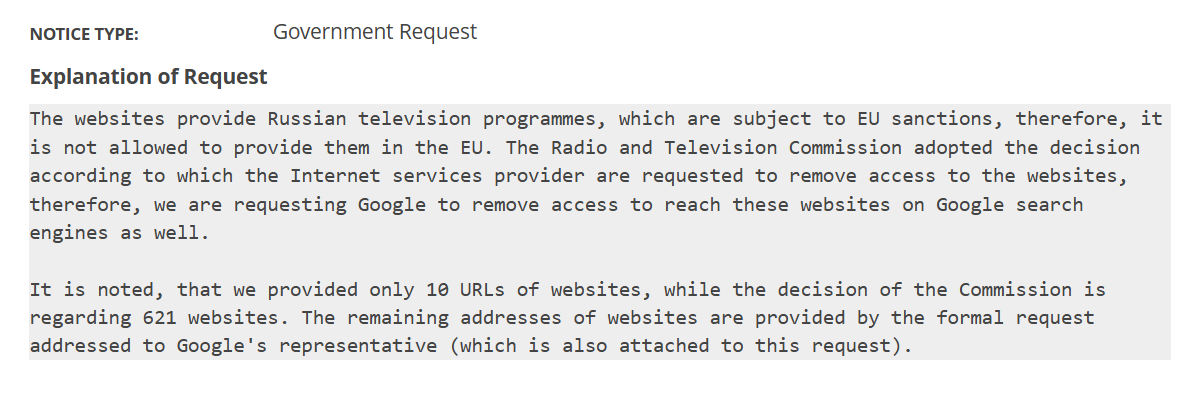
    On December 18, 2024, the Lithuanian Radio and Television Commission (LRTK) adopted a decision to block websites that provide access to Russian TV channels targeted by EU sanctions. In an announcement Tuesday, LRTK said that in order to ensure “more effective implementation” of the sanctions, it contacted Google with a request to deindex those websites from Google’s search results.

    Obtained by TorrentFreak from the Lumen Database, the request envisions the deindexing of more than 620 domains.

    “On January 3, 2025, Google announced that it had decided to remove 201 websites that hosted EU-sanctioned content,” LRTK continued.

    “This means that a user who wants to access a blocked website and enters its address into Google search will not be offered the site among the search results. Thus, the implementation of EU sanctions will be even more effective and the accessibility of such websites will be even more limited.”

    Silencing Only Propaganda?

    The list of 279 domains present in the only notice seen by TF reveals numerous proxy domains not dissimilar to those deployed by pirate sites. Sputnik news, for example, appears in 53 fully qualified domains, with subdomain usage indicating the direct targeting of EU member states; cz, fr, it, and ro, for example.

    Similar domains relating to Russia Today, Izvestia, and others facilitating access to already sanctioned platforms, offer no real surprises. Regardless of any propaganda value, the domains provide access to single, legitimate platforms. Under additional scrutiny, other domains on the list aren’t quite so straightforward.

    For example, ottplayer.tv displays no content whatsoever, at least to those without an account. While links to Russia are fairly obvious, the service is described as an IPTV playlist aggregator/manager, with users apparently required to bring their own content.

    ottplayer

    The live TV portal at InternTV also seems like an unusual addition. Several of the sites subject to sanctions do appear on the portal for embedded viewing, but in this case context is everything.

    In addition to providing access to pirated movies and TV shows, live TV channels from all around the world are featured no less prominently than their Russian counterparts.

    interntv-l

    Other live channels on offer include BB1, ITV, ITV2, ITV4, CNN, Bloomberg, Euronews, and Sky Sports. Sitting alongside in the same list are channels including Sport 2, XSport, Black Sea TV, and 1+1, all of which are notable for being Ukrainian channels targeting a Ukrainian audience.

    So as an alleged outlet for propaganda, in general InternTV seems to perform quite poorly. By catering to an international audience with a platform that allows all sides to see and hear what everyone else has to say, it not only provides more balance than Russian state-controlled media, but outperforms the EU as well.

    There will be no shortage of government leaders prepared to argue that responsibility to protect citizens from the evils of propaganda lies with them. Unfortunately, without first-hand experience of how propaganda manifests itself, those same citizens are denied an opportunity to learn and then think for themselves.

    On the plus side, social media remains freely accessible to all, with propaganda conveniently delivered mostly in English, by those currently too difficult to block.

    From: TF , for the latest news on copyright battles, piracy and more.

    • To chevron_right

      Google Deindexes 200 Streaming Sites For Violating EU Sanctions on Russia

      news.movim.eu / TorrentFreak • 8 January 2025 • 3 minutes

    propaganda-1s The adage that the first casualty of war is the truth held solid as Russia denied any intention of invading Ukraine, even as it was actively doing so.

    State-controlled media, television presenters in particular, turned in some remarkable performances for the benefit of local audiences. While dramatically documenting events that bore only a passing resemblance to reality on the ground, broadcasters including Russia Today, Sputnik, and RIA Novosti, ensured that Russia’s position on Ukraine was presented overseas exactly as the Kremlin intended.

    After quickly running out of patience, the EU banned all three broadcasters and many others ( list ) from transmitting from or to any EU member state, using any technical means. Whether by cable, satellite, websites or IPTV, the ban applied across the board to prevent (or at least limit) the spread of what the EU described as disinformation and propaganda.

    Lithuania Saw Room For Improvement

    On December 18, 2024, the Lithuanian Radio and Television Commission (LRTK) adopted a decision to block websites that provide access to Russian TV channels targeted by EU sanctions. In an announcement Tuesday, LRTK said that in order to ensure “more effective implementation” of the sanctions, it contacted Google with a request to deindex those websites from Google’s search results.

    Obtained by TorrentFreak from the Lumen Database, the request envisions the deindexing of more than 620 domains.

    “On January 3, 2025, Google announced that it had decided to remove 201 websites that hosted EU-sanctioned content,” LRTK continued.

    “This means that a user who wants to access a blocked website and enters its address into Google search will not be offered the site among the search results. Thus, the implementation of EU sanctions will be even more effective and the accessibility of such websites will be even more limited.”

    Silencing Only Propaganda?

    The list of 279 domains present in the only notice seen by TF reveals numerous proxy domains not dissimilar to those deployed by pirate sites. Sputnik news, for example, appears in 53 fully qualified domains, with subdomain usage indicating the direct targeting of EU member states; cz, fr, it, and ro, for example.

    Similar domains relating to Russia Today, Izvestia, and others facilitating access to already sanctioned platforms, offer no real surprises. Regardless of any propaganda value, the domains provide access to single, legitimate platforms. Under additional scrutiny, other domains on the list aren’t quite so straightforward.

    For example, ottplayer.tv displays no content whatsoever, at least to those without an account. While links to Russia are fairly obvious, the service is described as an IPTV playlist aggregator/manager, with users apparently required to bring their own content.

    ottplayer

    The live TV portal at InternTV also seems like an unusual addition. Several of the sites subject to sanctions do appear on the portal for embedded viewing, but in this case context is everything.

    In addition to providing access to pirated movies and TV shows, live TV channels from all around the world are featured no less prominently than their Russian counterparts.

    interntv-l

    Other live channels on offer include BB1, ITV, ITV2, ITV4, CNN, Bloomberg, Euronews, and Sky Sports. Sitting alongside in the same list are channels including Sport 2, XSport, Black Sea TV, and 1+1, all of which are notable for being Ukrainian channels targeting a Ukrainian audience.

    So as an alleged outlet for propaganda, in general InternTV seems to perform quite poorly. By catering to an international audience with a platform that allows all sides to see and hear what everyone else has to say, it not only provides more balance than Russian state-controlled media, but outperforms the EU as well.

    There will be no shortage of government leaders prepared to argue that responsibility to protect citizens from the evils of propaganda lies with them. Unfortunately, without first-hand experience of how propaganda manifests itself, those same citizens are denied an opportunity to learn and then think for themselves.

    On the plus side, social media remains freely accessible to all, with propaganda conveniently delivered mostly in English, by those currently too difficult to block.

    From: TF , for the latest news on copyright battles, piracy and more.

    • To chevron_right

      Google Deindexes 200 Streaming Sites For Violating EU Sanctions on Russia

      news.movim.eu / TorrentFreak • 8 January 2025 • 3 minutes

    propaganda-1s The adage that the first casualty of war is the truth held solid as Russia denied any intention of invading Ukraine, even as it was actively doing so.

    State-controlled media, television presenters in particular, turned in some remarkable performances for the benefit of local audiences. While dramatically documenting events that bore only a passing resemblance to reality on the ground, broadcasters including Russia Today, Sputnik, and RIA Novosti, ensured that Russia’s position on Ukraine was presented overseas exactly as the Kremlin intended.

    After quickly running out of patience, the EU banned all three broadcasters and many others ( list ) from transmitting from or to any EU member state, using any technical means. Whether by cable, satellite, websites or IPTV, the ban applied across the board to prevent (or at least limit) the spread of what the EU described as disinformation and propaganda.

    Lithuania Saw Room For Improvement

    On December 18, 2024, the Lithuanian Radio and Television Commission (LRTK) adopted a decision to block websites that provide access to Russian TV channels targeted by EU sanctions. In an announcement Tuesday, LRTK said that in order to ensure “more effective implementation” of the sanctions, it contacted Google with a request to deindex those websites from Google’s search results.

    Obtained by TorrentFreak from the Lumen Database, the request envisions the deindexing of more than 620 domains.

    “On January 3, 2025, Google announced that it had decided to remove 201 websites that hosted EU-sanctioned content,” LRTK continued.

    “This means that a user who wants to access a blocked website and enters its address into Google search will not be offered the site among the search results. Thus, the implementation of EU sanctions will be even more effective and the accessibility of such websites will be even more limited.”

    Silencing Only Propaganda?

    The list of 279 domains present in the only notice seen by TF reveals numerous proxy domains not dissimilar to those deployed by pirate sites. Sputnik news, for example, appears in 53 fully qualified domains, with subdomain usage indicating the direct targeting of EU member states; cz, fr, it, and ro, for example.

    Similar domains relating to Russia Today, Izvestia, and others facilitating access to already sanctioned platforms, offer no real surprises. Regardless of any propaganda value, the domains provide access to single, legitimate platforms. Under additional scrutiny, other domains on the list aren’t quite so straightforward.

    For example, ottplayer.tv displays no content whatsoever, at least to those without an account. While links to Russia are fairly obvious, the service is described as an IPTV playlist aggregator/manager, with users apparently required to bring their own content.

    ottplayer

    The live TV portal at InternTV also seems like an unusual addition. Several of the sites subject to sanctions do appear on the portal for embedded viewing, but in this case context is everything.

    In addition to providing access to pirated movies and TV shows, live TV channels from all around the world are featured no less prominently than their Russian counterparts.

    interntv-l

    Other live channels on offer include BB1, ITV, ITV2, ITV4, CNN, Bloomberg, Euronews, and Sky Sports. Sitting alongside in the same list are channels including Sport 2, XSport, Black Sea TV, and 1+1, all of which are notable for being Ukrainian channels targeting a Ukrainian audience.

    So as an alleged outlet for propaganda, in general InternTV seems to perform quite poorly. By catering to an international audience with a platform that allows all sides to see and hear what everyone else has to say, it not only provides more balance than Russian state-controlled media, but outperforms the EU as well.

    There will be no shortage of government leaders prepared to argue that responsibility to protect citizens from the evils of propaganda lies with them. Unfortunately, without first-hand experience of how propaganda manifests itself, those same citizens are denied an opportunity to learn and then think for themselves.

    On the plus side, social media remains freely accessible to all, with propaganda conveniently delivered mostly in English, by those currently too difficult to block.

    From: TF , for the latest news on copyright battles, piracy and more.