• To chevron_right

      Tonga! Tonga! Tonga! Online Piracy’s Unusual Attraction to ccTLD .to

      news.movim.eu / TorrentFreak • 11 January 2025 • 4 minutes
    pirate--dot-to With limited choice mostly a thing of the past, domain names today are available in many flavors. Above all others, however, the gTLD (generic top-level domain) .com is the most enduring.

    Domain Tools data shows that of all TLDs, .com is the stand-out leader with 153,999,258 domains registered at the time of writing.

    In distant second place, with 17,195,162 registered domains, is the German ccTLD (country code top-level domain) .de, with .net taking third spot with 12,477,708.

    The current ranking of ccTLD .to is only revealed after considerable scrolling; 256th it transpires, with just 26,241 domains currently registered.

    For perspective, Zonefiles reports that 129,614 .com domains were registered in the last 24 hours alone. Yet despite relative obscurity, .to domains have always been appreciated by pirate sites and, right now, they’re proving more popular than ever before.

    Tonga Does Domains Differently

    The Tonic Corporation opened for business in 1997 and during its first day, reportedly sold around 100 .to domains. Anyone who bought a domain from Tonic 28 years ago will appreciate the nostalgia visiting tonic.to today; text aside, nothing has changed.

    tonic-2025-1997

    The same applies to the product but that’s not a negative; Tonic’s approach was ahead of its time. As of today, the .to extension still denotes the ccTLD for Tonga, a small island nation in the South Pacific. It’s also still marketed more like a generic global domain than a ccTLD, imposing none of the region-based restrictions or requirements found elsewhere.

    The Go .to ccTLD For Pirates?

    In 1997, buying a .com domain was a laborious exercise, but Tonic mostly eliminated the form-filling, accepted payment, and registered the domain. When customers register a domain today, Tonic still requests some information relevant to the registration.

    It may come as a surprise to those who believe that .to domains are anonymous, but the information requested is fairly comprehensive. Those details include first name, middle initial, last name, billing address, country, email address , plus the all-important credit card details to complete the sale. Perhaps another surprise: if served with a court order, Tonic will hand everything over.

    In 2021, the MPA accused Tonic of doing little to prevent pirate sites from using the .to ccTLD, suggesting that it could simply disable domains names if it wanted to. Prominent examples included domains operated by some of the most well-known pirate sites; rarbg.to, fmovies.to, kinox.to, serienstream.to, 1337x.to, torrentgalaxy.to, solarmovie.to, ibit.to, and bs.to.

    Tonic was clear, however, that random requests are no substitute for the rule of law.

    “The .TO registry complies with court orders from courts of competent jurisdiction, including US courts, and has on many occasions taken down domain names in compliance with court orders,” TONIC’s Eric Gullichsen informed TF.

    Since then, MPA/ACE have obtained DMCA subpoenas compelling Tonic to hand over the registration details behind dozens of pirate sites.

    What information Tonic discloses is not for public consumption. However, reports suggest that, if information provided by domain registrants isn’t useful, especially when a third-party proxy is the registrant, anything handed over to comply with a subpoena won’t be useful either.

    A Small Sample of Big Problems

    Over the years, almost 500 .to domains have made an appearance on the UK’s pirate site-blocking list. They include former high traffic domains like watchseries.to, which dates back more than a decade, to relatively young domains popularized in the last five years; bflix.to and onionplay.to, for example.

    Given the current trend of treating domains as disposable, to be discarded whenever site-blocking or search engine penalties limit their usefulness, some piracy platforms have stuck to their .to domains through thick and thin.

    TorrentGalaxy.to is an obvious example, likewise 1337x.to. If its fortunes hadn’t shifted so dramatically in 2023, it’s likely that RARBG would still be a proud .to domain owner today. Other veteran sites including glodls.to, rlsbb.to, and limetorrents.to, still operate .to domains today.

    Some sites, however, make much more noise, even in the face of enforcement action.

    Sflix.to: A Single Example From Many

    While all major pirate sites are subjected to pressure, streaming site sflix.to has received more than its fair share of attention.

    After being blocked by courts in the UK and Australia in December 2021, Sflix.to was added to the PIPCU-maintained IWL (Infringing Website List) in April 2022. It remains listed today in the company of around 80 otherwise diverse domains with the same extension.

    Yet, if visitor numbers are any indication of success, Sflix.to easily exceeds the standard.

    In October, directly after sites with similar branding were shut down in Vietnam, Sflix.to received 43.8 million visits. By November, that had increased to 49 million visits and then, seemingly out of nowhere, traffic in December collapsed to ‘just’ 23.6 million.

    The coincidental debut appearance of sflix2.to in December more than balanced things up; total visits for the month (from a standing start) 57.2 million.

    Tonga’s Lure Remains

    Sflix.to and other previously mentioned pirate domains are just a few examples, there are many more operational today. Apparently, the .to lure is strong and enduring.

    A brief sample of popular and enduring sites, sporting familiar brands and .to domains, is sufficient to show that major pirate sites still prefer .to domains over hundreds of others readily available.

    Our aim is to present current main domains only, so we have excluded a number of high-traffic domains where switches to new, non .to domains are currently underway. The order of the list has no value and by default, all sites should be considered a security risk.

    From: TF , for the latest news on copyright battles, piracy and more.

    • To chevron_right

      Tonga! Tonga! Tonga! Online Piracy’s Unusual Attraction to ccTLD .to

      news.movim.eu / TorrentFreak • 11 January 2025 • 4 minutes

    pirate--dot-to With limited choice mostly a thing of the past, domain names today are available in many flavors. Above all others, however, the gTLD (generic top-level domain) .com is the most enduring.

    Domain Tools data shows that of all TLDs, .com is the stand-out leader with 153,999,258 domains registered at the time of writing.

    In distant second place, with 17,195,162 registered domains, is the German ccTLD (country code top-level domain) .de, with .net taking third spot with 12,477,708.

    The current ranking of ccTLD .to is only revealed after considerable scrolling; 256th it transpires, with just 26,241 domains currently registered.

    For perspective, Zonefiles reports that 129,614 .com domains were registered in the last 24 hours alone. Yet despite relative obscurity, .to domains have always been appreciated by pirate sites and, right now, they’re proving more popular than ever before.

    Tonga Does Domains Differently

    The Tonic Corporation opened for business in 1997 and during its first day, reportedly sold around 100 .to domains. Anyone who bought a domain from Tonic 28 years ago will appreciate the nostalgia visiting tonic.to today; text aside, nothing has changed.

    tonic-2025-1997

    The same applies to the product but that’s not a negative; Tonic’s approach was ahead of its time. As of today, the .to extension still denotes the ccTLD for Tonga, a small island nation in the South Pacific. It’s also still marketed more like a generic global domain than a ccTLD, imposing none of the region-based restrictions or requirements found elsewhere.

    The Go .to ccTLD For Pirates?

    In 1997, buying a .com domain was a laborious exercise, but Tonic mostly eliminated the form-filling, accepted payment, and registered the domain. When customers register a domain today, Tonic still requests some information relevant to the registration.

    It may come as a surprise to those who believe that .to domains are anonymous, but the information requested is fairly comprehensive. Those details include first name, middle initial, last name, billing address, country, email address , plus the all-important credit card details to complete the sale. Perhaps another surprise: if served with a court order, Tonic will hand everything over.

    In 2021, the MPA accused Tonic of doing little to prevent pirate sites from using the .to ccTLD, suggesting that it could simply disable domains names if it wanted to. Prominent examples included domains operated by some of the most well-known pirate sites; rarbg.to, fmovies.to, kinox.to, serienstream.to, 1337x.to, torrentgalaxy.to, solarmovie.to, ibit.to, and bs.to.

    Tonic was clear, however, that random requests are no substitute for the rule of law.

    “The .TO registry complies with court orders from courts of competent jurisdiction, including US courts, and has on many occasions taken down domain names in compliance with court orders,” TONIC’s Eric Gullichsen informed TF.

    Since then, MPA/ACE have obtained DMCA subpoenas compelling Tonic to hand over the registration details behind dozens of pirate sites.

    What information Tonic discloses is not for public consumption. However, reports suggest that, if information provided by domain registrants isn’t useful, especially when a third-party proxy is the registrant, anything handed over to comply with a subpoena won’t be useful either.

    A Small Sample of Big Problems

    Over the years, almost 500 .to domains have made an appearance on the UK’s pirate site-blocking list. They include former high traffic domains like watchseries.to, which dates back more than a decade, to relatively young domains popularized in the last five years; bflix.to and onionplay.to, for example.

    Given the current trend of treating domains as disposable, to be discarded whenever site-blocking or search engine penalties limit their usefulness, some piracy platforms have stuck to their .to domains through thick and thin.

    TorrentGalaxy.to is an obvious example, likewise 1337x.to. If its fortunes hadn’t shifted so dramatically in 2023, it’s likely that RARBG would still be a proud .to domain owner today. Other veteran sites including glodls.to, rlsbb.to, and limetorrents.to, still operate .to domains today.

    Some sites, however, make much more noise, even in the face of enforcement action.

    Sflix.to: A Single Example From Many

    While all major pirate sites are subjected to pressure, streaming site sflix.to has received more than its fair share of attention.

    After being blocked by courts in the UK and Australia in December 2021, Sflix.to was added to the PIPCU-maintained IWL (Infringing Website List) in April 2022. It remains listed today in the company of around 80 otherwise diverse domains with the same extension.

    Yet, if visitor numbers are any indication of success, Sflix.to easily exceeds the standard.

    In October, directly after sites with similar branding were shut down in Vietnam, Sflix.to received 43.8 million visits. By November, that had increased to 49 million visits and then, seemingly out of nowhere, traffic in December collapsed to ‘just’ 23.6 million.

    The coincidental debut appearance of sflix2.to in December more than balanced things up; total visits for the month (from a standing start) 57.2 million.

    Tonga’s Lure Remains

    Sflix.to and other previously mentioned pirate domains are just a few examples, there are many more operational today. Apparently, the .to lure is strong and enduring.

    A brief sample of popular and enduring sites, sporting familiar brands and .to domains, is sufficient to show that major pirate sites still prefer .to domains over hundreds of others readily available.

    Our aim is to present current main domains only, so we have excluded a number of high-traffic domains where switches to new, non .to domains are currently underway. The order of the list has no value and by default, all sites should be considered a security risk.

    From: TF , for the latest news on copyright battles, piracy and more.

    • To chevron_right

      Tonga! Tonga! Tonga! Online Piracy’s Unusual Attraction to ccTLD .to

      news.movim.eu / TorrentFreak • 11 January 2025 • 4 minutes

    pirate--dot-to With limited choice mostly a thing of the past, domain names today are available in many flavors. Above all others, however, the gTLD (generic top-level domain) .com is the most enduring.

    Domain Tools data shows that of all TLDs, .com is the stand-out leader with 153,999,258 domains registered at the time of writing.

    In distant second place, with 17,195,162 registered domains, is the German ccTLD (country code top-level domain) .de, with .net taking third spot with 12,477,708.

    The current ranking of ccTLD .to is only revealed after considerable scrolling; 256th it transpires, with just 26,241 domains currently registered.

    For perspective, Zonefiles reports that 129,614 .com domains were registered in the last 24 hours alone. Yet despite relative obscurity, .to domains have always been appreciated by pirate sites and, right now, they’re proving more popular than ever before.

    Tonga Does Domains Differently

    The Tonic Corporation opened for business in 1997 and during its first day, reportedly sold around 100 .to domains. Anyone who bought a domain from Tonic 28 years ago will appreciate the nostalgia visiting tonic.to today; text aside, nothing has changed.

    tonic-2025-1997

    The same applies to the product but that’s not a negative; Tonic’s approach was ahead of its time. As of today, the .to extension still denotes the ccTLD for Tonga, a small island nation in the South Pacific. It’s also still marketed more like a generic global domain than a ccTLD, imposing none of the region-based restrictions or requirements found elsewhere.

    The Go .to ccTLD For Pirates?

    In 1997, buying a .com domain was a laborious exercise, but Tonic mostly eliminated the form-filling, accepted payment, and registered the domain. When customers register a domain today, Tonic still requests some information relevant to the registration.

    It may come as a surprise to those who believe that .to domains are anonymous, but the information requested is fairly comprehensive. Those details include first name, middle initial, last name, billing address, country, email address , plus the all-important credit card details to complete the sale. Perhaps another surprise: if served with a court order, Tonic will hand everything over.

    In 2021, the MPA accused Tonic of doing little to prevent pirate sites from using the .to ccTLD, suggesting that it could simply disable domains names if it wanted to. Prominent examples included domains operated by some of the most well-known pirate sites; rarbg.to, fmovies.to, kinox.to, serienstream.to, 1337x.to, torrentgalaxy.to, solarmovie.to, ibit.to, and bs.to.

    Tonic was clear, however, that random requests are no substitute for the rule of law.

    “The .TO registry complies with court orders from courts of competent jurisdiction, including US courts, and has on many occasions taken down domain names in compliance with court orders,” TONIC’s Eric Gullichsen informed TF.

    Since then, MPA/ACE have obtained DMCA subpoenas compelling Tonic to hand over the registration details behind dozens of pirate sites.

    What information Tonic discloses is not for public consumption. However, reports suggest that, if information provided by domain registrants isn’t useful, especially when a third-party proxy is the registrant, anything handed over to comply with a subpoena won’t be useful either.

    A Small Sample of Big Problems

    Over the years, almost 500 .to domains have made an appearance on the UK’s pirate site-blocking list. They include former high traffic domains like watchseries.to, which dates back more than a decade, to relatively young domains popularized in the last five years; bflix.to and onionplay.to, for example.

    Given the current trend of treating domains as disposable, to be discarded whenever site-blocking or search engine penalties limit their usefulness, some piracy platforms have stuck to their .to domains through thick and thin.

    TorrentGalaxy.to is an obvious example, likewise 1337x.to. If its fortunes hadn’t shifted so dramatically in 2023, it’s likely that RARBG would still be a proud .to domain owner today. Other veteran sites including glodls.to, rlsbb.to, and limetorrents.to, still operate .to domains today.

    Some sites, however, make much more noise, even in the face of enforcement action.

    Sflix.to: A Single Example From Many

    While all major pirate sites are subjected to pressure, streaming site sflix.to has received more than its fair share of attention.

    After being blocked by courts in the UK and Australia in December 2021, Sflix.to was added to the PIPCU-maintained IWL (Infringing Website List) in April 2022. It remains listed today in the company of around 80 otherwise diverse domains with the same extension.

    Yet, if visitor numbers are any indication of success, Sflix.to easily exceeds the standard.

    In October, directly after sites with similar branding were shut down in Vietnam, Sflix.to received 43.8 million visits. By November, that had increased to 49 million visits and then, seemingly out of nowhere, traffic in December collapsed to ‘just’ 23.6 million.

    The coincidental debut appearance of sflix2.to in December more than balanced things up; total visits for the month (from a standing start) 57.2 million.

    Tonga’s Lure Remains

    Sflix.to and other previously mentioned pirate domains are just a few examples, there are many more operational today. Apparently, the .to lure is strong and enduring.

    A brief sample of popular and enduring sites, sporting familiar brands and .to domains, is sufficient to show that major pirate sites still prefer .to domains over hundreds of others readily available.

    Our aim is to present current main domains only, so we have excluded a number of high-traffic domains where switches to new, non .to domains are currently underway. The order of the list has no value and by default, all sites should be considered a security risk.

    From: TF , for the latest news on copyright battles, piracy and more.

    • To chevron_right

      ‘Strike 3’ Filed a Record Number of Piracy Lawsuits in 2024

      news.movim.eu / TorrentFreak • 10 January 2025 • 2 minutes

    justice The ease with which IP addresses and BitTorrent downloads can be tracked has created a fertile ground for copyright lawsuits.

    This inherent transparency has fueled thousands of lawsuits against alleged video pirates, both in the U.S. and around the world.

    In the United States, Strike 3 Holdings has emerged as a key player in this legal landscape. The company, known for adult entertainment videos published under the ‘Milfy’, ‘Tushy’, and ‘Vixen’ brands, pursues legal action against those who share its content illegally.

    ‘John Doe’ Lawsuits

    When these videos leak and are shared on pirate sites, Strike 3 takes action. After collecting the IP-addresses, it typically files a complaint, requesting a subpoena to obtain the subscriber’s details. Once the target is identified, the case can move forward.

    John Doe

    johndoe

    These lawsuits can be a lucrative business, especially when targeted defendants opt to swiftly settle the action for a few thousand dollars. The money comes on top of the deterrent factor that is often cited by copyright holders as one of the main reasons to take action.

    Legal pressure can deter the accused pirates and, perhaps, some of their neighbors too. There appears to be no shortage of pirates yet, though, not even within Strike 3’s niche market, as exemplified by Strike 3’s track record.

    3,900+ Cases Filed in 2024

    More than a decade ago, there were many rightsholders deploying this strategy in U.S. courts. Nowadays, Strike 3 mostly acts alone, but that doesn’t mean that their activity has diminished.

    Since 2017, the adult company has filed over 15,000 cases against alleged pirates. These repetitive complaints barely ever reach the news, but they continue to target real people. Not just that, the number of cases has also increased steadily since 2020.

    Strike 3 Cases

    strike 3 suits

    Last year, Strike 3 is listed as a party in 3,932 (*) cases filed in U.S. federal courts. This is a new all-time record. Never before has a copyright holder filed this many individual cases in a single year.

    For comparison, in 2017 – the first year Strike 3 was active – all copyright holders combined filed 1,019 cases related to file-sharing. At the time, Malibu Media was the most active copyright litigant.

    Strike 3 Holdings also dominates when it comes to all copyright cases filed in the US. According to Justia , over 7,000 copyright cases were filed in 2024, with Strike 3 responsible for more than half of that total.

    Recently filed…

    strike cases

    Settlements and Dismissals

    With this level of workload, it’s no surprise that most Strike 3 cases are resolved relatively swiftly. Of all lawsuits filed in the first half of 2024, more than 88% have already been closed. This typically happens when the parties reach an out-of-court settlement or if Strike 3 drops a complaint for other reasons.

    There have been a few rare instances where alleged pirates have fought back. For example, when Strike 3 filed a lawsuit against a 70+-year-old retired police officer, the defendant prevailed and ultimately ‘won’ a fees and costs award of $47,777 .

    Strike 3 has also had significant windfalls. In some instances, where defendants failed to respond, the adult entertainment company scored big wins, including a $108,750 damages award .

    Overall, the fact that Strike 3 continues to file news lawsuits, while also increasing its output, suggests that they are getting more out of this than it costs.


    (*) Note: the numbers presented here are based on a PACER and Justia searches for cases filed between January 1 and December 31, 2024, where ‘Strike 3’ is listed as a party. For 2024, all possible non-copyright cases have been filtered out.

    From: TF , for the latest news on copyright battles, piracy and more.

    • To chevron_right

      ‘Strike 3’ Filed a Record Number of Piracy Lawsuits in 2024

      news.movim.eu / TorrentFreak • 10 January 2025 • 2 minutes

    justice The ease with which IP addresses and BitTorrent downloads can be tracked has created a fertile ground for copyright lawsuits.

    This inherent transparency has fueled thousands of lawsuits against alleged video pirates, both in the U.S. and around the world.

    In the United States, Strike 3 Holdings has emerged as a key player in this legal landscape. The company, known for adult entertainment videos published under the ‘Milfy’, ‘Tushy’, and ‘Vixen’ brands, pursues legal action against those who share its content illegally.

    ‘John Doe’ Lawsuits

    When these videos leak and are shared on pirate sites, Strike 3 takes action. After collecting the IP-addresses, it typically files a complaint, requesting a subpoena to obtain the subscriber’s details. Once the target is identified, the case can move forward.

    John Doe

    johndoe

    These lawsuits can be a lucrative business, especially when targeted defendants opt to swiftly settle the action for a few thousand dollars. The money comes on top of the deterrent factor that is often cited by copyright holders as one of the main reasons to take action.

    Legal pressure can deter the accused pirates and, perhaps, some of their neighbors too. There appears to be no shortage of pirates yet, though, not even within Strike 3’s niche market, as exemplified by Strike 3’s track record.

    3,900+ Cases Filed in 2024

    More than a decade ago, there were many rightsholders deploying this strategy in U.S. courts. Nowadays, Strike 3 mostly acts alone, but that doesn’t mean that their activity has diminished.

    Since 2017, the adult company has filed over 15,000 cases against alleged pirates. These repetitive complaints barely ever reach the news, but they continue to target real people. Not just that, the number of cases has also increased steadily since 2020.

    Strike 3 Cases

    strike 3 suits

    Last year, Strike 3 is listed as a party in 3,932 (*) cases filed in U.S. federal courts. This is a new all-time record. Never before has a copyright holder filed this many individual cases in a single year.

    For comparison, in 2017 – the first year Strike 3 was active – all copyright holders combined filed 1,019 cases related to file-sharing. At the time, Malibu Media was the most active copyright litigant.

    Strike 3 Holdings also dominates when it comes to all copyright cases filed in the US. According to Justia , over 7,000 copyright cases were filed in 2024, with Strike 3 responsible for more than half of that total.

    Recently filed…

    strike cases

    Settlements and Dismissals

    With this level of workload, it’s no surprise that most Strike 3 cases are resolved relatively swiftly. Of all lawsuits filed in the first half of 2024, more than 88% have already been closed. This typically happens when the parties reach an out-of-court settlement or if Strike 3 drops a complaint for other reasons.

    There have been a few rare instances where alleged pirates have fought back. For example, when Strike 3 filed a lawsuit against a 70+-year-old retired police officer, the defendant prevailed and ultimately ‘won’ a fees and costs award of $47,777 .

    Strike 3 has also had significant windfalls. In some instances, where defendants failed to respond, the adult entertainment company scored big wins, including a $108,750 damages award .

    Overall, the fact that Strike 3 continues to file news lawsuits, while also increasing its output, suggests that they are getting more out of this than it costs.


    (*) Note: the numbers presented here are based on a PACER and Justia searches for cases filed between January 1 and December 31, 2024, where ‘Strike 3’ is listed as a party. For 2024, all possible non-copyright cases have been filtered out.

    From: TF , for the latest news on copyright battles, piracy and more.

    • To chevron_right

      ‘Strike 3’ Filed a Record Number of Piracy Lawsuits in 2024

      news.movim.eu / TorrentFreak • 10 January 2025 • 2 minutes

    justice The ease with which IP addresses and BitTorrent downloads can be tracked has created a fertile ground for copyright lawsuits.

    This inherent transparency has fueled thousands of lawsuits against alleged video pirates, both in the U.S. and around the world.

    In the United States, Strike 3 Holdings has emerged as a key player in this legal landscape. The company, known for adult entertainment videos published under the ‘Milfy’, ‘Tushy’, and ‘Vixen’ brands, pursues legal action against those who share its content illegally.

    ‘John Doe’ Lawsuits

    When these videos leak and are shared on pirate sites, Strike 3 takes action. After collecting the IP-addresses, it typically files a complaint, requesting a subpoena to obtain the subscriber’s details. Once the target is identified, the case can move forward.

    John Doe

    johndoe

    These lawsuits can be a lucrative business, especially when targeted defendants opt to swiftly settle the action for a few thousand dollars. The money comes on top of the deterrent factor that is often cited by copyright holders as one of the main reasons to take action.

    Legal pressure can deter the accused pirates and, perhaps, some of their neighbors too. There appears to be no shortage of pirates yet, though, not even within Strike 3’s niche market, as exemplified by Strike 3’s track record.

    3,900+ Cases Filed in 2024

    More than a decade ago, there were many rightsholders deploying this strategy in U.S. courts. Nowadays, Strike 3 mostly acts alone, but that doesn’t mean that their activity has diminished.

    Since 2017, the adult company has filed over 15,000 cases against alleged pirates. These repetitive complaints barely ever reach the news, but they continue to target real people. Not just that, the number of cases has also increased steadily since 2020.

    Strike 3 Cases

    strike 3 suits

    Last year, Strike 3 is listed as a party in 3,932 (*) cases filed in U.S. federal courts. This is a new all-time record. Never before has a copyright holder filed this many individual cases in a single year.

    For comparison, in 2017 – the first year Strike 3 was active – all copyright holders combined filed 1,019 cases related to file-sharing. At the time, Malibu Media was the most active copyright litigant.

    Strike 3 Holdings also dominates when it comes to all copyright cases filed in the US. According to Justia , over 7,000 copyright cases were filed in 2024, with Strike 3 responsible for more than half of that total.

    Recently filed…

    strike cases

    Settlements and Dismissals

    With this level of workload, it’s no surprise that most Strike 3 cases are resolved relatively swiftly. Of all lawsuits filed in the first half of 2024, more than 88% have already been closed. This typically happens when the parties reach an out-of-court settlement or if Strike 3 drops a complaint for other reasons.

    There have been a few rare instances where alleged pirates have fought back. For example, when Strike 3 filed a lawsuit against a 70+-year-old retired police officer, the defendant prevailed and ultimately ‘won’ a fees and costs award of $47,777 .

    Strike 3 has also had significant windfalls. In some instances, where defendants failed to respond, the adult entertainment company scored big wins, including a $108,750 damages award .

    Overall, the fact that Strike 3 continues to file news lawsuits, while also increasing its output, suggests that they are getting more out of this than it costs.


    (*) Note: the numbers presented here are based on a PACER and Justia searches for cases filed between January 1 and December 31, 2024, where ‘Strike 3’ is listed as a party. For 2024, all possible non-copyright cases have been filtered out.

    From: TF , for the latest news on copyright battles, piracy and more.

    • To chevron_right

      DoodStream Can’t Comply With Court Orders, Major Investor is a Russian Dude

      news.movim.eu / TorrentFreak • 9 January 2025 • 3 minutes

    doodstream After labeling DoodStream the world’s largest illegal video hosting site, the major Hollywood studios, Netflix, Amazon, and Apple, teamed up in a lawsuit filed against its India-based operators at the High Court of Delhi.
    The need for urgent action was underscored by the scale of the DoodStream operation; according to the MPA, 2.69 billion visitors in 2023 alone. A March 2024 injunction issued by the High Court compelled the site to purge itself of all links to the plaintiffs’ content inside 24 hours. An April 5 filing by the plaintiffs informed the Court that didn’t happen, with a filing by the defense two days later by arguing otherwise.

    Non-Compliance, With Attitude

    As described in court documents, some kind of technical roundtable subsequently took place, attended by a technical expert appointed by the plaintiffs and two representing the defense. More specifically, the DoodStream defendants – Raja Durai and Sarvesh Chandran – were permitted to act as the site’s technical experts, despite actively running the site while in breach of a court order, and the site paying users for content uploaded.

    That process led to the plaintiffs claiming that 1,512 tested links were still live. The Court tested six links at random, five of which remained functional. Counsel for the defendants said his clients had done their best under the circumstances; removing a million infringing links is very big job.

    To help prevent infringement moving forward, the plaintiffs requested the removal of certain site features attractive to infringers. The defendants refused to comply , citing their “inability to remove these features.” Another request, to place content uploaders’ usernames next to content they uploaded, was rejected “due to the lack of infrastructure and technical feasibility.”

    Interim Injunction

    In a trade barriers report submitted to the U.S. government, the MPA reported that an interim injunction issued by the High Court of Delhi had proven ineffective. After failing to fully comply with any of the High Court’s orders, in September 2024 contempt proceedings against the defendants were described as “ongoing.”

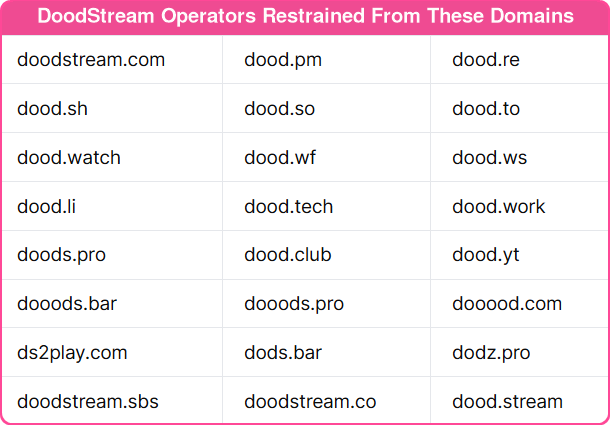
    The injunction attempted to ban DoodStreams’ operators “and all those acting for/on their behalf” from running the site. A list of domains was provided for convenience.

    doodstream-restrained

    It’s not clear whether all of these domains were in active use at the time, but many remain active today and still report significant traffic.

    Data collected by TF in December for November 2024 reveals examples including dood.li (120m), doods.pro (30.6m), dood.to (15.8m) and doodstream.com (5.5m), among dozens of similar domains that mostly redirect to the DoodStream frontpage.

    Minimal Progress, Slowly

    When first filed in March 2024, the complaint against DoodStream and its operators didn’t look much out of the ordinary. As the months progressed and the site remained online, the contrast between this lawsuit and actions against pirate sites based overseas, seemed to stand out.

    In dozens of site-blocking actions, for example, requests for urgent action are usually met with a suitable response. More extreme measures, including compelling overseas domain registrars to disable domain names, have been signed off in days and then revisited in cases of non-compliance.

    This case, albeit one contested by the defendants, has seen court orders and an injunction meet with non-compliance and ongoing infringement at considerable scale. But perhaps most jarring of all are comments from the defense suggesting that some of the Court’s instructions are optional, or at least up for negotiation.

    More nuance may be available in court filings that aren’t made available to the public, but one statement explaining why the High Court of Delhi’s orders carry less weight than one might expect, really is quite something.

    From Russia…

    doodstream-russia

    The next hearing is scheduled for early February.

    From: TF , for the latest news on copyright battles, piracy and more.

    • To chevron_right

      DoodStream Can’t Comply With Court Orders, Major Investor is a Russian Dude

      news.movim.eu / TorrentFreak • 9 January 2025 • 3 minutes

    doodstream After labeling DoodStream the world’s largest illegal video hosting site, the major Hollywood studios, Netflix, Amazon, and Apple, teamed up in a lawsuit filed against its India-based operators at the High Court of Delhi.

    The need for urgent action was underscored by the scale of the DoodStream operation; according to the MPA, 2.69 billion visitors in 2023 alone. A March 2024 injunction issued by the High Court compelled the site to purge itself of all links to the plaintiffs’ content inside 24 hours. An April 5 filing by the plaintiffs informed the Court that didn’t happen, with a filing by the defense two days later by arguing otherwise.

    Non-Compliance, With Attitude

    As described in court documents, some kind of technical roundtable subsequently took place, attended by a technical expert appointed by the plaintiffs and two representing the defense. More specifically, the DoodStream defendants – Raja Durai and Sarvesh Chandran – were permitted to act as the site’s technical experts, despite actively running the site while in breach of a court order, and the site paying users for content uploaded.

    That process led to the plaintiffs claiming that 1,512 tested links were still live. The Court tested six links at random, five of which remained functional. Counsel for the defendants said his clients had done their best under the circumstances; removing a million infringing links is very big job.

    To help prevent infringement moving forward, the plaintiffs requested the removal of certain site features attractive to infringers. The defendants refused to comply , citing their “inability to remove these features.” Another request, to place content uploaders’ usernames next to content they uploaded, was rejected “due to the lack of infrastructure and technical feasibility.”

    Interim Injunction

    In a trade barriers report submitted to the U.S. government, the MPA reported that an interim injunction issued by the High Court of Delhi had proven ineffective. After failing to fully comply with any of the High Court’s orders, in September 2024 contempt proceedings against the defendants were described as “ongoing.”

    The injunction attempted to ban DoodStreams’ operators “and all those acting for/on their behalf” from running the site. A list of domains was provided for convenience.

    doodstream-restrained

    It’s not clear whether all of these domains were in active use at the time, but many remain active today and still report significant traffic.

    Data collected by TF in December for November 2024 reveals examples including dood.li (120m), doods.pro (30.6m), dood.to (15.8m) and doodstream.com (5.5m), among dozens of similar domains that mostly redirect to the DoodStream frontpage.

    Minimal Progress, Slowly

    When first filed in March 2024, the complaint against DoodStream and its operators didn’t look much out of the ordinary. As the months progressed and the site remained online, the contrast between this lawsuit and actions against pirate sites based overseas, seemed to stand out.

    In dozens of site-blocking actions, for example, requests for urgent action are usually met with a suitable response. More extreme measures, including compelling overseas domain registrars to disable domain names, have been signed off in days and then revisited in cases of non-compliance.

    This case, albeit one contested by the defendants, has seen court orders and an injunction meet with non-compliance and ongoing infringement at considerable scale. But perhaps most jarring of all are comments from the defense suggesting that some of the Court’s instructions are optional, or at least up for negotiation.

    More nuance may be available in court filings that aren’t made available to the public, but one statement explaining why the High Court of Delhi’s orders carry less weight than one might expect, really is quite something.

    From Russia…

    doodstream-russia

    The next hearing is scheduled for early February.

    From: TF , for the latest news on copyright battles, piracy and more.

    • To chevron_right

      DoodStream Can’t Comply With Court Orders, Major Investor is a Russian Dude

      news.movim.eu / TorrentFreak • 9 January 2025 • 3 minutes

    doodstream After labeling DoodStream the world’s largest illegal video hosting site, the major Hollywood studios, Netflix, Amazon, and Apple, teamed up in a lawsuit filed against its India-based operators at the High Court of Delhi.

    The need for urgent action was underscored by the scale of the DoodStream operation; according to the MPA, 2.69 billion visitors in 2023 alone. A March 2024 injunction issued by the High Court compelled the site to purge itself of all links to the plaintiffs’ content inside 24 hours. An April 5 filing by the plaintiffs informed the Court that didn’t happen, with a filing by the defense two days later by arguing otherwise.

    Non-Compliance, With Attitude

    As described in court documents, some kind of technical roundtable subsequently took place, attended by a technical expert appointed by the plaintiffs and two representing the defense. More specifically, the DoodStream defendants – Raja Durai and Sarvesh Chandran – were permitted to act as the site’s technical experts, despite actively running the site while in breach of a court order, and the site paying users for content uploaded.

    That process led to the plaintiffs claiming that 1,512 tested links were still live. The Court tested six links at random, five of which remained functional. Counsel for the defendants said his clients had done their best under the circumstances; removing a million infringing links is very big job.

    To help prevent infringement moving forward, the plaintiffs requested the removal of certain site features attractive to infringers. The defendants refused to comply , citing their “inability to remove these features.” Another request, to place content uploaders’ usernames next to content they uploaded, was rejected “due to the lack of infrastructure and technical feasibility.”

    Interim Injunction

    In a trade barriers report submitted to the U.S. government, the MPA reported that an interim injunction issued by the High Court of Delhi had proven ineffective. After failing to fully comply with any of the High Court’s orders, in September 2024 contempt proceedings against the defendants were described as “ongoing.”

    The injunction attempted to ban DoodStreams’ operators “and all those acting for/on their behalf” from running the site. A list of domains was provided for convenience.

    doodstream-restrained

    It’s not clear whether all of these domains were in active use at the time, but many remain active today and still report significant traffic.

    Data collected by TF in December for November 2024 reveals examples including dood.li (120m), doods.pro (30.6m), dood.to (15.8m) and doodstream.com (5.5m), among dozens of similar domains that mostly redirect to the DoodStream frontpage.

    Minimal Progress, Slowly

    When first filed in March 2024, the complaint against DoodStream and its operators didn’t look much out of the ordinary. As the months progressed and the site remained online, the contrast between this lawsuit and actions against pirate sites based overseas, seemed to stand out.

    In dozens of site-blocking actions, for example, requests for urgent action are usually met with a suitable response. More extreme measures, including compelling overseas domain registrars to disable domain names, have been signed off in days and then revisited in cases of non-compliance.

    This case, albeit one contested by the defendants, has seen court orders and an injunction meet with non-compliance and ongoing infringement at considerable scale. But perhaps most jarring of all are comments from the defense suggesting that some of the Court’s instructions are optional, or at least up for negotiation.

    More nuance may be available in court filings that aren’t made available to the public, but one statement explaining why the High Court of Delhi’s orders carry less weight than one might expect, really is quite something.

    From Russia…

    doodstream-russia

    The next hearing is scheduled for early February.

    From: TF , for the latest news on copyright battles, piracy and more.