• To chevron_right

      ISP Huffs and Puffs Then Apologizes to 3 Little Piggies Over Pirate Downloads

      news.movim.eu / TorrentFreak • 13 January 2025 • 4 minutes

    So-called ‘three strikes’ anti-piracy schemes were once considered a cutting-edge response to P2P piracy.

    Also known as ‘graduated response’, a typical scenario would see rightsholders monitor BitTorrent swarms to capture participants’ IP addresses sharing their content illegally. Those IP addresses would then be reported to a friendly (or coerced) ISP for matching against subscriber records, as a prelude to ISP customer outreach.

    An initial letter sent to a subscriber would typically advise that piracy is illegal, so stop it. A second more strongly-worded letter would follow in case of continued infringement, with a third letter heralding termination of the subscriber’s account.

    Eircom (Now Eir) Resisted, Then Got on Board

    Following legal action by the Irish Recorded Music Association (IRMA), representing EMI, Sony, Universal and Warner, Irish ISP Eircom reached a settlement with the labels in 2009, leading to the introduction of a similar program, albeit to a background of legal complications.

    As the labels attempted to force other ISPs to comply , ‘three strikes’ was taken off the table , then put back on . By then, however, sharing music via BitTorrent had almost completely collapsed, with most pirates preferring YouTube and the free-tier of Spotify.

    Piracy at 3 Little Piggies

    With the majority of music piracy now taking place on sites ripping music from YouTube, it’s remarkable that a three-strikes scheme dating back 15+ years is still operational at Eir. Proof of that arrives courtesy of Paul Walsh, owner of the 3 Little Piggies cafe on Union Quay in Cork, who recently received a warning letter from Eir confirming his very first ever piracy ‘strike’.
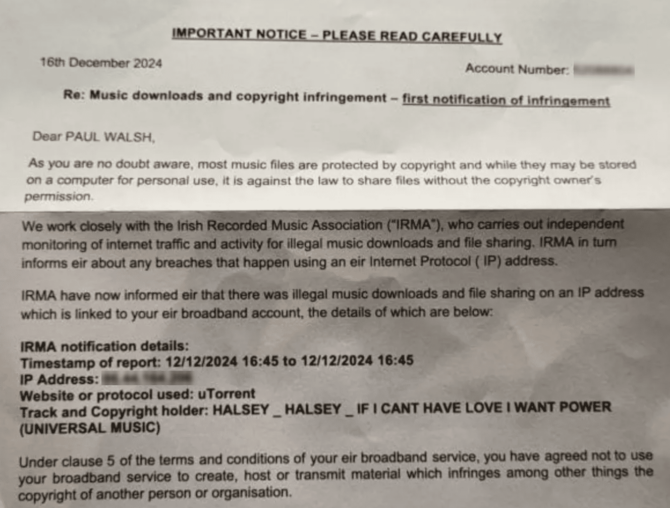
    No Love? EIR-warning-IRMA

    Walsh seemed genuinely surprised by the letter. Speaking with Corkbeo , he said he’d never seen anything like this before.

    “I’ve never seen a notification like this. It’s kind of worrying that they’re saying the onus is on you,” Walsh said.

    The letter contains a warning about the consequences of future infringement, including termination of Walsh’s internet connection should infringement continue. In common with all similar communications, the person paying the bill faces allegations; in this case, regardless of the fact that Walsh is a business customer of Eir, operating a free Wi-Fi service for the benefit of customers.

    “What alarms me about this is that it’s the first time we’ve seen this and they’re saying I’m the one liable. If you want to get more serious, what if someone downloads something they shouldn’t be downloading? That’s opening up a can of worms,” he said.

    Eir Apologizes, Warning Letter Sent in Error

    Receiving an apology from an ISP is extremely rare in these cases, but Walsh received one nonetheless. In a statement, Eir encouraged all users “to be aware of copyright laws in both residential and business settings” while acknowledging that the ‘three strikes’ program only applies to its residential customers. Those with a business account are exempt, so the warning letter shouldn’t have been sent in the first place.

    This effectively removes the ‘strike’ and eliminates the threat of future disconnection. Good news for a business owner and customers alike, even though one of them appears to have triggered this chain of events by downloading and sharing an album. Or did they?

    Information and Notification

    A document leaked in 2009 claimed to detail the draft protocol for administering the ‘three strikes’ program. One section detailed the minimum information that must appear in a notification for Eir (then Eircom) to consider a notification valid.
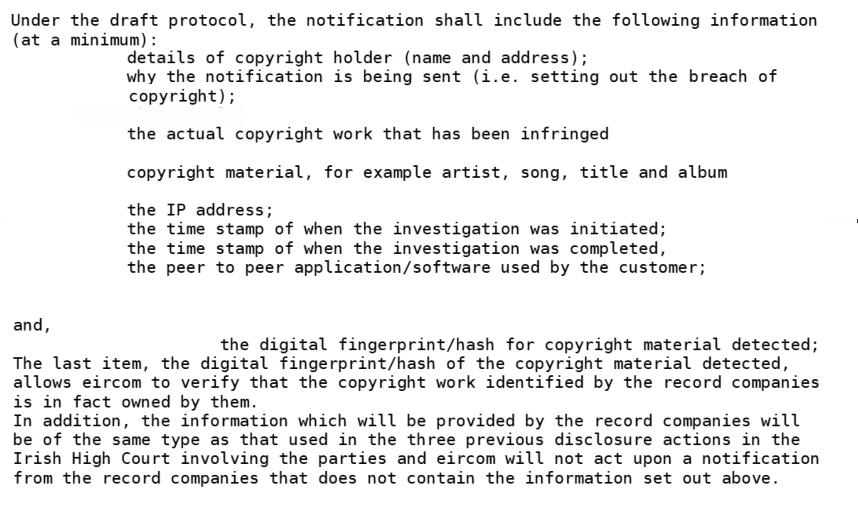
    Minimum Information Requirement

    Without losing sight of the age of the scheme, in terms of evidence the minimum requirement detailed above is fundamentally sound. What is evident, however, is that the level of detail in the notice received by Paul Walsh is well below that previously considered the minimum.

    Below Minimum Evidence

    Despite the major record labels driving this entire program, the requirement to identify the copyright holder making the allegation appears to be missing at the point of delivery. But more interesting than that is the requirement to provide a “time stamp of when the investigation was initiated” and the “time stamp of when the investigation was completed.”

    The warning letter clearly states that the ‘investigation’ began at 16:45 on the day in question, and ended at 16:45 on the very same day. That’s not an investigation, it’s a passing glimpse; and indeed, a glimpse of what exactly?

    The requirement to provide a hash for the copyright material detected also appears to be absent from subscriber warning letters. Eircom requested these values “to verify that the copyright work identified by the record companies is in fact owned by them.”

    For the same reasons, those receiving a warning letter would also find the information useful. For business subscribers exempt from notification it’s mostly irrelevant, but for residential bill payers – who may also share their connections with many other people who pay nothing – liability very often appears to be taken for granted. And without sufficient information to fight back, the chances of winning are extremely slim.

    There are claims that mistakes simply aren’t made; 3 Little Piggies receiving this letter in the first place clearly shows otherwise.

    From: TF , for the latest news on copyright battles, piracy and more.
    • To chevron_right

      ISP Huffs and Puffs Then Apologizes to 3 Little Piggies Over Pirate Downloads

      news.movim.eu / TorrentFreak • 13 January 2025 • 4 minutes

    So-called ‘three strikes’ anti-piracy schemes were once considered a cutting-edge response to P2P piracy.

    Also known as ‘graduated response’, a typical scenario would see rightsholders monitor BitTorrent swarms to capture participants’ IP addresses sharing their content illegally. Those IP addresses would then be reported to a friendly (or coerced) ISP for matching against subscriber records, as a prelude to ISP customer outreach.

    An initial letter sent to a subscriber would typically advise that piracy is illegal, so stop it. A second more strongly-worded letter would follow in case of continued infringement, with a third letter heralding termination of the subscriber’s account.

    Eircom (Now Eir) Resisted, Then Got on Board

    Following legal action by the Irish Recorded Music Association (IRMA), representing EMI, Sony, Universal and Warner, Irish ISP Eircom reached a settlement with the labels in 2009, leading to the introduction of a similar program, albeit to a background of legal complications.

    As the labels attempted to force other ISPs to comply , ‘three strikes’ was taken off the table , then put back on . By then, however, sharing music via BitTorrent had almost completely collapsed, with most pirates preferring YouTube and the free-tier of Spotify.

    Piracy at 3 Little Piggies

    With the majority of music piracy now taking place on sites ripping music from YouTube, it’s remarkable that a three-strikes scheme dating back 15+ years is still operational at Eir. Proof of that arrives courtesy of Paul Walsh, owner of the 3 Little Piggies cafe on Union Quay in Cork, who recently received a warning letter from Eir confirming his very first ever piracy ‘strike’.

    No Love? EIR-warning-IRMA

    Walsh seemed genuinely surprised by the letter. Speaking with Corkbeo , he said he’d never seen anything like this before.

    “I’ve never seen a notification like this. It’s kind of worrying that they’re saying the onus is on you,” Walsh said.

    The letter contains a warning about the consequences of future infringement, including termination of Walsh’s internet connection should infringement continue. In common with all similar communications, the person paying the bill faces allegations; in this case, regardless of the fact that Walsh is a business customer of Eir, operating a free Wi-Fi service for the benefit of customers.

    “What alarms me about this is that it’s the first time we’ve seen this and they’re saying I’m the one liable. If you want to get more serious, what if someone downloads something they shouldn’t be downloading? That’s opening up a can of worms,” he said.

    Eir Apologizes, Warning Letter Sent in Error

    Receiving an apology from an ISP is extremely rare in these cases, but Walsh received one nonetheless. In a statement, Eir encouraged all users “to be aware of copyright laws in both residential and business settings” while acknowledging that the ‘three strikes’ program only applies to its residential customers. Those with a business account are exempt, so the warning letter shouldn’t have been sent in the first place.

    This effectively removes the ‘strike’ and eliminates the threat of future disconnection. Good news for a business owner and customers alike, even though one of them appears to have triggered this chain of events by downloading and sharing an album. Or did they?

    Information and Notification

    A document leaked in 2009 claimed to detail the draft protocol for administering the ‘three strikes’ program. One section detailed the minimum information that must appear in a notification for Eir (then Eircom) to consider a notification valid.

    Minimum Information Requirement

    Without losing sight of the age of the scheme, in terms of evidence the minimum requirement detailed above is fundamentally sound. What is evident, however, is that the level of detail in the notice received by Paul Walsh is well below that previously considered the minimum.

    Below Minimum Evidence

    Despite the major record labels driving this entire program, the requirement to identify the copyright holder making the allegation appears to be missing at the point of delivery. But more interesting than that is the requirement to provide a “time stamp of when the investigation was initiated” and the “time stamp of when the investigation was completed.”

    The warning letter clearly states that the ‘investigation’ began at 16:45 on the day in question, and ended at 16:45 on the very same day. That’s not an investigation, it’s a passing glimpse; and indeed, a glimpse of what exactly?

    The requirement to provide a hash for the copyright material detected also appears to be absent from subscriber warning letters. Eircom requested these values “to verify that the copyright work identified by the record companies is in fact owned by them.”

    For the same reasons, those receiving a warning letter would also find the information useful. For business subscribers exempt from notification it’s mostly irrelevant, but for residential bill payers – who may also share their connections with many other people who pay nothing – liability very often appears to be taken for granted. And without sufficient information to fight back, the chances of winning are extremely slim.

    There are claims that mistakes simply aren’t made; 3 Little Piggies receiving this letter in the first place clearly shows otherwise.

    From: TF , for the latest news on copyright battles, piracy and more.

    • To chevron_right

      ISP Huffs and Puffs Then Apologizes to 3 Little Piggies Over Pirate Downloads

      news.movim.eu / TorrentFreak • 13 January 2025 • 4 minutes

    So-called ‘three strikes’ anti-piracy schemes were once considered a cutting-edge response to P2P piracy.

    Also known as ‘graduated response’, a typical scenario would see rightsholders monitor BitTorrent swarms to capture participants’ IP addresses sharing their content illegally. Those IP addresses would then be reported to a friendly (or coerced) ISP for matching against subscriber records, as a prelude to ISP customer outreach.

    An initial letter sent to a subscriber would typically advise that piracy is illegal, so stop it. A second more strongly-worded letter would follow in case of continued infringement, with a third letter heralding termination of the subscriber’s account.

    Eircom (Now Eir) Resisted, Then Got on Board

    Following legal action by the Irish Recorded Music Association (IRMA), representing EMI, Sony, Universal and Warner, Irish ISP Eircom reached a settlement with the labels in 2009, leading to the introduction of a similar program, albeit to a background of legal complications.

    As the labels attempted to force other ISPs to comply , ‘three strikes’ was taken off the table , then put back on . By then, however, sharing music via BitTorrent had almost completely collapsed, with most pirates preferring YouTube and the free-tier of Spotify.

    Piracy at 3 Little Piggies

    With the majority of music piracy now taking place on sites ripping music from YouTube, it’s remarkable that a three-strikes scheme dating back 15+ years is still operational at Eir. Proof of that arrives courtesy of Paul Walsh, owner of the 3 Little Piggies cafe on Union Quay in Cork, who recently received a warning letter from Eir confirming his very first ever piracy ‘strike’.

    No Love? EIR-warning-IRMA

    Walsh seemed genuinely surprised by the letter. Speaking with Corkbeo , he said he’d never seen anything like this before.

    “I’ve never seen a notification like this. It’s kind of worrying that they’re saying the onus is on you,” Walsh said.

    The letter contains a warning about the consequences of future infringement, including termination of Walsh’s internet connection should infringement continue. In common with all similar communications, the person paying the bill faces allegations; in this case, regardless of the fact that Walsh is a business customer of Eir, operating a free Wi-Fi service for the benefit of customers.

    “What alarms me about this is that it’s the first time we’ve seen this and they’re saying I’m the one liable. If you want to get more serious, what if someone downloads something they shouldn’t be downloading? That’s opening up a can of worms,” he said.

    Eir Apologizes, Warning Letter Sent in Error

    Receiving an apology from an ISP is extremely rare in these cases, but Walsh received one nonetheless. In a statement, Eir encouraged all users “to be aware of copyright laws in both residential and business settings” while acknowledging that the ‘three strikes’ program only applies to its residential customers. Those with a business account are exempt, so the warning letter shouldn’t have been sent in the first place.

    This effectively removes the ‘strike’ and eliminates the threat of future disconnection. Good news for a business owner and customers alike, even though one of them appears to have triggered this chain of events by downloading and sharing an album. Or did they?

    Information and Notification

    A document leaked in 2009 claimed to detail the draft protocol for administering the ‘three strikes’ program. One section detailed the minimum information that must appear in a notification for Eir (then Eircom) to consider a notification valid.

    Minimum Information Requirement

    Without losing sight of the age of the scheme, in terms of evidence the minimum requirement detailed above is fundamentally sound. What is evident, however, is that the level of detail in the notice received by Paul Walsh is well below that previously considered the minimum.

    Below Minimum Evidence

    Despite the major record labels driving this entire program, the requirement to identify the copyright holder making the allegation appears to be missing at the point of delivery. But more interesting than that is the requirement to provide a “time stamp of when the investigation was initiated” and the “time stamp of when the investigation was completed.”

    The warning letter clearly states that the ‘investigation’ began at 16:45 on the day in question, and ended at 16:45 on the very same day. That’s not an investigation, it’s a passing glimpse; and indeed, a glimpse of what exactly?

    The requirement to provide a hash for the copyright material detected also appears to be absent from subscriber warning letters. Eircom requested these values “to verify that the copyright work identified by the record companies is in fact owned by them.”

    For the same reasons, those receiving a warning letter would also find the information useful. For business subscribers exempt from notification it’s mostly irrelevant, but for residential bill payers – who may also share their connections with many other people who pay nothing – liability very often appears to be taken for granted. And without sufficient information to fight back, the chances of winning are extremely slim.

    There are claims that mistakes simply aren’t made; 3 Little Piggies receiving this letter in the first place clearly shows otherwise.

    From: TF , for the latest news on copyright battles, piracy and more.

    • To chevron_right

      MissAV: One of the World’s Largest ‘Pirate’ Sites Targeted in Takedown Effort

      news.movim.eu / TorrentFreak • 13 January 2025 • 2 minutes

    missav Adult entertainment is massively popular online and there are many pirate sites that specialize in this niche.

    In Asia, Japan in particular, MissAV is the leading player. The site, which has a strong focus on uncensored Japanese Adult Videos (JAV), is listed among the 15 most-visited websites in the country.

    With over 300 million monthly visits, it’s also one of the most trafficked websites globally. This is a major frustration for rightsholders of adult content, including FANZA, which is owned by the Japanese Internet company DMM .

    MissAV Confiscated

    FANZA has been trying to curb this problem for a while, in part through enforcement actions. This paid off a few hours ago when the official MissAV.com domain was seemingly confiscated. The same applies to ThisAV.com, another popular adult site connected to the same operators.

    Instead of adult content, these domains suddenly displayed a warning banner in multiple languages, clarifying that these unauthorized domains were confiscated as part of a legal procedure.

    “The domain you accessed was a site that handled illegally uploaded videos. Therefore, the domain was confiscated through legal procedures,” the message reads.

    “We want to remind you that it is a crime to infringe copyright and upload videos without permission. Using such sites encourages the crime of illegal uploading.”

    Caution

    caution

    In Japan, a slightly different message appeared . There, visitors get additional information about FANZA, which notes that payments for legal content help to fund new content. This banner also redirects people to the official FANZA website.

    MissAV Bounces Back

    While the significance of this enforcement effort shouldn’t be understated, as the news unfolded it appears that the deck was reshuffled once again.

    Apparently, MissAV didn’t lose full control over its domain names. While writing this article, they started to redirect to MissAV.ws, which provides the same unrestricted access to the site as before.

    This suggests that FANZA’s ‘legal procedure’ had a limited effect. It’s not clear what happened precisely, as details about the legal basis for the enforcement action is not known to us.

    What we do know is that the domains previously used Cloudflare’s nameservers, then switched to one controlled by its domain registrar Namecheap. After the new DNS propagates, the original domains then redirect to MissAV.ws.

    Previous nameservers

    nameservers

    One possible, but unconfirmed, scenario is that Cloudflare was ordered to take action against MissAV through a legal procedure. If that’s the case, MissAV’s operators would still have control over the domain, allowing them to simply redirect it by removing the ‘compromised’ nameservers.

    Whatever the case, it’s clear that MissAV is firmly in the crosshairs of FANZA and other rightsholders. So, this might not be the last enforcement action of this kind.

    From: TF , for the latest news on copyright battles, piracy and more.

    • To chevron_right

      MissAV: One of the World’s Largest ‘Pirate’ Sites Targeted in Takedown Effort

      news.movim.eu / TorrentFreak • 13 January 2025 • 2 minutes

    missav Adult entertainment is massively popular online and there are many pirate sites that specialize in this niche.

    In Asia, Japan in particular, MissAV is the leading player. The site, which has a strong focus on uncensored Japanese Adult Videos (JAV), is listed among the 15 most-visited websites in the country.

    With over 300 million monthly visits, it’s also one of the most trafficked websites globally. This is a major frustration for rightsholders of adult content, including FANZA, which is owned by the Japanese Internet company DMM .

    MissAV Confiscated

    FANZA has been trying to curb this problem for a while, in part through enforcement actions. This paid off a few hours ago when the official MissAV.com domain was seemingly confiscated. The same applies to ThisAV.com, another popular adult site connected to the same operators.

    Instead of adult content, these domains suddenly displayed a warning banner in multiple languages, clarifying that these unauthorized domains were confiscated as part of a legal procedure.

    “The domain you accessed was a site that handled illegally uploaded videos. Therefore, the domain was confiscated through legal procedures,” the message reads.

    “We want to remind you that it is a crime to infringe copyright and upload videos without permission. Using such sites encourages the crime of illegal uploading.”

    Caution

    caution

    In Japan, a slightly different message appeared . There, visitors get additional information about FANZA, which notes that payments for legal content help to fund new content. This banner also redirects people to the official FANZA website.

    MissAV Bounces Back

    While the significance of this enforcement effort shouldn’t be understated, as the news unfolded it appears that the deck was reshuffled once again.

    Apparently, MissAV didn’t lose full control over its domain names. While writing this article, they started to redirect to MissAV.ws, which provides the same unrestricted access to the site as before.

    This suggests that FANZA’s ‘legal procedure’ had a limited effect. It’s not clear what happened precisely, as details about the legal basis for the enforcement action is not known to us.

    What we do know is that the domains previously used Cloudflare’s nameservers, then switched to one controlled by its domain registrar Namecheap. After the new DNS propagates, the original domains then redirect to MissAV.ws.

    Previous nameservers

    nameservers

    One possible, but unconfirmed, scenario is that Cloudflare was ordered to take action against MissAV through a legal procedure. If that’s the case, MissAV’s operators would still have control over the domain, allowing them to simply redirect it by removing the ‘compromised’ nameservers.

    Whatever the case, it’s clear that MissAV is firmly in the crosshairs of FANZA and other rightsholders. So, this might not be the last enforcement action of this kind.

    From: TF , for the latest news on copyright battles, piracy and more.

    • To chevron_right

      MissAV: One of the World’s Largest ‘Pirate’ Sites Targeted in Takedown Effort

      news.movim.eu / TorrentFreak • 13 January 2025 • 2 minutes

    missav Adult entertainment is massively popular online and there are many pirate sites that specialize in this niche.

    In Asia, Japan in particular, MissAV is the leading player. The site, which has a strong focus on uncensored Japanese Adult Videos (JAV), is listed among the 15 most-visited websites in the country.

    With over 300 million monthly visits, it’s also one of the most trafficked websites globally. This is a major frustration for rightsholders of adult content, including FANZA, which is owned by the Japanese Internet company DMM .

    MissAV Confiscated

    FANZA has been trying to curb this problem for a while, in part through enforcement actions. This paid off a few hours ago when the official MissAV.com domain was seemingly confiscated. The same applies to ThisAV.com, another popular adult site connected to the same operators.

    Instead of adult content, these domains suddenly displayed a warning banner in multiple languages, clarifying that these unauthorized domains were confiscated as part of a legal procedure.

    “The domain you accessed was a site that handled illegally uploaded videos. Therefore, the domain was confiscated through legal procedures,” the message reads.

    “We want to remind you that it is a crime to infringe copyright and upload videos without permission. Using such sites encourages the crime of illegal uploading.”

    Caution

    caution

    In Japan, a slightly different message appeared . There, visitors get additional information about FANZA, which notes that payments for legal content help to fund new content. This banner also redirects people to the official FANZA website.

    MissAV Bounces Back

    While the significance of this enforcement effort shouldn’t be understated, as the news unfolded it appears that the deck was reshuffled once again.

    Apparently, MissAV didn’t lose full control over its domain names. While writing this article, they started to redirect to MissAV.ws, which provides the same unrestricted access to the site as before.

    This suggests that FANZA’s ‘legal procedure’ had a limited effect. It’s not clear what happened precisely, as details about the legal basis for the enforcement action is not known to us.

    What we do know is that the domains previously used Cloudflare’s nameservers, then switched to one controlled by its domain registrar Namecheap. After the new DNS propagates, the original domains then redirect to MissAV.ws.

    Previous nameservers

    nameservers

    One possible, but unconfirmed, scenario is that Cloudflare was ordered to take action against MissAV through a legal procedure. If that’s the case, MissAV’s operators would still have control over the domain, allowing them to simply redirect it by removing the ‘compromised’ nameservers.

    Whatever the case, it’s clear that MissAV is firmly in the crosshairs of FANZA and other rightsholders. So, this might not be the last enforcement action of this kind.

    From: TF , for the latest news on copyright battles, piracy and more.

    • To chevron_right

      Nhentai Asks California Court to Dismiss Piracy Lawsuit

      news.movim.eu / TorrentFreak • 12 January 2025 • 4 minutes

    nhentai Manga and anime have become increasingly popular in recent years. These formats originate in Japan but are now in demand worldwide.

    Similar popularity also extends to the adult counterpart known as “hentai,” which has millions of avid fans.

    Like other forms of media, not everyone accessing hentai content chooses to pay for it. Instead, many people opt for free websites like nHentai.net, which averaged close to 80 million visits in recent months.

    Nhentai Sued by Publisher for Widespread Piracy

    Nhentai.net has been around for over a decade but in a move last summer, California company PCR Distributing described the site as a threat to its business. PCR does business under various brands, including J18 and JAST USA, and views the ‘pirate’ site as unlicensed competition.

    jast

    Initially, PCR requested a DMCA subpoena asking Cloudflare to unmask the people behind the site, after they allegedly failed to process takedown notices. These requests are typically straightforward but not in this case, as Nhentai decided to object.

    Facing opposition, PCR dropped the subpoena request. Instead, it decided to file a full complaint at a California federal court. According to the publisher, Nhentai shares copyrighted material without obtaining permission from rightsholders.

    “[Nhentai] hosts a vast collection of hentai works, including commercially produced content, much of which, based on information and belief, is shared without proper authorization from the owners,” the complaint read.

    Nhentai Fights Back with a Vengeance

    Nhentai’s initial opposition already indicated that the site doesn’t plan to leave these allegations uncontested. And indeed, when PCR requested early discovery, Nhentai objected , pointing out that PCR had granted express permission to use its copyrighted works.

    This week, the alleged ‘pirate’ site went a step further, requesting the court to dismiss the lawsuit in its entirety. The request isn’t based on a single issue; Nhentai says there are several grounds for the court to end the lawsuit prematurely.

    Not the author

    First, Nhentai argues that it isn’t clear whether PCR is actually the ‘author’ of all works. Some official copyright registration records list ‘JAST USA’ as the author.

    Although PCR claims to operate under the JAST USA brand, the defendants argue that PCR is a separate company and has not provided sufficient evidence to demonstrate that they possess the necessary licenses or assignments for the copyrighted works.

    “Public records for JAST USA show it has an entirely separate status as a ‘stock corporation’ with what appears to be different ownership, i.e., no overlapping directors, officers, addresses, etc. from those shown in PCR’s corporate filings,” the motion to dismiss alleges.

    From the motion
    assiglicense

    Nhentai asserts that this potential discrepancy in ownership is sufficient grounds to dismiss the lawsuit.

    What is Copyrighted?

    The defense also brings up another copyright concern. They point out that it’s not clear what is actually copyrighted. The Nhentai website mostly shares images, but some copyright registrations refer to literary works , which might not cover the images in question.

    “Under copyright law, ‘Literary works’ specifically exclude images,” they argue. “This is critical because Plaintiff has not demonstrated any right to sue for copyright infringement as to the images.”

    Along similar lines, Nhentai contends that works registered as “English translations” may not grant the plaintiffs ownership of the corresponding images displayed on their website.

    Too Late

    Nhentai further argues that there are various problems with the timing of the lawsuit. Some of the alleged copyright infringements are barred as the statute of limitations has allegedly passed, for example.

    In addition, Nhentai believes that some of the copyrights were registered years after the associated images were distributed on its site. This means that the copyrights for the works were not registered when they were originally uploaded.

    “In such an instance, the law mandates that Plaintiff is not entitled to statutory damages or attorneys’ fees as to this copyright,” Nhentai writes.

    “Plaintiff also cannot show entitlement to statutory damages and/or attorneys’ fees on the other basis in section 412, as the work was not copyrighted within three months of publication,” the motion to dismiss adds.

    Copyright Registration Timing

    too late

    Permission Granted

    Finally, Nhentai’s attorney also highlights that a representative of PCR’s brands previously granted written permission via email for use of their content and had even explored the possibility of running paid advertisements on the site.

    One of the emails suggested that piracy helped manga and anime to grow in the West. It stated that “this isn’t a takedown request or a DMCA”, offering a collaboration instead.

    Email (provided as evidence)

    email

    Given this alleged ‘permission’, as well as the other arguments put forward in the motion, Nhentai believes that PCR has no legitimate claim for copyright infringement. Therefore, the case should be dismissed.

    No Tongan Connection

    If the court ultimately decides not to dismiss the case at this stage, Nhentai would at least like it to strike all claims related to Nhentai.to. This site used the same name, but Nhentai.net says that it’s an entirely unaffiliated operation.

    “Plaintiff states that Defendants also own and operate the URL nHentai.to.’ As discussed in a hearing before Magistrate Richlin, the website nhentai.to is wholly unrelated to www.nhentai.net,” they write.

    The ‘.to’ in nhentai.to refers to the Kingdom of Tonga, an island in Polynesia. It has nothing to do with Plaintiff’s allegations against Nhentai.net,” they add.

    PCR has yet to respond to the claims presented in the motion. In an upcoming reply, it’s expected to share its side of the story, which will likely paint a completely different picture. After that, it will be up to the court to render a decision.

    A copy of Nhentai’s notice of motions and motion to dismiss, filed at the U.S. District Court for the Central District of California, is available here (pdf)

    From: TF , for the latest news on copyright battles, piracy and more.

    • To chevron_right

      Nhentai Asks California Court to Dismiss Piracy Lawsuit

      news.movim.eu / TorrentFreak • 12 January 2025 • 4 minutes

    nhentai Manga and anime have become increasingly popular in recent years. These formats originate in Japan but are now in demand worldwide.

    Similar popularity also extends to the adult counterpart known as “hentai,” which has millions of avid fans.

    Like other forms of media, not everyone accessing hentai content chooses to pay for it. Instead, many people opt for free websites like nHentai.net, which averaged close to 80 million visits in recent months.

    Nhentai Sued by Publisher for Widespread Piracy

    Nhentai.net has been around for over a decade but in a move last summer, California company PCR Distributing described the site as a threat to its business. PCR does business under various brands, including J18 and JAST USA, and views the ‘pirate’ site as unlicensed competition.

    jast

    Initially, PCR requested a DMCA subpoena asking Cloudflare to unmask the people behind the site, after they allegedly failed to process takedown notices. These requests are typically straightforward but not in this case, as Nhentai decided to object.

    Facing opposition, PCR dropped the subpoena request. Instead, it decided to file a full complaint at a California federal court. According to the publisher, Nhentai shares copyrighted material without obtaining permission from rightsholders.

    “[Nhentai] hosts a vast collection of hentai works, including commercially produced content, much of which, based on information and belief, is shared without proper authorization from the owners,” the complaint read.

    Nhentai Fights Back with a Vengeance

    Nhentai’s initial opposition already indicated that the site doesn’t plan to leave these allegations uncontested. And indeed, when PCR requested early discovery, Nhentai objected , pointing out that PCR had granted express permission to use its copyrighted works.

    This week, the alleged ‘pirate’ site went a step further, requesting the court to dismiss the lawsuit in its entirety. The request isn’t based on a single issue; Nhentai says there are several grounds for the court to end the lawsuit prematurely.

    Not the author

    First, Nhentai argues that it isn’t clear whether PCR is actually the ‘author’ of all works. Some official copyright registration records list ‘JAST USA’ as the author.

    Although PCR claims to operate under the JAST USA brand, the defendants argue that PCR is a separate company and has not provided sufficient evidence to demonstrate that they possess the necessary licenses or assignments for the copyrighted works.

    “Public records for JAST USA show it has an entirely separate status as a ‘stock corporation’ with what appears to be different ownership, i.e., no overlapping directors, officers, addresses, etc. from those shown in PCR’s corporate filings,” the motion to dismiss alleges.

    From the motion
    assiglicense

    Nhentai asserts that this potential discrepancy in ownership is sufficient grounds to dismiss the lawsuit.

    What is Copyrighted?

    The defense also brings up another copyright concern. They point out that it’s not clear what is actually copyrighted. The Nhentai website mostly shares images, but some copyright registrations refer to literary works , which might not cover the images in question.

    “Under copyright law, ‘Literary works’ specifically exclude images,” they argue. “This is critical because Plaintiff has not demonstrated any right to sue for copyright infringement as to the images.”

    Along similar lines, Nhentai contends that works registered as “English translations” may not grant the plaintiffs ownership of the corresponding images displayed on their website.

    Too Late

    Nhentai further argues that there are various problems with the timing of the lawsuit. Some of the alleged copyright infringements are barred as the statute of limitations has allegedly passed, for example.

    In addition, Nhentai believes that some of the copyrights were registered years after the associated images were distributed on its site. This means that the copyrights for the works were not registered when they were originally uploaded.

    “In such an instance, the law mandates that Plaintiff is not entitled to statutory damages or attorneys’ fees as to this copyright,” Nhentai writes.

    “Plaintiff also cannot show entitlement to statutory damages and/or attorneys’ fees on the other basis in section 412, as the work was not copyrighted within three months of publication,” the motion to dismiss adds.

    Copyright Registration Timing

    too late

    Permission Granted

    Finally, Nhentai’s attorney also highlights that a representative of PCR’s brands previously granted written permission via email for use of their content and had even explored the possibility of running paid advertisements on the site.

    One of the emails suggested that piracy helped manga and anime to grow in the West. It stated that “this isn’t a takedown request or a DMCA”, offering a collaboration instead.

    Email (provided as evidence)

    email

    Given this alleged ‘permission’, as well as the other arguments put forward in the motion, Nhentai believes that PCR has no legitimate claim for copyright infringement. Therefore, the case should be dismissed.

    No Tongan Connection

    If the court ultimately decides not to dismiss the case at this stage, Nhentai would at least like it to strike all claims related to Nhentai.to. This site used the same name, but Nhentai.net says that it’s an entirely unaffiliated operation.

    “Plaintiff states that Defendants also own and operate the URL nHentai.to.’ As discussed in a hearing before Magistrate Richlin, the website nhentai.to is wholly unrelated to www.nhentai.net,” they write.

    The ‘.to’ in nhentai.to refers to the Kingdom of Tonga, an island in Polynesia. It has nothing to do with Plaintiff’s allegations against Nhentai.net,” they add.

    PCR has yet to respond to the claims presented in the motion. In an upcoming reply, it’s expected to share its side of the story, which will likely paint a completely different picture. After that, it will be up to the court to render a decision.

    A copy of Nhentai’s notice of motions and motion to dismiss, filed at the U.S. District Court for the Central District of California, is available here (pdf)

    From: TF , for the latest news on copyright battles, piracy and more.

    • To chevron_right

      Nhentai Asks California Court to Dismiss Piracy Lawsuit

      news.movim.eu / TorrentFreak • 12 January 2025 • 4 minutes

    nhentai Manga and anime have become increasingly popular in recent years. These formats originate in Japan but are now in demand worldwide.

    Similar popularity also extends to the adult counterpart known as “hentai,” which has millions of avid fans.

    Like other forms of media, not everyone accessing hentai content chooses to pay for it. Instead, many people opt for free websites like nHentai.net, which averaged close to 80 million visits in recent months.

    Nhentai Sued by Publisher for Widespread Piracy

    Nhentai.net has been around for over a decade but in a move last summer, California company PCR Distributing described the site as a threat to its business. PCR does business under various brands, including J18 and JAST USA, and views the ‘pirate’ site as unlicensed competition.

    jast

    Initially, PCR requested a DMCA subpoena asking Cloudflare to unmask the people behind the site, after they allegedly failed to process takedown notices. These requests are typically straightforward but not in this case, as Nhentai decided to object.

    Facing opposition, PCR dropped the subpoena request. Instead, it decided to file a full complaint at a California federal court. According to the publisher, Nhentai shares copyrighted material without obtaining permission from rightsholders.

    “[Nhentai] hosts a vast collection of hentai works, including commercially produced content, much of which, based on information and belief, is shared without proper authorization from the owners,” the complaint read.

    Nhentai Fights Back with a Vengeance

    Nhentai’s initial opposition already indicated that the site doesn’t plan to leave these allegations uncontested. And indeed, when PCR requested early discovery, Nhentai objected , pointing out that PCR had granted express permission to use its copyrighted works.

    This week, the alleged ‘pirate’ site went a step further, requesting the court to dismiss the lawsuit in its entirety. The request isn’t based on a single issue; Nhentai says there are several grounds for the court to end the lawsuit prematurely.

    Not the author

    First, Nhentai argues that it isn’t clear whether PCR is actually the ‘author’ of all works. Some official copyright registration records list ‘JAST USA’ as the author.

    Although PCR claims to operate under the JAST USA brand, the defendants argue that PCR is a separate company and has not provided sufficient evidence to demonstrate that they possess the necessary licenses or assignments for the copyrighted works.

    “Public records for JAST USA show it has an entirely separate status as a ‘stock corporation’ with what appears to be different ownership, i.e., no overlapping directors, officers, addresses, etc. from those shown in PCR’s corporate filings,” the motion to dismiss alleges.

    From the motion
    assiglicense

    Nhentai asserts that this potential discrepancy in ownership is sufficient grounds to dismiss the lawsuit.

    What is Copyrighted?

    The defense also brings up another copyright concern. They point out that it’s not clear what is actually copyrighted. The Nhentai website mostly shares images, but some copyright registrations refer to literary works , which might not cover the images in question.

    “Under copyright law, ‘Literary works’ specifically exclude images,” they argue. “This is critical because Plaintiff has not demonstrated any right to sue for copyright infringement as to the images.”

    Along similar lines, Nhentai contends that works registered as “English translations” may not grant the plaintiffs ownership of the corresponding images displayed on their website.

    Too Late

    Nhentai further argues that there are various problems with the timing of the lawsuit. Some of the alleged copyright infringements are barred as the statute of limitations has allegedly passed, for example.

    In addition, Nhentai believes that some of the copyrights were registered years after the associated images were distributed on its site. This means that the copyrights for the works were not registered when they were originally uploaded.

    “In such an instance, the law mandates that Plaintiff is not entitled to statutory damages or attorneys’ fees as to this copyright,” Nhentai writes.

    “Plaintiff also cannot show entitlement to statutory damages and/or attorneys’ fees on the other basis in section 412, as the work was not copyrighted within three months of publication,” the motion to dismiss adds.

    Copyright Registration Timing

    too late

    Permission Granted

    Finally, Nhentai’s attorney also highlights that a representative of PCR’s brands previously granted written permission via email for use of their content and had even explored the possibility of running paid advertisements on the site.

    One of the emails suggested that piracy helped manga and anime to grow in the West. It stated that “this isn’t a takedown request or a DMCA”, offering a collaboration instead.

    Email (provided as evidence)

    email

    Given this alleged ‘permission’, as well as the other arguments put forward in the motion, Nhentai believes that PCR has no legitimate claim for copyright infringement. Therefore, the case should be dismissed.

    No Tongan Connection

    If the court ultimately decides not to dismiss the case at this stage, Nhentai would at least like it to strike all claims related to Nhentai.to. This site used the same name, but Nhentai.net says that it’s an entirely unaffiliated operation.

    “Plaintiff states that Defendants also own and operate the URL nHentai.to.’ As discussed in a hearing before Magistrate Richlin, the website nhentai.to is wholly unrelated to www.nhentai.net,” they write.

    The ‘.to’ in nhentai.to refers to the Kingdom of Tonga, an island in Polynesia. It has nothing to do with Plaintiff’s allegations against Nhentai.net,” they add.

    PCR has yet to respond to the claims presented in the motion. In an upcoming reply, it’s expected to share its side of the story, which will likely paint a completely different picture. After that, it will be up to the court to render a decision.

    A copy of Nhentai’s notice of motions and motion to dismiss, filed at the U.S. District Court for the Central District of California, is available here (pdf)

    From: TF , for the latest news on copyright battles, piracy and more.