• To chevron_right

      Man Jailed For Pirate IPTV Used By “Hundreds of Thousands” Had 2,000 Users

      news.movim.eu / TorrentFreak • 20 January 2025 • 3 minutes

    p2p-iptv Official figures on exactly how many people have been arrested, prosecuted and sentenced for piracy-linked offenses, are not easily obtained in the UK.

    Indeed, disclosure in response to FOIA requests seems to become more difficult when petty offending results in no arrests, or when suspects are later released without charge.

    When it comes to those who sell or resell subscriptions or operate illegal IPTV services, the last couple of years have seen a fairly dramatic uptick in successful prosecutions and convictions. At this point even the term ‘major crackdown’ is justified.

    No country in Europe spends the same kind of money as the UK, either through allocation of police resources, or the refunding of millions in expenses mostly incurred by Sky and the Premier League, during numerous private prosecutions.

    Man Sentenced for ‘Sophisticated’ Pirate IPTV Operation

    At Birmingham Crown Court last week, Gary McNally, 55, was sentenced to two years and nine months for running a ‘sophisticated’ pirate IPTV service from his home in Acocks Green, Birmingham. The platform, identified as Each Online by the Federation Against Copyright Theft, was uncovered during an investigation by broadcaster Sky.

    The platform operated between November 2017 and June 2020, capturing Sky’s attention due to McNally’s use of legitimate NOW TV accounts to obtain content straight from the source, rather than relying on a third party illicit supplier. That makes the prosecution quite rare by UK standards but also exposes people like McNally to new content-based risks, and an increased risk of being exposed elsewhere.

    For example, high capacity broadband connectivity to a residential dwelling, at a cost of £400+ each month, would’ve been fairly difficult to account for. It would not, however, be too difficult to consume. Streaming Sky Sports, Sky Movies, and many other channels 24/7 may not be massively unusual as far as downloading goes, but there’s no credible explanation for upstream traffic at those levels, even with upstream servers elsewhere.

    McNally Pleads Guilty to Two Counts of Fraud

    McNally appeared at Birmingham Crown Court in March 2024, pleading guilty two counts of making articles for use in fraud, contrary to Section 7(1)(b) of the Fraud Act 2006.

    A person is guilty of an offense if he makes, adapts, supplies or offers to supply any article—
    (a) knowing that it is designed or adapted for use in the course of or in connection with fraud, or
    (b) intending it to be used to commit, or assist in the commission of, fraud

    McNally was sentenced to two years and nine months in prison on each count, with the sentences to be served concurrently. Matt Hibbert, Group Director of Anti-Piracy at Sky, thanked the police for their work and promised to continue the fight against piracy.

    “We are grateful to the West Midlands Police for acting so robustly to take down a highly sophisticated illegal streaming operation,” Hibbert said. “We will continue to work with law enforcement to protect our content and help keep consumers safe from criminal piracy networks.”

    A statement from West Midlands Police followed along similar lines. “We will work with partners wherever possible to disrupt criminal activity, and we hope this case sends a warning message to anyone involved in this kind of criminal enterprise.”

    Initial Estimates a Little High

    An interesting final note from Sky seemed to suggest perhaps a slim chance of further action.

    Two other individuals were arrested alongside McNally. One person has since been released with no further action. A second person has been released pending further investigation.

    When McNally was raided in 2021, two other people – a 35-year-old man and a 40-year-old woman – were detained on suspicion of copyright infringement, fraud, and conspiracy to commit fraud.

    According to a BBC report at the time, West Midlands Police and FACT “spent months planning raids at two addresses in Birmingham.” The reason for such a major commitment is described by the BBC as follows:

    Three people have been arrested after raids to dismantle what authorities called a major illegal streaming network.
    Hundreds of thousands of people are thought to have used the service.
    FACT said the streaming platform was believed to have provided more than 100 pirate TV services, allowing illegal access to premium content.

    The Court heard that the number of subscribers was a bit lower than that, as FACT reveals.

    “During a single world championship boxing match broadcast by Sky in February 2018, McNally claimed to have, over 2,000 subscribers to his illegal service.”

    From: TF , for the latest news on copyright battles, piracy and more.

    • To chevron_right

      Man Jailed For Pirate IPTV Used By “Hundreds of Thousands” Had 2,000 Users

      news.movim.eu / TorrentFreak • 20 January 2025 • 3 minutes

    p2p-iptv Official figures on exactly how many people have been arrested, prosecuted and sentenced for piracy-linked offenses, are not easily obtained in the UK.

    Indeed, disclosure in response to FOIA requests seems to become more difficult when petty offending results in no arrests, or when suspects are later released without charge.

    When it comes to those who sell or resell subscriptions or operate illegal IPTV services, the last couple of years have seen a fairly dramatic uptick in successful prosecutions and convictions. At this point even the term ‘major crackdown’ is justified.

    No country in Europe spends the same kind of money as the UK, either through allocation of police resources, or the refunding of millions in expenses mostly incurred by Sky and the Premier League, during numerous private prosecutions.

    Man Sentenced for ‘Sophisticated’ Pirate IPTV Operation

    At Birmingham Crown Court last week, Gary McNally, 55, was sentenced to two years and nine months for running a ‘sophisticated’ pirate IPTV service from his home in Acocks Green, Birmingham. The platform, identified as Each Online by the Federation Against Copyright Theft, was uncovered during an investigation by broadcaster Sky.

    The platform operated between November 2017 and June 2020, capturing Sky’s attention due to McNally’s use of legitimate NOW TV accounts to obtain content straight from the source, rather than relying on a third party illicit supplier. That makes the prosecution quite rare by UK standards but also exposes people like McNally to new content-based risks, and an increased risk of being exposed elsewhere.

    For example, high capacity broadband connectivity to a residential dwelling, at a cost of £400+ each month, would’ve been fairly difficult to account for. It would not, however, be too difficult to consume. Streaming Sky Sports, Sky Movies, and many other channels 24/7 may not be massively unusual as far as downloading goes, but there’s no credible explanation for upstream traffic at those levels, even with upstream servers elsewhere.

    McNally Pleads Guilty to Two Counts of Fraud

    McNally appeared at Birmingham Crown Court in March 2024, pleading guilty two counts of making articles for use in fraud, contrary to Section 7(1)(b) of the Fraud Act 2006.

    A person is guilty of an offense if he makes, adapts, supplies or offers to supply any article—
    (a) knowing that it is designed or adapted for use in the course of or in connection with fraud, or
    (b) intending it to be used to commit, or assist in the commission of, fraud

    McNally was sentenced to two years and nine months in prison on each count, with the sentences to be served concurrently. Matt Hibbert, Group Director of Anti-Piracy at Sky, thanked the police for their work and promised to continue the fight against piracy.

    “We are grateful to the West Midlands Police for acting so robustly to take down a highly sophisticated illegal streaming operation,” Hibbert said. “We will continue to work with law enforcement to protect our content and help keep consumers safe from criminal piracy networks.”

    A statement from West Midlands Police followed along similar lines. “We will work with partners wherever possible to disrupt criminal activity, and we hope this case sends a warning message to anyone involved in this kind of criminal enterprise.”

    Initial Estimates a Little High

    An interesting final note from Sky seemed to suggest perhaps a slim chance of further action.

    Two other individuals were arrested alongside McNally. One person has since been released with no further action. A second person has been released pending further investigation.

    When McNally was raided in 2021, two other people – a 35-year-old man and a 40-year-old woman – were detained on suspicion of copyright infringement, fraud, and conspiracy to commit fraud.

    According to a BBC report at the time, West Midlands Police and FACT “spent months planning raids at two addresses in Birmingham.” The reason for such a major commitment is described by the BBC as follows:

    Three people have been arrested after raids to dismantle what authorities called a major illegal streaming network.
    Hundreds of thousands of people are thought to have used the service.
    FACT said the streaming platform was believed to have provided more than 100 pirate TV services, allowing illegal access to premium content.

    The Court heard that the number of subscribers was a bit lower than that, as FACT reveals.

    “During a single world championship boxing match broadcast by Sky in February 2018, McNally claimed to have, over 2,000 subscribers to his illegal service.”

    From: TF , for the latest news on copyright battles, piracy and more.

    • To chevron_right

      Man Jailed For Pirate IPTV Used By “Hundreds of Thousands” Had 2,000 Users

      news.movim.eu / TorrentFreak • 20 January 2025 • 3 minutes

    p2p-iptv Official figures on exactly how many people have been arrested, prosecuted and sentenced for piracy-linked offenses, are not easily obtained in the UK.

    Indeed, disclosure in response to FOIA requests seems to become more difficult when petty offending results in no arrests, or when suspects are later released without charge.

    When it comes to those who sell or resell subscriptions or operate illegal IPTV services, the last couple of years have seen a fairly dramatic uptick in successful prosecutions and convictions. At this point even the term ‘major crackdown’ is justified.

    No country in Europe spends the same kind of money as the UK, either through allocation of police resources, or the refunding of millions in expenses mostly incurred by Sky and the Premier League, during numerous private prosecutions.

    Man Sentenced for ‘Sophisticated’ Pirate IPTV Operation

    At Birmingham Crown Court last week, Gary McNally, 55, was sentenced to two years and nine months for running a ‘sophisticated’ pirate IPTV service from his home in Acocks Green, Birmingham. The platform, identified as Each Online by the Federation Against Copyright Theft, was uncovered during an investigation by broadcaster Sky.

    The platform operated between November 2017 and June 2020, capturing Sky’s attention due to McNally’s use of legitimate NOW TV accounts to obtain content straight from the source, rather than relying on a third party illicit supplier. That makes the prosecution quite rare by UK standards but also exposes people like McNally to new content-based risks, and an increased risk of being exposed elsewhere.

    For example, high capacity broadband connectivity to a residential dwelling, at a cost of £400+ each month, would’ve been fairly difficult to account for. It would not, however, be too difficult to consume. Streaming Sky Sports, Sky Movies, and many other channels 24/7 may not be massively unusual as far as downloading goes, but there’s no credible explanation for upstream traffic at those levels, even with upstream servers elsewhere.

    McNally Pleads Guilty to Two Counts of Fraud

    McNally appeared at Birmingham Crown Court in March 2024, pleading guilty two counts of making articles for use in fraud, contrary to Section 7(1)(b) of the Fraud Act 2006.

    A person is guilty of an offense if he makes, adapts, supplies or offers to supply any article—
    (a) knowing that it is designed or adapted for use in the course of or in connection with fraud, or
    (b) intending it to be used to commit, or assist in the commission of, fraud

    McNally was sentenced to two years and nine months in prison on each count, with the sentences to be served concurrently. Matt Hibbert, Group Director of Anti-Piracy at Sky, thanked the police for their work and promised to continue the fight against piracy.

    “We are grateful to the West Midlands Police for acting so robustly to take down a highly sophisticated illegal streaming operation,” Hibbert said. “We will continue to work with law enforcement to protect our content and help keep consumers safe from criminal piracy networks.”

    A statement from West Midlands Police followed along similar lines. “We will work with partners wherever possible to disrupt criminal activity, and we hope this case sends a warning message to anyone involved in this kind of criminal enterprise.”

    Initial Estimates a Little High

    An interesting final note from Sky seemed to suggest perhaps a slim chance of further action.

    Two other individuals were arrested alongside McNally. One person has since been released with no further action. A second person has been released pending further investigation.

    When McNally was raided in 2021, two other people – a 35-year-old man and a 40-year-old woman – were detained on suspicion of copyright infringement, fraud, and conspiracy to commit fraud.

    According to a BBC report at the time, West Midlands Police and FACT “spent months planning raids at two addresses in Birmingham.” The reason for such a major commitment is described by the BBC as follows:

    Three people have been arrested after raids to dismantle what authorities called a major illegal streaming network.
    Hundreds of thousands of people are thought to have used the service.
    FACT said the streaming platform was believed to have provided more than 100 pirate TV services, allowing illegal access to premium content.

    The Court heard that the number of subscribers was a bit lower than that, as FACT reveals.

    “During a single world championship boxing match broadcast by Sky in February 2018, McNally claimed to have, over 2,000 subscribers to his illegal service.”

    From: TF , for the latest news on copyright battles, piracy and more.

    • To chevron_right

      ‘Piracy Shield’ Fails to Convert Pirates to Paying Subscribers, Data Suggest

      news.movim.eu / TorrentFreak • 19 January 2025 • 3 minutes

    pug Nearly a year has passed since Italy officially implemented ‘ Piracy Shield ‘, a system that aims to deter and decrease live sports streaming piracy.
    Since last February, Piracy Shield has blocked access to thousands of IP-addresses and domain names associated with unauthorized broadcasts.

    This massive blocking operation is seen as a grandiose success by the authorities and many participating rightsholders. There were some mishaps , including repeated instances of widespread overblocking, but these were regarded as unavoidable teething problems.

    ‘Piracy Shield’ Expansion

    There are no signs that ‘Piracy Shield’ will lose importance anytime soon. On the contrary, there are calls to expand the system beyond the protection of live football matches to many other types of content, movie premieres and live TV, for example.

    At the same time, stakeholders are working to enhance the impact of the program through various legal efforts and collaborative discussion. VPNs were brought into the mix recently, along with DNS services, Cloudflare and others. Broader blockades are better blockades, the theory goes.

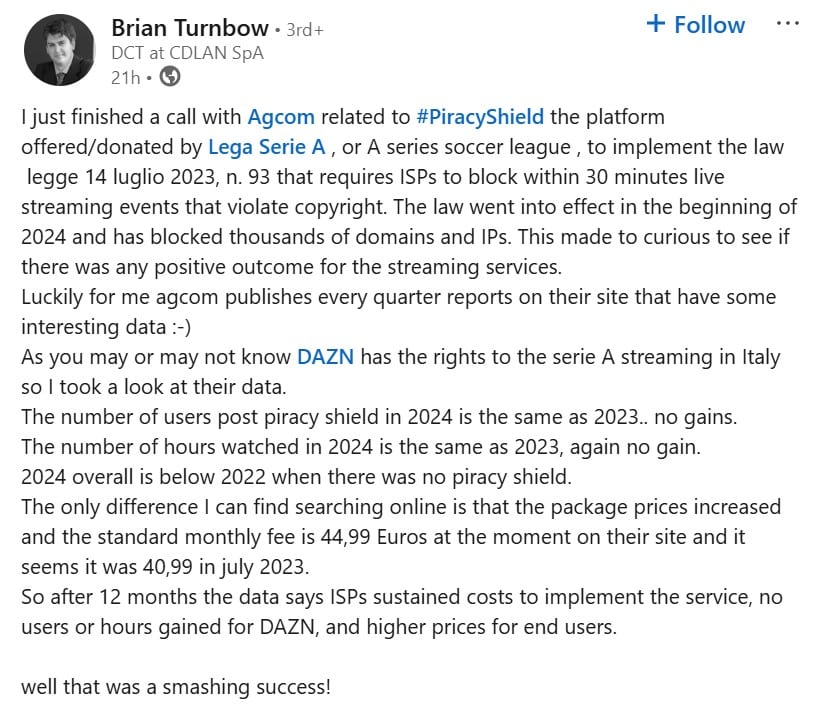
    Telecoms regulator AGCOM, which is in charge of the blocking system, actively reaches out to various stakeholders. Earlier this week, AGCOM spoke to Brian Turnbow of CDLAN , a technology company that operates cloud and hosting solutions, among other things.

    What was said during the call has not been disclosed, but the discussion prompted Turnbow to look more closely at Piracy Shield’s achievements thus far. That led to some interesting findings.

    ”Piracy Shield’ Blocks, So it Works

    To put these findings in context, it’s important to understand how an ‘effective anti-piracy blocking program’ should be defined.

    AGCOM and other backers have pointed out that Piracy Shield works because it blocks pirate domain names and IP addresses, which decreases traffic to these sources. Therefore, it ‘lowers’ piracy by definition. Obstruo, ergo efficax sum .

    However, reality doesn’t always reflect this tautological line of reasoning. While traffic to blocked services might indeed decline, people may have moved to other unblocked sources. And even if illegal traffic overall is down as an early study suggested, a drop in piracy doesn’t necessarily lead to more paying customers.

    This is where Turnbow comes in again. After his call with AGCOM, he shared some data from the regulator’s own quarterly report. This can be used to argue that the success of the year-long blocking effort is less spectacular than assumed.

    Skeptical Eye Spots Little Progress

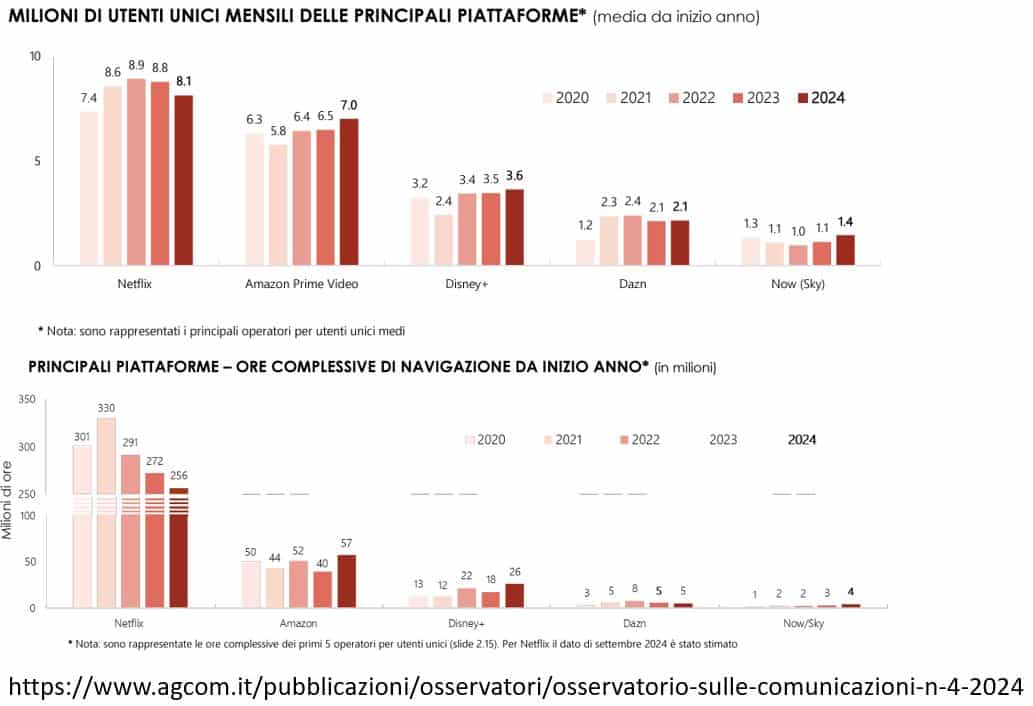
    Turnbow’s own ‘investigation’ isn’t complex either. But instead of focusing on the repressive elements, he checked if Piracy Shield positively impacted legal streaming services. He was particularly interested in DAZN’s viewership, as they hold the rights to Serie A content, which is a key player in the blocking program.

    There was little data crunching involved, as the bar charts clearly show that the number of DAZN subscribers didn’t go up in 2024. The same applies to the hours watched, which was flat too.

    “The number of users post piracy shield in 2024 is the same as 2023.. no gains. The number of hours watched in 2024 is the same as 2023, again no gain. 2024 overall is below 2022 when there was no piracy shield,” Turnbow notes.

    smashing

    The only noticeable increase he could find was in the subscription price, which wasn’t reported by AGCOM. That reportedly went up from €40.99 to €44.99 at DAZN.

    “So after 12 months, the data says ISPs sustained costs to implement the service, no users or hours gained for DAZN, and higher prices for end users,” the LinkedIn post reads.

    The data

    Wanted: A Nuanced Discussion

    Turnbow doesn’t claim to have shared groundbreaking conclusions. Besides, this type of cherry-picking is also selective, and opponents could argue that subscribers could have actually dropped significantly, without the anti-piracy measures.

    That said, the skeptical LinkedIn post shows that online intermediaries aren’t simply going along with a broad blocking program, without taking a critical look at what they’re getting themselves into.

    If the past year has shown anything, it’s that a lack of nuance, transparency, and openness to feedback, can end up being counterproductive. Extreme positions on both ends of the spectrum often block real progress.

    The fact that the tip-off for this article came from a major representative of a prominent copyright holder group, shows how dire the situation is. Even those who have fought piracy for decades are divided; the Piracy Shield effect seems reminiscent of the Tower of Babel.

    From: TF , for the latest news on copyright battles, piracy and more.

    • To chevron_right

      ‘Piracy Shield’ Fails to Convert Pirates to Paying Subscribers, Data Suggest

      news.movim.eu / TorrentFreak • 19 January 2025 • 3 minutes

    pug Nearly a year has passed since Italy officially implemented ‘ Piracy Shield ‘, a system that aims to deter and decrease live sports streaming piracy.
    Since last February, Piracy Shield has blocked access to thousands of IP-addresses and domain names associated with unauthorized broadcasts.

    This massive blocking operation is seen as a grandiose success by the authorities and many participating rightsholders. There were some mishaps , including repeated instances of widespread overblocking, but these were regarded as unavoidable teething problems.

    ‘Piracy Shield’ Expansion

    There are no signs that ‘Piracy Shield’ will lose importance anytime soon. On the contrary, there are calls to expand the system beyond the protection of live football matches to many other types of content, movie premieres and live TV, for example.

    At the same time, stakeholders are working to enhance the impact of the program through various legal efforts and collaborative discussion. VPNs were brought into the mix recently, along with DNS services, Cloudflare and others. Broader blockades are better blockades, the theory goes.

    Telecoms regulator AGCOM, which is in charge of the blocking system, actively reaches out to various stakeholders. Earlier this week, AGCOM spoke to Brian Turnbow of CDLAN , a technology company that operates cloud and hosting solutions, among other things.

    What was said during the call has not been disclosed, but the discussion prompted Turnbow to look more closely at Piracy Shield’s achievements thus far. That led to some interesting findings.

    ”Piracy Shield’ Blocks, So it Works

    To put these findings in context, it’s important to understand how an ‘effective anti-piracy blocking program’ should be defined.

    AGCOM and other backers have pointed out that Piracy Shield works because it blocks pirate domain names and IP addresses, which decreases traffic to these sources. Therefore, it ‘lowers’ piracy by definition. Obstruo, ergo efficax sum .

    However, reality doesn’t always reflect this tautological line of reasoning. While traffic to blocked services might indeed decline, people may have moved to other unblocked sources. And even if illegal traffic overall is down as an early study suggested, a drop in piracy doesn’t necessarily lead to more paying customers.

    This is where Turnbow comes in again. After his call with AGCOM, he shared some data from the regulator’s own quarterly report. This can be used to argue that the success of the year-long blocking effort is less spectacular than assumed.

    Skeptical Eye Spots Little Progress

    Turnbow’s own ‘investigation’ isn’t complex either. But instead of focusing on the repressive elements, he checked if Piracy Shield positively impacted legal streaming services. He was particularly interested in DAZN’s viewership, as they hold the rights to Serie A content, which is a key player in the blocking program.

    There was little data crunching involved, as the bar charts clearly show that the number of DAZN subscribers didn’t go up in 2024. The same applies to the hours watched, which was flat too.

    “The number of users post piracy shield in 2024 is the same as 2023.. no gains. The number of hours watched in 2024 is the same as 2023, again no gain. 2024 overall is below 2022 when there was no piracy shield,” Turnbow notes.

    smashing

    The only noticeable increase he could find was in the subscription price, which wasn’t reported by AGCOM. That reportedly went up from €40.99 to €44.99 at DAZN.

    “So after 12 months, the data says ISPs sustained costs to implement the service, no users or hours gained for DAZN, and higher prices for end users,” the LinkedIn post reads.

    The data

    Wanted: A Nuanced Discussion

    Turnbow doesn’t claim to have shared groundbreaking conclusions. Besides, this type of cherry-picking is also selective, and opponents could argue that subscribers could have actually dropped significantly, without the anti-piracy measures.

    That said, the skeptical LinkedIn post shows that online intermediaries aren’t simply going along with a broad blocking program, without taking a critical look at what they’re getting themselves into.

    If the past year has shown anything, it’s that a lack of nuance, transparency, and openness to feedback, can end up being counterproductive. Extreme positions on both ends of the spectrum often block real progress.

    The fact that the tip-off for this article came from a major representative of a prominent copyright holder group, shows how dire the situation is. Even those who have fought piracy for decades are divided; the Piracy Shield effect seems reminiscent of the Tower of Babel.

    From: TF , for the latest news on copyright battles, piracy and more.

    • To chevron_right

      ‘Piracy Shield’ Fails to Convert Pirates to Paying Subscribers, Data Suggest

      news.movim.eu / TorrentFreak • 19 January 2025 • 3 minutes

    pug Nearly a year has passed since Italy officially implemented ‘ Piracy Shield ‘, a system that aims to deter and decrease live sports streaming piracy.

    Since last February, Piracy Shield has blocked access to thousands of IP-addresses and domain names associated with unauthorized broadcasts.

    This massive blocking operation is seen as a grandiose success by the authorities and many participating rightsholders. There were some mishaps , including repeated instances of widespread overblocking, but these were regarded as unavoidable teething problems.

    ‘Piracy Shield’ Expansion

    There are no signs that ‘Piracy Shield’ will lose importance anytime soon. On the contrary, there are calls to expand the system beyond the protection of live football matches to many other types of content, movie premieres and live TV, for example.

    At the same time, stakeholders are working to enhance the impact of the program through various legal efforts and collaborative discussion. VPNs were brought into the mix recently, along with DNS services, Cloudflare and others. Broader blockades are better blockades, the theory goes.

    Telecoms regulator AGCOM, which is in charge of the blocking system, actively reaches out to various stakeholders. Earlier this week, AGCOM spoke to Brian Turnbow of CDLAN , a technology company that operates cloud and hosting solutions, among other things.

    What was said during the call has not been disclosed, but the discussion prompted Turnbow to look more closely at Piracy Shield’s achievements thus far. That led to some interesting findings.

    ”Piracy Shield’ Blocks, So it Works

    To put these findings in context, it’s important to understand how an ‘effective anti-piracy blocking program’ should be defined.

    AGCOM and other backers have pointed out that Piracy Shield works because it blocks pirate domain names and IP addresses, which decreases traffic to these sources. Therefore, it ‘lowers’ piracy by definition. Obstruo, ergo efficax sum .

    However, reality doesn’t always reflect this tautological line of reasoning. While traffic to blocked services might indeed decline, people may have moved to other unblocked sources. And even if illegal traffic overall is down as an early study suggested, a drop in piracy doesn’t necessarily lead to more paying customers.

    This is where Turnbow comes in again. After his call with AGCOM, he shared some data from the regulator’s own quarterly report. This can be used to argue that the success of the year-long blocking effort is less spectacular than assumed.

    Skeptical Eye Spots Little Progress

    Turnbow’s own ‘investigation’ isn’t complex either. But instead of focusing on the repressive elements, he checked if Piracy Shield positively impacted legal streaming services. He was particularly interested in DAZN’s viewership, as they hold the rights to Serie A content, which is a key player in the blocking program.

    There was little data crunching involved, as the bar charts clearly show that the number of DAZN subscribers didn’t go up in 2024. The same applies to the hours watched, which was flat too.

    “The number of users post piracy shield in 2024 is the same as 2023.. no gains. The number of hours watched in 2024 is the same as 2023, again no gain. 2024 overall is below 2022 when there was no piracy shield,” Turnbow notes.

    smashing

    The only noticeable increase he could find was in the subscription price, which wasn’t reported by AGCOM. That reportedly went up from €40.99 to €44.99 at DAZN.

    “So after 12 months, the data says ISPs sustained costs to implement the service, no users or hours gained for DAZN, and higher prices for end users,” the LinkedIn post reads.

    The data

    Wanted: A Nuanced Discussion

    Turnbow doesn’t claim to have shared groundbreaking conclusions. Besides, this type of cherry-picking is also selective, and opponents could argue that subscribers could have actually dropped significantly, without the anti-piracy measures.

    That said, the skeptical LinkedIn post shows that online intermediaries aren’t simply going along with a broad blocking program, without taking a critical look at what they’re getting themselves into.

    If the past year has shown anything, it’s that a lack of nuance, transparency, and openness to feedback, can end up being counterproductive. Extreme positions on both ends of the spectrum often block real progress.

    The fact that the tip-off for this article came from a major representative of a prominent copyright holder group, shows how dire the situation is. Even those who have fought piracy for decades are divided; the Piracy Shield effect seems reminiscent of the Tower of Babel.

    From: TF , for the latest news on copyright battles, piracy and more.

    • To chevron_right

      MAME Devs Spent 628 Years Cracking Protection on 712 Retro Games

      news.movim.eu / TorrentFreak • 18 January 2025 • 5 minutes

    mame-retro-s1 With the next cutting-edge big-budget AAA masterpiece never too far away, thousands of 8bit and 16bit classics dating back almost 50 years sit quietly by, waiting for the arrival of the next wave of curious explorers.

    The magic of emulation makes all of this happen and for many retro gaming enthusiasts, the Multiple Arcade Machine Emulator ( MAME ) rules them all. First released on February 7, 1997, development of this open source giant continues to this day, supporting a wide range of systems popular with millions of gamers of the past, and millions more today in pursuit of nostalgia.

    Emulation, ROMs and Legal Friction

    While emulators like MAME are legal, gaming code dumped from arcade machines, 8bit computer disks, or the cartridges of veteran consoles, find friction in the presence of copyright law. Commonly known as ROMs, these relatively tiny files contain the games but unlike other pieces of software in the emulation jigsaw, ROMs are less likely to be distributed openly for legal reasons.

    Rest assured, tens of thousands are rarely more than a few clicks away, but how they came to exist at all is a minor miracle. Video game preservation is seen as the only practical way of keeping games alive when companies fold and abandoned hardware begins to decay. Liberating software from ncient hardware is therefore key to preservation, but with anti-piracy systems of yesteryear still intact, circumvention is vital.

    A new study published by data scientists Kristofer Erickson and Felix Rodriguez Perez, in collaboration with the CREATe Centre at the University of Glasgow, considers the effect of Technological Protection Measures (TPM) on video game preservation. The researchers focused on MAME, which to date has successfully emulated over 14,377 legacy devices, including 3,783 arcade machines dating back to 1979.

    TPMs Not Omnipresent, But Their Presence is Undeniable

    According to live product data for the modern anti-piracy system Denuvo, on average protected games enjoy 68 crack-free days after their initial release. Even for a state-of-the-art system like Denuvo, an average of a couple of months of circumvention resilience seems to be the limit. Of the sample 3,783 arcade machines considered in the study, 712 machines contained TPMs, all of which required circumvention to enable preservation.

    “We measured the time delay introduced by the need to circumvent TPMs to the preservation effort, finding that this added an additional 10.6 months per item to preservation,” the researchers reveal.

    “Taking the 712 games from our sample that required circumvention, this represents 628 additional years required to preserve those games protected by TPMs. This represents a social cost in terms of additional labour from community volunteers, as well as missing use from the absence of preserved copies of games available for research, innovation and other productive uses.

    “Moreover, as preservation is delayed, technical costs for knowledge institutions may rise. Digital materials that depend on TPM-protected formats and devices can become permanently inaccessible to research and preservation when rightsholders or TPM manufacturers can no longer be located.”

    Move Over Denuvo, It’s Grandpa’s Turn Now

    The researchers’ conclusion, that legacy TPMs present “a considerable and statistically significant impediment” to preservation, suggests the presence of sophisticated TPMs that have stood the test of time. The key challenges to circumvention were as follows:

    • Encryption of game data: In the supported device list for MAME 0.258 and the sample of all arcade games released between 1979 and 2023, at least 1,072 games (29%) had some kind of protection against copying. The researchers report that encryption of game data was most common, present on 370 devices (10%) of the arcade sample.

    • Memory Controller Units: A similar number of game boards featured Memory Controller Units (MCUs). These devices manage the flow of data to and from a game’s main memory and with memory scrambling available, access to game data was further complicated.

    Self-Destruction

    • Suicide Chips: “The Hitachi FD1089 / FD1094 found on Sega System 16 boards used an encryption key to verify the contents of a game before running the code. The chip required battery power to operate correctly, so when batteries died the chip would no longer function, resulting in a fault,” the researchers explain.

    “Because such systems rely on inaccessible sources of power inside TPM modules in order to function, they have been dubbed ‘suicide boards’ by the preservation community. In 2018, researcher Eduardo Cruz published a method for backing up and restoring (‘de-suiciding’) Hitachi FD1094 modules. He indicates that circumvention required work by several individuals over a span of years.”

    • Slapstick Protection: Present on many 16-bit Atari games including Marble Madness (1984), Gauntlet (1985), and Paperboy (1985), the ‘Slapstic’ protection chip was reportedly one of the earliest TPM challenges faced by game preservationists.

    The researchers cite MAME developer Aaron Giles, who explained that the chip was unique to Atari games. Its purpose was to prevent machine operators from burning new EPROMs and “upgrading” their PCBs (circuit boards) to a new game without having to buy official upgrade kits from Atari. That’s an all-too-familiar story even today, one that has an equally familiar outcome.

    “In 1998, Giles successfully reverse engineered functionality of the Slapstic security, enabling full emulation of the 8- and 16-bit Atari arcade games that used the protection,” the researchers note.

    Conclusion

    In the context of game preservation, the researchers conclude that TPMs inhibit several positive effects, including the denial of benefits to society when games enter the public domain. The researchers conclude their study (available here ) with recommendations to guide future law and policy.

    The future costs of TPMs on society should be carefully considered, weighing the benefits of statutory exceptions for circumvention, to facilitate preservation, research, and interoperability.

    1/ to clarify that cultural heritage institutions may circumvent TPMs for preservation purposes without having to navigate the cumbersome administrative processes currently imposed by European copyright law; and

    2/ to weigh the future costs of TPMs against strong protections granted to rightsholders, for example by requiring that rightsholders maintain and offer robust means for European institutions and researchers to access TPM-protected works into the future.

    Given the uptake of new business models and distribution methods such as cloud and software-as-a-service (SaaS), born-digital materials are at greater risk than ever from inaccessibility. TPMs will continue to inhibit preservation of digital materials well into the future, so policy action to mitigate their impacts and support European memory institutions is vital.

    From: TF , for the latest news on copyright battles, piracy and more.

    • To chevron_right

      MAME Devs Spent 628 Years Cracking Protection on 712 Retro Games

      news.movim.eu / TorrentFreak • 18 January 2025 • 5 minutes

    mame-retro-s1 With the next cutting-edge big-budget AAA masterpiece never too far away, thousands of 8bit and 16bit classics dating back almost 50 years sit quietly by, waiting for the arrival of the next wave of curious explorers.

    The magic of emulation makes all of this happen and for many retro gaming enthusiasts, the Multiple Arcade Machine Emulator ( MAME ) rules them all. First released on February 7, 1997, development of this open source giant continues to this day, supporting a wide range of systems popular with millions of gamers of the past, and millions more today in pursuit of nostalgia.

    Emulation, ROMs and Legal Friction

    While emulators like MAME are legal, gaming code dumped from arcade machines, 8bit computer disks, or the cartridges of veteran consoles, find friction in the presence of copyright law. Commonly known as ROMs, these relatively tiny files contain the games but unlike other pieces of software in the emulation jigsaw, ROMs are less likely to be distributed openly for legal reasons.

    Rest assured, tens of thousands are rarely more than a few clicks away, but how they came to exist at all is a minor miracle. Video game preservation is seen as the only practical way of keeping games alive when companies fold and abandoned hardware begins to decay. Liberating software from ncient hardware is therefore key to preservation, but with anti-piracy systems of yesteryear still intact, circumvention is vital.

    A new study published by data scientists Kristofer Erickson and Felix Rodriguez Perez, in collaboration with the CREATe Centre at the University of Glasgow, considers the effect of Technological Protection Measures (TPM) on video game preservation. The researchers focused on MAME, which to date has successfully emulated over 14,377 legacy devices, including 3,783 arcade machines dating back to 1979.

    TPMs Not Omnipresent, But Their Presence is Undeniable

    According to live product data for the modern anti-piracy system Denuvo, on average protected games enjoy 68 crack-free days after their initial release. Even for a state-of-the-art system like Denuvo, an average of a couple of months of circumvention resilience seems to be the limit. Of the sample 3,783 arcade machines considered in the study, 712 machines contained TPMs, all of which required circumvention to enable preservation.

    “We measured the time delay introduced by the need to circumvent TPMs to the preservation effort, finding that this added an additional 10.6 months per item to preservation,” the researchers reveal.

    “Taking the 712 games from our sample that required circumvention, this represents 628 additional years required to preserve those games protected by TPMs. This represents a social cost in terms of additional labour from community volunteers, as well as missing use from the absence of preserved copies of games available for research, innovation and other productive uses.

    “Moreover, as preservation is delayed, technical costs for knowledge institutions may rise. Digital materials that depend on TPM-protected formats and devices can become permanently inaccessible to research and preservation when rightsholders or TPM manufacturers can no longer be located.”

    Move Over Denuvo, It’s Grandpa’s Turn Now

    The researchers’ conclusion, that legacy TPMs present “a considerable and statistically significant impediment” to preservation, suggests the presence of sophisticated TPMs that have stood the test of time. The key challenges to circumvention were as follows:

    • Encryption of game data: In the supported device list for MAME 0.258 and the sample of all arcade games released between 1979 and 2023, at least 1,072 games (29%) had some kind of protection against copying. The researchers report that encryption of game data was most common, present on 370 devices (10%) of the arcade sample.

    • Memory Controller Units: A similar number of game boards featured Memory Controller Units (MCUs). These devices manage the flow of data to and from a game’s main memory and with memory scrambling available, access to game data was further complicated.

    Self-Destruction

    • Suicide Chips: “The Hitachi FD1089 / FD1094 found on Sega System 16 boards used an encryption key to verify the contents of a game before running the code. The chip required battery power to operate correctly, so when batteries died the chip would no longer function, resulting in a fault,” the researchers explain.

    “Because such systems rely on inaccessible sources of power inside TPM modules in order to function, they have been dubbed ‘suicide boards’ by the preservation community. In 2018, researcher Eduardo Cruz published a method for backing up and restoring (‘de-suiciding’) Hitachi FD1094 modules. He indicates that circumvention required work by several individuals over a span of years.”

    • Slapstick Protection: Present on many 16-bit Atari games including Marble Madness (1984), Gauntlet (1985), and Paperboy (1985), the ‘Slapstic’ protection chip was reportedly one of the earliest TPM challenges faced by game preservationists.

    The researchers cite MAME developer Aaron Giles, who explained that the chip was unique to Atari games. Its purpose was to prevent machine operators from burning new EPROMs and “upgrading” their PCBs (circuit boards) to a new game without having to buy official upgrade kits from Atari. That’s an all-too-familiar story even today, one that has an equally familiar outcome.

    “In 1998, Giles successfully reverse engineered functionality of the Slapstic security, enabling full emulation of the 8- and 16-bit Atari arcade games that used the protection,” the researchers note.

    Conclusion

    In the context of game preservation, the researchers conclude that TPMs inhibit several positive effects, including the denial of benefits to society when games enter the public domain. The researchers conclude their study (available here ) with recommendations to guide future law and policy.

    The future costs of TPMs on society should be carefully considered, weighing the benefits of statutory exceptions for circumvention, to facilitate preservation, research, and interoperability.

    1/ to clarify that cultural heritage institutions may circumvent TPMs for preservation purposes without having to navigate the cumbersome administrative processes currently imposed by European copyright law; and

    2/ to weigh the future costs of TPMs against strong protections granted to rightsholders, for example by requiring that rightsholders maintain and offer robust means for European institutions and researchers to access TPM-protected works into the future.

    Given the uptake of new business models and distribution methods such as cloud and software-as-a-service (SaaS), born-digital materials are at greater risk than ever from inaccessibility. TPMs will continue to inhibit preservation of digital materials well into the future, so policy action to mitigate their impacts and support European memory institutions is vital.

    From: TF , for the latest news on copyright battles, piracy and more.

    • To chevron_right

      MAME Devs Spent 628 Years Cracking Protection on 712 Retro Games

      news.movim.eu / TorrentFreak • 18 January 2025 • 5 minutes

    mame-retro-s1 With the next cutting-edge big-budget AAA masterpiece never too far away, thousands of 8bit and 16bit classics dating back almost 50 years sit quietly by, waiting for the arrival of the next wave of curious explorers.

    The magic of emulation makes all of this happen and for many retro gaming enthusiasts, the Multiple Arcade Machine Emulator ( MAME ) rules them all. First released on February 7, 1997, development of this open source giant continues to this day, supporting a wide range of systems popular with millions of gamers of the past, and millions more today in pursuit of nostalgia.

    Emulation, ROMs and Legal Friction

    While emulators like MAME are legal, gaming code dumped from arcade machines, 8bit computer disks, or the cartridges of veteran consoles, find friction in the presence of copyright law. Commonly known as ROMs, these relatively tiny files contain the games but unlike other pieces of software in the emulation jigsaw, ROMs are less likely to be distributed openly for legal reasons.

    Rest assured, tens of thousands are rarely more than a few clicks away, but how they came to exist at all is a minor miracle. Video game preservation is seen as the only practical way of keeping games alive when companies fold and abandoned hardware begins to decay. Liberating software from ncient hardware is therefore key to preservation, but with anti-piracy systems of yesteryear still intact, circumvention is vital.

    A new study published by data scientists Kristofer Erickson and Felix Rodriguez Perez, in collaboration with the CREATe Centre at the University of Glasgow, considers the effect of Technological Protection Measures (TPM) on video game preservation. The researchers focused on MAME, which to date has successfully emulated over 14,377 legacy devices, including 3,783 arcade machines dating back to 1979.

    TPMs Not Omnipresent, But Their Presence is Undeniable

    According to live product data for the modern anti-piracy system Denuvo, on average protected games enjoy 68 crack-free days after their initial release. Even for a state-of-the-art system like Denuvo, an average of a couple of months of circumvention resilience seems to be the limit. Of the sample 3,783 arcade machines considered in the study, 712 machines contained TPMs, all of which required circumvention to enable preservation.

    “We measured the time delay introduced by the need to circumvent TPMs to the preservation effort, finding that this added an additional 10.6 months per item to preservation,” the researchers reveal.

    “Taking the 712 games from our sample that required circumvention, this represents 628 additional years required to preserve those games protected by TPMs. This represents a social cost in terms of additional labour from community volunteers, as well as missing use from the absence of preserved copies of games available for research, innovation and other productive uses.

    “Moreover, as preservation is delayed, technical costs for knowledge institutions may rise. Digital materials that depend on TPM-protected formats and devices can become permanently inaccessible to research and preservation when rightsholders or TPM manufacturers can no longer be located.”

    Move Over Denuvo, It’s Grandpa’s Turn Now

    The researchers’ conclusion, that legacy TPMs present “a considerable and statistically significant impediment” to preservation, suggests the presence of sophisticated TPMs that have stood the test of time. The key challenges to circumvention were as follows:

    • Encryption of game data: In the supported device list for MAME 0.258 and the sample of all arcade games released between 1979 and 2023, at least 1,072 games (29%) had some kind of protection against copying. The researchers report that encryption of game data was most common, present on 370 devices (10%) of the arcade sample.

    • Memory Controller Units: A similar number of game boards featured Memory Controller Units (MCUs). These devices manage the flow of data to and from a game’s main memory and with memory scrambling available, access to game data was further complicated.

    Self-Destruction

    • Suicide Chips: “The Hitachi FD1089 / FD1094 found on Sega System 16 boards used an encryption key to verify the contents of a game before running the code. The chip required battery power to operate correctly, so when batteries died the chip would no longer function, resulting in a fault,” the researchers explain.

    “Because such systems rely on inaccessible sources of power inside TPM modules in order to function, they have been dubbed ‘suicide boards’ by the preservation community. In 2018, researcher Eduardo Cruz published a method for backing up and restoring (‘de-suiciding’) Hitachi FD1094 modules. He indicates that circumvention required work by several individuals over a span of years.”

    • Slapstick Protection: Present on many 16-bit Atari games including Marble Madness (1984), Gauntlet (1985), and Paperboy (1985), the ‘Slapstic’ protection chip was reportedly one of the earliest TPM challenges faced by game preservationists.

    The researchers cite MAME developer Aaron Giles, who explained that the chip was unique to Atari games. Its purpose was to prevent machine operators from burning new EPROMs and “upgrading” their PCBs (circuit boards) to a new game without having to buy official upgrade kits from Atari. That’s an all-too-familiar story even today, one that has an equally familiar outcome.

    “In 1998, Giles successfully reverse engineered functionality of the Slapstic security, enabling full emulation of the 8- and 16-bit Atari arcade games that used the protection,” the researchers note.

    Conclusion

    In the context of game preservation, the researchers conclude that TPMs inhibit several positive effects, including the denial of benefits to society when games enter the public domain. The researchers conclude their study (available here ) with recommendations to guide future law and policy.

    The future costs of TPMs on society should be carefully considered, weighing the benefits of statutory exceptions for circumvention, to facilitate preservation, research, and interoperability.

    1/ to clarify that cultural heritage institutions may circumvent TPMs for preservation purposes without having to navigate the cumbersome administrative processes currently imposed by European copyright law; and

    2/ to weigh the future costs of TPMs against strong protections granted to rightsholders, for example by requiring that rightsholders maintain and offer robust means for European institutions and researchers to access TPM-protected works into the future.

    Given the uptake of new business models and distribution methods such as cloud and software-as-a-service (SaaS), born-digital materials are at greater risk than ever from inaccessibility. TPMs will continue to inhibit preservation of digital materials well into the future, so policy action to mitigate their impacts and support European memory institutions is vital.

    From: TF , for the latest news on copyright battles, piracy and more.