• To chevron_right

      Telefónica & LaLiga’s Anti-Piracy Collaboration Runs in Both Directions

      news.movim.eu / TorrentFreak • 17 January 2025 • 3 minutes
    pirate-view-card-football After steadfastly protecting the privacy rights of subscribers, usually against aggressive rightsholders determined to unmask them, ISPs today are more likely to view disclosure from a different perspective.

    At a time when internet subscriptions paid most of the bills, protecting customers accused of illicit file-sharing led to prolonged litigation. Cases were fought up to the highest courts in the United States. In Europe, further still.

    When rights organization Promusicae sued Telefonica in 2005, demanding the identities of customers accused of using KaZaA to pirate music, Telefonica fought tooth and nail all the way to Europe’s highest court.

    Telefonica argued that under Spanish law, ISPs were under no obligation to hand over customer details to rightsholders intent on civil litigation. On January 29, 2008, the Court of Justice of the European Union agreed , handing Telefonica – and its customers – a landmark win.

    Laws Change, Priorities Change

    Over time, legal amendments and the drive for profit rendered Telefonica’s win irrelevant. ISPs were already selling internet access alongside mobile phone contracts, live TV subscription packages, VOD services, music, and other valuable content, the vast majority of it regularly pirated online.

    As a result, the past several years have seen the traditional bright lines between exclusive rightsholders and ISPs licensed distributors become increasingly blurred.

    Common Interests Are the Main Focus Now

    In 2024, controversial legal action by LaLiga, Spain’s top-tier football league, led to Telefonica disclosing the identities of alleged pirate subscribers, based solely on LaLiga’s allegations.

    If Telefonica resisted at all during closed-door discussions on disclosure, only evidence of cooperation has seen the light of day. If that proves unpopular with a subset of customers, not much can be done. Since rival ISPs are also cooperating with LaLiga, jumping ship in protest would be completely pointless.

    Disclosures are now said to take place on a rolling basis, with LaLiga supplying IP addresses and Telefonica naming names. LaLiga’s subsequent letters, sent to freshly deanonymized subscribers, contain offers to settle for a few hundred euros. Financial penalties like these are meant to act as a deterrent and a forceful reminder that LaLiga matches should be purchased from licensed distributors.

    Those distributors include Movistar Plus+, a subscription digital TV platform owned by Telefónica, that currently accounts for almost half of the Spanish market. Telefonica paid 1.2 billion euros for the rights to broadcast LaLiga matches.

    TV channels owned by Sony, Disney, Warner Bros. Discovery, Paramount, and Comcast are also distributed through Movistar Plus+. Anti-piracy agreements between LaLiga and Movistar Plus+, and with the channel owners via the MPA, sees URLs/domains delivered to Telefonica and other ISPs, on a weekly and monthly basis, to enable effective blocking of pirate sites.

    You Scratch My Back, I’ll Scratch Yours

    Of course, similar agreements between rightsholders ISPs are common elsewhere, although nothing quite as unusual as the arrangement detailed in a DMCA takedown notice sent to GitHub earlier this week.

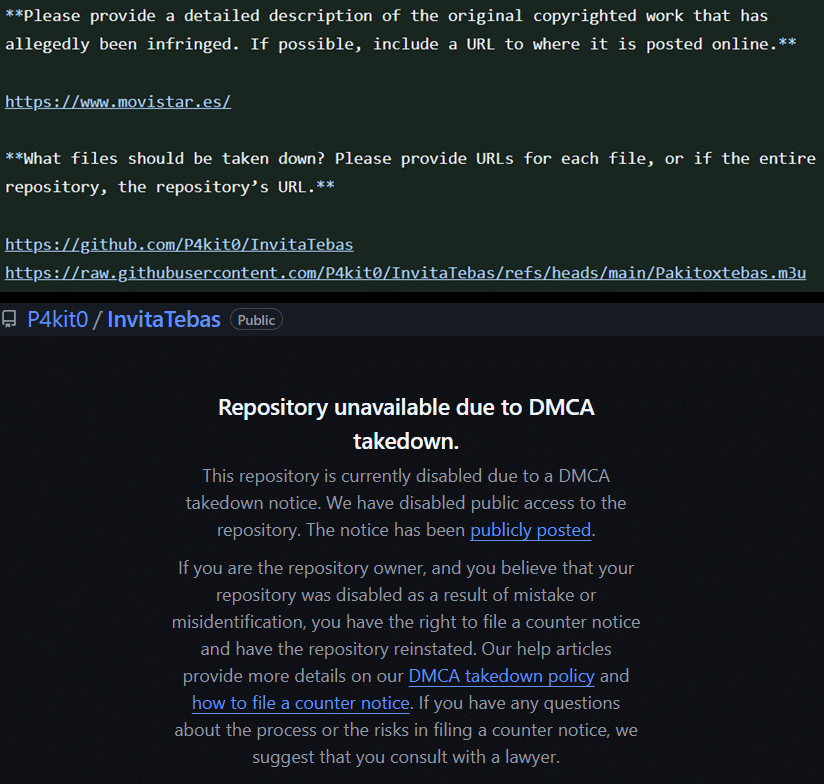
    While the sender’s identity isn’t 100% clear due to numerous redactions, GitHub’s report indicates Telefonica. In basic terms, the notice requests removal of an .M3U playlist which allegedly provides access to content to which Movistar owns the rights. GitHub responded as expected by disabling the repository which rendered the file inaccessible.
    telefonica-laliga-dmca

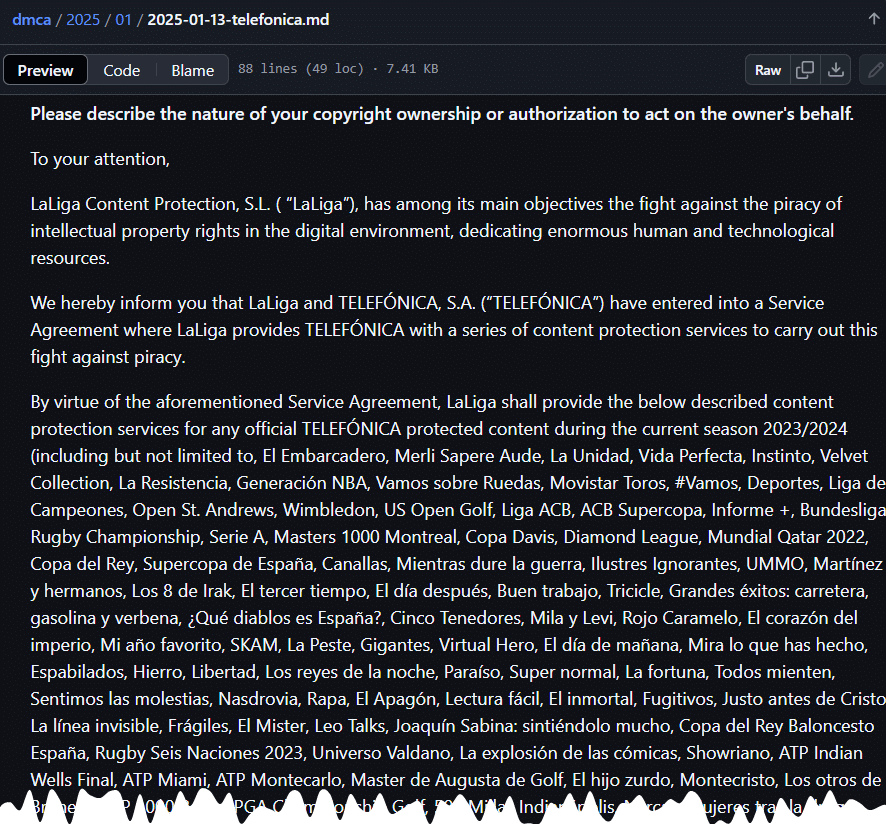
    In other respects the DMCA notice is both unusual and somewhat confusing. In response to the question, “Are you the copyright holder or authorized to act on the copyright owner’s behalf?” the sender said “Yes, I am the copyright holder.”

    In a notice sent by Telefonica, that’s nothing unusual, much less something to quantify in an explanatory wall of text that, if anything, seems to contradict the copyright holder declaration made earlier.
    telefonica-laliga-dmca-2

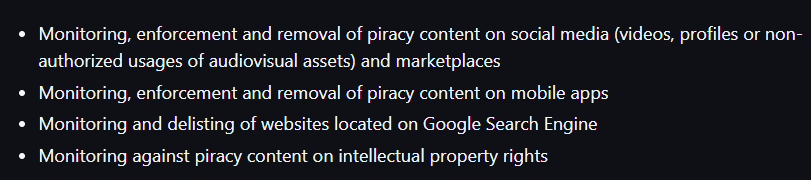
    The unlikely conclusion is that in order to protect content distributed by Movistar, to which Telefonica directly or indirectly owns the rights, the telecoms giant has entered into an anti-piracy agreement with LaLiga, Spain’s top football league. The agreement authorizes LaLiga to act on Telefonica’s behalf as follows:
    telefonica-laliga-dmca-3

    While the terms ‘monitoring’ and ‘removal’ are self-explanatory, ‘enforcement’ could apply to any number of measures, some of which are only available to exclusive rightsholders.

    Nevertheless, this is an intriguing situation that could play out in unpredictable ways. Quite simply, since the ideals behind the 2008 victory are dead and buried, increasingly vulnerable pirates may like to keep that in mind.

    From: TF , for the latest news on copyright battles, piracy and more.
    • To chevron_right

      Telefónica & LaLiga’s Anti-Piracy Collaboration Runs in Both Directions

      news.movim.eu / TorrentFreak • 17 January 2025 • 3 minutes

    pirate-view-card-football After steadfastly protecting the privacy rights of subscribers, usually against aggressive rightsholders determined to unmask them, ISPs today are more likely to view disclosure from a different perspective.

    At a time when internet subscriptions paid most of the bills, protecting customers accused of illicit file-sharing led to prolonged litigation. Cases were fought up to the highest courts in the United States. In Europe, further still.

    When rights organization Promusicae sued Telefonica in 2005, demanding the identities of customers accused of using KaZaA to pirate music, Telefonica fought tooth and nail all the way to Europe’s highest court.

    Telefonica argued that under Spanish law, ISPs were under no obligation to hand over customer details to rightsholders intent on civil litigation. On January 29, 2008, the Court of Justice of the European Union agreed , handing Telefonica – and its customers – a landmark win.

    Laws Change, Priorities Change

    Over time, legal amendments and the drive for profit rendered Telefonica’s win irrelevant. ISPs were already selling internet access alongside mobile phone contracts, live TV subscription packages, VOD services, music, and other valuable content, the vast majority of it regularly pirated online.

    As a result, the past several years have seen the traditional bright lines between exclusive rightsholders and ISPs licensed distributors become increasingly blurred.

    Common Interests Are the Main Focus Now

    In 2024, controversial legal action by LaLiga, Spain’s top-tier football league, led to Telefonica disclosing the identities of alleged pirate subscribers, based solely on LaLiga’s allegations.

    If Telefonica resisted at all during closed-door discussions on disclosure, only evidence of cooperation has seen the light of day. If that proves unpopular with a subset of customers, not much can be done. Since rival ISPs are also cooperating with LaLiga, jumping ship in protest would be completely pointless.

    Disclosures are now said to take place on a rolling basis, with LaLiga supplying IP addresses and Telefonica naming names. LaLiga’s subsequent letters, sent to freshly deanonymized subscribers, contain offers to settle for a few hundred euros. Financial penalties like these are meant to act as a deterrent and a forceful reminder that LaLiga matches should be purchased from licensed distributors.

    Those distributors include Movistar Plus+, a subscription digital TV platform owned by Telefónica, that currently accounts for almost half of the Spanish market. Telefonica paid 1.2 billion euros for the rights to broadcast LaLiga matches.

    TV channels owned by Sony, Disney, Warner Bros. Discovery, Paramount, and Comcast are also distributed through Movistar Plus+. Anti-piracy agreements between LaLiga and Movistar Plus+, and with the channel owners via the MPA, sees URLs/domains delivered to Telefonica and other ISPs, on a weekly and monthly basis, to enable effective blocking of pirate sites.

    You Scratch My Back, I’ll Scratch Yours

    Of course, similar agreements between rightsholders ISPs are common elsewhere, although nothing quite as unusual as the arrangement detailed in a DMCA takedown notice sent to GitHub earlier this week.

    While the sender’s identity isn’t 100% clear due to numerous redactions, GitHub’s report indicates Telefonica. In basic terms, the notice requests removal of an .M3U playlist which allegedly provides access to content to which Movistar owns the rights. GitHub responded as expected by disabling the repository which rendered the file inaccessible.

    telefonica-laliga-dmca

    In other respects the DMCA notice is both unusual and somewhat confusing. In response to the question, “Are you the copyright holder or authorized to act on the copyright owner’s behalf?” the sender said “Yes, I am the copyright holder.”

    In a notice sent by Telefonica, that’s nothing unusual, much less something to quantify in an explanatory wall of text that, if anything, seems to contradict the copyright holder declaration made earlier.

    telefonica-laliga-dmca-2

    The unlikely conclusion is that in order to protect content distributed by Movistar, to which Telefonica directly or indirectly owns the rights, the telecoms giant has entered into an anti-piracy agreement with LaLiga, Spain’s top football league. The agreement authorizes LaLiga to act on Telefonica’s behalf as follows:

    telefonica-laliga-dmca-3

    While the terms ‘monitoring’ and ‘removal’ are self-explanatory, ‘enforcement’ could apply to any number of measures, some of which are only available to exclusive rightsholders.

    Nevertheless, this is an intriguing situation that could play out in unpredictable ways. Quite simply, since the ideals behind the 2008 victory are dead and buried, increasingly vulnerable pirates may like to keep that in mind.

    From: TF , for the latest news on copyright battles, piracy and more.

    • To chevron_right

      Telefónica & LaLiga’s Anti-Piracy Collaboration Runs in Both Directions

      news.movim.eu / TorrentFreak • 17 January 2025 • 3 minutes

    pirate-view-card-football After steadfastly protecting the privacy rights of subscribers, usually against aggressive rightsholders determined to unmask them, ISPs today are more likely to view disclosure from a different perspective.

    At a time when internet subscriptions paid most of the bills, protecting customers accused of illicit file-sharing led to prolonged litigation. Cases were fought up to the highest courts in the United States. In Europe, further still.

    When rights organization Promusicae sued Telefonica in 2005, demanding the identities of customers accused of using KaZaA to pirate music, Telefonica fought tooth and nail all the way to Europe’s highest court.

    Telefonica argued that under Spanish law, ISPs were under no obligation to hand over customer details to rightsholders intent on civil litigation. On January 29, 2008, the Court of Justice of the European Union agreed , handing Telefonica – and its customers – a landmark win.

    Laws Change, Priorities Change

    Over time, legal amendments and the drive for profit rendered Telefonica’s win irrelevant. ISPs were already selling internet access alongside mobile phone contracts, live TV subscription packages, VOD services, music, and other valuable content, the vast majority of it regularly pirated online.

    As a result, the past several years have seen the traditional bright lines between exclusive rightsholders and ISPs licensed distributors become increasingly blurred.

    Common Interests Are the Main Focus Now

    In 2024, controversial legal action by LaLiga, Spain’s top-tier football league, led to Telefonica disclosing the identities of alleged pirate subscribers, based solely on LaLiga’s allegations.

    If Telefonica resisted at all during closed-door discussions on disclosure, only evidence of cooperation has seen the light of day. If that proves unpopular with a subset of customers, not much can be done. Since rival ISPs are also cooperating with LaLiga, jumping ship in protest would be completely pointless.

    Disclosures are now said to take place on a rolling basis, with LaLiga supplying IP addresses and Telefonica naming names. LaLiga’s subsequent letters, sent to freshly deanonymized subscribers, contain offers to settle for a few hundred euros. Financial penalties like these are meant to act as a deterrent and a forceful reminder that LaLiga matches should be purchased from licensed distributors.

    Those distributors include Movistar Plus+, a subscription digital TV platform owned by Telefónica, that currently accounts for almost half of the Spanish market. Telefonica paid 1.2 billion euros for the rights to broadcast LaLiga matches.

    TV channels owned by Sony, Disney, Warner Bros. Discovery, Paramount, and Comcast are also distributed through Movistar Plus+. Anti-piracy agreements between LaLiga and Movistar Plus+, and with the channel owners via the MPA, sees URLs/domains delivered to Telefonica and other ISPs, on a weekly and monthly basis, to enable effective blocking of pirate sites.

    You Scratch My Back, I’ll Scratch Yours

    Of course, similar agreements between rightsholders ISPs are common elsewhere, although nothing quite as unusual as the arrangement detailed in a DMCA takedown notice sent to GitHub earlier this week.

    While the sender’s identity isn’t 100% clear due to numerous redactions, GitHub’s report indicates Telefonica. In basic terms, the notice requests removal of an .M3U playlist which allegedly provides access to content to which Movistar owns the rights. GitHub responded as expected by disabling the repository which rendered the file inaccessible.

    telefonica-laliga-dmca

    In other respects the DMCA notice is both unusual and somewhat confusing. In response to the question, “Are you the copyright holder or authorized to act on the copyright owner’s behalf?” the sender said “Yes, I am the copyright holder.”

    In a notice sent by Telefonica, that’s nothing unusual, much less something to quantify in an explanatory wall of text that, if anything, seems to contradict the copyright holder declaration made earlier.

    telefonica-laliga-dmca-2

    The unlikely conclusion is that in order to protect content distributed by Movistar, to which Telefonica directly or indirectly owns the rights, the telecoms giant has entered into an anti-piracy agreement with LaLiga, Spain’s top football league. The agreement authorizes LaLiga to act on Telefonica’s behalf as follows:

    telefonica-laliga-dmca-3

    While the terms ‘monitoring’ and ‘removal’ are self-explanatory, ‘enforcement’ could apply to any number of measures, some of which are only available to exclusive rightsholders.

    Nevertheless, this is an intriguing situation that could play out in unpredictable ways. Quite simply, since the ideals behind the 2008 victory are dead and buried, increasingly vulnerable pirates may like to keep that in mind.

    From: TF , for the latest news on copyright battles, piracy and more.

    • To chevron_right

      Court Orders Pirate Site MissAV to Pay $4.5m in Damages, Domains Seized

      news.movim.eu / TorrentFreak • 17 January 2025 • 3 minutes

    missav With billions of annual visits, MissAV ranked among the top 60 most-visited websites on the internet.
    For years, the site appeared to operate without any significant setbacks, but that changed a few days ago, when several domain names including MissAV.com and ThisAV.com were seized.

    Initially, it wasn’t clear how permanent these seizures were, as the domains briefly became accessible again. However, that changed a few hours ago when the Japanese adult entertainment producer Will Co. LTD announced that these actions are backed up by a U.S. federal court order.

    The company sued the foreign defendants Ka Yeung Lee, Youhaha Marketing, Promotion Limited, and several “John Does”, holding them responsible for the copyright infringing activities on MissAV.com, ThisAV.com, and several related domains.

    In the early stages, the defense argued that the American court had no jurisdiction over the defendants, who are mostly linked to Hong Kong. However, the Washington District Court disagreed and allowed the case to continue.

    $4.5m Default Judgment

    When the defendants eventually stopped responding, the Japanese rightsholder requested a default judgment in its favor.

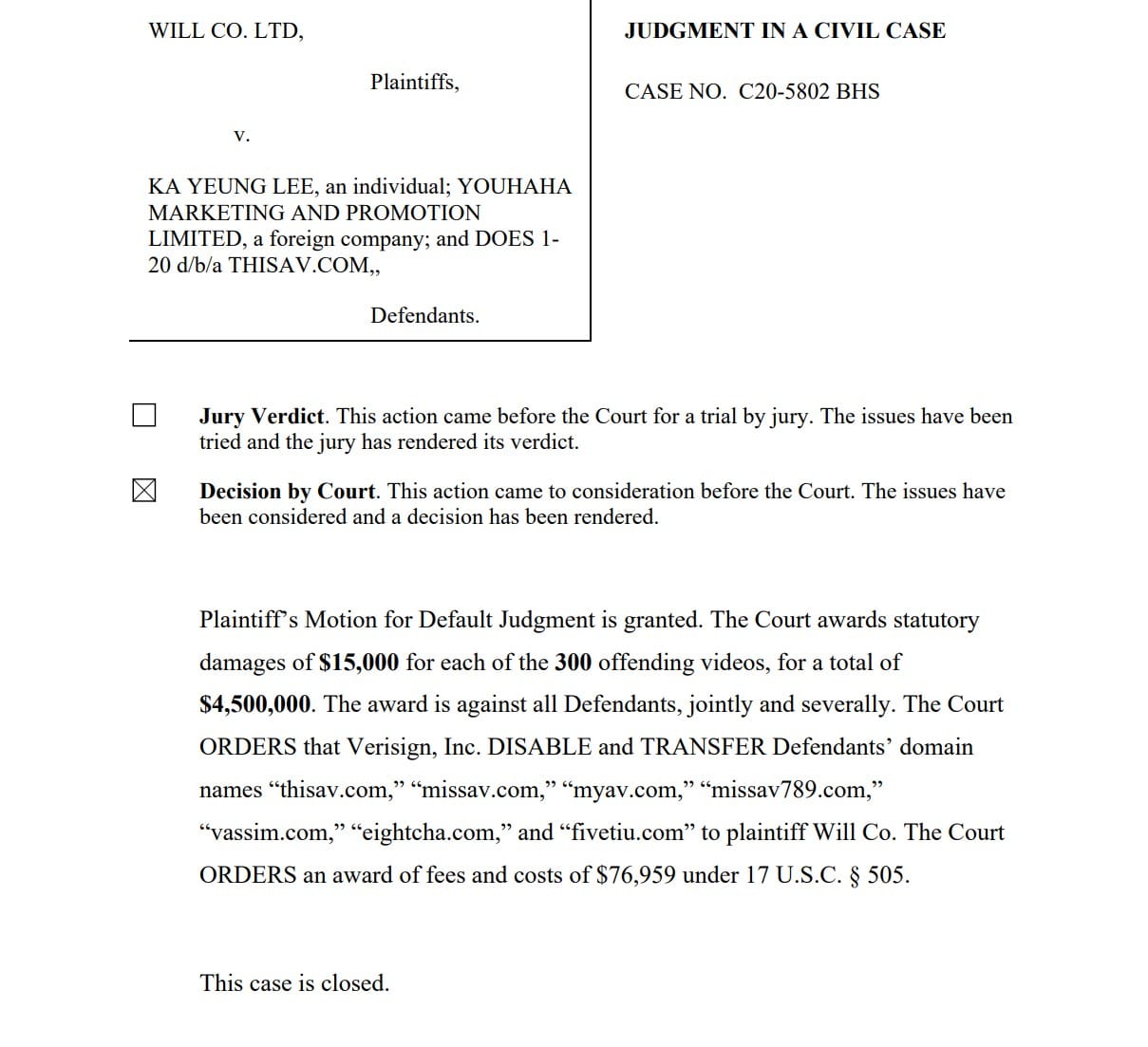
    In addition to seeking $45 million in damages for copyright infringement, the plaintiff requested an injunction allowing it to take control of several pirate domains, including thisav.com, missav.com, myav.com, missav789.com, vassim.com, eightcha.com, and fivetiu.com.

    The default judgment was granted last week, effectively putting an end to the case. Instead of the requested $150,000 for each of the 300 infringed works, the court settled on a tenth of that , bringing the total damages award to a still sizable $4.5 million.

    The order ( pdf )

    order

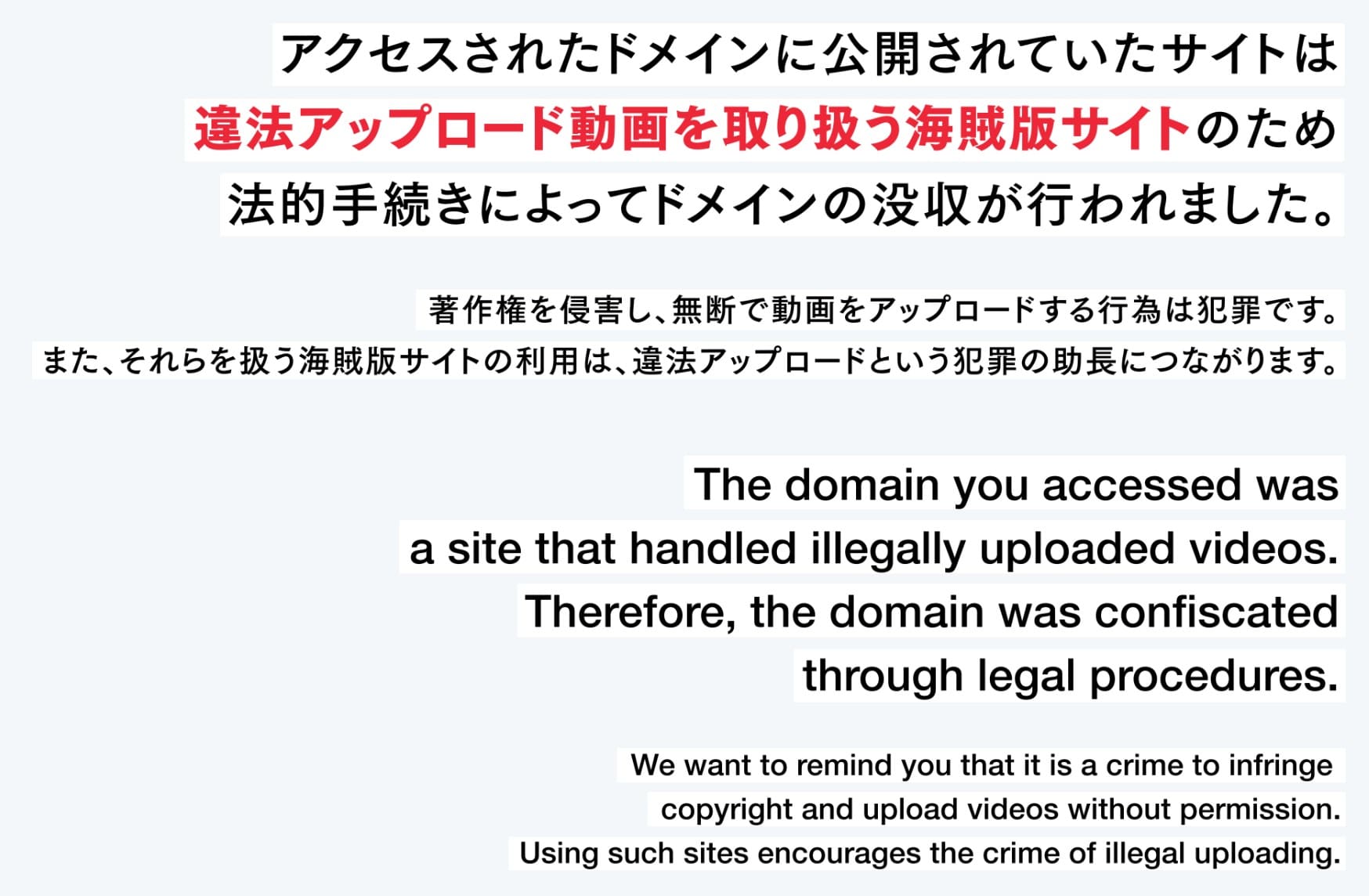
    Perhaps of equal importance is the injunctive relief which allowed Will Co. to take control of the domain names through the .com domain registry VeriSign. This took some time to process, but the handover is now complete with all domains pointing to a seizure banner.

    Seized

    seized

    Domain Seizures Send an Important Message

    Anti-piracy firm Battleship Stance , which helped to orchestrate the enforcement action against MissAV and ThisAV, is happy with the outcome of the long fought legal battle.

    “We are pleased with this ruling, which not only delivers justice for Will Co. but also strengthens the position of creators in their fight against international piracy,” says Jason Tucker, president of Battleship Stance.

    The U.S. court order against foreign pirate sites is particularly important, as this indicates that rightsholders can take effective legal action against stubborn pirate sites.

    “The transfer of these domains sends a clear message to pirate operators that they risk losing their assets when they steal content. Our commitment to defending creative works remains unwavering as we continue the fight against digital piracy,” Tucker explains.

    Lead counsel for the plaintiff Spencer Freeman agrees, noting that the case shows that foreign websites with ties to the U.S. can be held accountable.

    “This case sets a precedent for stronger enforcement of U.S. copyright laws against foreign entities. It underscores the importance of pursuing legal action across borders to protect intellectual property rights globally,” he says.

    MissAV Remains Online

    Despite the positive comments, MissAV and the related sites are not completely out of action. The site registered a new .ws domain name and continues to operate from there, not mentioning any of its legal troubles.

    Jason Tucker of Battleship Stance informs TorrentFreak that they are aware of these new domains and that legal actions are already underway to prevent the further spread of pirated content.

    For now, however, Will Co. is celebrating its win. And after this success in the Washington District Court, it’s likely that Will Co. and other rightsholders will try to use a similar procedure to go after more pirate sites in the future.

    From: TF , for the latest news on copyright battles, piracy and more.

    • To chevron_right

      Court Orders Pirate Site MissAV to Pay $4.5m in Damages, Domains Seized

      news.movim.eu / TorrentFreak • 17 January 2025 • 3 minutes

    missav With billions of annual visits, MissAV ranked among the top 60 most-visited websites on the internet.

    For years, the site appeared to operate without any significant setbacks, but that changed a few days ago, when several domain names including MissAV.com and ThisAV.com were seized.

    Initially, it wasn’t clear how permanent these seizures were, as the domains briefly became accessible again. However, that changed a few hours ago when the Japanese adult entertainment producer Will Co. LTD announced that these actions are backed up by a U.S. federal court order.

    The company sued the foreign defendants Ka Yeung Lee, Youhaha Marketing, Promotion Limited, and several “John Does”, holding them responsible for the copyright infringing activities on MissAV.com, ThisAV.com, and several related domains.

    In the early stages, the defense argued that the American court had no jurisdiction over the defendants, who are mostly linked to Hong Kong. However, the Washington District Court disagreed and allowed the case to continue.

    $4.5m Default Judgment

    When the defendants eventually stopped responding, the Japanese rightsholder requested a default judgment in its favor.

    In addition to seeking $45 million in damages for copyright infringement, the plaintiff requested an injunction allowing it to take control of several pirate domains, including thisav.com, missav.com, myav.com, missav789.com, vassim.com, eightcha.com, and fivetiu.com.

    The default judgment was granted last week, effectively putting an end to the case. Instead of the requested $150,000 for each of the 300 infringed works, the court settled on a tenth of that , bringing the total damages award to a still sizable $4.5 million.

    The order ( pdf )

    order

    Perhaps of equal importance is the injunctive relief which allowed Will Co. to take control of the domain names through the .com domain registry VeriSign. This took some time to process, but the handover is now complete with all domains pointing to a seizure banner.

    Seized

    seized

    Domain Seizures Send an Important Message

    Anti-piracy firm Battleship Stance , which helped to orchestrate the enforcement action against MissAV and ThisAV, is happy with the outcome of the long fought legal battle.

    “We are pleased with this ruling, which not only delivers justice for Will Co. but also strengthens the position of creators in their fight against international piracy,” says Jason Tucker, president of Battleship Stance.

    The U.S. court order against foreign pirate sites is particularly important, as this indicates that rightsholders can take effective legal action against stubborn pirate sites.

    “The transfer of these domains sends a clear message to pirate operators that they risk losing their assets when they steal content. Our commitment to defending creative works remains unwavering as we continue the fight against digital piracy,” Tucker explains.

    Lead counsel for the plaintiff Spencer Freeman agrees, noting that the case shows that foreign websites with ties to the U.S. can be held accountable.

    “This case sets a precedent for stronger enforcement of U.S. copyright laws against foreign entities. It underscores the importance of pursuing legal action across borders to protect intellectual property rights globally,” he says.

    MissAV Remains Online

    Despite the positive comments, MissAV and the related sites are not completely out of action. The site registered a new .ws domain name and continues to operate from there, not mentioning any of its legal troubles.

    Jason Tucker of Battleship Stance informs TorrentFreak that they are aware of these new domains and that legal actions are already underway to prevent the further spread of pirated content.

    For now, however, Will Co. is celebrating its win. And after this success in the Washington District Court, it’s likely that Will Co. and other rightsholders will try to use a similar procedure to go after more pirate sites in the future.

    From: TF , for the latest news on copyright battles, piracy and more.

    • To chevron_right

      Court Orders Pirate Site MissAV to Pay $4.5m in Damages, Domains Seized

      news.movim.eu / TorrentFreak • 17 January 2025 • 3 minutes

    missav With billions of annual visits, MissAV ranked among the top 60 most-visited websites on the internet.

    For years, the site appeared to operate without any significant setbacks, but that changed a few days ago, when several domain names including MissAV.com and ThisAV.com were seized.

    Initially, it wasn’t clear how permanent these seizures were, as the domains briefly became accessible again. However, that changed a few hours ago when the Japanese adult entertainment producer Will Co. LTD announced that these actions are backed up by a U.S. federal court order.

    The company sued the foreign defendants Ka Yeung Lee, Youhaha Marketing, Promotion Limited, and several “John Does”, holding them responsible for the copyright infringing activities on MissAV.com, ThisAV.com, and several related domains.

    In the early stages, the defense argued that the American court had no jurisdiction over the defendants, who are mostly linked to Hong Kong. However, the Washington District Court disagreed and allowed the case to continue.

    $4.5m Default Judgment

    When the defendants eventually stopped responding, the Japanese rightsholder requested a default judgment in its favor.

    In addition to seeking $45 million in damages for copyright infringement, the plaintiff requested an injunction allowing it to take control of several pirate domains, including thisav.com, missav.com, myav.com, missav789.com, vassim.com, eightcha.com, and fivetiu.com.

    The default judgment was granted last week, effectively putting an end to the case. Instead of the requested $150,000 for each of the 300 infringed works, the court settled on a tenth of that , bringing the total damages award to a still sizable $4.5 million.

    The order ( pdf )

    order

    Perhaps of equal importance is the injunctive relief which allowed Will Co. to take control of the domain names through the .com domain registry VeriSign. This took some time to process, but the handover is now complete with all domains pointing to a seizure banner.

    Seized

    seized

    Domain Seizures Send an Important Message

    Anti-piracy firm Battleship Stance , which helped to orchestrate the enforcement action against MissAV and ThisAV, is happy with the outcome of the long fought legal battle.

    “We are pleased with this ruling, which not only delivers justice for Will Co. but also strengthens the position of creators in their fight against international piracy,” says Jason Tucker, president of Battleship Stance.

    The U.S. court order against foreign pirate sites is particularly important, as this indicates that rightsholders can take effective legal action against stubborn pirate sites.

    “The transfer of these domains sends a clear message to pirate operators that they risk losing their assets when they steal content. Our commitment to defending creative works remains unwavering as we continue the fight against digital piracy,” Tucker explains.

    Lead counsel for the plaintiff Spencer Freeman agrees, noting that the case shows that foreign websites with ties to the U.S. can be held accountable.

    “This case sets a precedent for stronger enforcement of U.S. copyright laws against foreign entities. It underscores the importance of pursuing legal action across borders to protect intellectual property rights globally,” he says.

    MissAV Remains Online

    Despite the positive comments, MissAV and the related sites are not completely out of action. The site registered a new .ws domain name and continues to operate from there, not mentioning any of its legal troubles.

    Jason Tucker of Battleship Stance informs TorrentFreak that they are aware of these new domains and that legal actions are already underway to prevent the further spread of pirated content.

    For now, however, Will Co. is celebrating its win. And after this success in the Washington District Court, it’s likely that Will Co. and other rightsholders will try to use a similar procedure to go after more pirate sites in the future.

    From: TF , for the latest news on copyright battles, piracy and more.

    • To chevron_right

      Poppy Playtime Sues Google for Failing to Remove Copyright Infringing ‘Scam’ Apps

      news.movim.eu / TorrentFreak • 16 January 2025 • 3 minutes

    playtime With 40 million players worldwide and over a billion views on YouTube, the Poppy Playtime game series has gained a massive following.

    Created by the American indie game studio Mob Entertainment, the game is particularly popular among fans of horror games and online content creators. A planned Poppy Playtime live action movie will only add to this lure.

    Poppy Playtime’s success hasn’t gone unnoticed. As is often the case, popular games serve as inspiration for other developers. That’s fine, but when others use the same brand and content to attract users, a line is clearly being crossed.

    ‘Copyright Infringing Scam Apps’

    According to Mob Entertainment, this is precisely what happened on Google Play. In a new lawsuit filed at a federal court in California, Poppy Playtime’s creators accuse developer ‘Daigo Game 2020, Inc’ of releasing ‘scam’ applications on Google Play.

    The unauthorized games versions were advertised as “Poppy Playtime: Chapter 3” and “Poppy Playtime: Chapter 4” and allegedly contain many works protected by Mob Entertainment’s copyright. The comparison below does indeed show striking similarities.

    Similarities
    poppy

    Poppy Playtime’s developer notes that these knockoff games confused many thousands of players, not least due to ‘Chapter 3’ and ‘Chapter 4’ bring uploaded to Google Play before these versions were officially released.

    Aside from using Poppy Playtime’s name, logo, and characters, the ‘scam’ apps offer very little to the user. The complaint notes that the app is not a game at all. Instead, it asks users to pay $30 to $95 for the “Guide wuggy playtime mod.”

    “When users pay for the “Guide wuggy playtime mod,” all they receive is a link to a dead webpage,” the complaint notes.

    ‘Google Play Failed to Take Apps Offline’

    The complaint doesn’t just target the developers of these alleged scam apps, it also lists Google as a defendant. The plaintiffs allege that Google receives 15% or 30% of the unauthorized sales and failed to take proper action in response to DMCA notices.

    Mob Entertainment says it contacted Google on various occasions, using the web-based takedown form and the email address dmca-agent@google.com . These requests to remove the allegedly infringing app didn’t yield a satisfactory result and can be summarized as follows.


    – October 31, 2024: Takedown request sent for unauthorized Poppy Playtime Chapter 3 app

    – November 1, 2024: Google confirms receipt

    – December 5, 2024: No response, Mob Entertainment sends a follow-up

    – December 9, 2024: Google responds, stating that the app will be removed

    – December 9, 2024: Google removes “Poppy Playtime Chapter 3”

    – December 13, 2024: “Poppy Playtime Chapter 3” returns to the Play Store (same URL)

    – December 13, 2024: Mob Entertainment informs Google that the app returned

    – December 16, 2024: Google confirms receipt

    – December 19, 2024: Mob Entertainment sends another DMCA takedown notice

    – December 19, 2024: Google asks the developer to use the web-based takedown form

    – December 30, 2024: Takedown request sent for unauthorized Poppy Playtime Chapter 4

    – December 30, 2024: Google confirms receipt


    Mob Entertainment argues that, despite these efforts, Google did not expeditiously remove the copyright infringing applications, which are still available in the Play Store to this day.

    Scam apps?
    playtime

    Poppy Playtime Requests Damages

    Google’s alleged inaction makes the company ineligible for DMCA safe harbor protection, the lawsuit notes. As such, it can be held liable for copyright infringement.

    “Google forfeited the benefits of the DMCA’s safe harbor provision for its infringement of Mob Entertainment’s copyrighted works contained in the unauthorized ‘Poppy Playtime: Chapter 3’ and ‘Poppy Playtime Chapter 4’ applications.”

    Mob Entertainment accuses Google and Daigo of both copyright and trademark infringement, and they request to be compensated. This includes potential statutory damages of $150,000 per work.

    In addition, the indie game developer seeks an injunction preventing both Google and Daigo from infringing its copyrights and trademarks going forward.

    A copy of Mob Entertainment’s complaint against Google and Daigo, filed yesterday at the California federal court, is available here (pdf) . Neither defendant has responded to the lawsuit thus far.

    From: TF , for the latest news on copyright battles, piracy and more.

    • To chevron_right

      Poppy Playtime Sues Google for Failing to Remove Copyright Infringing ‘Scam’ Apps

      news.movim.eu / TorrentFreak • 16 January 2025 • 3 minutes

    playtime With 40 million players worldwide and over a billion views on YouTube, the Poppy Playtime game series has gained a massive following.

    Created by the American indie game studio Mob Entertainment, the game is particularly popular among fans of horror games and online content creators. A planned Poppy Playtime live action movie will only add to this lure.

    Poppy Playtime’s success hasn’t gone unnoticed. As is often the case, popular games serve as inspiration for other developers. That’s fine, but when others use the same brand and content to attract users, a line is clearly being crossed.

    ‘Copyright Infringing Scam Apps’

    According to Mob Entertainment, this is precisely what happened on Google Play. In a new lawsuit filed at a federal court in California, Poppy Playtime’s creators accuse developer ‘Daigo Game 2020, Inc’ of releasing ‘scam’ applications on Google Play.

    The unauthorized games versions were advertised as “Poppy Playtime: Chapter 3” and “Poppy Playtime: Chapter 4” and allegedly contain many works protected by Mob Entertainment’s copyright. The comparison below does indeed show striking similarities.

    Similarities
    poppy

    Poppy Playtime’s developer notes that these knockoff games confused many thousands of players, not least due to ‘Chapter 3’ and ‘Chapter 4’ bring uploaded to Google Play before these versions were officially released.

    Aside from using Poppy Playtime’s name, logo, and characters, the ‘scam’ apps offer very little to the user. The complaint notes that the app is not a game at all. Instead, it asks users to pay $30 to $95 for the “Guide wuggy playtime mod.”

    “When users pay for the “Guide wuggy playtime mod,” all they receive is a link to a dead webpage,” the complaint notes.

    ‘Google Play Failed to Take Apps Offline’

    The complaint doesn’t just target the developers of these alleged scam apps, it also lists Google as a defendant. The plaintiffs allege that Google receives 15% or 30% of the unauthorized sales and failed to take proper action in response to DMCA notices.

    Mob Entertainment says it contacted Google on various occasions, using the web-based takedown form and the email address dmca-agent@google.com . These requests to remove the allegedly infringing app didn’t yield a satisfactory result and can be summarized as follows.


    – October 31, 2024: Takedown request sent for unauthorized Poppy Playtime Chapter 3 app

    – November 1, 2024: Google confirms receipt

    – December 5, 2024: No response, Mob Entertainment sends a follow-up

    – December 9, 2024: Google responds, stating that the app will be removed

    – December 9, 2024: Google removes “Poppy Playtime Chapter 3”

    – December 13, 2024: “Poppy Playtime Chapter 3” returns to the Play Store (same URL)

    – December 13, 2024: Mob Entertainment informs Google that the app returned

    – December 16, 2024: Google confirms receipt

    – December 19, 2024: Mob Entertainment sends another DMCA takedown notice

    – December 19, 2024: Google asks the developer to use the web-based takedown form

    – December 30, 2024: Takedown request sent for unauthorized Poppy Playtime Chapter 4

    – December 30, 2024: Google confirms receipt


    Mob Entertainment argues that, despite these efforts, Google did not expeditiously remove the copyright infringing applications, which are still available in the Play Store to this day.

    Scam apps?
    playtime

    Poppy Playtime Requests Damages

    Google’s alleged inaction makes the company ineligible for DMCA safe harbor protection, the lawsuit notes. As such, it can be held liable for copyright infringement.

    “Google forfeited the benefits of the DMCA’s safe harbor provision for its infringement of Mob Entertainment’s copyrighted works contained in the unauthorized ‘Poppy Playtime: Chapter 3’ and ‘Poppy Playtime Chapter 4’ applications.”

    Mob Entertainment accuses Google and Daigo of both copyright and trademark infringement, and they request to be compensated. This includes potential statutory damages of $150,000 per work.

    In addition, the indie game developer seeks an injunction preventing both Google and Daigo from infringing its copyrights and trademarks going forward.

    A copy of Mob Entertainment’s complaint against Google and Daigo, filed yesterday at the California federal court, is available here (pdf) . Neither defendant has responded to the lawsuit thus far.

    From: TF , for the latest news on copyright battles, piracy and more.

    • To chevron_right

      Poppy Playtime Sues Google for Failing to Remove Copyright Infringing ‘Scam’ Apps

      news.movim.eu / TorrentFreak • 16 January 2025 • 3 minutes

    playtime With 40 million players worldwide and over a billion views on YouTube, the Poppy Playtime game series has gained a massive following.

    Created by the American indie game studio Mob Entertainment, the game is particularly popular among fans of horror games and online content creators. A planned Poppy Playtime live action movie will only add to this lure.

    Poppy Playtime’s success hasn’t gone unnoticed. As is often the case, popular games serve as inspiration for other developers. That’s fine, but when others use the same brand and content to attract users, a line is clearly being crossed.

    ‘Copyright Infringing Scam Apps’

    According to Mob Entertainment, this is precisely what happened on Google Play. In a new lawsuit filed at a federal court in California, Poppy Playtime’s creators accuse developer ‘Daigo Game 2020, Inc’ of releasing ‘scam’ applications on Google Play.

    The unauthorized games versions were advertised as “Poppy Playtime: Chapter 3” and “Poppy Playtime: Chapter 4” and allegedly contain many works protected by Mob Entertainment’s copyright. The comparison below does indeed show striking similarities.

    Similarities
    poppy

    Poppy Playtime’s developer notes that these knockoff games confused many thousands of players, not least due to ‘Chapter 3’ and ‘Chapter 4’ bring uploaded to Google Play before these versions were officially released.

    Aside from using Poppy Playtime’s name, logo, and characters, the ‘scam’ apps offer very little to the user. The complaint notes that the app is not a game at all. Instead, it asks users to pay $30 to $95 for the “Guide wuggy playtime mod.”

    “When users pay for the “Guide wuggy playtime mod,” all they receive is a link to a dead webpage,” the complaint notes.

    ‘Google Play Failed to Take Apps Offline’

    The complaint doesn’t just target the developers of these alleged scam apps, it also lists Google as a defendant. The plaintiffs allege that Google receives 15% or 30% of the unauthorized sales and failed to take proper action in response to DMCA notices.

    Mob Entertainment says it contacted Google on various occasions, using the web-based takedown form and the email address dmca-agent@google.com . These requests to remove the allegedly infringing app didn’t yield a satisfactory result and can be summarized as follows.


    – October 31, 2024: Takedown request sent for unauthorized Poppy Playtime Chapter 3 app

    – November 1, 2024: Google confirms receipt

    – December 5, 2024: No response, Mob Entertainment sends a follow-up

    – December 9, 2024: Google responds, stating that the app will be removed

    – December 9, 2024: Google removes “Poppy Playtime Chapter 3”

    – December 13, 2024: “Poppy Playtime Chapter 3” returns to the Play Store (same URL)

    – December 13, 2024: Mob Entertainment informs Google that the app returned

    – December 16, 2024: Google confirms receipt

    – December 19, 2024: Mob Entertainment sends another DMCA takedown notice

    – December 19, 2024: Google asks the developer to use the web-based takedown form

    – December 30, 2024: Takedown request sent for unauthorized Poppy Playtime Chapter 4

    – December 30, 2024: Google confirms receipt


    Mob Entertainment argues that, despite these efforts, Google did not expeditiously remove the copyright infringing applications, which are still available in the Play Store to this day.

    Scam apps?
    playtime

    Poppy Playtime Requests Damages

    Google’s alleged inaction makes the company ineligible for DMCA safe harbor protection, the lawsuit notes. As such, it can be held liable for copyright infringement.

    “Google forfeited the benefits of the DMCA’s safe harbor provision for its infringement of Mob Entertainment’s copyrighted works contained in the unauthorized ‘Poppy Playtime: Chapter 3’ and ‘Poppy Playtime Chapter 4’ applications.”

    Mob Entertainment accuses Google and Daigo of both copyright and trademark infringement, and they request to be compensated. This includes potential statutory damages of $150,000 per work.

    In addition, the indie game developer seeks an injunction preventing both Google and Daigo from infringing its copyrights and trademarks going forward.

    A copy of Mob Entertainment’s complaint against Google and Daigo, filed yesterday at the California federal court, is available here (pdf) . Neither defendant has responded to the lawsuit thus far.

    From: TF , for the latest news on copyright battles, piracy and more.