• To chevron_right

      Musi Faked UMG Email to Stay on App Store, Apple Claims in Sanctions Motion

      news.movim.eu / TorrentFreak • 6 May 2025 • 3 minutes

    musi logo Last September, Apple removed popular music streaming app Musi from its App Store, affecting millions of users.

    Apple’s action didn’t come as a complete surprise. Music industry groups had been trying to take Musi down for months, branding it a ‘parasitic’ app that skirts the rules.

    Delisting from the App Store put the future of Musi directly at risk. The company initially hoped to resolve the matter with Apple behind closed doors, but since the tech giant was unwilling to reverse its decision, Musi took the matter to court.

    “Backchannel Scheme”

    Musi claimed that the App Store removal was the result of “backroom conversations” between Apple and key music industry players. The app developer alleged this was an “unfair” and “tainted” removal process designed to put it out of business.

    Musi hoped for a quick reinstatement and requested a preliminary injunction to put the app back in the App Store while the lawsuit was pending. That attempt failed, however.

    In January, a California federal court denied the preliminary injunction, ruling that Apple did not act unreasonably or in bad faith when it removed the app following complaints from music industry players and YouTube.

    The order meant that the case would continue without Musi being available in the App Store. And a new filing submitted by Apple, shows that the company has absolutely no intention to change its mind.

    Apple Returns Fire

    In a motion for sanctions filed yesterday at the California court, Apple requests sanctions against Musi for false or misleading allegations, which include the remarks concerning the “backchannel scheme”.

    According to Apple, discovery in this case clearly revealed that there were no backroom deals but Musi nonetheless included these claims in its amended complaint.

    “[D]iscovery thoroughly disproved Musi’s baseless conspiracy theory that Apple schemed to eliminate the Musi app from the App Store to benefit ‘friends’ in the music industry,” Apple notes.

    “To make matters worse, Musi attempted to give its falsehoods a veneer of truth by provisionally redacting many allegations and misrepresenting to the Court that those allegations reflected information Apple produced in discovery.”

    These alleged misrepresentations are sanctionable, Apple argues. The tech giant reiterates that it received numerous complaints about Musi from various parties and dismisses the notion of a backchannel scheme.

    Apple: ‘Musi Impersonated UMG’

    Adding to the purported misrepresentations in the complaint, Apple adds further color by alleging that Musi previously impersonated UMG executive Jason Miller, to get reinstated in the App Store.

    “Apple previously removed Musi’s app from the App Store and Musi only regained access in 2020 by fraudulently impersonating a complainant,” Apple writes.

    Exhibits shared by Apple show that Musi informed Apple that a complaint from UMG was resolved, citing communications with jasonmiller@umusic.solar-secure.com. Musi founder Aaron Wojnowski forwarded this email chain to Apple, which seemingly confirmed this.
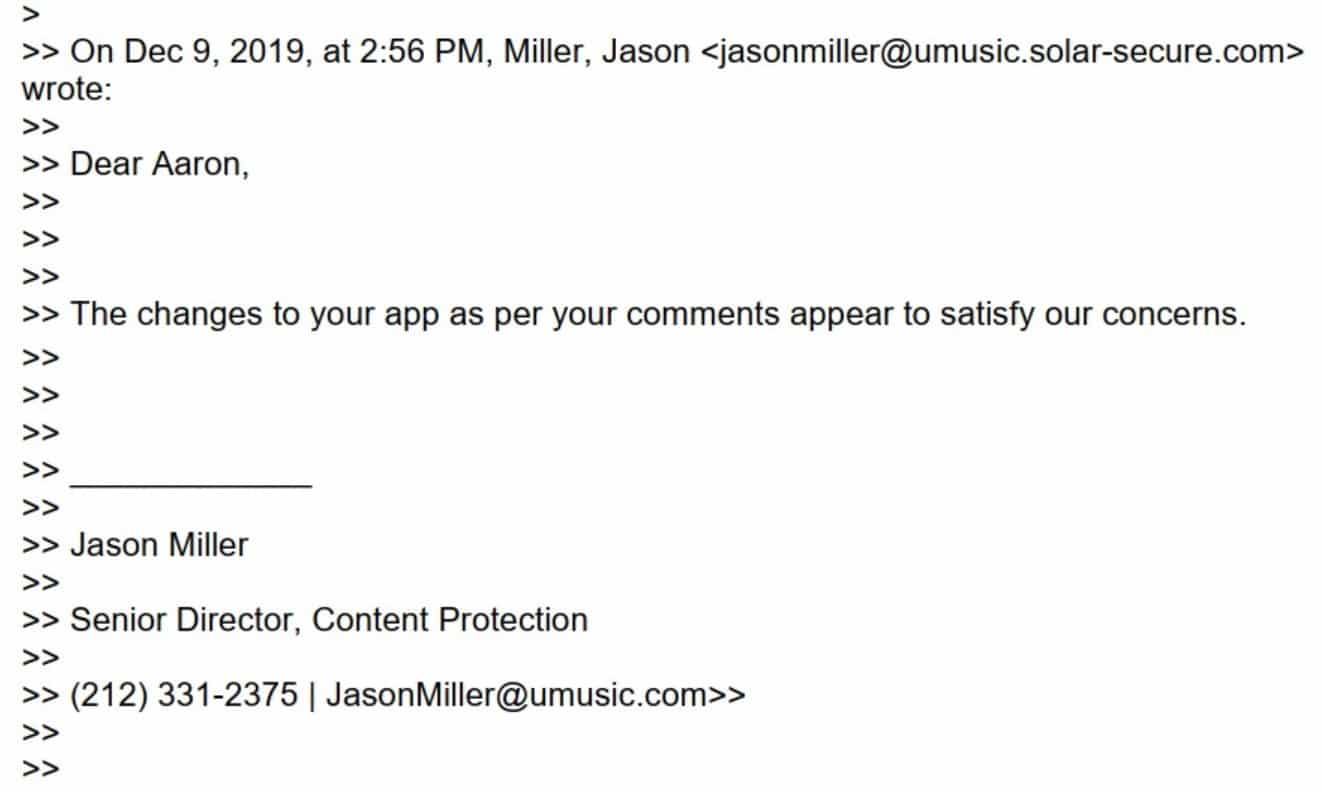
    Forwarded email

    umg

    Follow-up communications between Apple and Universal Music painted a different picture. UMG informed Apple that the email was “fraudulent,” that Jason Miller had no record of sending it, and the email address used was not a UMG address.

    “It appears that the app developer created a false email to misrepresent compliance on behalf of Universal. Therefore, the claim should not be closed and the app should be removed immediately,” UMG explained at the time.
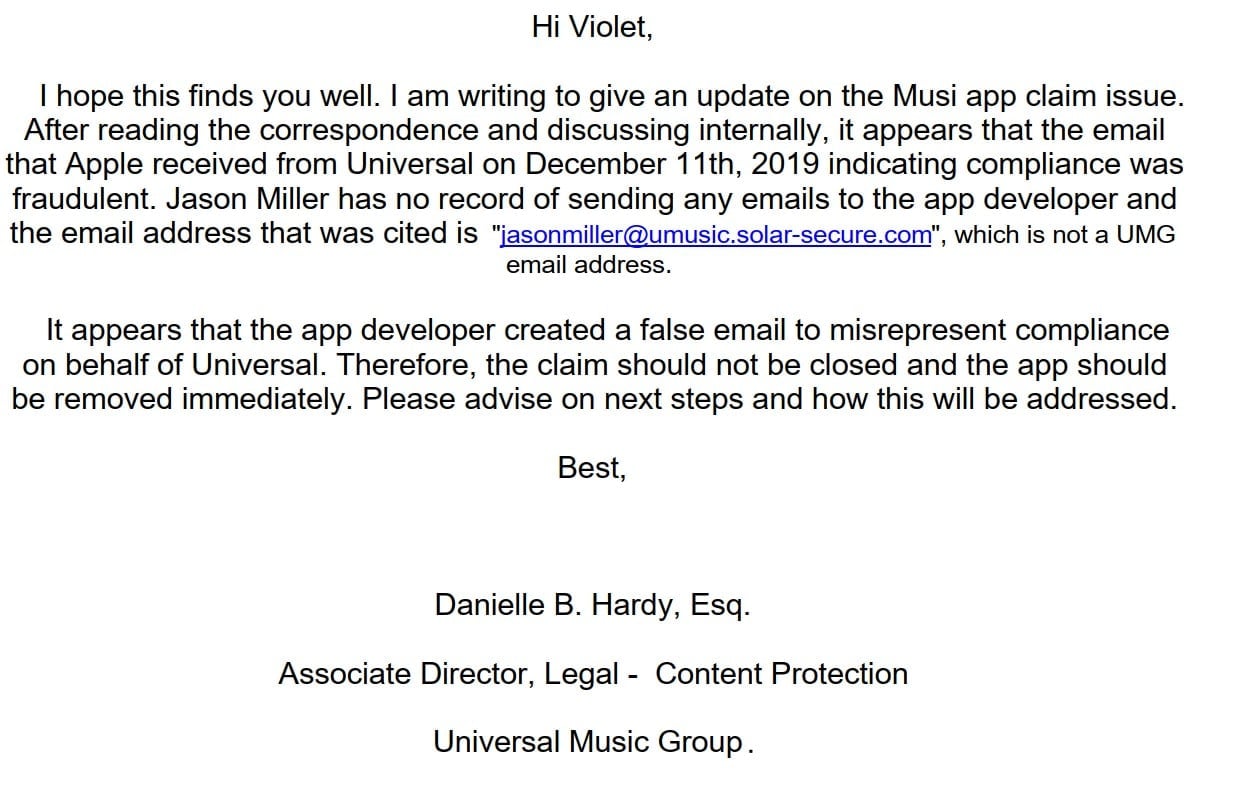
    ‘Fraudulent’

    fraudulent

    Making matters worse, in July 2020 UMG informed Apple of another instance where the same fraudulent ‘Jason Miller’ email address was allegedly used to file a false copyright claim against a different app, Yokee.

    Despite the alleged impersonation, Musi remained available in the App Store until last year. However, according to Apple, the alleged impersonation is further evidence of a pattern of dishonesty, which warrants sanctions.

    It is now up to the court to review the evidence and decide whether it proves that Musi did indeed cross the line and if sanctions are warranted. Meanwhile, Apple’s motion to dismiss the entire case also remains pending.

    —-

    A copy of Apple’s memorandum supporting its motion for sanctions, filed at the U.S. District Court for the Northern District of California, is available here (pdf)

    From: TF , for the latest news on copyright battles, piracy and more.

    • To chevron_right

      Musi Faked UMG Email to Stay on App Store, Apple Claims in Sanctions Motion

      news.movim.eu / TorrentFreak • 6 May 2025 • 3 minutes

    musi logo Last September, Apple removed popular music streaming app Musi from its App Store, affecting millions of users.

    Apple’s action didn’t come as a complete surprise. Music industry groups had been trying to take Musi down for months, branding it a ‘parasitic’ app that skirts the rules.

    Delisting from the App Store put the future of Musi directly at risk. The company initially hoped to resolve the matter with Apple behind closed doors, but since the tech giant was unwilling to reverse its decision, Musi took the matter to court.

    “Backchannel Scheme”

    Musi claimed that the App Store removal was the result of “backroom conversations” between Apple and key music industry players. The app developer alleged this was an “unfair” and “tainted” removal process designed to put it out of business.

    Musi hoped for a quick reinstatement and requested a preliminary injunction to put the app back in the App Store while the lawsuit was pending. That attempt failed, however.

    In January, a California federal court denied the preliminary injunction, ruling that Apple did not act unreasonably or in bad faith when it removed the app following complaints from music industry players and YouTube.

    The order meant that the case would continue without Musi being available in the App Store. And a new filing submitted by Apple, shows that the company has absolutely no intention to change its mind.

    Apple Returns Fire

    In a motion for sanctions filed yesterday at the California court, Apple requests sanctions against Musi for false or misleading allegations, which include the remarks concerning the “backchannel scheme”.

    According to Apple, discovery in this case clearly revealed that there were no backroom deals but Musi nonetheless included these claims in its amended complaint.

    “[D]iscovery thoroughly disproved Musi’s baseless conspiracy theory that Apple schemed to eliminate the Musi app from the App Store to benefit ‘friends’ in the music industry,” Apple notes.

    “To make matters worse, Musi attempted to give its falsehoods a veneer of truth by provisionally redacting many allegations and misrepresenting to the Court that those allegations reflected information Apple produced in discovery.”

    These alleged misrepresentations are sanctionable, Apple argues. The tech giant reiterates that it received numerous complaints about Musi from various parties and dismisses the notion of a backchannel scheme.

    Apple: ‘Musi Impersonated UMG’

    Adding to the purported misrepresentations in the complaint, Apple adds further color by alleging that Musi previously impersonated UMG executive Jason Miller, to get reinstated in the App Store.

    “Apple previously removed Musi’s app from the App Store and Musi only regained access in 2020 by fraudulently impersonating a complainant,” Apple writes.

    Exhibits shared by Apple show that Musi informed Apple that a complaint from UMG was resolved, citing communications with jasonmiller@umusic.solar-secure.com. Musi founder Aaron Wojnowski forwarded this email chain to Apple, which seemingly confirmed this.

    Forwarded email

    umg

    Follow-up communications between Apple and Universal Music painted a different picture. UMG informed Apple that the email was “fraudulent,” that Jason Miller had no record of sending it, and the email address used was not a UMG address.

    “It appears that the app developer created a false email to misrepresent compliance on behalf of Universal. Therefore, the claim should not be closed and the app should be removed immediately,” UMG explained at the time.

    ‘Fraudulent’

    fraudulent

    Making matters worse, in July 2020 UMG informed Apple of another instance where the same fraudulent ‘Jason Miller’ email address was allegedly used to file a false copyright claim against a different app, Yokee.

    Despite the alleged impersonation, Musi remained available in the App Store until last year. However, according to Apple, the alleged impersonation is further evidence of a pattern of dishonesty, which warrants sanctions.

    It is now up to the court to review the evidence and decide whether it proves that Musi did indeed cross the line and if sanctions are warranted. Meanwhile, Apple’s motion to dismiss the entire case also remains pending.

    —-

    A copy of Apple’s memorandum supporting its motion for sanctions, filed at the U.S. District Court for the Northern District of California, is available here (pdf)

    From: TF , for the latest news on copyright battles, piracy and more.

    • To chevron_right

      Musi Faked UMG Email to Stay on App Store, Apple Claims in Sanctions Motion

      news.movim.eu / TorrentFreak • 6 May 2025 • 3 minutes

    musi logo Last September, Apple removed popular music streaming app Musi from its App Store, affecting millions of users.

    Apple’s action didn’t come as a complete surprise. Music industry groups had been trying to take Musi down for months, branding it a ‘parasitic’ app that skirts the rules.

    Delisting from the App Store put the future of Musi directly at risk. The company initially hoped to resolve the matter with Apple behind closed doors, but since the tech giant was unwilling to reverse its decision, Musi took the matter to court.

    “Backchannel Scheme”

    Musi claimed that the App Store removal was the result of “backroom conversations” between Apple and key music industry players. The app developer alleged this was an “unfair” and “tainted” removal process designed to put it out of business.

    Musi hoped for a quick reinstatement and requested a preliminary injunction to put the app back in the App Store while the lawsuit was pending. That attempt failed, however.

    In January, a California federal court denied the preliminary injunction, ruling that Apple did not act unreasonably or in bad faith when it removed the app following complaints from music industry players and YouTube.

    The order meant that the case would continue without Musi being available in the App Store. And a new filing submitted by Apple, shows that the company has absolutely no intention to change its mind.

    Apple Returns Fire

    In a motion for sanctions filed yesterday at the California court, Apple requests sanctions against Musi for false or misleading allegations, which include the remarks concerning the “backchannel scheme”.

    According to Apple, discovery in this case clearly revealed that there were no backroom deals but Musi nonetheless included these claims in its amended complaint.

    “[D]iscovery thoroughly disproved Musi’s baseless conspiracy theory that Apple schemed to eliminate the Musi app from the App Store to benefit ‘friends’ in the music industry,” Apple notes.

    “To make matters worse, Musi attempted to give its falsehoods a veneer of truth by provisionally redacting many allegations and misrepresenting to the Court that those allegations reflected information Apple produced in discovery.”

    These alleged misrepresentations are sanctionable, Apple argues. The tech giant reiterates that it received numerous complaints about Musi from various parties and dismisses the notion of a backchannel scheme.

    Apple: ‘Musi Impersonated UMG’

    Adding to the purported misrepresentations in the complaint, Apple adds further color by alleging that Musi previously impersonated UMG executive Jason Miller, to get reinstated in the App Store.

    “Apple previously removed Musi’s app from the App Store and Musi only regained access in 2020 by fraudulently impersonating a complainant,” Apple writes.

    Exhibits shared by Apple show that Musi informed Apple that a complaint from UMG was resolved, citing communications with jasonmiller@umusic.solar-secure.com. Musi founder Aaron Wojnowski forwarded this email chain to Apple, which seemingly confirmed this.

    Forwarded email

    umg

    Follow-up communications between Apple and Universal Music painted a different picture. UMG informed Apple that the email was “fraudulent,” that Jason Miller had no record of sending it, and the email address used was not a UMG address.

    “It appears that the app developer created a false email to misrepresent compliance on behalf of Universal. Therefore, the claim should not be closed and the app should be removed immediately,” UMG explained at the time.

    ‘Fraudulent’

    fraudulent

    Making matters worse, in July 2020 UMG informed Apple of another instance where the same fraudulent ‘Jason Miller’ email address was allegedly used to file a false copyright claim against a different app, Yokee.

    Despite the alleged impersonation, Musi remained available in the App Store until last year. However, according to Apple, the alleged impersonation is further evidence of a pattern of dishonesty, which warrants sanctions.

    It is now up to the court to review the evidence and decide whether it proves that Musi did indeed cross the line and if sanctions are warranted. Meanwhile, Apple’s motion to dismiss the entire case also remains pending.

    —-

    A copy of Apple’s memorandum supporting its motion for sanctions, filed at the U.S. District Court for the Northern District of California, is available here (pdf)

    From: TF , for the latest news on copyright battles, piracy and more.

    • To chevron_right

      Swedish IPTV Crackdown Tested as Users Seek Workarounds

      news.movim.eu / TorrentFreak • 5 May 2025 • 3 minutes

    nordic Originally the home of The Pirate Bay, Sweden has a long and well documented history when it comes to online piracy.

    As in other countries, however, many Swedish pirates have made the switch from relatively cumbersome torrents to on-demand streaming. That includes pirate IPTV services.

    According to recent estimates, some 700,000 Swedish households have access to illegal IPTV services. These subscriptions are sold at a very low cost, making them substantially cheaper than the official plans offered by local streaming services such as Viaplay.

    Sweden’s IPTV Crackdown

    Viaplay and other rightsholders have grown increasingly worried about this trend and these concerns have reached lawmakers too. Earlier this year, Swedish Minister of Culture, Parisa Liljestrand, said that the authorities started looking into a possible ban on viewing pirate IPTV streams.

    Punishing pirate IPTV viewers en masse is a novel concept that may be difficult to roll out in practice. Legally, it may be possible, as the Court of Justice of the European Union previously ruled that consumption of pirate streams is illegal. However, since there is no public information available on who these subscribers are, tracking them down may prove challenging.

    Meanwhile, rightsholders were working on a more direct approach. Earlier this year, rightsholders including Viaplay, TV4, and Discovery took legal action in court to order local ISP Telenor to block access to the popular local IPTV service NordicOne, or N1 for short.

    Court Issues Broad IPTV Blocking Order

    After reviewing the complaint, the Patent and Market Court in Stockholm ordered Telenor to immediately block its subscribers’ access to the NordicOne IPTV service. Failure to comply carries a potential fine of 500,000 SEK ($50,000 USD).

    Skånska Dagbladet reports that the court deemed the blocking order appropriate, effective, and proportional. Telenor must block a list of specific domains associated with NordicOne, including ‘clientsportals.com’, ‘n1ip.tv’, ‘ptv.is’, and must also block any future domains used by the service upon notification.

    The order against Telenor remains valid for three years and further reports suggest that it doesn’t come in isolation. According to Dagens Media, Tele2 and Tre have been ordered to implement similar blocking measures.

    Through these blockades, Viaplay, Discovery and TV4 hope that IPTV subscribers will give up on their pirate habits, switching to official subscriptions instead. While some may indeed give up facing these blockades, others seek workarounds.

    Cat and Mouse

    Over the past days, Swedes complained bitterly about the blockades through online forums and messaging apps, while searching for workarounds. In the popular Flashback forums, for example, several people share new URLs through which they can regain access.

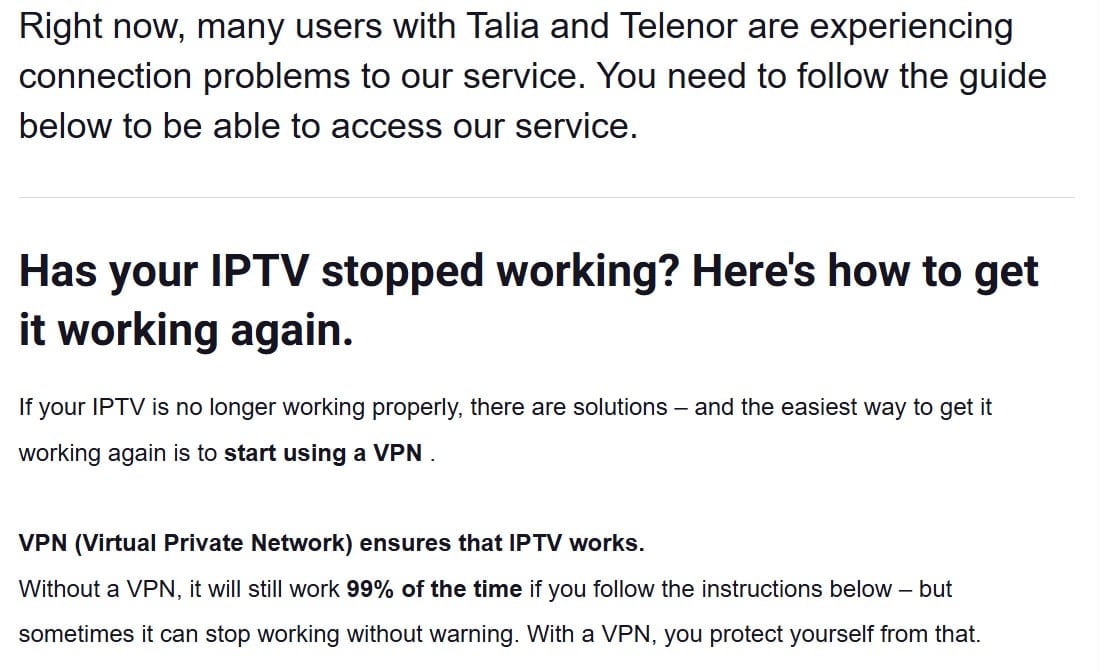
    Others mention other known workarounds, including the use of VPN services and alternative DNS resolvers. The effectiveness of alternative DNS resolvers suggests that the blocking measures are implemented primarily through the ISPs’ DNS servers.

    NordiskIPTV, likely a reseller service that was caught up in the blocking action, posted a public message pointing users to new portal URLs. Alternatively, they also mention VPNs as a workaround.

    NordiskIPTV message (translated)

    nordisk

    This cat-and-mouse game is not new; it is illustrative of the responses we have seen to blocking measures over the past fifteen years. The question now is whether Viaplay and the other rightsholders will take action in response.

    The court order allows rightsholders to add additional domain names to the blocking order, but VPNs and alternative DNS providers are not covered.

    Recently, rightsholders in other countries, including France , have applied for blocking orders against DNS providers such as Google and Cloudflare, and VPN providers have become a target too . Whether we will see the same in Sweden has yet to be seen.

    It’s clear, however, that the blocking scope in Europe is gradually expanding. And if it’s up to some rightsholders, even web browsers should be subject to blocking orders.

    From: TF , for the latest news on copyright battles, piracy and more.

    • To chevron_right

      Swedish IPTV Crackdown Tested as Users Seek Workarounds

      news.movim.eu / TorrentFreak • 5 May 2025 • 3 minutes

    nordic Originally the home of The Pirate Bay, Sweden has a long and well documented history when it comes to online piracy.

    As in other countries, however, many Swedish pirates have made the switch from relatively cumbersome torrents to on-demand streaming. That includes pirate IPTV services.

    According to recent estimates, some 700,000 Swedish households have access to illegal IPTV services. These subscriptions are sold at a very low cost, making them substantially cheaper than the official plans offered by local streaming services such as Viaplay.

    Sweden’s IPTV Crackdown

    Viaplay and other rightsholders have grown increasingly worried about this trend and these concerns have reached lawmakers too. Earlier this year, Swedish Minister of Culture, Parisa Liljestrand, said that the authorities started looking into a possible ban on viewing pirate IPTV streams.

    Punishing pirate IPTV viewers en masse is a novel concept that may be difficult to roll out in practice. Legally, it may be possible, as the Court of Justice of the European Union previously ruled that consumption of pirate streams is illegal. However, since there is no public information available on who these subscribers are, tracking them down may prove challenging.

    Meanwhile, rightsholders were working on a more direct approach. Earlier this year, rightsholders including Viaplay, TV4, and Discovery took legal action in court to order local ISP Telenor to block access to the popular local IPTV service NordicOne, or N1 for short.

    Court Issues Broad IPTV Blocking Order

    After reviewing the complaint, the Patent and Market Court in Stockholm ordered Telenor to immediately block its subscribers’ access to the NordicOne IPTV service. Failure to comply carries a potential fine of 500,000 SEK ($50,000 USD).

    Skånska Dagbladet reports that the court deemed the blocking order appropriate, effective, and proportional. Telenor must block a list of specific domains associated with NordicOne, including ‘clientsportals.com’, ‘n1ip.tv’, ‘ptv.is’, and must also block any future domains used by the service upon notification.

    The order against Telenor remains valid for three years and further reports suggest that it doesn’t come in isolation. According to Dagens Media, Tele2 and Tre have been ordered to implement similar blocking measures.

    Through these blockades, Viaplay, Discovery and TV4 hope that IPTV subscribers will give up on their pirate habits, switching to official subscriptions instead. While some may indeed give up facing these blockades, others seek workarounds.

    Cat and Mouse

    Over the past days, Swedes complained bitterly about the blockades through online forums and messaging apps, while searching for workarounds. In the popular Flashback forums, for example, several people share new URLs through which they can regain access.

    Others mention other known workarounds, including the use of VPN services and alternative DNS resolvers. The effectiveness of alternative DNS resolvers suggests that the blocking measures are implemented primarily through the ISPs’ DNS servers.

    NordiskIPTV, likely a reseller service that was caught up in the blocking action, posted a public message pointing users to new portal URLs. Alternatively, they also mention VPNs as a workaround.

    NordiskIPTV message (translated)

    nordisk

    This cat-and-mouse game is not new; it is illustrative of the responses we have seen to blocking measures over the past fifteen years. The question now is whether Viaplay and the other rightsholders will take action in response.

    The court order allows rightsholders to add additional domain names to the blocking order, but VPNs and alternative DNS providers are not covered.

    Recently, rightsholders in other countries, including France , have applied for blocking orders against DNS providers such as Google and Cloudflare, and VPN providers have become a target too . Whether we will see the same in Sweden has yet to be seen.

    It’s clear, however, that the blocking scope in Europe is gradually expanding. And if it’s up to some rightsholders, even web browsers should be subject to blocking orders.

    From: TF , for the latest news on copyright battles, piracy and more.

    • To chevron_right

      Swedish IPTV Crackdown Tested as Users Seek Workarounds

      news.movim.eu / TorrentFreak • 5 May 2025 • 3 minutes

    nordic Originally the home of The Pirate Bay, Sweden has a long and well documented history when it comes to online piracy.

    As in other countries, however, many Swedish pirates have made the switch from relatively cumbersome torrents to on-demand streaming. That includes pirate IPTV services.

    According to recent estimates, some 700,000 Swedish households have access to illegal IPTV services. These subscriptions are sold at a very low cost, making them substantially cheaper than the official plans offered by local streaming services such as Viaplay.

    Sweden’s IPTV Crackdown

    Viaplay and other rightsholders have grown increasingly worried about this trend and these concerns have reached lawmakers too. Earlier this year, Swedish Minister of Culture, Parisa Liljestrand, said that the authorities started looking into a possible ban on viewing pirate IPTV streams.

    Punishing pirate IPTV viewers en masse is a novel concept that may be difficult to roll out in practice. Legally, it may be possible, as the Court of Justice of the European Union previously ruled that consumption of pirate streams is illegal. However, since there is no public information available on who these subscribers are, tracking them down may prove challenging.

    Meanwhile, rightsholders were working on a more direct approach. Earlier this year, rightsholders including Viaplay, TV4, and Discovery took legal action in court to order local ISP Telenor to block access to the popular local IPTV service NordicOne, or N1 for short.

    Court Issues Broad IPTV Blocking Order

    After reviewing the complaint, the Patent and Market Court in Stockholm ordered Telenor to immediately block its subscribers’ access to the NordicOne IPTV service. Failure to comply carries a potential fine of 500,000 SEK ($50,000 USD).

    Skånska Dagbladet reports that the court deemed the blocking order appropriate, effective, and proportional. Telenor must block a list of specific domains associated with NordicOne, including ‘clientsportals.com’, ‘n1ip.tv’, ‘ptv.is’, and must also block any future domains used by the service upon notification.

    The order against Telenor remains valid for three years and further reports suggest that it doesn’t come in isolation. According to Dagens Media, Tele2 and Tre have been ordered to implement similar blocking measures.

    Through these blockades, Viaplay, Discovery and TV4 hope that IPTV subscribers will give up on their pirate habits, switching to official subscriptions instead. While some may indeed give up facing these blockades, others seek workarounds.

    Cat and Mouse

    Over the past days, Swedes complained bitterly about the blockades through online forums and messaging apps, while searching for workarounds. In the popular Flashback forums, for example, several people share new URLs through which they can regain access.

    Others mention other known workarounds, including the use of VPN services and alternative DNS resolvers. The effectiveness of alternative DNS resolvers suggests that the blocking measures are implemented primarily through the ISPs’ DNS servers.

    NordiskIPTV, likely a reseller service that was caught up in the blocking action, posted a public message pointing users to new portal URLs. Alternatively, they also mention VPNs as a workaround.

    NordiskIPTV message (translated)

    nordisk

    This cat-and-mouse game is not new; it is illustrative of the responses we have seen to blocking measures over the past fifteen years. The question now is whether Viaplay and the other rightsholders will take action in response.

    The court order allows rightsholders to add additional domain names to the blocking order, but VPNs and alternative DNS providers are not covered.

    Recently, rightsholders in other countries, including France , have applied for blocking orders against DNS providers such as Google and Cloudflare, and VPN providers have become a target too . Whether we will see the same in Sweden has yet to be seen.

    It’s clear, however, that the blocking scope in Europe is gradually expanding. And if it’s up to some rightsholders, even web browsers should be subject to blocking orders.

    From: TF , for the latest news on copyright battles, piracy and more.

    • To chevron_right

      Twitch Blocked For Piracy as LaLiga & ISPs Prioritize Football Over Everything

      news.movim.eu / TorrentFreak • 4 May 2025 • 6 minutes

    twitch-ball Attempts to significantly downplay the scale of the piracy problems faced by major European football leagues, are simply at odds with the facts on the ground.
    They’re also just as unhelpful as the staggering annual loss estimates spouted by rightsholders.

    These figures have a tendency to become ‘fact’ after endless repetition, before being built upon and defended to the very last man, in blood if that becomes necessary.

    Seemingly powerless to curtail piracy in any meaningful way, major European leagues are combining increasingly bitter rhetoric with threats against intermediaries, while tearing up what was left of the anti-piracy rule book.

    With their backs against the wall and so much at stake, some quite reasonably argue that a new approach was desperately needed. For those caught in the crossfire, new does not mean improved. It means seemingly random websites failing to load while from the opposite direction, perfectly functioning websites receiving no visits. For some businesses, it means tens of thousands of euros in reported losses.

    Three Months of Disbelief

    In Spain, where a power blackout made global headlines this week, mainstream media outlets seem strangely disinterested in the deliberate blackouts inflicted on companies doing business on the internet. Cloudflare, Vercel, GitHub, Amazon, and thousands of innocent internet users and businesses, have been subjected to blocking several times each week, every week. Since February.

    Under the authority of a local court order , obtained by LaLiga and Telefonica, IP addresses linked to pirate services are being blocked en masse by local ISPs. The stated aim is to prevent access to pirated live sports streams, but the same IP addresses are also used by thousands of ordinary people and businesses .

    Having seen this type of crisis loom on the horizon many times before, at the beginning it seemed that LaLiga’s determination to be heard could’ve resulted in a few shared IP addresses being blocked, effectively for demonstration purposes. While not without risk, a properly calibrated shock and a small amount of panic may have been just enough to break the deadlock.

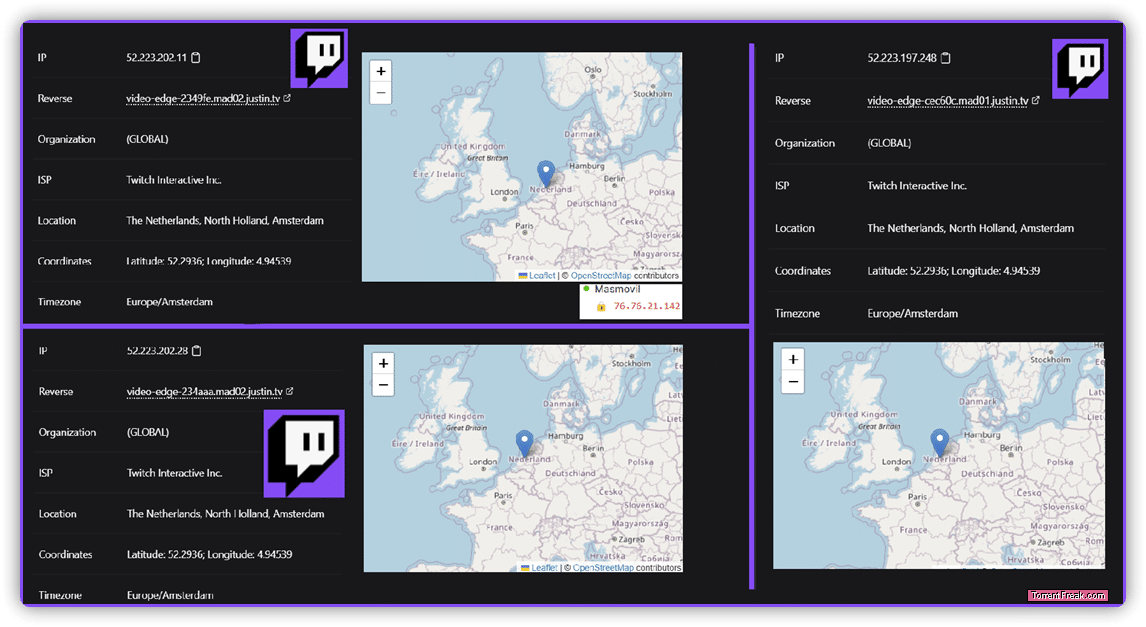
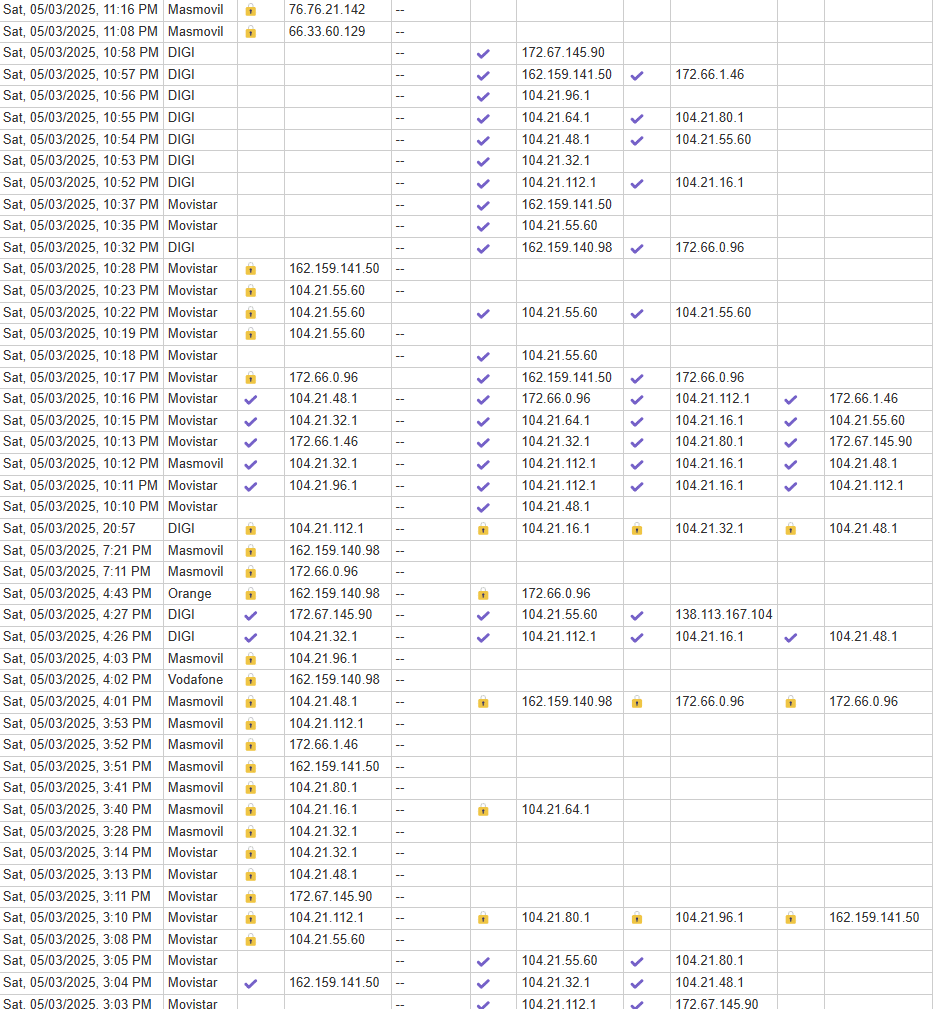
    After 90 days of blocking pirates and anything else in the way, there’s no real panic; just outrage and disappointment at the lack of concern shown by the authorities to those negatively affected. Of course, everything is subject to sudden change in volatile environments; blocking Twitch IP addresses on Saturday seemed unlikely to have had a calming effect.

    twitch-block-laligav2

    Yesterday’s blocking wave was once again immaculately documented by hayahora.futbol . Datta confirms that most blocking targeted IP addresses operated by United States-based companies, including Cloudflare, Vercel, and QUIC.cloud.

    Providing Transparency

    The service provided by hayahora.futbol records blocking in Spain that would otherwise thrive in the shadows. There is no transparency requirement under law but if there’s a case for mandatory transparency, there is no better example than this.

    Vercel, which publicly confirmed it would work with LaLiga to prevent its service being blocked again, may be disappointed that at least one ISP still hasn’t deactivated its original blocks (76.76.21.142 / 66.33.60.129) .

    Much of the pain yesterday was shouldered by Cloudflare, as partial data obtained from Hayahoro for some of Saturday’s blocking clearly shows.

    ips blocked spain

    And it’s going to get worse. Much worse. In fact, escalation is underway right now. No holds barred.

    After EUIPO Meetings, ‘All Firewood Thrown on The Grill’

    Site Reliability Engineer Sergio Conde works at Tiny Bird Co ., one of the companies whose business was suddenly interrupted following the recent blocking of Vercel IP addresses.

    In common with a growing number of computer and coding experts suddenly thrown into the cruel world of pirate site blocking, he now appears to be taking a much closer interest in events playing out in his country.

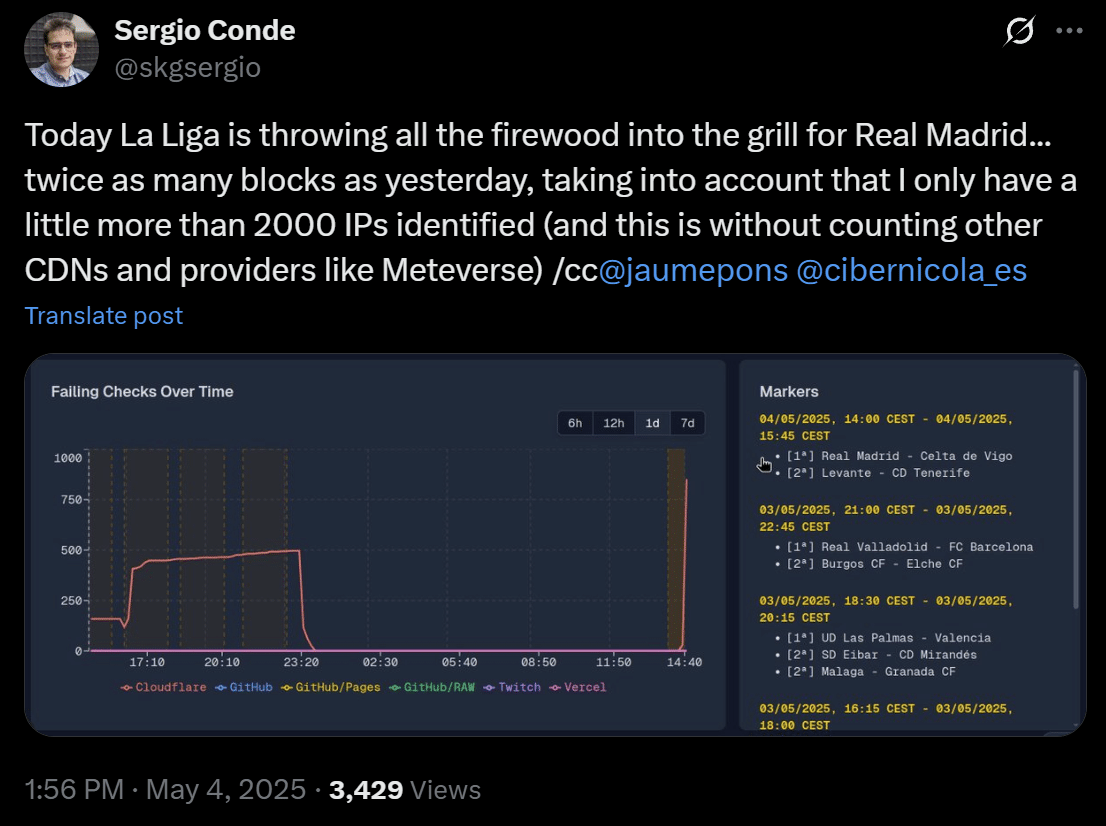
    Conde’s monitoring of blocking by Spain’s major ISPs today leaves little doubt that LaLiga’s priority is the protection of its soccer clubs, period.

    madrid-blocking

    The current crisis didn’t begin overnight, and the dangers were clearly visible. Yet in its midst, no authority – competent or otherwise – seems to have the power to end the collateral damage. That all authorities seem to lack even the basic will to encourage moderation to avoid collateral damage, is nothing short of extraordinary.

    Discussion Before the Storm

    A conference titled The Impact of Piracy on the Audiovisual Industry took place on January 29 at the Madrid headquarters of the Spanish Academy of Motion Picture Arts and Sciences. In attendance to present the European Union Intellectual Property Office’s (EUIPO) latest piracy facts and figures, Harrie Temmink had only bad news for Spain.

    Piracy figures are not only rising again in Spain, they’re doing so at a rate faster than seen elsewhere in Europe. Many Spaniards believe that if piracy is only for personal use, that is acceptable. As a result, around 21% admit to knowingly consuming pirated content, with a stubborn 6% vowing to always consume pirated content, no matter what.

    The Digital Services Act (DSA) is expected to play a wider role in the fight against online piracy. Temmink described the Directive as one of the “greatest triumphs” in the battle against piracy and noted that it “makes all online platforms safer and more reliable for users.”

    How to prevent anti-piracy work that can make all sites instantly less reliable, including those that have nothing whatsoever to do with the DSA, will probably need more time to think through. However, the issue of IP address blocking was raised during the conference by Lara Pérez-Caminha, the president of the Association of Independent Film Distributors (Adicine).

    Noting that LaLiga and Movistar worked extremely hard to obtain a court order to block IP addresses to protect live sports, having something similar to protect the film industry could prove beneficial, Pérez-Caminha said.

    Within Days, LaLiga Blocks Cloudflare

    Days after this event for the film industry, LaLiga started a campaign that continues today; blocking IP addresses used by pirate sites that are also used by innocent parties.

    On March 28, LaLiga reported that it had attended a meeting in Madrid, to “share relevant information on how the illegal distribution of sports content is carried out and how business models surrounding this criminal activity operate.” Also in attendance, representatives from the European Union Intellectual Property Office (EUIPO), and members of the European Parliament.

    Any claim that those in attendance had no knowledge of events playing out in Spain fail to appreciate the depth of the EU’s influence on regulatory matters. Yet while the public announcement addressed the impact of live sports piracy and emphasized that collaboration with the EU will address the challenges ahead, the elephant in the room was nowhere to be seen, or heard.

    Not only was the crisis facing ordinary members of the public and business communities never mentioned, the announcement boiled down to just two issues: protect live sports and immediately compel intermediaries to action.

    No commentary addressed the importance of safeguarding the rights of citizens and other businesses in the EU.

    Actions Speak Louder

    It would be naive to expect a warts-and-all press release that addressed positives and potential negatives that could help or harm the fight against piracy. There’s always a need to discuss such matters in private and some things are clearly better left at the negotiating table, not aired for the entertainment of the media.

    Whether the situation was mentioned, or not mentioned, is impossible to say. Arguably, that isn’t the test that matters. Whatever was said, or not said, only the actions post March 30 can demonstrate whether LaLiga felt more or less restrained by the EU, at least in the event any opinion was made clear either way.

    Perhaps the issue was mentioned last week, we really don’t know.

    laliga-euipo

    If it was discussed at all, there was no restraining effect observed today during the Real Madrid match. That the effort appears to have been doubled over yesterday’s action, raises more questions on top of existing concerns.

    From: TF , for the latest news on copyright battles, piracy and more.

    • To chevron_right

      Twitch Blocked For Piracy as LaLiga & ISPs Prioritize Football Over Everything

      news.movim.eu / TorrentFreak • 4 May 2025 • 6 minutes

    twitch-ball Attempts to significantly downplay the scale of the piracy problems faced by major European football leagues, are simply at odds with the facts on the ground.
    They’re also just as unhelpful as the staggering annual loss estimates spouted by rightsholders.

    These figures have a tendency to become ‘fact’ after endless repetition, before being built upon and defended to the very last man, in blood if that becomes necessary.

    Seemingly powerless to curtail piracy in any meaningful way, major European leagues are combining increasingly bitter rhetoric with threats against intermediaries, while tearing up what was left of the anti-piracy rule book.

    With their backs against the wall and so much at stake, some quite reasonably argue that a new approach was desperately needed. For those caught in the crossfire, new does not mean improved. It means seemingly random websites failing to load while from the opposite direction, perfectly functioning websites receiving no visits. For some businesses, it means tens of thousands of euros in reported losses.

    Three Months of Disbelief

    In Spain, where a power blackout made global headlines this week, mainstream media outlets seem strangely disinterested in the deliberate blackouts inflicted on companies doing business on the internet. Cloudflare, Vercel, GitHub, Amazon, and thousands of innocent internet users and businesses, have been subjected to blocking several times each week, every week. Since February.

    Under the authority of a local court order , obtained by LaLiga and Telefonica, IP addresses linked to pirate services are being blocked en masse by local ISPs. The stated aim is to prevent access to pirated live sports streams, but the same IP addresses are also used by thousands of ordinary people and businesses .

    Having seen this type of crisis loom on the horizon many times before, at the beginning it seemed that LaLiga’s determination to be heard could’ve resulted in a few shared IP addresses being blocked, effectively for demonstration purposes. While not without risk, a properly calibrated shock and a small amount of panic may have been just enough to break the deadlock.

    After 90 days of blocking pirates and anything else in the way, there’s no real panic; just outrage and disappointment at the lack of concern shown by the authorities to those negatively affected. Of course, everything is subject to sudden change in volatile environments; blocking Twitch IP addresses on Saturday seemed unlikely to have had a calming effect.

    twitch-block-laligav2

    Yesterday’s blocking wave was once again immaculately documented by hayahora.futbol . Datta confirms that most blocking targeted IP addresses operated by United States-based companies, including Cloudflare, Vercel, and QUIC.cloud.

    Providing Transparency

    The service provided by hayahora.futbol records blocking in Spain that would otherwise thrive in the shadows. There is no transparency requirement under law but if there’s a case for mandatory transparency, there is no better example than this.

    Vercel, which publicly confirmed it would work with LaLiga to prevent its service being blocked again, may be disappointed that at least one ISP still hasn’t deactivated its original blocks (76.76.21.142 / 66.33.60.129) .

    Much of the pain yesterday was shouldered by Cloudflare, as partial data obtained from Hayahoro for some of Saturday’s blocking clearly shows.

    ips blocked spain

    And it’s going to get worse. Much worse. In fact, escalation is underway right now. No holds barred.

    After EUIPO Meetings, ‘All Firewood Thrown on The Grill’

    Site Reliability Engineer Sergio Conde works at Tiny Bird Co ., one of the companies whose business was suddenly interrupted following the recent blocking of Vercel IP addresses.

    In common with a growing number of computer and coding experts suddenly thrown into the cruel world of pirate site blocking, he now appears to be taking a much closer interest in events playing out in his country.

    Conde’s monitoring of blocking by Spain’s major ISPs today leaves little doubt that LaLiga’s priority is the protection of its soccer clubs, period.

    madrid-blocking

    The current crisis didn’t begin overnight, and the dangers were clearly visible. Yet in its midst, no authority – competent or otherwise – seems to have the power to end the collateral damage. That all authorities seem to lack even the basic will to encourage moderation to avoid collateral damage, is nothing short of extraordinary.

    Discussion Before the Storm

    A conference titled The Impact of Piracy on the Audiovisual Industry took place on January 29 at the Madrid headquarters of the Spanish Academy of Motion Picture Arts and Sciences. In attendance to present the European Union Intellectual Property Office’s (EUIPO) latest piracy facts and figures, Harrie Temmink had only bad news for Spain.

    Piracy figures are not only rising again in Spain, they’re doing so at a rate faster than seen elsewhere in Europe. Many Spaniards believe that if piracy is only for personal use, that is acceptable. As a result, around 21% admit to knowingly consuming pirated content, with a stubborn 6% vowing to always consume pirated content, no matter what.

    The Digital Services Act (DSA) is expected to play a wider role in the fight against online piracy. Temmink described the Directive as one of the “greatest triumphs” in the battle against piracy and noted that it “makes all online platforms safer and more reliable for users.”

    How to prevent anti-piracy work that can make all sites instantly less reliable, including those that have nothing whatsoever to do with the DSA, will probably need more time to think through. However, the issue of IP address blocking was raised during the conference by Lara Pérez-Caminha, the president of the Association of Independent Film Distributors (Adicine).

    Noting that LaLiga and Movistar worked extremely hard to obtain a court order to block IP addresses to protect live sports, having something similar to protect the film industry could prove beneficial, Pérez-Caminha said.

    Within Days, LaLiga Blocks Cloudflare

    Days after this event for the film industry, LaLiga started a campaign that continues today; blocking IP addresses used by pirate sites that are also used by innocent parties.

    On March 28, LaLiga reported that it had attended a meeting in Madrid, to “share relevant information on how the illegal distribution of sports content is carried out and how business models surrounding this criminal activity operate.” Also in attendance, representatives from the European Union Intellectual Property Office (EUIPO), and members of the European Parliament.

    Any claim that those in attendance had no knowledge of events playing out in Spain fail to appreciate the depth of the EU’s influence on regulatory matters. Yet while the public announcement addressed the impact of live sports piracy and emphasized that collaboration with the EU will address the challenges ahead, the elephant in the room was nowhere to be seen, or heard.

    Not only was the crisis facing ordinary members of the public and business communities never mentioned, the announcement boiled down to just two issues: protect live sports and immediately compel intermediaries to action.

    No commentary addressed the importance of safeguarding the rights of citizens and other businesses in the EU.

    Actions Speak Louder

    It would be naive to expect a warts-and-all press release that addressed positives and potential negatives that could help or harm the fight against piracy. There’s always a need to discuss such matters in private and some things are clearly better left at the negotiating table, not aired for the entertainment of the media.

    Whether the situation was mentioned, or not mentioned, is impossible to say. Arguably, that isn’t the test that matters. Whatever was said, or not said, only the actions post March 30 can demonstrate whether LaLiga felt more or less restrained by the EU, at least in the event any opinion was made clear either way.

    Perhaps the issue was mentioned last week, we really don’t know.

    laliga-euipo

    If it was discussed at all, there was no restraining effect observed today during the Real Madrid match. That the effort appears to have been doubled over yesterday’s action, raises more questions on top of existing concerns.

    From: TF , for the latest news on copyright battles, piracy and more.

    • To chevron_right

      Twitch Blocked For Piracy as LaLiga & ISPs Prioritize Football Over Everything

      news.movim.eu / TorrentFreak • 4 May 2025 • 6 minutes

    twitch-ball Attempts to significantly downplay the scale of the piracy problems faced by major European football leagues, are simply at odds with the facts on the ground.

    They’re also just as unhelpful as the staggering annual loss estimates spouted by rightsholders.

    These figures have a tendency to become ‘fact’ after endless repetition, before being built upon and defended to the very last man, in blood if that becomes necessary.

    Seemingly powerless to curtail piracy in any meaningful way, major European leagues are combining increasingly bitter rhetoric with threats against intermediaries, while tearing up what was left of the anti-piracy rule book.

    With their backs against the wall and so much at stake, some quite reasonably argue that a new approach was desperately needed. For those caught in the crossfire, new does not mean improved. It means seemingly random websites failing to load while from the opposite direction, perfectly functioning websites receiving no visits. For some businesses, it means tens of thousands of euros in reported losses.

    Three Months of Disbelief

    In Spain, where a power blackout made global headlines this week, mainstream media outlets seem strangely disinterested in the deliberate blackouts inflicted on companies doing business on the internet. Cloudflare, Vercel, GitHub, Amazon, and thousands of innocent internet users and businesses, have been subjected to blocking several times each week, every week. Since February.

    Under the authority of a local court order , obtained by LaLiga and Telefonica, IP addresses linked to pirate services are being blocked en masse by local ISPs. The stated aim is to prevent access to pirated live sports streams, but the same IP addresses are also used by thousands of ordinary people and businesses .

    Having seen this type of crisis loom on the horizon many times before, at the beginning it seemed that LaLiga’s determination to be heard could’ve resulted in a few shared IP addresses being blocked, effectively for demonstration purposes. While not without risk, a properly calibrated shock and a small amount of panic may have been just enough to break the deadlock.

    After 90 days of blocking pirates and anything else in the way, there’s no real panic; just outrage and disappointment at the lack of concern shown by the authorities to those negatively affected. Of course, everything is subject to sudden change in volatile environments; blocking Twitch IP addresses on Saturday seemed unlikely to have had a calming effect.

    twitch-block-laligav2

    Yesterday’s blocking wave was once again immaculately documented by hayahora.futbol . Datta confirms that most blocking targeted IP addresses operated by United States-based companies, including Cloudflare, Vercel, and QUIC.cloud.

    Providing Transparency

    The service provided by hayahora.futbol records blocking in Spain that would otherwise thrive in the shadows. There is no transparency requirement under law but if there’s a case for mandatory transparency, there is no better example than this.

    Vercel, which publicly confirmed it would work with LaLiga to prevent its service being blocked again, may be disappointed that at least one ISP still hasn’t deactivated its original blocks (76.76.21.142 / 66.33.60.129) .

    Much of the pain yesterday was shouldered by Cloudflare, as partial data obtained from Hayahoro for some of Saturday’s blocking clearly shows.

    ips blocked spain

    And it’s going to get worse. Much worse. In fact, escalation is underway right now. No holds barred.

    After EUIPO Meetings, ‘All Firewood Thrown on The Grill’

    Site Reliability Engineer Sergio Conde works at Tiny Bird Co ., one of the companies whose business was suddenly interrupted following the recent blocking of Vercel IP addresses.

    In common with a growing number of computer and coding experts suddenly thrown into the cruel world of pirate site blocking, he now appears to be taking a much closer interest in events playing out in his country.

    Conde’s monitoring of blocking by Spain’s major ISPs today leaves little doubt that LaLiga’s priority is the protection of its soccer clubs, period.

    madrid-blocking

    The current crisis didn’t begin overnight, and the dangers were clearly visible. Yet in its midst, no authority – competent or otherwise – seems to have the power to end the collateral damage. That all authorities seem to lack even the basic will to encourage moderation to avoid collateral damage, is nothing short of extraordinary.

    Discussion Before the Storm

    A conference titled The Impact of Piracy on the Audiovisual Industry took place on January 29 at the Madrid headquarters of the Spanish Academy of Motion Picture Arts and Sciences. In attendance to present the European Union Intellectual Property Office’s (EUIPO) latest piracy facts and figures, Harrie Temmink had only bad news for Spain.

    Piracy figures are not only rising again in Spain, they’re doing so at a rate faster than seen elsewhere in Europe. Many Spaniards believe that if piracy is only for personal use, that is acceptable. As a result, around 21% admit to knowingly consuming pirated content, with a stubborn 6% vowing to always consume pirated content, no matter what.

    The Digital Services Act (DSA) is expected to play a wider role in the fight against online piracy. Temmink described the Directive as one of the “greatest triumphs” in the battle against piracy and noted that it “makes all online platforms safer and more reliable for users.”

    How to prevent anti-piracy work that can make all sites instantly less reliable, including those that have nothing whatsoever to do with the DSA, will probably need more time to think through. However, the issue of IP address blocking was raised during the conference by Lara Pérez-Caminha, the president of the Association of Independent Film Distributors (Adicine).

    Noting that LaLiga and Movistar worked extremely hard to obtain a court order to block IP addresses to protect live sports, having something similar to protect the film industry could prove beneficial, Pérez-Caminha said.

    Within Days, LaLiga Blocks Cloudflare

    Days after this event for the film industry, LaLiga started a campaign that continues today; blocking IP addresses used by pirate sites that are also used by innocent parties.

    On March 28, LaLiga reported that it had attended a meeting in Madrid, to “share relevant information on how the illegal distribution of sports content is carried out and how business models surrounding this criminal activity operate.” Also in attendance, representatives from the European Union Intellectual Property Office (EUIPO), and members of the European Parliament.

    Any claim that those in attendance had no knowledge of events playing out in Spain fail to appreciate the depth of the EU’s influence on regulatory matters. Yet while the public announcement addressed the impact of live sports piracy and emphasized that collaboration with the EU will address the challenges ahead, the elephant in the room was nowhere to be seen, or heard.

    Not only was the crisis facing ordinary members of the public and business communities never mentioned, the announcement boiled down to just two issues: protect live sports and immediately compel intermediaries to action.

    No commentary addressed the importance of safeguarding the rights of citizens and other businesses in the EU.

    Actions Speak Louder

    It would be naive to expect a warts-and-all press release that addressed positives and potential negatives that could help or harm the fight against piracy. There’s always a need to discuss such matters in private and some things are clearly better left at the negotiating table, not aired for the entertainment of the media.

    Whether the situation was mentioned, or not mentioned, is impossible to say. Arguably, that isn’t the test that matters. Whatever was said, or not said, only the actions post March 30 can demonstrate whether LaLiga felt more or less restrained by the EU, at least in the event any opinion was made clear either way.

    Perhaps the issue was mentioned last week, we really don’t know.

    laliga-euipo

    If it was discussed at all, there was no restraining effect observed today during the Real Madrid match. That the effort appears to have been doubled over yesterday’s action, raises more questions on top of existing concerns.

    From: TF , for the latest news on copyright battles, piracy and more.