• Pl chevron_right

      Erlang Solutions: Reimplementing Technical Debt with State Machines

      news.movim.eu / PlanetJabber • 6 December 2023 • 16 minutes

    In the ever-evolving landscape of software development, mastering the art of managing complexity is a skill every developer and manager alike aspires to attain. One powerful tool that often remains in the shadows, yet holds the key to simplifying intricate systems, is the humble state machine. Let’s get started.

    Models

    State machines can be seen as models that represent system behaviour. Much like a flowchart on steroids, these models represent an easy way to visualise complex computation flows through a system.

    A typical case study for state machines is the modelling implementation of internet protocols. Be it TLS, SSH, HTTP or XMPP, these protocols define an abstract machine that reacts to client input by transforming its own state, or, if the input is invalid, dying.

    A case study

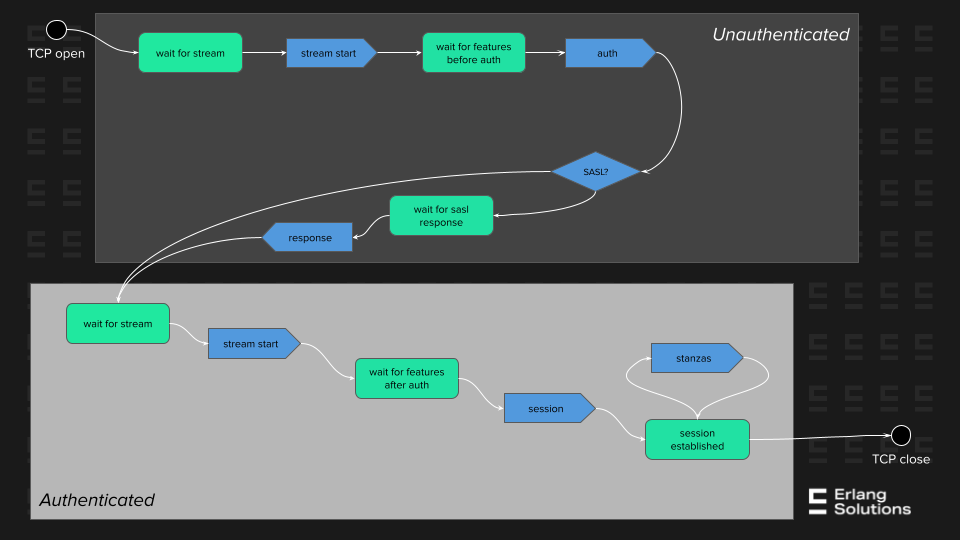
    Let’s see the case for –a simplified thereof– XMPP protocol. This messaging protocol is implemented on top of a TCP stream, and it uses XML elements as its payload format. The protocol, on the server side, goes as follows:

    1. The machine is in the “waiting for a stream-start” state, it hasn’t received any input yet.
    2. When the client sends such stream-start, a payload looking like the following:

    <stream:stream to='localhost' version='1.0' xml:lang='en' xmlns='jabber:client' xmlns:stream='http://etherx.jabber.org/streams'>

    Then the machine forwards certain payloads to the client –a stream-start and a stream-features, its details are omitted in this document for simplicity– and transitions to “waiting for features before authentication”.

    1. When the client sends an authentication request, a payload looking like the following:

    <auth xmlns='urn:ietf:params:xml:ns:xmpp-sasl' mechanism='PLAIN'>AGFsaWNFAG1hdHlncnlzYQ==</auth>

    Then the machine, if no request-response mechanism is required for authentication, answers to the client and transitions to a new “waiting for stream-start”, but this time “after authentication”.

    1. When the client again starts the stream, this time authenticated, with a payload like the following:

    <stream:stream to='localhost' version='1.0' xml:lang='en' xmlns='jabber:client' xmlns:stream='http://etherx.jabber.org/streams'>

    Then the machine again answers the respective payloads, and transitions to a new “waiting for features after authentication”.

    1. And finally, when the client sends

    <iq type='set' id='1c037e23fab169b92edb4b123fba1da6'>

    <bind xmlns='urn:ietf:params:xml:ns:xmpp-bind'>

    <resource>res1</resource>

    </bind>

    </iq>

    Then in transitions to “session established”.

    1. From this point, other machines can find it and send it new payloads, called “stanzas”, which are XML elements whose names are one of “message”, “iq”, or “presence”. We will omit the details of these for the sake of simplicity again.

    Because often one picture is worth a thousand words, see the diagram below:
    GhYeFukbpkkBRqqI_uX7wUX-bdr7mQA6xjJ55VWCrsU07DbMXwu1XYpNxYV6BYPsd6PgyjaGzmpIogKwV2ONZxC6qEqtxkvScSwnmpNBKSXuTmPmz7ndZMEyqxMyEmFKC8tr3sRgYPS5XUFmK5P5un2C40vTNOMzvLL4IaAud2CS0uQHGo28mx39zzYxHw

    Implementing the case

    Textbook examples of state machines, and indeed the old OTP implementation of such behaviour, gen_fsm, always give state machines whose states can be defined by a single name, not taking into account that such a name can be “the name of” a data structure instead. In Erlang in particular, gen_fsm imposed the name of the state to be an atom, just so that it can be mapped to a function name and be callable. But this is an unfortunate oversight of complexity management, where the state of a machine depends on a set of variables that, if not in the name, need to be stored elsewhere, usually the machine’s data, breaking the abstraction.

    Observe in the example above, the case for waiting for stream-start and features: they both exist within unauthenticated and authenticated realms. A naive implementation, where the function name is the state, the first parameter the client’s input, and the second parameter the machine’s data, would say that:

    wait_for_stream(stream_start, Data#data{auth = false}) ->
    	{wait_for_feature, Data}.
    
    wait_for_feature(authenticate, Data#data{auth = false}) ->
    	{wait_for_stream, Data#data{auth = true}}.
    
    wait_for_stream(stream_start, Data#data{auth = true}) ->
    	{wait_for_feature, Data}.
    
    wait_for_feature(session, Data#data{auth = true}) ->
    	{session, Data}.

    In each case, we will take different actions, like building different answers for the client, so we cannot coalesce seemingly similar states into less functions.

    But what if we want to implement retries on authentication?

    We need to add a new field to the data record, as follows:

    wait_for_stream(stream_start, Data#data{auth = false}) ->
    	{wait_for_feature, Data#data{retry = 3}}.
    
    wait_for_feature(authenticate, Data#data{auth = false}) ->
    	{wait_for_stream, Data#data{auth = true}};
    wait_for_feature(_, Data#data{auth = false, retry = 0}) ->
    stop;
    wait_for_feature(_, Data#data{auth = false, retry = N}) ->
    	{wait_for_feature, Data#data{auth = true, retry = N - 1}}.

    The problem here is twofold:

    1. When the machine is authenticated, this field is not valid anymore, yet it will be kept in the data record for the whole life of the machine, wasting memory and garbage collection time.
    2. It breaks the finite state machine abstraction –too early–, as it uses an unbounded memory field with random access lookups to decide how to compute the next transition, effectively behaving like a full Turing Machine — note that this power is one we will need nevertheless, but we will introduce it for a completely different purpose.

    This can get unwieldy when we introduce more features that depend on specific states. For example, when authentication requires roundtrips and the final result depends on all the accumulated input of such roundtrips, we would also accumulate them on the data record, and pattern-match which input is next, or introduce more function names.

    Or if authentication requires a request-response roundtrip to a separate machine, if we want to make such requests asynchronous because we want to process more authentication input while the server processes the first payload, we would also need to handle more states and remember the accumulated one. Again, storing these requests on the data record keeps more data permanent that is relevant only to this state, and uses more memory outside of the state definition. Fixing this antipattern lets us reduce the data record from having 62 fields to being composed of only 10.

    Before we go any further, let’s talk a bit about automatas.

    Automata theory

    In computer sciences, and more particularly in automata theory, we have at our disposal a set of theoretical constructs that allow us to model certain problems of computation, and even more ambitiously, define what a computer can do altogether. Namedly, there are three automatas ordered by computing power: finite state machines, pushdown automatas, and Turing machines. They define a very specific algorithm schema, and they define a state of “termination”. With the given algorithm schema and their definition of termination, they are distinguished by the input they are able to accept while terminating.

    Conceptually, a Turing Machine is a machine capable of computing everything we know computers can do: really, Turing Machines and our modern computers are theoretically one and the same thing, modulo equivalence.

    Let’s get more mathematical. Let’s give some definitions:

    1. Alphabet: a set denoted as Σ of input symbols, for example Σ = {0,1}, or Σ = [ASCII]
    2. A string over Σ: a concatenation of symbols of the alphabet Σ
    3. The Power of an Alphabet: Σ*, the set of all possible strings over Σ, including the empty set (an empty string).

    An automaton is said to recognise a string over if it “terminates” when consuming the string as input. On this view, automata generate formal languages, that is, a specific subset of Σ* with certain properties. Let’s see the typical automata:

    1. A Finite State Machine is a finite set of states Q (hence the name of the concept), an alphabet Σ and a function 𝛿 of a state and an input symbol that outputs a new state (and can have side-effects)
    2. A Pushdown Automata is a finite set of states Q, an alphabet Σ, a stack Γ of symbols of Σ, and a function 𝛿 of a state, an input symbol, and the stack, that outputs a new state, and modifies the stack by either popping the last symbol, pushing a new symbol, or both (effectively swapping the last symbol).
    3. A Turing Machine is a finite set of states Q, an alphabet Σ, an infinite tape Γ of cells containing symbols of Σ, and a function 𝛿 of a state, an input symbol, and the current tape cell, that outputs a new state, a new symbol to write in the current cell (which might be the same as before), and a direction, either left or right, to move the head of the tape.

    Conceptually, Finite State Machines can “keep track of” one thing, while Pushdown Automata can “keep track of” up to two things. For example, there is a state machine that can recognise all strings that have an even number of zeroes, but there is no state machine that can recognise all strings that have an equal number of ones and zeroes. However,this can be done by a pushdown automaton. But, neither state machines nor pushdown automata can generate the language for all strings that have an equal number of a’s, b’s, and c’s: this, a Turing Machine can do.

    How to relate these definitions to our protocols, when the input has been defined as an alphabet? In all protocols worth working on, however many inputs there are, they are finite set which can be enumerated. When we define an input element as, for example, <stream:start to=[SomeHost]/> , the list of all possible hosts in the world is a finite list, and we can isomorphically map these hosts to integers, and define our state machines as consuming integers. Likewise for all other input schemas. So, in order to save the space of defining all possible inputs and all possible states of our machines, we will work with schemas , that is, rules to construct states and input. The abstraction is isomorphic.

    Complex states

    We know that state machine behaviours, both the old gen_fsm and the new gen_statem, really are Turing Machines: they both keep a data record that can hold unbounded memory, hence acting as the Turing Machine tape. The OTP documentation for the gen_statem behaviour even says so explicitly:

    Like most gen_ behaviours, gen_statem keeps a server Data besides the state. Because of this, and as there is no restriction on the number of states (assuming that there is enough virtual machine memory) or on the number of distinct input events, a state machine implemented with this behaviour is in fact Turing complete. But it feels mostly like an Event-Driven Mealy machine .

    But we can still model a state machine schema with accuracy. ‘gen_statem’, on initialisation, admits a callback mode called ‘handle_event_function’. We won’t go into the details, but they are well explained in the available official documentation .

    By choosing the callback mode, we can use data structures as states. Note again that, theoretically, a state machine whose states are defined by complex data structures are isomorphic to giving unique names to every possible combination of such data structures internals: however large of a set, such a set is still finite.

    Now, let’s implement the previous protocol in an equivalent manner, but with no data record whatsoever, with retries and asynchronous authentication included:

    handle_event(_, {stream_start, Host},
                 [{wait_for_stream, not_auth}], _) ->
        StartCreds = get_configured_auth_for_host(Host),
        {next_state, [{wait_for_feature, not_auth}, {creds, StartCreds}, {retry, 3}]};
    
    handle_event(_, {authenticate, Creds},
                 [{wait_for_feature, not_auth}, {creds, StartCreds}, {retries, -1}], _) ->
    	stop;
    handle_event(_, {authenticate, Creds},
                 [{wait_for_feature, not_auth}, {creds, StartCreds}, {retries, N}], _) ->
        Req = auth_server:authenticate(StartCreds, Creds),
        {next_state, [{wait_for_feature, not_auth}, {req, Req}, {creds, Creds}, {retries, N-1}]};
    handle_event(_, {authenticated, Req},
                 [{wait_for_feature, not_auth}, {req, Req}, {creds, Creds} | _], _) ->
        {next_state, [{wait_for_stream, auth}, {jid, get_jid(Creds)}]};
    handle_event(_, Other,
                 [{wait_for_feature, not_auth} | _], _) ->
        {keep_state, [postpone]};
    
    handle_event(_, {stream_start, Host}, [{wait_for_stream, auth}, {jid, JID}], _) ->
        {next_state, [{wait_for_feature, auth}, {jid, JID}]};
    
    handle_event(_, {session, Resource}, [{wait_for_feature, auth}, {jid, JID}], _) ->
        FullJID = jid:replace_resource(JID, Resource),
        session_manager:put(self(), FullJID),
        {next_state, [{session, FullJID}]};

    And from this point on, we have a session with a known Jabber IDentifier (JID) registered in the session manager, that can send and receive messages. Note how the code pattern-matches between the given input and the state, and the state is a proplist ordered by every element being a substate of the previous.

    Now the machine is ready to send and receive messages, so we can add the following code:

    handle_event(_, {send_message_to, Message, To},
                 [{session, FullJID}], _) ->
        ToPid = session_manager:get(To),
        ToPid ! {receive_message_from, Message, FullJID,
        keep_state;
    handle_event(_, {receive_message_from, Message, From},
                 [{session, FullJID}], #data{socket = Socket}) ->
        tcp_socket:send(Socket, Message),
        keep_state;

    Only in these two function clauses, state machines interact with each other. There’s only one element that would be needed to be stored on the data record: the Socket. This element is valid for the entire life of the state-machine, and while we could include it on the state definition for every state, for once we might as well keep it globally on the data record for all of them, as it is globally valid.

    Please read the code carefully, as you’ll find it is self-explanatory.

    Staged processing of events

    A protocol like XMPP, is defined entirely in the Application Layer of the OSI Model , but as an implementation detail, we need to deal with the TCP (and potentially TLS) packets and transform them into the XML data-structures that XMPP will use as payloads. This can be implemented as a separate gen_server that owns the socket, receives the TCP packets, decrypts them, decodes the XML binaries, and sends the final XML data structure to the state-machine for processing. In fact, this is how this protocol was originally implemented, but for completely different reasons.

    In much older versions of OTP, SSL was implemented in pure Erlang code, where crypto operations (basically heavy number-crunching), was notoriously slow in Erlang. Furthermore, XML parsing was also in pure Erlang and using linked-lists as the underlying implementation of the strings. Both these operations were terribly slow and prone to produce enormous amounts of garbage, so it was implemented in a separate process. Not for the purity of the state machine abstractions, but simply to unblock the original state machine from doing other protocol related processing tasks.

    But this means a certain duplicity. Every client now has two Erlang processes that send messages to each other, effectively incurring a lot of copying in the messaging. Now OTP implements crypto operations by binding to native libcrypto code, and XML parsing is done using exml , our own fastest XML parser available in the BEAM world. So the cost of packet preprocessing is now lower than the message copying, and therefore, it can be implemented in a single process.

    Enter internal events:

    handle_event(info, {tls, Socket, Payload}, _, Data#{socket = Socket}) ->
    	XmlElements = exml:parse(tls:decrypt(Socket, Payload)),
    	StreamEvents = [{next_event, internal, El} || El <- XmlElements],
    	{keep_state, StreamEvents};

    Using this mechanism, all info messages from the socket will be preprocessed in a single function head, and all the previous handlers simply need to match on events of type internal and of contents an XML data structure.

    A pure abstraction

    We have prototyped a state machine implementing the full XMPP Core protocol (RFC6120) , without violating the abstraction of the state machine. At no point do we have a full Turing-complete machine, or even a pushdown automaton. We have a machine with a finite set of states and a finite set of input strings, albeit large as they’re both defined schematically, and a function, `handle_event/4`, that takes a new input and the current state and calculates side effects and the next state.

    However, for convenience we might break the abstraction in sensible ways. For example, in XMPP, you might want to enable different configurations for different hosts, and as the host is given in the very first event, you might as well store in the data record the host and the configuration type expected for this connection – this is what we do in MongooseIM’ s implementation of the XMPP server.

    Breaking purity

    But there’s one point of breaking in the XMPP case, which is in the name of the protocol. “ X” stands for extensible , that is, any number of extensions can be defined and enabled, that can significantly change the behaviour of the machine by introducing new states, or responding to new events. This means that the function 𝛿 that decides the next step and the side-effects, does not depend only on the current state and the current input, but also on the enabled extensions and the data of those extensions.

    Only at this point we need to break the finite state machine abstraction: the data record will keep an unbounded map of extensions and their data records, and 𝛿 will need to take this map to decide the next step and decide not only the next state and the side-effects, but also what to write on the map: that is, here, our State Machine does finally convert into a fully-fledged Turing Machine.

    With great power…

    Restraining your protocol to a Finite State Machine has certain advantages:

    • Memory consumption: the main difference, simplifying, between a Turing Machine and an FSM, is that the Turing Machine has infinite memory at its disposal, which means that when you have way too many Turing Machines roaming around in your system, it might get hard to reason about the amount of memory they all consume and how it aggregates. In contrast, it’s easier to reason about upper bounds for the memory the FSMs will need.
    • Determinism: FSMs exhibit deterministic behaviour, meaning that the transition from one state to another is uniquely determined by the input. This determinism can be advantageous in scenarios where predictability and reliability are crucial. Turing machines instead can exhibit a complexity that may not be needed for certain applications.
    • Halting: we have all heard of the Halting Problem, right? Turns out, proving that a Finite State Machine halts is always possible.
    • Testing: as the number of states and transitions of an FSM are finite, testing all the code-paths of such a machine is indeed a finite task. There are indeed State Machine learning algorithms that verify implementations (see LearnLib ) and property-based testing has a good chance to reach all edge-cases.

    When all we wanted was to implement a communication protocol, as varied as XMPP or TLS, where what we implement is a relationship of input, states, and output, a Finite State Machine is the right tool for the job. Using hierarchical states can model certain states better than using a simplified version of the states and global memory to decide the transitions (i.e., implement 𝛿) and will result in a purer and more testable implementation.

    Further examples:

    The post Reimplementing Technical Debt with State Machines appeared first on Erlang Solutions .

    • Pl chevron_right

      Erlang Solutions: Reimplementing Technical Debt with State Machines

      news.movim.eu / PlanetJabber • 6 December 2023 • 16 minutes

    In the ever-evolving landscape of software development, mastering the art of managing complexity is a skill every developer and manager alike aspires to attain. One powerful tool that often remains in the shadows, yet holds the key to simplifying intricate systems, is the humble state machine. Let’s get started.

    Models

    State machines can be seen as models that represent system behaviour. Much like a flowchart on steroids, these models represent an easy way to visualise complex computation flows through a system.

    A typical case study for state machines is the modelling implementation of internet protocols. Be it TLS, SSH, HTTP or XMPP, these protocols define an abstract machine that reacts to client input by transforming its own state, or, if the input is invalid, dying.

    A case study

    Let’s see the case for –a simplified thereof– XMPP protocol. This messaging protocol is implemented on top of a TCP stream, and it uses XML elements as its payload format. The protocol, on the server side, goes as follows:

    1. The machine is in the “waiting for a stream-start” state, it hasn’t received any input yet.
    2. When the client sends such stream-start, a payload looking like the following:

    <stream:stream to='localhost' version='1.0' xml:lang='en' xmlns='jabber:client' xmlns:stream='http://etherx.jabber.org/streams'>

    Then the machine forwards certain payloads to the client –a stream-start and a stream-features, its details are omitted in this document for simplicity– and transitions to “waiting for features before authentication”.

    1. When the client sends an authentication request, a payload looking like the following:

    <auth xmlns='urn:ietf:params:xml:ns:xmpp-sasl' mechanism='PLAIN'>AGFsaWNFAG1hdHlncnlzYQ==</auth>

    Then the machine, if no request-response mechanism is required for authentication, answers to the client and transitions to a new “waiting for stream-start”, but this time “after authentication”.

    1. When the client again starts the stream, this time authenticated, with a payload like the following:

    <stream:stream to='localhost' version='1.0' xml:lang='en' xmlns='jabber:client' xmlns:stream='http://etherx.jabber.org/streams'>

    Then the machine again answers the respective payloads, and transitions to a new “waiting for features after authentication”.

    1. And finally, when the client sends

    <iq type='set' id='1c037e23fab169b92edb4b123fba1da6'>

    <bind xmlns='urn:ietf:params:xml:ns:xmpp-bind'>

    <resource>res1</resource>

    </bind>

    </iq>

    Then in transitions to “session established”.

    1. From this point, other machines can find it and send it new payloads, called “stanzas”, which are XML elements whose names are one of “message”, “iq”, or “presence”. We will omit the details of these for the sake of simplicity again.

    Because often one picture is worth a thousand words, see the diagram below:

    GhYeFukbpkkBRqqI_uX7wUX-bdr7mQA6xjJ55VWCrsU07DbMXwu1XYpNxYV6BYPsd6PgyjaGzmpIogKwV2ONZxC6qEqtxkvScSwnmpNBKSXuTmPmz7ndZMEyqxMyEmFKC8tr3sRgYPS5XUFmK5P5un2C40vTNOMzvLL4IaAud2CS0uQHGo28mx39zzYxHw

    Implementing the case

    Textbook examples of state machines, and indeed the old OTP implementation of such behaviour, gen_fsm, always give state machines whose states can be defined by a single name, not taking into account that such a name can be “the name of” a data structure instead. In Erlang in particular, gen_fsm imposed the name of the state to be an atom, just so that it can be mapped to a function name and be callable. But this is an unfortunate oversight of complexity management, where the state of a machine depends on a set of variables that, if not in the name, need to be stored elsewhere, usually the machine’s data, breaking the abstraction.

    Observe in the example above, the case for waiting for stream-start and features: they both exist within unauthenticated and authenticated realms. A naive implementation, where the function name is the state, the first parameter the client’s input, and the second parameter the machine’s data, would say that:

    wait_for_stream(stream_start, Data#data{auth = false}) ->
    	{wait_for_feature, Data}.
    
    wait_for_feature(authenticate, Data#data{auth = false}) ->
    	{wait_for_stream, Data#data{auth = true}}.
    
    wait_for_stream(stream_start, Data#data{auth = true}) ->
    	{wait_for_feature, Data}.
    
    wait_for_feature(session, Data#data{auth = true}) ->
    	{session, Data}.

    In each case, we will take different actions, like building different answers for the client, so we cannot coalesce seemingly similar states into less functions.

    But what if we want to implement retries on authentication?

    We need to add a new field to the data record, as follows:

    wait_for_stream(stream_start, Data#data{auth = false}) ->
    	{wait_for_feature, Data#data{retry = 3}}.
    
    wait_for_feature(authenticate, Data#data{auth = false}) ->
    	{wait_for_stream, Data#data{auth = true}};
    wait_for_feature(_, Data#data{auth = false, retry = 0}) ->
    stop;
    wait_for_feature(_, Data#data{auth = false, retry = N}) ->
    	{wait_for_feature, Data#data{auth = true, retry = N - 1}}.

    The problem here is twofold:

    1. When the machine is authenticated, this field is not valid anymore, yet it will be kept in the data record for the whole life of the machine, wasting memory and garbage collection time.
    2. It breaks the finite state machine abstraction –too early–, as it uses an unbounded memory field with random access lookups to decide how to compute the next transition, effectively behaving like a full Turing Machine — note that this power is one we will need nevertheless, but we will introduce it for a completely different purpose.

    This can get unwieldy when we introduce more features that depend on specific states. For example, when authentication requires roundtrips and the final result depends on all the accumulated input of such roundtrips, we would also accumulate them on the data record, and pattern-match which input is next, or introduce more function names.

    Or if authentication requires a request-response roundtrip to a separate machine, if we want to make such requests asynchronous because we want to process more authentication input while the server processes the first payload, we would also need to handle more states and remember the accumulated one. Again, storing these requests on the data record keeps more data permanent that is relevant only to this state, and uses more memory outside of the state definition. Fixing this antipattern lets us reduce the data record from having 62 fields to being composed of only 10.

    Before we go any further, let’s talk a bit about automatas.

    Automata theory

    In computer sciences, and more particularly in automata theory, we have at our disposal a set of theoretical constructs that allow us to model certain problems of computation, and even more ambitiously, define what a computer can do altogether. Namedly, there are three automatas ordered by computing power: finite state machines, pushdown automatas, and Turing machines. They define a very specific algorithm schema, and they define a state of “termination”. With the given algorithm schema and their definition of termination, they are distinguished by the input they are able to accept while terminating.

    Conceptually, a Turing Machine is a machine capable of computing everything we know computers can do: really, Turing Machines and our modern computers are theoretically one and the same thing, modulo equivalence.

    Let’s get more mathematical. Let’s give some definitions:

    1. Alphabet: a set denoted as Σ of input symbols, for example Σ = {0,1}, or Σ = [ASCII]
    2. A string over Σ: a concatenation of symbols of the alphabet Σ
    3. The Power of an Alphabet: Σ*, the set of all possible strings over Σ, including the empty set (an empty string).

    An automaton is said to recognise a string over if it “terminates” when consuming the string as input. On this view, automata generate formal languages, that is, a specific subset of Σ* with certain properties. Let’s see the typical automata:

    1. A Finite State Machine is a finite set of states Q (hence the name of the concept), an alphabet Σ and a function 𝛿 of a state and an input symbol that outputs a new state (and can have side-effects)
    2. A Pushdown Automata is a finite set of states Q, an alphabet Σ, a stack Γ of symbols of Σ, and a function 𝛿 of a state, an input symbol, and the stack, that outputs a new state, and modifies the stack by either popping the last symbol, pushing a new symbol, or both (effectively swapping the last symbol).
    3. A Turing Machine is a finite set of states Q, an alphabet Σ, an infinite tape Γ of cells containing symbols of Σ, and a function 𝛿 of a state, an input symbol, and the current tape cell, that outputs a new state, a new symbol to write in the current cell (which might be the same as before), and a direction, either left or right, to move the head of the tape.

    Conceptually, Finite State Machines can “keep track of” one thing, while Pushdown Automata can “keep track of” up to two things. For example, there is a state machine that can recognise all strings that have an even number of zeroes, but there is no state machine that can recognise all strings that have an equal number of ones and zeroes. However,this can be done by a pushdown automaton. But, neither state machines nor pushdown automata can generate the language for all strings that have an equal number of a’s, b’s, and c’s: this, a Turing Machine can do.

    How to relate these definitions to our protocols, when the input has been defined as an alphabet? In all protocols worth working on, however many inputs there are, they are finite set which can be enumerated. When we define an input element as, for example, <stream:start to=[SomeHost]/> , the list of all possible hosts in the world is a finite list, and we can isomorphically map these hosts to integers, and define our state machines as consuming integers. Likewise for all other input schemas. So, in order to save the space of defining all possible inputs and all possible states of our machines, we will work with schemas , that is, rules to construct states and input. The abstraction is isomorphic.

    Complex states

    We know that state machine behaviours, both the old gen_fsm and the new gen_statem, really are Turing Machines: they both keep a data record that can hold unbounded memory, hence acting as the Turing Machine tape. The OTP documentation for the gen_statem behaviour even says so explicitly:

    Like most gen_ behaviours, gen_statem keeps a server Data besides the state. Because of this, and as there is no restriction on the number of states (assuming that there is enough virtual machine memory) or on the number of distinct input events, a state machine implemented with this behaviour is in fact Turing complete. But it feels mostly like an Event-Driven Mealy machine .

    But we can still model a state machine schema with accuracy. ‘gen_statem’, on initialisation, admits a callback mode called ‘handle_event_function’. We won’t go into the details, but they are well explained in the available official documentation .

    By choosing the callback mode, we can use data structures as states. Note again that, theoretically, a state machine whose states are defined by complex data structures are isomorphic to giving unique names to every possible combination of such data structures internals: however large of a set, such a set is still finite.

    Now, let’s implement the previous protocol in an equivalent manner, but with no data record whatsoever, with retries and asynchronous authentication included:

    handle_event(_, {stream_start, Host},
                 [{wait_for_stream, not_auth}], _) ->
        StartCreds = get_configured_auth_for_host(Host),
        {next_state, [{wait_for_feature, not_auth}, {creds, StartCreds}, {retry, 3}]};
    
    handle_event(_, {authenticate, Creds},
                 [{wait_for_feature, not_auth}, {creds, StartCreds}, {retries, -1}], _) ->
    	stop;
    handle_event(_, {authenticate, Creds},
                 [{wait_for_feature, not_auth}, {creds, StartCreds}, {retries, N}], _) ->
        Req = auth_server:authenticate(StartCreds, Creds),
        {next_state, [{wait_for_feature, not_auth}, {req, Req}, {creds, Creds}, {retries, N-1}]};
    handle_event(_, {authenticated, Req},
                 [{wait_for_feature, not_auth}, {req, Req}, {creds, Creds} | _], _) ->
        {next_state, [{wait_for_stream, auth}, {jid, get_jid(Creds)}]};
    handle_event(_, Other,
                 [{wait_for_feature, not_auth} | _], _) ->
        {keep_state, [postpone]};
    
    handle_event(_, {stream_start, Host}, [{wait_for_stream, auth}, {jid, JID}], _) ->
        {next_state, [{wait_for_feature, auth}, {jid, JID}]};
    
    handle_event(_, {session, Resource}, [{wait_for_feature, auth}, {jid, JID}], _) ->
        FullJID = jid:replace_resource(JID, Resource),
        session_manager:put(self(), FullJID),
        {next_state, [{session, FullJID}]};

    And from this point on, we have a session with a known Jabber IDentifier (JID) registered in the session manager, that can send and receive messages. Note how the code pattern-matches between the given input and the state, and the state is a proplist ordered by every element being a substate of the previous.

    Now the machine is ready to send and receive messages, so we can add the following code:

    handle_event(_, {send_message_to, Message, To},
                 [{session, FullJID}], _) ->
        ToPid = session_manager:get(To),
        ToPid ! {receive_message_from, Message, FullJID,
        keep_state;
    handle_event(_, {receive_message_from, Message, From},
                 [{session, FullJID}], #data{socket = Socket}) ->
        tcp_socket:send(Socket, Message),
        keep_state;

    Only in these two function clauses, state machines interact with each other. There’s only one element that would be needed to be stored on the data record: the Socket. This element is valid for the entire life of the state-machine, and while we could include it on the state definition for every state, for once we might as well keep it globally on the data record for all of them, as it is globally valid.

    Please read the code carefully, as you’ll find it is self-explanatory.

    Staged processing of events

    A protocol like XMPP, is defined entirely in the Application Layer of the OSI Model , but as an implementation detail, we need to deal with the TCP (and potentially TLS) packets and transform them into the XML data-structures that XMPP will use as payloads. This can be implemented as a separate gen_server that owns the socket, receives the TCP packets, decrypts them, decodes the XML binaries, and sends the final XML data structure to the state-machine for processing. In fact, this is how this protocol was originally implemented, but for completely different reasons.

    In much older versions of OTP, SSL was implemented in pure Erlang code, where crypto operations (basically heavy number-crunching), was notoriously slow in Erlang. Furthermore, XML parsing was also in pure Erlang and using linked-lists as the underlying implementation of the strings. Both these operations were terribly slow and prone to produce enormous amounts of garbage, so it was implemented in a separate process. Not for the purity of the state machine abstractions, but simply to unblock the original state machine from doing other protocol related processing tasks.

    But this means a certain duplicity. Every client now has two Erlang processes that send messages to each other, effectively incurring a lot of copying in the messaging. Now OTP implements crypto operations by binding to native libcrypto code, and XML parsing is done using exml , our own fastest XML parser available in the BEAM world. So the cost of packet preprocessing is now lower than the message copying, and therefore, it can be implemented in a single process.

    Enter internal events:

    handle_event(info, {tls, Socket, Payload}, _, Data#{socket = Socket}) ->
    	XmlElements = exml:parse(tls:decrypt(Socket, Payload)),
    	StreamEvents = [{next_event, internal, El} || El <- XmlElements],
    	{keep_state, StreamEvents};

    Using this mechanism, all info messages from the socket will be preprocessed in a single function head, and all the previous handlers simply need to match on events of type internal and of contents an XML data structure.

    A pure abstraction

    We have prototyped a state machine implementing the full XMPP Core protocol (RFC6120) , without violating the abstraction of the state machine. At no point do we have a full Turing-complete machine, or even a pushdown automaton. We have a machine with a finite set of states and a finite set of input strings, albeit large as they’re both defined schematically, and a function, `handle_event/4`, that takes a new input and the current state and calculates side effects and the next state.

    However, for convenience we might break the abstraction in sensible ways. For example, in XMPP, you might want to enable different configurations for different hosts, and as the host is given in the very first event, you might as well store in the data record the host and the configuration type expected for this connection – this is what we do in MongooseIM’ s implementation of the XMPP server.

    Breaking purity

    But there’s one point of breaking in the XMPP case, which is in the name of the protocol. “ X” stands for extensible , that is, any number of extensions can be defined and enabled, that can significantly change the behaviour of the machine by introducing new states, or responding to new events. This means that the function 𝛿 that decides the next step and the side-effects, does not depend only on the current state and the current input, but also on the enabled extensions and the data of those extensions.

    Only at this point we need to break the finite state machine abstraction: the data record will keep an unbounded map of extensions and their data records, and 𝛿 will need to take this map to decide the next step and decide not only the next state and the side-effects, but also what to write on the map: that is, here, our State Machine does finally convert into a fully-fledged Turing Machine.

    With great power…

    Restraining your protocol to a Finite State Machine has certain advantages:

    • Memory consumption: the main difference, simplifying, between a Turing Machine and an FSM, is that the Turing Machine has infinite memory at its disposal, which means that when you have way too many Turing Machines roaming around in your system, it might get hard to reason about the amount of memory they all consume and how it aggregates. In contrast, it’s easier to reason about upper bounds for the memory the FSMs will need.
    • Determinism: FSMs exhibit deterministic behaviour, meaning that the transition from one state to another is uniquely determined by the input. This determinism can be advantageous in scenarios where predictability and reliability are crucial. Turing machines instead can exhibit a complexity that may not be needed for certain applications.
    • Halting: we have all heard of the Halting Problem, right? Turns out, proving that a Finite State Machine halts is always possible.
    • Testing: as the number of states and transitions of an FSM are finite, testing all the code-paths of such a machine is indeed a finite task. There are indeed State Machine learning algorithms that verify implementations (see LearnLib ) and property-based testing has a good chance to reach all edge-cases.

    When all we wanted was to implement a communication protocol, as varied as XMPP or TLS, where what we implement is a relationship of input, states, and output, a Finite State Machine is the right tool for the job. Using hierarchical states can model certain states better than using a simplified version of the states and global memory to decide the transitions (i.e., implement 𝛿) and will result in a purer and more testable implementation.

    Further examples:

    The post Reimplementing Technical Debt with State Machines appeared first on Erlang Solutions .

    • Pl chevron_right

      Erlang Solutions: Reimplementing Technical Debt with State Machines

      news.movim.eu / PlanetJabber • 6 December 2023 • 16 minutes

    In the ever-evolving landscape of software development, mastering the art of managing complexity is a skill every developer and manager alike aspires to attain. One powerful tool that often remains in the shadows, yet holds the key to simplifying intricate systems, is the humble state machine. Let’s get started.

    Models

    State machines can be seen as models that represent system behaviour. Much like a flowchart on steroids, these models represent an easy way to visualise complex computation flows through a system.

    A typical case study for state machines is the modelling implementation of internet protocols. Be it TLS, SSH, HTTP or XMPP, these protocols define an abstract machine that reacts to client input by transforming its own state, or, if the input is invalid, dying.

    A case study

    Let’s see the case for –a simplified thereof– XMPP protocol. This messaging protocol is implemented on top of a TCP stream, and it uses XML elements as its payload format. The protocol, on the server side, goes as follows:

    1. The machine is in the “waiting for a stream-start” state, it hasn’t received any input yet.
    2. When the client sends such stream-start, a payload looking like the following:

    <stream:stream to='localhost' version='1.0' xml:lang='en' xmlns='jabber:client' xmlns:stream='http://etherx.jabber.org/streams'>

    Then the machine forwards certain payloads to the client –a stream-start and a stream-features, its details are omitted in this document for simplicity– and transitions to “waiting for features before authentication”.

    1. When the client sends an authentication request, a payload looking like the following:

    <auth xmlns='urn:ietf:params:xml:ns:xmpp-sasl' mechanism='PLAIN'>AGFsaWNFAG1hdHlncnlzYQ==</auth>

    Then the machine, if no request-response mechanism is required for authentication, answers to the client and transitions to a new “waiting for stream-start”, but this time “after authentication”.

    1. When the client again starts the stream, this time authenticated, with a payload like the following:

    <stream:stream to='localhost' version='1.0' xml:lang='en' xmlns='jabber:client' xmlns:stream='http://etherx.jabber.org/streams'>

    Then the machine again answers the respective payloads, and transitions to a new “waiting for features after authentication”.

    1. And finally, when the client sends

    <iq type='set' id='1c037e23fab169b92edb4b123fba1da6'>

    <bind xmlns='urn:ietf:params:xml:ns:xmpp-bind'>

    <resource>res1</resource>

    </bind>

    </iq>

    Then in transitions to “session established”.

    1. From this point, other machines can find it and send it new payloads, called “stanzas”, which are XML elements whose names are one of “message”, “iq”, or “presence”. We will omit the details of these for the sake of simplicity again.

    Because often one picture is worth a thousand words, see the diagram below:

    GhYeFukbpkkBRqqI_uX7wUX-bdr7mQA6xjJ55VWCrsU07DbMXwu1XYpNxYV6BYPsd6PgyjaGzmpIogKwV2ONZxC6qEqtxkvScSwnmpNBKSXuTmPmz7ndZMEyqxMyEmFKC8tr3sRgYPS5XUFmK5P5un2C40vTNOMzvLL4IaAud2CS0uQHGo28mx39zzYxHw

    Implementing the case

    Textbook examples of state machines, and indeed the old OTP implementation of such behaviour, gen_fsm, always give state machines whose states can be defined by a single name, not taking into account that such a name can be “the name of” a data structure instead. In Erlang in particular, gen_fsm imposed the name of the state to be an atom, just so that it can be mapped to a function name and be callable. But this is an unfortunate oversight of complexity management, where the state of a machine depends on a set of variables that, if not in the name, need to be stored elsewhere, usually the machine’s data, breaking the abstraction.

    Observe in the example above, the case for waiting for stream-start and features: they both exist within unauthenticated and authenticated realms. A naive implementation, where the function name is the state, the first parameter the client’s input, and the second parameter the machine’s data, would say that:

    wait_for_stream(stream_start, Data#data{auth = false}) ->
    	{wait_for_feature, Data}.
    
    wait_for_feature(authenticate, Data#data{auth = false}) ->
    	{wait_for_stream, Data#data{auth = true}}.
    
    wait_for_stream(stream_start, Data#data{auth = true}) ->
    	{wait_for_feature, Data}.
    
    wait_for_feature(session, Data#data{auth = true}) ->
    	{session, Data}.

    In each case, we will take different actions, like building different answers for the client, so we cannot coalesce seemingly similar states into less functions.

    But what if we want to implement retries on authentication?

    We need to add a new field to the data record, as follows:

    wait_for_stream(stream_start, Data#data{auth = false}) ->
    	{wait_for_feature, Data#data{retry = 3}}.
    
    wait_for_feature(authenticate, Data#data{auth = false}) ->
    	{wait_for_stream, Data#data{auth = true}};
    wait_for_feature(_, Data#data{auth = false, retry = 0}) ->
    stop;
    wait_for_feature(_, Data#data{auth = false, retry = N}) ->
    	{wait_for_feature, Data#data{auth = true, retry = N - 1}}.

    The problem here is twofold:

    1. When the machine is authenticated, this field is not valid anymore, yet it will be kept in the data record for the whole life of the machine, wasting memory and garbage collection time.
    2. It breaks the finite state machine abstraction –too early–, as it uses an unbounded memory field with random access lookups to decide how to compute the next transition, effectively behaving like a full Turing Machine — note that this power is one we will need nevertheless, but we will introduce it for a completely different purpose.

    This can get unwieldy when we introduce more features that depend on specific states. For example, when authentication requires roundtrips and the final result depends on all the accumulated input of such roundtrips, we would also accumulate them on the data record, and pattern-match which input is next, or introduce more function names.

    Or if authentication requires a request-response roundtrip to a separate machine, if we want to make such requests asynchronous because we want to process more authentication input while the server processes the first payload, we would also need to handle more states and remember the accumulated one. Again, storing these requests on the data record keeps more data permanent that is relevant only to this state, and uses more memory outside of the state definition. Fixing this antipattern lets us reduce the data record from having 62 fields to being composed of only 10.

    Before we go any further, let’s talk a bit about automatas.

    Automata theory

    In computer sciences, and more particularly in automata theory, we have at our disposal a set of theoretical constructs that allow us to model certain problems of computation, and even more ambitiously, define what a computer can do altogether. Namedly, there are three automatas ordered by computing power: finite state machines, pushdown automatas, and Turing machines. They define a very specific algorithm schema, and they define a state of “termination”. With the given algorithm schema and their definition of termination, they are distinguished by the input they are able to accept while terminating.

    Conceptually, a Turing Machine is a machine capable of computing everything we know computers can do: really, Turing Machines and our modern computers are theoretically one and the same thing, modulo equivalence.

    Let’s get more mathematical. Let’s give some definitions:

    1. Alphabet: a set denoted as Σ of input symbols, for example Σ = {0,1}, or Σ = [ASCII]
    2. A string over Σ: a concatenation of symbols of the alphabet Σ
    3. The Power of an Alphabet: Σ*, the set of all possible strings over Σ, including the empty set (an empty string).

    An automaton is said to recognise a string over if it “terminates” when consuming the string as input. On this view, automata generate formal languages, that is, a specific subset of Σ* with certain properties. Let’s see the typical automata:

    1. A Finite State Machine is a finite set of states Q (hence the name of the concept), an alphabet Σ and a function 𝛿 of a state and an input symbol that outputs a new state (and can have side-effects)
    2. A Pushdown Automata is a finite set of states Q, an alphabet Σ, a stack Γ of symbols of Σ, and a function 𝛿 of a state, an input symbol, and the stack, that outputs a new state, and modifies the stack by either popping the last symbol, pushing a new symbol, or both (effectively swapping the last symbol).
    3. A Turing Machine is a finite set of states Q, an alphabet Σ, an infinite tape Γ of cells containing symbols of Σ, and a function 𝛿 of a state, an input symbol, and the current tape cell, that outputs a new state, a new symbol to write in the current cell (which might be the same as before), and a direction, either left or right, to move the head of the tape.

    Conceptually, Finite State Machines can “keep track of” one thing, while Pushdown Automata can “keep track of” up to two things. For example, there is a state machine that can recognise all strings that have an even number of zeroes, but there is no state machine that can recognise all strings that have an equal number of ones and zeroes. However,this can be done by a pushdown automaton. But, neither state machines nor pushdown automata can generate the language for all strings that have an equal number of a’s, b’s, and c’s: this, a Turing Machine can do.

    How to relate these definitions to our protocols, when the input has been defined as an alphabet? In all protocols worth working on, however many inputs there are, they are finite set which can be enumerated. When we define an input element as, for example, <stream:start to=[SomeHost]/> , the list of all possible hosts in the world is a finite list, and we can isomorphically map these hosts to integers, and define our state machines as consuming integers. Likewise for all other input schemas. So, in order to save the space of defining all possible inputs and all possible states of our machines, we will work with schemas , that is, rules to construct states and input. The abstraction is isomorphic.

    Complex states

    We know that state machine behaviours, both the old gen_fsm and the new gen_statem, really are Turing Machines: they both keep a data record that can hold unbounded memory, hence acting as the Turing Machine tape. The OTP documentation for the gen_statem behaviour even says so explicitly:

    Like most gen_ behaviours, gen_statem keeps a server Data besides the state. Because of this, and as there is no restriction on the number of states (assuming that there is enough virtual machine memory) or on the number of distinct input events, a state machine implemented with this behaviour is in fact Turing complete. But it feels mostly like an Event-Driven Mealy machine .

    But we can still model a state machine schema with accuracy. ‘gen_statem’, on initialisation, admits a callback mode called ‘handle_event_function’. We won’t go into the details, but they are well explained in the available official documentation .

    By choosing the callback mode, we can use data structures as states. Note again that, theoretically, a state machine whose states are defined by complex data structures are isomorphic to giving unique names to every possible combination of such data structures internals: however large of a set, such a set is still finite.

    Now, let’s implement the previous protocol in an equivalent manner, but with no data record whatsoever, with retries and asynchronous authentication included:

    handle_event(_, {stream_start, Host},
                 [{wait_for_stream, not_auth}], _) ->
        StartCreds = get_configured_auth_for_host(Host),
        {next_state, [{wait_for_feature, not_auth}, {creds, StartCreds}, {retry, 3}]};
    
    handle_event(_, {authenticate, Creds},
                 [{wait_for_feature, not_auth}, {creds, StartCreds}, {retries, -1}], _) ->
    	stop;
    handle_event(_, {authenticate, Creds},
                 [{wait_for_feature, not_auth}, {creds, StartCreds}, {retries, N}], _) ->
        Req = auth_server:authenticate(StartCreds, Creds),
        {next_state, [{wait_for_feature, not_auth}, {req, Req}, {creds, Creds}, {retries, N-1}]};
    handle_event(_, {authenticated, Req},
                 [{wait_for_feature, not_auth}, {req, Req}, {creds, Creds} | _], _) ->
        {next_state, [{wait_for_stream, auth}, {jid, get_jid(Creds)}]};
    handle_event(_, Other,
                 [{wait_for_feature, not_auth} | _], _) ->
        {keep_state, [postpone]};
    
    handle_event(_, {stream_start, Host}, [{wait_for_stream, auth}, {jid, JID}], _) ->
        {next_state, [{wait_for_feature, auth}, {jid, JID}]};
    
    handle_event(_, {session, Resource}, [{wait_for_feature, auth}, {jid, JID}], _) ->
        FullJID = jid:replace_resource(JID, Resource),
        session_manager:put(self(), FullJID),
        {next_state, [{session, FullJID}]};

    And from this point on, we have a session with a known Jabber IDentifier (JID) registered in the session manager, that can send and receive messages. Note how the code pattern-matches between the given input and the state, and the state is a proplist ordered by every element being a substate of the previous.

    Now the machine is ready to send and receive messages, so we can add the following code:

    handle_event(_, {send_message_to, Message, To},
                 [{session, FullJID}], _) ->
        ToPid = session_manager:get(To),
        ToPid ! {receive_message_from, Message, FullJID,
        keep_state;
    handle_event(_, {receive_message_from, Message, From},
                 [{session, FullJID}], #data{socket = Socket}) ->
        tcp_socket:send(Socket, Message),
        keep_state;

    Only in these two function clauses, state machines interact with each other. There’s only one element that would be needed to be stored on the data record: the Socket. This element is valid for the entire life of the state-machine, and while we could include it on the state definition for every state, for once we might as well keep it globally on the data record for all of them, as it is globally valid.

    Please read the code carefully, as you’ll find it is self-explanatory.

    Staged processing of events

    A protocol like XMPP, is defined entirely in the Application Layer of the OSI Model , but as an implementation detail, we need to deal with the TCP (and potentially TLS) packets and transform them into the XML data-structures that XMPP will use as payloads. This can be implemented as a separate gen_server that owns the socket, receives the TCP packets, decrypts them, decodes the XML binaries, and sends the final XML data structure to the state-machine for processing. In fact, this is how this protocol was originally implemented, but for completely different reasons.

    In much older versions of OTP, SSL was implemented in pure Erlang code, where crypto operations (basically heavy number-crunching), was notoriously slow in Erlang. Furthermore, XML parsing was also in pure Erlang and using linked-lists as the underlying implementation of the strings. Both these operations were terribly slow and prone to produce enormous amounts of garbage, so it was implemented in a separate process. Not for the purity of the state machine abstractions, but simply to unblock the original state machine from doing other protocol related processing tasks.

    But this means a certain duplicity. Every client now has two Erlang processes that send messages to each other, effectively incurring a lot of copying in the messaging. Now OTP implements crypto operations by binding to native libcrypto code, and XML parsing is done using exml , our own fastest XML parser available in the BEAM world. So the cost of packet preprocessing is now lower than the message copying, and therefore, it can be implemented in a single process.

    Enter internal events:

    handle_event(info, {tls, Socket, Payload}, _, Data#{socket = Socket}) ->
    	XmlElements = exml:parse(tls:decrypt(Socket, Payload)),
    	StreamEvents = [{next_event, internal, El} || El <- XmlElements],
    	{keep_state, StreamEvents};

    Using this mechanism, all info messages from the socket will be preprocessed in a single function head, and all the previous handlers simply need to match on events of type internal and of contents an XML data structure.

    A pure abstraction

    We have prototyped a state machine implementing the full XMPP Core protocol (RFC6120) , without violating the abstraction of the state machine. At no point do we have a full Turing-complete machine, or even a pushdown automaton. We have a machine with a finite set of states and a finite set of input strings, albeit large as they’re both defined schematically, and a function, `handle_event/4`, that takes a new input and the current state and calculates side effects and the next state.

    However, for convenience we might break the abstraction in sensible ways. For example, in XMPP, you might want to enable different configurations for different hosts, and as the host is given in the very first event, you might as well store in the data record the host and the configuration type expected for this connection – this is what we do in MongooseIM’ s implementation of the XMPP server.

    Breaking purity

    But there’s one point of breaking in the XMPP case, which is in the name of the protocol. “ X” stands for extensible , that is, any number of extensions can be defined and enabled, that can significantly change the behaviour of the machine by introducing new states, or responding to new events. This means that the function 𝛿 that decides the next step and the side-effects, does not depend only on the current state and the current input, but also on the enabled extensions and the data of those extensions.

    Only at this point we need to break the finite state machine abstraction: the data record will keep an unbounded map of extensions and their data records, and 𝛿 will need to take this map to decide the next step and decide not only the next state and the side-effects, but also what to write on the map: that is, here, our State Machine does finally convert into a fully-fledged Turing Machine.

    With great power…

    Restraining your protocol to a Finite State Machine has certain advantages:

    • Memory consumption: the main difference, simplifying, between a Turing Machine and an FSM, is that the Turing Machine has infinite memory at its disposal, which means that when you have way too many Turing Machines roaming around in your system, it might get hard to reason about the amount of memory they all consume and how it aggregates. In contrast, it’s easier to reason about upper bounds for the memory the FSMs will need.
    • Determinism: FSMs exhibit deterministic behaviour, meaning that the transition from one state to another is uniquely determined by the input. This determinism can be advantageous in scenarios where predictability and reliability are crucial. Turing machines instead can exhibit a complexity that may not be needed for certain applications.
    • Halting: we have all heard of the Halting Problem, right? Turns out, proving that a Finite State Machine halts is always possible.
    • Testing: as the number of states and transitions of an FSM are finite, testing all the code-paths of such a machine is indeed a finite task. There are indeed State Machine learning algorithms that verify implementations (see LearnLib ) and property-based testing has a good chance to reach all edge-cases.

    When all we wanted was to implement a communication protocol, as varied as XMPP or TLS, where what we implement is a relationship of input, states, and output, a Finite State Machine is the right tool for the job. Using hierarchical states can model certain states better than using a simplified version of the states and global memory to decide the transitions (i.e., implement 𝛿) and will result in a purer and more testable implementation.

    Further examples:

    The post Reimplementing Technical Debt with State Machines appeared first on Erlang Solutions .

    • Pl chevron_right

      Erlang Solutions: Advent of Code 2023

      news.movim.eu / PlanetJabber • 1 December 2023 • 3 minutes

    Hello! I’m Piotr from Erlang Solutions Poland and I have the pleasure of saving Christmas this year with the power of Erlang for you!

    This is the second time we participate in the amazing event called the Advent of Code . Last year’s edition was solved by my colleague Aleksander and as far as I know – many of you enjoyed following his efforts. I hope you’ll like my tale of helping Santa too!

    I’m going to publish my solutions in my GitHub repository . They will be accompanied by a commentary, added to this page on a daily basis. I will add solutions for each day in an individual folder, with my input file downloaded from the AoC website.

    I’m also going to include a bit of microbenchmarking in every solution, with and without JIT. Firstly, to measure the overall performance of the code and secondly to see how much the efficiency improves thanks to JIT. I’m going to measure the computation time only with `timer:tc/3` call, as I consider time needed to compile a module and load the input file irrelevant. By “load” I mean: read it and split it into lines. Any further processing of individual lines is considered a computation. I will provide min, max and arithmetic average of 100 runs.

    I’ll be implementing solutions as EScripts, so running them is a bit more straightforward. And frankly – I think they are underrated and sometimes I prefer them over writing BASH scripts. I’ll always include `-mode(compile).` directive to avoid the interpretation performance penalty. For those who are not aware of this capability, I’ll also run Day 1 without this option to show you how the timings change.

    I’m going to run every piece of the code on Linux Mint 21.2 VirtualBox machine with 4 cores and 8GB of memory, hosted on my personal PC with Ryzen 3700X and DDR4 at 3200MHz. I will use OTP 26.1.1.

    Day 1

    Part 1

    I would never suspect that I’ll begin the AoC challenge with being loaded onto a trebuchet. I’d better do the math properly! Or rather – have Erlang do the calibration for me.

    FYI: I do have some extra motivation to repair the snow production: my kids have been singing “Do You Want to Build a Snowman?” for a couple of days already and there is still nowhere enough of it where I live.

    I considered three approaches to the first part of the puzzle:

    1. Run a regular expression on each line.
    2. Filter characters of a line with binary comprehension and then get the first and last digit from the result.
    3. Iterate over characters of a line and store digits in two accumulators.

    I chose the last one, as (1) felt like shooting a mosquito with a M61 Vulcan Cannon. Second one felt kind of less Erlang-ish than the third one. After all, matching binaries and recursive solutions are very natural in this language.

    Timings

    Min Avg Max
    Compiled + JIT 0.000091s 0.000098s 0.000202s
    Compiled + no JIT 0.000252s 0.000268s 0.000344s
    Interpreted 0.091494s 0.094965s 0.111017s

    Part 2

    By choosing the method of matching binaries, I was able to add support for digits as words pretty easily. If there were more mappings than just nine, I’d probably use a map to store all possible conversions and maybe even compile a regular expression from them.

    Eventually, the temptation of violating the DRY rule a bit was too strong and I just went for individual function clauses.

    And my solution was invalid. Shame on me but I admit I needed a hint from other participants – it turned out that some words can overlap and they have to be treated as individual digits. It wasn’t explicitly specified and ignoring overlaps in the example did not lead to an invalid result – a truly evil decision of AoC maintainers!

    Simply put, at first I thought such a code would be enough:

    parse(<<"one", Rest/binary>>, First, _Last) -> store(1, Rest, First);

    But the actual Rest must be defined as <<_:8, Rest/binary>>.

    Timings

    Min Avg Max
    Compiled + JIT 0.000212s 0.000225s 0.000324s
    Compiled + no JIT 0.000648s 0.000679s 0.000778s
    Interpreted 0.207670s 0.213344s 0.242223s

    JIT does make a difference, doesn’t it?

    The post Advent of Code 2023 appeared first on Erlang Solutions .

    • Pl chevron_right

      Erlang Solutions: Advent of Code 2023

      news.movim.eu / PlanetJabber • 1 December 2023 • 3 minutes

    Hello! I’m Piotr from Erlang Solutions Poland and I have the pleasure of saving Christmas this year with the power of Erlang for you!

    This is the second time we participate in the amazing event called the Advent of Code . Last year’s edition was solved by my colleague Aleksander and as far as I know – many of you enjoyed following his efforts. I hope you’ll like my tale of helping Santa too!

    I’m going to publish my solutions in my GitHub repository . They will be accompanied by a commentary, added to this page on a daily basis. I will add solutions for each day in an individual folder, with my input file downloaded from the AoC website.

    I’m also going to include a bit of microbenchmarking in every solution, with and without JIT. Firstly, to measure the overall performance of the code and secondly to see how much the efficiency improves thanks to JIT. I’m going to measure the computation time only with `timer:tc/3` call, as I consider time needed to compile a module and load the input file irrelevant. By “load” I mean: read it and split it into lines. Any further processing of individual lines is considered a computation. I will provide min, max and arithmetic average of 100 runs.

    I’ll be implementing solutions as EScripts, so running them is a bit more straightforward. And frankly – I think they are underrated and sometimes I prefer them over writing BASH scripts. I’ll always include `-mode(compile).` directive to avoid the interpretation performance penalty. For those who are not aware of this capability, I’ll also run Day 1 without this option to show you how the timings change.

    I’m going to run every piece of the code on Linux Mint 21.2 VirtualBox machine with 4 cores and 8GB of memory, hosted on my personal PC with Ryzen 3700X and DDR4 at 3200MHz. I will use OTP 26.1.1.

    Day 1

    Part 1

    I would never suspect that I’ll begin the AoC challenge with being loaded onto a trebuchet. I’d better do the math properly! Or rather – have Erlang do the calibration for me.

    FYI: I do have some extra motivation to repair the snow production: my kids have been singing “Do You Want to Build a Snowman?” for a couple of days already and there is still nowhere enough of it where I live.

    I considered three approaches to the first part of the puzzle:

    1. Run a regular expression on each line.
    2. Filter characters of a line with binary comprehension and then get the first and last digit from the result.
    3. Iterate over characters of a line and store digits in two accumulators.

    I chose the last one, as (1) felt like shooting a mosquito with a M61 Vulcan Cannon. Second one felt kind of less Erlang-ish than the third one. After all, matching binaries and recursive solutions are very natural in this language.

    Timings

    Min Avg Max
    Compiled + JIT 0.000091s 0.000098s 0.000202s
    Compiled + no JIT 0.000252s 0.000268s 0.000344s
    Interpreted 0.091494s 0.094965s 0.111017s

    Part 2

    By choosing the method of matching binaries, I was able to add support for digits as words pretty easily. If there were more mappings than just nine, I’d probably use a map to store all possible conversions and maybe even compile a regular expression from them.

    Eventually, the temptation of violating the DRY rule a bit was too strong and I just went for individual function clauses.

    And my solution was invalid. Shame on me but I admit I needed a hint from other participants – it turned out that some words can overlap and they have to be treated as individual digits. It wasn’t explicitly specified and ignoring overlaps in the example did not lead to an invalid result – a truly evil decision of AoC maintainers!

    Simply put, at first I thought such a code would be enough:

    parse(<<"one", Rest/binary>>, First, _Last) -> store(1, Rest, First);

    But the actual Rest must be defined as <<_:8, Rest/binary>>.

    Timings

    Min Avg Max
    Compiled + JIT 0.000212s 0.000225s 0.000324s
    Compiled + no JIT 0.000648s 0.000679s 0.000778s
    Interpreted 0.207670s 0.213344s 0.242223s

    JIT does make a difference, doesn’t it?

    The post Advent of Code 2023 appeared first on Erlang Solutions .

    • Pl chevron_right

      Erlang Solutions: Advent of Code 2023

      news.movim.eu / PlanetJabber • 1 December 2023 • 3 minutes

    Hello! I’m Piotr from Erlang Solutions Poland and I have the pleasure of saving Christmas this year with the power of Erlang for you!

    This is the second time we participate in the amazing event called the Advent of Code . Last year’s edition was solved by my colleague Aleksander and as far as I know – many of you enjoyed following his efforts. I hope you’ll like my tale of helping Santa too!

    I’m going to publish my solutions in my GitHub repository . They will be accompanied by a commentary, added to this page on a daily basis. I will add solutions for each day in an individual folder, with my input file downloaded from the AoC website.

    I’m also going to include a bit of microbenchmarking in every solution, with and without JIT. Firstly, to measure the overall performance of the code and secondly to see how much the efficiency improves thanks to JIT. I’m going to measure the computation time only with `timer:tc/3` call, as I consider time needed to compile a module and load the input file irrelevant. By “load” I mean: read it and split it into lines. Any further processing of individual lines is considered a computation. I will provide min, max and arithmetic average of 100 runs.

    I’ll be implementing solutions as EScripts, so running them is a bit more straightforward. And frankly – I think they are underrated and sometimes I prefer them over writing BASH scripts. I’ll always include `-mode(compile).` directive to avoid the interpretation performance penalty. For those who are not aware of this capability, I’ll also run Day 1 without this option to show you how the timings change.

    I’m going to run every piece of the code on Linux Mint 21.2 VirtualBox machine with 4 cores and 8GB of memory, hosted on my personal PC with Ryzen 3700X and DDR4 at 3200MHz. I will use OTP 26.1.1.

    Day 1

    Part 1

    I would never suspect that I’ll begin the AoC challenge with being loaded onto a trebuchet. I’d better do the math properly! Or rather – have Erlang do the calibration for me.

    FYI: I do have some extra motivation to repair the snow production: my kids have been singing “Do You Want to Build a Snowman?” for a couple of days already and there is still nowhere enough of it where I live.

    I considered three approaches to the first part of the puzzle:

    1. Run a regular expression on each line.
    2. Filter characters of a line with binary comprehension and then get the first and last digit from the result.
    3. Iterate over characters of a line and store digits in two accumulators.

    I chose the last one, as (1) felt like shooting a mosquito with a M61 Vulcan Cannon. Second one felt kind of less Erlang-ish than the third one. After all, matching binaries and recursive solutions are very natural in this language.

    Timings

    Min Avg Max
    Compiled + JIT 0.000091s 0.000098s 0.000202s
    Compiled + no JIT 0.000252s 0.000268s 0.000344s
    Interpreted 0.091494s 0.094965s 0.111017s

    Part 2

    By choosing the method of matching binaries, I was able to add support for digits as words pretty easily. If there were more mappings than just nine, I’d probably use a map to store all possible conversions and maybe even compile a regular expression from them.

    Eventually, the temptation of violating the DRY rule a bit was too strong and I just went for individual function clauses.

    And my solution was invalid. Shame on me but I admit I needed a hint from other participants – it turned out that some words can overlap and they have to be treated as individual digits. It wasn’t explicitly specified and ignoring overlaps in the example did not lead to an invalid result – a truly evil decision of AoC maintainers!

    Simply put, at first I thought such a code would be enough:

    parse(<<"one", Rest/binary>>, First, _Last) -> store(1, Rest, First);

    But the actual Rest must be defined as <<_:8, Rest/binary>>.

    Timings

    Min Avg Max
    Compiled + JIT 0.000212s 0.000225s 0.000324s
    Compiled + no JIT 0.000648s 0.000679s 0.000778s
    Interpreted 0.207670s 0.213344s 0.242223s

    JIT does make a difference, doesn’t it?

    The post Advent of Code 2023 appeared first on Erlang Solutions .

    • Pl chevron_right

      Ignite Realtime Blog: More Openfire plugin maintenance releases!

      news.movim.eu / PlanetJabber • 28 November 2023 • 2 minutes

    Following the initial batch of Openfire plugin releases that we did last week, another few have been made available!

    Version 1.0.1 of the Spam Blacklist plugin was released. This plugin uses an external blocklist to reject traffic from specific addresses. This is a minor maintenance release that does not introduce functionality changes.

    Version 1.0.0 of the EXI plugin was released. Efficient XML Interchange (EXI) is a binary XML format for exchange of data on a computer network. It is one of the most prominent efforts to encode XML documents in a binary data format, rather than plain text. Using EXI format reduces the verbosity of XML documents as well as the cost of parsing. Improvements in the performance of writing (generating) content depends on the speed of the medium being written to, the methods and quality of actual implementations. After our request for comments on this prototype, no major defects were reported. As such, we’ve decided to publish a proper release of the plugin!

    Version 1.0.4 of the Email on Away plugin was released. This plugin allows to forward messages to user’s email address when the user is away (not offline). In this release, the build process was fixed. No functional changes were introduced.

    Version 1.0.0 of the Push Notification plugin was released. This plugin adds support sending push notifications to client software, as described in XEP-0357: “Push Notifications” . In this release, compatibility with Openfire 4.8 was implemented.

    Version 0.0.3 of the Ohùn plugin was released. This plugin implements a simple audio conferencing solution for Openfire using the Kraken WebRTC client and server . No functional changes were introduced in this release.

    Version 0.0.3 of the Gitea plugin was released. This Openfire plugin adds a real-time communication to content management using a familiar GIT based workflow to create a very responsive collaboration platform that will enable an agile team to create, manage and deliver any type of content with quality assurance. IN this release, the gitea dependency was updated to 1.7.3.

    Version 1.3.0 of the User Status plugin was released. This plugin automatically saves the last status (presence, IP address, logon and logoff time) per user and resource to userStatus table in the Openfire database. In this release, compatibility with Openfire 4.8 was implemented.

    All of these plugins should show up in your Openfire admin console in the next few hours. You can also download them directly from their archive pages, which is linked to in the text above.

    For other release announcements and news follow us on Mastodon or X

    1 post - 1 participant

    Read full topic

    • Pl chevron_right

      Ignite Realtime Blog: More Openfire plugin maintenance releases!

      news.movim.eu / PlanetJabber • 28 November 2023 • 2 minutes

    Following the initial batch of Openfire plugin releases that we did last week, another few have been made available!

    Version 1.0.1 of the Spam Blacklist plugin was released. This plugin uses an external blocklist to reject traffic from specific addresses. This is a minor maintenance release that does not introduce functionality changes.

    Version 1.0.0 of the EXI plugin was released. Efficient XML Interchange (EXI) is a binary XML format for exchange of data on a computer network. It is one of the most prominent efforts to encode XML documents in a binary data format, rather than plain text. Using EXI format reduces the verbosity of XML documents as well as the cost of parsing. Improvements in the performance of writing (generating) content depends on the speed of the medium being written to, the methods and quality of actual implementations. After our request for comments on this prototype, no major defects were reported. As such, we’ve decided to publish a proper release of the plugin!

    Version 1.0.4 of the Email on Away plugin was released. This plugin allows to forward messages to user’s email address when the user is away (not offline). In this release, the build process was fixed. No functional changes were introduced.

    Version 1.0.0 of the Push Notification plugin was released. This plugin adds support sending push notifications to client software, as described in XEP-0357: “Push Notifications” . In this release, compatibility with Openfire 4.8 was implemented.

    Version 0.0.3 of the Ohùn plugin was released. This plugin implements a simple audio conferencing solution for Openfire using the Kraken WebRTC client and server . No functional changes were introduced in this release.

    Version 0.0.3 of the Gitea plugin was released. This Openfire plugin adds a real-time communication to content management using a familiar GIT based workflow to create a very responsive collaboration platform that will enable an agile team to create, manage and deliver any type of content with quality assurance. IN this release, the gitea dependency was updated to 1.7.3.

    Version 1.3.0 of the User Status plugin was released. This plugin automatically saves the last status (presence, IP address, logon and logoff time) per user and resource to userStatus table in the Openfire database. In this release, compatibility with Openfire 4.8 was implemented.

    All of these plugins should show up in your Openfire admin console in the next few hours. You can also download them directly from their archive pages, which is linked to in the text above.

    For other release announcements and news follow us on Mastodon or X

    1 post - 1 participant

    Read full topic

    • Pl chevron_right

      Ignite Realtime Blog: More Openfire plugin maintenance releases!

      news.movim.eu / PlanetJabber • 28 November 2023 • 2 minutes

    Following the initial batch of Openfire plugin releases that we did last week, another few have been made available!

    Version 1.0.1 of the Spam Blacklist plugin was released. This plugin uses an external blocklist to reject traffic from specific addresses. This is a minor maintenance release that does not introduce functionality changes.

    Version 1.0.0 of the EXI plugin was released. Efficient XML Interchange (EXI) is a binary XML format for exchange of data on a computer network. It is one of the most prominent efforts to encode XML documents in a binary data format, rather than plain text. Using EXI format reduces the verbosity of XML documents as well as the cost of parsing. Improvements in the performance of writing (generating) content depends on the speed of the medium being written to, the methods and quality of actual implementations. After our request for comments on this prototype, no major defects were reported. As such, we’ve decided to publish a proper release of the plugin!

    Version 1.0.4 of the Email on Away plugin was released. This plugin allows to forward messages to user’s email address when the user is away (not offline). In this release, the build process was fixed. No functional changes were introduced.

    Version 1.0.0 of the Push Notification plugin was released. This plugin adds support sending push notifications to client software, as described in XEP-0357: “Push Notifications” . In this release, compatibility with Openfire 4.8 was implemented.

    Version 0.0.3 of the Ohùn plugin was released. This plugin implements a simple audio conferencing solution for Openfire using the Kraken WebRTC client and server . No functional changes were introduced in this release.

    Version 0.0.3 of the Gitea plugin was released. This Openfire plugin adds a real-time communication to content management using a familiar GIT based workflow to create a very responsive collaboration platform that will enable an agile team to create, manage and deliver any type of content with quality assurance. IN this release, the gitea dependency was updated to 1.7.3.

    Version 1.3.0 of the User Status plugin was released. This plugin automatically saves the last status (presence, IP address, logon and logoff time) per user and resource to userStatus table in the Openfire database. In this release, compatibility with Openfire 4.8 was implemented.

    All of these plugins should show up in your Openfire admin console in the next few hours. You can also download them directly from their archive pages, which is linked to in the text above.

    For other release announcements and news follow us on Mastodon or X

    1 post - 1 participant

    Read full topic