• Pl chevron_right

      Ignite Realtime Blog: Smack 4.5.0-beta5 released

      news.movim.eu / PlanetJabber • 17 October 2024

    The Ignite Realtime developer community is happy to announce that Smack 4.5 entered its beta phase. Smack is a XMPP client API written in Java that is able to run on Java SE and Android. Smack’s beta phase started already a few weeks ago, but 4.5.0-beta5 is considered to be a good candidate to announce, as many smaller issues have been ironed out.

    With Smack 4.5 we bumped the minimum Java version to 11. Furthermore Smack now requires a minimum Android API of 26 to run.

    If you are using Smack 4.4 (or maybe an even older version), then right now is the perfect time to create an experimental branch with Smack 4.5 to ease the transition.

    Smack 4.5 APIs is considered stable, however small adjustments are still possible during the beta phase.

    1 post - 1 participant

    Read full topic

    • Pl chevron_right

      Ignite Realtime Blog: Smack 4.5.0-beta5 released

      news.movim.eu / PlanetJabber • 17 October 2024

    The Ignite Realtime developer community is happy to announce that Smack 4.5 entered its beta phase. Smack is a XMPP client API written in Java that is able to run on Java SE and Android. Smack’s beta phase started already a few weeks ago, but 4.5.0-beta5 is considered to be a good candidate to announce, as many smaller issues have been ironed out.

    With Smack 4.5 we bumped the minimum Java version to 11. Furthermore Smack now requires a minimum Android API of 26 to run.

    If you are using Smack 4.4 (or maybe an even older version), then right now is the perfect time to create an experimental branch with Smack 4.5 to ease the transition.

    Smack 4.5 APIs is considered stable, however small adjustments are still possible during the beta phase.

    1 post - 1 participant

    Read full topic

    • Pl chevron_right

      Ignite Realtime Blog: Smack 4.5.0-beta5 released

      news.movim.eu / PlanetJabber • 17 October 2024

    The Ignite Realtime developer community is happy to announce that Smack 4.5 entered its beta phase. Smack is a XMPP client API written in Java that is able to run on Java SE and Android. Smack’s beta phase started already a few weeks ago, but 4.5.0-beta5 is considered to be a good candidate to announce, as many smaller issues have been ironed out.

    With Smack 4.5 we bumped the minimum Java version to 11. Furthermore Smack now requires a minimum Android API of 26 to run.

    If you are using Smack 4.4 (or maybe an even older version), then right now is the perfect time to create an experimental branch with Smack 4.5 to ease the transition.

    Smack 4.5 APIs is considered stable, however small adjustments are still possible during the beta phase.

    1 post - 1 participant

    Read full topic

    • Pl chevron_right

      Erlang Solutions: Why Open Source Technologies is a Smart Choice for Fintech Businesses

      news.movim.eu / PlanetJabber • 10 October 2024 • 11 minutes

    Traditionally, the fintech industry relied on proprietary software , with usage and distribution restricted by paid licences. Fintech open-source technologies were distrusted due to security concerns over visible code in complex systems.

    But fast-forward to today and financial institutions, including neobanks like Revolut and Monzo, have embraced open source solutions. These banks have built technology stacks on open-source platforms, using new software and innovation to strengthen their competitive edge.

    While proprietary software has its role, it faces challenges exemplified by Oracle/Java’s subscription model changes, which have led to significant cost hikes. In contrast, open source Delivers flexibility, scalability, and more control, making it a great choice for fintechs aiming to remain adaptable.

    Curious why open source is the smart choice for fintech? Let’s look into how this shift can help future-proof operations, drive innovation, and enhance customer-centric services.

    The impact of Oracle Java’s pricing changes

    Before we understand why open source is a smart choice for fintech, let’s look at a recent example that highlights the risks of relying on proprietary software—Oracle Java’s subscription model changes.

    A change to subscription

    Java, known as the “language of business,” has been the top choice for developers and 90% of Fortune 500 companies for over 28 years, due to its stability, performance, and strong Oracle Java community.

    In January 2023, Oracle quietly shifted its Java SE subscription model to an employee-based system, charging businesses based on total headcount, not just the number of users. This change alarmed many subscribers and resulted in steep increases in licensing fees. According to Gartner , these changes made operations two to five times more expensive for most organisations.

    Fintech open source Java SE universal products

    Oracle Java SE Universal Subscription Global Price List (by volume)

    Impact on Oracle Java SE user base

    By January 2024, many Oracle Java SE subscribers had switched to OpenJDK, the open-source version of Java. Online sentiment towards Oracle has been unfavourable, with many users expressing dissatisfaction in forums. Those who stuck with Oracle are now facing hefty subscription fee increases with little added benefit.

    Lessons from Oracle Java SE

    For fintech companies, Oracle Java’s pricing changes have highlighted the risks of proprietary software. In particular, there are unexpected cost hikes, less flexibility, and disruptions to critical infrastructure. Open source solutions, on the other hand, give fintech firms more control, reduce vendor lock-in, and allow them to adapt to future changes while keeping costs in check.

    The advantages of open source technologies for Fintech

    Open source software is gaining attention in financial institutions, thanks to the rise of digital financial services and fintech advancements.

    It is expected to grow by 24% by 2025 and companies that embrace open-source benefit from enhanced security, support for cryptocurrency trading, and a boost to fintech innovation.

    Cost-effectiveness

    The cost advantages of open-source software have been a major draw for companies looking to shift from proprietary systems. For fintech companies, open-source reduces operational expenses compared to the unpredictable, high costs of proprietary solutions like Oracle Java SE.

    Open source software is often free, allowing fintech startups and established firms to lower development costs and redirect funds to key areas such as compliance, security, and user experience. It also avoids fees like:

    • Multi-user licences
    • Administrative charges
    • Ongoing annual software support charges

    These savings help reduce operating expenses while enabling investment in valuable services like user training, ongoing support, and customised development, driving growth and efficiency.

    A solution to big tech monopolies

    Monopolies in tech, particularly in fintech, are increasing. As reported by CB Insights , about 80% of global payment transactions are controlled by just a few major players. These monopolies stifle innovation and drive up costs.

    Open-source software decentralises development, preventing any single entity from holding total control. It offers fintech companies an alternative to proprietary systems, reducing reliance on monopolistic players and fostering healthy competition. Open-source models promote transparency, innovation, and lower costs, helping create more inclusive and competitive systems.

    Transparent and secure solutions

    Security concerns have been a major roadblock that causes companies and startups to hesitate in adopting open-source software.

    A common myth about open source is that its public code makes it insecure. But, open-source benefits from transparency, as it allows for continuous public scrutiny. Security flaws are discovered and addressed quickly by the community, unlike proprietary software, where vulnerabilities may remain hidden.

    An example is Vocalink , which powers real-time global payment systems. Vocalink uses Erlang , an open-source language designed for high-availability systems, ensuring secure, scalable payment handling. The transparency of open source allows businesses to audit security, ensure compliance, and quickly implement fixes, leading to more secure fintech infrastructure.

    Ongoing community support

    Beyond security, open source benefits from vibrant communities of developers and users who share knowledge and collaborate to enhance software. This fosters innovation and accelerates development, allowing for faster adaptation to trends or market demands.

    Since the code is open, fintech firms can build custom solutions, which can be contributed back to the community for others to use. The rapid pace of innovation within these communities helps keep the software relevant and adaptable.

    Interoperability

    Interoperability is a game-changer for open-source solutions in financial institutions, allowing for the seamless integration of diverse applications and systems- essential for financial services with complex tech stacks.

    By adopting open standards (publicly accessible guidelines ensuring compatibility), financial institutions can eliminate costly manual integrations and enable plug-and-play functionality. This enhances agility, allowing institutions to adopt the best applications without being tied to a single vendor.

    A notable example is NatWest’s Backplane , an open-source interoperability solution built on FDC3 standards. Backplane enables customers and fintechs to integrate their desktop apps with various banking and fintech applications, enhancing the financial desktop experience. This approach fosters innovation, saves time and resources, and creates a more flexible, customer-centric ecosystem.

    Future-proofing for longevity

    Open-source software has long-term viability. Since the source code is accessible, even if the original team disbands, other organisations, developers or the community at large can maintain and update the software. This ensures the software remains usable and up-to-date, preventing reliance on unsupported tools.

    Open Source powering Fintech trends

    According to the latest study by McKinsey and Company , Artificial Intelligence (AI), machine learning (ML), blockchain technology, and hyper-personalisation will be among some of the key technologies driving financial services in the next decade.

    Open-source platforms will play a key role in supporting and accelerating these developments, making them more accessible and innovative.

    AI and fintech innovation

    • Cost-effective AI/ML : Open-source AI frameworks like TensorFlow , PyTorch , and Scikit -learn enable startups to prototype and deploy AI models affordably, with the flexibility to scale as they grow. This democratisation of AI allows smaller players to compete with larger firms.
    • Fraud detection and personalisation : AI-powered fraud detection and personalised services are central to fintech innovation. Open-source AI libraries help companies like Stripe and PayPal detect fraudulent transactions by analysing patterns, while AI enables dynamic pricing and custom loan offers based on user behaviour.
    • Efficient operations : AI streamlines back-office tasks through automation, knowledge graphs, and natural language processing (NLP), improving fraud detection and overall operational efficiency.
    • Privacy-aware AI : Emerging technologies like federated learning and encryption tools help keep sensitive data secure, for rapid AI innovation while ensuring privacy and compliance.

    Blockchain and fintech

    Open-source blockchain platforms allow fintech startups to innovate without the hefty cost of proprietary systems:

    • Open-source blockchain platforms : Platforms like Ethereum , Bitcoin Core, and Hyperledger are decentralising finance, providing transparency, reducing reliance on intermediaries, and reshaping financial services.
    • Decentralised finance (DeFi) :  DeFi is projected to see an impressive rise, with P2P lending growing from $43.16 billion in 2018 to an estimated $567.3 billion by 2026 . Platforms like Uniswap and Aave , built on Ethereum, are pioneering decentralised lending and asset management, offering an alternative to traditional banking. By 2023, Ethereum alone locked $23 billion in DeFi assets, proving its growing influence in the fintech space. Enterprise blockchain solutions: Open source frameworks like Hyperledger Fabric and Corda are enabling enterprises to develop private, permissioned blockchain solutions, enhancing security and scalability across industries, including finance.

    Cost-effective innovation: Startups leveraging open-source blockchain technologies can build innovative financial services while keeping costs low, helping them compete effectively with traditional financial institutions.

    Hyper-personalisation

    Hyper-personalisation is another key trend in fintech, with AI and open-source technologies enabling companies to create highly tailored financial products. This shift moves away from the traditional “one-size-fits-all” model, helping fintechs solve niche customer challenges and deliver more precise services.

    Consumer demand for personalisation

    A Salesforce survey found that 65% of consumers expect businesses to personalise their services, while 86% are willing to share data to receive more customised experiences.
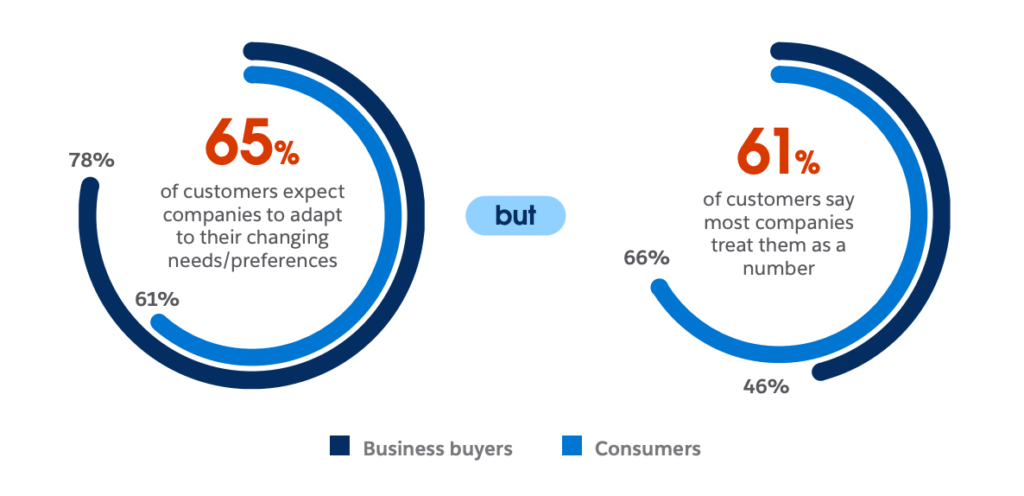
    Salesforce survey fintech open source businesses

    source- State of the connected customer

    The expectation for personalised services is shaping how financial institutions approach customer engagement and product development.

    Real-world examples of open-source fintech

    Companies like Robinhood and Chime leverage open-source tools to analyse user data and create personalised financial recommendations. These platforms use technologies like Apache Kafka and Apache Spark to process real-time data, improving the accuracy and relevance of their personalised offerings-from customised investment options to tailored loan products.

    Implementing hyper-personalisation lets fintech companies strengthen customer relationships, boost retention, and increase deposits. By leveraging real-time, data-driven technologies, they can offer highly relevant products that foster customer loyalty and maximise value throughout the customer lifecycle. With the scalability and flexibility of open-source solutions, companies can provide precise, cost-effective personalised services, positioning themselves for success in a competitive market.

    Erlang and Elixir: Open Source solutions for fintech applications

    Released as open-source in 1998 , Erlang has become essential for fintech companies that need scalable, high-concurrency, and fault-tolerant systems. Its open-source nature, combined with the capabilities of Elixir (which builds on Erlang’s robust architecture), enables fintech firms to innovate without relying on proprietary software, providing the flexibility to develop custom and efficient solutions.

    Both Erlang and Elixir’s architecture are designed to ensure potentially zero downtime, making them well-suited for real-time financial transactions.

    Why Erlang and Elixir are ideal for Fintech:

    • Reliability : Erlang’s and Elixir’s design ensures that applications continue to function smoothly even during hardware or network failures, crucial for financial services that operate 24/7, guaranteeing uninterrupted service. Elixir inherits Erlang’s reliability while providing a more modern syntax for development.
    • Scalability : Erlang and Elixir can handle thousands of concurrent processes, making them perfect for fintech companies looking to scale quickly, especially when dealing with growing data volumes and transactions. Elixir enhances Erlang’s scalability with modern tooling and enhanced performance for certain types of workloads.
    • Fault tolerance: Built-in error detection and recovery features ensure that unexpected failures are managed with minimal disruption. This is vital for fintech applications, where downtime can lead to significant financial losses. Erlang’s auto restoration philosophy and Elixir’s features enable 100% availability and no transaction is lost.
    • Concurrency & distribution : Both Erlang and Elixir excel at managing multiple concurrent processes across distributed systems. This makes them ideal for fintechs with global operations that require real-time data processing across various locations.

    Open-source fintech use cases

    Several leading fintech companies have already used Erlang to build scalable, reliable systems that support their complex operations and real-time transactions.

    • Klarna : This major European fintech relies on Erlang to manage real-time e-commerce payment solutions, where scalability and reliability are critical for managing millions of transactions daily.
    • Goldman Sachs : Erlang is utilised in Goldman Sachs’ high-frequency trading platform, allowing for ultra-low latency and real-time processing essential for responding to market conditions in microseconds.
    • Kivra : Erlang/ Elixir supports Kivra’s backend services, managing secure digital communications for millions of users, and ensuring constant uptime and data security.

    Erlang and Elixir -supporting future fintech trends

    The features of Erlang and Elixir align well with emerging fintech trends:

    • DeFi and Decentralised Applications (dApps) : With the growth of decentralised finance (DeFi), Erlang’s and Elixir’s fault tolerance and real-time scalability make them ideal for building dApps that require secure, distributed networks capable of handling large transaction volumes without failure.
    • Hyperpersonalisation : As demand for hyperpersonalised financial services grows, Erlang and Elixir’s ability to process vast amounts of real-time data across users simultaneously makes them vital for delivering tailored, data-driven experiences.
    • Open banking : Erlang and Elixir’s concurrency support enables fintechs to build seamless, scalable platforms in the open banking era, where various financial systems must interact across multiple applications and services to provide integrated solutions.

    Erlang and Elixir can handle thousands of real-time transactions with zero downtime making them well-suited for trends like DeFi, hyperpersonalisation, and open banking. Their flexibility and active developer community ensure that fintechs can innovate without being locked into costly proprietary software.

    To conclude

    Fintech businesses are navigating an increasingly complex and competitive landscape where traditional solutions no longer provide a competitive edge. If you’re a company still reliant on proprietary software, ask yourself: Is your system equipped to expect the unexpected? Can your existing solutions keep up with market demands?

    Open-source technologies offer a solution to these challenges. Fintech firms can reduce costs, improve security, and, most importantly, innovate and scale according to their needs. Whether by reducing vendor lock-ins, tapping into a vibrant developer community, or leveraging customisation, open-source software is set to transform the fintech experience, providing the tools necessary to stay ahead in a digital-first world. If you’re interested in exploring how open-source solutions like Erlang or Elixir can help future-proof your fintech systems, contact the Erlang Solutions team .

    The post Why Open Source Technologies is a Smart Choice for Fintech Businesses appeared first on Erlang Solutions .

    • Pl chevron_right

      Erlang Solutions: Why Open Source Technologies is a Smart Choice for Fintech Businesses

      news.movim.eu / PlanetJabber • 10 October 2024 • 11 minutes

    Traditionally, the fintech industry relied on proprietary software , with usage and distribution restricted by paid licences. Fintech open-source technologies were distrusted due to security concerns over visible code in complex systems.

    But fast-forward to today and financial institutions, including neobanks like Revolut and Monzo, have embraced open source solutions. These banks have built technology stacks on open-source platforms, using new software and innovation to strengthen their competitive edge.

    While proprietary software has its role, it faces challenges exemplified by Oracle/Java’s subscription model changes, which have led to significant cost hikes. In contrast, open source Delivers flexibility, scalability, and more control, making it a great choice for fintechs aiming to remain adaptable.

    Curious why open source is the smart choice for fintech? Let’s look into how this shift can help future-proof operations, drive innovation, and enhance customer-centric services.

    The impact of Oracle Java’s pricing changes

    Before we understand why open source is a smart choice for fintech, let’s look at a recent example that highlights the risks of relying on proprietary software—Oracle Java’s subscription model changes.

    A change to subscription

    Java, known as the “language of business,” has been the top choice for developers and 90% of Fortune 500 companies for over 28 years, due to its stability, performance, and strong Oracle Java community.

    In January 2023, Oracle quietly shifted its Java SE subscription model to an employee-based system, charging businesses based on total headcount, not just the number of users. This change alarmed many subscribers and resulted in steep increases in licensing fees. According to Gartner , these changes made operations two to five times more expensive for most organisations.

    Fintech open source Java SE universal products

    Oracle Java SE Universal Subscription Global Price List (by volume)

    Impact on Oracle Java SE user base

    By January 2024, many Oracle Java SE subscribers had switched to OpenJDK, the open-source version of Java. Online sentiment towards Oracle has been unfavourable, with many users expressing dissatisfaction in forums. Those who stuck with Oracle are now facing hefty subscription fee increases with little added benefit.

    Lessons from Oracle Java SE

    For fintech companies, Oracle Java’s pricing changes have highlighted the risks of proprietary software. In particular, there are unexpected cost hikes, less flexibility, and disruptions to critical infrastructure. Open source solutions, on the other hand, give fintech firms more control, reduce vendor lock-in, and allow them to adapt to future changes while keeping costs in check.

    The advantages of open source technologies for Fintech

    Open source software is gaining attention in financial institutions, thanks to the rise of digital financial services and fintech advancements.

    It is expected to grow by 24% by 2025 and companies that embrace open-source benefit from enhanced security, support for cryptocurrency trading, and a boost to fintech innovation.

    Cost-effectiveness

    The cost advantages of open-source software have been a major draw for companies looking to shift from proprietary systems. For fintech companies, open-source reduces operational expenses compared to the unpredictable, high costs of proprietary solutions like Oracle Java SE.

    Open source software is often free, allowing fintech startups and established firms to lower development costs and redirect funds to key areas such as compliance, security, and user experience. It also avoids fees like:

    • Multi-user licences
    • Administrative charges
    • Ongoing annual software support charges

    These savings help reduce operating expenses while enabling investment in valuable services like user training, ongoing support, and customised development, driving growth and efficiency.

    A solution to big tech monopolies

    Monopolies in tech, particularly in fintech, are increasing. As reported by CB Insights , about 80% of global payment transactions are controlled by just a few major players. These monopolies stifle innovation and drive up costs.

    Open-source software decentralises development, preventing any single entity from holding total control. It offers fintech companies an alternative to proprietary systems, reducing reliance on monopolistic players and fostering healthy competition. Open-source models promote transparency, innovation, and lower costs, helping create more inclusive and competitive systems.

    Transparent and secure solutions

    Security concerns have been a major roadblock that causes companies and startups to hesitate in adopting open-source software.

    A common myth about open source is that its public code makes it insecure. But, open-source benefits from transparency, as it allows for continuous public scrutiny. Security flaws are discovered and addressed quickly by the community, unlike proprietary software, where vulnerabilities may remain hidden.

    An example is Vocalink , which powers real-time global payment systems. Vocalink uses Erlang , an open-source language designed for high-availability systems, ensuring secure, scalable payment handling. The transparency of open source allows businesses to audit security, ensure compliance, and quickly implement fixes, leading to more secure fintech infrastructure.

    Ongoing community support

    Beyond security, open source benefits from vibrant communities of developers and users who share knowledge and collaborate to enhance software. This fosters innovation and accelerates development, allowing for faster adaptation to trends or market demands.

    Since the code is open, fintech firms can build custom solutions, which can be contributed back to the community for others to use. The rapid pace of innovation within these communities helps keep the software relevant and adaptable.

    Interoperability

    Interoperability is a game-changer for open-source solutions in financial institutions, allowing for the seamless integration of diverse applications and systems- essential for financial services with complex tech stacks.

    By adopting open standards (publicly accessible guidelines ensuring compatibility), financial institutions can eliminate costly manual integrations and enable plug-and-play functionality. This enhances agility, allowing institutions to adopt the best applications without being tied to a single vendor.

    A notable example is NatWest’s Backplane , an open-source interoperability solution built on FDC3 standards. Backplane enables customers and fintechs to integrate their desktop apps with various banking and fintech applications, enhancing the financial desktop experience. This approach fosters innovation, saves time and resources, and creates a more flexible, customer-centric ecosystem.

    Future-proofing for longevity

    Open-source software has long-term viability. Since the source code is accessible, even if the original team disbands, other organisations, developers or the community at large can maintain and update the software. This ensures the software remains usable and up-to-date, preventing reliance on unsupported tools.

    Open Source powering Fintech trends

    According to the latest study by McKinsey and Company , Artificial Intelligence (AI), machine learning (ML), blockchain technology, and hyper-personalisation will be among some of the key technologies driving financial services in the next decade.

    Open-source platforms will play a key role in supporting and accelerating these developments, making them more accessible and innovative.

    AI and fintech innovation

    • Cost-effective AI/ML : Open-source AI frameworks like TensorFlow , PyTorch , and Scikit -learn enable startups to prototype and deploy AI models affordably, with the flexibility to scale as they grow. This democratisation of AI allows smaller players to compete with larger firms.
    • Fraud detection and personalisation : AI-powered fraud detection and personalised services are central to fintech innovation. Open-source AI libraries help companies like Stripe and PayPal detect fraudulent transactions by analysing patterns, while AI enables dynamic pricing and custom loan offers based on user behaviour.
    • Efficient operations : AI streamlines back-office tasks through automation, knowledge graphs, and natural language processing (NLP), improving fraud detection and overall operational efficiency.
    • Privacy-aware AI : Emerging technologies like federated learning and encryption tools help keep sensitive data secure, for rapid AI innovation while ensuring privacy and compliance.

    Blockchain and fintech

    Open-source blockchain platforms allow fintech startups to innovate without the hefty cost of proprietary systems:

    • Open-source blockchain platforms : Platforms like Ethereum , Bitcoin Core, and Hyperledger are decentralising finance, providing transparency, reducing reliance on intermediaries, and reshaping financial services.
    • Decentralised finance (DeFi) :  DeFi is projected to see an impressive rise, with P2P lending growing from $43.16 billion in 2018 to an estimated $567.3 billion by 2026 . Platforms like Uniswap and Aave , built on Ethereum, are pioneering decentralised lending and asset management, offering an alternative to traditional banking. By 2023, Ethereum alone locked $23 billion in DeFi assets, proving its growing influence in the fintech space. Enterprise blockchain solutions: Open source frameworks like Hyperledger Fabric and Corda are enabling enterprises to develop private, permissioned blockchain solutions, enhancing security and scalability across industries, including finance.

    Cost-effective innovation: Startups leveraging open-source blockchain technologies can build innovative financial services while keeping costs low, helping them compete effectively with traditional financial institutions.

    Hyper-personalisation

    Hyper-personalisation is another key trend in fintech, with AI and open-source technologies enabling companies to create highly tailored financial products. This shift moves away from the traditional “one-size-fits-all” model, helping fintechs solve niche customer challenges and deliver more precise services.

    Consumer demand for personalisation

    A Salesforce survey found that 65% of consumers expect businesses to personalise their services, while 86% are willing to share data to receive more customised experiences.

    Salesforce survey fintech open source businesses

    source- State of the connected customer

    The expectation for personalised services is shaping how financial institutions approach customer engagement and product development.

    Real-world examples of open-source fintech

    Companies like Robinhood and Chime leverage open-source tools to analyse user data and create personalised financial recommendations. These platforms use technologies like Apache Kafka and Apache Spark to process real-time data, improving the accuracy and relevance of their personalised offerings-from customised investment options to tailored loan products.

    Implementing hyper-personalisation lets fintech companies strengthen customer relationships, boost retention, and increase deposits. By leveraging real-time, data-driven technologies, they can offer highly relevant products that foster customer loyalty and maximise value throughout the customer lifecycle. With the scalability and flexibility of open-source solutions, companies can provide precise, cost-effective personalised services, positioning themselves for success in a competitive market.

    Erlang and Elixir: Open Source solutions for fintech applications

    Released as open-source in 1998 , Erlang has become essential for fintech companies that need scalable, high-concurrency, and fault-tolerant systems. Its open-source nature, combined with the capabilities of Elixir (which builds on Erlang’s robust architecture), enables fintech firms to innovate without relying on proprietary software, providing the flexibility to develop custom and efficient solutions.

    Both Erlang and Elixir’s architecture are designed to ensure potentially zero downtime, making them well-suited for real-time financial transactions.

    Why Erlang and Elixir are ideal for Fintech:

    • Reliability : Erlang’s and Elixir’s design ensures that applications continue to function smoothly even during hardware or network failures, crucial for financial services that operate 24/7, guaranteeing uninterrupted service. Elixir inherits Erlang’s reliability while providing a more modern syntax for development.
    • Scalability : Erlang and Elixir can handle thousands of concurrent processes, making them perfect for fintech companies looking to scale quickly, especially when dealing with growing data volumes and transactions. Elixir enhances Erlang’s scalability with modern tooling and enhanced performance for certain types of workloads.
    • Fault tolerance: Built-in error detection and recovery features ensure that unexpected failures are managed with minimal disruption. This is vital for fintech applications, where downtime can lead to significant financial losses. Erlang’s auto restoration philosophy and Elixir’s features enable 100% availability and no transaction is lost.
    • Concurrency & distribution : Both Erlang and Elixir excel at managing multiple concurrent processes across distributed systems. This makes them ideal for fintechs with global operations that require real-time data processing across various locations.

    Open-source fintech use cases

    Several leading fintech companies have already used Erlang to build scalable, reliable systems that support their complex operations and real-time transactions.

    • Klarna : This major European fintech relies on Erlang to manage real-time e-commerce payment solutions, where scalability and reliability are critical for managing millions of transactions daily.
    • Goldman Sachs : Erlang is utilised in Goldman Sachs’ high-frequency trading platform, allowing for ultra-low latency and real-time processing essential for responding to market conditions in microseconds.
    • Kivra : Erlang/ Elixir supports Kivra’s backend services, managing secure digital communications for millions of users, and ensuring constant uptime and data security.

    Erlang and Elixir -supporting future fintech trends

    The features of Erlang and Elixir align well with emerging fintech trends:

    • DeFi and Decentralised Applications (dApps) : With the growth of decentralised finance (DeFi), Erlang’s and Elixir’s fault tolerance and real-time scalability make them ideal for building dApps that require secure, distributed networks capable of handling large transaction volumes without failure.
    • Hyperpersonalisation : As demand for hyperpersonalised financial services grows, Erlang and Elixir’s ability to process vast amounts of real-time data across users simultaneously makes them vital for delivering tailored, data-driven experiences.
    • Open banking : Erlang and Elixir’s concurrency support enables fintechs to build seamless, scalable platforms in the open banking era, where various financial systems must interact across multiple applications and services to provide integrated solutions.

    Erlang and Elixir can handle thousands of real-time transactions with zero downtime making them well-suited for trends like DeFi, hyperpersonalisation, and open banking. Their flexibility and active developer community ensure that fintechs can innovate without being locked into costly proprietary software.

    To conclude

    Fintech businesses are navigating an increasingly complex and competitive landscape where traditional solutions no longer provide a competitive edge. If you’re a company still reliant on proprietary software, ask yourself: Is your system equipped to expect the unexpected? Can your existing solutions keep up with market demands?

    Open-source technologies offer a solution to these challenges. Fintech firms can reduce costs, improve security, and, most importantly, innovate and scale according to their needs. Whether by reducing vendor lock-ins, tapping into a vibrant developer community, or leveraging customisation, open-source software is set to transform the fintech experience, providing the tools necessary to stay ahead in a digital-first world. If you’re interested in exploring how open-source solutions like Erlang or Elixir can help future-proof your fintech systems, contact the Erlang Solutions team .

    The post Why Open Source Technologies is a Smart Choice for Fintech Businesses appeared first on Erlang Solutions .

    • Pl chevron_right

      Erlang Solutions: Why Open Source Technologies is a Smart Choice for Fintech Businesses

      news.movim.eu / PlanetJabber • 10 October 2024 • 11 minutes

    Traditionally, the fintech industry relied on proprietary software , with usage and distribution restricted by paid licences. Fintech open-source technologies were distrusted due to security concerns over visible code in complex systems.

    But fast-forward to today and financial institutions, including neobanks like Revolut and Monzo, have embraced open source solutions. These banks have built technology stacks on open-source platforms, using new software and innovation to strengthen their competitive edge.

    While proprietary software has its role, it faces challenges exemplified by Oracle/Java’s subscription model changes, which have led to significant cost hikes. In contrast, open source Delivers flexibility, scalability, and more control, making it a great choice for fintechs aiming to remain adaptable.

    Curious why open source is the smart choice for fintech? Let’s look into how this shift can help future-proof operations, drive innovation, and enhance customer-centric services.

    The impact of Oracle Java’s pricing changes

    Before we understand why open source is a smart choice for fintech, let’s look at a recent example that highlights the risks of relying on proprietary software—Oracle Java’s subscription model changes.

    A change to subscription

    Java, known as the “language of business,” has been the top choice for developers and 90% of Fortune 500 companies for over 28 years, due to its stability, performance, and strong Oracle Java community.

    In January 2023, Oracle quietly shifted its Java SE subscription model to an employee-based system, charging businesses based on total headcount, not just the number of users. This change alarmed many subscribers and resulted in steep increases in licensing fees. According to Gartner , these changes made operations two to five times more expensive for most organisations.

    Fintech open source Java SE universal products

    Oracle Java SE Universal Subscription Global Price List (by volume)

    Impact on Oracle Java SE user base

    By January 2024, many Oracle Java SE subscribers had switched to OpenJDK, the open-source version of Java. Online sentiment towards Oracle has been unfavourable, with many users expressing dissatisfaction in forums. Those who stuck with Oracle are now facing hefty subscription fee increases with little added benefit.

    Lessons from Oracle Java SE

    For fintech companies, Oracle Java’s pricing changes have highlighted the risks of proprietary software. In particular, there are unexpected cost hikes, less flexibility, and disruptions to critical infrastructure. Open source solutions, on the other hand, give fintech firms more control, reduce vendor lock-in, and allow them to adapt to future changes while keeping costs in check.

    The advantages of open source technologies for Fintech

    Open source software is gaining attention in financial institutions, thanks to the rise of digital financial services and fintech advancements.

    It is expected to grow by 24% by 2025 and companies that embrace open-source benefit from enhanced security, support for cryptocurrency trading, and a boost to fintech innovation.

    Cost-effectiveness

    The cost advantages of open-source software have been a major draw for companies looking to shift from proprietary systems. For fintech companies, open-source reduces operational expenses compared to the unpredictable, high costs of proprietary solutions like Oracle Java SE.

    Open source software is often free, allowing fintech startups and established firms to lower development costs and redirect funds to key areas such as compliance, security, and user experience. It also avoids fees like:

    • Multi-user licences
    • Administrative charges
    • Ongoing annual software support charges

    These savings help reduce operating expenses while enabling investment in valuable services like user training, ongoing support, and customised development, driving growth and efficiency.

    A solution to big tech monopolies

    Monopolies in tech, particularly in fintech, are increasing. As reported by CB Insights , about 80% of global payment transactions are controlled by just a few major players. These monopolies stifle innovation and drive up costs.

    Open-source software decentralises development, preventing any single entity from holding total control. It offers fintech companies an alternative to proprietary systems, reducing reliance on monopolistic players and fostering healthy competition. Open-source models promote transparency, innovation, and lower costs, helping create more inclusive and competitive systems.

    Transparent and secure solutions

    Security concerns have been a major roadblock that causes companies and startups to hesitate in adopting open-source software.

    A common myth about open source is that its public code makes it insecure. But, open-source benefits from transparency, as it allows for continuous public scrutiny. Security flaws are discovered and addressed quickly by the community, unlike proprietary software, where vulnerabilities may remain hidden.

    An example is Vocalink , which powers real-time global payment systems. Vocalink uses Erlang , an open-source language designed for high-availability systems, ensuring secure, scalable payment handling. The transparency of open source allows businesses to audit security, ensure compliance, and quickly implement fixes, leading to more secure fintech infrastructure.

    Ongoing community support

    Beyond security, open source benefits from vibrant communities of developers and users who share knowledge and collaborate to enhance software. This fosters innovation and accelerates development, allowing for faster adaptation to trends or market demands.

    Since the code is open, fintech firms can build custom solutions, which can be contributed back to the community for others to use. The rapid pace of innovation within these communities helps keep the software relevant and adaptable.

    Interoperability

    Interoperability is a game-changer for open-source solutions in financial institutions, allowing for the seamless integration of diverse applications and systems- essential for financial services with complex tech stacks.

    By adopting open standards (publicly accessible guidelines ensuring compatibility), financial institutions can eliminate costly manual integrations and enable plug-and-play functionality. This enhances agility, allowing institutions to adopt the best applications without being tied to a single vendor.

    A notable example is NatWest’s Backplane , an open-source interoperability solution built on FDC3 standards. Backplane enables customers and fintechs to integrate their desktop apps with various banking and fintech applications, enhancing the financial desktop experience. This approach fosters innovation, saves time and resources, and creates a more flexible, customer-centric ecosystem.

    Future-proofing for longevity

    Open-source software has long-term viability. Since the source code is accessible, even if the original team disbands, other organisations, developers or the community at large can maintain and update the software. This ensures the software remains usable and up-to-date, preventing reliance on unsupported tools.

    Open Source powering Fintech trends

    According to the latest study by McKinsey and Company , Artificial Intelligence (AI), machine learning (ML), blockchain technology, and hyper-personalisation will be among some of the key technologies driving financial services in the next decade.

    Open-source platforms will play a key role in supporting and accelerating these developments, making them more accessible and innovative.

    AI and fintech innovation

    • Cost-effective AI/ML : Open-source AI frameworks like TensorFlow , PyTorch , and Scikit -learn enable startups to prototype and deploy AI models affordably, with the flexibility to scale as they grow. This democratisation of AI allows smaller players to compete with larger firms.
    • Fraud detection and personalisation : AI-powered fraud detection and personalised services are central to fintech innovation. Open-source AI libraries help companies like Stripe and PayPal detect fraudulent transactions by analysing patterns, while AI enables dynamic pricing and custom loan offers based on user behaviour.
    • Efficient operations : AI streamlines back-office tasks through automation, knowledge graphs, and natural language processing (NLP), improving fraud detection and overall operational efficiency.
    • Privacy-aware AI : Emerging technologies like federated learning and encryption tools help keep sensitive data secure, for rapid AI innovation while ensuring privacy and compliance.

    Blockchain and fintech

    Open-source blockchain platforms allow fintech startups to innovate without the hefty cost of proprietary systems:

    • Open-source blockchain platforms : Platforms like Ethereum , Bitcoin Core, and Hyperledger are decentralising finance, providing transparency, reducing reliance on intermediaries, and reshaping financial services.
    • Decentralised finance (DeFi) :  DeFi is projected to see an impressive rise, with P2P lending growing from $43.16 billion in 2018 to an estimated $567.3 billion by 2026 . Platforms like Uniswap and Aave , built on Ethereum, are pioneering decentralised lending and asset management, offering an alternative to traditional banking. By 2023, Ethereum alone locked $23 billion in DeFi assets, proving its growing influence in the fintech space. Enterprise blockchain solutions: Open source frameworks like Hyperledger Fabric and Corda are enabling enterprises to develop private, permissioned blockchain solutions, enhancing security and scalability across industries, including finance.

    Cost-effective innovation: Startups leveraging open-source blockchain technologies can build innovative financial services while keeping costs low, helping them compete effectively with traditional financial institutions.

    Hyper-personalisation

    Hyper-personalisation is another key trend in fintech, with AI and open-source technologies enabling companies to create highly tailored financial products. This shift moves away from the traditional “one-size-fits-all” model, helping fintechs solve niche customer challenges and deliver more precise services.

    Consumer demand for personalisation

    A Salesforce survey found that 65% of consumers expect businesses to personalise their services, while 86% are willing to share data to receive more customised experiences.

    Salesforce survey fintech open source businesses

    source- State of the connected customer

    The expectation for personalised services is shaping how financial institutions approach customer engagement and product development.

    Real-world examples of open-source fintech

    Companies like Robinhood and Chime leverage open-source tools to analyse user data and create personalised financial recommendations. These platforms use technologies like Apache Kafka and Apache Spark to process real-time data, improving the accuracy and relevance of their personalised offerings-from customised investment options to tailored loan products.

    Implementing hyper-personalisation lets fintech companies strengthen customer relationships, boost retention, and increase deposits. By leveraging real-time, data-driven technologies, they can offer highly relevant products that foster customer loyalty and maximise value throughout the customer lifecycle. With the scalability and flexibility of open-source solutions, companies can provide precise, cost-effective personalised services, positioning themselves for success in a competitive market.

    Erlang and Elixir: Open Source solutions for fintech applications

    Released as open-source in 1998 , Erlang has become essential for fintech companies that need scalable, high-concurrency, and fault-tolerant systems. Its open-source nature, combined with the capabilities of Elixir (which builds on Erlang’s robust architecture), enables fintech firms to innovate without relying on proprietary software, providing the flexibility to develop custom and efficient solutions.

    Both Erlang and Elixir’s architecture are designed to ensure potentially zero downtime, making them well-suited for real-time financial transactions.

    Why Erlang and Elixir are ideal for Fintech:

    • Reliability : Erlang’s and Elixir’s design ensures that applications continue to function smoothly even during hardware or network failures, crucial for financial services that operate 24/7, guaranteeing uninterrupted service. Elixir inherits Erlang’s reliability while providing a more modern syntax for development.
    • Scalability : Erlang and Elixir can handle thousands of concurrent processes, making them perfect for fintech companies looking to scale quickly, especially when dealing with growing data volumes and transactions. Elixir enhances Erlang’s scalability with modern tooling and enhanced performance for certain types of workloads.
    • Fault tolerance: Built-in error detection and recovery features ensure that unexpected failures are managed with minimal disruption. This is vital for fintech applications, where downtime can lead to significant financial losses. Erlang’s auto restoration philosophy and Elixir’s features enable 100% availability and no transaction is lost.
    • Concurrency & distribution : Both Erlang and Elixir excel at managing multiple concurrent processes across distributed systems. This makes them ideal for fintechs with global operations that require real-time data processing across various locations.

    Open-source fintech use cases

    Several leading fintech companies have already used Erlang to build scalable, reliable systems that support their complex operations and real-time transactions.

    • Klarna : This major European fintech relies on Erlang to manage real-time e-commerce payment solutions, where scalability and reliability are critical for managing millions of transactions daily.
    • Goldman Sachs : Erlang is utilised in Goldman Sachs’ high-frequency trading platform, allowing for ultra-low latency and real-time processing essential for responding to market conditions in microseconds.
    • Kivra : Erlang/ Elixir supports Kivra’s backend services, managing secure digital communications for millions of users, and ensuring constant uptime and data security.

    Erlang and Elixir -supporting future fintech trends

    The features of Erlang and Elixir align well with emerging fintech trends:

    • DeFi and Decentralised Applications (dApps) : With the growth of decentralised finance (DeFi), Erlang’s and Elixir’s fault tolerance and real-time scalability make them ideal for building dApps that require secure, distributed networks capable of handling large transaction volumes without failure.
    • Hyperpersonalisation : As demand for hyperpersonalised financial services grows, Erlang and Elixir’s ability to process vast amounts of real-time data across users simultaneously makes them vital for delivering tailored, data-driven experiences.
    • Open banking : Erlang and Elixir’s concurrency support enables fintechs to build seamless, scalable platforms in the open banking era, where various financial systems must interact across multiple applications and services to provide integrated solutions.

    Erlang and Elixir can handle thousands of real-time transactions with zero downtime making them well-suited for trends like DeFi, hyperpersonalisation, and open banking. Their flexibility and active developer community ensure that fintechs can innovate without being locked into costly proprietary software.

    To conclude

    Fintech businesses are navigating an increasingly complex and competitive landscape where traditional solutions no longer provide a competitive edge. If you’re a company still reliant on proprietary software, ask yourself: Is your system equipped to expect the unexpected? Can your existing solutions keep up with market demands?

    Open-source technologies offer a solution to these challenges. Fintech firms can reduce costs, improve security, and, most importantly, innovate and scale according to their needs. Whether by reducing vendor lock-ins, tapping into a vibrant developer community, or leveraging customisation, open-source software is set to transform the fintech experience, providing the tools necessary to stay ahead in a digital-first world. If you’re interested in exploring how open-source solutions like Erlang or Elixir can help future-proof your fintech systems, contact the Erlang Solutions team .

    The post Why Open Source Technologies is a Smart Choice for Fintech Businesses appeared first on Erlang Solutions .
    • Pl chevron_right

      Erlang Solutions: Why do systems fail? Tandem NonStop system and fault tolerance

      news.movim.eu / PlanetJabber • 3 October 2024 • 6 minutes

    If you’re an Elixir, Gleam, or Erlang developer, you’ve probably heard about the capabilities of the BEAM virtual machine, such as concurrency, distribution, and fault tolerance. Fault tolerance was one of the biggest concerns of Tandem Computers. They created their Tandem Non-Stop architecture for high availability in their systems, which included ATMs and mainframes.

    In this post, I’ll be sharing the fundamentals of the NonStop architecture design with you. Their approach to achieving high availability in the presence of failures is similar to some implementations in the Erlang Virtual Machine, as both rely on concepts of processes and modularity.

    Systems with High Availability

    Why do systems fail? This question should probably be asked more often, considering all the factors it involves. It was central to the NonStop architecture because achieving high availability depends on understanding system failures.

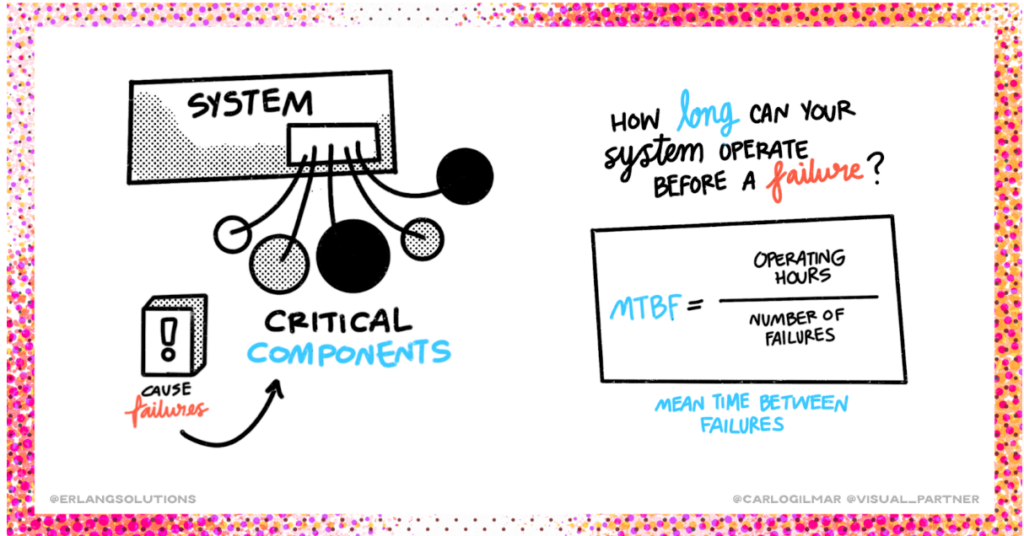
    For tandem systems , any system has critical components that could potentially cause failures. How often do you ask yourself how long can your system operate before a failure? There is a metric known as MTBF (mean time between failures), which is calculated by dividing the total operating hours of the system by the number of failures. The result represents the hours of uninterrupted operation.

    Many factors can affect the MTBF, including administration, configuration, maintenance, power outages, hardware failures, and more. So, how can you survive these eventualities to achieve at least virtual high availability in your systems?

    Tandem NonStop critical components

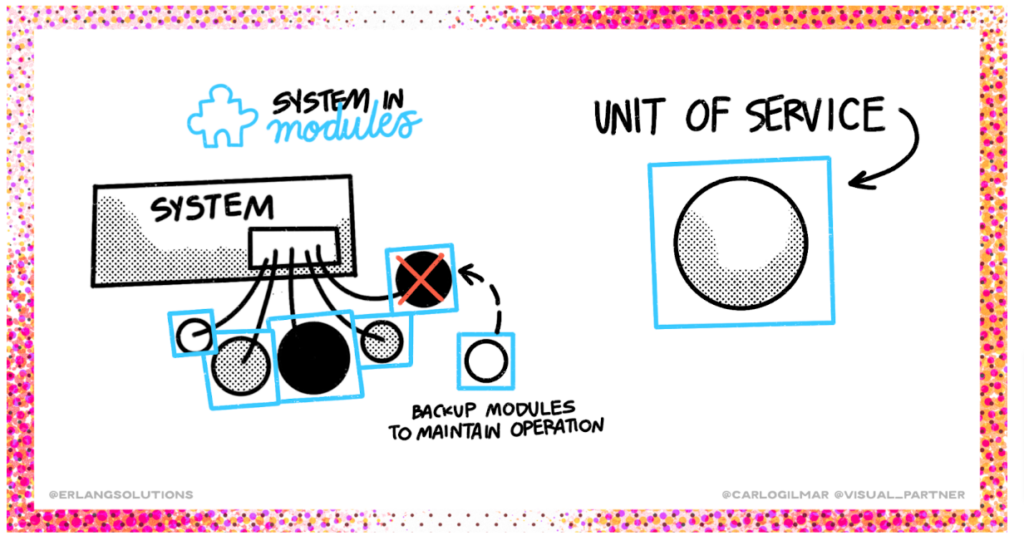
    High availability in hardware has taught us important insights about continuous operation. Some hardware implementations rely on decomposing the system into modules, allowing for modularity to contain failures and maintain operation through backup modules instead of breaking the whole system and needing to restart it. The main concept, from this point of view, is to use modules as units of failure and replacement.

    Tandem NonStop system in modules

    High Availability for Software Systems

    But what about the software’s high availability? Just as with hardware, we can find important lessons from operative system designers who decompose systems into modules as units of service. This approach provides a mechanism for having a unit of protection and fault containment.

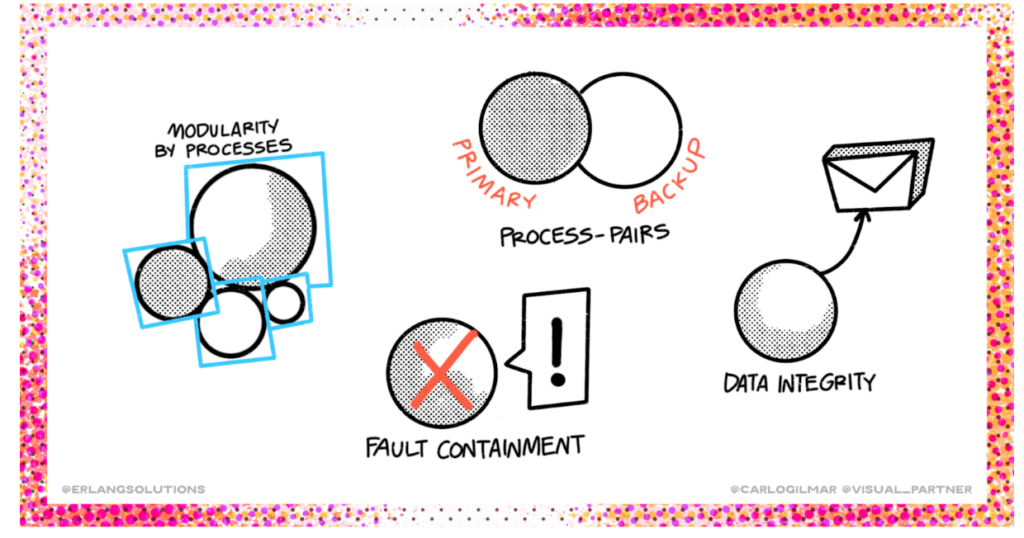
    To achieve fault tolerance in software, it’s important to address similar insights from the NonStop design:

    • Modularity through processes and messages.
    • Fault containment.
    • Process pairs for fault tolerance.
    • Data integrity.

    Can you recognise some similarities so far?

    The NonStop architecture essentially relies on these concepts. The key to high availability, as I mentioned before, is modularity as a unit of service failure and protection.

    A process should have a fail-fast mechanism, meaning it should be able to detect a failure during its operation, send a failure signal and then stop its operation. In this way, a system can achieve fault detection through fault containment and by sharing no state.

    Tandem NonStop primary backup

    Another important consideration for your system is how long it takes to recover from a failure. Jim Gray, software designer and researcher at Tandem Computers, in his paper ”Why computers stop and what can be done about it?” proposed a model of failure affected by two kinds of bugs: Bohrbugs, which cause critical failures during operation, and Heisenbugs, which are more soft and can persist in the system for years.

    Implementing Processes-Pairs Strategies

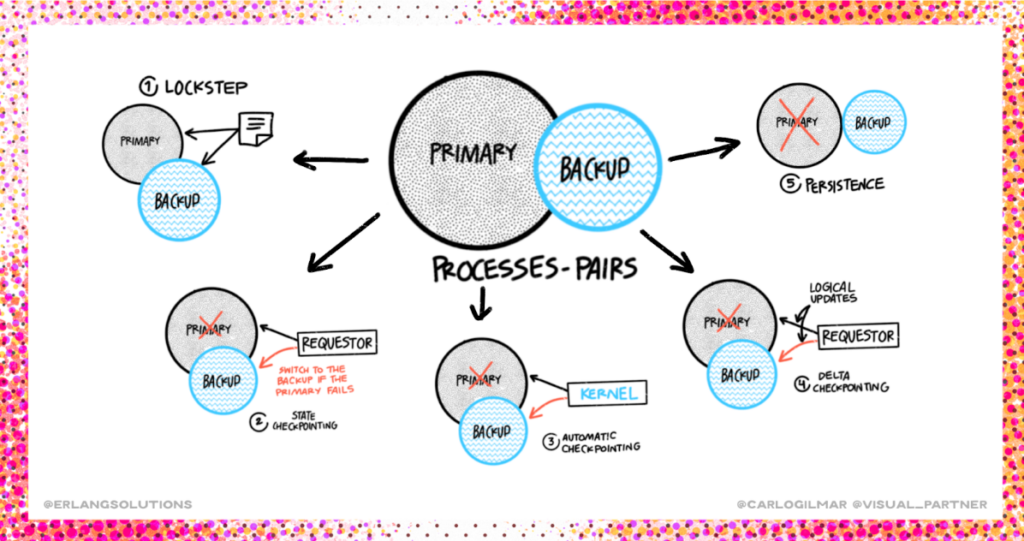
    The previous categorisation helps us to understand better strategies for implementing processes-pairs design, based on a primary process and a backup process:

    • Lockstep: Primary and backup processes execute the same task, so if the primary fails, the backup continues the execution. This is good for hardware failures, but in the presence of Heisenbugs, both processes will remain the failure.
    • State checkpointing: A requestor entity is connected to a processes-pair. When the primary process stops operation, the requestor switches to the backup process. You need to design the requestor logic.
    • Automatic checkpointing: Similar to the previous, but using the kernel to manage the checkpointing.
    • Delta checkpointing : Similar to state checkpointing but using logical rather than physical updates.
    • Persistence: When the primary process fails, the backup process starts its operation without a state. The system must implement a way to synchronise all the modules and avoid corrupt interaction.
    Tandem NonStop processes pairs

    All of these insights are drawn from Jim Gray’s paper, written in 1985 and referenced in Joe Armstrong’s 2003 thesis, “Making Reliable Distributed Systems in the presence of software errors” . Joe emphasised the importance of the Tandem NonStop system design as an inspiration for the OTP design principles.

    Elixir and High Availability

    So if you’re a software developer learning Elixir, you’ll probably be amazed by all the capabilities and great tooling available to build software systems. By leveraging frameworks like Phoenix and toolkits such as Ecto, you can build full-stack systems in Elixir. However, to fully harness the power of the Erlang virtual machine (BEAM) you must understand processes.

    Just as the Tandem computer system relied on transactions, fault containment and a fail-fast mechanism, Erlang achieves high availability through processes. Both systems consider it important to modularise systems into units of service and failure: processes.

    About the process

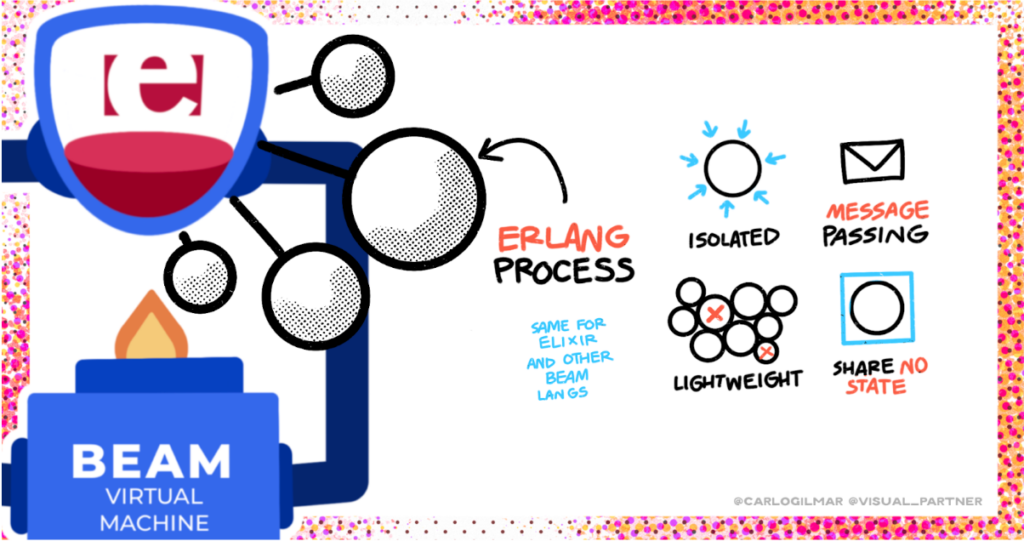
    A process is the basic unit of abstraction in Erlang, a crucial concept because the Erlang virtual machine (BEAM) operates around this. Elixir and Gleam share the same virtual machine, which is why this concept is important for the entire ecosystem.

    A process is:

    • A strongly isolated entity.
    • Creation and destruction is a lightweight operation.
    • Message passing is the only way to interact with processes.
    • Share no state.
    • Do what they are supposed to do or fail.

    Just remember, these are the fundamentals of Erlang, which is considered a message-oriented language, and its virtual machine (BEAM), on which Elixir runs.

    Tandem NonStop BEAM

    If you want to read more about processes in Elixir I recommend reading this article I wrote: Understanding Processes for Elixir Developers.

    I consider it important to read papers like Jim Gray’s article because they teach us the history behind implementations that attempt to solve problems. I find it interesting to read and share these insights with the community because it’s crucial to understand the context behind the tools we use. Recognising that implementations exist for a reason and have stories behind them is essential.

    You can find many similarities between Tandem and Erlang design principles:

    • Both aim to achieve high availability .
    • Isolation of operations is extremely important to contain failure.
    • Processes that share no state are crucial for building modular systems.
    • Process interactions are key to maintaining operation in the presence of errors. While Tandem computers implemented process-pairs design, Erlang implemented OTP patterns .

    To conclude

    Take some time to read about the Tandem computer design. It’s interesting because these features share significant similarities with OTP design principles for achieving high availability. Failure is something we need to deal with in any kind of system, and it’s important to be aware of the reasons and know what you can do to manage it and continue your operation. This is crucial for any software developer, but if you’re an Elixir developer, you’ll probably dive deeper into how processes work and how to start designing components with them and OTP.

    Thanks for reading about the Tandem NonStop system. If you like this kind of content, I’d appreciate it if you shared it with your community or teammates. You can visit this public repository on GitHub where I’m adding my graphic recordings and insights related to the Erlang ecosystem or contact the Erlang Solutions team to chat more about Erlang and Elixir.

    Tandem NonStop Joe Armstrong

    Illustrations by Visual Partner-Ship @visual_partner

    Jaguares, ESL Americas Office

    @carlogilmar

    The post Why do systems fail? Tandem NonStop system and fault tolerance appeared first on Erlang Solutions .
    • Pl chevron_right

      Erlang Solutions: Why do systems fail? Tandem NonStop system and fault tolerance

      news.movim.eu / PlanetJabber • 3 October 2024 • 6 minutes

    If you’re an Elixir, Gleam, or Erlang developer, you’ve probably heard about the capabilities of the BEAM virtual machine, such as concurrency, distribution, and fault tolerance. Fault tolerance was one of the biggest concerns of Tandem Computers. They created their Tandem Non-Stop architecture for high availability in their systems, which included ATMs and mainframes.

    In this post, I’ll be sharing the fundamentals of the NonStop architecture design with you. Their approach to achieving high availability in the presence of failures is similar to some implementations in the Erlang Virtual Machine, as both rely on concepts of processes and modularity.

    Systems with High Availability

    Why do systems fail? This question should probably be asked more often, considering all the factors it involves. It was central to the NonStop architecture because achieving high availability depends on understanding system failures.

    For tandem systems , any system has critical components that could potentially cause failures. How often do you ask yourself how long can your system operate before a failure? There is a metric known as MTBF (mean time between failures), which is calculated by dividing the total operating hours of the system by the number of failures. The result represents the hours of uninterrupted operation.

    Many factors can affect the MTBF, including administration, configuration, maintenance, power outages, hardware failures, and more. So, how can you survive these eventualities to achieve at least virtual high availability in your systems?

    Tandem NonStop critical components

    High availability in hardware has taught us important insights about continuous operation. Some hardware implementations rely on decomposing the system into modules, allowing for modularity to contain failures and maintain operation through backup modules instead of breaking the whole system and needing to restart it. The main concept, from this point of view, is to use modules as units of failure and replacement.

    Tandem NonStop system in modules

    High Availability for Software Systems

    But what about the software’s high availability? Just as with hardware, we can find important lessons from operative system designers who decompose systems into modules as units of service. This approach provides a mechanism for having a unit of protection and fault containment.

    To achieve fault tolerance in software, it’s important to address similar insights from the NonStop design:

    • Modularity through processes and messages.
    • Fault containment.
    • Process pairs for fault tolerance.
    • Data integrity.

    Can you recognise some similarities so far?

    The NonStop architecture essentially relies on these concepts. The key to high availability, as I mentioned before, is modularity as a unit of service failure and protection.

    A process should have a fail-fast mechanism, meaning it should be able to detect a failure during its operation, send a failure signal and then stop its operation. In this way, a system can achieve fault detection through fault containment and by sharing no state.

    Tandem NonStop primary backup

    Another important consideration for your system is how long it takes to recover from a failure. Jim Gray, software designer and researcher at Tandem Computers, in his paper ”Why computers stop and what can be done about it?” proposed a model of failure affected by two kinds of bugs: Bohrbugs, which cause critical failures during operation, and Heisenbugs, which are more soft and can persist in the system for years.

    Implementing Processes-Pairs Strategies

    The previous categorisation helps us to understand better strategies for implementing processes-pairs design, based on a primary process and a backup process:

    • Lockstep: Primary and backup processes execute the same task, so if the primary fails, the backup continues the execution. This is good for hardware failures, but in the presence of Heisenbugs, both processes will remain the failure.
    • State checkpointing: A requestor entity is connected to a processes-pair. When the primary process stops operation, the requestor switches to the backup process. You need to design the requestor logic.
    • Automatic checkpointing: Similar to the previous, but using the kernel to manage the checkpointing.
    • Delta checkpointing : Similar to state checkpointing but using logical rather than physical updates.
    • Persistence: When the primary process fails, the backup process starts its operation without a state. The system must implement a way to synchronise all the modules and avoid corrupt interaction.
    Tandem NonStop processes pairs

    All of these insights are drawn from Jim Gray’s paper, written in 1985 and referenced in Joe Armstrong’s 2003 thesis, “Making Reliable Distributed Systems in the presence of software errors” . Joe emphasised the importance of the Tandem NonStop system design as an inspiration for the OTP design principles.

    Elixir and High Availability

    So if you’re a software developer learning Elixir, you’ll probably be amazed by all the capabilities and great tooling available to build software systems. By leveraging frameworks like Phoenix and toolkits such as Ecto, you can build full-stack systems in Elixir. However, to fully harness the power of the Erlang virtual machine (BEAM) you must understand processes.

    Just as the Tandem computer system relied on transactions, fault containment and a fail-fast mechanism, Erlang achieves high availability through processes. Both systems consider it important to modularise systems into units of service and failure: processes.

    About the process

    A process is the basic unit of abstraction in Erlang, a crucial concept because the Erlang virtual machine (BEAM) operates around this. Elixir and Gleam share the same virtual machine, which is why this concept is important for the entire ecosystem.

    A process is:

    • A strongly isolated entity.
    • Creation and destruction is a lightweight operation.
    • Message passing is the only way to interact with processes.
    • Share no state.
    • Do what they are supposed to do or fail.

    Just remember, these are the fundamentals of Erlang, which is considered a message-oriented language, and its virtual machine (BEAM), on which Elixir runs.

    Tandem NonStop BEAM

    If you want to read more about processes in Elixir I recommend reading this article I wrote: Understanding Processes for Elixir Developers.

    I consider it important to read papers like Jim Gray’s article because they teach us the history behind implementations that attempt to solve problems. I find it interesting to read and share these insights with the community because it’s crucial to understand the context behind the tools we use. Recognising that implementations exist for a reason and have stories behind them is essential.

    You can find many similarities between Tandem and Erlang design principles:

    • Both aim to achieve high availability .
    • Isolation of operations is extremely important to contain failure.
    • Processes that share no state are crucial for building modular systems.
    • Process interactions are key to maintaining operation in the presence of errors. While Tandem computers implemented process-pairs design, Erlang implemented OTP patterns .

    To conclude

    Take some time to read about the Tandem computer design. It’s interesting because these features share significant similarities with OTP design principles for achieving high availability. Failure is something we need to deal with in any kind of system, and it’s important to be aware of the reasons and know what you can do to manage it and continue your operation. This is crucial for any software developer, but if you’re an Elixir developer, you’ll probably dive deeper into how processes work and how to start designing components with them and OTP.

    Thanks for reading about the Tandem NonStop system. If you like this kind of content, I’d appreciate it if you shared it with your community or teammates. You can visit this public repository on GitHub where I’m adding my graphic recordings and insights related to the Erlang ecosystem or contact the Erlang Solutions team to chat more about Erlang and Elixir.

    Tandem NonStop Joe Armstrong

    Illustrations by Visual Partner-Ship @visual_partner

    Jaguares, ESL Americas Office

    @carlogilmar

    The post Why do systems fail? Tandem NonStop system and fault tolerance appeared first on Erlang Solutions .
    • Pl chevron_right

      Erlang Solutions: Why do systems fail? Tandem NonStop system and fault tolerance

      news.movim.eu / PlanetJabber • 3 October 2024 • 6 minutes

    If you’re an Elixir, Gleam, or Erlang developer, you’ve probably heard about the capabilities of the BEAM virtual machine, such as concurrency, distribution, and fault tolerance. Fault tolerance was one of the biggest concerns of Tandem Computers. They created their Tandem Non-Stop architecture for high availability in their systems, which included ATMs and mainframes.

    In this post, I’ll be sharing the fundamentals of the NonStop architecture design with you. Their approach to achieving high availability in the presence of failures is similar to some implementations in the Erlang Virtual Machine, as both rely on concepts of processes and modularity.

    Systems with High Availability

    Why do systems fail? This question should probably be asked more often, considering all the factors it involves. It was central to the NonStop architecture because achieving high availability depends on understanding system failures.

    For tandem systems , any system has critical components that could potentially cause failures. How often do you ask yourself how long can your system operate before a failure? There is a metric known as MTBF (mean time between failures), which is calculated by dividing the total operating hours of the system by the number of failures. The result represents the hours of uninterrupted operation.

    Many factors can affect the MTBF, including administration, configuration, maintenance, power outages, hardware failures, and more. So, how can you survive these eventualities to achieve at least virtual high availability in your systems?

    Tandem NonStop critical components

    High availability in hardware has taught us important insights about continuous operation. Some hardware implementations rely on decomposing the system into modules, allowing for modularity to contain failures and maintain operation through backup modules instead of breaking the whole system and needing to restart it. The main concept, from this point of view, is to use modules as units of failure and replacement.

    Tandem NonStop system in modules

    High Availability for Software Systems

    But what about the software’s high availability? Just as with hardware, we can find important lessons from operative system designers who decompose systems into modules as units of service. This approach provides a mechanism for having a unit of protection and fault containment.

    To achieve fault tolerance in software, it’s important to address similar insights from the NonStop design:

    • Modularity through processes and messages.
    • Fault containment.
    • Process pairs for fault tolerance.
    • Data integrity.

    Can you recognise some similarities so far?

    The NonStop architecture essentially relies on these concepts. The key to high availability, as I mentioned before, is modularity as a unit of service failure and protection.

    A process should have a fail-fast mechanism, meaning it should be able to detect a failure during its operation, send a failure signal and then stop its operation. In this way, a system can achieve fault detection through fault containment and by sharing no state.

    Tandem NonStop primary backup

    Another important consideration for your system is how long it takes to recover from a failure. Jim Gray, software designer and researcher at Tandem Computers, in his paper ”Why computers stop and what can be done about it?” proposed a model of failure affected by two kinds of bugs: Bohrbugs, which cause critical failures during operation, and Heisenbugs, which are more soft and can persist in the system for years.

    Implementing Processes-Pairs Strategies

    The previous categorisation helps us to understand better strategies for implementing processes-pairs design, based on a primary process and a backup process:

    • Lockstep: Primary and backup processes execute the same task, so if the primary fails, the backup continues the execution. This is good for hardware failures, but in the presence of Heisenbugs, both processes will remain the failure.
    • State checkpointing: A requestor entity is connected to a processes-pair. When the primary process stops operation, the requestor switches to the backup process. You need to design the requestor logic.
    • Automatic checkpointing: Similar to the previous, but using the kernel to manage the checkpointing.
    • Delta checkpointing : Similar to state checkpointing but using logical rather than physical updates.
    • Persistence: When the primary process fails, the backup process starts its operation without a state. The system must implement a way to synchronise all the modules and avoid corrupt interaction.
    Tandem NonStop processes pairs

    All of these insights are drawn from Jim Gray’s paper, written in 1985 and referenced in Joe Armstrong’s 2003 thesis, “Making Reliable Distributed Systems in the presence of software errors” . Joe emphasised the importance of the Tandem NonStop system design as an inspiration for the OTP design principles.

    Elixir and High Availability

    So if you’re a software developer learning Elixir, you’ll probably be amazed by all the capabilities and great tooling available to build software systems. By leveraging frameworks like Phoenix and toolkits such as Ecto, you can build full-stack systems in Elixir. However, to fully harness the power of the Erlang virtual machine (BEAM) you must understand processes.

    Just as the Tandem computer system relied on transactions, fault containment and a fail-fast mechanism, Erlang achieves high availability through processes. Both systems consider it important to modularise systems into units of service and failure: processes.

    About the process

    A process is the basic unit of abstraction in Erlang, a crucial concept because the Erlang virtual machine (BEAM) operates around this. Elixir and Gleam share the same virtual machine, which is why this concept is important for the entire ecosystem.

    A process is:

    • A strongly isolated entity.
    • Creation and destruction is a lightweight operation.
    • Message passing is the only way to interact with processes.
    • Share no state.
    • Do what they are supposed to do or fail.

    Just remember, these are the fundamentals of Erlang, which is considered a message-oriented language, and its virtual machine (BEAM), on which Elixir runs.

    Tandem NonStop BEAM

    If you want to read more about processes in Elixir I recommend reading this article I wrote: Understanding Processes for Elixir Developers.

    I consider it important to read papers like Jim Gray’s article because they teach us the history behind implementations that attempt to solve problems. I find it interesting to read and share these insights with the community because it’s crucial to understand the context behind the tools we use. Recognising that implementations exist for a reason and have stories behind them is essential.

    You can find many similarities between Tandem and Erlang design principles:

    • Both aim to achieve high availability .
    • Isolation of operations is extremely important to contain failure.
    • Processes that share no state are crucial for building modular systems.
    • Process interactions are key to maintaining operation in the presence of errors. While Tandem computers implemented process-pairs design, Erlang implemented OTP patterns .

    To conclude

    Take some time to read about the Tandem computer design. It’s interesting because these features share significant similarities with OTP design principles for achieving high availability. Failure is something we need to deal with in any kind of system, and it’s important to be aware of the reasons and know what you can do to manage it and continue your operation. This is crucial for any software developer, but if you’re an Elixir developer, you’ll probably dive deeper into how processes work and how to start designing components with them and OTP.

    Thanks for reading about the Tandem NonStop system. If you like this kind of content, I’d appreciate it if you shared it with your community or teammates. You can visit this public repository on GitHub where I’m adding my graphic recordings and insights related to the Erlang ecosystem or contact the Erlang Solutions team to chat more about Erlang and Elixir.

    Tandem NonStop Joe Armstrong

    Illustrations by Visual Partner-Ship @visual_partner

    Jaguares, ESL Americas Office

    @carlogilmar

    The post Why do systems fail? Tandem NonStop system and fault tolerance appeared first on Erlang Solutions .