• Pl chevron_right

      Dino: Dino 0.5 Release

      news.movim.eu / PlanetJabber • 11 April 2025 • 1 minute

    Dino is a secure and open-source messaging application. It uses the XMPP (Jabber) protocol for decentralized communication. We aim to provide an intuitive and enjoyable user interface.

    The 0.5 release improves the user experience around file transfers and includes two completely reworked dialogs.

    Improved file sharing

    image_preview_loading.png

    The way file transfers are currently done in the XMPP ecosystem is limited in functionality and files can sometimes be received out-of-order. Dino now supports a new method for announcing file transfers ( XEP-0447 ), which solves this issue. Additionally, users can now see preview images or other file details before downloading the file. Dino currently only uses the new method for unencrypted file transfers, for example in public channels. Encrypted file transfers will also support the new protocol once Dino supports full-stanza encryption. All file transfers now also display the upload or download progress.
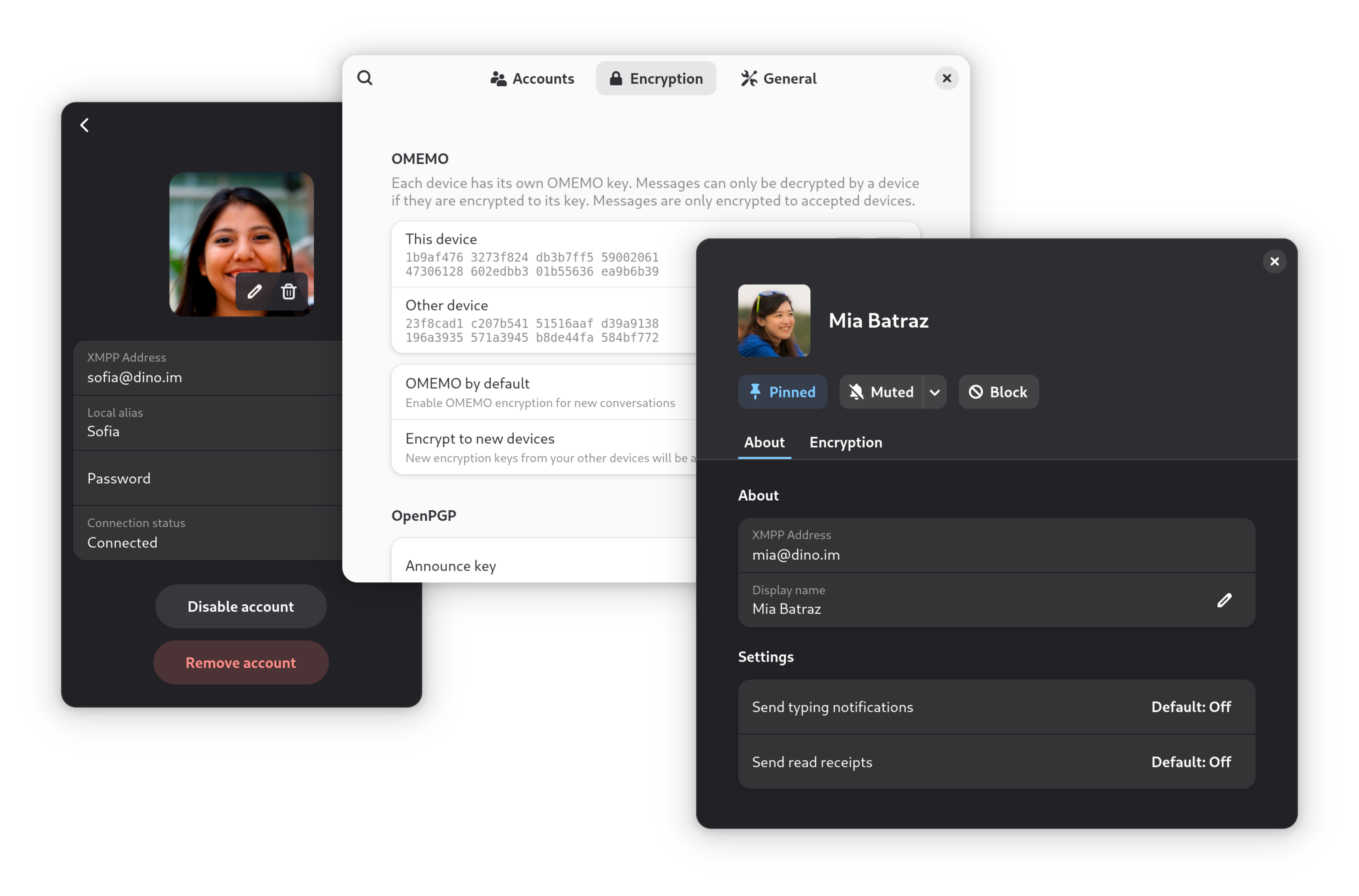
    Screenshots of three dialogs for account settings, encryption and contact details

    Reworked dialogs

    The account and preferences dialogs have been combined into a single, new dialog. This dialog lets you manage accounts and adjust encryption and other settings. It now also includes some new settings like an option for OMEMO encryption by default, which is enabled by default.

    Additionally, the conversation details dialog has been completely redesigned. Both dialogs are now fully compatible with mobile devices.

    Colors and more

    Dino now uses the same fallback avatar colors as other clients ( XEP-0392 ), creating a more consistent experience across applications.

    A new unread line has been added, indicating the point up to which you’ve already read the messages.

    Dino has also switched from CMake to Meson, which allows for an easier development process.

    Alentejo

    We named this Dino release “Alentejo” after a region in Portugal.

    monsaraz.jpg

    Alentejo is a region in southern Portugal that is known for its wide plains that are dotted with wineyards and cork trees. The region has a Mediterranean climate with summers regularly reaching temperatures above 40 degrees.

    Currently, about 3.6% of all deaths in the region are caused by heat. Heatwaves, in particular, pose a serious health risk and are expected to become more frequent and severe due to global warming [ 1 ]. If CO₂ emissions keep increasing, heat-related deaths could make up 15.8% of all deaths in the region by 2100. However, if action is taken to combat climate change, this number could be limited to 6.6% [ 2 ].

    • Pl chevron_right

      Dino: Dino 0.5 Release

      news.movim.eu / PlanetJabber • 11 April 2025 • 1 minute

    Dino is a secure and open-source messaging application. It uses the XMPP (Jabber) protocol for decentralized communication. We aim to provide an intuitive and enjoyable user interface.

    The 0.5 release improves the user experience around file transfers and includes two completely reworked dialogs.

    Improved file sharing

    image_preview_loading.png

    The way file transfers are currently done in the XMPP ecosystem is limited in functionality and files can sometimes be received out-of-order. Dino now supports a new method for announcing file transfers ( XEP-0447 ), which solves this issue. Additionally, users can now see preview images or other file details before downloading the file. Dino currently only uses the new method for unencrypted file transfers, for example in public channels. Encrypted file transfers will also support the new protocol once Dino supports full-stanza encryption. All file transfers now also display the upload or download progress.

    Screenshots of three dialogs for account settings, encryption and contact details

    Reworked dialogs

    The account and preferences dialogs have been combined into a single, new dialog. This dialog lets you manage accounts and adjust encryption and other settings. It now also includes some new settings like an option for OMEMO encryption by default, which is enabled by default.

    Additionally, the conversation details dialog has been completely redesigned. Both dialogs are now fully compatible with mobile devices.

    Colors and more

    Dino now uses the same fallback avatar colors as other clients ( XEP-0392 ), creating a more consistent experience across applications.

    A new unread line has been added, indicating the point up to which you’ve already read the messages.

    Dino has also switched from CMake to Meson, which allows for an easier development process.

    Alentejo

    We named this Dino release “Alentejo” after a region in Portugal.

    monsaraz.jpg

    Alentejo is a region in southern Portugal that is known for its wide plains that are dotted with wineyards and cork trees. The region has a Mediterranean climate with summers regularly reaching temperatures above 40 degrees.

    Currently, about 3.6% of all deaths in the region are caused by heat. Heatwaves, in particular, pose a serious health risk and are expected to become more frequent and severe due to global warming [ 1 ]. If CO₂ emissions keep increasing, heat-related deaths could make up 15.8% of all deaths in the region by 2100. However, if action is taken to combat climate change, this number could be limited to 6.6% [ 2 ].

    • Pl chevron_right

      Dino: Dino 0.5 Release

      news.movim.eu / PlanetJabber • 11 April 2025 • 1 minute

    Dino is a secure and open-source messaging application. It uses the XMPP (Jabber) protocol for decentralized communication. We aim to provide an intuitive and enjoyable user interface.

    The 0.5 release improves the user experience around file transfers and includes two completely reworked dialogs.

    Improved file sharing

    image_preview_loading.png

    The way file transfers are currently done in the XMPP ecosystem is limited in functionality and files can sometimes be received out-of-order. Dino now supports a new method for announcing file transfers ( XEP-0447 ), which solves this issue. Additionally, users can now see preview images or other file details before downloading the file. Dino currently only uses the new method for unencrypted file transfers, for example in public channels. Encrypted file transfers will also support the new protocol once Dino supports full-stanza encryption. All file transfers now also display the upload or download progress.

    Screenshots of three dialogs for account settings, encryption and contact details

    Reworked dialogs

    The account and preferences dialogs have been combined into a single, new dialog. This dialog lets you manage accounts and adjust encryption and other settings. It now also includes some new settings like an option for OMEMO encryption by default, which is enabled by default.

    Additionally, the conversation details dialog has been completely redesigned. Both dialogs are now fully compatible with mobile devices.

    Colors and more

    Dino now uses the same fallback avatar colors as other clients ( XEP-0392 ), creating a more consistent experience across applications.

    A new unread line has been added, indicating the point up to which you’ve already read the messages.

    Dino has also switched from CMake to Meson, which allows for an easier development process.

    Alentejo

    We named this Dino release “Alentejo” after a region in Portugal.

    monsaraz.jpg

    Alentejo is a region in southern Portugal that is known for its wide plains that are dotted with wineyards and cork trees. The region has a Mediterranean climate with summers regularly reaching temperatures above 40 degrees.

    Currently, about 3.6% of all deaths in the region are caused by heat. Heatwaves, in particular, pose a serious health risk and are expected to become more frequent and severe due to global warming [ 1 ]. If CO₂ emissions keep increasing, heat-related deaths could make up 15.8% of all deaths in the region by 2100. However, if action is taken to combat climate change, this number could be limited to 6.6% [ 2 ].

    • Pl chevron_right

      Ignite Realtime Blog: New releases for Tinder and Whack!

      news.movim.eu / PlanetJabber • 11 April 2025 • 1 minute

    The IgniteRealtime community is happy to announce releases for two of its projects! Both are for XMPP-libraries that we produce.

    Tinder is a Java based XMPP library, providing an implementation for XMPP stanzas and components. Tinder’s origins lie in code that’s shared between our Openfire and Whack implementations. The implementation that’s provided in Tinder hasn’t been written again from scratch. Instead, code has been moved from the original projects into Tinder, preserving al of the existing features and functionality.

    The v2.1.0 release of Tinder is a maintenance release. It updates various libraries that are used by Tinder, and removes deprecated, unused code. Tinder now requires Java 11 or later. The full list of changes in this release can be found in the release notes .

    Whack is a Java library that easily allows the creation of external components that follow the XEP-0114: Jabber Component Protocol. This library allows you to create server-sided components of your XMPP network that can run as stand-alone processes. That’s particularly useful when you are creating functionality for which scalability configuration differs from that of Openfire, or if you want to re-use your component for XMPP servers other than Openfire!

    The v3.0.0 release of Whack is a maintenance release. It improves reconnection logic (when connection to the XMPP server is lost), it no longer ships with an embedded webserver (that was old, unused, and was raising vulnerability warnings, and updates some libraries (such as Tinder) to more recent versions. The fulll list of chagnes in this release can be found in the release notes .

    We would love to hear from you! If you have any questions, please stop by our community forum or our live groupchat .

    For other release announcements and news follow us on Mastodon or X

    1 post - 1 participant

    Read full topic

    • Pl chevron_right

      Ignite Realtime Blog: New releases for Tinder and Whack!

      news.movim.eu / PlanetJabber • 11 April 2025 • 1 minute

    The IgniteRealtime community is happy to announce releases for two of its projects! Both are for XMPP-libraries that we produce.

    Tinder is a Java based XMPP library, providing an implementation for XMPP stanzas and components. Tinder’s origins lie in code that’s shared between our Openfire and Whack implementations. The implementation that’s provided in Tinder hasn’t been written again from scratch. Instead, code has been moved from the original projects into Tinder, preserving al of the existing features and functionality.

    The v2.1.0 release of Tinder is a maintenance release. It updates various libraries that are used by Tinder, and removes deprecated, unused code. Tinder now requires Java 11 or later. The full list of changes in this release can be found in the release notes .

    Whack is a Java library that easily allows the creation of external components that follow the XEP-0114: Jabber Component Protocol. This library allows you to create server-sided components of your XMPP network that can run as stand-alone processes. That’s particularly useful when you are creating functionality for which scalability configuration differs from that of Openfire, or if you want to re-use your component for XMPP servers other than Openfire!

    The v3.0.0 release of Whack is a maintenance release. It improves reconnection logic (when connection to the XMPP server is lost), it no longer ships with an embedded webserver (that was old, unused, and was raising vulnerability warnings, and updates some libraries (such as Tinder) to more recent versions. The fulll list of chagnes in this release can be found in the release notes .

    We would love to hear from you! If you have any questions, please stop by our community forum or our live groupchat .

    For other release announcements and news follow us on Mastodon or X

    1 post - 1 participant

    Read full topic

    • Pl chevron_right

      Ignite Realtime Blog: New releases for Tinder and Whack!

      news.movim.eu / PlanetJabber • 11 April 2025 • 1 minute

    The IgniteRealtime community is happy to announce releases for two of its projects! Both are for XMPP-libraries that we produce.

    Tinder is a Java based XMPP library, providing an implementation for XMPP stanzas and components. Tinder’s origins lie in code that’s shared between our Openfire and Whack implementations. The implementation that’s provided in Tinder hasn’t been written again from scratch. Instead, code has been moved from the original projects into Tinder, preserving al of the existing features and functionality.

    The v2.1.0 release of Tinder is a maintenance release. It updates various libraries that are used by Tinder, and removes deprecated, unused code. Tinder now requires Java 11 or later. The full list of changes in this release can be found in the release notes .

    Whack is a Java library that easily allows the creation of external components that follow the XEP-0114: Jabber Component Protocol. This library allows you to create server-sided components of your XMPP network that can run as stand-alone processes. That’s particularly useful when you are creating functionality for which scalability configuration differs from that of Openfire, or if you want to re-use your component for XMPP servers other than Openfire!

    The v3.0.0 release of Whack is a maintenance release. It improves reconnection logic (when connection to the XMPP server is lost), it no longer ships with an embedded webserver (that was old, unused, and was raising vulnerability warnings, and updates some libraries (such as Tinder) to more recent versions. The fulll list of chagnes in this release can be found in the release notes .

    We would love to hear from you! If you have any questions, please stop by our community forum or our live groupchat .

    For other release announcements and news follow us on Mastodon or X

    1 post - 1 participant

    Read full topic

    • Pl chevron_right

      Erlang Solutions: Elixir for Business: 5 Ways It Transforms Your Processes

      news.movim.eu / PlanetJabber • 10 April 2025 • 2 minutes

    Elixir is a lightweight, high-performance programming language built on the Erlang virtual machine. It’s known for its simple syntax and efficient use of digital resources. But how does this translate to business benefits?

    Elixir is already powering companies like Discord and Pinterest. It helps businesses reduce costs, improve process efficiency, and speed up time to market.

    Here are five reasons why Elixir is a game-changer for your business.

    1. Cleaner Code, Faster Progress

    Elixir is designed for simplicity. Its clean syntax and functional style help developers write concise, readable code, with fewer bugs and less overhead.

    For teams, this means faster development cycles and smoother collaboration. For businesses, it means shorter time to market and reduced long-term maintenance costs, which is especially useful during talent shortages.

    Projects move faster when your team isn’t fighting complexity.

    2. Built-In Concurrency, Built-In Stability

    Concurrency – the ability to run multiple tasks at once -is essential for modern applications. Elixir handles this natively, thanks to the Erlang virtual machine it runs on.

    With Elixir, you can run millions of lightweight processes simultaneously . It’s ideal for:

    • Real-time systems (e.g., messaging, live data feeds)
    • Applications with high user demand
    • Businesses that can’t afford downtime

    Crucially, these processes run independently. If one fails, the rest carry on — making your application more resilient by design.

    3. Smarter Use of Resources

    Elixir is resource-efficient. As your infrastructure scales, Elixir adapts automatically using the processing power available.

    This has clear benefits:

    • No wasted server capacity
    • Better app performance on existing infrastructure
    • Lower hosting and scaling costs

    Your tech stack runs leaner and more efficiently, with fewer surprises at scale.

    4. Elixir means simple scalability

    Elixir was made for scalable systems. Its lightweight processes and distributed architecture allow your application to grow without rewriting core components.

    What sets it apart:

    • Seamless horizontal scaling across machines
    • High fault tolerance through process isolation
    • Built-in support for distributed systems

    This makes Elixir especially strong for digital products that need to scale quickly or support unpredictable usage.

    Take Bleacher Report . They switched from Ruby to Elixir and saw results:

    Bleacher report Elixir

    • Server count dropped from 150 to 8
    • The app now handles over 200 million push notifications a day
    • Performance improved, with far fewer bottlenecks

    All of this was achieved while reducing infrastructure overhead.

    Read the full case study here .

    Modern Tools for Modern Challenges

    Elixir isn’t just fast it’s current.

    It supports distributed teams, integrates with today’s tools, and works well alongside other languages and frameworks.

    It’s especially useful for:

    • Products that need to ship fast and scale cleanly
    • Teams juggling real-time features, analytics or event-driven systems
    • Organisations focused on reliability and long-term performance

    Unlike many programming languages, Elixir is both powerful and practical.

    To conclude

    Elixir helps teams move quickly, handle growth with ease, and build reliable systems without unnecessary complexity. For modern businesses building digital platforms, it’s a quiet powerhouse and a strong strategic choice.

    Want to learn more about Elixir? Explore the full “What is Elixir?” post .

    Want to discuss how Elixir can enhance your business performance? Get in touch with the team.

    The post Elixir for Business: 5 Ways It Transforms Your Processes appeared first on Erlang Solutions .

    • Pl chevron_right

      Erlang Solutions: Elixir for Business: 5 Ways It Transforms Your Processes

      news.movim.eu / PlanetJabber • 10 April 2025 • 2 minutes

    Elixir is a lightweight, high-performance programming language built on the Erlang virtual machine. It’s known for its simple syntax and efficient use of digital resources. But how does this translate to business benefits?

    Elixir is already powering companies like Discord and Pinterest. It helps businesses reduce costs, improve process efficiency, and speed up time to market.

    Here are five reasons why Elixir is a game-changer for your business.

    1. Cleaner Code, Faster Progress

    Elixir is designed for simplicity. Its clean syntax and functional style help developers write concise, readable code, with fewer bugs and less overhead.

    For teams, this means faster development cycles and smoother collaboration. For businesses, it means shorter time to market and reduced long-term maintenance costs, which is especially useful during talent shortages.

    Projects move faster when your team isn’t fighting complexity.

    2. Built-In Concurrency, Built-In Stability

    Concurrency – the ability to run multiple tasks at once -is essential for modern applications. Elixir handles this natively, thanks to the Erlang virtual machine it runs on.

    With Elixir, you can run millions of lightweight processes simultaneously . It’s ideal for:

    • Real-time systems (e.g., messaging, live data feeds)
    • Applications with high user demand
    • Businesses that can’t afford downtime

    Crucially, these processes run independently. If one fails, the rest carry on — making your application more resilient by design.

    3. Smarter Use of Resources

    Elixir is resource-efficient. As your infrastructure scales, Elixir adapts automatically using the processing power available.

    This has clear benefits:

    • No wasted server capacity
    • Better app performance on existing infrastructure
    • Lower hosting and scaling costs

    Your tech stack runs leaner and more efficiently, with fewer surprises at scale.

    4. Elixir means simple scalability

    Elixir was made for scalable systems. Its lightweight processes and distributed architecture allow your application to grow without rewriting core components.

    What sets it apart:

    • Seamless horizontal scaling across machines
    • High fault tolerance through process isolation
    • Built-in support for distributed systems

    This makes Elixir especially strong for digital products that need to scale quickly or support unpredictable usage.

    Take Bleacher Report . They switched from Ruby to Elixir and saw results:

    Bleacher report Elixir

    • Server count dropped from 150 to 8
    • The app now handles over 200 million push notifications a day
    • Performance improved, with far fewer bottlenecks

    All of this was achieved while reducing infrastructure overhead.

    Read the full case study here .

    Modern Tools for Modern Challenges

    Elixir isn’t just fast it’s current.

    It supports distributed teams, integrates with today’s tools, and works well alongside other languages and frameworks.

    It’s especially useful for:

    • Products that need to ship fast and scale cleanly
    • Teams juggling real-time features, analytics or event-driven systems
    • Organisations focused on reliability and long-term performance

    Unlike many programming languages, Elixir is both powerful and practical.

    To conclude

    Elixir helps teams move quickly, handle growth with ease, and build reliable systems without unnecessary complexity. For modern businesses building digital platforms, it’s a quiet powerhouse and a strong strategic choice.

    Want to learn more about Elixir? Explore the full “What is Elixir?” post .

    Want to discuss how Elixir can enhance your business performance? Get in touch with the team.

    The post Elixir for Business: 5 Ways It Transforms Your Processes appeared first on Erlang Solutions .

    • Pl chevron_right

      Erlang Solutions: Elixir for Business: 5 Ways It Transforms Your Processes

      news.movim.eu / PlanetJabber • 10 April 2025 • 2 minutes

    Elixir is a lightweight, high-performance programming language built on the Erlang virtual machine. It’s known for its simple syntax and efficient use of digital resources. But how does this translate to business benefits?

    Elixir is already powering companies like Discord and Pinterest. It helps businesses reduce costs, improve process efficiency, and speed up time to market.

    Here are five reasons why Elixir is a game-changer for your business.

    1. Cleaner Code, Faster Progress

    Elixir is designed for simplicity. Its clean syntax and functional style help developers write concise, readable code, with fewer bugs and less overhead.

    For teams, this means faster development cycles and smoother collaboration. For businesses, it means shorter time to market and reduced long-term maintenance costs, which is especially useful during talent shortages.

    Projects move faster when your team isn’t fighting complexity.

    2. Built-In Concurrency, Built-In Stability

    Concurrency – the ability to run multiple tasks at once -is essential for modern applications. Elixir handles this natively, thanks to the Erlang virtual machine it runs on.

    With Elixir, you can run millions of lightweight processes simultaneously . It’s ideal for:

    • Real-time systems (e.g., messaging, live data feeds)
    • Applications with high user demand
    • Businesses that can’t afford downtime

    Crucially, these processes run independently. If one fails, the rest carry on — making your application more resilient by design.

    3. Smarter Use of Resources

    Elixir is resource-efficient. As your infrastructure scales, Elixir adapts automatically using the processing power available.

    This has clear benefits:

    • No wasted server capacity
    • Better app performance on existing infrastructure
    • Lower hosting and scaling costs

    Your tech stack runs leaner and more efficiently, with fewer surprises at scale.

    4. Elixir means simple scalability

    Elixir was made for scalable systems. Its lightweight processes and distributed architecture allow your application to grow without rewriting core components.

    What sets it apart:

    • Seamless horizontal scaling across machines
    • High fault tolerance through process isolation
    • Built-in support for distributed systems

    This makes Elixir especially strong for digital products that need to scale quickly or support unpredictable usage.

    Take Bleacher Report . They switched from Ruby to Elixir and saw results:

    Bleacher report Elixir

    • Server count dropped from 150 to 8
    • The app now handles over 200 million push notifications a day
    • Performance improved, with far fewer bottlenecks

    All of this was achieved while reducing infrastructure overhead.

    Read the full case study here .

    Modern Tools for Modern Challenges

    Elixir isn’t just fast it’s current.

    It supports distributed teams, integrates with today’s tools, and works well alongside other languages and frameworks.

    It’s especially useful for:

    • Products that need to ship fast and scale cleanly
    • Teams juggling real-time features, analytics or event-driven systems
    • Organisations focused on reliability and long-term performance

    Unlike many programming languages, Elixir is both powerful and practical.

    To conclude

    Elixir helps teams move quickly, handle growth with ease, and build reliable systems without unnecessary complexity. For modern businesses building digital platforms, it’s a quiet powerhouse and a strong strategic choice.

    Want to learn more about Elixir? Explore the full “What is Elixir?” post .

    Want to discuss how Elixir can enhance your business performance? Get in touch with the team.

    The post Elixir for Business: 5 Ways It Transforms Your Processes appeared first on Erlang Solutions .