• To chevron_right

      NVIDIA Denies Copyright Infringement Claims in Authors’ AI Lawsuit

      news.movim.eu / TorrentFreak • 27 May 2024 • 3 minutes

    nvidia logo Thus far, chip giant NVIDIA has been the main financial beneficiary of the Artificial Intelligence boom.

    The company published its latest quarterly results last week, reporting $26 billion in revenue; a 340% increase compared to two years ago.

    The staggering revenue numbers over the past year have significantly raised the value of the company, which is now worth more than all public companies in Germany combined. At the same time, however, the AI revolution presents the semiconductor giant with new legal challenges.

    NVIDIA Faces Copyright Infringement Claims

    Earlier this year, several authors sued NVIDIA over alleged copyright infringement. The class action lawsuit claims that the company’s AI models were trained on copyrighted works taken from the ‘pirate’ site Bibliotik. Since this happened without permission, the rightsholders demand compensation.

    This lawsuit doesn’t exist in isolation. Previously, authors and other rightsholders filed similar cases against OpenAI, Google, Meta, and others. Soon after the lawsuit appeared on the docket, another case against NVIDIA followed too.

    The similarities between these lawsuits shouldn’t diminish their significance. While not all are equally important, some cases will end up setting important precedents. These will, in large part, determine to what extent AI companies can use external sources to train their models, and when or if compensation is required.

    Books3

    In several cases, the defendants stand accused of using the controversial ‘Books3’ dataset without permission. Books3 was created by AI researcher Shawn Presser in 2020, who scraped the library of ‘pirate’ site Bibliotik. The dataset made its way into other databases, which AI companies allegedly used as input.

    In the NVIDIA lawsuit, for example, American authors Abdi Nazemian, Brian Keene, and Stewart O’Nan alleged that the semiconductor company used the Books3 dataset to train its NeMo Megatron language models. This claim isn’t far-fetched, since NVIDIA publicly stated that it used EleutherAI’s ‘The Pile’ dataset, which includes Books3.

    “Certain books written by Plaintiffs are part of Books3 — including the Infringed Works — and thus NVIDIA necessarily trained its NeMo Megatron models on one or more copies of the Infringed Works, thereby directly infringing the copyrights of the Plaintiffs,” the authors claimed.

    NVIDIA Responds in Court

    The main question for this and other lawsuits is whether the use of this data is permitted under U.S. law. According to NVIDIA, there’s nothing wrong with how it trained its AI.

    On Friday, NVIDIA filed its answer to the complaint and responded to the copyright infringement allegations. The company admits that it used “The Pile” dataset for training purposes. However, it specifically denies that it made multiple copies of the Books3 dataset.

    In addition, the company specifically rejects the use of the term “ shadow library ” to describe sites such as Bibliotik, LibGen, Z-Library, Sci-Hub, and Anna’s Archive.

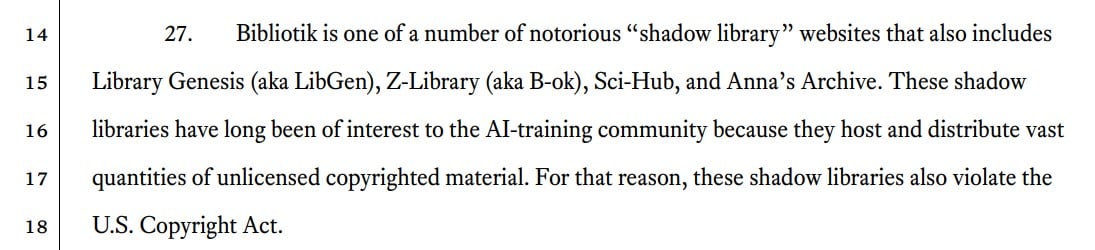
    This refers to paragraph 27 of the complaint, shown below, where the authors also alleged that hosting or distributing data – as these book repositories do – amounts to copyright infringement.
    shadow library

    “NVIDIA denies the characterization of the listed data repositories as ‘shadow libraries’ and denies that hosting data in or distributing data from the data repositories necessarily violates the U.S. Copyright Act,” the company writes.

    NVIDIA Denies Copyright Infringement

    Overall, NVIDIA’s response is mostly made up of denials, as is common at this stage of the legal battle. The company lists several affirmative defenses, including an absence of copyright infringement displaced by fair use.

    “Plaintiffs’ claims and the putative class members’ claims fail, in whole or in part, because NVIDIA has not infringed Plaintiffs’ alleged copyrighted works.”

    “Plaintiffs’ claims and the putative class members’ claims are barred, in whole or in part, by fair use under Section 107 of the Copyright Act.

    “Plaintiffs’ claims and the putative class members’ claims fail, in whole or in part, to the extent they claim rights to elements of works or to works which are not protectable under copyright law […].”

    affirmative defenses

    NVIDIA further notes that this complaint isn’t suitable for class action treatment under federal rules, without providing any further detail.

    NVIDIA’s response to the complaint is rather straightforward. There are no counterclaims either. The authors now have four weeks to respond to NVIDIA’s filing, which can be countered by the defendant, if required.

    A copy of NVIDIA’s answer to the complaint, filed last Friday at the U.S. District Court for the Northern District of California, is available here (pdf)

    From: TF , for the latest news on copyright battles, piracy and more.

    • To chevron_right

      NVIDIA Denies Copyright Infringement Claims in Authors’ AI Lawsuit

      news.movim.eu / TorrentFreak • 27 May 2024 • 3 minutes

    nvidia logo Thus far, chip giant NVIDIA has been the main financial beneficiary of the Artificial Intelligence boom.

    The company published its latest quarterly results last week, reporting $26 billion in revenue; a 340% increase compared to two years ago.

    The staggering revenue numbers over the past year have significantly raised the value of the company, which is now worth more than all public companies in Germany combined. At the same time, however, the AI revolution presents the semiconductor giant with new legal challenges.

    NVIDIA Faces Copyright Infringement Claims

    Earlier this year, several authors sued NVIDIA over alleged copyright infringement. The class action lawsuit claims that the company’s AI models were trained on copyrighted works taken from the ‘pirate’ site Bibliotik. Since this happened without permission, the rightsholders demand compensation.

    This lawsuit doesn’t exist in isolation. Previously, authors and other rightsholders filed similar cases against OpenAI, Google, Meta, and others. Soon after the lawsuit appeared on the docket, another case against NVIDIA followed too.

    The similarities between these lawsuits shouldn’t diminish their significance. While not all are equally important, some cases will end up setting important precedents. These will, in large part, determine to what extent AI companies can use external sources to train their models, and when or if compensation is required.

    Books3

    In several cases, the defendants stand accused of using the controversial ‘Books3’ dataset without permission. Books3 was created by AI researcher Shawn Presser in 2020, who scraped the library of ‘pirate’ site Bibliotik. The dataset made its way into other databases, which AI companies allegedly used as input.

    In the NVIDIA lawsuit, for example, American authors Abdi Nazemian, Brian Keene, and Stewart O’Nan alleged that the semiconductor company used the Books3 dataset to train its NeMo Megatron language models. This claim isn’t far-fetched, since NVIDIA publicly stated that it used EleutherAI’s ‘The Pile’ dataset, which includes Books3.

    “Certain books written by Plaintiffs are part of Books3 — including the Infringed Works — and thus NVIDIA necessarily trained its NeMo Megatron models on one or more copies of the Infringed Works, thereby directly infringing the copyrights of the Plaintiffs,” the authors claimed.

    NVIDIA Responds in Court

    The main question for this and other lawsuits is whether the use of this data is permitted under U.S. law. According to NVIDIA, there’s nothing wrong with how it trained its AI.

    On Friday, NVIDIA filed its answer to the complaint and responded to the copyright infringement allegations. The company admits that it used “The Pile” dataset for training purposes. However, it specifically denies that it made multiple copies of the Books3 dataset.

    In addition, the company specifically rejects the use of the term “ shadow library ” to describe sites such as Bibliotik, LibGen, Z-Library, Sci-Hub, and Anna’s Archive.

    This refers to paragraph 27 of the complaint, shown below, where the authors also alleged that hosting or distributing data – as these book repositories do – amounts to copyright infringement.

    shadow library

    “NVIDIA denies the characterization of the listed data repositories as ‘shadow libraries’ and denies that hosting data in or distributing data from the data repositories necessarily violates the U.S. Copyright Act,” the company writes.

    NVIDIA Denies Copyright Infringement

    Overall, NVIDIA’s response is mostly made up of denials, as is common at this stage of the legal battle. The company lists several affirmative defenses, including an absence of copyright infringement displaced by fair use.

    “Plaintiffs’ claims and the putative class members’ claims fail, in whole or in part, because NVIDIA has not infringed Plaintiffs’ alleged copyrighted works.”

    “Plaintiffs’ claims and the putative class members’ claims are barred, in whole or in part, by fair use under Section 107 of the Copyright Act.

    “Plaintiffs’ claims and the putative class members’ claims fail, in whole or in part, to the extent they claim rights to elements of works or to works which are not protectable under copyright law […].”

    affirmative defenses

    NVIDIA further notes that this complaint isn’t suitable for class action treatment under federal rules, without providing any further detail.

    NVIDIA’s response to the complaint is rather straightforward. There are no counterclaims either. The authors now have four weeks to respond to NVIDIA’s filing, which can be countered by the defendant, if required.

    A copy of NVIDIA’s answer to the complaint, filed last Friday at the U.S. District Court for the Northern District of California, is available here (pdf)

    From: TF , for the latest news on copyright battles, piracy and more.

    • To chevron_right

      NVIDIA Denies Copyright Infringement Claims in Authors’ AI Lawsuit

      news.movim.eu / TorrentFreak • 27 May 2024 • 3 minutes

    nvidia logo Thus far, chip giant NVIDIA has been the main financial beneficiary of the Artificial Intelligence boom.

    The company published its latest quarterly results last week, reporting $26 billion in revenue; a 340% increase compared to two years ago.

    The staggering revenue numbers over the past year have significantly raised the value of the company, which is now worth more than all public companies in Germany combined. At the same time, however, the AI revolution presents the semiconductor giant with new legal challenges.

    NVIDIA Faces Copyright Infringement Claims

    Earlier this year, several authors sued NVIDIA over alleged copyright infringement. The class action lawsuit claims that the company’s AI models were trained on copyrighted works taken from the ‘pirate’ site Bibliotik. Since this happened without permission, the rightsholders demand compensation.

    This lawsuit doesn’t exist in isolation. Previously, authors and other rightsholders filed similar cases against OpenAI, Google, Meta, and others. Soon after the lawsuit appeared on the docket, another case against NVIDIA followed too.

    The similarities between these lawsuits shouldn’t diminish their significance. While not all are equally important, some cases will end up setting important precedents. These will, in large part, determine to what extent AI companies can use external sources to train their models, and when or if compensation is required.

    Books3

    In several cases, the defendants stand accused of using the controversial ‘Books3’ dataset without permission. Books3 was created by AI researcher Shawn Presser in 2020, who scraped the library of ‘pirate’ site Bibliotik. The dataset made its way into other databases, which AI companies allegedly used as input.

    In the NVIDIA lawsuit, for example, American authors Abdi Nazemian, Brian Keene, and Stewart O’Nan alleged that the semiconductor company used the Books3 dataset to train its NeMo Megatron language models. This claim isn’t far-fetched, since NVIDIA publicly stated that it used EleutherAI’s ‘The Pile’ dataset, which includes Books3.

    “Certain books written by Plaintiffs are part of Books3 — including the Infringed Works — and thus NVIDIA necessarily trained its NeMo Megatron models on one or more copies of the Infringed Works, thereby directly infringing the copyrights of the Plaintiffs,” the authors claimed.

    NVIDIA Responds in Court

    The main question for this and other lawsuits is whether the use of this data is permitted under U.S. law. According to NVIDIA, there’s nothing wrong with how it trained its AI.

    On Friday, NVIDIA filed its answer to the complaint and responded to the copyright infringement allegations. The company admits that it used “The Pile” dataset for training purposes. However, it specifically denies that it made multiple copies of the Books3 dataset.

    In addition, the company specifically rejects the use of the term “ shadow library ” to describe sites such as Bibliotik, LibGen, Z-Library, Sci-Hub, and Anna’s Archive.

    This refers to paragraph 27 of the complaint, shown below, where the authors also alleged that hosting or distributing data – as these book repositories do – amounts to copyright infringement.

    shadow library

    “NVIDIA denies the characterization of the listed data repositories as ‘shadow libraries’ and denies that hosting data in or distributing data from the data repositories necessarily violates the U.S. Copyright Act,” the company writes.

    NVIDIA Denies Copyright Infringement

    Overall, NVIDIA’s response is mostly made up of denials, as is common at this stage of the legal battle. The company lists several affirmative defenses, including an absence of copyright infringement displaced by fair use.

    “Plaintiffs’ claims and the putative class members’ claims fail, in whole or in part, because NVIDIA has not infringed Plaintiffs’ alleged copyrighted works.”

    “Plaintiffs’ claims and the putative class members’ claims are barred, in whole or in part, by fair use under Section 107 of the Copyright Act.

    “Plaintiffs’ claims and the putative class members’ claims fail, in whole or in part, to the extent they claim rights to elements of works or to works which are not protectable under copyright law […].”

    affirmative defenses

    NVIDIA further notes that this complaint isn’t suitable for class action treatment under federal rules, without providing any further detail.

    NVIDIA’s response to the complaint is rather straightforward. There are no counterclaims either. The authors now have four weeks to respond to NVIDIA’s filing, which can be countered by the defendant, if required.

    A copy of NVIDIA’s answer to the complaint, filed last Friday at the U.S. District Court for the Northern District of California, is available here (pdf)

    From: TF , for the latest news on copyright battles, piracy and more.
    • To chevron_right

      Expend4bles: 3,000 Canadians Targeted in Federal Court Piracy Sweep

      news.movim.eu / TorrentFreak • 27 May 2024 • 4 minutes

    expend4bles According to The Numbers , the most financially successful movie franchise of all time is the Marvel Cinematic Universe. Generating almost $30 billion at the worldwide box office, its closest rival is Star Wars, with just $10.3 billion.

    In 198th place with a still-respectable $840 million is The Expendables franchise. While not at the top of the heap here, none of the competition would have a chance of beating this series if legal action against members of the public was a competition.

    Record Breakers

    Early 2011 after pulling in $274 million at the worldwide box office, the company behind the first movie targeted 6,500 suspected pirates via a complaint filed at a district court in Columbia. That case quickly expanded to over 23,300 potential defendants in a list that ran to 371 pages ; that made it the largest case of its type in legal history.

    While that case was dismissed due to almost none of the potential defendants actually residing in the district where they were sued, every movie in the franchise subsequently released featured lawsuits against alleged pirates. A leaked copy of Expendables 3 triggered legal action against downloaders and pirate sites , and then came the arrests and prison sentences ( 1 , 2 ) for those who obtained and leaked the movie.

    Expend4bles Released in 2023, Predictable Plot

    If the paperwork filed at Canada’s Federal Court is taken on face value, almost 3,000 Canadian internet subscribers grabbed a copy of Expend4bles after it appeared on BitTorrent networks in 2023. In common with every movie in the series, they were being monitored as they did so.

    Whether they were simply oblivious to the history, not especially interested due to being a small child at the time, or merely the bill-payer of an internet subscription used by others, will be a discussion for later. Right now, the company behind the movie, Ex4 Productions, Inc., hopes to receive permission from the Federal Court to obtain their names and addresses from their ISP.

    There’s currently nothing on the docket to say that permission has already been obtained but after investigating 500 IP addresses out of the 2,964 in the statement of claim, we can confirm that every one of the 500 is registered to Bell.

    Sample of 500 IP addresses, all registered to Bell ip-whois-sample

    There’s almost no doubt that the purpose of obtaining names and addresses will be to write to the defendants with a demand for a substantial cash settlement to avoid ‘unnecessary’ legal action.

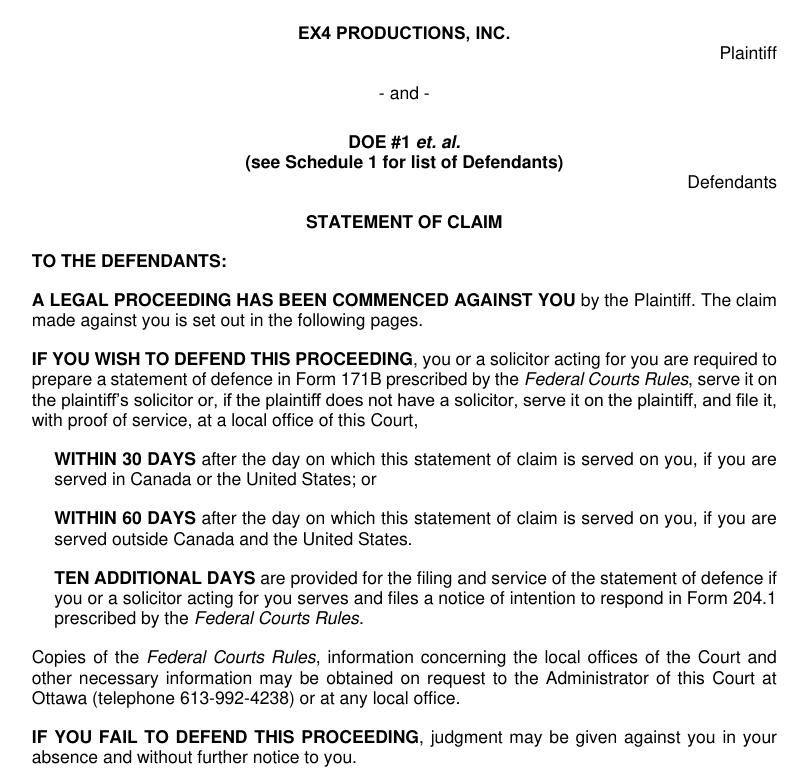
    The start of what appears to be a proposed letter to those affected is shown below.

    The allegations made in the 14-page statement of claim mostly stick to the usual format, noting that all ‘Doe defendants’ were monitored ‘uploading’ or distributing the movie, contrary to copyright law. The plaintiffs acknowledge that they don’t know the identities of those they’re targeting, hence this action.

    No Evidence to Identify Infringer

    After making their case in the strongest terms against internet subscribers they do not know, asserting in the clearest terms that these people are direct infringers, there’s the usual switch to account for just one of several alternative scenarios.

    After acknowledging that the bill payer may not be responsible and someone else with access to the connection may be the culprit after all, the bill payer is painted as responsible for other people’s infringement regardless.

    Alternatively, some of the Defendants may not be the direct infringer, but through negligence, willful blindness or indifference has authorized others (“Direct Infringers”) to do the foregoing acts, including the Unlawful Acts, acquiesced to the Direct Infringers doing of the foregoing acts, and/or has acted in concert with the Direct Infringers with a common design with respect to their activities set out herein, including the Unlawful Acts.

    To add weight to the claim that the bill payer is negligent, the plaintiffs point out that each subscriber was sent a warning notice in advance, which allegedly they did nothing about.

    Each Defendant was provided with prior notice (the First Notice) that such Defendant’s internet account was being used in a way that infringed the Plaintiff’s copyright, and yet such Defendant did nothing to prevent or cease the infringement. Each Defendant therefore knew or should have known that their internet account was being used contrary to s. 27(1) of the Copyright Act.

    No further detail is provided about the warning notices, how they were sent, or when, but it seems likely they were issued as part of the notice-and-notice scheme operated via Canadian ISPs.

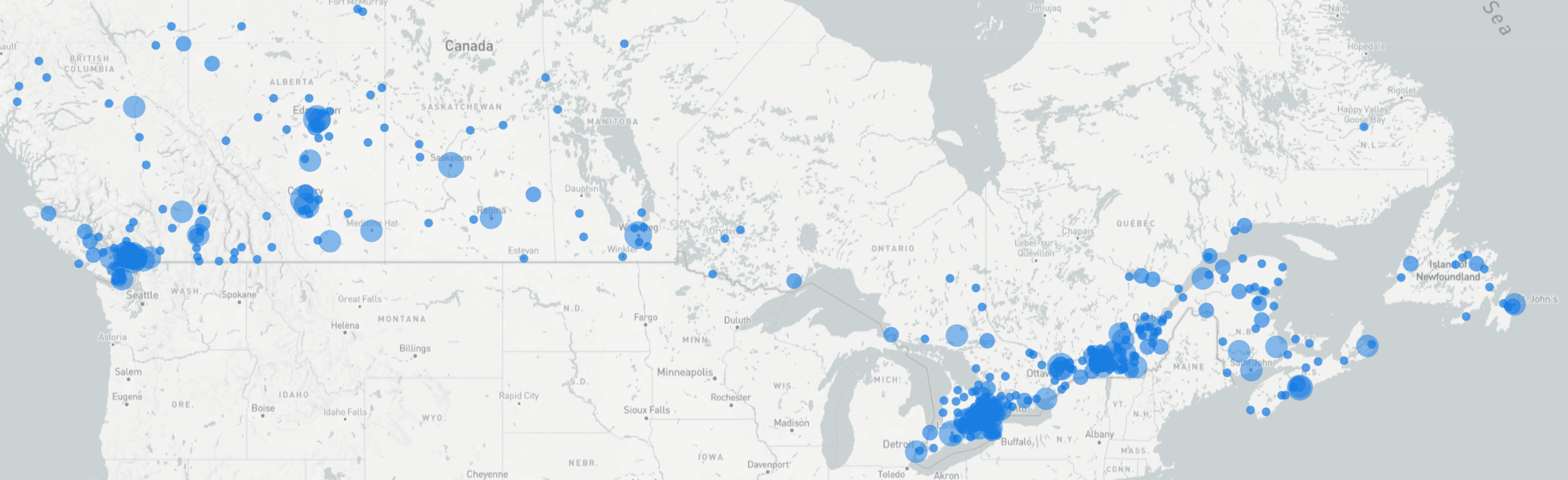
    Since the defendants’ IP addresses are listed in the statement of claim, and we needed to extract those for the purpose of identifying the internet provider as mentioned above, we took the opportunity to geo-locate each one.

    Since geolocation by IP is not always accurate, the usual caveats apply. Nevertheless, the map below should provide a very general overview of where the defendants reside. The larger the dots, the more defendants located in that region.

    2,964 IP addresses in the statement of claim (click to enlarge) geo-expendables4

    The statement of claim is available here (pdf)

    From: TF , for the latest news on copyright battles, piracy and more.
    • To chevron_right

      Expend4bles: 3,000 Canadians Targeted in Federal Court Piracy Sweep

      news.movim.eu / TorrentFreak • 27 May 2024 • 4 minutes

    expend4bles According to The Numbers , the most financially successful movie franchise of all time is the Marvel Cinematic Universe. Generating almost $30 billion at the worldwide box office, its closest rival is Star Wars, with just $10.3 billion.

    In 198th place with a still-respectable $840 million is The Expendables franchise. While not at the top of the heap here, none of the competition would have a chance of beating this series if legal action against members of the public was a competition.

    Record Breakers

    Early 2011 after pulling in $274 million at the worldwide box office, the company behind the first movie targeted 6,500 suspected pirates via a complaint filed at a district court in Columbia. That case quickly expanded to over 23,300 potential defendants in a list that ran to 371 pages ; that made it the largest case of its type in legal history.

    While that case was dismissed due to almost none of the potential defendants actually residing in the district where they were sued, every movie in the franchise subsequently released featured lawsuits against alleged pirates. A leaked copy of Expendables 3 triggered legal action against downloaders and pirate sites , and then came the arrests and prison sentences ( 1 , 2 ) for those who obtained and leaked the movie.

    Expend4bles Released in 2023, Predictable Plot

    If the paperwork filed at Canada’s Federal Court is taken on face value, almost 3,000 Canadian internet subscribers grabbed a copy of Expend4bles after it appeared on BitTorrent networks in 2023. In common with every movie in the series, they were being monitored as they did so.

    Whether they were simply oblivious to the history, not especially interested due to being a small child at the time, or merely the bill-payer of an internet subscription used by others, will be a discussion for later. Right now, the company behind the movie, Ex4 Productions, Inc., hopes to receive permission from the Federal Court to obtain their names and addresses from their ISP.

    There’s currently nothing on the docket to say that permission has already been obtained but after investigating 500 IP addresses out of the 2,964 in the statement of claim, we can confirm that every one of the 500 is registered to Bell.

    Sample of 500 IP addresses, all registered to Bell ip-whois-sample

    There’s almost no doubt that the purpose of obtaining names and addresses will be to write to the defendants with a demand for a substantial cash settlement to avoid ‘unnecessary’ legal action.

    The start of what appears to be a proposed letter to those affected is shown below.

    The allegations made in the 14-page statement of claim mostly stick to the usual format, noting that all ‘Doe defendants’ were monitored ‘uploading’ or distributing the movie, contrary to copyright law. The plaintiffs acknowledge that they don’t know the identities of those they’re targeting, hence this action.

    No Evidence to Identify Infringer

    After making their case in the strongest terms against internet subscribers they do not know, asserting in the clearest terms that these people are direct infringers, there’s the usual switch to account for just one of several alternative scenarios.

    After acknowledging that the bill payer may not be responsible and someone else with access to the connection may be the culprit after all, the bill payer is painted as responsible for other people’s infringement regardless.

    Alternatively, some of the Defendants may not be the direct infringer, but through negligence, willful blindness or indifference has authorized others (“Direct Infringers”) to do the foregoing acts, including the Unlawful Acts, acquiesced to the Direct Infringers doing of the foregoing acts, and/or has acted in concert with the Direct Infringers with a common design with respect to their activities set out herein, including the Unlawful Acts.

    To add weight to the claim that the bill payer is negligent, the plaintiffs point out that each subscriber was sent a warning notice in advance, which allegedly they did nothing about.

    Each Defendant was provided with prior notice (the First Notice) that such Defendant’s internet account was being used in a way that infringed the Plaintiff’s copyright, and yet such Defendant did nothing to prevent or cease the infringement. Each Defendant therefore knew or should have known that their internet account was being used contrary to s. 27(1) of the Copyright Act.

    No further detail is provided about the warning notices, how they were sent, or when, but it seems likely they were issued as part of the notice-and-notice scheme operated via Canadian ISPs.

    Since the defendants’ IP addresses are listed in the statement of claim, and we needed to extract those for the purpose of identifying the internet provider as mentioned above, we took the opportunity to geo-locate each one.

    Since geolocation by IP is not always accurate, the usual caveats apply. Nevertheless, the map below should provide a very general overview of where the defendants reside. The larger the dots, the more defendants located in that region.

    2,964 IP addresses in the statement of claim (click to enlarge) geo-expendables4

    The statement of claim is available here (pdf)

    From: TF , for the latest news on copyright battles, piracy and more.

    • To chevron_right

      Expend4bles: 3,000 Canadians Targeted in Federal Court Piracy Sweep

      news.movim.eu / TorrentFreak • 27 May 2024 • 4 minutes

    expend4bles According to The Numbers , the most financially successful movie franchise of all time is the Marvel Cinematic Universe. Generating almost $30 billion at the worldwide box office, its closest rival is Star Wars, with just $10.3 billion.

    In 198th place with a still-respectable $840 million is The Expendables franchise. While not at the top of the heap here, none of the competition would have a chance of beating this series if legal action against members of the public was a competition.

    Record Breakers

    Early 2011 after pulling in $274 million at the worldwide box office, the company behind the first movie targeted 6,500 suspected pirates via a complaint filed at a district court in Columbia. That case quickly expanded to over 23,300 potential defendants in a list that ran to 371 pages ; that made it the largest case of its type in legal history.

    While that case was dismissed due to almost none of the potential defendants actually residing in the district where they were sued, every movie in the franchise subsequently released featured lawsuits against alleged pirates. A leaked copy of Expendables 3 triggered legal action against downloaders and pirate sites , and then came the arrests and prison sentences ( 1 , 2 ) for those who obtained and leaked the movie.

    Expend4bles Released in 2023, Predictable Plot

    If the paperwork filed at Canada’s Federal Court is taken on face value, almost 3,000 Canadian internet subscribers grabbed a copy of Expend4bles after it appeared on BitTorrent networks in 2023. In common with every movie in the series, they were being monitored as they did so.

    Whether they were simply oblivious to the history, not especially interested due to being a small child at the time, or merely the bill-payer of an internet subscription used by others, will be a discussion for later. Right now, the company behind the movie, Ex4 Productions, Inc., hopes to receive permission from the Federal Court to obtain their names and addresses from their ISP.

    There’s currently nothing on the docket to say that permission has already been obtained but after investigating 500 IP addresses out of the 2,964 in the statement of claim, we can confirm that every one of the 500 is registered to Bell.

    Sample of 500 IP addresses, all registered to Bell ip-whois-sample

    There’s almost no doubt that the purpose of obtaining names and addresses will be to write to the defendants with a demand for a substantial cash settlement to avoid ‘unnecessary’ legal action.

    The start of what appears to be a proposed letter to those affected is shown below.

    The allegations made in the 14-page statement of claim mostly stick to the usual format, noting that all ‘Doe defendants’ were monitored ‘uploading’ or distributing the movie, contrary to copyright law. The plaintiffs acknowledge that they don’t know the identities of those they’re targeting, hence this action.

    No Evidence to Identify Infringer

    After making their case in the strongest terms against internet subscribers they do not know, asserting in the clearest terms that these people are direct infringers, there’s the usual switch to account for just one of several alternative scenarios.

    After acknowledging that the bill payer may not be responsible and someone else with access to the connection may be the culprit after all, the bill payer is painted as responsible for other people’s infringement regardless.

    Alternatively, some of the Defendants may not be the direct infringer, but through negligence, willful blindness or indifference has authorized others (“Direct Infringers”) to do the foregoing acts, including the Unlawful Acts, acquiesced to the Direct Infringers doing of the foregoing acts, and/or has acted in concert with the Direct Infringers with a common design with respect to their activities set out herein, including the Unlawful Acts.

    To add weight to the claim that the bill payer is negligent, the plaintiffs point out that each subscriber was sent a warning notice in advance, which allegedly they did nothing about.

    Each Defendant was provided with prior notice (the First Notice) that such Defendant’s internet account was being used in a way that infringed the Plaintiff’s copyright, and yet such Defendant did nothing to prevent or cease the infringement. Each Defendant therefore knew or should have known that their internet account was being used contrary to s. 27(1) of the Copyright Act.

    No further detail is provided about the warning notices, how they were sent, or when, but it seems likely they were issued as part of the notice-and-notice scheme operated via Canadian ISPs.

    Since the defendants’ IP addresses are listed in the statement of claim, and we needed to extract those for the purpose of identifying the internet provider as mentioned above, we took the opportunity to geo-locate each one.

    Since geolocation by IP is not always accurate, the usual caveats apply. Nevertheless, the map below should provide a very general overview of where the defendants reside. The larger the dots, the more defendants located in that region.

    2,964 IP addresses in the statement of claim (click to enlarge) geo-expendables4

    The statement of claim is available here (pdf)

    From: TF , for the latest news on copyright battles, piracy and more.

    • To chevron_right

      Jury Finds ‘Destiny 2’ Cheat Seller Liable For Copyright Infringement in Landmark Lawsuit

      news.movim.eu / TorrentFreak • 26 May 2024 • 2 minutes

    aimjunkies Three years ago, Bungie filed a complaint at a federal court in Seattle, accusing Destiny 2 cheat seller AimJunkies.com of copyright and trademark infringement, among other things.

    The same accusations were also made against Phoenix Digital Group, the operating company behind the website, and third-party developer James May.

    AimJunkies denied the claims and argued that cheating isn’t against the law . In addition, it refuted the copyright infringement allegations; these lacked substance because some of the referenced copyrights were registered well after the cheats were first made available, AimJunkies said.

    Landmark Trial in Seattle, Washington

    After years of legal twists and turns, the case went to trial this week , where both sides presented their arguments. AimJunkies, among other things, stressed that the defendants never touched any of Destiny 2’s copyrighted game code.

    In addition to deciding over the copyright infringement claims, the jury also had to rule on a counterclaim from third-party developer James May. May denied being responsible for coding the cheat and alleged that Bungie ‘hacked’ his computer.

    After the hearings were finalized, the jury released its verdict late Friday, finding all defendants liable for direct, vicarious, and contributory copyright infringement. Phoenix Digital Group and all individual defendants are ordered to pay Bungie damages for the actual profits they reaped, totaling $63,210.

    bungie

    This is the first trial in U.S. history where a cheat seller was found liable for copyright infringement. As such, it is bad news for other companies who operate in a similar niche.

    Counterclaim Fails

    The jury denied the counterclaim from developer James May, who argued that Bungie circumvented technological measures under the DMCA, by accessing his hard drive without permission. No further details on any of these decisions were provided.

    The jury verdict is a big win for Bungie although not the first.

    Previously, the non-copyright-related complaints were referred to arbitration, including allegations that AimJunkies’ cheats violated the DMCA’s anti-circumvention provision. This resulted in a resounding win for the game developer for a total of nearly $4.4 million in damages and fees .

    It’s Not Over Yet

    The $4.4 million arbitration outcome is still under appeal and AimJunkies can also appeal the jury verdict, so the legal battle is not necessarily over just yet. Bungie clearly won the first rounds, however.

    At the time of writing, the AimJunkies website remains online, but those looking for Destiny 2 cheats will be disappointed. The cheats were already removed from the online store years ago.

    From: TF , for the latest news on copyright battles, piracy and more.

    • To chevron_right

      Jury Finds ‘Destiny 2’ Cheat Seller Liable For Copyright Infringement in Landmark Lawsuit

      news.movim.eu / TorrentFreak • 26 May 2024 • 2 minutes

    aimjunkies Three years ago, Bungie filed a complaint at a federal court in Seattle, accusing Destiny 2 cheat seller AimJunkies.com of copyright and trademark infringement, among other things.

    The same accusations were also made against Phoenix Digital Group, the operating company behind the website, and third-party developer James May.

    AimJunkies denied the claims and argued that cheating isn’t against the law . In addition, it refuted the copyright infringement allegations; these lacked substance because some of the referenced copyrights were registered well after the cheats were first made available, AimJunkies said.

    Landmark Trial in Seattle, Washington

    After years of legal twists and turns, the case went to trial this week , where both sides presented their arguments. AimJunkies, among other things, stressed that the defendants never touched any of Destiny 2’s copyrighted game code.

    In addition to deciding over the copyright infringement claims, the jury also had to rule on a counterclaim from third-party developer James May. May denied being responsible for coding the cheat and alleged that Bungie ‘hacked’ his computer.

    After the hearings were finalized, the jury released its verdict late Friday, finding all defendants liable for direct, vicarious, and contributory copyright infringement. Phoenix Digital Group and all individual defendants are ordered to pay Bungie damages for the actual profits they reaped, totaling $63,210.

    bungie

    This is the first trial in U.S. history where a cheat seller was found liable for copyright infringement. As such, it is bad news for other companies who operate in a similar niche.

    Counterclaim Fails

    The jury denied the counterclaim from developer James May, who argued that Bungie circumvented technological measures under the DMCA, by accessing his hard drive without permission. No further details on any of these decisions were provided.

    The jury verdict is a big win for Bungie although not the first.

    Previously, the non-copyright-related complaints were referred to arbitration, including allegations that AimJunkies’ cheats violated the DMCA’s anti-circumvention provision. This resulted in a resounding win for the game developer for a total of nearly $4.4 million in damages and fees .

    It’s Not Over Yet

    The $4.4 million arbitration outcome is still under appeal and AimJunkies can also appeal the jury verdict, so the legal battle is not necessarily over just yet. Bungie clearly won the first rounds, however.

    At the time of writing, the AimJunkies website remains online, but those looking for Destiny 2 cheats will be disappointed. The cheats were already removed from the online store years ago.

    From: TF , for the latest news on copyright battles, piracy and more.

    • To chevron_right

      Jury Finds ‘Destiny 2’ Cheat Seller Liable For Copyright Infringement in Landmark Lawsuit

      news.movim.eu / TorrentFreak • 26 May 2024 • 2 minutes

    aimjunkies Three years ago, Bungie filed a complaint at a federal court in Seattle, accusing Destiny 2 cheat seller AimJunkies.com of copyright and trademark infringement, among other things.

    The same accusations were also made against Phoenix Digital Group, the operating company behind the website, and third-party developer James May.

    AimJunkies denied the claims and argued that cheating isn’t against the law . In addition, it refuted the copyright infringement allegations; these lacked substance because some of the referenced copyrights were registered well after the cheats were first made available, AimJunkies said.

    Landmark Trial in Seattle, Washington

    After years of legal twists and turns, the case went to trial this week , where both sides presented their arguments. AimJunkies, among other things, stressed that the defendants never touched any of Destiny 2’s copyrighted game code.

    In addition to deciding over the copyright infringement claims, the jury also had to rule on a counterclaim from third-party developer James May. May denied being responsible for coding the cheat and alleged that Bungie ‘hacked’ his computer.

    After the hearings were finalized, the jury released its verdict late Friday, finding all defendants liable for direct, vicarious, and contributory copyright infringement. Phoenix Digital Group and all individual defendants are ordered to pay Bungie damages for the actual profits they reaped, totaling $63,210.

    bungie

    This is the first trial in U.S. history where a cheat seller was found liable for copyright infringement. As such, it is bad news for other companies who operate in a similar niche.

    Counterclaim Fails

    The jury denied the counterclaim from developer James May, who argued that Bungie circumvented technological measures under the DMCA, by accessing his hard drive without permission. No further details on any of these decisions were provided.

    The jury verdict is a big win for Bungie although not the first.

    Previously, the non-copyright-related complaints were referred to arbitration, including allegations that AimJunkies’ cheats violated the DMCA’s anti-circumvention provision. This resulted in a resounding win for the game developer for a total of nearly $4.4 million in damages and fees .

    It’s Not Over Yet

    The $4.4 million arbitration outcome is still under appeal and AimJunkies can also appeal the jury verdict, so the legal battle is not necessarily over just yet. Bungie clearly won the first rounds, however.

    At the time of writing, the AimJunkies website remains online, but those looking for Destiny 2 cheats will be disappointed. The cheats were already removed from the online store years ago.

    From: TF , for the latest news on copyright battles, piracy and more.