• To chevron_right

      Fmovies & Aniwave: Will The Masters of Pirate Resurrection Rise Again?

      news.movim.eu / TorrentFreak • 1 September 2024 • 6 minutes

    The demise of pirate streaming giant Fmovies in June, followed by the closure of Aniwave and more than a dozen others in the space of a few hours Monday night, will be remembered for a very long time.

    When the Alliance for Creativity and Entertainment modestly confirmed on Thursday it had supported Vietnamese authorities to shut down the sites, the focus was on huge but easily digested numbers. When combined, fmovies, bflixz, flixtorz, movies7, myflixer, and aniwave, reportedly drew more than 6.7 billion visits between January 2023 and June 2024.

    The popularity of these sites obviously made them a target, but significance can also be found elsewhere. For reasons we’re aware of and have reported previously, and likely many more besides, shutting down these sites was never going to be straightforward.

    Frustrations date back years but more recently, at the same time domain names were being handed over to the MPA, presumably as part of an agreement, site resurrections were also underway.

    The big question is whether Fmovies, Aniwave, and the other sites will attempt something similar.

    Giving Up Was Never an Option

    Some believed that nothing could be done about the piracy situation in Vietnam in the short term. Both Hollywood and Japan’s major anime studios seemed to have few options left, but that didn’t mean no options at all.

    What follows is a sample of events relating to Vietnam that show the type of environment Fmovies and the other sites were up against. To what extent the background to these events affected the outcome, if they did so at all, is hard to quantify. What’s fairly clear is that when business needs are met in a mutually beneficial manner, momentum can take on a life of its own. As part of the overall vision for the Hollywood/Vietnam relationship, the sites’ existence may have simply become untenable.

    International Symposium on Copyright Enforcement

    As previously reported , Vietnam played host to the International Symposium on Copyright Enforcement starting June 17; those in attendance included the World Intellectual Property Organization (WIPO), the World Trade Organization (WTO), Vietnam’s Copyright Office under the Ministry of Culture, the MPA and who’s-who of major rightsholders and specialist anti-piracy companies.

    mpa_meet_vnd The symposium ended on June 21 and Fmovies reportedly stopped updating June 22/23. One day later, MPA Chairman/CEO Charles Rivkin appeared in a photograph alongside Nguyen Quoc Dzung, Vietnam’s Ambassador to the United States.

    Topics discussed over lunch included the importance of Vietnam’s streaming market to the Hollywood studios, and “how to strengthen the bonds between our creative economies and protect the livelihoods of the creative workforce driving this shared growth.”

    That was June 24 and just a few hours earlier, Fmovies had suddenly started to fail. On life support for a few days, the world’s most popular streaming site would soon be declared dead.

    The obvious beneficiary was Hollywood but as we noted in an earlier report, other meetings were also taking place elsewhere in Vietnam. One event attended by the Vice Chairman of Sony Pictures mentioned potential funding mechanisms for local films.

    Vietnam Tourism – Cinema Promotion Program in the United States

    Official government documents dated July 2024 show that a “tourism and cinema promotion program” will take place in Los Angeles in the “third and fourth quarters of 2024” with exhibitions on Vietnamese cinema and tourism and a program to “introduce the potential of Vietnam’s cinema scene and policies towards international cinema activities.”
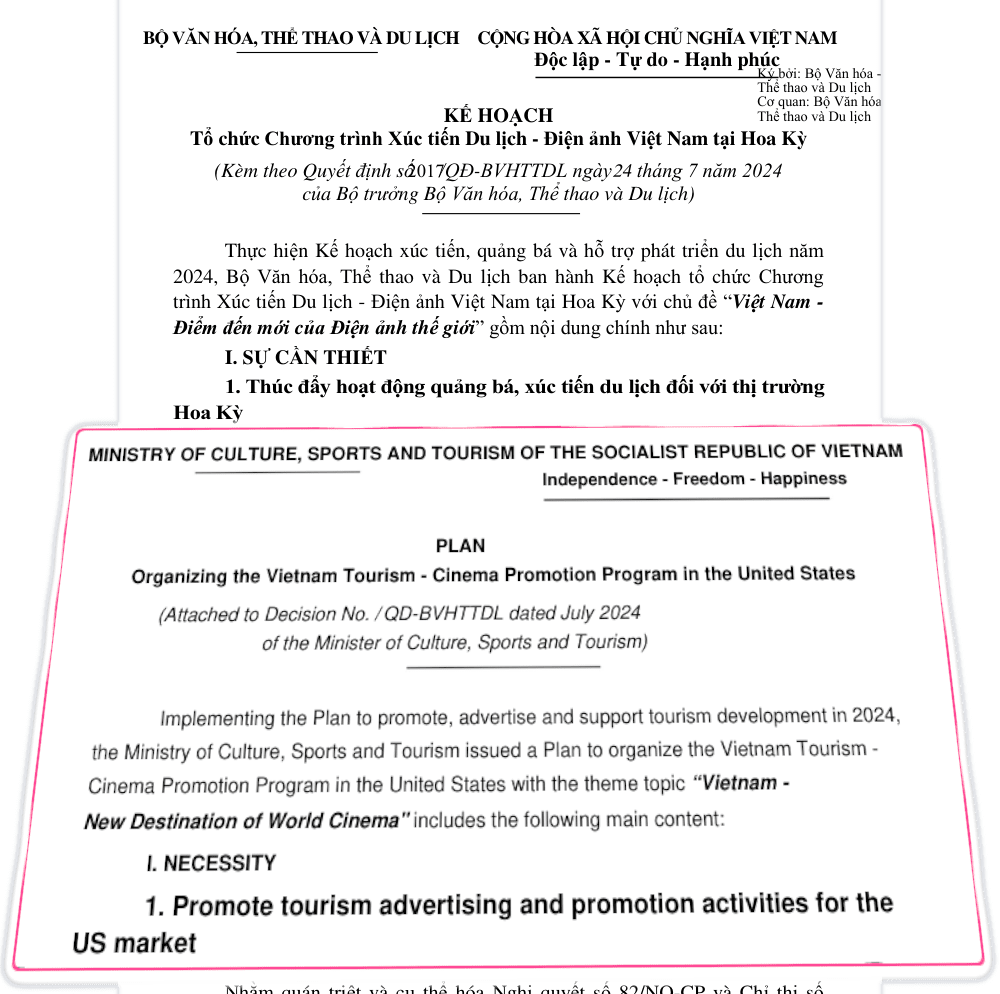
    The goals of the program in the United States include the promotion of tourist destinations and potential filming destinations in Vietnam, plus the following:

    Attract Hollywood film studios to Vietnam to film movies with great appeal, capable of creating international media attention, to promote and attract tourists to Vietnam.

    And there’s more;

    – Take advantage of the prestige and influence of Hollywood partners to organize the Program, attract public attention, and widely promote Vietnamese tourism. Promote tourism promotion through cinema, effectively exploit tourism from cinema, and create a breakthrough in tourism promotion.

    – Introduce the image and brand of friendly, quality, and sustainable Vietnamese tourism destinations. Create opportunities for Vietnamese tourism service providers to meet and connect with US businesses and partners.

    – Strengthening cooperation and exchange; promoting the signing and commitment to effectively implementing cooperation agreements on tourism and cinema between relevant agencies, localities, Vietnamese enterprises and US partners, contributing to concretizing and deepening tourism and cinema cooperation between the two countries.

    – Contact, exchange and work with a number of US tourism and film organizations (US Travel Association, Motion Picture Association of America), a number of large tourism corporations and businesses, media corporations, airlines, cruise lines, and relevant US partners to promote cooperation in tourism and film development.

    The documents suggest that the MPA agreed to ensure that producers, studio directors, directors, film set directors, and Hollywood stars, attend a special event on an unspecified date. The MPA was asked to make a speech on the same day.

    Japanese Animation Movie Screening

    As part of the 2024 Japan-Vietnam Copyright Cooperation Project, a meeting took place on July 23, 2024, between staff from the Copyright Office of Vietnam, Japanese publishers, and anti-piracy group CODA.

    After a presentation, those in attendance took part in a “lively discussion, during which participants exchanged views on topics such as the Vietnamese government’s anti-piracy measures, cooperation with copyright awareness activities, and Vietnam’s intellectual property laws and their implementation.”

    Another Vietnamese government document dated May 2024, details “The organization of the Program ‘Japanese Animation Film Screening’.”

    If everything went according to plan, that event took place on Friday, August 23, 2024. Coincidentally or not, the world’s largest anime piracy site Aniwave closed down on August 26, just three days later.

    What kind of effect the closure will have on the local anime market is unclear, but for Vietnam’s Beta Media and Japan’s Aeon Entertainment, any reduction in availability of pirated content will be considered good news.

    On July 31, the partnership committed to building more than 50 premium cinema complexes across Vietnam under the Aeon Beta Cinema brand by 2035. The first is scheduled to open in 2025 and with overall investment reported as “tens of billions” of yen (one billion yen currently US$64.4 million), confidence in Vietnam’s cinema business seems fairly high right now.

    Momentum Builds Pressure

    These events are just a few examples of recent activity in Vietnam; when combined, they show that despite the existence of Fmovies, bridge building work has never stopped. Indeed, after U.S. President Joe Biden met with Nguyen Phu Trong, General Secretary of the Communist Party of Vietnam Central Committee, in Hanoi last September, forging closer ties is expected under the U.S.–Vietnam Comprehensive Strategic Partnership .

    General reports and details of progress were reported several times in June; Daniel J. Kritenbrink, Assistant Secretary of State for East Asian and Pacific Affairs, spent June 21/22 in Hanoi where he met senior government officials. On June 25, with Fmovies drifting away in the background, Jose W. Fernandez, Under Secretary for Economic Growth, Energy, and the Environment, welcomed Vietnam’s Minister of Planning and Investment, Nguyen Chi Dung, to Washington, D.C.

    Surfacing Anytime Soon Would Be….Complicated

    On balance then, it seems fairly unlikely that Fmovies2 will debut anytime soon. With Hollywood pulling and pushing in the same direction as Vietnam, whatever appears on the table can be obtained or achieved much more easily. That’s something that money can’t buy, at least not directly. Transactions like these often find themselves settled through the bank of goodwill instead.

    If pushed to highlight a negative, Vietnamese media reports on Fmovies’ demise seem limited to repeating what has already been reported in Western media. At least far as we can determine, government officials and the police have made no official comments. Government websites, which include news resources, haven’t reported the news at all.

    Two people were indeed arrested, but nobody has yet been charged. ACE, meanwhile, has a local trademark application underway; all fingers will be crossed that moving forward, any use for it will be strictly limited.

    From: TF , for the latest news on copyright battles, piracy and more.

    • To chevron_right

      Fmovies & Aniwave: Will The Masters of Pirate Resurrection Rise Again?

      news.movim.eu / TorrentFreak • 1 September 2024 • 6 minutes

    The demise of pirate streaming giant Fmovies in June, followed by the closure of Aniwave and more than a dozen others in the space of a few hours Monday night, will be remembered for a very long time.

    When the Alliance for Creativity and Entertainment modestly confirmed on Thursday it had supported Vietnamese authorities to shut down the sites, the focus was on huge but easily digested numbers. When combined, fmovies, bflixz, flixtorz, movies7, myflixer, and aniwave, reportedly drew more than 6.7 billion visits between January 2023 and June 2024.

    The popularity of these sites obviously made them a target, but significance can also be found elsewhere. For reasons we’re aware of and have reported previously, and likely many more besides, shutting down these sites was never going to be straightforward.

    Frustrations date back years but more recently, at the same time domain names were being handed over to the MPA, presumably as part of an agreement, site resurrections were also underway.

    The big question is whether Fmovies, Aniwave, and the other sites will attempt something similar.

    Giving Up Was Never an Option

    Some believed that nothing could be done about the piracy situation in Vietnam in the short term. Both Hollywood and Japan’s major anime studios seemed to have few options left, but that didn’t mean no options at all.

    What follows is a sample of events relating to Vietnam that show the type of environment Fmovies and the other sites were up against. To what extent the background to these events affected the outcome, if they did so at all, is hard to quantify. What’s fairly clear is that when business needs are met in a mutually beneficial manner, momentum can take on a life of its own. As part of the overall vision for the Hollywood/Vietnam relationship, the sites’ existence may have simply become untenable.

    International Symposium on Copyright Enforcement

    As previously reported , Vietnam played host to the International Symposium on Copyright Enforcement starting June 17; those in attendance included the World Intellectual Property Organization (WIPO), the World Trade Organization (WTO), Vietnam’s Copyright Office under the Ministry of Culture, the MPA and who’s-who of major rightsholders and specialist anti-piracy companies.

    mpa_meet_vnd The symposium ended on June 21 and Fmovies reportedly stopped updating June 22/23. One day later, MPA Chairman/CEO Charles Rivkin appeared in a photograph alongside Nguyen Quoc Dzung, Vietnam’s Ambassador to the United States.

    Topics discussed over lunch included the importance of Vietnam’s streaming market to the Hollywood studios, and “how to strengthen the bonds between our creative economies and protect the livelihoods of the creative workforce driving this shared growth.”

    That was June 24 and just a few hours earlier, Fmovies had suddenly started to fail. On life support for a few days, the world’s most popular streaming site would soon be declared dead.

    The obvious beneficiary was Hollywood but as we noted in an earlier report, other meetings were also taking place elsewhere in Vietnam. One event attended by the Vice Chairman of Sony Pictures mentioned potential funding mechanisms for local films.

    Vietnam Tourism – Cinema Promotion Program in the United States

    Official government documents dated July 2024 show that a “tourism and cinema promotion program” will take place in Los Angeles in the “third and fourth quarters of 2024” with exhibitions on Vietnamese cinema and tourism and a program to “introduce the potential of Vietnam’s cinema scene and policies towards international cinema activities.”

    The goals of the program in the United States include the promotion of tourist destinations and potential filming destinations in Vietnam, plus the following:

    Attract Hollywood film studios to Vietnam to film movies with great appeal, capable of creating international media attention, to promote and attract tourists to Vietnam.

    And there’s more;

    – Take advantage of the prestige and influence of Hollywood partners to organize the Program, attract public attention, and widely promote Vietnamese tourism. Promote tourism promotion through cinema, effectively exploit tourism from cinema, and create a breakthrough in tourism promotion.

    – Introduce the image and brand of friendly, quality, and sustainable Vietnamese tourism destinations. Create opportunities for Vietnamese tourism service providers to meet and connect with US businesses and partners.

    – Strengthening cooperation and exchange; promoting the signing and commitment to effectively implementing cooperation agreements on tourism and cinema between relevant agencies, localities, Vietnamese enterprises and US partners, contributing to concretizing and deepening tourism and cinema cooperation between the two countries.

    – Contact, exchange and work with a number of US tourism and film organizations (US Travel Association, Motion Picture Association of America), a number of large tourism corporations and businesses, media corporations, airlines, cruise lines, and relevant US partners to promote cooperation in tourism and film development.

    The documents suggest that the MPA agreed to ensure that producers, studio directors, directors, film set directors, and Hollywood stars, attend a special event on an unspecified date. The MPA was asked to make a speech on the same day.

    Japanese Animation Movie Screening

    As part of the 2024 Japan-Vietnam Copyright Cooperation Project, a meeting took place on July 23, 2024, between staff from the Copyright Office of Vietnam, Japanese publishers, and anti-piracy group CODA.

    After a presentation, those in attendance took part in a “lively discussion, during which participants exchanged views on topics such as the Vietnamese government’s anti-piracy measures, cooperation with copyright awareness activities, and Vietnam’s intellectual property laws and their implementation.”

    Another Vietnamese government document dated May 2024, details “The organization of the Program ‘Japanese Animation Film Screening’.”

    If everything went according to plan, that event took place on Friday, August 23, 2024. Coincidentally or not, the world’s largest anime piracy site Aniwave closed down on August 26, just three days later.

    What kind of effect the closure will have on the local anime market is unclear, but for Vietnam’s Beta Media and Japan’s Aeon Entertainment, any reduction in availability of pirated content will be considered good news.

    On July 31, the partnership committed to building more than 50 premium cinema complexes across Vietnam under the Aeon Beta Cinema brand by 2035. The first is scheduled to open in 2025 and with overall investment reported as “tens of billions” of yen (one billion yen currently US$64.4 million), confidence in Vietnam’s cinema business seems fairly high right now.

    Momentum Builds Pressure

    These events are just a few examples of recent activity in Vietnam; when combined, they show that despite the existence of Fmovies, bridge building work has never stopped. Indeed, after U.S. President Joe Biden met with Nguyen Phu Trong, General Secretary of the Communist Party of Vietnam Central Committee, in Hanoi last September, forging closer ties is expected under the U.S.–Vietnam Comprehensive Strategic Partnership .

    General reports and details of progress were reported several times in June; Daniel J. Kritenbrink, Assistant Secretary of State for East Asian and Pacific Affairs, spent June 21/22 in Hanoi where he met senior government officials. On June 25, with Fmovies drifting away in the background, Jose W. Fernandez, Under Secretary for Economic Growth, Energy, and the Environment, welcomed Vietnam’s Minister of Planning and Investment, Nguyen Chi Dung, to Washington, D.C.

    Surfacing Anytime Soon Would Be….Complicated

    On balance then, it seems fairly unlikely that Fmovies2 will debut anytime soon. With Hollywood pulling and pushing in the same direction as Vietnam, whatever appears on the table can be obtained or achieved much more easily. That’s something that money can’t buy, at least not directly. Transactions like these often find themselves settled through the bank of goodwill instead.

    If pushed to highlight a negative, Vietnamese media reports on Fmovies’ demise seem limited to repeating what has already been reported in Western media. At least far as we can determine, government officials and the police have made no official comments. Government websites, which include news resources, haven’t reported the news at all.

    Two people were indeed arrested, but nobody has yet been charged. ACE, meanwhile, has a local trademark application underway; all fingers will be crossed that moving forward, any use for it will be strictly limited.

    From: TF , for the latest news on copyright battles, piracy and more.

    • To chevron_right

      Fmovies & Aniwave: Will The Masters of Pirate Resurrection Rise Again?

      news.movim.eu / TorrentFreak • 1 September 2024 • 6 minutes

    The demise of pirate streaming giant Fmovies in June, followed by the closure of Aniwave and more than a dozen others in the space of a few hours Monday night, will be remembered for a very long time.

    When the Alliance for Creativity and Entertainment modestly confirmed on Thursday it had supported Vietnamese authorities to shut down the sites, the focus was on huge but easily digested numbers. When combined, fmovies, bflixz, flixtorz, movies7, myflixer, and aniwave, reportedly drew more than 6.7 billion visits between January 2023 and June 2024.

    The popularity of these sites obviously made them a target, but significance can also be found elsewhere. For reasons we’re aware of and have reported previously, and likely many more besides, shutting down these sites was never going to be straightforward.

    Frustrations date back years but more recently, at the same time domain names were being handed over to the MPA, presumably as part of an agreement, site resurrections were also underway.

    The big question is whether Fmovies, Aniwave, and the other sites will attempt something similar.

    Giving Up Was Never an Option

    Some believed that nothing could be done about the piracy situation in Vietnam in the short term. Both Hollywood and Japan’s major anime studios seemed to have few options left, but that didn’t mean no options at all.

    What follows is a sample of events relating to Vietnam that show the type of environment Fmovies and the other sites were up against. To what extent the background to these events affected the outcome, if they did so at all, is hard to quantify. What’s fairly clear is that when business needs are met in a mutually beneficial manner, momentum can take on a life of its own. As part of the overall vision for the Hollywood/Vietnam relationship, the sites’ existence may have simply become untenable.

    International Symposium on Copyright Enforcement

    As previously reported , Vietnam played host to the International Symposium on Copyright Enforcement starting June 17; those in attendance included the World Intellectual Property Organization (WIPO), the World Trade Organization (WTO), Vietnam’s Copyright Office under the Ministry of Culture, the MPA and who’s-who of major rightsholders and specialist anti-piracy companies.

    mpa_meet_vnd The symposium ended on June 21 and Fmovies reportedly stopped updating June 22/23. One day later, MPA Chairman/CEO Charles Rivkin appeared in a photograph alongside Nguyen Quoc Dzung, Vietnam’s Ambassador to the United States.

    Topics discussed over lunch included the importance of Vietnam’s streaming market to the Hollywood studios, and “how to strengthen the bonds between our creative economies and protect the livelihoods of the creative workforce driving this shared growth.”

    That was June 24 and just a few hours earlier, Fmovies had suddenly started to fail. On life support for a few days, the world’s most popular streaming site would soon be declared dead.

    The obvious beneficiary was Hollywood but as we noted in an earlier report, other meetings were also taking place elsewhere in Vietnam. One event attended by the Vice Chairman of Sony Pictures mentioned potential funding mechanisms for local films.

    Vietnam Tourism – Cinema Promotion Program in the United States

    Official government documents dated July 2024 show that a “tourism and cinema promotion program” will take place in Los Angeles in the “third and fourth quarters of 2024” with exhibitions on Vietnamese cinema and tourism and a program to “introduce the potential of Vietnam’s cinema scene and policies towards international cinema activities.”

    The goals of the program in the United States include the promotion of tourist destinations and potential filming destinations in Vietnam, plus the following:

    Attract Hollywood film studios to Vietnam to film movies with great appeal, capable of creating international media attention, to promote and attract tourists to Vietnam.

    And there’s more;

    – Take advantage of the prestige and influence of Hollywood partners to organize the Program, attract public attention, and widely promote Vietnamese tourism. Promote tourism promotion through cinema, effectively exploit tourism from cinema, and create a breakthrough in tourism promotion.

    – Introduce the image and brand of friendly, quality, and sustainable Vietnamese tourism destinations. Create opportunities for Vietnamese tourism service providers to meet and connect with US businesses and partners.

    – Strengthening cooperation and exchange; promoting the signing and commitment to effectively implementing cooperation agreements on tourism and cinema between relevant agencies, localities, Vietnamese enterprises and US partners, contributing to concretizing and deepening tourism and cinema cooperation between the two countries.

    – Contact, exchange and work with a number of US tourism and film organizations (US Travel Association, Motion Picture Association of America), a number of large tourism corporations and businesses, media corporations, airlines, cruise lines, and relevant US partners to promote cooperation in tourism and film development.

    The documents suggest that the MPA agreed to ensure that producers, studio directors, directors, film set directors, and Hollywood stars, attend a special event on an unspecified date. The MPA was asked to make a speech on the same day.

    Japanese Animation Movie Screening

    As part of the 2024 Japan-Vietnam Copyright Cooperation Project, a meeting took place on July 23, 2024, between staff from the Copyright Office of Vietnam, Japanese publishers, and anti-piracy group CODA.

    After a presentation, those in attendance took part in a “lively discussion, during which participants exchanged views on topics such as the Vietnamese government’s anti-piracy measures, cooperation with copyright awareness activities, and Vietnam’s intellectual property laws and their implementation.”

    Another Vietnamese government document dated May 2024, details “The organization of the Program ‘Japanese Animation Film Screening’.”

    If everything went according to plan, that event took place on Friday, August 23, 2024. Coincidentally or not, the world’s largest anime piracy site Aniwave closed down on August 26, just three days later.

    What kind of effect the closure will have on the local anime market is unclear, but for Vietnam’s Beta Media and Japan’s Aeon Entertainment, any reduction in availability of pirated content will be considered good news.

    On July 31, the partnership committed to building more than 50 premium cinema complexes across Vietnam under the Aeon Beta Cinema brand by 2035. The first is scheduled to open in 2025 and with overall investment reported as “tens of billions” of yen (one billion yen currently US$64.4 million), confidence in Vietnam’s cinema business seems fairly high right now.

    Momentum Builds Pressure

    These events are just a few examples of recent activity in Vietnam; when combined, they show that despite the existence of Fmovies, bridge building work has never stopped. Indeed, after U.S. President Joe Biden met with Nguyen Phu Trong, General Secretary of the Communist Party of Vietnam Central Committee, in Hanoi last September, forging closer ties is expected under the U.S.–Vietnam Comprehensive Strategic Partnership .

    General reports and details of progress were reported several times in June; Daniel J. Kritenbrink, Assistant Secretary of State for East Asian and Pacific Affairs, spent June 21/22 in Hanoi where he met senior government officials. On June 25, with Fmovies drifting away in the background, Jose W. Fernandez, Under Secretary for Economic Growth, Energy, and the Environment, welcomed Vietnam’s Minister of Planning and Investment, Nguyen Chi Dung, to Washington, D.C.

    Surfacing Anytime Soon Would Be….Complicated

    On balance then, it seems fairly unlikely that Fmovies2 will debut anytime soon. With Hollywood pulling and pushing in the same direction as Vietnam, whatever appears on the table can be obtained or achieved much more easily. That’s something that money can’t buy, at least not directly. Transactions like these often find themselves settled through the bank of goodwill instead.

    If pushed to highlight a negative, Vietnamese media reports on Fmovies’ demise seem limited to repeating what has already been reported in Western media. At least far as we can determine, government officials and the police have made no official comments. Government websites, which include news resources, haven’t reported the news at all.

    Two people were indeed arrested, but nobody has yet been charged. ACE, meanwhile, has a local trademark application underway; all fingers will be crossed that moving forward, any use for it will be strictly limited.

    From: TF , for the latest news on copyright battles, piracy and more.

    • To chevron_right

      Sports Streaming Site Streameast Plans to Appeal U.S. Domain Name Seizures

      news.movim.eu / TorrentFreak • 31 August 2024 • 4 minutes

    streameast logo With millions of visits per month, pirate sports streaming site Streameast is a fan favorite among many sports aficionados.
    The site is particularly popular in the United States, where even the largest sports icons, including LeBron James, have reportedly used it to stream content.

    The appeal of free sports content is understandable, as legal options can cost hundreds of dollars per month. This can lead to legal complications such as those that became apparent earlier this month, when Homeland Security Investigations (HSI) seized several Streameast domains .

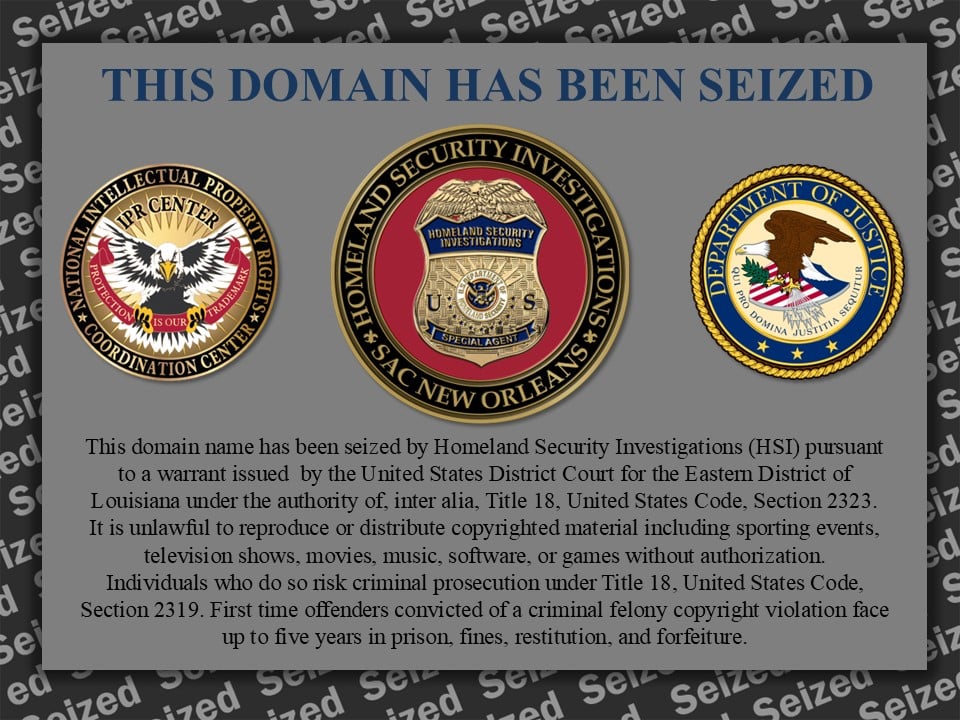
    “It is unlawful to reproduce or distribute copyrighted material including sporting events, television shows, movies, music, software, or games without authorization. Individuals who do so risk criminal prosecution under Title 18,” the banner explained.

    Domain seizure banner

    seized banner streameast

    The seizure warrant effectively targeted five domain names, including Streameast’s main home; thestreameast.to. There was no mention of an associated indictment and no further comments from law enforcement that we know of. That remains the case today.

    Streameast Plans to Appeal

    What is clear, however, is that these initial domain name seizures didn’t take out Streameast. On the contrary, the site’s operators immediately reassured visitors that they would keep going, and are now considering an appeal against the domain seizure warrant.

    Streameast’s operator, ‘quick,’ explains that after extensive efforts, the site finally managed to obtain a copy of the seizure warrant. This raised more questions than it answered.

    The warrant

    warrant

    The order shown above was sent to the Tonic (.to) registry. Streameast eventually obtained a copy but it did not include any other paperwork. The full docket might contain more information where the allegations are discussed in detail, but Streameast hasn’t seen that.

    Based on the paperwork provided, Streameast is planning to appeal the matter in court.

    “[The warrant] did not provide any reasons for the shutdown, which is quite intriguing. As a result, we have doubts about the legitimacy of this decision, and we will be filing an appeal in the coming days,” ‘quick’ tells TorrentFreak.

    No Advance Warning

    Streameast wasn’t informed about the legal action beforehand. This is not unusual as domain seizures are intended to come as a surprise, so the operators of these sites can’t take precautionary measures.

    The popular sports streaming site further informs TorrentFreak that it has never received direct legal threats from copyright holders either; only DMCA notices, which are standard practice for these types of sites.

    “We’ve never received any legal threats in the past. However, we constantly receive DMCA requests, which have led us to change hosting providers several times. This is normal given the nature of the business.

    “However, before the shutdown requests, we did not receive any official requests,” Streameast’s ‘quick’ notes.

    While it may seem unusual for a ‘pirate site’ to challenge the U.S. government on this matter, Streameast is not the first sports streaming site to appeal a domain seizure. Rojadirecta did the same, twelve years ago, and the U.S. authorities eventually returned the seized domains .

    Times have changed, however, and U.S. law enforcement may have upgraded its procedures to prevent the same from happening again. In addition, the Protecting Lawful Streaming Act ( PLSA ) effectively criminalized unauthorized streaming services when it became law late 2020.

    New Mirror Domains

    Despite the looming threat of criminal charges, Streameast remains devoted to keeping the site online. Following the domain seizures, it established several new mirrors, which are shared through the official Streameast Mirror List.

    Streameast Mirror List

    mirror list

    The sports streaming portal previously said that once access to sports streaming is affordable to everyone, it will shut down. While the site doesn’t have a concrete figure in mind, it believes that current prices are too high.

    “While we can somewhat understand the need to pay in today’s world, it’s clear that the current prices are unrealistic. If a sports fan wants to watch all sporting events, including UFC and boxing PPVs, the monthly cost is almost $1500,” Streameast’s ‘quick’ says.

    Streameast’s motivation to keep the site online stems from its loyalty to the audience, the operator says. While it clearly makes money from ads, the site cares about its users and stresses that it’s not “in it for the money”.

    Pirate Streaming Gangs

    Sports rightsholders will likely paint a different picture, accusing Streameast of being a criminal operation that generates revenue off the backs of companies that invest in live sports.

    Interestingly, Streameast doesn’t deny that there are criminal gangs active in the pirate sports streaming business, but they view themselves differently. Instead, the site points a finger at competitors and copycat sites, some of which abuse the Streameast brand.

    Many of these ‘fake’ Streameast domains are still operational today, as they weren’t part of the seizure warrant.

    “It’s perplexing that while the real Streameast domain names are being seized, the sites created by gangs who set up fake Streameast sites are still operational. These gangs replicate every major streaming site, employing spam tactics to rank high on Google, and they have no ethical values.”

    According to Streameast’s operator, many sports streaming sites lost their innocence years ago. Some have reverted to dangerous malware-linked ads, while ‘Asian spam gangs’ are launching copycats left and right, trying to outrank official sites in Google’s search results.

    “I wish the USA would choose to deal with these gangs instead of targeting us,” ‘quick’ concludes.

    From: TF , for the latest news on copyright battles, piracy and more.

    • To chevron_right

      Sports Streaming Site Streameast Plans to Appeal U.S. Domain Name Seizures

      news.movim.eu / TorrentFreak • 31 August 2024 • 4 minutes

    streameast logo With millions of visits per month, pirate sports streaming site Streameast is a fan favorite among many sports aficionados.

    The site is particularly popular in the United States, where even the largest sports icons, including LeBron James, have reportedly used it to stream content.

    The appeal of free sports content is understandable, as legal options can cost hundreds of dollars per month. This can lead to legal complications such as those that became apparent earlier this month, when Homeland Security Investigations (HSI) seized several Streameast domains .

    “It is unlawful to reproduce or distribute copyrighted material including sporting events, television shows, movies, music, software, or games without authorization. Individuals who do so risk criminal prosecution under Title 18,” the banner explained.

    Domain seizure banner

    seized banner streameast

    The seizure warrant effectively targeted five domain names, including Streameast’s main home; thestreameast.to. There was no mention of an associated indictment and no further comments from law enforcement that we know of. That remains the case today.

    Streameast Plans to Appeal

    What is clear, however, is that these initial domain name seizures didn’t take out Streameast. On the contrary, the site’s operators immediately reassured visitors that they would keep going, and are now considering an appeal against the domain seizure warrant.

    Streameast’s operator, ‘quick,’ explains that after extensive efforts, the site finally managed to obtain a copy of the seizure warrant. This raised more questions than it answered.

    The warrant

    warrant

    The order shown above was sent to the Tonic (.to) registry. Streameast eventually obtained a copy but it did not include any other paperwork. The full docket might contain more information where the allegations are discussed in detail, but Streameast hasn’t seen that.

    Based on the paperwork provided, Streameast is planning to appeal the matter in court.

    “[The warrant] did not provide any reasons for the shutdown, which is quite intriguing. As a result, we have doubts about the legitimacy of this decision, and we will be filing an appeal in the coming days,” ‘quick’ tells TorrentFreak.

    No Advance Warning

    Streameast wasn’t informed about the legal action beforehand. This is not unusual as domain seizures are intended to come as a surprise, so the operators of these sites can’t take precautionary measures.

    The popular sports streaming site further informs TorrentFreak that it has never received direct legal threats from copyright holders either; only DMCA notices, which are standard practice for these types of sites.

    “We’ve never received any legal threats in the past. However, we constantly receive DMCA requests, which have led us to change hosting providers several times. This is normal given the nature of the business.

    “However, before the shutdown requests, we did not receive any official requests,” Streameast’s ‘quick’ notes.

    While it may seem unusual for a ‘pirate site’ to challenge the U.S. government on this matter, Streameast is not the first sports streaming site to appeal a domain seizure. Rojadirecta did the same, twelve years ago, and the U.S. authorities eventually returned the seized domains .

    Times have changed, however, and U.S. law enforcement may have upgraded its procedures to prevent the same from happening again. In addition, the Protecting Lawful Streaming Act ( PLSA ) effectively criminalized unauthorized streaming services when it became law late 2020.

    New Mirror Domains

    Despite the looming threat of criminal charges, Streameast remains devoted to keeping the site online. Following the domain seizures, it established several new mirrors, which are shared through the official Streameast Mirror List.

    Streameast Mirror List

    mirror list

    The sports streaming portal previously said that once access to sports streaming is affordable to everyone, it will shut down. While the site doesn’t have a concrete figure in mind, it believes that current prices are too high.

    “While we can somewhat understand the need to pay in today’s world, it’s clear that the current prices are unrealistic. If a sports fan wants to watch all sporting events, including UFC and boxing PPVs, the monthly cost is almost $1500,” Streameast’s ‘quick’ says.

    Streameast’s motivation to keep the site online stems from its loyalty to the audience, the operator says. While it clearly makes money from ads, the site cares about its users and stresses that it’s not “in it for the money”.

    Pirate Streaming Gangs

    Sports rightsholders will likely paint a different picture, accusing Streameast of being a criminal operation that generates revenue off the backs of companies that invest in live sports.

    Interestingly, Streameast doesn’t deny that there are criminal gangs active in the pirate sports streaming business, but they view themselves differently. Instead, the site points a finger at competitors and copycat sites, some of which abuse the Streameast brand.

    Many of these ‘fake’ Streameast domains are still operational today, as they weren’t part of the seizure warrant.

    “It’s perplexing that while the real Streameast domain names are being seized, the sites created by gangs who set up fake Streameast sites are still operational. These gangs replicate every major streaming site, employing spam tactics to rank high on Google, and they have no ethical values.”

    According to Streameast’s operator, many sports streaming sites lost their innocence years ago. Some have reverted to dangerous malware-linked ads, while ‘Asian spam gangs’ are launching copycats left and right, trying to outrank official sites in Google’s search results.

    “I wish the USA would choose to deal with these gangs instead of targeting us,” ‘quick’ concludes.

    From: TF , for the latest news on copyright battles, piracy and more.

    • To chevron_right

      Sports Streaming Site Streameast Plans to Appeal U.S. Domain Name Seizures

      news.movim.eu / TorrentFreak • 31 August 2024 • 4 minutes

    streameast logo With millions of visits per month, pirate sports streaming site Streameast is a fan favorite among many sports aficionados.

    The site is particularly popular in the United States, where even the largest sports icons, including LeBron James, have reportedly used it to stream content.

    The appeal of free sports content is understandable, as legal options can cost hundreds of dollars per month. This can lead to legal complications such as those that became apparent earlier this month, when Homeland Security Investigations (HSI) seized several Streameast domains .

    “It is unlawful to reproduce or distribute copyrighted material including sporting events, television shows, movies, music, software, or games without authorization. Individuals who do so risk criminal prosecution under Title 18,” the banner explained.

    Domain seizure banner

    seized banner streameast

    The seizure warrant effectively targeted five domain names, including Streameast’s main home; thestreameast.to. There was no mention of an associated indictment and no further comments from law enforcement that we know of. That remains the case today.

    Streameast Plans to Appeal

    What is clear, however, is that these initial domain name seizures didn’t take out Streameast. On the contrary, the site’s operators immediately reassured visitors that they would keep going, and are now considering an appeal against the domain seizure warrant.

    Streameast’s operator, ‘quick,’ explains that after extensive efforts, the site finally managed to obtain a copy of the seizure warrant. This raised more questions than it answered.

    The warrant

    warrant

    The order shown above was sent to the Tonic (.to) registry. Streameast eventually obtained a copy but it did not include any other paperwork. The full docket might contain more information where the allegations are discussed in detail, but Streameast hasn’t seen that.

    Based on the paperwork provided, Streameast is planning to appeal the matter in court.

    “[The warrant] did not provide any reasons for the shutdown, which is quite intriguing. As a result, we have doubts about the legitimacy of this decision, and we will be filing an appeal in the coming days,” ‘quick’ tells TorrentFreak.

    No Advance Warning

    Streameast wasn’t informed about the legal action beforehand. This is not unusual as domain seizures are intended to come as a surprise, so the operators of these sites can’t take precautionary measures.

    The popular sports streaming site further informs TorrentFreak that it has never received direct legal threats from copyright holders either; only DMCA notices, which are standard practice for these types of sites.

    “We’ve never received any legal threats in the past. However, we constantly receive DMCA requests, which have led us to change hosting providers several times. This is normal given the nature of the business.

    “However, before the shutdown requests, we did not receive any official requests,” Streameast’s ‘quick’ notes.

    While it may seem unusual for a ‘pirate site’ to challenge the U.S. government on this matter, Streameast is not the first sports streaming site to appeal a domain seizure. Rojadirecta did the same, twelve years ago, and the U.S. authorities eventually returned the seized domains .

    Times have changed, however, and U.S. law enforcement may have upgraded its procedures to prevent the same from happening again. In addition, the Protecting Lawful Streaming Act ( PLSA ) effectively criminalized unauthorized streaming services when it became law late 2020.

    New Mirror Domains

    Despite the looming threat of criminal charges, Streameast remains devoted to keeping the site online. Following the domain seizures, it established several new mirrors, which are shared through the official Streameast Mirror List.

    Streameast Mirror List

    mirror list

    The sports streaming portal previously said that once access to sports streaming is affordable to everyone, it will shut down. While the site doesn’t have a concrete figure in mind, it believes that current prices are too high.

    “While we can somewhat understand the need to pay in today’s world, it’s clear that the current prices are unrealistic. If a sports fan wants to watch all sporting events, including UFC and boxing PPVs, the monthly cost is almost $1500,” Streameast’s ‘quick’ says.

    Streameast’s motivation to keep the site online stems from its loyalty to the audience, the operator says. While it clearly makes money from ads, the site cares about its users and stresses that it’s not “in it for the money”.

    Pirate Streaming Gangs

    Sports rightsholders will likely paint a different picture, accusing Streameast of being a criminal operation that generates revenue off the backs of companies that invest in live sports.

    Interestingly, Streameast doesn’t deny that there are criminal gangs active in the pirate sports streaming business, but they view themselves differently. Instead, the site points a finger at competitors and copycat sites, some of which abuse the Streameast brand.

    Many of these ‘fake’ Streameast domains are still operational today, as they weren’t part of the seizure warrant.

    “It’s perplexing that while the real Streameast domain names are being seized, the sites created by gangs who set up fake Streameast sites are still operational. These gangs replicate every major streaming site, employing spam tactics to rank high on Google, and they have no ethical values.”

    According to Streameast’s operator, many sports streaming sites lost their innocence years ago. Some have reverted to dangerous malware-linked ads, while ‘Asian spam gangs’ are launching copycats left and right, trying to outrank official sites in Google’s search results.

    “I wish the USA would choose to deal with these gangs instead of targeting us,” ‘quick’ concludes.

    From: TF , for the latest news on copyright battles, piracy and more.

    • To chevron_right

      Operation Redirect: Police Anti-Malware Action Protects Music & Pirates

      news.movim.eu / TorrentFreak • 30 August 2024 • 5 minutes

    mp3-assault Most anti-piracy campaigns of the last four or five decades feature a direct order (Don’t Pirate) followed by some additional information for people to consider before making an informed choice.

    The direct order “Don’t Pirate” has never changed, but it only becomes effective when paired with a reason to abstain, ideally something that provokes consideration of the consequences.

    Most angles have already been tested. “Home Taping is Killing Music” implied that if piracy continued, people would stop making music. Other campaigns have encouraged people to think of bands just starting out, artists struggling to make ends meet, and people who paint scenery on the set of Hollywood blockbusters.

    When none of those hit the spot, “Don’t Pirate” was paired with “….because you’re probably going to get sued.” Yet even when pirates were prompted to think only of themselves, some inevitably continued to pirate.

    One Anti-Piracy Strategy Consistently Performs

    The best anti-piracy strategy is the accessible content at a fair price strategy, and after a reluctant start, the music industry is still leading the way, and reaping the rewards.

    This week’s publication of IFPI’s Global Music Report 2024 includes the chart below which speaks for itself.

    Results like these present a dilemma. On one hand they are very, very impressive; on the other, they could be even more impressive if piracy could be further reduced. Unfortunately, when sales are trending strongly in the right direction, pairing “Don’t Pirate” with anything that implies an industry on the financial brink, will probably end in failure.

    Any attempt to promote a doom narrative in Latin America right now would run up against the fourteenth consecutive year of revenue growth, per IFPI’s latest report, with recorded music revenues “once again outpacing the global growth rate” with an increase of 19.4% in 2023. When homing in on Brazil, in 2023 there was a double-digit percentage climb of 13.4%.

    Fortunately, the latest trend in anti-piracy messaging couples “Don’t Pirate” with something that can be used no matter how well the music industry is performing: “Malware Warning.”

    “First-of-a-Kind Operation” in Brazil

    As IFPI explained in a separate announcement this week, anti-piracy operations benefit creators but can also benefit the wider public. Case in point, Operation Redirect, a recently launched Brazilian law enforcement initiative supported by IFPI and Pro-Música Brasil.

    “Operation Redirect is the first operation of its kind in Brazil to target illegal sites associated with malware distribution. It has already resulted in the identification and deactivation of eight sites that were sharing unauthorized music whilst exposing users to malware and viruses,” IFPI explains.

    “This first iteration of the operation targeted a range of infringing websites that collectively received over 12 million visits in Brazil in the last year. They include illegal linking music sites, Stream ripping sites and Torrent search engines.”

    Sites ‘Redirected’ end up here (translated) operation_redirect

    IFPI says the operation was carried out by The Ministry of Justice and Public Security, through the Cyber Operations Laboratory (CIBERLAB) of the Directorate of Integrated Operations and Intelligence (DIOPI / SENASP), in partnership with the Civil Police of Bahia, Mato Grosso and Pernambuco.

    Brazil regularly shuts down pirate sites but the suggestion here – that music piracy and malware have been placed on broadly equal footing – is intriguing.

    Pirates may complain strongly when they lose access to free music, but a site operator arrested for deliberately hurting site visitors rather than for just piracy itself , is something new. Not only would that significantly damage any ‘Robin Hood’ imagery, it would show that the authorities are using finite public resources to protect the public, not just the music industry.

    That might also help dampen suspicions that “Malware Warning” isn’t simply the latest “Don’t Pirate” add-on. And if things went really well, the overall message might be one that even pirates would find persuasive.

    How Things Played Out in Brazil

    Within the first few seconds of the CNN report broadcast to millions on live TV, it was clear this was report was, first and foremost, all about music piracy.

    CNN went with ‘OPERAÇÃO DERRUBA SITES PIRATA DE MÚSICA’ (OPERATION TAKES DOWN PIRATE MUSIC SITES) to a background video of three unmarked SUVs departing police HQ, with red strobes already blazing from behind blacked-out windows. (English captions from voiceover)

    Operation Redirect begins brazil-op-redirect -1

    “The Ministry of Justice is carrying out an operation against pirated music sites,” the studio presenter said, before handing over to a reporter with additional details.

    “[T]here are still many pirated music sites on the internet, that is why this operation coordinated by the Ministry of Justice is on the streets with the support of three civil police from the states, for example Bahia, Pernambuco, and also in Mato Grosso,” he explained.

    “Three search and seizure warrants were served, and the current assessment is that eight illegal sites that were making irregular music available without due authorization have already been taken down in this operation investigated by the cyberlab.”

    Weapons drawn, searches begin brazil-op-redirected -2

    The reporter goes on to note that the operation resulted in just one arrest, and that the suspect was caught in flagrante delicto .

    “Inside the house of a person who is responsible for one of these illegal sites, there were a lot of weapons, unregistered weapons. These are the weapons that were seized and why the person was arrested.”

    Man arrested for unlicensed guns brazil-op-redirected -3

    So after hearing about the music piracy and the unlicensed weapons, what about the malware?

    More About the Malware

    Towards the end of the report, CNN did raise the issue of malware, noting that users who visit pirate music sites “become vulnerable because there are many viruses that these criminals are putting them on these sites which then appear on the computers and also on the cell phones of these users of the platforms on the internet.”

    Brazil’s government also mentioned the malware angle.

    “In addition to appropriating the works, the criminals left consumers who accessed these platforms vulnerable to viruses and malware (programs created to cause damage to computers and servers). As a result, users could have their machines infected and damaged or be redirected to phishing websites, capable of stealing personal, financial and corporate information,” a statement reads.

    The big question is whether this relatively new strategy, now deployed across all entertainment industries, can succeed where others have failed. If CNN’s coverage is anything to go by, where malware was mentioned as a footnote, in an operation that was supposed to see piracy and malware given similar priority, not a chance.

    Most current campaigns spend very little time ordering people not to pirate. Instead, they focus on associated dangers and then try to persuade people that, on balance, free or cheap content that arrives with malware or other threats to security, is actually poor value for money, not the bargain they were promised.

    Unfortunately, without some kind of proof, the messages mean almost nothing. Yet there’s actually no shortage of proof , only a reluctance to share it.

    From: TF , for the latest news on copyright battles, piracy and more.

    • To chevron_right

      Operation Redirect: Police Anti-Malware Action Protects Music & Pirates

      news.movim.eu / TorrentFreak • 30 August 2024 • 5 minutes

    mp3-assault Most anti-piracy campaigns of the last four or five decades feature a direct order (Don’t Pirate) followed by some additional information for people to consider before making an informed choice.

    The direct order “Don’t Pirate” has never changed, but it only becomes effective when paired with a reason to abstain, ideally something that provokes consideration of the consequences.

    Most angles have already been tested. “Home Taping is Killing Music” implied that if piracy continued, people would stop making music. Other campaigns have encouraged people to think of bands just starting out, artists struggling to make ends meet, and people who paint scenery on the set of Hollywood blockbusters.

    When none of those hit the spot, “Don’t Pirate” was paired with “….because you’re probably going to get sued.” Yet even when pirates were prompted to think only of themselves, some inevitably continued to pirate.

    One Anti-Piracy Strategy Consistently Performs

    The best anti-piracy strategy is the accessible content at a fair price strategy, and after a reluctant start, the music industry is still leading the way, and reaping the rewards.

    This week’s publication of IFPI’s Global Music Report 2024 includes the chart below which speaks for itself.

    Results like these present a dilemma. On one hand they are very, very impressive; on the other, they could be even more impressive if piracy could be further reduced. Unfortunately, when sales are trending strongly in the right direction, pairing “Don’t Pirate” with anything that implies an industry on the financial brink, will probably end in failure.

    Any attempt to promote a doom narrative in Latin America right now would run up against the fourteenth consecutive year of revenue growth, per IFPI’s latest report, with recorded music revenues “once again outpacing the global growth rate” with an increase of 19.4% in 2023. When homing in on Brazil, in 2023 there was a double-digit percentage climb of 13.4%.

    Fortunately, the latest trend in anti-piracy messaging couples “Don’t Pirate” with something that can be used no matter how well the music industry is performing: “Malware Warning.”

    “First-of-a-Kind Operation” in Brazil

    As IFPI explained in a separate announcement this week, anti-piracy operations benefit creators but can also benefit the wider public. Case in point, Operation Redirect, a recently launched Brazilian law enforcement initiative supported by IFPI and Pro-Música Brasil.

    “Operation Redirect is the first operation of its kind in Brazil to target illegal sites associated with malware distribution. It has already resulted in the identification and deactivation of eight sites that were sharing unauthorized music whilst exposing users to malware and viruses,” IFPI explains.

    “This first iteration of the operation targeted a range of infringing websites that collectively received over 12 million visits in Brazil in the last year. They include illegal linking music sites, Stream ripping sites and Torrent search engines.”

    Sites ‘Redirected’ end up here (translated) operation_redirect

    IFPI says the operation was carried out by The Ministry of Justice and Public Security, through the Cyber Operations Laboratory (CIBERLAB) of the Directorate of Integrated Operations and Intelligence (DIOPI / SENASP), in partnership with the Civil Police of Bahia, Mato Grosso and Pernambuco.

    Brazil regularly shuts down pirate sites but the suggestion here – that music piracy and malware have been placed on broadly equal footing – is intriguing.

    Pirates may complain strongly when they lose access to free music, but a site operator arrested for deliberately hurting site visitors rather than for just piracy itself , is something new. Not only would that significantly damage any ‘Robin Hood’ imagery, it would show that the authorities are using finite public resources to protect the public, not just the music industry.

    That might also help dampen suspicions that “Malware Warning” isn’t simply the latest “Don’t Pirate” add-on. And if things went really well, the overall message might be one that even pirates would find persuasive.

    How Things Played Out in Brazil

    Within the first few seconds of the CNN report broadcast to millions on live TV, it was clear this was report was, first and foremost, all about music piracy.

    CNN went with ‘OPERAÇÃO DERRUBA SITES PIRATA DE MÚSICA’ (OPERATION TAKES DOWN PIRATE MUSIC SITES) to a background video of three unmarked SUVs departing police HQ, with red strobes already blazing from behind blacked-out windows. (English captions from voiceover)

    Operation Redirect begins brazil-op-redirect -1

    “The Ministry of Justice is carrying out an operation against pirated music sites,” the studio presenter said, before handing over to a reporter with additional details.

    “[T]here are still many pirated music sites on the internet, that is why this operation coordinated by the Ministry of Justice is on the streets with the support of three civil police from the states, for example Bahia, Pernambuco, and also in Mato Grosso,” he explained.

    “Three search and seizure warrants were served, and the current assessment is that eight illegal sites that were making irregular music available without due authorization have already been taken down in this operation investigated by the cyberlab.”

    Weapons drawn, searches begin brazil-op-redirected -2

    The reporter goes on to note that the operation resulted in just one arrest, and that the suspect was caught in flagrante delicto .

    “Inside the house of a person who is responsible for one of these illegal sites, there were a lot of weapons, unregistered weapons. These are the weapons that were seized and why the person was arrested.”

    Man arrested for unlicensed guns brazil-op-redirected -3

    So after hearing about the music piracy and the unlicensed weapons, what about the malware?

    More About the Malware

    Towards the end of the report, CNN did raise the issue of malware, noting that users who visit pirate music sites “become vulnerable because there are many viruses that these criminals are putting them on these sites which then appear on the computers and also on the cell phones of these users of the platforms on the internet.”

    Brazil’s government also mentioned the malware angle.

    “In addition to appropriating the works, the criminals left consumers who accessed these platforms vulnerable to viruses and malware (programs created to cause damage to computers and servers). As a result, users could have their machines infected and damaged or be redirected to phishing websites, capable of stealing personal, financial and corporate information,” a statement reads.

    The big question is whether this relatively new strategy, now deployed across all entertainment industries, can succeed where others have failed. If CNN’s coverage is anything to go by, where malware was mentioned as a footnote, in an operation that was supposed to see piracy and malware given similar priority, not a chance.

    Most current campaigns spend very little time ordering people not to pirate. Instead, they focus on associated dangers and then try to persuade people that, on balance, free or cheap content that arrives with malware or other threats to security, is actually poor value for money, not the bargain they were promised.

    Unfortunately, without some kind of proof, the messages mean almost nothing. Yet there’s actually no shortage of proof , only a reluctance to share it.

    From: TF , for the latest news on copyright battles, piracy and more.

    • To chevron_right

      Operation Redirect: Police Anti-Malware Action Protects Music & Pirates

      news.movim.eu / TorrentFreak • 30 August 2024 • 5 minutes

    mp3-assault Most anti-piracy campaigns of the last four or five decades feature a direct order (Don’t Pirate) followed by some additional information for people to consider before making an informed choice.

    The direct order “Don’t Pirate” has never changed, but it only becomes effective when paired with a reason to abstain, ideally something that provokes consideration of the consequences.

    Most angles have already been tested. “Home Taping is Killing Music” implied that if piracy continued, people would stop making music. Other campaigns have encouraged people to think of bands just starting out, artists struggling to make ends meet, and people who paint scenery on the set of Hollywood blockbusters.

    When none of those hit the spot, “Don’t Pirate” was paired with “….because you’re probably going to get sued.” Yet even when pirates were prompted to think only of themselves, some inevitably continued to pirate.

    One Anti-Piracy Strategy Consistently Performs

    The best anti-piracy strategy is the accessible content at a fair price strategy, and after a reluctant start, the music industry is still leading the way, and reaping the rewards.

    This week’s publication of IFPI’s Global Music Report 2024 includes the chart below which speaks for itself.

    Results like these present a dilemma. On one hand they are very, very impressive; on the other, they could be even more impressive if piracy could be further reduced. Unfortunately, when sales are trending strongly in the right direction, pairing “Don’t Pirate” with anything that implies an industry on the financial brink, will probably end in failure.

    Any attempt to promote a doom narrative in Latin America right now would run up against the fourteenth consecutive year of revenue growth, per IFPI’s latest report, with recorded music revenues “once again outpacing the global growth rate” with an increase of 19.4% in 2023. When homing in on Brazil, in 2023 there was a double-digit percentage climb of 13.4%.

    Fortunately, the latest trend in anti-piracy messaging couples “Don’t Pirate” with something that can be used no matter how well the music industry is performing: “Malware Warning.”

    “First-of-a-Kind Operation” in Brazil

    As IFPI explained in a separate announcement this week, anti-piracy operations benefit creators but can also benefit the wider public. Case in point, Operation Redirect, a recently launched Brazilian law enforcement initiative supported by IFPI and Pro-Música Brasil.

    “Operation Redirect is the first operation of its kind in Brazil to target illegal sites associated with malware distribution. It has already resulted in the identification and deactivation of eight sites that were sharing unauthorized music whilst exposing users to malware and viruses,” IFPI explains.

    “This first iteration of the operation targeted a range of infringing websites that collectively received over 12 million visits in Brazil in the last year. They include illegal linking music sites, Stream ripping sites and Torrent search engines.”

    Sites ‘Redirected’ end up here (translated) operation_redirect

    IFPI says the operation was carried out by The Ministry of Justice and Public Security, through the Cyber Operations Laboratory (CIBERLAB) of the Directorate of Integrated Operations and Intelligence (DIOPI / SENASP), in partnership with the Civil Police of Bahia, Mato Grosso and Pernambuco.

    Brazil regularly shuts down pirate sites but the suggestion here – that music piracy and malware have been placed on broadly equal footing – is intriguing.

    Pirates may complain strongly when they lose access to free music, but a site operator arrested for deliberately hurting site visitors rather than for just piracy itself , is something new. Not only would that significantly damage any ‘Robin Hood’ imagery, it would show that the authorities are using finite public resources to protect the public, not just the music industry.

    That might also help dampen suspicions that “Malware Warning” isn’t simply the latest “Don’t Pirate” add-on. And if things went really well, the overall message might be one that even pirates would find persuasive.

    How Things Played Out in Brazil

    Within the first few seconds of the CNN report broadcast to millions on live TV, it was clear this was report was, first and foremost, all about music piracy.

    CNN went with ‘OPERAÇÃO DERRUBA SITES PIRATA DE MÚSICA’ (OPERATION TAKES DOWN PIRATE MUSIC SITES) to a background video of three unmarked SUVs departing police HQ, with red strobes already blazing from behind blacked-out windows. (English captions from voiceover)

    Operation Redirect begins brazil-op-redirect -1

    “The Ministry of Justice is carrying out an operation against pirated music sites,” the studio presenter said, before handing over to a reporter with additional details.

    “[T]here are still many pirated music sites on the internet, that is why this operation coordinated by the Ministry of Justice is on the streets with the support of three civil police from the states, for example Bahia, Pernambuco, and also in Mato Grosso,” he explained.

    “Three search and seizure warrants were served, and the current assessment is that eight illegal sites that were making irregular music available without due authorization have already been taken down in this operation investigated by the cyberlab.”

    Weapons drawn, searches begin brazil-op-redirected -2

    The reporter goes on to note that the operation resulted in just one arrest, and that the suspect was caught in flagrante delicto .

    “Inside the house of a person who is responsible for one of these illegal sites, there were a lot of weapons, unregistered weapons. These are the weapons that were seized and why the person was arrested.”

    Man arrested for unlicensed guns brazil-op-redirected -3

    So after hearing about the music piracy and the unlicensed weapons, what about the malware?

    More About the Malware

    Towards the end of the report, CNN did raise the issue of malware, noting that users who visit pirate music sites “become vulnerable because there are many viruses that these criminals are putting them on these sites which then appear on the computers and also on the cell phones of these users of the platforms on the internet.”

    Brazil’s government also mentioned the malware angle.

    “In addition to appropriating the works, the criminals left consumers who accessed these platforms vulnerable to viruses and malware (programs created to cause damage to computers and servers). As a result, users could have their machines infected and damaged or be redirected to phishing websites, capable of stealing personal, financial and corporate information,” a statement reads.

    The big question is whether this relatively new strategy, now deployed across all entertainment industries, can succeed where others have failed. If CNN’s coverage is anything to go by, where malware was mentioned as a footnote, in an operation that was supposed to see piracy and malware given similar priority, not a chance.

    Most current campaigns spend very little time ordering people not to pirate. Instead, they focus on associated dangers and then try to persuade people that, on balance, free or cheap content that arrives with malware or other threats to security, is actually poor value for money, not the bargain they were promised.

    Unfortunately, without some kind of proof, the messages mean almost nothing. Yet there’s actually no shortage of proof , only a reluctance to share it.

    From: TF , for the latest news on copyright battles, piracy and more.