• To chevron_right

      Man Arrested for Sharing Copyright Infringing Nude Scenes Through Reddit

      news.movim.eu / TorrentFreak • 6 September 2024 • 3 minutes

    nude reddit The web is riddled with copyright infringing content, ranging from full-length blockbuster films, through small music samples, to reposted celebrity photos on social media.

    Not all of these offenses are equally problematic. Law enforcement authorities may go after the operators of large-scale pirate sites or services, but posting short film clips without permission typically doesn’t lead to trouble.

    Sharing Nude Scenes of Reddit

    Last year, we reported on a Danish case where a then-anonymous person shared small clips of films online in a subreddit. This type of ‘organized’ copyright infringement is seen as more problematic by rightsholders and in this case, the nature of the clips was all-important too.

    Instead of posting random clips, the group was dedicated to nude scenes of Danish female actors. These were taken out of context and posted online, for the group’s more than 6,000 members to enjoy. In addition, the same clips appeared on pornographic websites.

    plot reddit

    The unauthorized activity was considered a slap in the face by the actresses, many of whom complained to local media. They felt violated by the actions and called on Reddit and the authorities to respond.

    Actress Andrea Vagn Jensen, who has had one of her explicit scenes shared online, told DR that there’s a huge difference between appearing naked in a film and being posted on Reddit.

    “It’s just abuse. You deliver something for the production and the story, and then you end up being molested that way,” Jensen said.

    Police Arrest 39-Year-Old Man

    The complaints caught the attention of Rights Alliance , which reported the issue to the police on behalf of the Danish Actors’ Association and the respective rightsholders. While these clips may not directly hurt revenues, copyrights also have moral rights which include the right to integrity, which could come into play here.

    Rights Alliance also called on Reddit to take the matter seriously. While many of the problematic clips were already removed at that point, the group urged Reddit to implement upload filters to prevent future trouble. That included banning external URLs.

    It’s unclear whether these demands were translated into action by Reddit but the police certainly took the matter seriously. This week, the National Unit for Serious Crime (NSK) announced that a 39-year-old man from Valby had been arrested and charged with copyright infringement.

    “The arrested person is suspected of being behind extensive sharing of video clips with nude scenes from Danish feature films and series on various pornographic websites and the social media Reddit,” NSK writes.

    The r/SeDetForPlottet subreddit is no longer online today. After the earlier media coverage, the group was made private and eventually shut down but for the suspect, this case is far from over.

    Real People

    NSK Police Commissioner Anders-Emil Kelbæk is pleased with the arrest. Not just in the interest of rightsholders, but also the actresses who felt abused by the unauthorized activity.

    “I am satisfied that we have now been able to make an arrest in this case. Both actors and rights holders have rightly felt offended when nude scenes have suddenly been shared in an entirely different context than the one they were intended for,” Kelbæk says.

    Rights Alliance Director Maria Fredenslund is happy with the outcome as well, as it sends a clear message that there are serious consequences for posting short copyright-infringing clips out of context.

    “The case here deeply affects the rights holders involved and emphasizes what can be at stake when content is shared without permission and out of context,” Fredenslund notes.

    “Any film or television production is created by real people with personal boundaries and artistic visions that are seriously violated by this kind of illegal sharing. Great praise must go to NSK for their effort in investigating the case,” she adds.

    The r/SeDetForPlottet group, allegedly operated by the suspect, was inspired by the popular English-language subreddit r/WatchItForThePlot . The latter remains online today and has over 1.4 million subscribers.

    r/WatchItForThePlot

    watch plot

    From: TF , for the latest news on copyright battles, piracy and more.
    • To chevron_right

      Man Arrested for Sharing Copyright Infringing Nude Scenes Through Reddit

      news.movim.eu / TorrentFreak • 6 September 2024 • 3 minutes

    nude reddit The web is riddled with copyright infringing content, ranging from full-length blockbuster films, through small music samples, to reposted celebrity photos on social media.

    Not all of these offenses are equally problematic. Law enforcement authorities may go after the operators of large-scale pirate sites or services, but posting short film clips without permission typically doesn’t lead to trouble.

    Sharing Nude Scenes of Reddit

    Last year, we reported on a Danish case where a then-anonymous person shared small clips of films online in a subreddit. This type of ‘organized’ copyright infringement is seen as more problematic by rightsholders and in this case, the nature of the clips was all-important too.

    Instead of posting random clips, the group was dedicated to nude scenes of Danish female actors. These were taken out of context and posted online, for the group’s more than 6,000 members to enjoy. In addition, the same clips appeared on pornographic websites.

    plot reddit

    The unauthorized activity was considered a slap in the face by the actresses, many of whom complained to local media. They felt violated by the actions and called on Reddit and the authorities to respond.

    Actress Andrea Vagn Jensen, who has had one of her explicit scenes shared online, told DR that there’s a huge difference between appearing naked in a film and being posted on Reddit.

    “It’s just abuse. You deliver something for the production and the story, and then you end up being molested that way,” Jensen said.

    Police Arrest 39-Year-Old Man

    The complaints caught the attention of Rights Alliance , which reported the issue to the police on behalf of the Danish Actors’ Association and the respective rightsholders. While these clips may not directly hurt revenues, copyrights also have moral rights which include the right to integrity, which could come into play here.

    Rights Alliance also called on Reddit to take the matter seriously. While many of the problematic clips were already removed at that point, the group urged Reddit to implement upload filters to prevent future trouble. That included banning external URLs.

    It’s unclear whether these demands were translated into action by Reddit but the police certainly took the matter seriously. This week, the National Unit for Serious Crime (NSK) announced that a 39-year-old man from Valby had been arrested and charged with copyright infringement.

    “The arrested person is suspected of being behind extensive sharing of video clips with nude scenes from Danish feature films and series on various pornographic websites and the social media Reddit,” NSK writes.

    The r/SeDetForPlottet subreddit is no longer online today. After the earlier media coverage, the group was made private and eventually shut down but for the suspect, this case is far from over.

    Real People

    NSK Police Commissioner Anders-Emil Kelbæk is pleased with the arrest. Not just in the interest of rightsholders, but also the actresses who felt abused by the unauthorized activity.

    “I am satisfied that we have now been able to make an arrest in this case. Both actors and rights holders have rightly felt offended when nude scenes have suddenly been shared in an entirely different context than the one they were intended for,” Kelbæk says.

    Rights Alliance Director Maria Fredenslund is happy with the outcome as well, as it sends a clear message that there are serious consequences for posting short copyright-infringing clips out of context.

    “The case here deeply affects the rights holders involved and emphasizes what can be at stake when content is shared without permission and out of context,” Fredenslund notes.

    “Any film or television production is created by real people with personal boundaries and artistic visions that are seriously violated by this kind of illegal sharing. Great praise must go to NSK for their effort in investigating the case,” she adds.

    The r/SeDetForPlottet group, allegedly operated by the suspect, was inspired by the popular English-language subreddit r/WatchItForThePlot . The latter remains online today and has over 1.4 million subscribers.

    r/WatchItForThePlot

    watch plot

    From: TF , for the latest news on copyright battles, piracy and more.

    • To chevron_right

      Man Arrested for Sharing Copyright Infringing Nude Scenes Through Reddit

      news.movim.eu / TorrentFreak • 6 September 2024 • 3 minutes

    nude reddit The web is riddled with copyright infringing content, ranging from full-length blockbuster films, through small music samples, to reposted celebrity photos on social media.

    Not all of these offenses are equally problematic. Law enforcement authorities may go after the operators of large-scale pirate sites or services, but posting short film clips without permission typically doesn’t lead to trouble.

    Sharing Nude Scenes of Reddit

    Last year, we reported on a Danish case where a then-anonymous person shared small clips of films online in a subreddit. This type of ‘organized’ copyright infringement is seen as more problematic by rightsholders and in this case, the nature of the clips was all-important too.

    Instead of posting random clips, the group was dedicated to nude scenes of Danish female actors. These were taken out of context and posted online, for the group’s more than 6,000 members to enjoy. In addition, the same clips appeared on pornographic websites.

    plot reddit

    The unauthorized activity was considered a slap in the face by the actresses, many of whom complained to local media. They felt violated by the actions and called on Reddit and the authorities to respond.

    Actress Andrea Vagn Jensen, who has had one of her explicit scenes shared online, told DR that there’s a huge difference between appearing naked in a film and being posted on Reddit.

    “It’s just abuse. You deliver something for the production and the story, and then you end up being molested that way,” Jensen said.

    Police Arrest 39-Year-Old Man

    The complaints caught the attention of Rights Alliance , which reported the issue to the police on behalf of the Danish Actors’ Association and the respective rightsholders. While these clips may not directly hurt revenues, copyrights also have moral rights which include the right to integrity, which could come into play here.

    Rights Alliance also called on Reddit to take the matter seriously. While many of the problematic clips were already removed at that point, the group urged Reddit to implement upload filters to prevent future trouble. That included banning external URLs.

    It’s unclear whether these demands were translated into action by Reddit but the police certainly took the matter seriously. This week, the National Unit for Serious Crime (NSK) announced that a 39-year-old man from Valby had been arrested and charged with copyright infringement.

    “The arrested person is suspected of being behind extensive sharing of video clips with nude scenes from Danish feature films and series on various pornographic websites and the social media Reddit,” NSK writes.

    The r/SeDetForPlottet subreddit is no longer online today. After the earlier media coverage, the group was made private and eventually shut down but for the suspect, this case is far from over.

    Real People

    NSK Police Commissioner Anders-Emil Kelbæk is pleased with the arrest. Not just in the interest of rightsholders, but also the actresses who felt abused by the unauthorized activity.

    “I am satisfied that we have now been able to make an arrest in this case. Both actors and rights holders have rightly felt offended when nude scenes have suddenly been shared in an entirely different context than the one they were intended for,” Kelbæk says.

    Rights Alliance Director Maria Fredenslund is happy with the outcome as well, as it sends a clear message that there are serious consequences for posting short copyright-infringing clips out of context.

    “The case here deeply affects the rights holders involved and emphasizes what can be at stake when content is shared without permission and out of context,” Fredenslund notes.

    “Any film or television production is created by real people with personal boundaries and artistic visions that are seriously violated by this kind of illegal sharing. Great praise must go to NSK for their effort in investigating the case,” she adds.

    The r/SeDetForPlottet group, allegedly operated by the suspect, was inspired by the popular English-language subreddit r/WatchItForThePlot . The latter remains online today and has over 1.4 million subscribers.

    r/WatchItForThePlot

    watch plot

    From: TF , for the latest news on copyright battles, piracy and more.

    • To chevron_right

      Internet Archive Loses Landmark E-Book Lending Copyright Appeal Against Publishers

      news.movim.eu / TorrentFreak • 5 September 2024 • 4 minutes

    internet archive In 2020, publishers Hachette, HarperCollins, John Wiley and Penguin Random House sued the Internet Archive (IA) for copyright infringement, equating its ‘Open Library’ to a pirate site.

    IA’s library is a non-profit organization that, among other things, scans physical books in-house so these can be lent out to patrons as e-books.

    This “Controlled Digital Lending” (CDL) practice allows for only one copy of a book to be lent at a time, mirroring the traditional library lending model. At the same time, however, CDL bypasses the publishers’ e-book licensing model.

    Publishers vs. Internet Archive

    The in-house scanning service at the Internet Archive (IA) differs from the licensing agreements entered into by other libraries. These agreements see libraries license ‘official’ e-book versions from publishers, who charge for every book that’s lent out to patrons.

    The major book publishers eventually ran out of patience with IA’s DIY approach, filing a lawsuit that kicked off a major legal battle four years ago. The publishers equated IA’s lending operation to piracy and, last year, a New York federal court concluded that the library is indeed in the wrong .

    The court’s decision effectively put an end to IA’s self-scanning library, at least for books from the publishers in suit. However, IA was not giving up that easily; in December the non-profit filed its opening brief at the Second Circuit Court of Appeals, hoping to reverse the judgment .

    Publishers Win at Court of Appeal

    During a hearing in June, both sides defended their positions. At the time, the court didn’t appear to be entirely convinced by IA’s arguments. This was confirmed by an opinion and judgment from the three judge panel published a few hours ago.

    After reviewing the evidence, circuit judges Steven Menashi, Beth Robinson, and Maria Kahn, affirmed the lower court’s order. They conclude that IA’s self-scanning approach can’t be classified as fair use under U.S. copyright law.

    Affirmed

    affirmed

    The court understands that libraries are burdened by e-book licensing fees, which can make book lending relatively expensive. However, that doesn’t give IA the right to create its own e-books and lend those out instead.

    “IA asks this Court to bless the large scale copying and distribution of copyrighted books without permission from or payment to the Publishers or authors,” the appeal court’s opinion reads.

    “Such a holding would allow for widescale copying that deprives creators of compensation and diminishes the incentive to produce new works. This may be what IA and its amici prefer, but it is not an approach that the Copyright Act permits.”

    Fair Use?

    The Internet Archive hoped to rely on a fair use determination. It stressed that the in-house e-book scanning approach is transformative, because it enhances access to books, especially for those who cannot easily visit physical libraries.

    The fact that the organization has no profit motive and only lends out as many digital copies as they have physical copies, should also favor fair use, they argued.

    The Second Circuit Court of Appeals ultimately disagrees. For one, the court emphasized that simply digitizing a book is not transformative, as it does not create a new purpose or character. The digital copies served the same function as the original books – reading.

    The court reasons that IA’s free digital lending could serve as a substitute for purchasing or licensing e-books, potentially harming the publishers’ revenue. That also goes against a fair use determination.

    The court further stresses that while IA is a non-profit, its activities to have a commercial aspect, as it indirectly benefits from its partnerships and donations. That, again, weighs against fair use.

    Harmful

    The court of appeal had to find a balance between the interests of rightsholders and IA. In this case, it concludes that the scale tilts in favor of the book publishers.

    In essence, the court prioritized the publishers’ right to control the reproduction and distribution of their works over IA’s goal of expanding access to knowledge. While IA’s actions are potentially beneficial in some ways, they ultimately harm the market for the publishers’ books, the court concludes.

    “While IA claims that prohibiting its practices would harm consumers and researchers, allowing its practices would―and does―harm authors. With each digital book IA disseminates, it deprives Publishers and authors of the revenues due to them as compensation for their unique creations,” the opinion reads.

    The decision means that IA’s e-book lending approach remains off-limits, as it applies to these copyrighted works. This may not signal the end of the legal battle, however.

    IA is clearly disappointed by the outcome, but it hasn’t thrown in the towel yet.

    “We are disappointed in today’s opinion about the Internet Archive’s digital lending of books that are available electronically elsewhere. We are reviewing the court’s opinion and will continue to defend the rights of libraries to own, lend, and preserve books,” IA writes.

    A copy of the opinion from the Second Circuit Court of Appeals is available here (pdf) , and the associated judgment can be found here (pdf) .

    From: TF , for the latest news on copyright battles, piracy and more.

    • To chevron_right

      Internet Archive Loses Landmark E-Book Lending Copyright Appeal Against Publishers

      news.movim.eu / TorrentFreak • 5 September 2024 • 4 minutes

    internet archive In 2020, publishers Hachette, HarperCollins, John Wiley and Penguin Random House sued the Internet Archive (IA) for copyright infringement, equating its ‘Open Library’ to a pirate site.
    IA’s library is a non-profit organization that, among other things, scans physical books in-house so these can be lent out to patrons as e-books.

    This “Controlled Digital Lending” (CDL) practice allows for only one copy of a book to be lent at a time, mirroring the traditional library lending model. At the same time, however, CDL bypasses the publishers’ e-book licensing model.

    Publishers vs. Internet Archive

    The in-house scanning service at the Internet Archive (IA) differs from the licensing agreements entered into by other libraries. These agreements see libraries license ‘official’ e-book versions from publishers, who charge for every book that’s lent out to patrons.

    The major book publishers eventually ran out of patience with IA’s DIY approach, filing a lawsuit that kicked off a major legal battle four years ago. The publishers equated IA’s lending operation to piracy and, last year, a New York federal court concluded that the library is indeed in the wrong .

    The court’s decision effectively put an end to IA’s self-scanning library, at least for books from the publishers in suit. However, IA was not giving up that easily; in December the non-profit filed its opening brief at the Second Circuit Court of Appeals, hoping to reverse the judgment .

    Publishers Win at Court of Appeal

    During a hearing in June, both sides defended their positions. At the time, the court didn’t appear to be entirely convinced by IA’s arguments. This was confirmed by an opinion and judgment from the three judge panel published a few hours ago.

    After reviewing the evidence, circuit judges Steven Menashi, Beth Robinson, and Maria Kahn, affirmed the lower court’s order. They conclude that IA’s self-scanning approach can’t be classified as fair use under U.S. copyright law.

    Affirmed

    affirmed

    The court understands that libraries are burdened by e-book licensing fees, which can make book lending relatively expensive. However, that doesn’t give IA the right to create its own e-books and lend those out instead.

    “IA asks this Court to bless the large scale copying and distribution of copyrighted books without permission from or payment to the Publishers or authors,” the appeal court’s opinion reads.

    “Such a holding would allow for widescale copying that deprives creators of compensation and diminishes the incentive to produce new works. This may be what IA and its amici prefer, but it is not an approach that the Copyright Act permits.”

    Fair Use?

    The Internet Archive hoped to rely on a fair use determination. It stressed that the in-house e-book scanning approach is transformative, because it enhances access to books, especially for those who cannot easily visit physical libraries.

    The fact that the organization has no profit motive and only lends out as many digital copies as they have physical copies, should also favor fair use, they argued.

    The Second Circuit Court of Appeals ultimately disagrees. For one, the court emphasized that simply digitizing a book is not transformative, as it does not create a new purpose or character. The digital copies served the same function as the original books – reading.

    The court reasons that IA’s free digital lending could serve as a substitute for purchasing or licensing e-books, potentially harming the publishers’ revenue. That also goes against a fair use determination.

    The court further stresses that while IA is a non-profit, its activities to have a commercial aspect, as it indirectly benefits from its partnerships and donations. That, again, weighs against fair use.

    Harmful

    The court of appeal had to find a balance between the interests of rightsholders and IA. In this case, it concludes that the scale tilts in favor of the book publishers.

    In essence, the court prioritized the publishers’ right to control the reproduction and distribution of their works over IA’s goal of expanding access to knowledge. While IA’s actions are potentially beneficial in some ways, they ultimately harm the market for the publishers’ books, the court concludes.

    “While IA claims that prohibiting its practices would harm consumers and researchers, allowing its practices would―and does―harm authors. With each digital book IA disseminates, it deprives Publishers and authors of the revenues due to them as compensation for their unique creations,” the opinion reads.

    The decision means that IA’s e-book lending approach remains off-limits, as it applies to these copyrighted works. This may not signal the end of the legal battle, however.

    IA is clearly disappointed by the outcome, but it hasn’t thrown in the towel yet.

    “We are disappointed in today’s opinion about the Internet Archive’s digital lending of books that are available electronically elsewhere. We are reviewing the court’s opinion and will continue to defend the rights of libraries to own, lend, and preserve books,” IA writes.

    A copy of the opinion from the Second Circuit Court of Appeals is available here (pdf) , and the associated judgment can be found here (pdf) .

    From: TF , for the latest news on copyright battles, piracy and more.

    • To chevron_right

      Internet Archive Loses Landmark E-Book Lending Copyright Appeal Against Publishers

      news.movim.eu / TorrentFreak • 5 September 2024 • 4 minutes

    internet archive In 2020, publishers Hachette, HarperCollins, John Wiley and Penguin Random House sued the Internet Archive (IA) for copyright infringement, equating its ‘Open Library’ to a pirate site.

    IA’s library is a non-profit organization that, among other things, scans physical books in-house so these can be lent out to patrons as e-books.

    This “Controlled Digital Lending” (CDL) practice allows for only one copy of a book to be lent at a time, mirroring the traditional library lending model. At the same time, however, CDL bypasses the publishers’ e-book licensing model.

    Publishers vs. Internet Archive

    The in-house scanning service at the Internet Archive (IA) differs from the licensing agreements entered into by other libraries. These agreements see libraries license ‘official’ e-book versions from publishers, who charge for every book that’s lent out to patrons.

    The major book publishers eventually ran out of patience with IA’s DIY approach, filing a lawsuit that kicked off a major legal battle four years ago. The publishers equated IA’s lending operation to piracy and, last year, a New York federal court concluded that the library is indeed in the wrong .

    The court’s decision effectively put an end to IA’s self-scanning library, at least for books from the publishers in suit. However, IA was not giving up that easily; in December the non-profit filed its opening brief at the Second Circuit Court of Appeals, hoping to reverse the judgment .

    Publishers Win at Court of Appeal

    During a hearing in June, both sides defended their positions. At the time, the court didn’t appear to be entirely convinced by IA’s arguments. This was confirmed by an opinion and judgment from the three judge panel published a few hours ago.

    After reviewing the evidence, circuit judges Steven Menashi, Beth Robinson, and Maria Kahn, affirmed the lower court’s order. They conclude that IA’s self-scanning approach can’t be classified as fair use under U.S. copyright law.

    Affirmed

    affirmed

    The court understands that libraries are burdened by e-book licensing fees, which can make book lending relatively expensive. However, that doesn’t give IA the right to create its own e-books and lend those out instead.

    “IA asks this Court to bless the large scale copying and distribution of copyrighted books without permission from or payment to the Publishers or authors,” the appeal court’s opinion reads.

    “Such a holding would allow for widescale copying that deprives creators of compensation and diminishes the incentive to produce new works. This may be what IA and its amici prefer, but it is not an approach that the Copyright Act permits.”

    Fair Use?

    The Internet Archive hoped to rely on a fair use determination. It stressed that the in-house e-book scanning approach is transformative, because it enhances access to books, especially for those who cannot easily visit physical libraries.

    The fact that the organization has no profit motive and only lends out as many digital copies as they have physical copies, should also favor fair use, they argued.

    The Second Circuit Court of Appeals ultimately disagrees. For one, the court emphasized that simply digitizing a book is not transformative, as it does not create a new purpose or character. The digital copies served the same function as the original books – reading.

    The court reasons that IA’s free digital lending could serve as a substitute for purchasing or licensing e-books, potentially harming the publishers’ revenue. That also goes against a fair use determination.

    The court further stresses that while IA is a non-profit, its activities to have a commercial aspect, as it indirectly benefits from its partnerships and donations. That, again, weighs against fair use.

    Harmful

    The court of appeal had to find a balance between the interests of rightsholders and IA. In this case, it concludes that the scale tilts in favor of the book publishers.

    In essence, the court prioritized the publishers’ right to control the reproduction and distribution of their works over IA’s goal of expanding access to knowledge. While IA’s actions are potentially beneficial in some ways, they ultimately harm the market for the publishers’ books, the court concludes.

    “While IA claims that prohibiting its practices would harm consumers and researchers, allowing its practices would―and does―harm authors. With each digital book IA disseminates, it deprives Publishers and authors of the revenues due to them as compensation for their unique creations,” the opinion reads.

    The decision means that IA’s e-book lending approach remains off-limits, as it applies to these copyrighted works. This may not signal the end of the legal battle, however.

    IA is clearly disappointed by the outcome, but it hasn’t thrown in the towel yet.

    “We are disappointed in today’s opinion about the Internet Archive’s digital lending of books that are available electronically elsewhere. We are reviewing the court’s opinion and will continue to defend the rights of libraries to own, lend, and preserve books,” IA writes.

    A copy of the opinion from the Second Circuit Court of Appeals is available here (pdf) , and the associated judgment can be found here (pdf) .

    From: TF , for the latest news on copyright battles, piracy and more.

    • To chevron_right

      UFC & MLB Join Pirate IPTV Blocking as Broadcasters Collaborate to Cut Costs

      news.movim.eu / TorrentFreak • 4 September 2024 • 3 minutes

    iptv-blocked In June 2022, Canada’s Federal Court handed down a ‘dynamic’ blocking order to prevent live NHL games from being viewed via pirate IPTV streams.

    Obtained by companies including Rogers, Bell, The Sports Network, and Groupe TVA, the injunction was the first of its kind in Canada and had flexibility built-in by design. That was only the beginning and just like the UK and other countries in Europe, more applications resulted in more blocking injunctions being granted, each more adaptive than the preceding one.

    In April 2024, a new application caught the eye. Led by Bell, Fubo TV, Rogers, and The Sports Network, the rightsholders requested permission to block pirate streams of three different sports; NHL and NBA games, plus matches played in the UK’s Premier League.

    Greater Efficiency Through Collaboration

    Since obtaining an injunction is a time-consuming and expensive process, the application in April aimed to significantly improve efficiency. Instead of separate proceedings for each sports league’s content and each time new content is broadcast, the applicants bundled everything into a single track process.

    An announcement this morning by anti-piracy company Friend MTS confirms that collaboration to increase efficiency in court, also extends to pirate IPTV monitoring and blocking activities under the authority of the injunction.

    “Friend MTS, the leading provider of video content security solutions, today reported that numerous video service providers in Canada have uniformly chosen Friend MTS as their partner of choice to prevent piracy with Dynamic Delivery Server Blocking (DDSB),” the announcement reads.

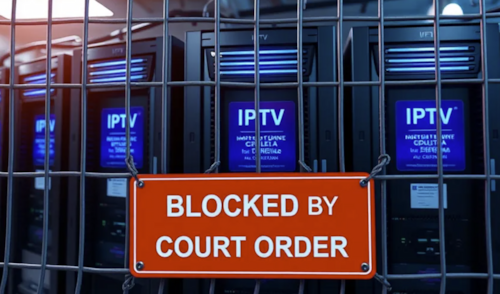
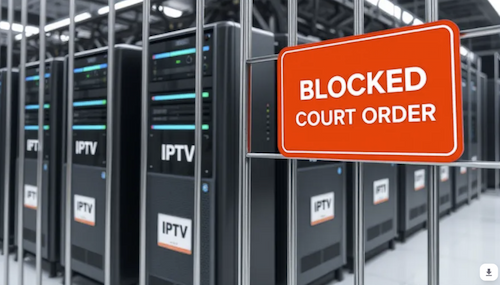
    blocked-iptv While Friend MTS describes the formation of “an industry-first collaboration” it doesn’t actually name any of the companies involved.

    However, it does mention NBA, NHL, and a “nationwide court order to dynamically block access to any servers hosting broadcasters’ pirated content,” which certainly narrows things down.

    An additional note, that the collaboration “saves money and time by reducing court application fees and appearances while simultaneously protecting billions of dollars of sports content rights,” leads directly to the following copyright owners or exclusive licensees.

    Rogers Media Inc., Rogers Communications, Inc., BCE Inc., Bell Media Inc., CTV Specialty, Television Enterprises, Inc., The Sports Network Inc., Le Reseau des Sports, (RDS) Inc., and Groupe TVA Inc.

    The above companies are clearly listed in the April application and the dynamic injunction handed down in July . Interestingly, it appears that the flexibility of the injunction was utilized before the ink even had a chance to dry.

    UFC and MLB Enter Pirate IPTV Blocking Arena

    On July 9, 2024, the same day the injunction was granted by the Federal Court, the applicants filed a motion to expand the scope of the injunction with additional content owned by other rightsholders.

    These received no mention in the injunction but since a provision in the order allows for additional rightsholders to be added, these were somewhat more quietly introduced via amendment.

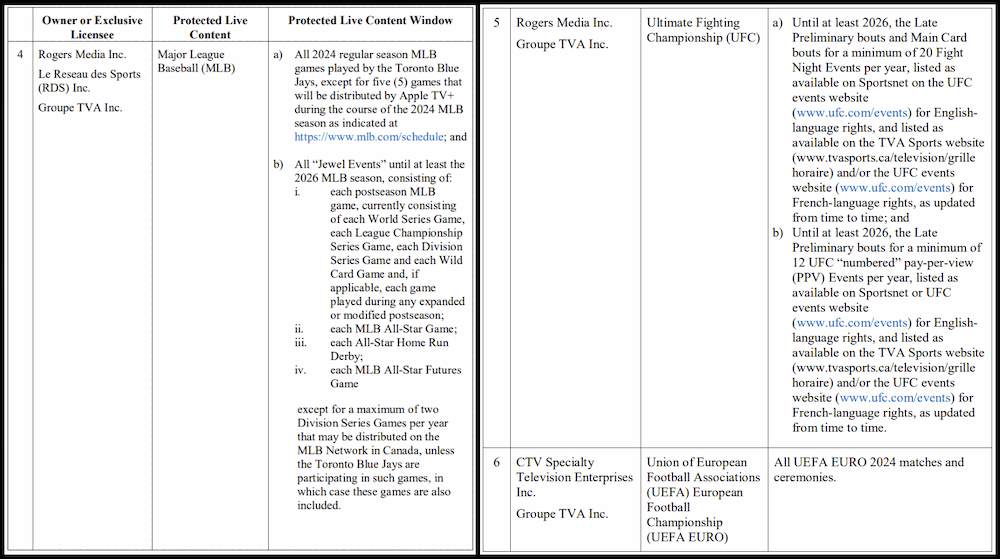
    The addition of UEFA seems to be limited to the coverage of Euro 2024 but in respect of Major League Baseball (MLB) and Ultimate Fighting Championship (UFC), ongoing protection of events seems logical, and indeed turns out to be the case.

    To the extent of our knowledge, the involvement of UFC and MLB hasn’t been widely publicized. However, the details of content to be blocked by Canadian ISPs (Bell Canada, Eastlink, Cogeco, Fido, Rogers, Sasktel, Teksavvy, Telus, Videotron, and Vmedia) appears as a subsequent amendment to Schedule 1 of the order handed down on July 9, 2024.

    Confirmation that rightsholders are working together, and that all monitoring and IPTV target acquisition will take place under one roof at Friend MTS, indicates a blocking program capable of expansion without causing too many headaches.

    If other countries’ programs are taken as guidance, expansion is almost guaranteed.

    From: TF , for the latest news on copyright battles, piracy and more.

    • To chevron_right

      UFC & MLB Join Pirate IPTV Blocking as Broadcasters Collaborate to Cut Costs

      news.movim.eu / TorrentFreak • 4 September 2024 • 3 minutes

    iptv-blocked In June 2022, Canada’s Federal Court handed down a ‘dynamic’ blocking order to prevent live NHL games from being viewed via pirate IPTV streams.

    Obtained by companies including Rogers, Bell, The Sports Network, and Groupe TVA, the injunction was the first of its kind in Canada and had flexibility built-in by design. That was only the beginning and just like the UK and other countries in Europe, more applications resulted in more blocking injunctions being granted, each more adaptive than the preceding one.

    In April 2024, a new application caught the eye. Led by Bell, Fubo TV, Rogers, and The Sports Network, the rightsholders requested permission to block pirate streams of three different sports; NHL and NBA games, plus matches played in the UK’s Premier League.

    Greater Efficiency Through Collaboration

    Since obtaining an injunction is a time-consuming and expensive process, the application in April aimed to significantly improve efficiency. Instead of separate proceedings for each sports league’s content and each time new content is broadcast, the applicants bundled everything into a single track process.

    An announcement this morning by anti-piracy company Friend MTS confirms that collaboration to increase efficiency in court, also extends to pirate IPTV monitoring and blocking activities under the authority of the injunction.

    “Friend MTS, the leading provider of video content security solutions, today reported that numerous video service providers in Canada have uniformly chosen Friend MTS as their partner of choice to prevent piracy with Dynamic Delivery Server Blocking (DDSB),” the announcement reads.

    blocked-iptv While Friend MTS describes the formation of “an industry-first collaboration” it doesn’t actually name any of the companies involved.

    However, it does mention NBA, NHL, and a “nationwide court order to dynamically block access to any servers hosting broadcasters’ pirated content,” which certainly narrows things down.

    An additional note, that the collaboration “saves money and time by reducing court application fees and appearances while simultaneously protecting billions of dollars of sports content rights,” leads directly to the following copyright owners or exclusive licensees.

    Rogers Media Inc., Rogers Communications, Inc., BCE Inc., Bell Media Inc., CTV Specialty, Television Enterprises, Inc., The Sports Network Inc., Le Reseau des Sports, (RDS) Inc., and Groupe TVA Inc.

    The above companies are clearly listed in the April application and the dynamic injunction handed down in July . Interestingly, it appears that the flexibility of the injunction was utilized before the ink even had a chance to dry.

    UFC and MLB Enter Pirate IPTV Blocking Arena

    On July 9, 2024, the same day the injunction was granted by the Federal Court, the applicants filed a motion to expand the scope of the injunction with additional content owned by other rightsholders.

    These received no mention in the injunction but since a provision in the order allows for additional rightsholders to be added, these were somewhat more quietly introduced via amendment.

    The addition of UEFA seems to be limited to the coverage of Euro 2024 but in respect of Major League Baseball (MLB) and Ultimate Fighting Championship (UFC), ongoing protection of events seems logical, and indeed turns out to be the case.

    To the extent of our knowledge, the involvement of UFC and MLB hasn’t been widely publicized. However, the details of content to be blocked by Canadian ISPs (Bell Canada, Eastlink, Cogeco, Fido, Rogers, Sasktel, Teksavvy, Telus, Videotron, and Vmedia) appears as a subsequent amendment to Schedule 1 of the order handed down on July 9, 2024.

    Confirmation that rightsholders are working together, and that all monitoring and IPTV target acquisition will take place under one roof at Friend MTS, indicates a blocking program capable of expansion without causing too many headaches.

    If other countries’ programs are taken as guidance, expansion is almost guaranteed.

    From: TF , for the latest news on copyright battles, piracy and more.

    • To chevron_right

      UFC & MLB Join Pirate IPTV Blocking as Broadcasters Collaborate to Cut Costs

      news.movim.eu / TorrentFreak • 4 September 2024 • 3 minutes

    iptv-blocked In June 2022, Canada’s Federal Court handed down a ‘dynamic’ blocking order to prevent live NHL games from being viewed via pirate IPTV streams.

    Obtained by companies including Rogers, Bell, The Sports Network, and Groupe TVA, the injunction was the first of its kind in Canada and had flexibility built-in by design. That was only the beginning and just like the UK and other countries in Europe, more applications resulted in more blocking injunctions being granted, each more adaptive than the preceding one.

    In April 2024, a new application caught the eye. Led by Bell, Fubo TV, Rogers, and The Sports Network, the rightsholders requested permission to block pirate streams of three different sports; NHL and NBA games, plus matches played in the UK’s Premier League.

    Greater Efficiency Through Collaboration

    Since obtaining an injunction is a time-consuming and expensive process, the application in April aimed to significantly improve efficiency. Instead of separate proceedings for each sports league’s content and each time new content is broadcast, the applicants bundled everything into a single track process.

    An announcement this morning by anti-piracy company Friend MTS confirms that collaboration to increase efficiency in court, also extends to pirate IPTV monitoring and blocking activities under the authority of the injunction.

    “Friend MTS, the leading provider of video content security solutions, today reported that numerous video service providers in Canada have uniformly chosen Friend MTS as their partner of choice to prevent piracy with Dynamic Delivery Server Blocking (DDSB),” the announcement reads.

    blocked-iptv While Friend MTS describes the formation of “an industry-first collaboration” it doesn’t actually name any of the companies involved.

    However, it does mention NBA, NHL, and a “nationwide court order to dynamically block access to any servers hosting broadcasters’ pirated content,” which certainly narrows things down.

    An additional note, that the collaboration “saves money and time by reducing court application fees and appearances while simultaneously protecting billions of dollars of sports content rights,” leads directly to the following copyright owners or exclusive licensees.

    Rogers Media Inc., Rogers Communications, Inc., BCE Inc., Bell Media Inc., CTV Specialty, Television Enterprises, Inc., The Sports Network Inc., Le Reseau des Sports, (RDS) Inc., and Groupe TVA Inc.

    The above companies are clearly listed in the April application and the dynamic injunction handed down in July . Interestingly, it appears that the flexibility of the injunction was utilized before the ink even had a chance to dry.

    UFC and MLB Enter Pirate IPTV Blocking Arena

    On July 9, 2024, the same day the injunction was granted by the Federal Court, the applicants filed a motion to expand the scope of the injunction with additional content owned by other rightsholders.

    These received no mention in the injunction but since a provision in the order allows for additional rightsholders to be added, these were somewhat more quietly introduced via amendment.

    The addition of UEFA seems to be limited to the coverage of Euro 2024 but in respect of Major League Baseball (MLB) and Ultimate Fighting Championship (UFC), ongoing protection of events seems logical, and indeed turns out to be the case.

    To the extent of our knowledge, the involvement of UFC and MLB hasn’t been widely publicized. However, the details of content to be blocked by Canadian ISPs (Bell Canada, Eastlink, Cogeco, Fido, Rogers, Sasktel, Teksavvy, Telus, Videotron, and Vmedia) appears as a subsequent amendment to Schedule 1 of the order handed down on July 9, 2024.

    Confirmation that rightsholders are working together, and that all monitoring and IPTV target acquisition will take place under one roof at Friend MTS, indicates a blocking program capable of expansion without causing too many headaches.

    If other countries’ programs are taken as guidance, expansion is almost guaranteed.

    From: TF , for the latest news on copyright battles, piracy and more.