• To chevron_right

      ISPs Back Cox’s Supreme Court Petition to Counter “Extortionate” Piracy Liability Pressure

      news.movim.eu / TorrentFreak • 17 September 2024 • 5 minutes
    supremecourt In August, Cox Communications filed a petition at the U.S. Supreme Court , requesting a review of a Fourth Circuit ruling that held the company liable for pirating subscribers.

    The Internet provider ultimately challenges a $1 billion jury verdict in favor of major record labels, including Sony and Universal, arguing that it has far-reaching implications for Internet providers and the broader American public.

    Cox wrote that, in its view, the lower court’s ruling stretches service provider liability too far and creates the “most draconian secondary-liability regime” in the country. As a result, ISPs find themselves ‘forced’ to terminate subscribers, who may have done little wrong.

    Two Questions

    This case is about who is responsible for Internet piracy. Is it only the users who actually share pirated material, or can ISPs be held responsible too, when they fail to properly respond to “repeat infringers”, as the DMCA prescribes?

    The Fourth Circuit concluded that Cox “materially contributed” to the infringements of its subscribers because the company knew about this activity and didn’t terminate their accounts.

    That leads Cox to present the following question to the Supreme Court:

    “Did the Fourth Circuit err in holding that a service provider can be held liable […] merely because it knew that people were using certain accounts to infringe and did not terminate access, without proof that the service provider affirmatively fostered infringement or otherwise intended to promote it?”

    The second question is indirectly related to the damages award. The jury awarded the maximum statutory damages of $150,000 per work, which is typically reserved for “willful” infringement. Cox questions whether simply knowing about subscribers’ copyright infringements is willful.

    “Did the Fourth Circuit err in holding that mere knowledge of another’s direct infringement suffices to find willfulness under 17 U.S.C. § 504(c)?” the petition reads.

    ISPs Back Cox

    This case doesn’t only affect Cox, it has implications for all Internet providers. Yesterday, several other ISPs including Verizon, Frontier, Altice, and Lumen Technologies, filed an amicus curiae brief at the Supreme Court, backing the petition.

    Several of these providers are involved in similar lawsuits, with potential damages running in the hundreds of millions, if not billions of dollars. This ‘threat’ created by the lower court’s ruling creates “extortionate pressure” and invites mass terminations, they argue.

    “The decision […] imperils the future of the internet. It exposes internet service providers to massive liability if they do not carry out mass internet evictions.

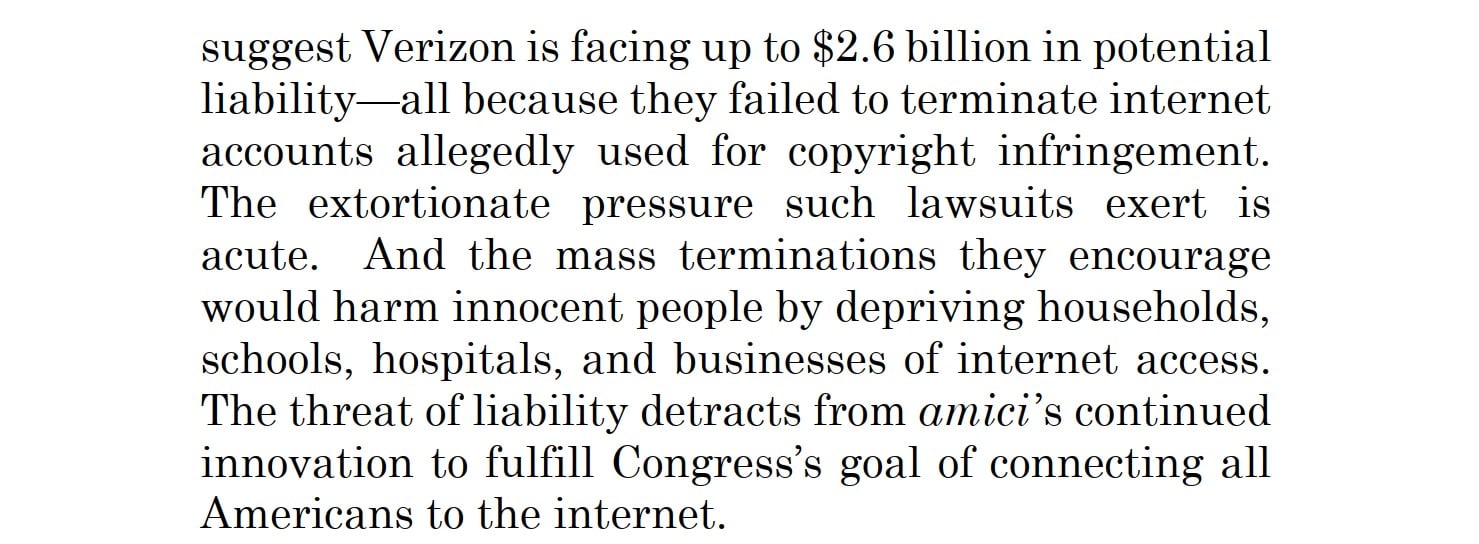
    “The extortionate pressure such lawsuits exert is acute. And the mass terminations they encourage would harm innocent people by depriving households, schools, hospitals, and businesses of internet access.”
    extortionate

    The ISPs note that, as things stand, they are required to terminate connections of alleged pirates that may also be used by innocent others. This is all based on third-party accusations that, in large part, rely on automated processes which are not error free.

    Twitter

    The amicus brief stresses that the Fourth Circuit’s decision to hold Cox liable, directly contradicts the recent Supreme Court ruling in Twitter vs Taamneh . In that case, the Supreme Court rejected the claim that Twitter aided-and-abetted terrorist activity because it didn’t “consciously and culpably” participate in the illegal activity.

    According to the ISPs’ brief, the same logic applies in this case. Cox was held liable for the piracy activities of subscribers, without taking any culpable action.

    A service provider’s failure to stop bad actors from misusing its platform does not qualify as culpable action. To emphasize this point, the brief cites the Supreme Court’s own words.

    “Under the common law, this Court explained, ‘communication providing services’ have no ‘duty’ ‘to terminate customers after discovering that the customers were using the service for illicit ends’.

    “For that reason, the Court held that the social-media companies’ continued provision of routine communication service to terrorists was ‘mere passive nonfeasance’ that did not amount to culpable aid.”

    In conclusion, the ISPs urge the Supreme Court to grant Cox’s petition and overturn the Fourth Circuit’s decision, emphasizing the need to protect ISPs from excessive liability and safeguard the internet’s future.

    Law Professor Chimes In

    It’s no surprise that these ISPs are siding with Cox, as they have a direct interest in the outcome of the case. However, they are not the only amici; Professor Alfred Yen from Boston College Law School also wrote in.

    Professor Yen urges the Supreme Court to grant certiorari (Cox’s appeal) and rectify what he perceives as a flawed interpretation of contributory copyright infringement law by the Fourth Circuit. His only interest in this case is the “orderly and logical development of the law for the benefit of society,” his brief explains.

    The brief also focuses on culpable intent. The Fourth Circuit concluded that Cox was ‘culpable’ because it provided internet service to subscribers, while knowing that those subscribers could likely continue to pirate.

    The court specifically stated that “supplying a product with knowledge that the recipient will use it to infringe is exactly the sort of culpable conduct sufficient for contributory infringement.”

    Professor Yen believes that this is wrong, as Cox could not conclude with “substantial certainty” that infringers would continue. Especially since Cox also operated a graduated response program, aimed at stopping piracy on its network.

    Electric Shock

    In addition, the brief notes that ‘certainty of injury’ does not always imply intent. There are many other services that are guaranteed to lead to injury, where intent is not in question.

    “For example, the operator of a railroad knows with substantial certainty that this activity will eventually cause injury to someone. The same would be true for the electric company because eventually, someone will suffer an electric shock,” Professor Yen writes.

    While the Fourth Circuit’s conclusion that Cox is liable might seem superficially attractive, the professor warns of far-reaching and dangerous consequences if it holds up.

    Under the same logic, many other companies could be drawn into liability battles because they provide services to individuals who may use that service to infringe, ranging from electricity providers to ink sellers.

    “The Fourth Circuit’s logic makes all of these service providers culpably responsible for infringement as long as they receive the same kinds of notice sent to Petitioners and continue providing service,” Professor Yen writes.

    Moving Forward

    The Supreme Court took both briefs under consideration, to see if these will eventually factor into the decision to hear the case or not.

    The respondents in this case, a group of major record labels including Sony and Universal, were required to file their planned opposition brief yesterday. However, they were given a month’s extension previously, so that will come in later.

    A copy of the amicus brief filed by the Internet providers is available here (pdf) . A copy of Professor Alfred Yen’s brief can be found here (pdf)

    From: TF , for the latest news on copyright battles, piracy and more.

    • To chevron_right

      ISPs Back Cox’s Supreme Court Petition to Counter “Extortionate” Piracy Liability Pressure

      news.movim.eu / TorrentFreak • 17 September 2024 • 5 minutes

    supremecourt In August, Cox Communications filed a petition at the U.S. Supreme Court , requesting a review of a Fourth Circuit ruling that held the company liable for pirating subscribers.

    The Internet provider ultimately challenges a $1 billion jury verdict in favor of major record labels, including Sony and Universal, arguing that it has far-reaching implications for Internet providers and the broader American public.

    Cox wrote that, in its view, the lower court’s ruling stretches service provider liability too far and creates the “most draconian secondary-liability regime” in the country. As a result, ISPs find themselves ‘forced’ to terminate subscribers, who may have done little wrong.

    Two Questions

    This case is about who is responsible for Internet piracy. Is it only the users who actually share pirated material, or can ISPs be held responsible too, when they fail to properly respond to “repeat infringers”, as the DMCA prescribes?

    The Fourth Circuit concluded that Cox “materially contributed” to the infringements of its subscribers because the company knew about this activity and didn’t terminate their accounts.

    That leads Cox to present the following question to the Supreme Court:

    “Did the Fourth Circuit err in holding that a service provider can be held liable […] merely because it knew that people were using certain accounts to infringe and did not terminate access, without proof that the service provider affirmatively fostered infringement or otherwise intended to promote it?”

    The second question is indirectly related to the damages award. The jury awarded the maximum statutory damages of $150,000 per work, which is typically reserved for “willful” infringement. Cox questions whether simply knowing about subscribers’ copyright infringements is willful.

    “Did the Fourth Circuit err in holding that mere knowledge of another’s direct infringement suffices to find willfulness under 17 U.S.C. § 504(c)?” the petition reads.

    ISPs Back Cox

    This case doesn’t only affect Cox, it has implications for all Internet providers. Yesterday, several other ISPs including Verizon, Frontier, Altice, and Lumen Technologies, filed an amicus curiae brief at the Supreme Court, backing the petition.

    Several of these providers are involved in similar lawsuits, with potential damages running in the hundreds of millions, if not billions of dollars. This ‘threat’ created by the lower court’s ruling creates “extortionate pressure” and invites mass terminations, they argue.

    “The decision […] imperils the future of the internet. It exposes internet service providers to massive liability if they do not carry out mass internet evictions.

    “The extortionate pressure such lawsuits exert is acute. And the mass terminations they encourage would harm innocent people by depriving households, schools, hospitals, and businesses of internet access.”

    extortionate

    The ISPs note that, as things stand, they are required to terminate connections of alleged pirates that may also be used by innocent others. This is all based on third-party accusations that, in large part, rely on automated processes which are not error free.

    Twitter

    The amicus brief stresses that the Fourth Circuit’s decision to hold Cox liable, directly contradicts the recent Supreme Court ruling in Twitter vs Taamneh . In that case, the Supreme Court rejected the claim that Twitter aided-and-abetted terrorist activity because it didn’t “consciously and culpably” participate in the illegal activity.

    According to the ISPs’ brief, the same logic applies in this case. Cox was held liable for the piracy activities of subscribers, without taking any culpable action.

    A service provider’s failure to stop bad actors from misusing its platform does not qualify as culpable action. To emphasize this point, the brief cites the Supreme Court’s own words.

    “Under the common law, this Court explained, ‘communication providing services’ have no ‘duty’ ‘to terminate customers after discovering that the customers were using the service for illicit ends’.

    “For that reason, the Court held that the social-media companies’ continued provision of routine communication service to terrorists was ‘mere passive nonfeasance’ that did not amount to culpable aid.”

    In conclusion, the ISPs urge the Supreme Court to grant Cox’s petition and overturn the Fourth Circuit’s decision, emphasizing the need to protect ISPs from excessive liability and safeguard the internet’s future.

    Law Professor Chimes In

    It’s no surprise that these ISPs are siding with Cox, as they have a direct interest in the outcome of the case. However, they are not the only amici; Professor Alfred Yen from Boston College Law School also wrote in.

    Professor Yen urges the Supreme Court to grant certiorari (Cox’s appeal) and rectify what he perceives as a flawed interpretation of contributory copyright infringement law by the Fourth Circuit. His only interest in this case is the “orderly and logical development of the law for the benefit of society,” his brief explains.

    The brief also focuses on culpable intent. The Fourth Circuit concluded that Cox was ‘culpable’ because it provided internet service to subscribers, while knowing that those subscribers could likely continue to pirate.

    The court specifically stated that “supplying a product with knowledge that the recipient will use it to infringe is exactly the sort of culpable conduct sufficient for contributory infringement.”

    Professor Yen believes that this is wrong, as Cox could not conclude with “substantial certainty” that infringers would continue. Especially since Cox also operated a graduated response program, aimed at stopping piracy on its network.

    Electric Shock

    In addition, the brief notes that ‘certainty of injury’ does not always imply intent. There are many other services that are guaranteed to lead to injury, where intent is not in question.

    “For example, the operator of a railroad knows with substantial certainty that this activity will eventually cause injury to someone. The same would be true for the electric company because eventually, someone will suffer an electric shock,” Professor Yen writes.

    While the Fourth Circuit’s conclusion that Cox is liable might seem superficially attractive, the professor warns of far-reaching and dangerous consequences if it holds up.

    Under the same logic, many other companies could be drawn into liability battles because they provide services to individuals who may use that service to infringe, ranging from electricity providers to ink sellers.

    “The Fourth Circuit’s logic makes all of these service providers culpably responsible for infringement as long as they receive the same kinds of notice sent to Petitioners and continue providing service,” Professor Yen writes.

    Moving Forward

    The Supreme Court took both briefs under consideration, to see if these will eventually factor into the decision to hear the case or not.

    The respondents in this case, a group of major record labels including Sony and Universal, were required to file their planned opposition brief yesterday. However, they were given a month’s extension previously, so that will come in later.

    A copy of the amicus brief filed by the Internet providers is available here (pdf) . A copy of Professor Alfred Yen’s brief can be found here (pdf)

    From: TF , for the latest news on copyright battles, piracy and more.

    • To chevron_right

      ISPs Back Cox’s Supreme Court Petition to Counter “Extortionate” Piracy Liability Pressure

      news.movim.eu / TorrentFreak • 17 September 2024 • 5 minutes

    supremecourt In August, Cox Communications filed a petition at the U.S. Supreme Court , requesting a review of a Fourth Circuit ruling that held the company liable for pirating subscribers.

    The Internet provider ultimately challenges a $1 billion jury verdict in favor of major record labels, including Sony and Universal, arguing that it has far-reaching implications for Internet providers and the broader American public.

    Cox wrote that, in its view, the lower court’s ruling stretches service provider liability too far and creates the “most draconian secondary-liability regime” in the country. As a result, ISPs find themselves ‘forced’ to terminate subscribers, who may have done little wrong.

    Two Questions

    This case is about who is responsible for Internet piracy. Is it only the users who actually share pirated material, or can ISPs be held responsible too, when they fail to properly respond to “repeat infringers”, as the DMCA prescribes?

    The Fourth Circuit concluded that Cox “materially contributed” to the infringements of its subscribers because the company knew about this activity and didn’t terminate their accounts.

    That leads Cox to present the following question to the Supreme Court:

    “Did the Fourth Circuit err in holding that a service provider can be held liable […] merely because it knew that people were using certain accounts to infringe and did not terminate access, without proof that the service provider affirmatively fostered infringement or otherwise intended to promote it?”

    The second question is indirectly related to the damages award. The jury awarded the maximum statutory damages of $150,000 per work, which is typically reserved for “willful” infringement. Cox questions whether simply knowing about subscribers’ copyright infringements is willful.

    “Did the Fourth Circuit err in holding that mere knowledge of another’s direct infringement suffices to find willfulness under 17 U.S.C. § 504(c)?” the petition reads.

    ISPs Back Cox

    This case doesn’t only affect Cox, it has implications for all Internet providers. Yesterday, several other ISPs including Verizon, Frontier, Altice, and Lumen Technologies, filed an amicus curiae brief at the Supreme Court, backing the petition.

    Several of these providers are involved in similar lawsuits, with potential damages running in the hundreds of millions, if not billions of dollars. This ‘threat’ created by the lower court’s ruling creates “extortionate pressure” and invites mass terminations, they argue.

    “The decision […] imperils the future of the internet. It exposes internet service providers to massive liability if they do not carry out mass internet evictions.

    “The extortionate pressure such lawsuits exert is acute. And the mass terminations they encourage would harm innocent people by depriving households, schools, hospitals, and businesses of internet access.”

    extortionate

    The ISPs note that, as things stand, they are required to terminate connections of alleged pirates that may also be used by innocent others. This is all based on third-party accusations that, in large part, rely on automated processes which are not error free.

    Twitter

    The amicus brief stresses that the Fourth Circuit’s decision to hold Cox liable, directly contradicts the recent Supreme Court ruling in Twitter vs Taamneh . In that case, the Supreme Court rejected the claim that Twitter aided-and-abetted terrorist activity because it didn’t “consciously and culpably” participate in the illegal activity.

    According to the ISPs’ brief, the same logic applies in this case. Cox was held liable for the piracy activities of subscribers, without taking any culpable action.

    A service provider’s failure to stop bad actors from misusing its platform does not qualify as culpable action. To emphasize this point, the brief cites the Supreme Court’s own words.

    “Under the common law, this Court explained, ‘communication providing services’ have no ‘duty’ ‘to terminate customers after discovering that the customers were using the service for illicit ends’.

    “For that reason, the Court held that the social-media companies’ continued provision of routine communication service to terrorists was ‘mere passive nonfeasance’ that did not amount to culpable aid.”

    In conclusion, the ISPs urge the Supreme Court to grant Cox’s petition and overturn the Fourth Circuit’s decision, emphasizing the need to protect ISPs from excessive liability and safeguard the internet’s future.

    Law Professor Chimes In

    It’s no surprise that these ISPs are siding with Cox, as they have a direct interest in the outcome of the case. However, they are not the only amici; Professor Alfred Yen from Boston College Law School also wrote in.

    Professor Yen urges the Supreme Court to grant certiorari (Cox’s appeal) and rectify what he perceives as a flawed interpretation of contributory copyright infringement law by the Fourth Circuit. His only interest in this case is the “orderly and logical development of the law for the benefit of society,” his brief explains.

    The brief also focuses on culpable intent. The Fourth Circuit concluded that Cox was ‘culpable’ because it provided internet service to subscribers, while knowing that those subscribers could likely continue to pirate.

    The court specifically stated that “supplying a product with knowledge that the recipient will use it to infringe is exactly the sort of culpable conduct sufficient for contributory infringement.”

    Professor Yen believes that this is wrong, as Cox could not conclude with “substantial certainty” that infringers would continue. Especially since Cox also operated a graduated response program, aimed at stopping piracy on its network.

    Electric Shock

    In addition, the brief notes that ‘certainty of injury’ does not always imply intent. There are many other services that are guaranteed to lead to injury, where intent is not in question.

    “For example, the operator of a railroad knows with substantial certainty that this activity will eventually cause injury to someone. The same would be true for the electric company because eventually, someone will suffer an electric shock,” Professor Yen writes.

    While the Fourth Circuit’s conclusion that Cox is liable might seem superficially attractive, the professor warns of far-reaching and dangerous consequences if it holds up.

    Under the same logic, many other companies could be drawn into liability battles because they provide services to individuals who may use that service to infringe, ranging from electricity providers to ink sellers.

    “The Fourth Circuit’s logic makes all of these service providers culpably responsible for infringement as long as they receive the same kinds of notice sent to Petitioners and continue providing service,” Professor Yen writes.

    Moving Forward

    The Supreme Court took both briefs under consideration, to see if these will eventually factor into the decision to hear the case or not.

    The respondents in this case, a group of major record labels including Sony and Universal, were required to file their planned opposition brief yesterday. However, they were given a month’s extension previously, so that will come in later.

    A copy of the amicus brief filed by the Internet providers is available here (pdf) . A copy of Professor Alfred Yen’s brief can be found here (pdf)

    From: TF , for the latest news on copyright battles, piracy and more.
    • To chevron_right

      Fake Streams ‘Save’ Premier League Pirates, Security Tips Can Save More

      news.movim.eu / TorrentFreak • 17 September 2024 • 6 minutes

    bestreamwise-s In a couple of weeks the UK’s BeStreamWise anti-piracy campaign will celebrate its one-year anniversary.

    Launched last October, the campaign aims to deter citizens from consuming live sports from pirate IPTV services and other platforms offering illegal streams.

    With the slogan “Illegal Streams Let Criminals In” companies including Sky, Premier League, FACT, and ITV, hope that consumers will weigh cheap prices against the risk of malware and fraud, before concluding that a legal subscription is the best option overall.

    12 Months of Saving

    For the last year, the battle for hearts-and-minds has mostly played out online. Friendly tabloids and other publications known for their considerable social media reach, have taken a real interest in the campaign; not just by amplifying the message but presenting it as a preparatory hors d’oeuvre before the main course apocalypse.

    The latest phase of the campaign, reported by BeStreamWise late last week, aimed to protect pirates seeking out pirated match streams on social media.

    bebrookwise-1a “BeStreamWise will redirect consumers searching for illegal streams of the game this weekend to protect them from the dangers of digital piracy.

    “The initiative has been arranged for the high profile north London derby, renowned for being one of the highest scoring games in the top division and famous for the long-standing rivalry between its clubs,” an announcement on the campaign site reads.

    “Highlighting the risks of illegal streaming, which include identity theft, fraud, viruses and dangerous malware, BeStreamWise will target those looking to watch the game illegally for free via X and Reddit. Those who click on the link will find that instead of watching one of the most exciting clashes in this year’s football calendar, they will instead see a gentle brook babbling its way past the camera lens.”

    Given that a gentle babbling brook is a type of stream , the imagery complements the main theme of the campaign perfectly. The stream on the BeStreamWise website is actually Burbage Brook in Padley Gorge in Derbyshire’s Peak District, but whether the replacement live stream displayed this particular brook is still unconfirmed.

    Determined to See the Stream

    Our efforts to find fake Premier League match links that led to the live brook stream were a complete failure. There was no sign of any on Reddit or X, or any sign that any had ever been posted.

    A plausible explanation is that posting links publicly was never the plan; a better option would be to wait for someone to show interest or ask for a pirate link, then send the fake link via DM. That would mean no instabans from Reddit mods for spamming fake links and no chance of being instantly called out on X for watering piracy down.

    Another explanation is that in our desperate quest to find the link, leading to the brook and then salvation, too much time was spent clicking links that promised Premier League matches but mostly led to phishing sites and malware. With BeStreamWise falling short of omnipresence, self-preservation offered the only chance of survival.

    Beware Glossy Tweets, Underneath Evil Lurks

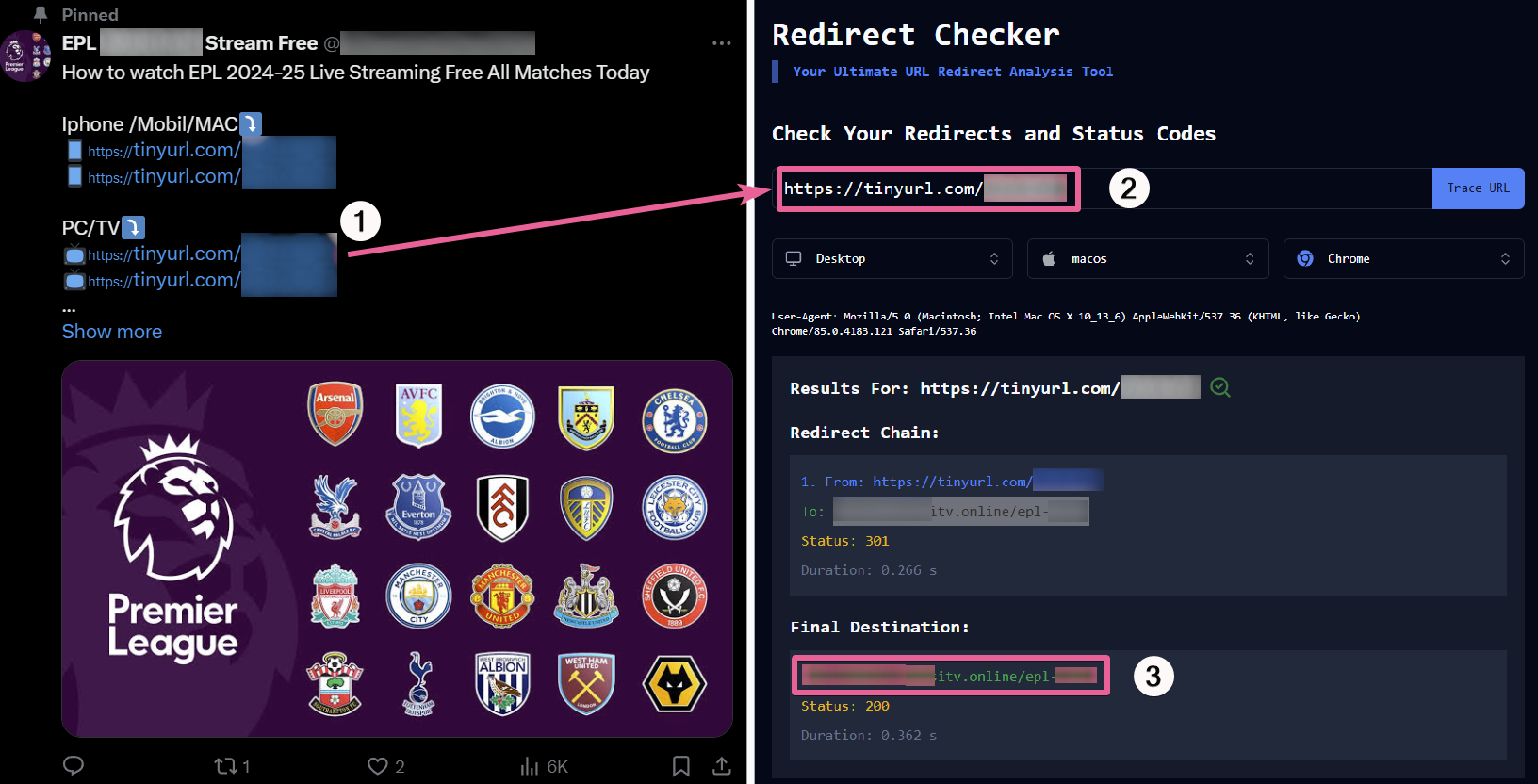
    The image below represents a game of two halves. On our left, X.com (formerly known as Twitter) featuring a rather glossy tweet that promises an entire season of Premier League games for free. With Premier League branding and official club badges, it certainly looks promising and of course, that’s the idea.

    Apparently compatible with every mainstream device, all that remains is for the user to click on the TinyURL shortlink and wait for the streams in all their glory. A much better approach is to find out where a link leads before clicking it , as demonstrated in the screenshot on the right.

    Find out where links lead in advance; BeLinkWise (click to enlarge) malstep1a

    Redirect Checker is a useful service for anyone confronted with a shortlink, regardless of the circumstances. In this case, the shortlink (marked 1 in the first image) looks neater and offers an element of surprise by hiding the destination. In other cases, shortlinks hide trackers that undermine privacy; all should be stripped before being clicked.

    Redirect Checker doesn’t discriminate; paste the URL in the box (2) and the previously obfuscated destination URL appears below (3). Once the URL is exposed, testing it on a site like VirusTotal is the recommended option for most people. Understanding the results of a scan isn’t vital since the presence of red text makes it clear not to continue.

    Continue Anyway, Cautiously

    For theatrical and dramatic purposes, we decided to click through regardless of the VirusTotal report, albeit with a pretty secure setup inside a virtual machine ready to be dumped if necessary.

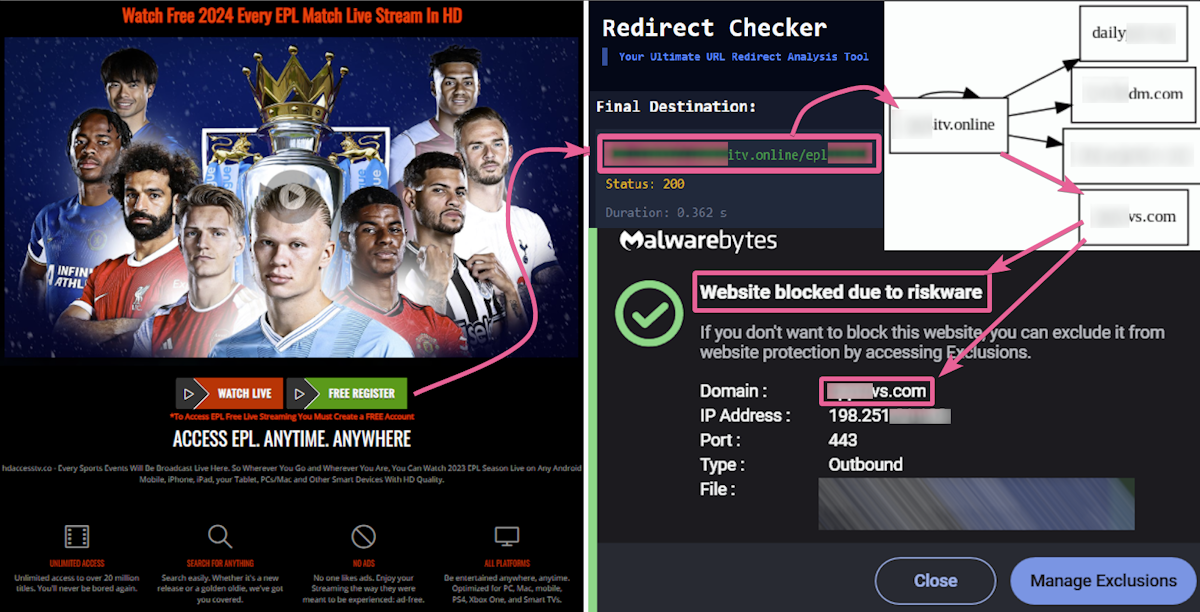
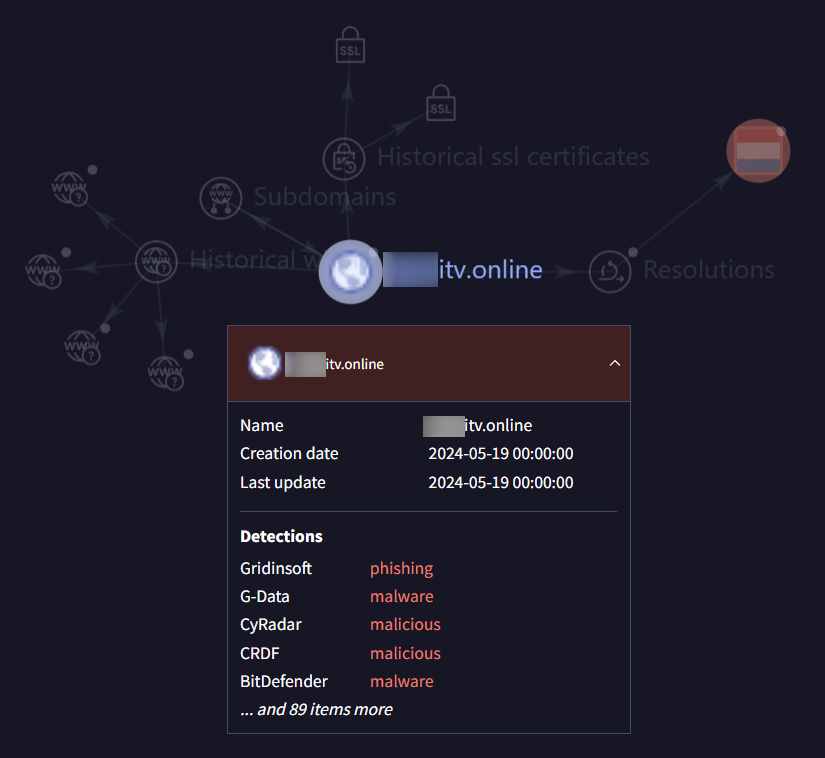
    On the left of the image below is the website that appeared after accessing the ‘final destination’ URL indicated by Redirect Checker. However, when clicking through visitors are taken to another domain (present in the white diagram) that in our case triggered a malware/riskware warning. Until this point, security software had remained silent.

    More gloss, more red flags malstep2b

    The website seems to offer everything, but makes it quite clear that visitors MUST sign up for an account first. Pirate IPTV sites do something similar except they tend to be quite up front about a) what’s on offer and b) the need to communicate when payment takes place.

    Bright Red Flags

    The offer of free streams here is still hidden behind a registration wall. That’s not typical of a completely free pirate streaming service. Often reliant on ads, more eyeballs on the site is usually preferred to unnecessary, traffic-limiting restrictions.

    Never, EVER, put personal details into a pirate site malware3aj

    Visiting VirusTotal at the first opportunity would’ve given a vital heads-up on why proceeding this far was always ill-advised and an unnecessary risk.

    The benefits of checking are obvious in this case, but the same applies equally to any other site, operating in any other niche, even (or especially) links received via email. There are no big campaigns warning the public about the dangers of email, but it remains the primary route through which internet users are exposed to phishing operations that aim to empty bank accounts, with zero regard for the devastation that causes.

    Malware is Real

    While we had zero intention of going any further, having seen enough of these types of sites in the past, we sincerely doubt that Premier League streams were ever on offer. Insult to injury, on the other hand, most likely in plentiful supply. The price of a genuine subscription package might sting and take a large chunk of a fan’s disposable income, but it won’t take all of it and give nothing back.

    The majority of people are unlikely to find themselves saved by a BeStreamWise intervention. Nor will they receive any basic security advice such as constantly running up-to-date anti-virus software and, if possible, an anti-malware solution on top.

    Yet, without seeing evidence themselves, any security risks will likely find themselves waved aside by the masses in favor of free streams. Some will get away without experiencing too many problems, many others won’t be so lucky. Malware’s effect on piracy rates is more difficult to quantify; what we know is malware increases as piracy consumption goes up, make of that what you will.

    From: TF , for the latest news on copyright battles, piracy and more.
    • To chevron_right

      Fake Streams ‘Save’ Premier League Pirates, Security Tips Can Save More

      news.movim.eu / TorrentFreak • 17 September 2024 • 6 minutes

    bestreamwise-s In a couple of weeks the UK’s BeStreamWise anti-piracy campaign will celebrate its one-year anniversary.

    Launched last October, the campaign aims to deter citizens from consuming live sports from pirate IPTV services and other platforms offering illegal streams.

    With the slogan “Illegal Streams Let Criminals In” companies including Sky, Premier League, FACT, and ITV, hope that consumers will weigh cheap prices against the risk of malware and fraud, before concluding that a legal subscription is the best option overall.

    12 Months of Saving

    For the last year, the battle for hearts-and-minds has mostly played out online. Friendly tabloids and other publications known for their considerable social media reach, have taken a real interest in the campaign; not just by amplifying the message but presenting it as a preparatory hors d’oeuvre before the main course apocalypse.

    The latest phase of the campaign, reported by BeStreamWise late last week, aimed to protect pirates seeking out pirated match streams on social media.

    bebrookwise-1a “BeStreamWise will redirect consumers searching for illegal streams of the game this weekend to protect them from the dangers of digital piracy.

    “The initiative has been arranged for the high profile north London derby, renowned for being one of the highest scoring games in the top division and famous for the long-standing rivalry between its clubs,” an announcement on the campaign site reads.

    “Highlighting the risks of illegal streaming, which include identity theft, fraud, viruses and dangerous malware, BeStreamWise will target those looking to watch the game illegally for free via X and Reddit. Those who click on the link will find that instead of watching one of the most exciting clashes in this year’s football calendar, they will instead see a gentle brook babbling its way past the camera lens.”

    Given that a gentle babbling brook is a type of stream , the imagery complements the main theme of the campaign perfectly. The stream on the BeStreamWise website is actually Burbage Brook in Padley Gorge in Derbyshire’s Peak District, but whether the replacement live stream displayed this particular brook is still unconfirmed.

    Determined to See the Stream

    Our efforts to find fake Premier League match links that led to the live brook stream were a complete failure. There was no sign of any on Reddit or X, or any sign that any had ever been posted.

    A plausible explanation is that posting links publicly was never the plan; a better option would be to wait for someone to show interest or ask for a pirate link, then send the fake link via DM. That would mean no instabans from Reddit mods for spamming fake links and no chance of being instantly called out on X for watering piracy down.

    Another explanation is that in our desperate quest to find the link, leading to the brook and then salvation, too much time was spent clicking links that promised Premier League matches but mostly led to phishing sites and malware. With BeStreamWise falling short of omnipresence, self-preservation offered the only chance of survival.

    Beware Glossy Tweets, Underneath Evil Lurks

    The image below represents a game of two halves. On our left, X.com (formerly known as Twitter) featuring a rather glossy tweet that promises an entire season of Premier League games for free. With Premier League branding and official club badges, it certainly looks promising and of course, that’s the idea.

    Apparently compatible with every mainstream device, all that remains is for the user to click on the TinyURL shortlink and wait for the streams in all their glory. A much better approach is to find out where a link leads before clicking it , as demonstrated in the screenshot on the right.

    Find out where links lead in advance; BeLinkWise (click to enlarge) malstep1a

    Redirect Checker is a useful service for anyone confronted with a shortlink, regardless of the circumstances. In this case, the shortlink (marked 1 in the first image) looks neater and offers an element of surprise by hiding the destination. In other cases, shortlinks hide trackers that undermine privacy; all should be stripped before being clicked.

    Redirect Checker doesn’t discriminate; paste the URL in the box (2) and the previously obfuscated destination URL appears below (3). Once the URL is exposed, testing it on a site like VirusTotal is the recommended option for most people. Understanding the results of a scan isn’t vital since the presence of red text makes it clear not to continue.

    Continue Anyway, Cautiously

    For theatrical and dramatic purposes, we decided to click through regardless of the VirusTotal report, albeit with a pretty secure setup inside a virtual machine ready to be dumped if necessary.

    On the left of the image below is the website that appeared after accessing the ‘final destination’ URL indicated by Redirect Checker. However, when clicking through visitors are taken to another domain (present in the white diagram) that in our case triggered a malware/riskware warning. Until this point, security software had remained silent.

    More gloss, more red flags malstep2b

    The website seems to offer everything, but makes it quite clear that visitors MUST sign up for an account first. Pirate IPTV sites do something similar except they tend to be quite up front about a) what’s on offer and b) the need to communicate when payment takes place.

    Bright Red Flags

    The offer of free streams here is still hidden behind a registration wall. That’s not typical of a completely free pirate streaming service. Often reliant on ads, more eyeballs on the site is usually preferred to unnecessary, traffic-limiting restrictions.

    Never, EVER, put personal details into a pirate site malware3aj

    Visiting VirusTotal at the first opportunity would’ve given a vital heads-up on why proceeding this far was always ill-advised and an unnecessary risk.

    The benefits of checking are obvious in this case, but the same applies equally to any other site, operating in any other niche, even (or especially) links received via email. There are no big campaigns warning the public about the dangers of email, but it remains the primary route through which internet users are exposed to phishing operations that aim to empty bank accounts, with zero regard for the devastation that causes.

    Malware is Real

    While we had zero intention of going any further, having seen enough of these types of sites in the past, we sincerely doubt that Premier League streams were ever on offer. Insult to injury, on the other hand, most likely in plentiful supply. The price of a genuine subscription package might sting and take a large chunk of a fan’s disposable income, but it won’t take all of it and give nothing back.

    The majority of people are unlikely to find themselves saved by a BeStreamWise intervention. Nor will they receive any basic security advice such as constantly running up-to-date anti-virus software and, if possible, an anti-malware solution on top.

    Yet, without seeing evidence themselves, any security risks will likely find themselves waved aside by the masses in favor of free streams. Some will get away without experiencing too many problems, many others won’t be so lucky. Malware’s effect on piracy rates is more difficult to quantify; what we know is malware increases as piracy consumption goes up, make of that what you will.

    From: TF , for the latest news on copyright battles, piracy and more.
    • To chevron_right

      Fake Streams ‘Save’ Premier League Pirates, Security Tips Can Save More

      news.movim.eu / TorrentFreak • 17 September 2024 • 6 minutes

    bestreamwise-s In a couple of weeks the UK’s BeStreamWise anti-piracy campaign will celebrate its one-year anniversary.

    Launched last October, the campaign aims to deter citizens from consuming live sports from pirate IPTV services and other platforms offering illegal streams.

    With the slogan “Illegal Streams Let Criminals In” companies including Sky, Premier League, FACT, and ITV, hope that consumers will weigh cheap prices against the risk of malware and fraud, before concluding that a legal subscription is the best option overall.

    12 Months of Saving

    For the last year, the battle for hearts-and-minds has mostly played out online. Friendly tabloids and other publications known for their considerable social media reach, have taken a real interest in the campaign; not just by amplifying the message but presenting it as a preparatory hors d’oeuvre before the main course apocalypse.

    The latest phase of the campaign, reported by BeStreamWise late last week, aimed to protect pirates seeking out pirated match streams on social media.

    bebrookwise-1a “BeStreamWise will redirect consumers searching for illegal streams of the game this weekend to protect them from the dangers of digital piracy.

    “The initiative has been arranged for the high profile north London derby, renowned for being one of the highest scoring games in the top division and famous for the long-standing rivalry between its clubs,” an announcement on the campaign site reads.

    “Highlighting the risks of illegal streaming, which include identity theft, fraud, viruses and dangerous malware, BeStreamWise will target those looking to watch the game illegally for free via X and Reddit. Those who click on the link will find that instead of watching one of the most exciting clashes in this year’s football calendar, they will instead see a gentle brook babbling its way past the camera lens.”

    Given that a gentle babbling brook is a type of stream , the imagery complements the main theme of the campaign perfectly. The stream on the BeStreamWise website is actually Burbage Brook in Padley Gorge in Derbyshire’s Peak District, but whether the replacement live stream displayed this particular brook is still unconfirmed.

    Determined to See the Stream

    Our efforts to find fake Premier League match links that led to the live brook stream were a complete failure. There was no sign of any on Reddit or X, or any sign that any had ever been posted.

    A plausible explanation is that posting links publicly was never the plan; a better option would be to wait for someone to show interest or ask for a pirate link, then send the fake link via DM. That would mean no instabans from Reddit mods for spamming fake links and no chance of being instantly called out on X for watering piracy down.

    Another explanation is that in our desperate quest to find the link, leading to the brook and then salvation, too much time was spent clicking links that promised Premier League matches but mostly led to phishing sites and malware. With BeStreamWise falling short of omnipresence, self-preservation offered the only chance of survival.

    Beware Glossy Tweets, Underneath Evil Lurks

    The image below represents a game of two halves. On our left, X.com (formerly known as Twitter) featuring a rather glossy tweet that promises an entire season of Premier League games for free. With Premier League branding and official club badges, it certainly looks promising and of course, that’s the idea.

    Apparently compatible with every mainstream device, all that remains is for the user to click on the TinyURL shortlink and wait for the streams in all their glory. A much better approach is to find out where a link leads before clicking it , as demonstrated in the screenshot on the right.

    Find out where links lead in advance; BeLinkWise (click to enlarge) malstep1a

    Redirect Checker is a useful service for anyone confronted with a shortlink, regardless of the circumstances. In this case, the shortlink (marked 1 in the first image) looks neater and offers an element of surprise by hiding the destination. In other cases, shortlinks hide trackers that undermine privacy; all should be stripped before being clicked.

    Redirect Checker doesn’t discriminate; paste the URL in the box (2) and the previously obfuscated destination URL appears below (3). Once the URL is exposed, testing it on a site like VirusTotal is the recommended option for most people. Understanding the results of a scan isn’t vital since the presence of red text makes it clear not to continue.

    Continue Anyway, Cautiously

    For theatrical and dramatic purposes, we decided to click through regardless of the VirusTotal report, albeit with a pretty secure setup inside a virtual machine ready to be dumped if necessary.

    On the left of the image below is the website that appeared after accessing the ‘final destination’ URL indicated by Redirect Checker. However, when clicking through visitors are taken to another domain (present in the white diagram) that in our case triggered a malware/riskware warning. Until this point, security software had remained silent.

    More gloss, more red flags malstep2b

    The website seems to offer everything, but makes it quite clear that visitors MUST sign up for an account first. Pirate IPTV sites do something similar except they tend to be quite up front about a) what’s on offer and b) the need to communicate when payment takes place.

    Bright Red Flags

    The offer of free streams here is still hidden behind a registration wall. That’s not typical of a completely free pirate streaming service. Often reliant on ads, more eyeballs on the site is usually preferred to unnecessary, traffic-limiting restrictions.

    Never, EVER, put personal details into a pirate site malware3aj

    Visiting VirusTotal at the first opportunity would’ve given a vital heads-up on why proceeding this far was always ill-advised and an unnecessary risk.

    The benefits of checking are obvious in this case, but the same applies equally to any other site, operating in any other niche, even (or especially) links received via email. There are no big campaigns warning the public about the dangers of email, but it remains the primary route through which internet users are exposed to phishing operations that aim to empty bank accounts, with zero regard for the devastation that causes.

    Malware is Real

    While we had zero intention of going any further, having seen enough of these types of sites in the past, we sincerely doubt that Premier League streams were ever on offer. Insult to injury, on the other hand, most likely in plentiful supply. The price of a genuine subscription package might sting and take a large chunk of a fan’s disposable income, but it won’t take all of it and give nothing back.

    The majority of people are unlikely to find themselves saved by a BeStreamWise intervention. Nor will they receive any basic security advice such as constantly running up-to-date anti-virus software and, if possible, an anti-malware solution on top.

    Yet, without seeing evidence themselves, any security risks will likely find themselves waved aside by the masses in favor of free streams. Some will get away without experiencing too many problems, many others won’t be so lucky. Malware’s effect on piracy rates is more difficult to quantify; what we know is malware increases as piracy consumption goes up, make of that what you will.

    From: TF , for the latest news on copyright battles, piracy and more.

    • To chevron_right

      Movie Companies Take DMCA Subpoena ‘Shortcut’ Dispute to Court of Appeals

      news.movim.eu / TorrentFreak • 16 September 2024 • 5 minutes

    pirate-flag Tracking BitTorrent pirates isn’t all that hard since IP addresses are openly broadcasted. With help from Internet providers, these addresses can then be linked to account holders.
    ISPs don’t hand over this data voluntarily; they typically require a subpoena or court order before taking action.

    In the United States, subpoenas are typically obtained by filing a copyright complaint in federal court against a “John Doe” who’s known only by an IP address. Most of these cases are filed against a single person, which makes it a relatively expensive process.

    DMCA Shortcut

    In recent years, some rightsholders have used a shortcut to bypass this costly process. Drawing inspiration from the RIAA’s early efforts to identify music pirates in the early 2000s, they use the DMCA subpoena process to obtain the personal details of suspected copyright infringers.

    Unlike regular subpoenas, the DMCA equivalents are not reviewed by a judge and only require a signature from the court clerk. While several courts effectively banned the practice two decades ago, more recent attempts cite fresh interpretations and conflicting case law to support their requests.

    Many courts granted these new requests, which required Internet providers to identify hundreds, if not thousands of alleged pirates.

    Cox Successfully Intervenes

    Most of these recent DMCA subpoenas progressed quietly, with little fanfare or pushback. That changed last year when a Cox subscriber, suspected of pirating the movie Fall , filed an objection in court.

    The objection prompted Cox Communications to intervene. The Internet provider decided to challenge the use of the DMCA subpoena tool, as detailed in DMCA §512(h) . Similar to the earlier opposition against RIAA’s attempts, the ISP argued that DMCA subpoenas don’t apply to mere conduit providers, as defined under § 512(a).

    Earlier this year, a district court judge in Hawaii sided with Cox. The court ruled that DMCA subpoenas don’t apply to mere conduit services, but do apply to other providers that store or link to infringing content directly. As such, the movie companies’ request for a subpoena was denied .

    The rightsholders in this matter, film companies Voltage Holdings, Millennium Funding, and Capstone Studios, swiftly submitted a motion for reconsideration. Among other things, they countered that ISPs are not just ‘mere conduits’, since they can remove or disable ‘references or links’ to infringing content.

    The Hawaii district court reviewed the opposition, but eventually ruled that the ‘DMCA shortcut’ will remain closed.

    Movie Companies Take Case to Court of Appeals

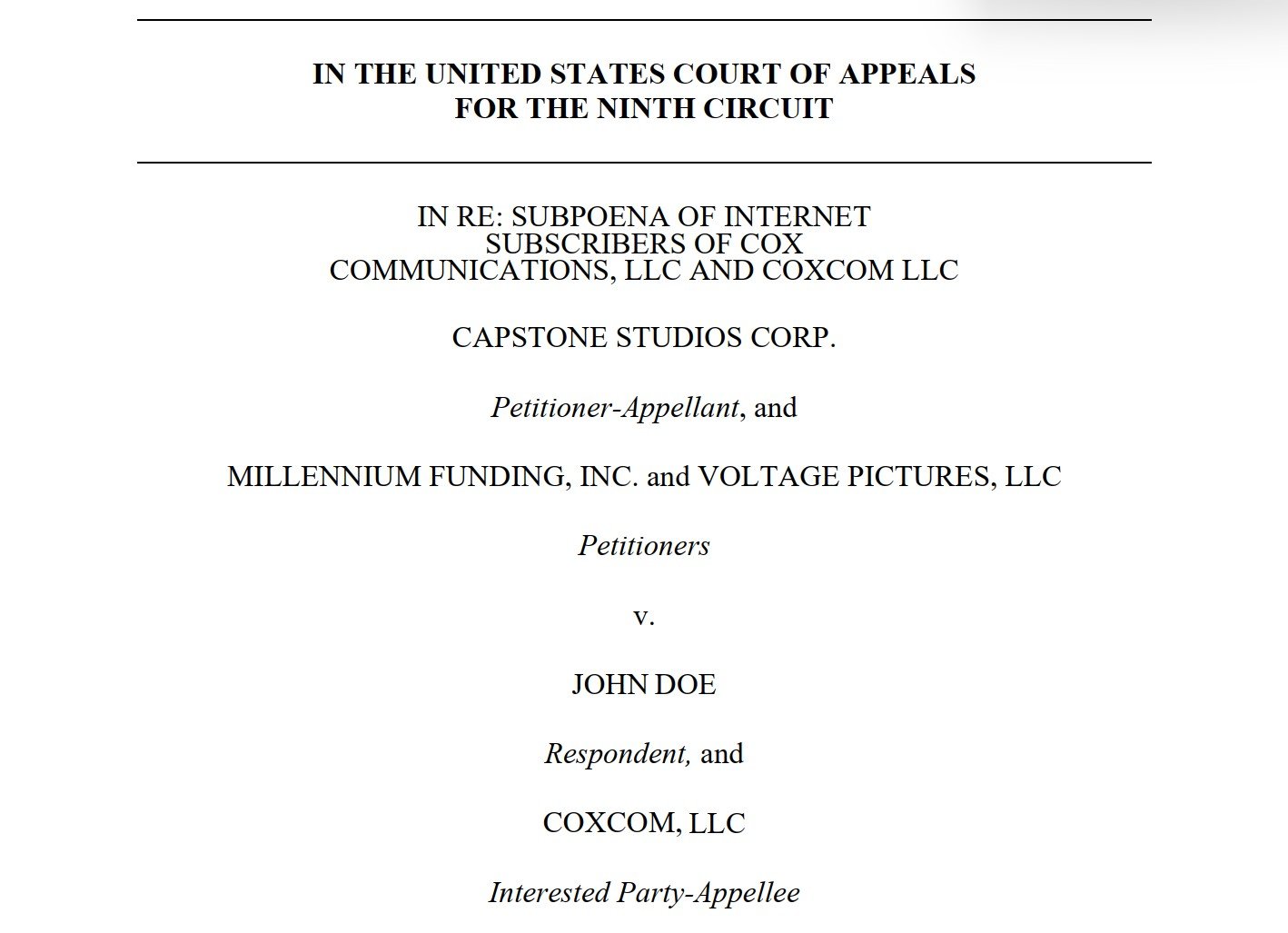
    The movie companies are not letting this issue go that easily. A few days ago, they filed a petition at the Ninth Circuit Court of Appeals, arguing that the district court’s interpretation of the DMCA was overly narrow and hinders their efforts to combat online piracy.

    ninth circuit

    The 81-page petition presents a wide array of arguments. The movie studios argue that the district court’s interpretation, which relies on dated precedents, doesn’t reflect the realities of the modern Internet. They note that ISPs do play a role in facilitating piracy, even if indirectly, and should be subject to DMCA subpoenas.

    “A careful reading of the full text of 17 U.S.C. §512 leads to the unquestionable conclusion that Congress intended for DMCA subpoenas to apply to §512(a) service providers despite the contrary conclusions of Verizon and Charter,” the petition reads.

    Key Questions

    The appeal touches on various DMCA nuances and how these have been interpreted by courts. Ultimately, two key questions are presented.

    First, whether DMCA subpoenas can apply to residential ISPs under §512(a) and second, can ISPs be seen as information location tools. These fall under §512(d), which could make an ISP subject to DMCA subpoenas.

    (1) Can a valid subpoena under 17 U.S.C. §512(h) be issued commanding a §512(a) residential Internet service provider (“ISP”) to identify subscribers that use the ISP’s service to share copies of pirated copyright protected content online to the entire world via the BitTorrent peer-to-peer network?

    (2) Is a residential ISP a provider of information location tools as defined in §512(d) when it provides a subscriber with customer premise equipment (modems and/or residential gateways) and assigns the subscriber an Internet Protocol (“IP”) addresses and links other users to the subscribers’ assigned IP addresses where the subscriber shares pirated copies of copyright protected Works via the BitTorrent peer-to-peer network?

    The first question zooms in on the statutory language of the DMCA which, according to the movie companies, suggests that Congress intended DMCA subpoenas to apply to ‘mere conduit’ providers too.

    For example, it mentions that §512(e) of the DMCA, which applies to educational institutions, explicitly conditions that a §512(a) service provider should not receive more than two §512(c)(3)(A) notifications within three years.

    The District Court, however, concluded that these notifications don’t apply to §512(a) providers because there is no material to take down. That’s a clear conflict, the movie companies note.

    Alternative Angle

    The second key question is whether ISPs such as Cox operate as information location tools under §512(d). That would make DMCA subpoenas a valid instrument as well. The petition argues that this applies directly to Cox.

    “Cox assigns the IP addresses that are used by its subscribers to share pirated copies of Fall online. Cox links other users to the online location to obtain copies of Fall when it routes their data to and from that IP address. Accordingly, Cox is a §512(d) service provider.”

    To support this angle, the rightsholders add that Cox can take technical measures in response to infringing activity.

    “Cox can use measures to disable the link to the infringing material such as null routing the IP addresses, blocking the ports associated with BitTorrent activity from the subscribers’ endpoint, or filtering the BitTorrent content from the subscriber’s endpoint,” the petitions reads.

    Landmark Appeal

    The above is just a brief overview of some of the angles, questions, and arguments laid out in the petition. Much of it goes into great detail on the various DMCA sections, how these are linked, and what that means for the present case.

    Whether the court agrees that there’s a statutory conflict has yet to be seen. However, the stakes are significant. If rightsholders can identify alleged pirates more easily, enforcement will likely ramp up.

    Cox has yet to respond to the appeal. When it does, the ISP’s response will likely be mindful of the Supreme Court petition it filed in a separate copyright-related case, where a jury held the ISP liable for pirating subscribers.

    —-

    A copy of the petition, filed by Voltage Holdings, Millennium Funding, and Capstone Studios is available here (pdf) .

    From: TF , for the latest news on copyright battles, piracy and more.

    • To chevron_right

      Movie Companies Take DMCA Subpoena ‘Shortcut’ Dispute to Court of Appeals

      news.movim.eu / TorrentFreak • 16 September 2024 • 5 minutes

    pirate-flag Tracking BitTorrent pirates isn’t all that hard since IP addresses are openly broadcasted. With help from Internet providers, these addresses can then be linked to account holders.

    ISPs don’t hand over this data voluntarily; they typically require a subpoena or court order before taking action.

    In the United States, subpoenas are typically obtained by filing a copyright complaint in federal court against a “John Doe” who’s known only by an IP address. Most of these cases are filed against a single person, which makes it a relatively expensive process.

    DMCA Shortcut

    In recent years, some rightsholders have used a shortcut to bypass this costly process. Drawing inspiration from the RIAA’s early efforts to identify music pirates in the early 2000s, they use the DMCA subpoena process to obtain the personal details of suspected copyright infringers.

    Unlike regular subpoenas, the DMCA equivalents are not reviewed by a judge and only require a signature from the court clerk. While several courts effectively banned the practice two decades ago, more recent attempts cite fresh interpretations and conflicting case law to support their requests.

    Many courts granted these new requests, which required Internet providers to identify hundreds, if not thousands of alleged pirates.

    Cox Successfully Intervenes

    Most of these recent DMCA subpoenas progressed quietly, with little fanfare or pushback. That changed last year when a Cox subscriber, suspected of pirating the movie Fall , filed an objection in court.

    The objection prompted Cox Communications to intervene. The Internet provider decided to challenge the use of the DMCA subpoena tool, as detailed in DMCA §512(h) . Similar to the earlier opposition against RIAA’s attempts, the ISP argued that DMCA subpoenas don’t apply to mere conduit providers, as defined under § 512(a).

    Earlier this year, a district court judge in Hawaii sided with Cox. The court ruled that DMCA subpoenas don’t apply to mere conduit services, but do apply to other providers that store or link to infringing content directly. As such, the movie companies’ request for a subpoena was denied .

    The rightsholders in this matter, film companies Voltage Holdings, Millennium Funding, and Capstone Studios, swiftly submitted a motion for reconsideration. Among other things, they countered that ISPs are not just ‘mere conduits’, since they can remove or disable ‘references or links’ to infringing content.

    The Hawaii district court reviewed the opposition, but eventually ruled that the ‘DMCA shortcut’ will remain closed.

    Movie Companies Take Case to Court of Appeals

    The movie companies are not letting this issue go that easily. A few days ago, they filed a petition at the Ninth Circuit Court of Appeals, arguing that the district court’s interpretation of the DMCA was overly narrow and hinders their efforts to combat online piracy.

    ninth circuit

    The 81-page petition presents a wide array of arguments. The movie studios argue that the district court’s interpretation, which relies on dated precedents, doesn’t reflect the realities of the modern Internet. They note that ISPs do play a role in facilitating piracy, even if indirectly, and should be subject to DMCA subpoenas.

    “A careful reading of the full text of 17 U.S.C. §512 leads to the unquestionable conclusion that Congress intended for DMCA subpoenas to apply to §512(a) service providers despite the contrary conclusions of Verizon and Charter,” the petition reads.

    Key Questions

    The appeal touches on various DMCA nuances and how these have been interpreted by courts. Ultimately, two key questions are presented.

    First, whether DMCA subpoenas can apply to residential ISPs under §512(a) and second, can ISPs be seen as information location tools. These fall under §512(d), which could make an ISP subject to DMCA subpoenas.

    (1) Can a valid subpoena under 17 U.S.C. §512(h) be issued commanding a §512(a) residential Internet service provider (“ISP”) to identify subscribers that use the ISP’s service to share copies of pirated copyright protected content online to the entire world via the BitTorrent peer-to-peer network?

    (2) Is a residential ISP a provider of information location tools as defined in §512(d) when it provides a subscriber with customer premise equipment (modems and/or residential gateways) and assigns the subscriber an Internet Protocol (“IP”) addresses and links other users to the subscribers’ assigned IP addresses where the subscriber shares pirated copies of copyright protected Works via the BitTorrent peer-to-peer network?

    The first question zooms in on the statutory language of the DMCA which, according to the movie companies, suggests that Congress intended DMCA subpoenas to apply to ‘mere conduit’ providers too.

    For example, it mentions that §512(e) of the DMCA, which applies to educational institutions, explicitly conditions that a §512(a) service provider should not receive more than two §512(c)(3)(A) notifications within three years.

    The District Court, however, concluded that these notifications don’t apply to §512(a) providers because there is no material to take down. That’s a clear conflict, the movie companies note.

    Alternative Angle

    The second key question is whether ISPs such as Cox operate as information location tools under §512(d). That would make DMCA subpoenas a valid instrument as well. The petition argues that this applies directly to Cox.

    “Cox assigns the IP addresses that are used by its subscribers to share pirated copies of Fall online. Cox links other users to the online location to obtain copies of Fall when it routes their data to and from that IP address. Accordingly, Cox is a §512(d) service provider.”

    To support this angle, the rightsholders add that Cox can take technical measures in response to infringing activity.

    “Cox can use measures to disable the link to the infringing material such as null routing the IP addresses, blocking the ports associated with BitTorrent activity from the subscribers’ endpoint, or filtering the BitTorrent content from the subscriber’s endpoint,” the petitions reads.

    Landmark Appeal

    The above is just a brief overview of some of the angles, questions, and arguments laid out in the petition. Much of it goes into great detail on the various DMCA sections, how these are linked, and what that means for the present case.

    Whether the court agrees that there’s a statutory conflict has yet to be seen. However, the stakes are significant. If rightsholders can identify alleged pirates more easily, enforcement will likely ramp up.

    Cox has yet to respond to the appeal. When it does, the ISP’s response will likely be mindful of the Supreme Court petition it filed in a separate copyright-related case, where a jury held the ISP liable for pirating subscribers.

    —-

    A copy of the petition, filed by Voltage Holdings, Millennium Funding, and Capstone Studios is available here (pdf) .

    From: TF , for the latest news on copyright battles, piracy and more.

    • To chevron_right

      Movie Companies Take DMCA Subpoena ‘Shortcut’ Dispute to Court of Appeals

      news.movim.eu / TorrentFreak • 16 September 2024 • 5 minutes

    pirate-flag Tracking BitTorrent pirates isn’t all that hard since IP addresses are openly broadcasted. With help from Internet providers, these addresses can then be linked to account holders.

    ISPs don’t hand over this data voluntarily; they typically require a subpoena or court order before taking action.

    In the United States, subpoenas are typically obtained by filing a copyright complaint in federal court against a “John Doe” who’s known only by an IP address. Most of these cases are filed against a single person, which makes it a relatively expensive process.

    DMCA Shortcut

    In recent years, some rightsholders have used a shortcut to bypass this costly process. Drawing inspiration from the RIAA’s early efforts to identify music pirates in the early 2000s, they use the DMCA subpoena process to obtain the personal details of suspected copyright infringers.

    Unlike regular subpoenas, the DMCA equivalents are not reviewed by a judge and only require a signature from the court clerk. While several courts effectively banned the practice two decades ago, more recent attempts cite fresh interpretations and conflicting case law to support their requests.

    Many courts granted these new requests, which required Internet providers to identify hundreds, if not thousands of alleged pirates.

    Cox Successfully Intervenes

    Most of these recent DMCA subpoenas progressed quietly, with little fanfare or pushback. That changed last year when a Cox subscriber, suspected of pirating the movie Fall , filed an objection in court.

    The objection prompted Cox Communications to intervene. The Internet provider decided to challenge the use of the DMCA subpoena tool, as detailed in DMCA §512(h) . Similar to the earlier opposition against RIAA’s attempts, the ISP argued that DMCA subpoenas don’t apply to mere conduit providers, as defined under § 512(a).

    Earlier this year, a district court judge in Hawaii sided with Cox. The court ruled that DMCA subpoenas don’t apply to mere conduit services, but do apply to other providers that store or link to infringing content directly. As such, the movie companies’ request for a subpoena was denied .

    The rightsholders in this matter, film companies Voltage Holdings, Millennium Funding, and Capstone Studios, swiftly submitted a motion for reconsideration. Among other things, they countered that ISPs are not just ‘mere conduits’, since they can remove or disable ‘references or links’ to infringing content.

    The Hawaii district court reviewed the opposition, but eventually ruled that the ‘DMCA shortcut’ will remain closed.

    Movie Companies Take Case to Court of Appeals

    The movie companies are not letting this issue go that easily. A few days ago, they filed a petition at the Ninth Circuit Court of Appeals, arguing that the district court’s interpretation of the DMCA was overly narrow and hinders their efforts to combat online piracy.

    ninth circuit

    The 81-page petition presents a wide array of arguments. The movie studios argue that the district court’s interpretation, which relies on dated precedents, doesn’t reflect the realities of the modern Internet. They note that ISPs do play a role in facilitating piracy, even if indirectly, and should be subject to DMCA subpoenas.

    “A careful reading of the full text of 17 U.S.C. §512 leads to the unquestionable conclusion that Congress intended for DMCA subpoenas to apply to §512(a) service providers despite the contrary conclusions of Verizon and Charter,” the petition reads.

    Key Questions

    The appeal touches on various DMCA nuances and how these have been interpreted by courts. Ultimately, two key questions are presented.

    First, whether DMCA subpoenas can apply to residential ISPs under §512(a) and second, can ISPs be seen as information location tools. These fall under §512(d), which could make an ISP subject to DMCA subpoenas.

    (1) Can a valid subpoena under 17 U.S.C. §512(h) be issued commanding a §512(a) residential Internet service provider (“ISP”) to identify subscribers that use the ISP’s service to share copies of pirated copyright protected content online to the entire world via the BitTorrent peer-to-peer network?

    (2) Is a residential ISP a provider of information location tools as defined in §512(d) when it provides a subscriber with customer premise equipment (modems and/or residential gateways) and assigns the subscriber an Internet Protocol (“IP”) addresses and links other users to the subscribers’ assigned IP addresses where the subscriber shares pirated copies of copyright protected Works via the BitTorrent peer-to-peer network?

    The first question zooms in on the statutory language of the DMCA which, according to the movie companies, suggests that Congress intended DMCA subpoenas to apply to ‘mere conduit’ providers too.

    For example, it mentions that §512(e) of the DMCA, which applies to educational institutions, explicitly conditions that a §512(a) service provider should not receive more than two §512(c)(3)(A) notifications within three years.

    The District Court, however, concluded that these notifications don’t apply to §512(a) providers because there is no material to take down. That’s a clear conflict, the movie companies note.

    Alternative Angle

    The second key question is whether ISPs such as Cox operate as information location tools under §512(d). That would make DMCA subpoenas a valid instrument as well. The petition argues that this applies directly to Cox.

    “Cox assigns the IP addresses that are used by its subscribers to share pirated copies of Fall online. Cox links other users to the online location to obtain copies of Fall when it routes their data to and from that IP address. Accordingly, Cox is a §512(d) service provider.”

    To support this angle, the rightsholders add that Cox can take technical measures in response to infringing activity.

    “Cox can use measures to disable the link to the infringing material such as null routing the IP addresses, blocking the ports associated with BitTorrent activity from the subscribers’ endpoint, or filtering the BitTorrent content from the subscriber’s endpoint,” the petitions reads.

    Landmark Appeal

    The above is just a brief overview of some of the angles, questions, and arguments laid out in the petition. Much of it goes into great detail on the various DMCA sections, how these are linked, and what that means for the present case.

    Whether the court agrees that there’s a statutory conflict has yet to be seen. However, the stakes are significant. If rightsholders can identify alleged pirates more easily, enforcement will likely ramp up.

    Cox has yet to respond to the appeal. When it does, the ISP’s response will likely be mindful of the Supreme Court petition it filed in a separate copyright-related case, where a jury held the ISP liable for pirating subscribers.

    —-

    A copy of the petition, filed by Voltage Holdings, Millennium Funding, and Capstone Studios is available here (pdf) .

    From: TF , for the latest news on copyright battles, piracy and more.