• To chevron_right

      RIAA Should Disclose Anti-Piracy Details, Altice Argues

      news.movim.eu / TorrentFreak • 16 November 2024 • 4 minutes

    cassette tape pirate music Under U.S. copyright law, Internet providers must terminate the accounts of repeat infringers “in appropriate circumstances”.

    This legal requirement remained largely unenforced for nearly two decades but a series of copyright infringement liability lawsuits, with hundreds of millions of dollars at stake, have shaken up the industry.

    RIAA Labels vs. Altice

    These piracy liability lawsuits have targeted large and small Internet providers across the United States. This includes Altice, which was sued by various parties in recent years both directly and indirectly as the owner of ISP Optimum.

    This summer, Optimum settled its lawsuit with some music industry giants, including BMG, UMG, and Capitol Records, but that doesn’t mean its legal woes are over.

    Last December, a group of nearly 50 music labels filed a similar yet separate ‘mass-infringement’ lawsuit against Altice. All members of the RIAA, these music companies claim the ISP is liable for copyright infringement, alleging that it failed to take action against repeat infringers on the “Optimum” network.

    “Despite Altice’s stated policies and despite receiving tens of thousands of infringement notices concerning Plaintiffs’ works […] Altice knowingly permitted repeat infringers to continue to use its services to infringe,” the complaint read.

    RIAA Denies Discovery Requests

    Nearly a year has passed since the complaint was filed. Both parties are currently conducting discovery, seeking relevant evidence to support their arguments. For Altice, the RIAA is a key target, as the music industry group was involved in events that led up to the lawsuit.

    To find out more, Altice subpoenaed the RIAA for what it believes is relevant information. The RIAA responded to the request, but refused to produce several documents, so Altice filed a motion at the federal court, asking it to compel the RIAA to comply.

    The ISP is particularly interested in the RIAA’s dealings with anti-piracy vendor OpSec Online. The company was responsible for tracking subscribers’ piracy activity on BitTorrent networks and alerting the associated Internet providers, including Altice. These piracy notices were then used as evidence in the current lawsuit.

    “According to Plaintiffs, OpSec’s system was used to detect all of the alleged downloads by Altice’s subscribers that serve as the basis for Plaintiffs’ secondary copyright infringement case against Altice,” the motion reads.

    RIAA’s Dealings with OpSec

    The RIAA reportedly responded with standard rejections to many of these requests. The music group agreed to hand over a copy of its 2019 agreement with OpSec, but rejected to share any other communications related to it.

    According to Altice, this missing context is vital to its defense. It may reveal more about the accuracy and reliability of the piracy notices, for example, including details of potential errors and inaccurate notices.

    In addition, the RIAA should also be required to share reports and other details that provide more insight into the scope and purpose of the piracy notice efforts.

    “[T]he broader reports are relevant to, for example, (1) how many notices were sent to other ISPs, (2) how the RIAA directed OpSec to gather evidence of piracy from other ISPs, and (3) whether the RIAA had a strategy for bringing suits against the entire ISP industry, and, if so, its motivations for doing so,” Altice writes.
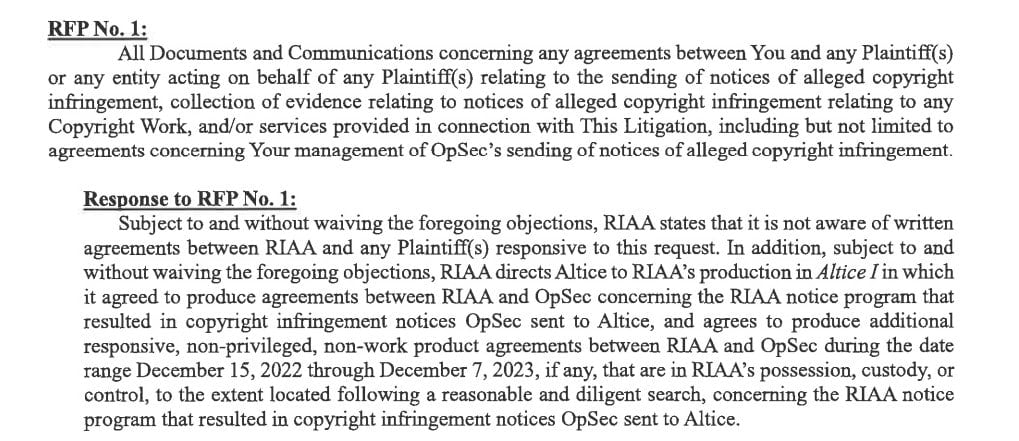
    Altice request, RIAA response

    riaa altice

    Along the same lines, the RIAA should also disclose about how much it paid OpSec for its services. The music industry group already shared payments between 2020 and 2023, but it should hand over older data too. That will help to establish OpSec’s credibility as a witness, Altice notes.

    RIAA’s Other Enforcement Efforts

    The remaining information mostly relates to other enforcement efforts. The RIAA is asked to explain how it selects the copyrighted works that are used as evidence in lawsuits, for example, and whether it chose to extend the protection of certain titles, while discarding others.

    The RIAA has so far refused to share this information. The same also applies to details of any other enforcement options it considered, including actions against torrent sites and potential lawsuits against providers of file-sharing software.

    “These requests are directly relevant to the RIAA’s motivations for pursuing actions against ISPS, like Altice, instead of taking action themselves to address online copyright infringement such as sending notices of infringement to torrent site aggregators […] or taking legal action against providers of peer-to-peer file-sharing technologies.”
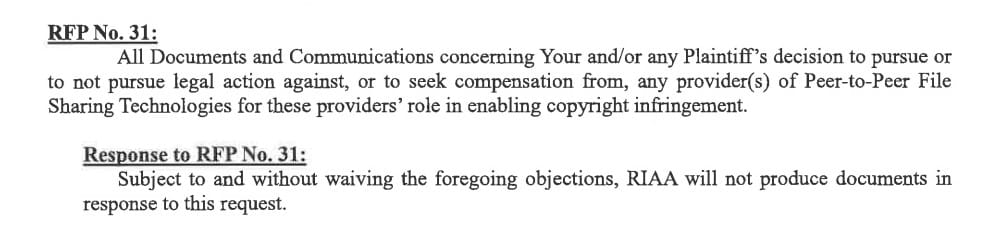
    Altice request, RIAA response

    p2p

    Finally, Altice brings up the Copyright Alert System (CAS). This now-defunct voluntary agreement between rightsholders and Internet providers was previously used in an effort to deter infringement. Notably, this industry sanctioned model did not require ISPs to terminate subscriber accounts.

    The music labels have sued Altice for its alleged failure to terminate accounts of repeat infringers, so this information is highly relevant to its defense, the company notes. Through the motion to compel, Altice hopes that the court will order the music group to comply.

    At the time of writing, the RIAA has yet to respond to the motion. After that, the court is expected to issue a decision.

    A copy of the motion to compel, as well as an associated request to transfer it to the Eastern District of Texas, is available here (pdf) .

    Instant update: The motion is transferred to Texas (pdf) .

    From: TF , for the latest news on copyright battles, piracy and more.

    • To chevron_right

      RIAA Should Disclose Anti-Piracy Details, Altice Argues

      news.movim.eu / TorrentFreak • 16 November 2024 • 4 minutes

    cassette tape pirate music Under U.S. copyright law, Internet providers must terminate the accounts of repeat infringers “in appropriate circumstances”.

    This legal requirement remained largely unenforced for nearly two decades but a series of copyright infringement liability lawsuits, with hundreds of millions of dollars at stake, have shaken up the industry.

    RIAA Labels vs. Altice

    These piracy liability lawsuits have targeted large and small Internet providers across the United States. This includes Altice, which was sued by various parties in recent years both directly and indirectly as the owner of ISP Optimum.

    This summer, Optimum settled its lawsuit with some music industry giants, including BMG, UMG, and Capitol Records, but that doesn’t mean its legal woes are over.

    Last December, a group of nearly 50 music labels filed a similar yet separate ‘mass-infringement’ lawsuit against Altice. All members of the RIAA, these music companies claim the ISP is liable for copyright infringement, alleging that it failed to take action against repeat infringers on the “Optimum” network.

    “Despite Altice’s stated policies and despite receiving tens of thousands of infringement notices concerning Plaintiffs’ works […] Altice knowingly permitted repeat infringers to continue to use its services to infringe,” the complaint read.

    RIAA Denies Discovery Requests

    Nearly a year has passed since the complaint was filed. Both parties are currently conducting discovery, seeking relevant evidence to support their arguments. For Altice, the RIAA is a key target, as the music industry group was involved in events that led up to the lawsuit.

    To find out more, Altice subpoenaed the RIAA for what it believes is relevant information. The RIAA responded to the request, but refused to produce several documents, so Altice filed a motion at the federal court, asking it to compel the RIAA to comply.

    The ISP is particularly interested in the RIAA’s dealings with anti-piracy vendor OpSec Online. The company was responsible for tracking subscribers’ piracy activity on BitTorrent networks and alerting the associated Internet providers, including Altice. These piracy notices were then used as evidence in the current lawsuit.

    “According to Plaintiffs, OpSec’s system was used to detect all of the alleged downloads by Altice’s subscribers that serve as the basis for Plaintiffs’ secondary copyright infringement case against Altice,” the motion reads.

    RIAA’s Dealings with OpSec

    The RIAA reportedly responded with standard rejections to many of these requests. The music group agreed to hand over a copy of its 2019 agreement with OpSec, but rejected to share any other communications related to it.

    According to Altice, this missing context is vital to its defense. It may reveal more about the accuracy and reliability of the piracy notices, for example, including details of potential errors and inaccurate notices.

    In addition, the RIAA should also be required to share reports and other details that provide more insight into the scope and purpose of the piracy notice efforts.

    “[T]he broader reports are relevant to, for example, (1) how many notices were sent to other ISPs, (2) how the RIAA directed OpSec to gather evidence of piracy from other ISPs, and (3) whether the RIAA had a strategy for bringing suits against the entire ISP industry, and, if so, its motivations for doing so,” Altice writes.

    Altice request, RIAA response

    riaa altice

    Along the same lines, the RIAA should also disclose about how much it paid OpSec for its services. The music industry group already shared payments between 2020 and 2023, but it should hand over older data too. That will help to establish OpSec’s credibility as a witness, Altice notes.

    RIAA’s Other Enforcement Efforts

    The remaining information mostly relates to other enforcement efforts. The RIAA is asked to explain how it selects the copyrighted works that are used as evidence in lawsuits, for example, and whether it chose to extend the protection of certain titles, while discarding others.

    The RIAA has so far refused to share this information. The same also applies to details of any other enforcement options it considered, including actions against torrent sites and potential lawsuits against providers of file-sharing software.

    “These requests are directly relevant to the RIAA’s motivations for pursuing actions against ISPS, like Altice, instead of taking action themselves to address online copyright infringement such as sending notices of infringement to torrent site aggregators […] or taking legal action against providers of peer-to-peer file-sharing technologies.”

    Altice request, RIAA response

    p2p

    Finally, Altice brings up the Copyright Alert System (CAS). This now-defunct voluntary agreement between rightsholders and Internet providers was previously used in an effort to deter infringement. Notably, this industry sanctioned model did not require ISPs to terminate subscriber accounts.

    The music labels have sued Altice for its alleged failure to terminate accounts of repeat infringers, so this information is highly relevant to its defense, the company notes. Through the motion to compel, Altice hopes that the court will order the music group to comply.

    At the time of writing, the RIAA has yet to respond to the motion. After that, the court is expected to issue a decision.

    A copy of the motion to compel, as well as an associated request to transfer it to the Eastern District of Texas, is available here (pdf) .

    Instant update: The motion is transferred to Texas (pdf) .

    From: TF , for the latest news on copyright battles, piracy and more.

    • To chevron_right

      RIAA Should Disclose Anti-Piracy Details, Altice Argues

      news.movim.eu / TorrentFreak • 16 November 2024 • 4 minutes

    cassette tape pirate music Under U.S. copyright law, Internet providers must terminate the accounts of repeat infringers “in appropriate circumstances”.

    This legal requirement remained largely unenforced for nearly two decades but a series of copyright infringement liability lawsuits, with hundreds of millions of dollars at stake, have shaken up the industry.

    RIAA Labels vs. Altice

    These piracy liability lawsuits have targeted large and small Internet providers across the United States. This includes Altice, which was sued by various parties in recent years both directly and indirectly as the owner of ISP Optimum.

    This summer, Optimum settled its lawsuit with some music industry giants, including BMG, UMG, and Capitol Records, but that doesn’t mean its legal woes are over.

    Last December, a group of nearly 50 music labels filed a similar yet separate ‘mass-infringement’ lawsuit against Altice. All members of the RIAA, these music companies claim the ISP is liable for copyright infringement, alleging that it failed to take action against repeat infringers on the “Optimum” network.

    “Despite Altice’s stated policies and despite receiving tens of thousands of infringement notices concerning Plaintiffs’ works […] Altice knowingly permitted repeat infringers to continue to use its services to infringe,” the complaint read.

    RIAA Denies Discovery Requests

    Nearly a year has passed since the complaint was filed. Both parties are currently conducting discovery, seeking relevant evidence to support their arguments. For Altice, the RIAA is a key target, as the music industry group was involved in events that led up to the lawsuit.

    To find out more, Altice subpoenaed the RIAA for what it believes is relevant information. The RIAA responded to the request, but refused to produce several documents, so Altice filed a motion at the federal court, asking it to compel the RIAA to comply.

    The ISP is particularly interested in the RIAA’s dealings with anti-piracy vendor OpSec Online. The company was responsible for tracking subscribers’ piracy activity on BitTorrent networks and alerting the associated Internet providers, including Altice. These piracy notices were then used as evidence in the current lawsuit.

    “According to Plaintiffs, OpSec’s system was used to detect all of the alleged downloads by Altice’s subscribers that serve as the basis for Plaintiffs’ secondary copyright infringement case against Altice,” the motion reads.

    RIAA’s Dealings with OpSec

    The RIAA reportedly responded with standard rejections to many of these requests. The music group agreed to hand over a copy of its 2019 agreement with OpSec, but rejected to share any other communications related to it.

    According to Altice, this missing context is vital to its defense. It may reveal more about the accuracy and reliability of the piracy notices, for example, including details of potential errors and inaccurate notices.

    In addition, the RIAA should also be required to share reports and other details that provide more insight into the scope and purpose of the piracy notice efforts.

    “[T]he broader reports are relevant to, for example, (1) how many notices were sent to other ISPs, (2) how the RIAA directed OpSec to gather evidence of piracy from other ISPs, and (3) whether the RIAA had a strategy for bringing suits against the entire ISP industry, and, if so, its motivations for doing so,” Altice writes.

    Altice request, RIAA response

    riaa altice

    Along the same lines, the RIAA should also disclose about how much it paid OpSec for its services. The music industry group already shared payments between 2020 and 2023, but it should hand over older data too. That will help to establish OpSec’s credibility as a witness, Altice notes.

    RIAA’s Other Enforcement Efforts

    The remaining information mostly relates to other enforcement efforts. The RIAA is asked to explain how it selects the copyrighted works that are used as evidence in lawsuits, for example, and whether it chose to extend the protection of certain titles, while discarding others.

    The RIAA has so far refused to share this information. The same also applies to details of any other enforcement options it considered, including actions against torrent sites and potential lawsuits against providers of file-sharing software.

    “These requests are directly relevant to the RIAA’s motivations for pursuing actions against ISPS, like Altice, instead of taking action themselves to address online copyright infringement such as sending notices of infringement to torrent site aggregators […] or taking legal action against providers of peer-to-peer file-sharing technologies.”

    Altice request, RIAA response

    p2p

    Finally, Altice brings up the Copyright Alert System (CAS). This now-defunct voluntary agreement between rightsholders and Internet providers was previously used in an effort to deter infringement. Notably, this industry sanctioned model did not require ISPs to terminate subscriber accounts.

    The music labels have sued Altice for its alleged failure to terminate accounts of repeat infringers, so this information is highly relevant to its defense, the company notes. Through the motion to compel, Altice hopes that the court will order the music group to comply.

    At the time of writing, the RIAA has yet to respond to the motion. After that, the court is expected to issue a decision.

    A copy of the motion to compel, as well as an associated request to transfer it to the Eastern District of Texas, is available here (pdf) .

    Instant update: The motion is transferred to Texas (pdf) .

    From: TF , for the latest news on copyright battles, piracy and more.

    • To chevron_right

      Dutch Court Orders ISP to Block Torrent Site TorrentGalaxy

      news.movim.eu / TorrentFreak • 15 November 2024 • 3 minutes

    tgx logo Pirate site blocking is one of the entertainment industry’s favorite enforcement tools. In recent years, it’s become a common practice in many countries around the world.

    In the Netherlands, it took over a decade for the first order to be approved. After detours through the Supreme Court and the EU Court of Justice, the final order was issued in 2020, targeting The Pirate Bay .

    With all the legal paperwork in order, the doors were open to more blocking requests, especially after rightsholders and local ISPs signed a covenant to streamline the process. If a court orders one company to block pirate sites, by agreement the other ISPs will follow suit.

    After the initial Pirate Bay blockade, a follow-up order targeted YTS, EZTV and other torrent sites in 2022. Last year, the court approved a ‘dynamic’ blocking order against Lookmovie and Flixtor, followed by similar action against popular shadow libraries a few months ago.

    New TorrentGalaxy Blockade

    Yesterday, BREIN announced that it has won another blocking case. In a recent ruling, the Rotterdam District Court ordered Dutch internet provider Odido to block access to popular torrent site TorrentGalaxy and its associated proxy and mirror domains.

    The Court found that TorrentGalaxy facilitates copyright infringement by providing unauthorized access to copyrighted works. As an internet service provider, Odido plays a role in facilitating access to TorrentGalaxy, therefore it’s obliged to take action to limit the piracy activity.

    The ISP is seen as an intermediary under Dutch copyright law. Without taking action, it can be held liable, the Court explained. This wasn’t contested by Odido, but the ISP opposed BREIN’s blocking request for other reasons.

    ISP Opposition Fails

    In court, the ISP mentioned the subsidiarity requirement of the blocking covenant, arguing that BREIN had not sufficiently tested other avenues to shut the site down. BREIN could have done more to address the infringements closer to the source, by going after TorrentGalaxy’s hosting provider, for example.

    BREIN had reached out to TorrentGalaxy’s former host FlokiNET in the past, but without any result. However, when the torrent site reportedly relocated this summer, it was weeks before BREIN contacted the new hosting company, Virtual Systems, which typically doesn’t respond to its inquiries either.

    After reviewing the arguments from both sides, the Court agreed that BREIN had taken all appropriate steps as agreed in the blocking covenant.

    “BREIN not only wrote to the site and the hosting provider, but also to the registrant, registrar and registry of each domain. BREIN has therefore done more than was expected of it,” the Rotterdam District Court’s decision notes.

    There are additional steps BREIN could have taken. For example, it could have sued the hosting companies. However, that’s not needed to warrant a blocking order.

    “The subsidiarity requirement does not extend so far that BREIN is required to first conduct numerous lawsuits abroad against foreign parties before it demands a blockade in the Netherlands,” the Court adds

    500+ Domain Blockade

    BREIN director Bastiaan van Ramshorst is pleased with the outcome, which requires other Dutch ISPs to follow suit. Overall, these blocking measures have proven to be effective, particularly since dynamic orders allow new domains to be added later on.

    “The websites blocking covenant is working satisfactorily. Dynamic blocking is effective and in the Netherlands it leads to a substantial decrease in visits to the evidently illegal websites that are blocked,” he says.

    In addition to ISPs, the order also extends to Google, as the search engine previously decided to voluntarily remove domains from local search results based on ISP blocking orders.

    “Moreover, all websites that Dutch access providers must block by court order, Google removes from its search results at the request of BREIN. This cuts both ways,” Van Ramshorst adds.

    At the time of writing, the full Dutch pirate site blocklist covers 574 domain names, including proxies and mirrors. In addition to newcomer TorrentGalaxy, it includes The Pirate Bay, YTS, KAT, 1337x, EZTV, LimeTorrents, RARBG (offline), Lookmovie, Flixtor, Anna’s Archive, and Library Genesis.

    Update November 14: A copy of the Dutch verdict is now publicly available .

    From: TF , for the latest news on copyright battles, piracy and more.

    • To chevron_right

      Dutch Court Orders ISP to Block Torrent Site TorrentGalaxy

      news.movim.eu / TorrentFreak • 15 November 2024 • 3 minutes

    tgx logo Pirate site blocking is one of the entertainment industry’s favorite enforcement tools. In recent years, it’s become a common practice in many countries around the world.

    In the Netherlands, it took over a decade for the first order to be approved. After detours through the Supreme Court and the EU Court of Justice, the final order was issued in 2020, targeting The Pirate Bay .

    With all the legal paperwork in order, the doors were open to more blocking requests, especially after rightsholders and local ISPs signed a covenant to streamline the process. If a court orders one company to block pirate sites, by agreement the other ISPs will follow suit.

    After the initial Pirate Bay blockade, a follow-up order targeted YTS, EZTV and other torrent sites in 2022. Last year, the court approved a ‘dynamic’ blocking order against Lookmovie and Flixtor, followed by similar action against popular shadow libraries a few months ago.

    New TorrentGalaxy Blockade

    Yesterday, BREIN announced that it has won another blocking case. In a recent ruling, the Rotterdam District Court ordered Dutch internet provider Odido to block access to popular torrent site TorrentGalaxy and its associated proxy and mirror domains.

    The Court found that TorrentGalaxy facilitates copyright infringement by providing unauthorized access to copyrighted works. As an internet service provider, Odido plays a role in facilitating access to TorrentGalaxy, therefore it’s obliged to take action to limit the piracy activity.

    The ISP is seen as an intermediary under Dutch copyright law. Without taking action, it can be held liable, the Court explained. This wasn’t contested by Odido, but the ISP opposed BREIN’s blocking request for other reasons.

    ISP Opposition Fails

    In court, the ISP mentioned the subsidiarity requirement of the blocking covenant, arguing that BREIN had not sufficiently tested other avenues to shut the site down. BREIN could have done more to address the infringements closer to the source, by going after TorrentGalaxy’s hosting provider, for example.

    BREIN had reached out to TorrentGalaxy’s former host FlokiNET in the past, but without any result. However, when the torrent site reportedly relocated this summer, it was weeks before BREIN contacted the new hosting company, Virtual Systems, which typically doesn’t respond to its inquiries either.

    After reviewing the arguments from both sides, the Court agreed that BREIN had taken all appropriate steps as agreed in the blocking covenant.

    “BREIN not only wrote to the site and the hosting provider, but also to the registrant, registrar and registry of each domain. BREIN has therefore done more than was expected of it,” the Rotterdam District Court’s decision notes.

    There are additional steps BREIN could have taken. For example, it could have sued the hosting companies. However, that’s not needed to warrant a blocking order.

    “The subsidiarity requirement does not extend so far that BREIN is required to first conduct numerous lawsuits abroad against foreign parties before it demands a blockade in the Netherlands,” the Court adds

    500+ Domain Blockade

    BREIN director Bastiaan van Ramshorst is pleased with the outcome, which requires other Dutch ISPs to follow suit. Overall, these blocking measures have proven to be effective, particularly since dynamic orders allow new domains to be added later on.

    “The websites blocking covenant is working satisfactorily. Dynamic blocking is effective and in the Netherlands it leads to a substantial decrease in visits to the evidently illegal websites that are blocked,” he says.

    In addition to ISPs, the order also extends to Google, as the search engine previously decided to voluntarily remove domains from local search results based on ISP blocking orders.

    “Moreover, all websites that Dutch access providers must block by court order, Google removes from its search results at the request of BREIN. This cuts both ways,” Van Ramshorst adds.

    At the time of writing, the full Dutch pirate site blocklist covers 574 domain names, including proxies and mirrors. In addition to newcomer TorrentGalaxy, it includes The Pirate Bay, YTS, KAT, 1337x, EZTV, LimeTorrents, RARBG (offline), Lookmovie, Flixtor, Anna’s Archive, and Library Genesis.

    Update November 14: A copy of the Dutch verdict is now publicly available .

    From: TF , for the latest news on copyright battles, piracy and more.

    • To chevron_right

      Dutch Court Orders ISP to Block Torrent Site TorrentGalaxy

      news.movim.eu / TorrentFreak • 15 November 2024 • 3 minutes

    tgx logo Pirate site blocking is one of the entertainment industry’s favorite enforcement tools. In recent years, it’s become a common practice in many countries around the world.

    In the Netherlands, it took over a decade for the first order to be approved. After detours through the Supreme Court and the EU Court of Justice, the final order was issued in 2020, targeting The Pirate Bay .

    With all the legal paperwork in order, the doors were open to more blocking requests, especially after rightsholders and local ISPs signed a covenant to streamline the process. If a court orders one company to block pirate sites, by agreement the other ISPs will follow suit.

    After the initial Pirate Bay blockade, a follow-up order targeted YTS, EZTV and other torrent sites in 2022. Last year, the court approved a ‘dynamic’ blocking order against Lookmovie and Flixtor, followed by similar action against popular shadow libraries a few months ago.

    New TorrentGalaxy Blockade

    Yesterday, BREIN announced that it has won another blocking case. In a recent ruling, the Rotterdam District Court ordered Dutch internet provider Odido to block access to popular torrent site TorrentGalaxy and its associated proxy and mirror domains.

    The Court found that TorrentGalaxy facilitates copyright infringement by providing unauthorized access to copyrighted works. As an internet service provider, Odido plays a role in facilitating access to TorrentGalaxy, therefore it’s obliged to take action to limit the piracy activity.

    The ISP is seen as an intermediary under Dutch copyright law. Without taking action, it can be held liable, the Court explained. This wasn’t contested by Odido, but the ISP opposed BREIN’s blocking request for other reasons.

    ISP Opposition Fails

    In court, the ISP mentioned the subsidiarity requirement of the blocking covenant, arguing that BREIN had not sufficiently tested other avenues to shut the site down. BREIN could have done more to address the infringements closer to the source, by going after TorrentGalaxy’s hosting provider, for example.

    BREIN had reached out to TorrentGalaxy’s former host FlokiNET in the past, but without any result. However, when the torrent site reportedly relocated this summer, it was weeks before BREIN contacted the new hosting company, Virtual Systems, which typically doesn’t respond to its inquiries either.

    After reviewing the arguments from both sides, the Court agreed that BREIN had taken all appropriate steps as agreed in the blocking covenant.

    “BREIN not only wrote to the site and the hosting provider, but also to the registrant, registrar and registry of each domain. BREIN has therefore done more than was expected of it,” the Rotterdam District Court’s decision notes.

    There are additional steps BREIN could have taken. For example, it could have sued the hosting companies. However, that’s not needed to warrant a blocking order.

    “The subsidiarity requirement does not extend so far that BREIN is required to first conduct numerous lawsuits abroad against foreign parties before it demands a blockade in the Netherlands,” the Court adds

    500+ Domain Blockade

    BREIN director Bastiaan van Ramshorst is pleased with the outcome, which requires other Dutch ISPs to follow suit. Overall, these blocking measures have proven to be effective, particularly since dynamic orders allow new domains to be added later on.

    “The websites blocking covenant is working satisfactorily. Dynamic blocking is effective and in the Netherlands it leads to a substantial decrease in visits to the evidently illegal websites that are blocked,” he says.

    In addition to ISPs, the order also extends to Google, as the search engine previously decided to voluntarily remove domains from local search results based on ISP blocking orders.

    “Moreover, all websites that Dutch access providers must block by court order, Google removes from its search results at the request of BREIN. This cuts both ways,” Van Ramshorst adds.

    At the time of writing, the full Dutch pirate site blocklist covers 574 domain names, including proxies and mirrors. In addition to newcomer TorrentGalaxy, it includes The Pirate Bay, YTS, KAT, 1337x, EZTV, LimeTorrents, RARBG (offline), Lookmovie, Flixtor, Anna’s Archive, and Library Genesis.

    Update November 14: A copy of the Dutch verdict is now publicly available .

    From: TF , for the latest news on copyright battles, piracy and more.

    • To chevron_right

      Nintendo v. Pomelo: Yuzu-Based iOS Switch Emu in Circumvention Dead End

      news.movim.eu / TorrentFreak • 15 November 2024 • 2 minutes

    pomelo-nintendo At the start of 2024, few would’ve believed that Nintendo had a plan up its sleeve that would turn the Switch emulator scene upside down in a matter of months.
    That Nintendo’s core strategy is effective regardless of the target, and appears flexible enough to put pressure on pro-piracy speech , is a rarity in itself. Even the timing and pace seem to have been measured to perfection.

    While no action has been able to conclusively end Switch emulation, or even nudge the scene towards an existential crisis, things are not like they were in 2023. It’s possible there will never be a return, but all things considered, mass uptake of emulation for piracy purposes was never likely to end well.

    A less shouty and brazen attitude towards the risky side of emulation, may actually end up being a plus for those determined to continue. When mainstream attraction eventually wears off, Nintendo itself may experience diminishing returns; right now, however, there’s still plenty of work left to do.

    Undermining Foundations, Limiting Options

    After the dust settled on Yuzu’s demise, any software based on Yuzu had already inherited the same poisonous traits that led to its downfall. With those details in hand, Nintendo has had a much easier time taking down developers’ repos.

    Suyu, Nuzu, Uzuy and Torzu all faced disruption in July , along with Sudachi, a Yuzu-based emulator whose DNA can also be found in Pomelo, a Switch emulator for iOS devices.

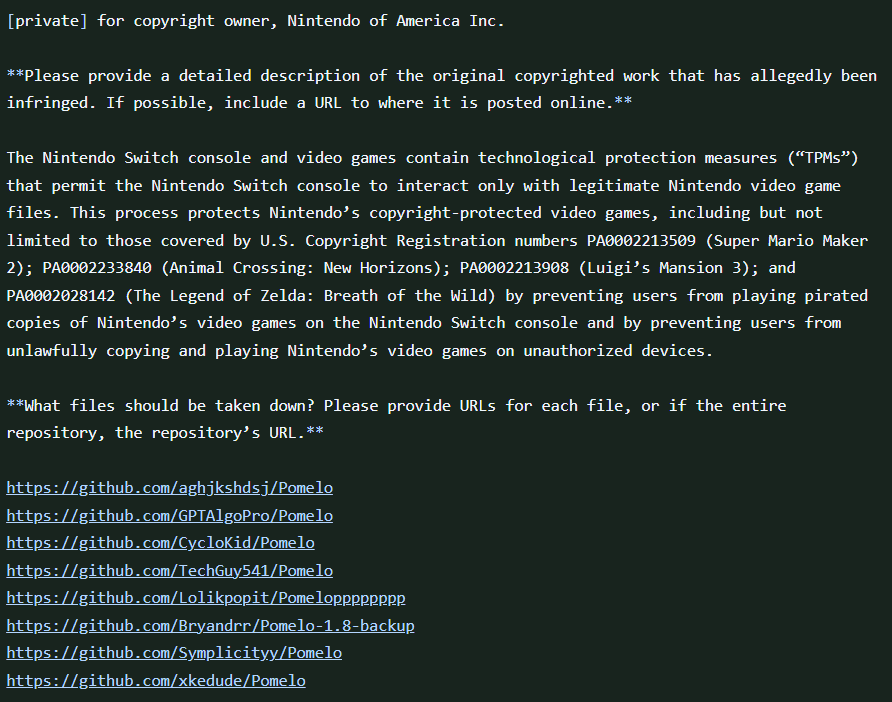
    In a DMCA takedown notice filed at GitHub a few hours ago, Nintendo targets eight Pomelo repos. Highlighting that Pomelo code can be traced back to Yuzu, Nintendo’s notice lists everything that Yuzu did wrong and then links that directly to Pomelo.

    “The reported repository provides access to the yuzu emulator or code based on the yuzu emulator (specifically, a program called Pomelo),” the notice reads, before complaining about Yuzu’s actions and leaving GitHub to connect the dots.

    PO,ELO-DMCA

    “The yuzu emulator is primarily designed to play Nintendo Switch games. Specifically, yuzu illegally circumvents Nintendo’s technological protection measures and runs illegal copies of Nintendo Switch games,” Nintendo continues.

    “Nintendo Switch games are encrypted using proprietary cryptographic keys (prod.keys) which protect against unauthorized access to and copying of the copyrighted games. During operation, yuzu necessarily uses unauthorized copies of these cryptographic keys to decrypt unauthorized copies of Nintendo Switch games, or ROMs, at or immediately before runtime without Nintendo’s authorization,” the notice adds.

    All Switch Decryption is Illegal

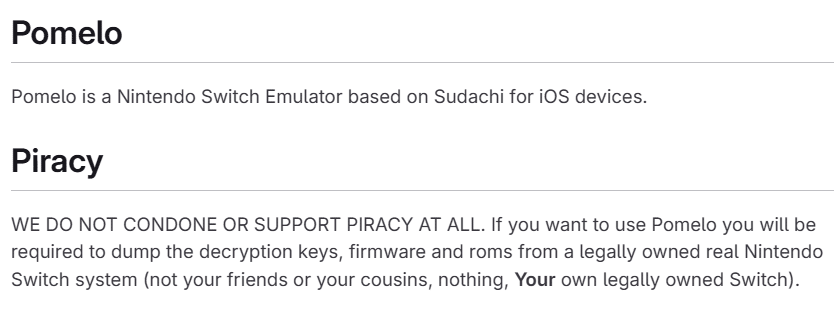
    On GitLab, where Pomelo currently continues unhindered, the repo has an unmissable notice on the very front page.

    No-piracy-1

    Unfortunately the disclaimer isn’t especially useful. Using the Yuzu case for guidance, dumping encryption keys, regardless of the source of those keys, is illegal. In fact, anywhere where encryption is mentioned, decryption is described as illegal, even when users extract keys from their own, legally purchased devices.

    When taken together, these factors lead Pomelo and other Switch emulators down a dead end with nowhere left to go.

    From: TF , for the latest news on copyright battles, piracy and more.

    • To chevron_right

      Nintendo v. Pomelo: Yuzu-Based iOS Switch Emu in Circumvention Dead End

      news.movim.eu / TorrentFreak • 15 November 2024 • 2 minutes

    pomelo-nintendo At the start of 2024, few would’ve believed that Nintendo had a plan up its sleeve that would turn the Switch emulator scene upside down in a matter of months.

    That Nintendo’s core strategy is effective regardless of the target, and appears flexible enough to put pressure on pro-piracy speech , is a rarity in itself. Even the timing and pace seem to have been measured to perfection.

    While no action has been able to conclusively end Switch emulation, or even nudge the scene towards an existential crisis, things are not like they were in 2023. It’s possible there will never be a return, but all things considered, mass uptake of emulation for piracy purposes was never likely to end well.

    A less shouty and brazen attitude towards the risky side of emulation, may actually end up being a plus for those determined to continue. When mainstream attraction eventually wears off, Nintendo itself may experience diminishing returns; right now, however, there’s still plenty of work left to do.

    Undermining Foundations, Limiting Options

    After the dust settled on Yuzu’s demise, any software based on Yuzu had already inherited the same poisonous traits that led to its downfall. With those details in hand, Nintendo has had a much easier time taking down developers’ repos.

    Suyu, Nuzu, Uzuy and Torzu all faced disruption in July , along with Sudachi, a Yuzu-based emulator whose DNA can also be found in Pomelo, a Switch emulator for iOS devices.

    In a DMCA takedown notice filed at GitHub a few hours ago, Nintendo targets eight Pomelo repos. Highlighting that Pomelo code can be traced back to Yuzu, Nintendo’s notice lists everything that Yuzu did wrong and then links that directly to Pomelo.

    “The reported repository provides access to the yuzu emulator or code based on the yuzu emulator (specifically, a program called Pomelo),” the notice reads, before complaining about Yuzu’s actions and leaving GitHub to connect the dots.

    PO,ELO-DMCA

    “The yuzu emulator is primarily designed to play Nintendo Switch games. Specifically, yuzu illegally circumvents Nintendo’s technological protection measures and runs illegal copies of Nintendo Switch games,” Nintendo continues.

    “Nintendo Switch games are encrypted using proprietary cryptographic keys (prod.keys) which protect against unauthorized access to and copying of the copyrighted games. During operation, yuzu necessarily uses unauthorized copies of these cryptographic keys to decrypt unauthorized copies of Nintendo Switch games, or ROMs, at or immediately before runtime without Nintendo’s authorization,” the notice adds.

    All Switch Decryption is Illegal

    On GitLab, where Pomelo currently continues unhindered, the repo has an unmissable notice on the very front page.

    No-piracy-1

    Unfortunately the disclaimer isn’t especially useful. Using the Yuzu case for guidance, dumping encryption keys, regardless of the source of those keys, is illegal. In fact, anywhere where encryption is mentioned, decryption is described as illegal, even when users extract keys from their own, legally purchased devices.

    When taken together, these factors lead Pomelo and other Switch emulators down a dead end with nowhere left to go.

    From: TF , for the latest news on copyright battles, piracy and more.

    • To chevron_right

      Nintendo v. Pomelo: Yuzu-Based iOS Switch Emu in Circumvention Dead End

      news.movim.eu / TorrentFreak • 15 November 2024 • 2 minutes

    pomelo-nintendo At the start of 2024, few would’ve believed that Nintendo had a plan up its sleeve that would turn the Switch emulator scene upside down in a matter of months.

    That Nintendo’s core strategy is effective regardless of the target, and appears flexible enough to put pressure on pro-piracy speech , is a rarity in itself. Even the timing and pace seem to have been measured to perfection.

    While no action has been able to conclusively end Switch emulation, or even nudge the scene towards an existential crisis, things are not like they were in 2023. It’s possible there will never be a return, but all things considered, mass uptake of emulation for piracy purposes was never likely to end well.

    A less shouty and brazen attitude towards the risky side of emulation, may actually end up being a plus for those determined to continue. When mainstream attraction eventually wears off, Nintendo itself may experience diminishing returns; right now, however, there’s still plenty of work left to do.

    Undermining Foundations, Limiting Options

    After the dust settled on Yuzu’s demise, any software based on Yuzu had already inherited the same poisonous traits that led to its downfall. With those details in hand, Nintendo has had a much easier time taking down developers’ repos.

    Suyu, Nuzu, Uzuy and Torzu all faced disruption in July , along with Sudachi, a Yuzu-based emulator whose DNA can also be found in Pomelo, a Switch emulator for iOS devices.

    In a DMCA takedown notice filed at GitHub a few hours ago, Nintendo targets eight Pomelo repos. Highlighting that Pomelo code can be traced back to Yuzu, Nintendo’s notice lists everything that Yuzu did wrong and then links that directly to Pomelo.

    “The reported repository provides access to the yuzu emulator or code based on the yuzu emulator (specifically, a program called Pomelo),” the notice reads, before complaining about Yuzu’s actions and leaving GitHub to connect the dots.

    PO,ELO-DMCA

    “The yuzu emulator is primarily designed to play Nintendo Switch games. Specifically, yuzu illegally circumvents Nintendo’s technological protection measures and runs illegal copies of Nintendo Switch games,” Nintendo continues.

    “Nintendo Switch games are encrypted using proprietary cryptographic keys (prod.keys) which protect against unauthorized access to and copying of the copyrighted games. During operation, yuzu necessarily uses unauthorized copies of these cryptographic keys to decrypt unauthorized copies of Nintendo Switch games, or ROMs, at or immediately before runtime without Nintendo’s authorization,” the notice adds.

    All Switch Decryption is Illegal

    On GitLab, where Pomelo currently continues unhindered, the repo has an unmissable notice on the very front page.

    No-piracy-1

    Unfortunately the disclaimer isn’t especially useful. Using the Yuzu case for guidance, dumping encryption keys, regardless of the source of those keys, is illegal. In fact, anywhere where encryption is mentioned, decryption is described as illegal, even when users extract keys from their own, legally purchased devices.

    When taken together, these factors lead Pomelo and other Switch emulators down a dead end with nowhere left to go.

    From: TF , for the latest news on copyright battles, piracy and more.