• To chevron_right

      ‘Historic Decision’ to Imprison Pirate IPTV User Smells of Propaganda

      news.movim.eu / TorrentFreak • 9 December 2024 • 7 minutes

    prison-propaganda-s After investing huge resources into tackling pirate IPTV platforms as significant as the one reportedly taken down last week , a little stagecraft should be as expected when authorities and rightsholders declare victory.

    Information suggests that the blackout impacted supply across Europe and beyond, so a small amount of window-dressing on the number of users affected and profits generated don’t really have a misleading impact. There’s no denying the importance of the operation either; a lot of information was shared by the authorities and while difficult to confirm, in general most things felt coherent and unforced.

    As previously highlighted, negatives related to these types of operations usually receive no mention, even when so serious that they completely undermine statements made just hours previously .

    There’s nothing like that following last week’s operation, but it will be a serious concern that end-users whose providers relied on those streams were mostly without service for just 48/72 hours, several sources suggest.

    Clearly, users of these services need to be dissuaded.

    The Importance of User Attitudes

    There are well-publicized efforts to convince users of pirate services that they’re incurring various risks, up to and including being sent to prison.

    In Greece right now there are hundreds of news articles (unrelated to the events of last week) reporting on a “landmark” and/or “historic” decision by a local court to send a pirate IPTV subscriber to prison for five months. We reviewed a total of 62 of these articles and selected two for illustration purposes within this article (translated from Greek) .

    greek-iptv-1

    Leaving aside that a casual reader might believe the sentence was connected to events last week ( zero action reported in Greece by Europol), the article is consistent with the majority of dozens of others in claiming a “historical precedent” (first time a user has received a custodial sentence), a “significant shift” in judicial attitudes, and interestingly “a return to the rule of law.”

    Common Details in the Majority of Articles

    There appears to be no question that the defendant was indeed a pirate IPTV subscriber, but pleading not guilty with the defense outlined below seems quite the long shot. There seems no reasonable basis to criticize the Court’s conclusion that the defense lacked credibility, at least how the case is being reported.

    greek-iptv-2

    “The judges concluded that the consequences of piracy cannot be considered ‘minor,’ given the enormous damage it causes on multiple levels,” a report from Skair.gr reads.

    The Skai article is cited on many occasions as the source of this news, likewise a video news report from Alpha TV.

    Effectively The Same Source For All Articles

    Skai, AlphaTV news, and the majority of publications citing these outlets as a source, state that the trial judges rejected the notion that the defendant’s viewing of pirate IPTV streams was anything other than a serious matter.

    “According to the evidence presented at the trial, pay-TV piracy causes serious economic and social consequences, such as revenue losses for the Greek State from the non-collection of VAT and tax revenues and the parallel circulation of ‘black money’,” Skai reports.

    “It causes damage to Greek society from the loss of jobs and the non-payment of remuneration to creators. And it increases crime as pirate organizations have a clear criminal organization structure with a multitude of parallel criminal crimes. And finally, piracy causes financial disaster for providers from revenue losses and degradation of the quality of services.”

    These talking points are well-worn industry standards across the world. The articles state that these claims were provided in evidence, so these aren’t necessarily the words of any or all of the three judges. Yet this is where things start to get interesting.

    The Important Details Are Those That Didn’t Get Reported

    Let’s start with the basics that any journalist would include in the most mundane of reports. Despite being central to the entire ‘historic decision’ the defendant almost seems irrelevant.

    Privacy issues surrounding real names aside, there is no indication whether the defendant is a 29-year-old man from the Athens area, or a grandmother in her sixties from Thessaloniki. Since this was a criminal case, details such as when the investigation began or even when the person was arrested and what for – nada, nothing.

    And there’s the Court where the historic decision was handed down, the Athens Court of Appeals for Misdemeanors. If we assume that having “Court of Appeals” in the title means what it says, logically this can’t be the first trial. So when was the first trial, what were the allegations, in which court did it take place, and what was the outcome?

    For that matter, on what basis was there an appeal? Did the defendant get found not guilty? If so, when was the announcement and if not, why wasn’t there an announcement in the interests of balanced reporting?

    Given the industry standard evidence in respect of the damage caused by IPTV, it should be safe to assume there is an injured party, such as a broadcaster or similar rightsholder.

    Who is that party or parties?

    Perhaps more to the point, why isn’t that party and all the other major rightsholders in Greece, all over this landmark decision and wringing every last piece of value out of it? Having got a headsup on the historic event, why isn’t a single source mentioned in the initial report?

    Why hasn’t any major rightsholder welcomed the decision in public? This is exactly what many have been demanding for the last few years yet now, all of a sudden, nobody wants to own it, celebrate it, or even give it a mention?

    Nobody is Going to Prison

    Why many reports insist that the anonymous defendant is going to prison is unclear. A source familiar with the Greek legal system informs TF that a five-month sentence would almost certainly be suspended, likely for a period of three years.

    Effectively, if the defendant stays on the straight and narrow, no prison time will be served. Interestingly the issue of compensation hasn’t been reported at all, which is very unusual when the entertainment industries are involved. Again, the suspended aspect of the sentence would likely ensure nothing would be paid anyway.

    Of course, all of these issues are extremely relevant and could be easily cleared up in a handful of minutes. Instead, a story with no cited source has effectively become the single source of truth without providing any of the important details that might explain why such a long sentence was warranted.

    Previous convictions perhaps, or breaching an injunction? Absconded foreigner, we’ve seen that before . It’s all guesswork really, unlike the details of another anti-piracy initiative that’s stated on record as actually working.

    Cosmote TV / Nova Deal Was a Success

    In the summer we reported how two of the largest streaming platforms in Greece launched a highly experimental approach to tackling piracy; cheap bundles, to lower the costs for legitimate viewers.

    Cosmote TV and Nova signed a new deal designed to provide customers with access to more sports for less money. Starting on August 23, subscribers of one service could get content from the other, for a minimal extra charge. According to a Business in Brief report, that really hit the spot.

    The value brought by the summer agreement between Cosmote TV and Nova was pointed out by the CEO of OTE, Kostas Nebis, during the analysts’ briefing on OTE’s figures.

    Mr. Nebis emphasized that through the agreement Cosmote TV subscribers increased in the third quarter, with the number of new subscribers setting a new record in September. He estimated that this upward trend will continue until the end of this year, while also in 2025 it will give a boost to the company’s figures.

    He noted that the promotional period, during which Cosmote subscribers had free access to Nova’s sports content, ended at the end of October, while at the beginning of this month, the application of the additional charge of €3 on a monthly basis began. Something that will be seen in the group’s revenues, in the figures it will announce in the first quarter of 2025.

    Mr. Nebis emphasized that piracy is receding, but many steps still need to be taken. The penetration of legal subscription television in our country is 30%, a much lower percentage compared to the average of European countries.

    It’s rumored that Greece will soon begin fining IPTV subscribers €600, payable to the Greek tax office, should they be unlucky enough to have their personal details exposed in the event their supplier gets busted. It’s unlikely that those numbers will be extremely high so perhaps having a prison sentence hanging in the air could prove useful.

    Credible sources prepared to go on record are useful too, but the people can’t have everything.

    Update: Article updated concerning Skai/Alpha connections

    From: TF , for the latest news on copyright battles, piracy and more.

    • To chevron_right

      ‘Historic Decision’ to Imprison Pirate IPTV User Smells of Propaganda

      news.movim.eu / TorrentFreak • 9 December 2024 • 7 minutes

    prison-propaganda-s After investing huge resources into tackling pirate IPTV platforms as significant as the one reportedly taken down last week , a little stagecraft should be as expected when authorities and rightsholders declare victory.

    Information suggests that the blackout impacted supply across Europe and beyond, so a small amount of window-dressing on the number of users affected and profits generated don’t really have a misleading impact. There’s no denying the importance of the operation either; a lot of information was shared by the authorities and while difficult to confirm, in general most things felt coherent and unforced.

    As previously highlighted, negatives related to these types of operations usually receive no mention, even when so serious that they completely undermine statements made just hours previously .

    There’s nothing like that following last week’s operation, but it will be a serious concern that end-users whose providers relied on those streams were mostly without service for just 48/72 hours, several sources suggest.

    Clearly, users of these services need to be dissuaded.

    The Importance of User Attitudes

    There are well-publicized efforts to convince users of pirate services that they’re incurring various risks, up to and including being sent to prison.

    In Greece right now there are hundreds of news articles (unrelated to the events of last week) reporting on a “landmark” and/or “historic” decision by a local court to send a pirate IPTV subscriber to prison for five months. We reviewed a total of 62 of these articles and selected two for illustration purposes within this article (translated from Greek) .

    greek-iptv-1

    Leaving aside that a casual reader might believe the sentence was connected to events last week ( zero action reported in Greece by Europol), the article is consistent with the majority of dozens of others in claiming a “historical precedent” (first time a user has received a custodial sentence), a “significant shift” in judicial attitudes, and interestingly “a return to the rule of law.”

    Common Details in the Majority of Articles

    There appears to be no question that the defendant was indeed a pirate IPTV subscriber, but pleading not guilty with the defense outlined below seems quite the long shot. There seems no reasonable basis to criticize the Court’s conclusion that the defense lacked credibility, at least how the case is being reported.

    greek-iptv-2

    “The judges concluded that the consequences of piracy cannot be considered ‘minor,’ given the enormous damage it causes on multiple levels,” a report from Skair.gr reads.

    The Skai article is cited on many occasions as the source of this news, likewise a video news report from Alpha TV.

    Effectively The Same Source For All Articles

    Skai, AlphaTV news, and the majority of publications citing these outlets as a source, state that the trial judges rejected the notion that the defendant’s viewing of pirate IPTV streams was anything other than a serious matter.

    “According to the evidence presented at the trial, pay-TV piracy causes serious economic and social consequences, such as revenue losses for the Greek State from the non-collection of VAT and tax revenues and the parallel circulation of ‘black money’,” Skai reports.

    “It causes damage to Greek society from the loss of jobs and the non-payment of remuneration to creators. And it increases crime as pirate organizations have a clear criminal organization structure with a multitude of parallel criminal crimes. And finally, piracy causes financial disaster for providers from revenue losses and degradation of the quality of services.”

    These talking points are well-worn industry standards across the world. The articles state that these claims were provided in evidence, so these aren’t necessarily the words of any or all of the three judges. Yet this is where things start to get interesting.

    The Important Details Are Those That Didn’t Get Reported

    Let’s start with the basics that any journalist would include in the most mundane of reports. Despite being central to the entire ‘historic decision’ the defendant almost seems irrelevant.

    Privacy issues surrounding real names aside, there is no indication whether the defendant is a 29-year-old man from the Athens area, or a grandmother in her sixties from Thessaloniki. Since this was a criminal case, details such as when the investigation began or even when the person was arrested and what for – nada, nothing.

    And there’s the Court where the historic decision was handed down, the Athens Court of Appeals for Misdemeanors. If we assume that having “Court of Appeals” in the title means what it says, logically this can’t be the first trial. So when was the first trial, what were the allegations, in which court did it take place, and what was the outcome?

    For that matter, on what basis was there an appeal? Did the defendant get found not guilty? If so, when was the announcement and if not, why wasn’t there an announcement in the interests of balanced reporting?

    Given the industry standard evidence in respect of the damage caused by IPTV, it should be safe to assume there is an injured party, such as a broadcaster or similar rightsholder.

    Who is that party or parties?

    Perhaps more to the point, why isn’t that party and all the other major rightsholders in Greece, all over this landmark decision and wringing every last piece of value out of it? Having got a headsup on the historic event, why isn’t a single source mentioned in the initial report?

    Why hasn’t any major rightsholder welcomed the decision in public? This is exactly what many have been demanding for the last few years yet now, all of a sudden, nobody wants to own it, celebrate it, or even give it a mention?

    Nobody is Going to Prison

    Why many reports insist that the anonymous defendant is going to prison is unclear. A source familiar with the Greek legal system informs TF that a five-month sentence would almost certainly be suspended, likely for a period of three years.

    Effectively, if the defendant stays on the straight and narrow, no prison time will be served. Interestingly the issue of compensation hasn’t been reported at all, which is very unusual when the entertainment industries are involved. Again, the suspended aspect of the sentence would likely ensure nothing would be paid anyway.

    Of course, all of these issues are extremely relevant and could be easily cleared up in a handful of minutes. Instead, a story with no cited source has effectively become the single source of truth without providing any of the important details that might explain why such a long sentence was warranted.

    Previous convictions perhaps, or breaching an injunction? Absconded foreigner, we’ve seen that before . It’s all guesswork really, unlike the details of another anti-piracy initiative that’s stated on record as actually working.

    Cosmote TV / Nova Deal Was a Success

    In the summer we reported how two of the largest streaming platforms in Greece launched a highly experimental approach to tackling piracy; cheap bundles, to lower the costs for legitimate viewers.

    Cosmote TV and Nova signed a new deal designed to provide customers with access to more sports for less money. Starting on August 23, subscribers of one service could get content from the other, for a minimal extra charge. According to a Business in Brief report, that really hit the spot.

    The value brought by the summer agreement between Cosmote TV and Nova was pointed out by the CEO of OTE, Kostas Nebis, during the analysts’ briefing on OTE’s figures.

    Mr. Nebis emphasized that through the agreement Cosmote TV subscribers increased in the third quarter, with the number of new subscribers setting a new record in September. He estimated that this upward trend will continue until the end of this year, while also in 2025 it will give a boost to the company’s figures.

    He noted that the promotional period, during which Cosmote subscribers had free access to Nova’s sports content, ended at the end of October, while at the beginning of this month, the application of the additional charge of €3 on a monthly basis began. Something that will be seen in the group’s revenues, in the figures it will announce in the first quarter of 2025.

    Mr. Nebis emphasized that piracy is receding, but many steps still need to be taken. The penetration of legal subscription television in our country is 30%, a much lower percentage compared to the average of European countries.

    It’s rumored that Greece will soon begin fining IPTV subscribers €600, payable to the Greek tax office, should they be unlucky enough to have their personal details exposed in the event their supplier gets busted. It’s unlikely that those numbers will be extremely high so perhaps having a prison sentence hanging in the air could prove useful.

    Credible sources prepared to go on record are useful too, but the people can’t have everything.

    Update: Article updated concerning Skai/Alpha connections

    From: TF , for the latest news on copyright battles, piracy and more.

    • To chevron_right

      ‘Historic Decision’ to Imprison Pirate IPTV User Smells of Propaganda

      news.movim.eu / TorrentFreak • 9 December 2024 • 7 minutes

    prison-propaganda-s After investing huge resources into tackling pirate IPTV platforms as significant as the one reportedly taken down last week , a little stagecraft should be as expected when authorities and rightsholders declare victory.

    Information suggests that the blackout impacted supply across Europe and beyond, so a small amount of window-dressing on the number of users affected and profits generated don’t really have a misleading impact. There’s no denying the importance of the operation either; a lot of information was shared by the authorities and while difficult to confirm, in general most things felt coherent and unforced.

    As previously highlighted, negatives related to these types of operations usually receive no mention, even when so serious that they completely undermine statements made just hours previously .

    There’s nothing like that following last week’s operation, but it will be a serious concern that end-users whose providers relied on those streams were mostly without service for just 48/72 hours, several sources suggest.

    Clearly, users of these services need to be dissuaded.

    The Importance of User Attitudes

    There are well-publicized efforts to convince users of pirate services that they’re incurring various risks, up to and including being sent to prison.

    In Greece right now there are hundreds of news articles (unrelated to the events of last week) reporting on a “landmark” and/or “historic” decision by a local court to send a pirate IPTV subscriber to prison for five months. We reviewed a total of 62 of these articles and selected two for illustration purposes within this article (translated from Greek) .

    greek-iptv-1

    Leaving aside that a casual reader might believe the sentence was connected to events last week ( zero action reported in Greece by Europol), the article is consistent with the majority of dozens of others in claiming a “historical precedent” (first time a user has received a custodial sentence), a “significant shift” in judicial attitudes, and interestingly “a return to the rule of law.”

    Common Details in the Majority of Articles

    There appears to be no question that the defendant was indeed a pirate IPTV subscriber, but pleading not guilty with the defense outlined below seems quite the long shot. There seems no reasonable basis to criticize the Court’s conclusion that the defense lacked credibility, at least how the case is being reported.

    greek-iptv-2

    “The judges concluded that the consequences of piracy cannot be considered ‘minor,’ given the enormous damage it causes on multiple levels,” a report from Skair.gr reads.

    The Skai article is cited on many occasions as the source of this news, likewise a video news report from Alpha TV.

    Effectively The Same Source For All Articles

    Skai, AlphaTV news, and the majority of publications citing these outlets as a source, state that the trial judges rejected the notion that the defendant’s viewing of pirate IPTV streams was anything other than a serious matter.

    “According to the evidence presented at the trial, pay-TV piracy causes serious economic and social consequences, such as revenue losses for the Greek State from the non-collection of VAT and tax revenues and the parallel circulation of ‘black money’,” Skai reports.

    “It causes damage to Greek society from the loss of jobs and the non-payment of remuneration to creators. And it increases crime as pirate organizations have a clear criminal organization structure with a multitude of parallel criminal crimes. And finally, piracy causes financial disaster for providers from revenue losses and degradation of the quality of services.”

    These talking points are well-worn industry standards across the world. The articles state that these claims were provided in evidence, so these aren’t necessarily the words of any or all of the three judges. Yet this is where things start to get interesting.

    The Important Details Are Those That Didn’t Get Reported

    Let’s start with the basics that any journalist would include in the most mundane of reports. Despite being central to the entire ‘historic decision’ the defendant almost seems irrelevant.

    Privacy issues surrounding real names aside, there is no indication whether the defendant is a 29-year-old man from the Athens area, or a grandmother in her sixties from Thessaloniki. Since this was a criminal case, details such as when the investigation began or even when the person was arrested and what for – nada, nothing.

    And there’s the Court where the historic decision was handed down, the Athens Court of Appeals for Misdemeanors. If we assume that having “Court of Appeals” in the title means what it says, logically this can’t be the first trial. So when was the first trial, what were the allegations, in which court did it take place, and what was the outcome?

    For that matter, on what basis was there an appeal? Did the defendant get found not guilty? If so, when was the announcement and if not, why wasn’t there an announcement in the interests of balanced reporting?

    Given the industry standard evidence in respect of the damage caused by IPTV, it should be safe to assume there is an injured party, such as a broadcaster or similar rightsholder.

    Who is that party or parties?

    Perhaps more to the point, why isn’t that party and all the other major rightsholders in Greece, all over this landmark decision and wringing every last piece of value out of it? Having got a headsup on the historic event, why isn’t a single source mentioned in the initial report?

    Why hasn’t any major rightsholder welcomed the decision in public? This is exactly what many have been demanding for the last few years yet now, all of a sudden, nobody wants to own it, celebrate it, or even give it a mention?

    Nobody is Going to Prison

    Why many reports insist that the anonymous defendant is going to prison is unclear. A source familiar with the Greek legal system informs TF that a five-month sentence would almost certainly be suspended, likely for a period of three years.

    Effectively, if the defendant stays on the straight and narrow, no prison time will be served. Interestingly the issue of compensation hasn’t been reported at all, which is very unusual when the entertainment industries are involved. Again, the suspended aspect of the sentence would likely ensure nothing would be paid anyway.

    Of course, all of these issues are extremely relevant and could be easily cleared up in a handful of minutes. Instead, a story with no cited source has effectively become the single source of truth without providing any of the important details that might explain why such a long sentence was warranted.

    Previous convictions perhaps, or breaching an injunction? Absconded foreigner, we’ve seen that before . It’s all guesswork really, unlike the details of another anti-piracy initiative that’s stated on record as actually working.

    Cosmote TV / Nova Deal Was a Success

    In the summer we reported how two of the largest streaming platforms in Greece launched a highly experimental approach to tackling piracy; cheap bundles, to lower the costs for legitimate viewers.

    Cosmote TV and Nova signed a new deal designed to provide customers with access to more sports for less money. Starting on August 23, subscribers of one service could get content from the other, for a minimal extra charge. According to a Business in Brief report, that really hit the spot.

    The value brought by the summer agreement between Cosmote TV and Nova was pointed out by the CEO of OTE, Kostas Nebis, during the analysts’ briefing on OTE’s figures.

    Mr. Nebis emphasized that through the agreement Cosmote TV subscribers increased in the third quarter, with the number of new subscribers setting a new record in September. He estimated that this upward trend will continue until the end of this year, while also in 2025 it will give a boost to the company’s figures.

    He noted that the promotional period, during which Cosmote subscribers had free access to Nova’s sports content, ended at the end of October, while at the beginning of this month, the application of the additional charge of €3 on a monthly basis began. Something that will be seen in the group’s revenues, in the figures it will announce in the first quarter of 2025.

    Mr. Nebis emphasized that piracy is receding, but many steps still need to be taken. The penetration of legal subscription television in our country is 30%, a much lower percentage compared to the average of European countries.

    It’s rumored that Greece will soon begin fining IPTV subscribers €600, payable to the Greek tax office, should they be unlucky enough to have their personal details exposed in the event their supplier gets busted. It’s unlikely that those numbers will be extremely high so perhaps having a prison sentence hanging in the air could prove useful.

    Credible sources prepared to go on record are useful too, but the people can’t have everything.

    Update: Article updated concerning Skai/Alpha connections

    From: TF , for the latest news on copyright battles, piracy and more.

    • To chevron_right

      Jadoo TV Piracy Lawsuit Ends in $24.9m Judgment, Customers Exposed

      news.movim.eu / TorrentFreak • 3 December 2024 • 2 minutes

    jadoo-tv In November 2018, DISH Network filed a copyright infringement lawsuit against Jadoo TV and its CEO Sajid Sohail.

    Jadoo TV distributed self-branded set-top IPTV boxes and later various software apps. The DISH complaint described Jadoo TV’s operation as a “deliberate, multi-year effort” to distribute its exclusively-licensed TV channels without authorization, amounting to direct, contributory, and vicarious infringement under 17 U.S.C. Section 501 .

    From the beginning, DISH took the position that Sohail could be held personally liable because he authorized, directed, or participated in Jadoo TV’s copyright-infringing activities. Sohail argued to the contrary but in September 2020, the court found “plausible inference” that Sohail “authorized, directed, or participated” in the alleged infringement.

    In June 2023, the court granted summary judgment against Jadoo TV and Sohail, finding them liable for direct, contributory and vicarious copyright infringement, noting that Sohail was personally liable as the “guiding spirit” behind the infringement carried out via Jadoo TV.

    Final Judgment and Permanent Injunction

    In a joint stipulation filed yesterday at the U.S. District Court for the Northern District of California, DISH Network and Jadoo TV, Inc. and Sajid Sohail, filed a request that the Court enter a final judgment and permanent injunction.

    “DISH and Defendants agree that a final judgment should be entered for DISH on Counts I, II, and III of the Amended Complaint for direct, contributory, and vicarious copyright infringement under 17 U.S.C. § 501 ,” the request reads.

    “DISH and Defendants also agree that damages should be awarded to DISH in the amount of $24,969,911, consisting of statutory damages of $14,550,000
    for 97 registered Works (calculated at $150,000 per Work) and Defendants’ profits of $10,419,911 for 159 unregistered Works. 17 U.S.C. § 504(b), (c)(2) .”

    DISH and the defendants also agreed to the Court’s entry of a permanent injunction, effective immediately, enjoining Jadoo TV and Sohail and any other persons acting in concert, from infringing the plaintiff’s rights moving forward.

    IBCAP Welcomes Conclusion of Long-Running Litigation

    In an announcement welcoming the end of the long-running litigation which dates back to 2018, the International Broadcaster Coalition Against Piracy (IBCAP) celebrated the win alongside IBCAP member DISH.

    “This final judgment and settlement marks the culmination of a six-year legal battle against one of the most popular South Asian services offering pirated content, Jadoo TV, and its CEO, who was found personally liable for the damages caused by his and his company’s copyright infringement,” says Chris Kuelling, executive director of IBCAP.

    “Today’s announcement sends a strong message that the end of the road for a pirate IPTV service is a significant monetary payment and loss of your entire business.”

    The statement also revealed the existence of a separate settlement, one that has a financial component but also potential implications for entities that conducted business with Jadoo TV.

    “Jadoo TV and Mr. Sohail agreed to transfer all Jadoo TV customer lists to DISH, transfer all Jadoo TV trademarks and domain names to DISH, and pay DISH $1,500,000 by Feb. 20, 2025,” the statement reads.

    Details of the final judgment and permanent injunction are available here ( pdf )

    From: TF , for the latest news on copyright battles, piracy and more.

    • To chevron_right

      Jadoo TV Piracy Lawsuit Ends in $24.9m Judgment, Customers Exposed

      news.movim.eu / TorrentFreak • 3 December 2024 • 2 minutes

    jadoo-tv In November 2018, DISH Network filed a copyright infringement lawsuit against Jadoo TV and its CEO Sajid Sohail.

    Jadoo TV distributed self-branded set-top IPTV boxes and later various software apps. The DISH complaint described Jadoo TV’s operation as a “deliberate, multi-year effort” to distribute its exclusively-licensed TV channels without authorization, amounting to direct, contributory, and vicarious infringement under 17 U.S.C. Section 501 .

    From the beginning, DISH took the position that Sohail could be held personally liable because he authorized, directed, or participated in Jadoo TV’s copyright-infringing activities. Sohail argued to the contrary but in September 2020, the court found “plausible inference” that Sohail “authorized, directed, or participated” in the alleged infringement.

    In June 2023, the court granted summary judgment against Jadoo TV and Sohail, finding them liable for direct, contributory and vicarious copyright infringement, noting that Sohail was personally liable as the “guiding spirit” behind the infringement carried out via Jadoo TV.

    Final Judgment and Permanent Injunction

    In a joint stipulation filed yesterday at the U.S. District Court for the Northern District of California, DISH Network and Jadoo TV, Inc. and Sajid Sohail, filed a request that the Court enter a final judgment and permanent injunction.

    “DISH and Defendants agree that a final judgment should be entered for DISH on Counts I, II, and III of the Amended Complaint for direct, contributory, and vicarious copyright infringement under 17 U.S.C. § 501 ,” the request reads.

    “DISH and Defendants also agree that damages should be awarded to DISH in the amount of $24,969,911, consisting of statutory damages of $14,550,000
    for 97 registered Works (calculated at $150,000 per Work) and Defendants’ profits of $10,419,911 for 159 unregistered Works. 17 U.S.C. § 504(b), (c)(2) .”

    DISH and the defendants also agreed to the Court’s entry of a permanent injunction, effective immediately, enjoining Jadoo TV and Sohail and any other persons acting in concert, from infringing the plaintiff’s rights moving forward.

    IBCAP Welcomes Conclusion of Long-Running Litigation

    In an announcement welcoming the end of the long-running litigation which dates back to 2018, the International Broadcaster Coalition Against Piracy (IBCAP) celebrated the win alongside IBCAP member DISH.

    “This final judgment and settlement marks the culmination of a six-year legal battle against one of the most popular South Asian services offering pirated content, Jadoo TV, and its CEO, who was found personally liable for the damages caused by his and his company’s copyright infringement,” says Chris Kuelling, executive director of IBCAP.

    “Today’s announcement sends a strong message that the end of the road for a pirate IPTV service is a significant monetary payment and loss of your entire business.”

    The statement also revealed the existence of a separate settlement, one that has a financial component but also potential implications for entities that conducted business with Jadoo TV.

    “Jadoo TV and Mr. Sohail agreed to transfer all Jadoo TV customer lists to DISH, transfer all Jadoo TV trademarks and domain names to DISH, and pay DISH $1,500,000 by Feb. 20, 2025,” the statement reads.

    Details of the final judgment and permanent injunction are available here ( pdf )

    From: TF , for the latest news on copyright battles, piracy and more.

    • To chevron_right

      Jadoo TV Piracy Lawsuit Ends in $24.9m Judgment, Customers Exposed

      news.movim.eu / TorrentFreak • 3 December 2024 • 2 minutes

    jadoo-tv In November 2018, DISH Network filed a copyright infringement lawsuit against Jadoo TV and its CEO Sajid Sohail.

    Jadoo TV distributed self-branded set-top IPTV boxes and later various software apps. The DISH complaint described Jadoo TV’s operation as a “deliberate, multi-year effort” to distribute its exclusively-licensed TV channels without authorization, amounting to direct, contributory, and vicarious infringement under 17 U.S.C. Section 501 .

    From the beginning, DISH took the position that Sohail could be held personally liable because he authorized, directed, or participated in Jadoo TV’s copyright-infringing activities. Sohail argued to the contrary but in September 2020, the court found “plausible inference” that Sohail “authorized, directed, or participated” in the alleged infringement.

    In June 2023, the court granted summary judgment against Jadoo TV and Sohail, finding them liable for direct, contributory and vicarious copyright infringement, noting that Sohail was personally liable as the “guiding spirit” behind the infringement carried out via Jadoo TV.

    Final Judgment and Permanent Injunction

    In a joint stipulation filed yesterday at the U.S. District Court for the Northern District of California, DISH Network and Jadoo TV, Inc. and Sajid Sohail, filed a request that the Court enter a final judgment and permanent injunction.

    “DISH and Defendants agree that a final judgment should be entered for DISH on Counts I, II, and III of the Amended Complaint for direct, contributory, and vicarious copyright infringement under 17 U.S.C. § 501 ,” the request reads.

    “DISH and Defendants also agree that damages should be awarded to DISH in the amount of $24,969,911, consisting of statutory damages of $14,550,000
    for 97 registered Works (calculated at $150,000 per Work) and Defendants’ profits of $10,419,911 for 159 unregistered Works. 17 U.S.C. § 504(b), (c)(2) .”

    DISH and the defendants also agreed to the Court’s entry of a permanent injunction, effective immediately, enjoining Jadoo TV and Sohail and any other persons acting in concert, from infringing the plaintiff’s rights moving forward.

    IBCAP Welcomes Conclusion of Long-Running Litigation

    In an announcement welcoming the end of the long-running litigation which dates back to 2018, the International Broadcaster Coalition Against Piracy (IBCAP) celebrated the win alongside IBCAP member DISH.

    “This final judgment and settlement marks the culmination of a six-year legal battle against one of the most popular South Asian services offering pirated content, Jadoo TV, and its CEO, who was found personally liable for the damages caused by his and his company’s copyright infringement,” says Chris Kuelling, executive director of IBCAP.

    “Today’s announcement sends a strong message that the end of the road for a pirate IPTV service is a significant monetary payment and loss of your entire business.”

    The statement also revealed the existence of a separate settlement, one that has a financial component but also potential implications for entities that conducted business with Jadoo TV.

    “Jadoo TV and Mr. Sohail agreed to transfer all Jadoo TV customer lists to DISH, transfer all Jadoo TV trademarks and domain names to DISH, and pay DISH $1,500,000 by Feb. 20, 2025,” the statement reads.

    Details of the final judgment and permanent injunction are available here ( pdf )

    From: TF , for the latest news on copyright battles, piracy and more.

    • To chevron_right

      AnimeFenix Shuts Down & GogoAnime/Anitaku Freezes in Time

      news.movim.eu / TorrentFreak • 2 December 2024 • 4 minutes

    anime shutdown Pirates who are into Asian drama and anime were hit hard over the past week.

    On Wednesday, Dramacool announced that it would shut down its Asianc, Watchasia, Dramanice and Runasian websites, facing pressure from copyright holders.

    These sites catered to millions of users, as is exemplified by the shutdown message on X, which has been viewed more than five million times already . While alternatives still exist, pressure is mounting.

    Yesterday, the Spanish-language anime streaming portal AnimeFenix announced that it will also close its doors indefinitely. According to the team, the domain will be terminated following pressure from copyright holders. While exact details are lacking, the operators point a finger at Sony.

    “Sony now owns more than 60% of the anime industry with the purchase of Funimation and now also Kadokawa. The call is for you as consumers to be aware of the monopolies that the big companies are creating and through local regulations in your countries,” AnimeFenix writes.

    The pirate site is concerned that, by monopolizing the anime industry, legal content will become increasingly expensive. The creators themselves are not necessarily bearing the fruits of this. AnimeFenix’s role is finished, but the operators caution that piracy will prevail as long as the anime industry puts profits before its key assets; the creators and fans.

    “Piracy will never go away as long as there are companies with more greed than heart,” the site’s operators warn.

    AnimeFenix Farewell

    animefenix

    With over 12 million monthly visits, AnimeFenix will certainly be missed by many. However, there are even darker clouds forming on the horizon as another anime juggernaut appears to be in trouble. Over the past few days, GogoAnime, also known as Anitaku, has stopped adding new content.

    Together, GogoAnime and Anitaku have well over a hundred million monthly visits, making it one of the largest piracy portals to ever exist. While both sites are still accessible today, fresh content is no longer being added.

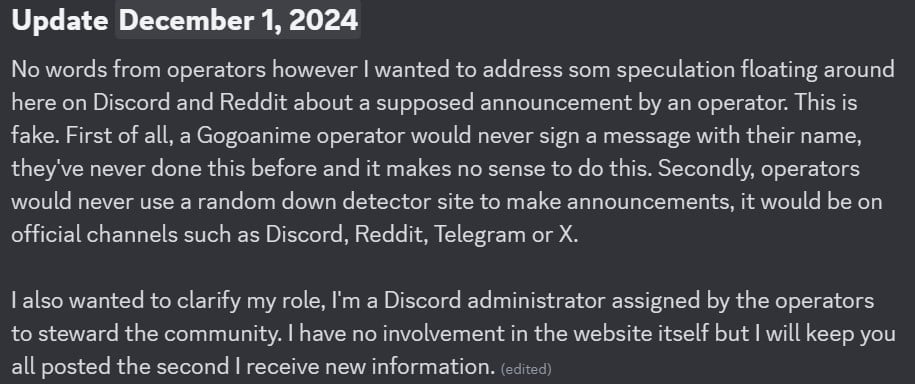
    So far, the site’s operators remain silent. The sites have been linked to Dramacool, which means that it may face similar copyright pressure. However, even the main moderators of the Discord channel, who are typically in the know, haven’t heard from the site’s operators in days.

    “No words from operators,” Discord moderator Undo wrote yesterday, dismissing rumors that the operators have formally thrown in the towel.

    No Word

    no word

    On the surface, GogoAnime’s downtime is reminiscent of the FMovies troubles that started earlier this year. At the time, FMovies simply stopped updating as well and, after a few weeks, the site shut down completely, together with many other piracy portals. We later learned that the Alliance for Creativity and Entertainment helped Vietnamese authorities to topple the ‘piracy ring’ .

    Regardless of the reasons for GogoAnime’s troubles, they are being felt at many other anime streaming sites that use it as a primary content source. All sites that scrape or mirror GogoAnime face the same dry spell today.

    Seeking Alternatives

    Rightsholders hope that these enforcement actions will drive people to legal alternatives. While these may get a boost, many former Dramacool, AnimeFenix, and GogoAnime users will simply look for new pirate homes.

    As a result, sites that remain online have seen an influx of new traffic over the past few days. This will undoubtedly increase the legal pressure on these alternatives, starting the cycle all over again. After all, an ‘invincible’ pirate site has yet to be invented.

    On that topic, it’s interesting to note that the relatively unknown file-sharing software Tribler reportedly saw an influx of Asian content last week. This includes many Korean drama series.

    Tribler is a BitTorrent client that’s been around for nearly two decades, developed by a research group at Delft University of Technology. The software uses decentralized search, removing the need for torrent sites, and has implemented ‘anonymity‘ by adding an onion routing layer to file transfers.

    This technical setup makes the file-sharing network resilient to external pressure. While we can’t draw any direct connections, the fact that Tribler’s userbase more than doubled this week suggests that the recent Asian troubles drove some people to the software.

    TorrentFreak spoke to Dr. Johan Pouwelse, leader of the university’s Tribler Lab, who confirmed that interest in the project surged over the past few days.

    “Our network is running red-hot, but thankfully it is fully operational,” Pouwelse says. “We’re completely in the dark why we’re suddenly a hit as we are blind to the anonymous downloads on the network.”

    Pouwelse notes that Tribler also witnessed a massive boost in users twelve years ago when Megaupload was pulled offline. At the time, Fox News touted Tribler as ‘invincible’ and the software has survived the rise and fall of many pirate sites since.

    Whether any of these alternatives will ‘stick’ has yet to be seen, but the recent shutdowns and disruptions show that anti-piracy tensions remain elevated.

    From: TF , for the latest news on copyright battles, piracy and more.

    • To chevron_right

      AnimeFenix Shuts Down & GogoAnime/Anitaku Freezes in Time

      news.movim.eu / TorrentFreak • 2 December 2024 • 4 minutes

    anime shutdown Pirates who are into Asian drama and anime were hit hard over the past week.
    On Wednesday, Dramacool announced that it would shut down its Asianc, Watchasia, Dramanice and Runasian websites, facing pressure from copyright holders.

    These sites catered to millions of users, as is exemplified by the shutdown message on X, which has been viewed more than five million times already . While alternatives still exist, pressure is mounting.

    Yesterday, the Spanish-language anime streaming portal AnimeFenix announced that it will also close its doors indefinitely. According to the team, the domain will be terminated following pressure from copyright holders. While exact details are lacking, the operators point a finger at Sony.

    “Sony now owns more than 60% of the anime industry with the purchase of Funimation and now also Kadokawa. The call is for you as consumers to be aware of the monopolies that the big companies are creating and through local regulations in your countries,” AnimeFenix writes.

    The pirate site is concerned that, by monopolizing the anime industry, legal content will become increasingly expensive. The creators themselves are not necessarily bearing the fruits of this. AnimeFenix’s role is finished, but the operators caution that piracy will prevail as long as the anime industry puts profits before its key assets; the creators and fans.

    “Piracy will never go away as long as there are companies with more greed than heart,” the site’s operators warn.

    AnimeFenix Farewell

    animefenix

    With over 12 million monthly visits, AnimeFenix will certainly be missed by many. However, there are even darker clouds forming on the horizon as another anime juggernaut appears to be in trouble. Over the past few days, GogoAnime, also known as Anitaku, has stopped adding new content.

    Together, GogoAnime and Anitaku have well over a hundred million monthly visits, making it one of the largest piracy portals to ever exist. While both sites are still accessible today, fresh content is no longer being added.

    So far, the site’s operators remain silent. The sites have been linked to Dramacool, which means that it may face similar copyright pressure. However, even the main moderators of the Discord channel, who are typically in the know, haven’t heard from the site’s operators in days.

    “No words from operators,” Discord moderator Undo wrote yesterday, dismissing rumors that the operators have formally thrown in the towel.

    No Word

    no word

    On the surface, GogoAnime’s downtime is reminiscent of the FMovies troubles that started earlier this year. At the time, FMovies simply stopped updating as well and, after a few weeks, the site shut down completely, together with many other piracy portals. We later learned that the Alliance for Creativity and Entertainment helped Vietnamese authorities to topple the ‘piracy ring’ .

    Regardless of the reasons for GogoAnime’s troubles, they are being felt at many other anime streaming sites that use it as a primary content source. All sites that scrape or mirror GogoAnime face the same dry spell today.

    Seeking Alternatives

    Rightsholders hope that these enforcement actions will drive people to legal alternatives. While these may get a boost, many former Dramacool, AnimeFenix, and GogoAnime users will simply look for new pirate homes.

    As a result, sites that remain online have seen an influx of new traffic over the past few days. This will undoubtedly increase the legal pressure on these alternatives, starting the cycle all over again. After all, an ‘invincible’ pirate site has yet to be invented.

    On that topic, it’s interesting to note that the relatively unknown file-sharing software Tribler reportedly saw an influx of Asian content last week. This includes many Korean drama series.

    Tribler is a BitTorrent client that’s been around for nearly two decades, developed by a research group at Delft University of Technology. The software uses decentralized search, removing the need for torrent sites, and has implemented ‘anonymity‘ by adding an onion routing layer to file transfers.

    This technical setup makes the file-sharing network resilient to external pressure. While we can’t draw any direct connections, the fact that Tribler’s userbase more than doubled this week suggests that the recent Asian troubles drove some people to the software.

    TorrentFreak spoke to Dr. Johan Pouwelse, leader of the university’s Tribler Lab, who confirmed that interest in the project surged over the past few days.

    “Our network is running red-hot, but thankfully it is fully operational,” Pouwelse says. “We’re completely in the dark why we’re suddenly a hit as we are blind to the anonymous downloads on the network.”

    Pouwelse notes that Tribler also witnessed a massive boost in users twelve years ago when Megaupload was pulled offline. At the time, Fox News touted Tribler as ‘invincible’ and the software has survived the rise and fall of many pirate sites since.

    Whether any of these alternatives will ‘stick’ has yet to be seen, but the recent shutdowns and disruptions show that anti-piracy tensions remain elevated.

    From: TF , for the latest news on copyright battles, piracy and more.

    • To chevron_right

      AnimeFenix Shuts Down & GogoAnime/Anitaku Freezes in Time

      news.movim.eu / TorrentFreak • 2 December 2024 • 4 minutes

    anime shutdown Pirates who are into Asian drama and anime were hit hard over the past week.

    On Wednesday, Dramacool announced that it would shut down its Asianc, Watchasia, Dramanice and Runasian websites, facing pressure from copyright holders.

    These sites catered to millions of users, as is exemplified by the shutdown message on X, which has been viewed more than five million times already . While alternatives still exist, pressure is mounting.

    Yesterday, the Spanish-language anime streaming portal AnimeFenix announced that it will also close its doors indefinitely. According to the team, the domain will be terminated following pressure from copyright holders. While exact details are lacking, the operators point a finger at Sony.

    “Sony now owns more than 60% of the anime industry with the purchase of Funimation and now also Kadokawa. The call is for you as consumers to be aware of the monopolies that the big companies are creating and through local regulations in your countries,” AnimeFenix writes.

    The pirate site is concerned that, by monopolizing the anime industry, legal content will become increasingly expensive. The creators themselves are not necessarily bearing the fruits of this. AnimeFenix’s role is finished, but the operators caution that piracy will prevail as long as the anime industry puts profits before its key assets; the creators and fans.

    “Piracy will never go away as long as there are companies with more greed than heart,” the site’s operators warn.

    AnimeFenix Farewell

    animefenix

    With over 12 million monthly visits, AnimeFenix will certainly be missed by many. However, there are even darker clouds forming on the horizon as another anime juggernaut appears to be in trouble. Over the past few days, GogoAnime, also known as Anitaku, has stopped adding new content.

    Together, GogoAnime and Anitaku have well over a hundred million monthly visits, making it one of the largest piracy portals to ever exist. While both sites are still accessible today, fresh content is no longer being added.

    So far, the site’s operators remain silent. The sites have been linked to Dramacool, which means that it may face similar copyright pressure. However, even the main moderators of the Discord channel, who are typically in the know, haven’t heard from the site’s operators in days.

    “No words from operators,” Discord moderator Undo wrote yesterday, dismissing rumors that the operators have formally thrown in the towel.

    No Word

    no word

    On the surface, GogoAnime’s downtime is reminiscent of the FMovies troubles that started earlier this year. At the time, FMovies simply stopped updating as well and, after a few weeks, the site shut down completely, together with many other piracy portals. We later learned that the Alliance for Creativity and Entertainment helped Vietnamese authorities to topple the ‘piracy ring’ .

    Regardless of the reasons for GogoAnime’s troubles, they are being felt at many other anime streaming sites that use it as a primary content source. All sites that scrape or mirror GogoAnime face the same dry spell today.

    Seeking Alternatives

    Rightsholders hope that these enforcement actions will drive people to legal alternatives. While these may get a boost, many former Dramacool, AnimeFenix, and GogoAnime users will simply look for new pirate homes.

    As a result, sites that remain online have seen an influx of new traffic over the past few days. This will undoubtedly increase the legal pressure on these alternatives, starting the cycle all over again. After all, an ‘invincible’ pirate site has yet to be invented.

    On that topic, it’s interesting to note that the relatively unknown file-sharing software Tribler reportedly saw an influx of Asian content last week. This includes many Korean drama series.

    Tribler is a BitTorrent client that’s been around for nearly two decades, developed by a research group at Delft University of Technology. The software uses decentralized search, removing the need for torrent sites, and has implemented ‘anonymity‘ by adding an onion routing layer to file transfers.

    This technical setup makes the file-sharing network resilient to external pressure. While we can’t draw any direct connections, the fact that Tribler’s userbase more than doubled this week suggests that the recent Asian troubles drove some people to the software.

    TorrentFreak spoke to Dr. Johan Pouwelse, leader of the university’s Tribler Lab, who confirmed that interest in the project surged over the past few days.

    “Our network is running red-hot, but thankfully it is fully operational,” Pouwelse says. “We’re completely in the dark why we’re suddenly a hit as we are blind to the anonymous downloads on the network.”

    Pouwelse notes that Tribler also witnessed a massive boost in users twelve years ago when Megaupload was pulled offline. At the time, Fox News touted Tribler as ‘invincible’ and the software has survived the rise and fall of many pirate sites since.

    Whether any of these alternatives will ‘stick’ has yet to be seen, but the recent shutdowns and disruptions show that anti-piracy tensions remain elevated.

    From: TF , for the latest news on copyright battles, piracy and more.