• To chevron_right

      EU and NL Domain Registries Take Down Piracy-Linked Domains

      news.movim.eu / TorrentFreak • 20 December 2024 • 4 minutes

    eurid sidn There are plenty of options for copyright holders to frustrate pirate site operations, but attacking their domain names is particularly effective.

    In recent years, various entertainment industry groups have called on the domain name industry to help out on this front.

    The MPA previously signed landmark agreements with registries , enabling the movie industry group to act as a “trusted notifier” of “pirate” domains. Other players in the domain name market have been more reserved.

    EU and NL Registries Tackle Pirate Domains

    The Public Interest Registry (PIR), for example, which oversees the .org gTLD, previously denied requests to take action against The Pirate Bay. According to PIR, caution is advised to ensure a “free, open, safe and secure internet”.

    In recent years, rightsholder pressure hasn’t abated. Domain name registries that fail to take action are now listed as “ notorious piracy markets ” themselves, as recent reports against the .cc, .io, and .tv domain extensions have shown.

    Politics also play a part. For example, U.S. lawmakers previously asked domain name registry VeriSign, known for managing the .com domain, to help tackle online piracy .

    EU and NL Registries Tackle Pirate Domains

    Despite these developments, there’s little public discussion about new agreements between domain registries and rightsholders. Given the sensitivities involved, not all collaboration needs a spotlight.

    This week, Dutch anti-piracy group BREIN reported that it had booked new success with its previously unknown ‘ registry strategy ‘.

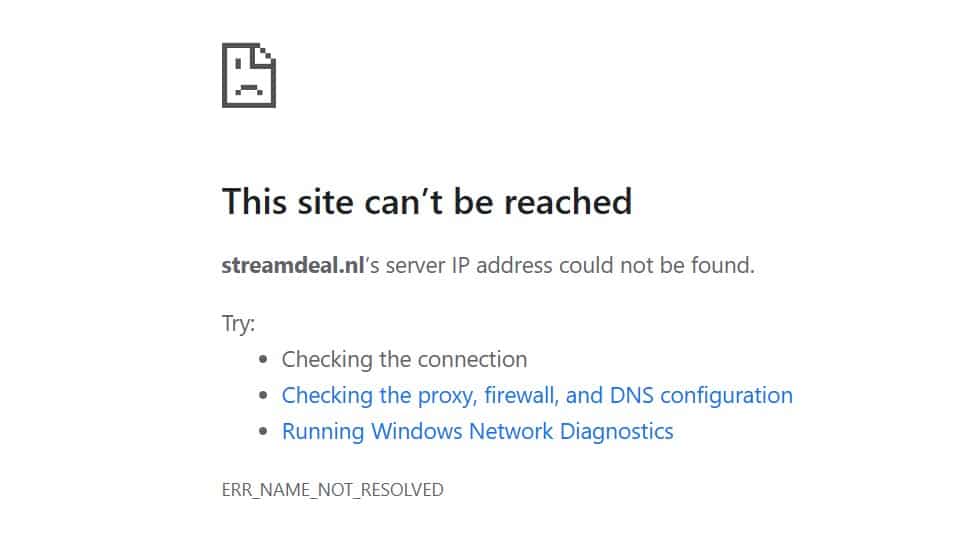
    Following a notice from BREIN, the SIDN (.nl) and EURid (.eu) registries took several pirate site domains offline. SIDN’s actions targeted IPTV-related domains, such as streamdeal.nl, iptvproviders.nl, omniptv.nl and iptvstreamplus.nl.

    Streamdeal Quarantined

    quarantined

    EURid reportedly removed seven domain names after BREIN reached out. These domains, which were used to provide access to pirated films, music, books and games, were registered though domain proxy services that shield the identity of the owners.

    The .eu domain names are not publicized as those sites use alternative gTLDs that remain active. Mentioning these domains in public could therefore serve as an unwanted advertisement.

    Reporting Illegal Content?

    BREIN says that these registries take responsibility by helping to shut down illegal activity. On what grounds these companies take action isn’t immediately clear.

    “Pirates like to use trustworthy top-level domains such as .nl and .eu for their illegal websites. The organizations responsible for this, SIDN and EURid, know this and take their responsibility by helping to combat illegality,” BREIN writes.

    The anti-piracy group goes on to mention that pirate IPTV services infringe copyrights. That violates the terms and conditions of the domain registries, so they can be terminated on these grounds. But were they?

    TorrentFreak reached out to both SIDN and EURid, requesting more information and both registries say that the domain name terminations referenced by BREIN were not copyright related.

    Inaccurate WHOIS Information

    SIDN spokesperson Marnie van Duijnhoven explains that the domain name registrations were canceled, because the owners didn’t provide or confirm the correct WHOIS registration data.

    “This is a standard procedure at SIDN that we apply if there is reason to doubt the correctness of the registrant’s data. The reason may be a report from a third party such as Stichting Brein, but also, for example, the Police,” Van Duijnhoven says.

    While these verification procedures were initiated in response to BREIN’s notifications, the decision to cancel the domain names was not directly related to the content on the sites. Instead, the cancellations were made under Articles 16 and 18 of SIDN’s terms and conditions, which cover inaccurate WHOIS information

    EURid spokesperson Reelika Kirna confirmed that inaccurate registrant data also triggered their response. This is a terms of service violation, but not one related to copyright.

    “Following the request from BREIN regarding seven .eu domain names, we carried out our standard procedure for registration data validation and subsequently suspended these domain names due to a breach of Articles 3(b) and 4(d) and (e) of our Terms and Conditions,” Kirna informed us.

    Roads to Rome

    BREIN’s director Bastiaan van Ramshorst informs us that SIDN and EURid are indeed correct. In these instances, copyright wasn’t the reason to report the domains, at least on paper.

    The anti-piracy group previously reported domains to SIDN on the basis of copyright infringement. These complaints are handled under the separate notice and takedown procedure. That wasn’t the case here, but the aim is the same.

    “BREIN’s goal is the same: to take the domain offline because copyright and related rights are being violated on a large scale. The grounds on which SIDN takes action does not matter to us.”

    “Both roads lead to Rome. Obviously illegal websites almost always have incorrect WHOIS data because infringers want to remain anonymous. BREIN can and does use both grounds,” Van Ramshorst adds.

    Whether any of these roads is easier than the other is unknown, but SIDN’s latest transparency report shows that notice and takedown (NTD) reports are rare. The registry received 39 NTD requests in the first three quarters of the year.

    During the same period, SIDN launched over 5,000 procedures under article 16 and 18 of its terms and conditions, which includes claims concerning inaccurate WHOIS information.

    From: TF , for the latest news on copyright battles, piracy and more.

    • To chevron_right

      EU and NL Domain Registries Take Down Piracy-Linked Domains

      news.movim.eu / TorrentFreak • 20 December 2024 • 4 minutes

    eurid sidn There are plenty of options for copyright holders to frustrate pirate site operations, but attacking their domain names is particularly effective.

    In recent years, various entertainment industry groups have called on the domain name industry to help out on this front.

    The MPA previously signed landmark agreements with registries , enabling the movie industry group to act as a “trusted notifier” of “pirate” domains. Other players in the domain name market have been more reserved.

    EU and NL Registries Tackle Pirate Domains

    The Public Interest Registry (PIR), for example, which oversees the .org gTLD, previously denied requests to take action against The Pirate Bay. According to PIR, caution is advised to ensure a “free, open, safe and secure internet”.

    In recent years, rightsholder pressure hasn’t abated. Domain name registries that fail to take action are now listed as “ notorious piracy markets ” themselves, as recent reports against the .cc, .io, and .tv domain extensions have shown.

    Politics also play a part. For example, U.S. lawmakers previously asked domain name registry VeriSign, known for managing the .com domain, to help tackle online piracy .

    EU and NL Registries Tackle Pirate Domains

    Despite these developments, there’s little public discussion about new agreements between domain registries and rightsholders. Given the sensitivities involved, not all collaboration needs a spotlight.

    This week, Dutch anti-piracy group BREIN reported that it had booked new success with its previously unknown ‘ registry strategy ‘.

    Following a notice from BREIN, the SIDN (.nl) and EURid (.eu) registries took several pirate site domains offline. SIDN’s actions targeted IPTV-related domains, such as streamdeal.nl, iptvproviders.nl, omniptv.nl and iptvstreamplus.nl.

    Streamdeal Quarantined

    quarantined

    EURid reportedly removed seven domain names after BREIN reached out. These domains, which were used to provide access to pirated films, music, books and games, were registered though domain proxy services that shield the identity of the owners.

    The .eu domain names are not publicized as those sites use alternative gTLDs that remain active. Mentioning these domains in public could therefore serve as an unwanted advertisement.

    Reporting Illegal Content?

    BREIN says that these registries take responsibility by helping to shut down illegal activity. On what grounds these companies take action isn’t immediately clear.

    “Pirates like to use trustworthy top-level domains such as .nl and .eu for their illegal websites. The organizations responsible for this, SIDN and EURid, know this and take their responsibility by helping to combat illegality,” BREIN writes.

    The anti-piracy group goes on to mention that pirate IPTV services infringe copyrights. That violates the terms and conditions of the domain registries, so they can be terminated on these grounds. But were they?

    TorrentFreak reached out to both SIDN and EURid, requesting more information and both registries say that the domain name terminations referenced by BREIN were not copyright related.

    Inaccurate WHOIS Information

    SIDN spokesperson Marnie van Duijnhoven explains that the domain name registrations were canceled, because the owners didn’t provide or confirm the correct WHOIS registration data.

    “This is a standard procedure at SIDN that we apply if there is reason to doubt the correctness of the registrant’s data. The reason may be a report from a third party such as Stichting Brein, but also, for example, the Police,” Van Duijnhoven says.

    While these verification procedures were initiated in response to BREIN’s notifications, the decision to cancel the domain names was not directly related to the content on the sites. Instead, the cancellations were made under Articles 16 and 18 of SIDN’s terms and conditions, which cover inaccurate WHOIS information

    EURid spokesperson Reelika Kirna confirmed that inaccurate registrant data also triggered their response. This is a terms of service violation, but not one related to copyright.

    “Following the request from BREIN regarding seven .eu domain names, we carried out our standard procedure for registration data validation and subsequently suspended these domain names due to a breach of Articles 3(b) and 4(d) and (e) of our Terms and Conditions,” Kirna informed us.

    Roads to Rome

    BREIN’s director Bastiaan van Ramshorst informs us that SIDN and EURid are indeed correct. In these instances, copyright wasn’t the reason to report the domains, at least on paper.

    The anti-piracy group previously reported domains to SIDN on the basis of copyright infringement. These complaints are handled under the separate notice and takedown procedure. That wasn’t the case here, but the aim is the same.

    “BREIN’s goal is the same: to take the domain offline because copyright and related rights are being violated on a large scale. The grounds on which SIDN takes action does not matter to us.”

    “Both roads lead to Rome. Obviously illegal websites almost always have incorrect WHOIS data because infringers want to remain anonymous. BREIN can and does use both grounds,” Van Ramshorst adds.

    Whether any of these roads is easier than the other is unknown, but SIDN’s latest transparency report shows that notice and takedown (NTD) reports are rare. The registry received 39 NTD requests in the first three quarters of the year.

    During the same period, SIDN launched over 5,000 procedures under article 16 and 18 of its terms and conditions, which includes claims concerning inaccurate WHOIS information.

    From: TF , for the latest news on copyright battles, piracy and more.

    • To chevron_right

      EU and NL Domain Registries Take Down Piracy-Linked Domains

      news.movim.eu / TorrentFreak • 20 December 2024 • 4 minutes

    eurid sidn There are plenty of options for copyright holders to frustrate pirate site operations, but attacking their domain names is particularly effective.

    In recent years, various entertainment industry groups have called on the domain name industry to help out on this front.

    The MPA previously signed landmark agreements with registries , enabling the movie industry group to act as a “trusted notifier” of “pirate” domains. Other players in the domain name market have been more reserved.

    EU and NL Registries Tackle Pirate Domains

    The Public Interest Registry (PIR), for example, which oversees the .org gTLD, previously denied requests to take action against The Pirate Bay. According to PIR, caution is advised to ensure a “free, open, safe and secure internet”.

    In recent years, rightsholder pressure hasn’t abated. Domain name registries that fail to take action are now listed as “ notorious piracy markets ” themselves, as recent reports against the .cc, .io, and .tv domain extensions have shown.

    Politics also play a part. For example, U.S. lawmakers previously asked domain name registry VeriSign, known for managing the .com domain, to help tackle online piracy .

    EU and NL Registries Tackle Pirate Domains

    Despite these developments, there’s little public discussion about new agreements between domain registries and rightsholders. Given the sensitivities involved, not all collaboration needs a spotlight.

    This week, Dutch anti-piracy group BREIN reported that it had booked new success with its previously unknown ‘ registry strategy ‘.

    Following a notice from BREIN, the SIDN (.nl) and EURid (.eu) registries took several pirate site domains offline. SIDN’s actions targeted IPTV-related domains, such as streamdeal.nl, iptvproviders.nl, omniptv.nl and iptvstreamplus.nl.

    Streamdeal Quarantined

    quarantined

    EURid reportedly removed seven domain names after BREIN reached out. These domains, which were used to provide access to pirated films, music, books and games, were registered though domain proxy services that shield the identity of the owners.

    The .eu domain names are not publicized as those sites use alternative gTLDs that remain active. Mentioning these domains in public could therefore serve as an unwanted advertisement.

    Reporting Illegal Content?

    BREIN says that these registries take responsibility by helping to shut down illegal activity. On what grounds these companies take action isn’t immediately clear.

    “Pirates like to use trustworthy top-level domains such as .nl and .eu for their illegal websites. The organizations responsible for this, SIDN and EURid, know this and take their responsibility by helping to combat illegality,” BREIN writes.

    The anti-piracy group goes on to mention that pirate IPTV services infringe copyrights. That violates the terms and conditions of the domain registries, so they can be terminated on these grounds. But were they?

    TorrentFreak reached out to both SIDN and EURid, requesting more information and both registries say that the domain name terminations referenced by BREIN were not copyright related.

    Inaccurate WHOIS Information

    SIDN spokesperson Marnie van Duijnhoven explains that the domain name registrations were canceled, because the owners didn’t provide or confirm the correct WHOIS registration data.

    “This is a standard procedure at SIDN that we apply if there is reason to doubt the correctness of the registrant’s data. The reason may be a report from a third party such as Stichting Brein, but also, for example, the Police,” Van Duijnhoven says.

    While these verification procedures were initiated in response to BREIN’s notifications, the decision to cancel the domain names was not directly related to the content on the sites. Instead, the cancellations were made under Articles 16 and 18 of SIDN’s terms and conditions, which cover inaccurate WHOIS information

    EURid spokesperson Reelika Kirna confirmed that inaccurate registrant data also triggered their response. This is a terms of service violation, but not one related to copyright.

    “Following the request from BREIN regarding seven .eu domain names, we carried out our standard procedure for registration data validation and subsequently suspended these domain names due to a breach of Articles 3(b) and 4(d) and (e) of our Terms and Conditions,” Kirna informed us.

    Roads to Rome

    BREIN’s director Bastiaan van Ramshorst informs us that SIDN and EURid are indeed correct. In these instances, copyright wasn’t the reason to report the domains, at least on paper.

    The anti-piracy group previously reported domains to SIDN on the basis of copyright infringement. These complaints are handled under the separate notice and takedown procedure. That wasn’t the case here, but the aim is the same.

    “BREIN’s goal is the same: to take the domain offline because copyright and related rights are being violated on a large scale. The grounds on which SIDN takes action does not matter to us.”

    “Both roads lead to Rome. Obviously illegal websites almost always have incorrect WHOIS data because infringers want to remain anonymous. BREIN can and does use both grounds,” Van Ramshorst adds.

    Whether any of these roads is easier than the other is unknown, but SIDN’s latest transparency report shows that notice and takedown (NTD) reports are rare. The registry received 39 NTD requests in the first three quarters of the year.

    During the same period, SIDN launched over 5,000 procedures under article 16 and 18 of its terms and conditions, which includes claims concerning inaccurate WHOIS information.

    From: TF , for the latest news on copyright battles, piracy and more.

    • To chevron_right

      Dismantling a 22m User Pirate IPTV Service Led to Big Rise in ISP Blocking

      news.movim.eu / TorrentFreak • 20 December 2024 • 3 minutes

    iptv-ufo-s For those who enjoy reading professional reports filled with statistics and detailed analysis, the piracy landscape has an endless supply.

    Many reports are highly informative and, regardless of underlying political aims, few get things completely wrong.

    Yet, even the most detailed studies and elaborate industry reports can at times leave the reader feeling puzzled. On the one hand, multi-billion dollar companies have more piracy data and intelligence than anyone else, period. On the other, nobody needs a meteorologist’s report to determine whether it’s raining outside.

    In no other area is this more evident than in the promotion of reportedly effective site-blocking measures; and in no other country has site-blocking been adopted so comprehensively than in Italy. Bur even with very few guardrails and direct access to every tool available, the last year has seen tens of thousands of IP addresses and domains blocked by rightsholders, despite an obvious decline in the availability of pirated content.

    Targeting The Source

    By definition, site-blocking doesn’t remove pirated content from the internet. That’s why removing suppliers from the ecosystem is seen as a much better response than putting up endless, easily circumvented roadblocks. Late November, an investigation led by the Italians came to fruition with an enforcement operation billed as the largest to ever target a pirate IPTV network.

    Operation Takendown reportedly took place on November 26/27 and according to authorities in Italy and several other countries in Europe, it “dismantled” an international pirate IPTV network serving 22 million users and generating an estimated €3 billion per year. At least 11 suspects were detained and around 100 others were said to be under investigation. Meanwhile, there were reports of subscribers all over Europe losing access to channels and in some cases their entire service.

    At the time, this certainly sounded like a very big deal. Law enforcement seized 29 servers, 270 pieces of IPTV equipment, searched 112 private homes, identified close to 600 IPTV subscription resellers, and seized EUR 1.6 million in cryptocurrency plus EUR 40,000 in cash. Since the pirate IPTV provider in question was seen as a significant threat to the Italian live sports and broadcasting sectors, its reported demise was enthusiastically celebrated in the media.

    Eliminating such a massive supplier should in theory restrict availability of illegal streams in Italy, even if only temporarily. After all, that was the entire point of the operation. By extension then, demand for ISP blocking in Italy should be reduced too, even if only for a short time.

    Three Weeks Before, Three Weeks After

    While keeping an open mind, we expected a sizeable albeit temporary dip in blocking tickets filed at Piracy Shield, followed by a relatively short recovery as the pirate IPTV market repaired itself and everything returned to normal.

    Using Piracy Shield blocking data unofficially made available at piracyshield.iperv.it , we took the raid dates of November 26/27 as the central point. From there we examined every blocking ticket filed by rightsholders in the three weeks preceding Operation Takendown, and for comparison every ticket filed in the three weeks after.

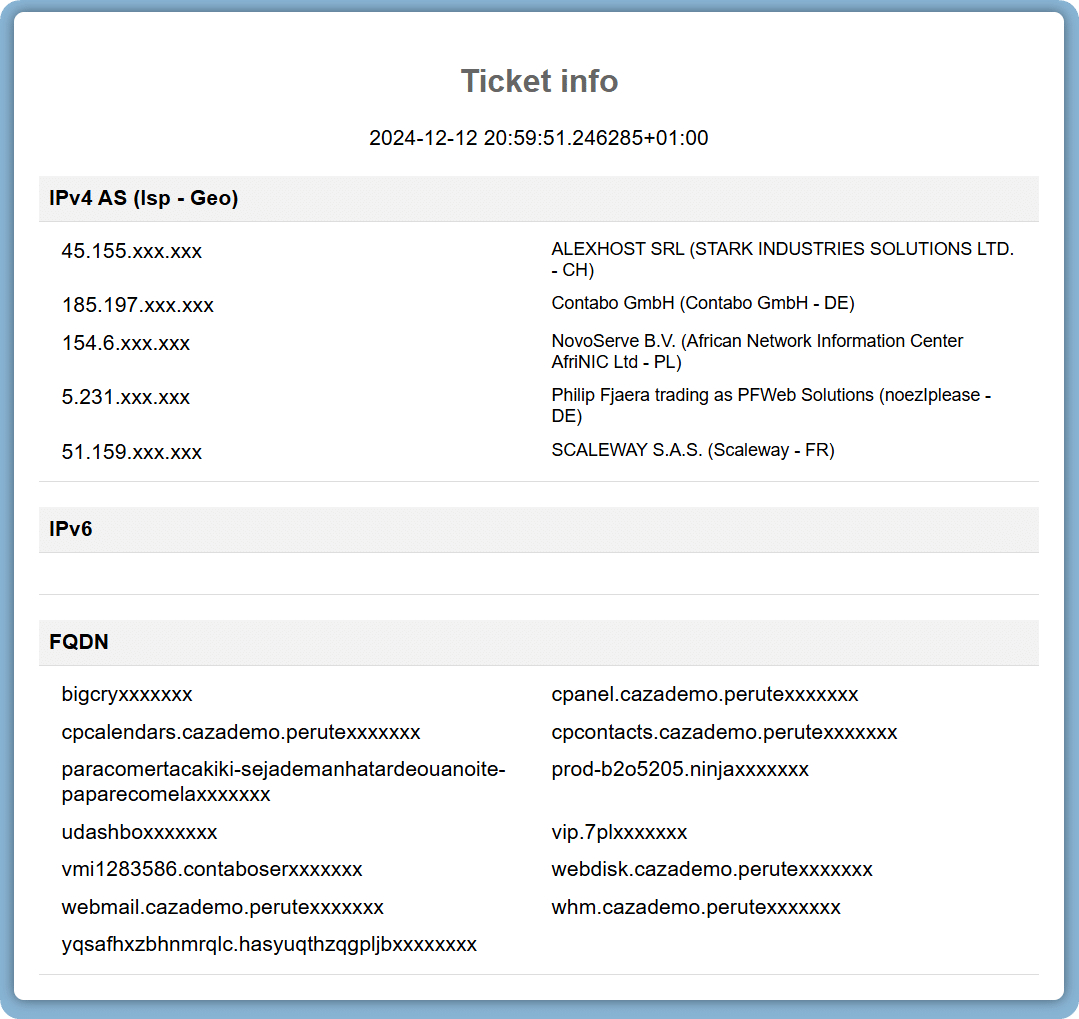
    A typical Piracy Shield ticket (credit: piracyshield.iperv.it ) piracy-shield-ticket

    During that six-week period, rightsholders filed around 186 Piracy Shield tickets similar to the one above, containing instructions for local ISPs to block a total of 527 IP addresses and 3,322 fully qualified domain names.

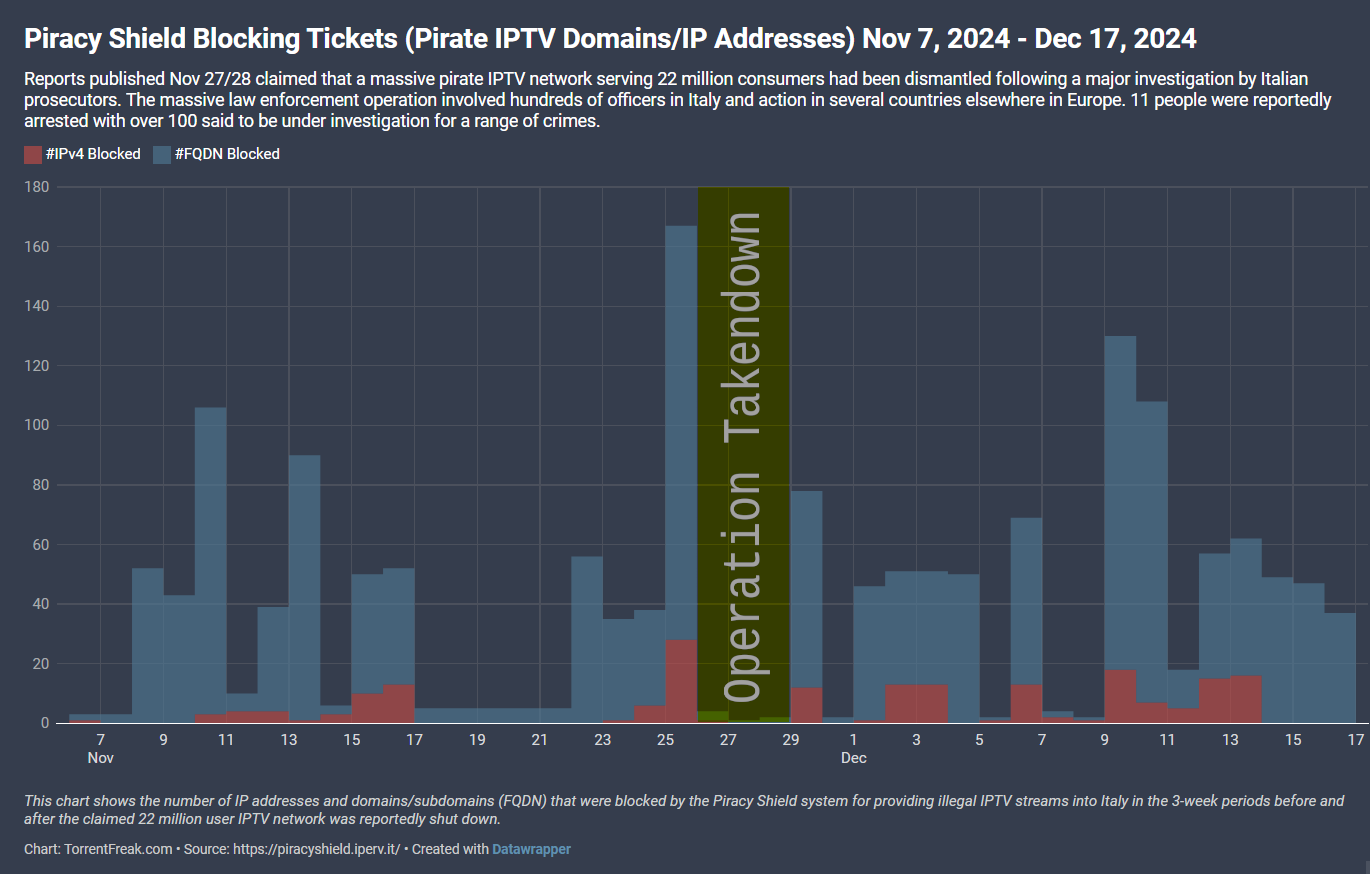
    The chart below shows domain name blocking in blue, IP address blocking in red, and the approximate dates of the operation in green in the center.

    click to enlarge piracyshield-blocking-op-takendown

    The data reveals that in the three-week period leading up to the enforcement action, rightsholders’ tickets required ISPs to block 204 IP addresses after they were observed providing access to pirate IPTV.

    In the three weeks following the claimed “dismantling” of the 22 million-user service, rightsholders’ tickets required ISPs to block 323 IP addresses, up 50%+ on the preceding three weeks.

    In respect of domain name blocking, the 1,322 FQDNs requested in the three weeks before the takedown, were easily eclipsed by 2,000 domains listed for blocking in the three-week period afterward.

    Apparently, there were still plenty of piracy threats. And indeed, reports from a number of sources indicate that subscribers who lost service around November 26/27 had their channels restored within 48/72 hours.

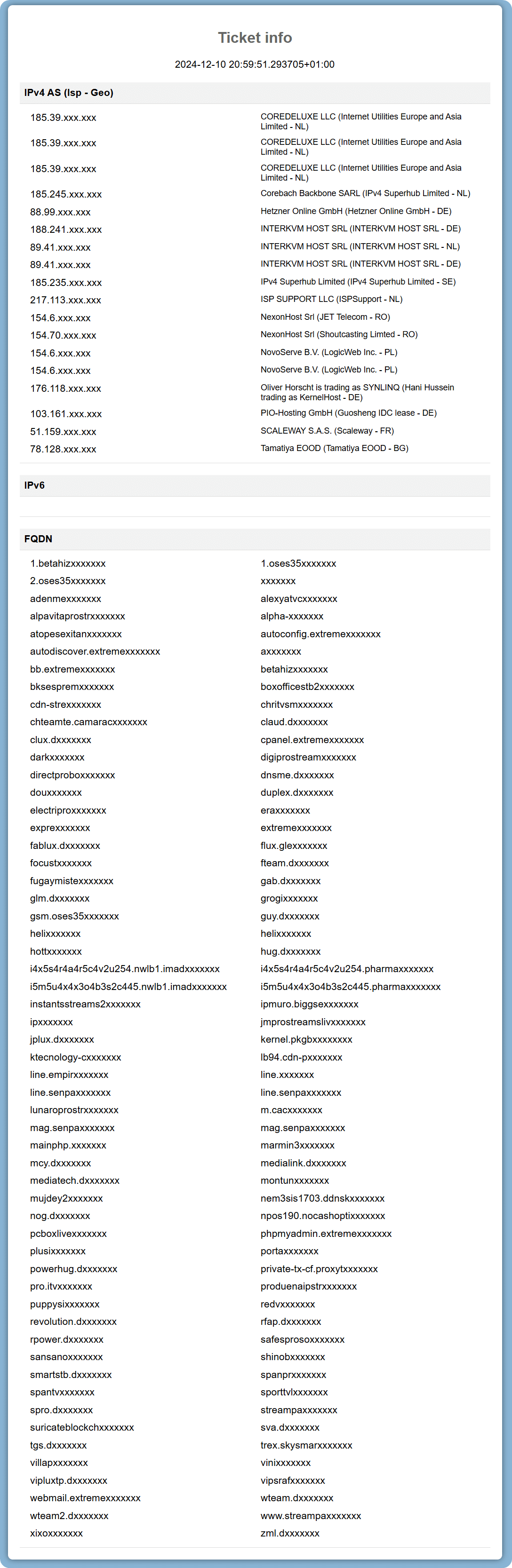
    Meanwhile, tickets like the one below are being filed almost daily and on some days, several at a time. It’s a perpetual workload that somehow seems to increase when massive providers get shut down or ‘dismantled’.

    ps-ticket-1

    From: TF , for the latest news on copyright battles, piracy and more.

    • To chevron_right

      Dismantling a 22m User Pirate IPTV Service Led to Big Rise in ISP Blocking

      news.movim.eu / TorrentFreak • 20 December 2024 • 3 minutes

    iptv-ufo-s For those who enjoy reading professional reports filled with statistics and detailed analysis, the piracy landscape has an endless supply.

    Many reports are highly informative and, regardless of underlying political aims, few get things completely wrong.

    Yet, even the most detailed studies and elaborate industry reports can at times leave the reader feeling puzzled. On the one hand, multi-billion dollar companies have more piracy data and intelligence than anyone else, period. On the other, nobody needs a meteorologist’s report to determine whether it’s raining outside.

    In no other area is this more evident than in the promotion of reportedly effective site-blocking measures; and in no other country has site-blocking been adopted so comprehensively than in Italy. Bur even with very few guardrails and direct access to every tool available, the last year has seen tens of thousands of IP addresses and domains blocked by rightsholders, despite an obvious decline in the availability of pirated content.

    Targeting The Source

    By definition, site-blocking doesn’t remove pirated content from the internet. That’s why removing suppliers from the ecosystem is seen as a much better response than putting up endless, easily circumvented roadblocks. Late November, an investigation led by the Italians came to fruition with an enforcement operation billed as the largest to ever target a pirate IPTV network.

    Operation Takendown reportedly took place on November 26/27 and according to authorities in Italy and several other countries in Europe, it “dismantled” an international pirate IPTV network serving 22 million users and generating an estimated €3 billion per year. At least 11 suspects were detained and around 100 others were said to be under investigation. Meanwhile, there were reports of subscribers all over Europe losing access to channels and in some cases their entire service.

    At the time, this certainly sounded like a very big deal. Law enforcement seized 29 servers, 270 pieces of IPTV equipment, searched 112 private homes, identified close to 600 IPTV subscription resellers, and seized EUR 1.6 million in cryptocurrency plus EUR 40,000 in cash. Since the pirate IPTV provider in question was seen as a significant threat to the Italian live sports and broadcasting sectors, its reported demise was enthusiastically celebrated in the media.

    Eliminating such a massive supplier should in theory restrict availability of illegal streams in Italy, even if only temporarily. After all, that was the entire point of the operation. By extension then, demand for ISP blocking in Italy should be reduced too, even if only for a short time.

    Three Weeks Before, Three Weeks After

    While keeping an open mind, we expected a sizeable albeit temporary dip in blocking tickets filed at Piracy Shield, followed by a relatively short recovery as the pirate IPTV market repaired itself and everything returned to normal.

    Using Piracy Shield blocking data unofficially made available at piracyshield.iperv.it , we took the raid dates of November 26/27 as the central point. From there we examined every blocking ticket filed by rightsholders in the three weeks preceding Operation Takendown, and for comparison every ticket filed in the three weeks after.

    A typical Piracy Shield ticket (credit: piracyshield.iperv.it ) piracy-shield-ticket

    During that six-week period, rightsholders filed around 186 Piracy Shield tickets similar to the one above, containing instructions for local ISPs to block a total of 527 IP addresses and 3,322 fully qualified domain names.

    The chart below shows domain name blocking in blue, IP address blocking in red, and the approximate dates of the operation in green in the center.

    click to enlarge piracyshield-blocking-op-takendown

    The data reveals that in the three-week period leading up to the enforcement action, rightsholders’ tickets required ISPs to block 204 IP addresses after they were observed providing access to pirate IPTV.

    In the three weeks following the claimed “dismantling” of the 22 million-user service, rightsholders’ tickets required ISPs to block 323 IP addresses, up 50%+ on the preceding three weeks.

    In respect of domain name blocking, the 1,322 FQDNs requested in the three weeks before the takedown, were easily eclipsed by 2,000 domains listed for blocking in the three-week period afterward.

    Apparently, there were still plenty of piracy threats. And indeed, reports from a number of sources indicate that subscribers who lost service around November 26/27 had their channels restored within 48/72 hours.

    Meanwhile, tickets like the one below are being filed almost daily and on some days, several at a time. It’s a perpetual workload that somehow seems to increase when massive providers get shut down or ‘dismantled’.

    ps-ticket-1

    From: TF , for the latest news on copyright battles, piracy and more.

    • To chevron_right

      Dismantling a 22m User Pirate IPTV Service Led to Big Rise in ISP Blocking

      news.movim.eu / TorrentFreak • 20 December 2024 • 3 minutes

    iptv-ufo-s For those who enjoy reading professional reports filled with statistics and detailed analysis, the piracy landscape has an endless supply.

    Many reports are highly informative and, regardless of underlying political aims, few get things completely wrong.

    Yet, even the most detailed studies and elaborate industry reports can at times leave the reader feeling puzzled. On the one hand, multi-billion dollar companies have more piracy data and intelligence than anyone else, period. On the other, nobody needs a meteorologist’s report to determine whether it’s raining outside.

    In no other area is this more evident than in the promotion of reportedly effective site-blocking measures; and in no other country has site-blocking been adopted so comprehensively than in Italy. Bur even with very few guardrails and direct access to every tool available, the last year has seen tens of thousands of IP addresses and domains blocked by rightsholders, despite an obvious decline in the availability of pirated content.

    Targeting The Source

    By definition, site-blocking doesn’t remove pirated content from the internet. That’s why removing suppliers from the ecosystem is seen as a much better response than putting up endless, easily circumvented roadblocks. Late November, an investigation led by the Italians came to fruition with an enforcement operation billed as the largest to ever target a pirate IPTV network.

    Operation Takendown reportedly took place on November 26/27 and according to authorities in Italy and several other countries in Europe, it “dismantled” an international pirate IPTV network serving 22 million users and generating an estimated €3 billion per year. At least 11 suspects were detained and around 100 others were said to be under investigation. Meanwhile, there were reports of subscribers all over Europe losing access to channels and in some cases their entire service.

    At the time, this certainly sounded like a very big deal. Law enforcement seized 29 servers, 270 pieces of IPTV equipment, searched 112 private homes, identified close to 600 IPTV subscription resellers, and seized EUR 1.6 million in cryptocurrency plus EUR 40,000 in cash. Since the pirate IPTV provider in question was seen as a significant threat to the Italian live sports and broadcasting sectors, its reported demise was enthusiastically celebrated in the media.

    Eliminating such a massive supplier should in theory restrict availability of illegal streams in Italy, even if only temporarily. After all, that was the entire point of the operation. By extension then, demand for ISP blocking in Italy should be reduced too, even if only for a short time.

    Three Weeks Before, Three Weeks After

    While keeping an open mind, we expected a sizeable albeit temporary dip in blocking tickets filed at Piracy Shield, followed by a relatively short recovery as the pirate IPTV market repaired itself and everything returned to normal.

    Using Piracy Shield blocking data unofficially made available at piracyshield.iperv.it , we took the raid dates of November 26/27 as the central point. From there we examined every blocking ticket filed by rightsholders in the three weeks preceding Operation Takendown, and for comparison every ticket filed in the three weeks after.

    A typical Piracy Shield ticket (credit: piracyshield.iperv.it ) piracy-shield-ticket

    During that six-week period, rightsholders filed around 186 Piracy Shield tickets similar to the one above, containing instructions for local ISPs to block a total of 527 IP addresses and 3,322 fully qualified domain names.

    The chart below shows domain name blocking in blue, IP address blocking in red, and the approximate dates of the operation in green in the center.

    click to enlarge piracyshield-blocking-op-takendown

    The data reveals that in the three-week period leading up to the enforcement action, rightsholders’ tickets required ISPs to block 204 IP addresses after they were observed providing access to pirate IPTV.

    In the three weeks following the claimed “dismantling” of the 22 million-user service, rightsholders’ tickets required ISPs to block 323 IP addresses, up 50%+ on the preceding three weeks.

    In respect of domain name blocking, the 1,322 FQDNs requested in the three weeks before the takedown, were easily eclipsed by 2,000 domains listed for blocking in the three-week period afterward.

    Apparently, there were still plenty of piracy threats. And indeed, reports from a number of sources indicate that subscribers who lost service around November 26/27 had their channels restored within 48/72 hours.

    Meanwhile, tickets like the one below are being filed almost daily and on some days, several at a time. It’s a perpetual workload that somehow seems to increase when massive providers get shut down or ‘dismantled’.

    ps-ticket-1

    From: TF , for the latest news on copyright battles, piracy and more.

    • To chevron_right

      Suprnova’s Founder Speaks: 20 Years, Many Lessons, and a YouTube Empire

      news.movim.eu / TorrentFreak • 19 December 2024 • 13 minutes

    suprnova In the fall of 2002, Suprnova.org launched as one of the first sites dedicated to sharing ‘torrents’.

    At the time, Napster has just shut down, leaving a void in the file-sharing landscape. A Slovenian teenager named Andrej Preston has just discovered the new BitTorrent protocol at the time and decided to embrace it.

    Andrej, commonly known under the nickname ‘Sloncek’, started Suprnova out of personal interest, as he couldn’t watch some TV-shows in his home country. Like many of these early hobby projects, it started as a very primitive setup, hosted on a Linux box at Peston’s home.

    In the weeks that followed, word of the “Universal BitTorrent Source” spread like wildfire, maxing out the meager 16kb/s upload capacity of the residential internet connection. Faced with this explosive growth, Suprnova was moved to an external hosting company, with many mirror sites later helping to distribute the traffic.

    December 19, 2004: Suprnova.org Shuts Down

    In record time, Suprnova became one of the most visited websites on the Internet. It became the go-to site for pirates who had discovered the unlimited sharing capacity of BitTorrent and the community that came with it. It also served as inspiration for other torrent sites that launched later, The Pirate Bay included.

    20+ Years Ago…

    Just as quickly as it rose to stardom, exactly twenty years ago today on December 19, 2004, Suprnova went dark . Initially, not much was known about the circumstances, but Andrej later said that he pulled the plug after he started reading about himself in the newspapers. Something didn’t feel right .

    In hindsight, this was likely a pivotal decision. A month after the shutdown, police raided Andrej’s home, taking equipment and media as part of a criminal investigation. The case was closed in October 2005, but it’s not hard to see how things may have ended differently if the site had been active.

    Not all decisions made at the time were great. Following the demise of Suprnova, Andrej became the spokesperson for the ambitious file-sharing software startup eXeem , which failed miserably. The same can be said for the relaunch of Suprnova in 2009 by The Pirate Bay, which Andrej wasn’t actively involved in. That never really took off.

    Academy of Art University

    Instead of focusing on new file-sharing ventures, Andrej explored his creative side. He dreamed of being in the film and TV business and wanted to study in the United States, close to LA. Eventually, he was admitted to Academy of Art University in San Francisco.

    Ironically, the funds he earned from Suprnova helped him pursue this dream, but the money eventually dried up and Andrej worked as a Resident Assistant to get free room and board. Together with funds scraped together by his parents, he made it though school.

    During this time, Andrej also gained experience at an online video production company, working for free. He was also the driving power and creative mind behind TorrentFreak TV , which offered more room to improve his skills between 2008 and 2010. While that project stopped after two seasons, the passion for online video certainly wasn’t over.

    A YouTube Star…

    Today, Andrej is the owner of “ The Infographics Show ” a YouTube channel with more than 14 million subscribers. The first videos were posted on Suprnova’s video portal back in 2011. There are still traces of Suprnova.org on YouTube today, as the channel’s oldest videos display its logo in their intro .

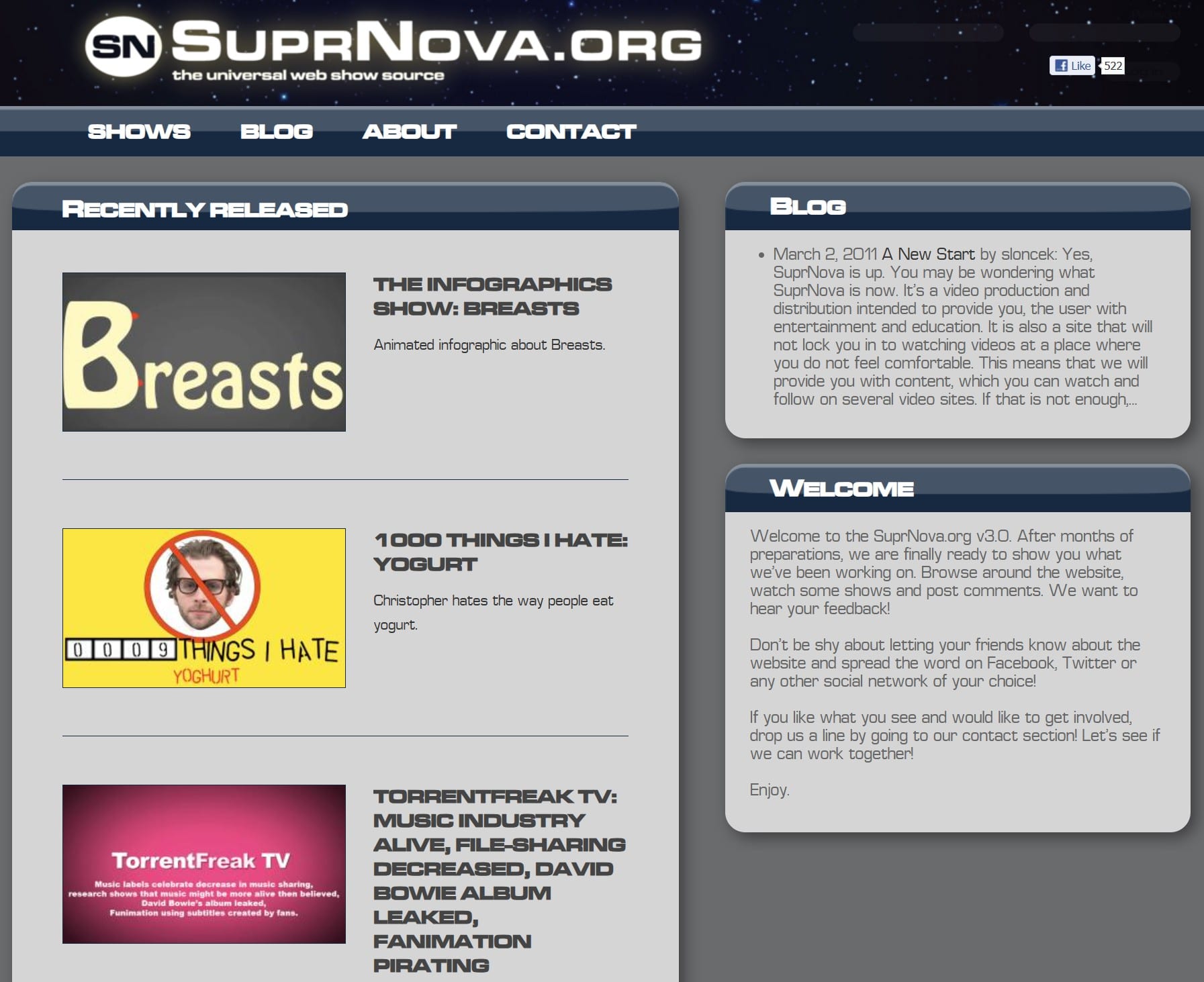
    Video Portal (2011)

    With more than a decade of YouTube experience, six billion video views, and a team that consists of nearly 200 people, Suprnova’s founder has come a long way. But what was this journey like? About time to hear his thoughts again, twenty years after he pulled the plug.

    We typically don’t post interviews in full, but we gladly make an exception here for what is a truly authentic story, with remarkable depth and detail tracing back to the early days of torrents. In addition, it offers a unique perspective on copyright, online entertainment, and life in general.

    ——

    TF: Looking back 20 years, what’s your overriding feeling about Suprnova.org? Pride, regret, something else?

    Andrej: Honestly I feel like I’ve lived quite a few lives. Do I look at it with a particular feeling? It’s kind of hard to put into words. I’d say for most of my adult life, I saw it as just something that happened. It’s the only life I know.

    As I’m quickly approaching 40, I view the past with quite different eyes. I am proud of myself and the size of the project I ran starting at the age of 15. Is my view of copyrights and business in general as naive as it was back then? Absolutely no, and I wouldn’t risk doing something like that today.

    But overall, in short, yeah, I am proud. I am proud of the project and who it made me today. I also feel so lucky for the life long friends I made because of it.

    TF: The profits generated though Suprnova allowed you to study in the United States. Why did you choose the Academy of Arts in San Francisco? How did that go?

    Andrej: I used all the money I made to put myself through school. I loved film & tv and I felt that, the only way to do it at the scale I dreamt of, required me move to the states. But I was never a great student.

    My grades through school were pretty much between a C and a D. I attended a Waldorf school through all my school years but even that felt like it wasn’t right for me in terms of education. So, I had to choose a school that offered a TV Producing major that had open enrollment and I really wanted to be close to LA.

    I worked through the whole school process. I was a Resident Assistant for 3 out of 4 years to get room and board for free and I worked for almost two years for free as an intern at an online video production company to gain additional skills and experience.

    I also ran out of money to continue paying for my school and had to have my parents take out a loan against their property they lived in and I grew up in. Having to study and my homework be something I was so passionate about made it really easy to get good grades. It was the first time in my life that I felt school came easy.

    TF: After handing over the Suprnova.org domain to The Pirate Bay briefly, you later regained control. In 2011 you relaunched is as a video portal, briefly showing TorrentFreak TV episodes and a new project called the “Infographics Show”. Where did the idea for the Infographics Show come from?

    Andrej: I realized that I really loved everything internet and as much as I felt hurt by being torn to pieces online by people for launching eXeem – which was also a financial debacle – I needed to embrace what I really loved.

    I was fortunate enough to be given an opportunity by you to record some TorrentFreak episodes, which actually helped me learn a lot more about the online video streaming landscape.

    I was also a huge fan of statistics, data and visual representations of them. I had an idea that if I just took a static infographic and made it animated people would for sure want to watch it, as that’s something I’d want to watch. The show has evolved a lot since then and is an ‘infographic’ only in its name.

    TF: It’s been over a decade since you launched The Infographics Show on YouTube, which now has millions of subscribers. How do you look back on the past years? Any milestones you can share?

    Andrej: The weird part about milestones is that the bigger they are, the less they mean. The Infographics Show now sits at around 14.7 million subscribers with over 6 billion views and over 5 thousand videos made.

    The Infographics Show (2024)

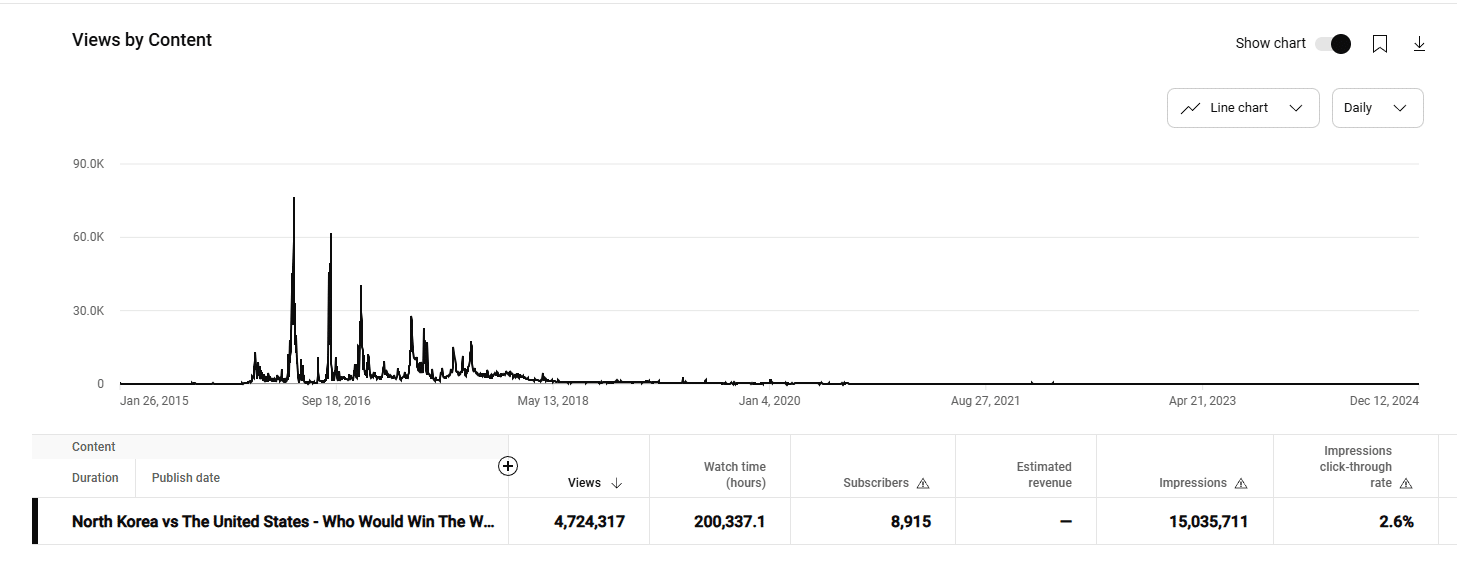
    I believe I made about 25 videos between 2011 and 2016 and had a few thousand subscribers. It was the video ‘ North Korea vs United States – Who Would Win The War ‘ that started getting some views after a year of publishing, that made me look at my YouTube channel again.

    North Korea vs United States

    There was also a comment by the best friend of my spouse who at the time expressed doubt about my earning potential by making a comment “but does the lightning really strike twice”, suggesting that I had luck with SuprNova and that was it. I felt like I had something to prove to myself at that point and decided to make a few more videos.

    My biggest memorable milestone was when I made another video with a similar theme and it received 10,000 views in a day. That was the time I felt I can do this and I am on to something.

    Of course the million subscribers milestone and then the 10 million were special (I made sure I invited the person who made the comment about having luck to my 10 million subscribers celebration, but they have no idea how their comment ever affected me or that I even knew about it).

    The milestones are different now, there isn’t just The Infographics Show (even though that’s what people mostly know about). There are many other channels, including SCP Explained . It’s also not just me. The team is large, close to 200 people. I am lucky I get to work with my best friends and I am lucky to once again have my brother working with me.

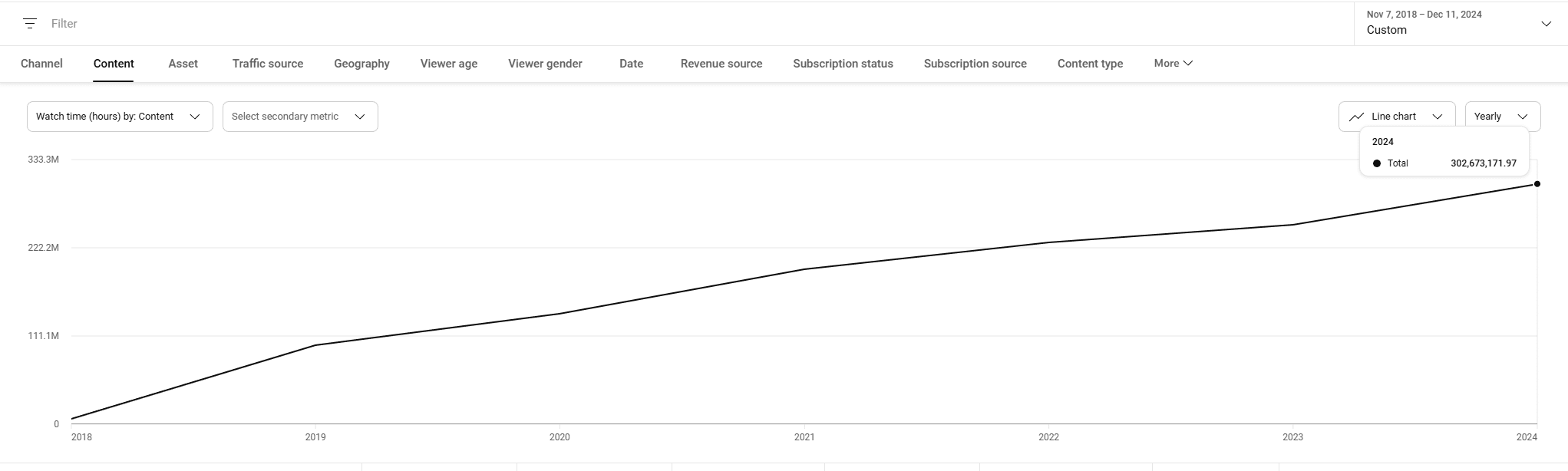
    And while a lot of people look at The Infographics Show and see that it’s generating smaller numbers than even a few years ago, the amount of watch time has never been higher.

    Between all the channels, we’ve generated over 300 million watch time hours and, when putting that in perspective, that’s a lot more than a lot of my favorite TV shows that inspired me ever did. Yet of course it still feels like it’s not enough.

    300 Million Watch Hours

    TF: Did any specific aspects of your experience with Suprnova influence your approach to creating and sharing content on The Infographics Show?

    Andrej: I think SuprNova taught me at a very young age how to project manage and delegate. At the time I had no idea what I was learning but it made me the producer I am today. I also believed from the start that the way I’d like to make money is by making content available to everyone and I’ll make the money against the ads shown to them.

    I believe there are so many ways to make money from popular content. Even views that aren’t directly monetized today can still contribute to revenue I make in the future. Whether that’s via the person watching more of my content but seeing ads, telling their friends about it, or maybe just showing the algorithm that it’s worth watching and spreading the reach.

    TF: 20 years ago you were worrying about cease and desist letters from copyright holders. Today, you’re an established ‘creator’ yourself. Has this changed your outlook in any way?

    Andrej: Ha, this is a funny one. I honestly have no real recollection of receiving cease and desist letters, maybe my brain just erased those memories. But I do often ask myself if I’m a hypocrite as I send a takedown notice.

    I have to explain this part a little. I generally ‘copyright claim’ reuploads of my content on YouTube. This means other people will upload it and I will earn the money based on the ads shown on those videos.

    I will sometimes copyright strike videos, where you can see somebody is just downloading my videos and reuploading them, without even editing them or giving them any new value. It’s rare but I do.

    This is where you might call me a hypocrite but let me explain myself. I believe that all media (entertainment and the rest) has a significant impact on who we are and how it shapes us. I believe that there should be a way for everyone to have access to it, via different sources.

    I think people who want a better experience should pay for those experiences, but I think those who would otherwise be deprived of ever having the opportunity to see it in any way, should have a chance to see it.

    I feel that if I hadn’t had a chance to use certain applications as a kid, due to being in a country where access was limited, and coming from a family that was not well off, I would have not had a chance to compete on a global market at the same level as someone who had the privilege from a young age to have access to all of it. The same goes for media and entertainment. Those experiences show a person what is possible.

    Since my videos are already completely free on YouTube, I don’t think there is a reason for somebody to be uploading to the exact same platform where I already provide everything, and try to collect money from it. If people were putting my videos somewhere where I could not put them myself, and that was the only way for people to see them, I would have absolutely no problem with that.

    TF: Suprnova existed in a different era. How do you view the current state of online entertainment and piracy, and what are your thoughts on how the industry can adapt?

    Andrej: SuprNova existed because it needed to exist. This was a time that old school business models met new emerging technologies. The world needed to change and adapt to how people consume all sorts of media. If SuprNova didn’t exist, you would be talking with a different person right now but the questions would have been the same.

    The current state of online entertainment is something I am trying to predict as it will affect me massively.

    I think the golden age of streaming is already over. Every legacy media empire was forced to come up with an online streaming platform. They all competed for subscribers so we saw the lowest prices we will ever see. We were also able to pick what kind of content we preferred and paid only for those platforms. I believe this is now over and we are moving into a rapid consolidation of media into what we will soon see as old school TV packages.

    Streaming platforms will be more expensive and if you want to have access to all the content available, it will cost you A LOT. TV ad dollars are moving online. Sadly I believe we will eventually get to the point where even the most premium and most expensive option will be ad supported and there will not be a way to pay for services without ads.

    While I don’t follow much of what is happening in the piracy world nowadays, I think once we get there, you will see a lot more people resorting to piracy, once again.

    One thing we shouldn’t leave unmentioned is the advancement of AI and video generation. My prediction is that platforms like YouTube and others will be flooded within the next few years with auto generated content.

    While it’s scary to think how it will affect my bottom line, I just have to accept that I was a part of technological revolution at some point and I can’t fight it. I have to see how I can adapt and embrace it and understand that nothing stays the same for long.

    TF: We want to thank Andrej for his openness and insight he provided over the years. Looking back at more than two decades of following the piracy scene, this is one of the stories that stands out most. We’ll check in again in another decade.

    From: TF , for the latest news on copyright battles, piracy and more.

    • To chevron_right

      Suprnova’s Founder Speaks: 20 Years, Many Lessons, and a YouTube Empire

      news.movim.eu / TorrentFreak • 19 December 2024 • 13 minutes

    suprnova In the fall of 2002, Suprnova.org launched as one of the first sites dedicated to sharing ‘torrents’.

    At the time, Napster has just shut down, leaving a void in the file-sharing landscape. A Slovenian teenager named Andrej Preston has just discovered the new BitTorrent protocol at the time and decided to embrace it.

    Andrej, commonly known under the nickname ‘Sloncek’, started Suprnova out of personal interest, as he couldn’t watch some TV-shows in his home country. Like many of these early hobby projects, it started as a very primitive setup, hosted on a Linux box at Peston’s home.

    In the weeks that followed, word of the “Universal BitTorrent Source” spread like wildfire, maxing out the meager 16kb/s upload capacity of the residential internet connection. Faced with this explosive growth, Suprnova was moved to an external hosting company, with many mirror sites later helping to distribute the traffic.

    December 19, 2004: Suprnova.org Shuts Down

    In record time, Suprnova became one of the most visited websites on the Internet. It became the go-to site for pirates who had discovered the unlimited sharing capacity of BitTorrent and the community that came with it. It also served as inspiration for other torrent sites that launched later, The Pirate Bay included.

    20+ Years Ago…

    Just as quickly as it rose to stardom, exactly twenty years ago today on December 19, 2004, Suprnova went dark . Initially, not much was known about the circumstances, but Andrej later said that he pulled the plug after he started reading about himself in the newspapers. Something didn’t feel right .

    In hindsight, this was likely a pivotal decision. A month after the shutdown, police raided Andrej’s home, taking equipment and media as part of a criminal investigation. The case was closed in October 2005, but it’s not hard to see how things may have ended differently if the site had been active.

    Not all decisions made at the time were great. Following the demise of Suprnova, Andrej became the spokesperson for the ambitious file-sharing software startup eXeem , which failed miserably. The same can be said for the relaunch of Suprnova in 2009 by The Pirate Bay, which Andrej wasn’t actively involved in. That never really took off.

    Academy of Art University

    Instead of focusing on new file-sharing ventures, Andrej explored his creative side. He dreamed of being in the film and TV business and wanted to study in the United States, close to LA. Eventually, he was admitted to Academy of Art University in San Francisco.

    Ironically, the funds he earned from Suprnova helped him pursue this dream, but the money eventually dried up and Andrej worked as a Resident Assistant to get free room and board. Together with funds scraped together by his parents, he made it though school.

    During this time, Andrej also gained experience at an online video production company, working for free. He was also the driving power and creative mind behind TorrentFreak TV , which offered more room to improve his skills between 2008 and 2010. While that project stopped after two seasons, the passion for online video certainly wasn’t over.

    A YouTube Star…

    Today, Andrej is the owner of “ The Infographics Show ” a YouTube channel with more than 14 million subscribers. The first videos were posted on Suprnova’s video portal back in 2011. There are still traces of Suprnova.org on YouTube today, as the channel’s oldest videos display its logo in their intro .

    Video Portal (2011)

    With more than a decade of YouTube experience, six billion video views, and a team that consists of nearly 200 people, Suprnova’s founder has come a long way. But what was this journey like? About time to hear his thoughts again, twenty years after he pulled the plug.

    We typically don’t post interviews in full, but we gladly make an exception here for what is a truly authentic story, with remarkable depth and detail tracing back to the early days of torrents. In addition, it offers a unique perspective on copyright, online entertainment, and life in general.

    ——

    TF: Looking back 20 years, what’s your overriding feeling about Suprnova.org? Pride, regret, something else?

    Andrej: Honestly I feel like I’ve lived quite a few lives. Do I look at it with a particular feeling? It’s kind of hard to put into words. I’d say for most of my adult life, I saw it as just something that happened. It’s the only life I know.

    As I’m quickly approaching 40, I view the past with quite different eyes. I am proud of myself and the size of the project I ran starting at the age of 15. Is my view of copyrights and business in general as naive as it was back then? Absolutely no, and I wouldn’t risk doing something like that today.

    But overall, in short, yeah, I am proud. I am proud of the project and who it made me today. I also feel so lucky for the life long friends I made because of it.

    TF: The profits generated though Suprnova allowed you to study in the United States. Why did you choose the Academy of Arts in San Francisco? How did that go?

    Andrej: I used all the money I made to put myself through school. I loved film & tv and I felt that, the only way to do it at the scale I dreamt of, required me move to the states. But I was never a great student.

    My grades through school were pretty much between a C and a D. I attended a Waldorf school through all my school years but even that felt like it wasn’t right for me in terms of education. So, I had to choose a school that offered a TV Producing major that had open enrollment and I really wanted to be close to LA.

    I worked through the whole school process. I was a Resident Assistant for 3 out of 4 years to get room and board for free and I worked for almost two years for free as an intern at an online video production company to gain additional skills and experience.

    I also ran out of money to continue paying for my school and had to have my parents take out a loan against their property they lived in and I grew up in. Having to study and my homework be something I was so passionate about made it really easy to get good grades. It was the first time in my life that I felt school came easy.

    TF: After handing over the Suprnova.org domain to The Pirate Bay briefly, you later regained control. In 2011 you relaunched is as a video portal, briefly showing TorrentFreak TV episodes and a new project called the “Infographics Show”. Where did the idea for the Infographics Show come from?

    Andrej: I realized that I really loved everything internet and as much as I felt hurt by being torn to pieces online by people for launching eXeem – which was also a financial debacle – I needed to embrace what I really loved.

    I was fortunate enough to be given an opportunity by you to record some TorrentFreak episodes, which actually helped me learn a lot more about the online video streaming landscape.

    I was also a huge fan of statistics, data and visual representations of them. I had an idea that if I just took a static infographic and made it animated people would for sure want to watch it, as that’s something I’d want to watch. The show has evolved a lot since then and is an ‘infographic’ only in its name.

    TF: It’s been over a decade since you launched The Infographics Show on YouTube, which now has millions of subscribers. How do you look back on the past years? Any milestones you can share?

    Andrej: The weird part about milestones is that the bigger they are, the less they mean. The Infographics Show now sits at around 14.7 million subscribers with over 6 billion views and over 5 thousand videos made.

    The Infographics Show (2024)

    I believe I made about 25 videos between 2011 and 2016 and had a few thousand subscribers. It was the video ‘ North Korea vs United States – Who Would Win The War ‘ that started getting some views after a year of publishing, that made me look at my YouTube channel again.

    North Korea vs United States

    There was also a comment by the best friend of my spouse who at the time expressed doubt about my earning potential by making a comment “but does the lightning really strike twice”, suggesting that I had luck with SuprNova and that was it. I felt like I had something to prove to myself at that point and decided to make a few more videos.

    My biggest memorable milestone was when I made another video with a similar theme and it received 10,000 views in a day. That was the time I felt I can do this and I am on to something.

    Of course the million subscribers milestone and then the 10 million were special (I made sure I invited the person who made the comment about having luck to my 10 million subscribers celebration, but they have no idea how their comment ever affected me or that I even knew about it).

    The milestones are different now, there isn’t just The Infographics Show (even though that’s what people mostly know about). There are many other channels, including SCP Explained . It’s also not just me. The team is large, close to 200 people. I am lucky I get to work with my best friends and I am lucky to once again have my brother working with me.

    And while a lot of people look at The Infographics Show and see that it’s generating smaller numbers than even a few years ago, the amount of watch time has never been higher.

    Between all the channels, we’ve generated over 300 million watch time hours and, when putting that in perspective, that’s a lot more than a lot of my favorite TV shows that inspired me ever did. Yet of course it still feels like it’s not enough.

    300 Million Watch Hours

    TF: Did any specific aspects of your experience with Suprnova influence your approach to creating and sharing content on The Infographics Show?

    Andrej: I think SuprNova taught me at a very young age how to project manage and delegate. At the time I had no idea what I was learning but it made me the producer I am today. I also believed from the start that the way I’d like to make money is by making content available to everyone and I’ll make the money against the ads shown to them.

    I believe there are so many ways to make money from popular content. Even views that aren’t directly monetized today can still contribute to revenue I make in the future. Whether that’s via the person watching more of my content but seeing ads, telling their friends about it, or maybe just showing the algorithm that it’s worth watching and spreading the reach.

    TF: 20 years ago you were worrying about cease and desist letters from copyright holders. Today, you’re an established ‘creator’ yourself. Has this changed your outlook in any way?

    Andrej: Ha, this is a funny one. I honestly have no real recollection of receiving cease and desist letters, maybe my brain just erased those memories. But I do often ask myself if I’m a hypocrite as I send a takedown notice.

    I have to explain this part a little. I generally ‘copyright claim’ reuploads of my content on YouTube. This means other people will upload it and I will earn the money based on the ads shown on those videos.

    I will sometimes copyright strike videos, where you can see somebody is just downloading my videos and reuploading them, without even editing them or giving them any new value. It’s rare but I do.

    This is where you might call me a hypocrite but let me explain myself. I believe that all media (entertainment and the rest) has a significant impact on who we are and how it shapes us. I believe that there should be a way for everyone to have access to it, via different sources.

    I think people who want a better experience should pay for those experiences, but I think those who would otherwise be deprived of ever having the opportunity to see it in any way, should have a chance to see it.

    I feel that if I hadn’t had a chance to use certain applications as a kid, due to being in a country where access was limited, and coming from a family that was not well off, I would have not had a chance to compete on a global market at the same level as someone who had the privilege from a young age to have access to all of it. The same goes for media and entertainment. Those experiences show a person what is possible.

    Since my videos are already completely free on YouTube, I don’t think there is a reason for somebody to be uploading to the exact same platform where I already provide everything, and try to collect money from it. If people were putting my videos somewhere where I could not put them myself, and that was the only way for people to see them, I would have absolutely no problem with that.

    TF: Suprnova existed in a different era. How do you view the current state of online entertainment and piracy, and what are your thoughts on how the industry can adapt?

    Andrej: SuprNova existed because it needed to exist. This was a time that old school business models met new emerging technologies. The world needed to change and adapt to how people consume all sorts of media. If SuprNova didn’t exist, you would be talking with a different person right now but the questions would have been the same.

    The current state of online entertainment is something I am trying to predict as it will affect me massively.

    I think the golden age of streaming is already over. Every legacy media empire was forced to come up with an online streaming platform. They all competed for subscribers so we saw the lowest prices we will ever see. We were also able to pick what kind of content we preferred and paid only for those platforms. I believe this is now over and we are moving into a rapid consolidation of media into what we will soon see as old school TV packages.

    Streaming platforms will be more expensive and if you want to have access to all the content available, it will cost you A LOT. TV ad dollars are moving online. Sadly I believe we will eventually get to the point where even the most premium and most expensive option will be ad supported and there will not be a way to pay for services without ads.

    While I don’t follow much of what is happening in the piracy world nowadays, I think once we get there, you will see a lot more people resorting to piracy, once again.

    One thing we shouldn’t leave unmentioned is the advancement of AI and video generation. My prediction is that platforms like YouTube and others will be flooded within the next few years with auto generated content.

    While it’s scary to think how it will affect my bottom line, I just have to accept that I was a part of technological revolution at some point and I can’t fight it. I have to see how I can adapt and embrace it and understand that nothing stays the same for long.

    TF: We want to thank Andrej for his openness and insight he provided over the years. Looking back at more than two decades of following the piracy scene, this is one of the stories that stands out most. We’ll check in again in another decade.

    From: TF , for the latest news on copyright battles, piracy and more.
    • To chevron_right

      Suprnova’s Founder Speaks: 20 Years, Many Lessons, and a YouTube Empire

      news.movim.eu / TorrentFreak • 19 December 2024 • 13 minutes

    suprnova In the fall of 2002, Suprnova.org launched as one of the first sites dedicated to sharing ‘torrents’.

    At the time, Napster has just shut down, leaving a void in the file-sharing landscape. A Slovenian teenager named Andrej Preston has just discovered the new BitTorrent protocol at the time and decided to embrace it.

    Andrej, commonly known under the nickname ‘Sloncek’, started Suprnova out of personal interest, as he couldn’t watch some TV-shows in his home country. Like many of these early hobby projects, it started as a very primitive setup, hosted on a Linux box at Peston’s home.

    In the weeks that followed, word of the “Universal BitTorrent Source” spread like wildfire, maxing out the meager 16kb/s upload capacity of the residential internet connection. Faced with this explosive growth, Suprnova was moved to an external hosting company, with many mirror sites later helping to distribute the traffic.

    December 19, 2004: Suprnova.org Shuts Down

    In record time, Suprnova became one of the most visited websites on the Internet. It became the go-to site for pirates who had discovered the unlimited sharing capacity of BitTorrent and the community that came with it. It also served as inspiration for other torrent sites that launched later, The Pirate Bay included.

    20+ Years Ago…

    Just as quickly as it rose to stardom, exactly twenty years ago today on December 19, 2004, Suprnova went dark . Initially, not much was known about the circumstances, but Andrej later said that he pulled the plug after he started reading about himself in the newspapers. Something didn’t feel right .

    In hindsight, this was likely a pivotal decision. A month after the shutdown, police raided Andrej’s home, taking equipment and media as part of a criminal investigation. The case was closed in October 2005, but it’s not hard to see how things may have ended differently if the site had been active.

    Not all decisions made at the time were great. Following the demise of Suprnova, Andrej became the spokesperson for the ambitious file-sharing software startup eXeem , which failed miserably. The same can be said for the relaunch of Suprnova in 2009 by The Pirate Bay, which Andrej wasn’t actively involved in. That never really took off.

    Academy of Art University

    Instead of focusing on new file-sharing ventures, Andrej explored his creative side. He dreamed of being in the film and TV business and wanted to study in the United States, close to LA. Eventually, he was admitted to Academy of Art University in San Francisco.

    Ironically, the funds he earned from Suprnova helped him pursue this dream, but the money eventually dried up and Andrej worked as a Resident Assistant to get free room and board. Together with funds scraped together by his parents, he made it though school.

    During this time, Andrej also gained experience at an online video production company, working for free. He was also the driving power and creative mind behind TorrentFreak TV , which offered more room to improve his skills between 2008 and 2010. While that project stopped after two seasons, the passion for online video certainly wasn’t over.

    A YouTube Star…

    Today, Andrej is the owner of “ The Infographics Show ” a YouTube channel with more than 14 million subscribers. The first videos were posted on Suprnova’s video portal back in 2011. There are still traces of Suprnova.org on YouTube today, as the channel’s oldest videos display its logo in their intro .

    Video Portal (2011)

    With more than a decade of YouTube experience, six billion video views, and a team that consists of nearly 200 people, Suprnova’s founder has come a long way. But what was this journey like? About time to hear his thoughts again, twenty years after he pulled the plug.

    We typically don’t post interviews in full, but we gladly make an exception here for what is a truly authentic story, with remarkable depth and detail tracing back to the early days of torrents. In addition, it offers a unique perspective on copyright, online entertainment, and life in general.

    ——

    TF: Looking back 20 years, what’s your overriding feeling about Suprnova.org? Pride, regret, something else?

    Andrej: Honestly I feel like I’ve lived quite a few lives. Do I look at it with a particular feeling? It’s kind of hard to put into words. I’d say for most of my adult life, I saw it as just something that happened. It’s the only life I know.

    As I’m quickly approaching 40, I view the past with quite different eyes. I am proud of myself and the size of the project I ran starting at the age of 15. Is my view of copyrights and business in general as naive as it was back then? Absolutely no, and I wouldn’t risk doing something like that today.

    But overall, in short, yeah, I am proud. I am proud of the project and who it made me today. I also feel so lucky for the life long friends I made because of it.

    TF: The profits generated though Suprnova allowed you to study in the United States. Why did you choose the Academy of Arts in San Francisco? How did that go?

    Andrej: I used all the money I made to put myself through school. I loved film & tv and I felt that, the only way to do it at the scale I dreamt of, required me move to the states. But I was never a great student.

    My grades through school were pretty much between a C and a D. I attended a Waldorf school through all my school years but even that felt like it wasn’t right for me in terms of education. So, I had to choose a school that offered a TV Producing major that had open enrollment and I really wanted to be close to LA.

    I worked through the whole school process. I was a Resident Assistant for 3 out of 4 years to get room and board for free and I worked for almost two years for free as an intern at an online video production company to gain additional skills and experience.

    I also ran out of money to continue paying for my school and had to have my parents take out a loan against their property they lived in and I grew up in. Having to study and my homework be something I was so passionate about made it really easy to get good grades. It was the first time in my life that I felt school came easy.

    TF: After handing over the Suprnova.org domain to The Pirate Bay briefly, you later regained control. In 2011 you relaunched is as a video portal, briefly showing TorrentFreak TV episodes and a new project called the “Infographics Show”. Where did the idea for the Infographics Show come from?

    Andrej: I realized that I really loved everything internet and as much as I felt hurt by being torn to pieces online by people for launching eXeem – which was also a financial debacle – I needed to embrace what I really loved.

    I was fortunate enough to be given an opportunity by you to record some TorrentFreak episodes, which actually helped me learn a lot more about the online video streaming landscape.

    I was also a huge fan of statistics, data and visual representations of them. I had an idea that if I just took a static infographic and made it animated people would for sure want to watch it, as that’s something I’d want to watch. The show has evolved a lot since then and is an ‘infographic’ only in its name.

    TF: It’s been over a decade since you launched The Infographics Show on YouTube, which now has millions of subscribers. How do you look back on the past years? Any milestones you can share?

    Andrej: The weird part about milestones is that the bigger they are, the less they mean. The Infographics Show now sits at around 14.7 million subscribers with over 6 billion views and over 5 thousand videos made.

    The Infographics Show (2024)

    I believe I made about 25 videos between 2011 and 2016 and had a few thousand subscribers. It was the video ‘ North Korea vs United States – Who Would Win The War ‘ that started getting some views after a year of publishing, that made me look at my YouTube channel again.

    North Korea vs United States

    There was also a comment by the best friend of my spouse who at the time expressed doubt about my earning potential by making a comment “but does the lightning really strike twice”, suggesting that I had luck with SuprNova and that was it. I felt like I had something to prove to myself at that point and decided to make a few more videos.

    My biggest memorable milestone was when I made another video with a similar theme and it received 10,000 views in a day. That was the time I felt I can do this and I am on to something.

    Of course the million subscribers milestone and then the 10 million were special (I made sure I invited the person who made the comment about having luck to my 10 million subscribers celebration, but they have no idea how their comment ever affected me or that I even knew about it).

    The milestones are different now, there isn’t just The Infographics Show (even though that’s what people mostly know about). There are many other channels, including SCP Explained . It’s also not just me. The team is large, close to 200 people. I am lucky I get to work with my best friends and I am lucky to once again have my brother working with me.

    And while a lot of people look at The Infographics Show and see that it’s generating smaller numbers than even a few years ago, the amount of watch time has never been higher.

    Between all the channels, we’ve generated over 300 million watch time hours and, when putting that in perspective, that’s a lot more than a lot of my favorite TV shows that inspired me ever did. Yet of course it still feels like it’s not enough.

    300 Million Watch Hours

    TF: Did any specific aspects of your experience with Suprnova influence your approach to creating and sharing content on The Infographics Show?

    Andrej: I think SuprNova taught me at a very young age how to project manage and delegate. At the time I had no idea what I was learning but it made me the producer I am today. I also believed from the start that the way I’d like to make money is by making content available to everyone and I’ll make the money against the ads shown to them.

    I believe there are so many ways to make money from popular content. Even views that aren’t directly monetized today can still contribute to revenue I make in the future. Whether that’s via the person watching more of my content but seeing ads, telling their friends about it, or maybe just showing the algorithm that it’s worth watching and spreading the reach.

    TF: 20 years ago you were worrying about cease and desist letters from copyright holders. Today, you’re an established ‘creator’ yourself. Has this changed your outlook in any way?

    Andrej: Ha, this is a funny one. I honestly have no real recollection of receiving cease and desist letters, maybe my brain just erased those memories. But I do often ask myself if I’m a hypocrite as I send a takedown notice.

    I have to explain this part a little. I generally ‘copyright claim’ reuploads of my content on YouTube. This means other people will upload it and I will earn the money based on the ads shown on those videos.

    I will sometimes copyright strike videos, where you can see somebody is just downloading my videos and reuploading them, without even editing them or giving them any new value. It’s rare but I do.

    This is where you might call me a hypocrite but let me explain myself. I believe that all media (entertainment and the rest) has a significant impact on who we are and how it shapes us. I believe that there should be a way for everyone to have access to it, via different sources.

    I think people who want a better experience should pay for those experiences, but I think those who would otherwise be deprived of ever having the opportunity to see it in any way, should have a chance to see it.

    I feel that if I hadn’t had a chance to use certain applications as a kid, due to being in a country where access was limited, and coming from a family that was not well off, I would have not had a chance to compete on a global market at the same level as someone who had the privilege from a young age to have access to all of it. The same goes for media and entertainment. Those experiences show a person what is possible.

    Since my videos are already completely free on YouTube, I don’t think there is a reason for somebody to be uploading to the exact same platform where I already provide everything, and try to collect money from it. If people were putting my videos somewhere where I could not put them myself, and that was the only way for people to see them, I would have absolutely no problem with that.

    TF: Suprnova existed in a different era. How do you view the current state of online entertainment and piracy, and what are your thoughts on how the industry can adapt?

    Andrej: SuprNova existed because it needed to exist. This was a time that old school business models met new emerging technologies. The world needed to change and adapt to how people consume all sorts of media. If SuprNova didn’t exist, you would be talking with a different person right now but the questions would have been the same.

    The current state of online entertainment is something I am trying to predict as it will affect me massively.

    I think the golden age of streaming is already over. Every legacy media empire was forced to come up with an online streaming platform. They all competed for subscribers so we saw the lowest prices we will ever see. We were also able to pick what kind of content we preferred and paid only for those platforms. I believe this is now over and we are moving into a rapid consolidation of media into what we will soon see as old school TV packages.

    Streaming platforms will be more expensive and if you want to have access to all the content available, it will cost you A LOT. TV ad dollars are moving online. Sadly I believe we will eventually get to the point where even the most premium and most expensive option will be ad supported and there will not be a way to pay for services without ads.

    While I don’t follow much of what is happening in the piracy world nowadays, I think once we get there, you will see a lot more people resorting to piracy, once again.

    One thing we shouldn’t leave unmentioned is the advancement of AI and video generation. My prediction is that platforms like YouTube and others will be flooded within the next few years with auto generated content.

    While it’s scary to think how it will affect my bottom line, I just have to accept that I was a part of technological revolution at some point and I can’t fight it. I have to see how I can adapt and embrace it and understand that nothing stays the same for long.

    TF: We want to thank Andrej for his openness and insight he provided over the years. Looking back at more than two decades of following the piracy scene, this is one of the stories that stands out most. We’ll check in again in another decade.

    From: TF , for the latest news on copyright battles, piracy and more.