• To chevron_right

      IFPI: Stream-Ripping Fuels Generative AI From Which Existential Threats Emerge

      news.movim.eu / TorrentFreak • 30 December 2024 • 5 minutes

    youtube-ripper-s The global recording industry portrays itself as a dynamic and successful business that’s either fighting an existential crisis right now, or sounding the alarm for the next one looming on the horizon.

    Considering the upheaval caused by Napster, its predecessors, and the demise of the lucrative album format, concerns of another technological surprise creating havoc aren’t entirely unreasonable.

    Yet to a background of recovery and then impressive year-on-year growth since 2014, imagery of an industry teetering on the brink wouldn’t be the easiest sell.
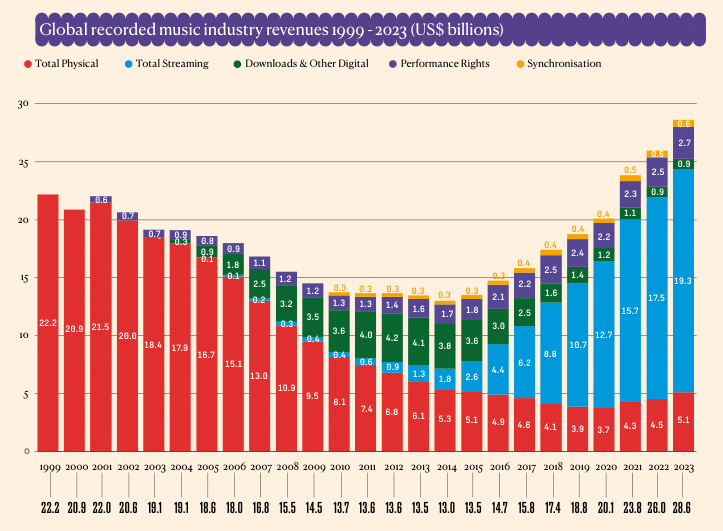
    Credit: IFPI Global Music Report 2024 IFPI GMR 2024

    IFPI certainly hasn’t forgotten about piracy but, compared to its video industry counterparts, the last two or three years have been relatively quiet. Looking towards the horizon, maybe it’s just the calm before the storm.

    The current number one piracy threat according to IFPI is stream-ripping; on the horizon, abusive use of generative AI. No need for formal introductions, IFPI says they know each other already.

    Piracy Wars: ‘Abusive’ Use of AI

    The seminar Digital Music Piracy: New Trends and Practical Approaches took place before the holidays in Bulgaria. Organized by the Bulgarian Association of Music Producers (BAMP), in partnership with IFPI and the Cybercrime Directorate at the Directorate General of the Ministry of Internal Affairs, discussion centered on the latest trends in digital investigation and evidence collection methods.

    Those in attendance included Catherine Lloyd, senior legal advisor to IFPI. In a subsequent interview with BTA.bg , Lloyd cited abusive use of AI as a significant threat to the industry.

    “Record labels and artists have been using AI for years as a tool to enhance the creative process and collaborate on unique and cutting-edge projects. When AI is used responsibly to enhance human artistry, it can bring incredible creative possibilities,” Lloyd said.

    “However, the emergence of generative AI presents a new and rapidly evolving challenge. If generative AI developers can use music without permission in their models to create clones or products that compete directly with the original works, then this creates a fundamental problem for the music ecosystem and threatens its long-term sustainability.”

    Voicing Concerns

    Another major concern for IFPI is the rapid rise of voice cloning. In 2023, IFPI added ‘AI Vocal Cloning’ as a new category in its annual overview of ‘notorious’ piracy markets submitted to the Office of the US Trade Representative (USTR).

    The focus was on Voicify.ai, an AI-powered service that enables users to create new versions of existing songs on YouTube accompanied by the cloned voices of stars including Bruno Mars, Eminem, and Taylor Swift. The USTR declined to include the service in its final report and in February 2024, affiliated UK music industry group BPI threatened the service – now renamed ‘Jammable’ – with legal action.

    There has been no further news on that front and the site remains operational. In November, Danish anti-piracy group Rights Alliance forced ElevenLabs to remove a voice clone of David Bateson. The British/Danish actor appears in the game Hitman as the voice of Agent 47 who, somewhat ironically, is a clone himself.

    Stream-Ripping and Generative AI

    The roller-coaster of current and emerging piracy threats is nothing new for IFPI. As downloading of ‘physical’ MP3-based tracks from peer-to-peer networks finally began to subside, in no small part assisted by the rise of legal streaming platforms like Spotify, a new foe had already emerged.

    The battle was long, complicated, and dragged on for years and years, but eventually YouTube and the music industry found common ground . Today, YouTube payments worth billions of dollars every year help to smooth things over.

    Yet as predictably as night follows day, the world’s largest open repository of publicly accessible copyrighted music on YouTube, now acts as the main source of fuel for stream-ripping aficionados of all kinds.

    “In addition to AI, stream-ripping sites remain a significant threat to piracy in the music industry and have become the most common way to illegally download music. The music industry has been fighting stream-ripping sites through legal action, including blocking access to such sites,” IFPI’s senior legal counsel explained.

    ISP Blocking and Shunning a Fair Fight

    Dozens of stream-ripping platforms are currently blocked by ISPs all around the world. Many use the open source ripping software youtube-dl to easily download music from YouTube. The platform has only minimal anti-piracy protection or, according to some, effectively no protection at all.

    As far as we know the developers of youtube-dl have faced no legal action. The same holds true for YouTube, which may be as leaky as a sieve, but a multi-billion-dollar sieve nonetheless. There has been no legal action against GitHub either, the Microsoft owned developer platform where youtube-dl remains available for download, even today. Instead, IFPI sued German web-hosting company Uberspace from where youtube-dl was available for download.

    In November, the Hamburg Court of Appeal ruled against youtube-dl’s former hosting provider, holding it liable for supposed violations of YouTube’s copyright protection measures, despite YouTube playing no part in the case.

    “The software in question has enabled countless streaming ripping services to steal music from legitimate, licensed platforms and to take away revenue from artists and rights holders,” Lloyd added, noting that the stream-ripping threat of today is already complicit in the new AI threat looming on the horizon.

    “Piracy via stream-ripping sites is a problem – not only for individual users who download content to their devices, but also in the context of AI, as these services are likely used to obtain training data and create cover versions.”

    Who Controls The Market? Those Who Understand Music

    It’s not difficult to see why IFPI is concerned. Restricting access or providing licenses to use music as training data may be its only chance of preventing unprecedented competition from which it earns no revenue, in a market where its members currently account for the majority of all business.

    Interestingly, the arrival of significant competition can often have a depressant effect on pricing, as market participants jostle for market share. Yet even in the unlikely event that AI creations are able to compete with humans in a musical sense, a reminder; in today’s market consumers effectively pay the same regardless of whether a track is a world-class smash hit or an affront to the discount bins.

    So with no competition on price, the fight against a tsunami of AI-generated music will boil down to quality, originality, and the ability to be seen and heard above more background noise than ever before. When the floodgates eventually open, music fans will be heard crying out for something they may have taken for granted but now need more than ever before: human curation.

    Meet the new boss…

    From: TF , for the latest news on copyright battles, piracy and more.

    • To chevron_right

      IFPI: Stream-Ripping Fuels Generative AI From Which Existential Threats Emerge

      news.movim.eu / TorrentFreak • 30 December 2024 • 5 minutes

    youtube-ripper-s The global recording industry portrays itself as a dynamic and successful business that’s either fighting an existential crisis right now, or sounding the alarm for the next one looming on the horizon.

    Considering the upheaval caused by Napster, its predecessors, and the demise of the lucrative album format, concerns of another technological surprise creating havoc aren’t entirely unreasonable.

    Yet to a background of recovery and then impressive year-on-year growth since 2014, imagery of an industry teetering on the brink wouldn’t be the easiest sell.

    Credit: IFPI Global Music Report 2024 IFPI GMR 2024

    IFPI certainly hasn’t forgotten about piracy but, compared to its video industry counterparts, the last two or three years have been relatively quiet. Looking towards the horizon, maybe it’s just the calm before the storm.

    The current number one piracy threat according to IFPI is stream-ripping; on the horizon, abusive use of generative AI. No need for formal introductions, IFPI says they know each other already.

    Piracy Wars: ‘Abusive’ Use of AI

    The seminar Digital Music Piracy: New Trends and Practical Approaches took place before the holidays in Bulgaria. Organized by the Bulgarian Association of Music Producers (BAMP), in partnership with IFPI and the Cybercrime Directorate at the Directorate General of the Ministry of Internal Affairs, discussion centered on the latest trends in digital investigation and evidence collection methods.

    Those in attendance included Catherine Lloyd, senior legal advisor to IFPI. In a subsequent interview with BTA.bg , Lloyd cited abusive use of AI as a significant threat to the industry.

    “Record labels and artists have been using AI for years as a tool to enhance the creative process and collaborate on unique and cutting-edge projects. When AI is used responsibly to enhance human artistry, it can bring incredible creative possibilities,” Lloyd said.

    “However, the emergence of generative AI presents a new and rapidly evolving challenge. If generative AI developers can use music without permission in their models to create clones or products that compete directly with the original works, then this creates a fundamental problem for the music ecosystem and threatens its long-term sustainability.”

    Voicing Concerns

    Another major concern for IFPI is the rapid rise of voice cloning. In 2023, IFPI added ‘AI Vocal Cloning’ as a new category in its annual overview of ‘notorious’ piracy markets submitted to the Office of the US Trade Representative (USTR).

    The focus was on Voicify.ai, an AI-powered service that enables users to create new versions of existing songs on YouTube accompanied by the cloned voices of stars including Bruno Mars, Eminem, and Taylor Swift. The USTR declined to include the service in its final report and in February 2024, affiliated UK music industry group BPI threatened the service – now renamed ‘Jammable’ – with legal action.

    There has been no further news on that front and the site remains operational. In November, Danish anti-piracy group Rights Alliance forced ElevenLabs to remove a voice clone of David Bateson. The British/Danish actor appears in the game Hitman as the voice of Agent 47 who, somewhat ironically, is a clone himself.

    Stream-Ripping and Generative AI

    The roller-coaster of current and emerging piracy threats is nothing new for IFPI. As downloading of ‘physical’ MP3-based tracks from peer-to-peer networks finally began to subside, in no small part assisted by the rise of legal streaming platforms like Spotify, a new foe had already emerged.

    The battle was long, complicated, and dragged on for years and years, but eventually YouTube and the music industry found common ground . Today, YouTube payments worth billions of dollars every year help to smooth things over.

    Yet as predictably as night follows day, the world’s largest open repository of publicly accessible copyrighted music on YouTube, now acts as the main source of fuel for stream-ripping aficionados of all kinds.

    “In addition to AI, stream-ripping sites remain a significant threat to piracy in the music industry and have become the most common way to illegally download music. The music industry has been fighting stream-ripping sites through legal action, including blocking access to such sites,” IFPI’s senior legal counsel explained.

    ISP Blocking and Shunning a Fair Fight

    Dozens of stream-ripping platforms are currently blocked by ISPs all around the world. Many use the open source ripping software youtube-dl to easily download music from YouTube. The platform has only minimal anti-piracy protection or, according to some, effectively no protection at all.

    As far as we know the developers of youtube-dl have faced no legal action. The same holds true for YouTube, which may be as leaky as a sieve, but a multi-billion-dollar sieve nonetheless. There has been no legal action against GitHub either, the Microsoft owned developer platform where youtube-dl remains available for download, even today. Instead, IFPI sued German web-hosting company Uberspace from where youtube-dl was available for download.

    In November, the Hamburg Court of Appeal ruled against youtube-dl’s former hosting provider, holding it liable for supposed violations of YouTube’s copyright protection measures, despite YouTube playing no part in the case.

    “The software in question has enabled countless streaming ripping services to steal music from legitimate, licensed platforms and to take away revenue from artists and rights holders,” Lloyd added, noting that the stream-ripping threat of today is already complicit in the new AI threat looming on the horizon.

    “Piracy via stream-ripping sites is a problem – not only for individual users who download content to their devices, but also in the context of AI, as these services are likely used to obtain training data and create cover versions.”

    Who Controls The Market? Those Who Understand Music

    It’s not difficult to see why IFPI is concerned. Restricting access or providing licenses to use music as training data may be its only chance of preventing unprecedented competition from which it earns no revenue, in a market where its members currently account for the majority of all business.

    Interestingly, the arrival of significant competition can often have a depressant effect on pricing, as market participants jostle for market share. Yet even in the unlikely event that AI creations are able to compete with humans in a musical sense, a reminder; in today’s market consumers effectively pay the same regardless of whether a track is a world-class smash hit or an affront to the discount bins.

    So with no competition on price, the fight against a tsunami of AI-generated music will boil down to quality, originality, and the ability to be seen and heard above more background noise than ever before. When the floodgates eventually open, music fans will be heard crying out for something they may have taken for granted but now need more than ever before: human curation.

    Meet the new boss…

    From: TF , for the latest news on copyright battles, piracy and more.

    • To chevron_right

      IFPI: Stream-Ripping Fuels Generative AI From Which Existential Threats Emerge

      news.movim.eu / TorrentFreak • 30 December 2024 • 5 minutes

    youtube-ripper-s The global recording industry portrays itself as a dynamic and successful business that’s either fighting an existential crisis right now, or sounding the alarm for the next one looming on the horizon.

    Considering the upheaval caused by Napster, its predecessors, and the demise of the lucrative album format, concerns of another technological surprise creating havoc aren’t entirely unreasonable.

    Yet to a background of recovery and then impressive year-on-year growth since 2014, imagery of an industry teetering on the brink wouldn’t be the easiest sell.

    Credit: IFPI Global Music Report 2024 IFPI GMR 2024

    IFPI certainly hasn’t forgotten about piracy but, compared to its video industry counterparts, the last two or three years have been relatively quiet. Looking towards the horizon, maybe it’s just the calm before the storm.

    The current number one piracy threat according to IFPI is stream-ripping; on the horizon, abusive use of generative AI. No need for formal introductions, IFPI says they know each other already.

    Piracy Wars: ‘Abusive’ Use of AI

    The seminar Digital Music Piracy: New Trends and Practical Approaches took place before the holidays in Bulgaria. Organized by the Bulgarian Association of Music Producers (BAMP), in partnership with IFPI and the Cybercrime Directorate at the Directorate General of the Ministry of Internal Affairs, discussion centered on the latest trends in digital investigation and evidence collection methods.

    Those in attendance included Catherine Lloyd, senior legal advisor to IFPI. In a subsequent interview with BTA.bg , Lloyd cited abusive use of AI as a significant threat to the industry.

    “Record labels and artists have been using AI for years as a tool to enhance the creative process and collaborate on unique and cutting-edge projects. When AI is used responsibly to enhance human artistry, it can bring incredible creative possibilities,” Lloyd said.

    “However, the emergence of generative AI presents a new and rapidly evolving challenge. If generative AI developers can use music without permission in their models to create clones or products that compete directly with the original works, then this creates a fundamental problem for the music ecosystem and threatens its long-term sustainability.”

    Voicing Concerns

    Another major concern for IFPI is the rapid rise of voice cloning. In 2023, IFPI added ‘AI Vocal Cloning’ as a new category in its annual overview of ‘notorious’ piracy markets submitted to the Office of the US Trade Representative (USTR).

    The focus was on Voicify.ai, an AI-powered service that enables users to create new versions of existing songs on YouTube accompanied by the cloned voices of stars including Bruno Mars, Eminem, and Taylor Swift. The USTR declined to include the service in its final report and in February 2024, affiliated UK music industry group BPI threatened the service – now renamed ‘Jammable’ – with legal action.

    There has been no further news on that front and the site remains operational. In November, Danish anti-piracy group Rights Alliance forced ElevenLabs to remove a voice clone of David Bateson. The British/Danish actor appears in the game Hitman as the voice of Agent 47 who, somewhat ironically, is a clone himself.

    Stream-Ripping and Generative AI

    The roller-coaster of current and emerging piracy threats is nothing new for IFPI. As downloading of ‘physical’ MP3-based tracks from peer-to-peer networks finally began to subside, in no small part assisted by the rise of legal streaming platforms like Spotify, a new foe had already emerged.

    The battle was long, complicated, and dragged on for years and years, but eventually YouTube and the music industry found common ground . Today, YouTube payments worth billions of dollars every year help to smooth things over.

    Yet as predictably as night follows day, the world’s largest open repository of publicly accessible copyrighted music on YouTube, now acts as the main source of fuel for stream-ripping aficionados of all kinds.

    “In addition to AI, stream-ripping sites remain a significant threat to piracy in the music industry and have become the most common way to illegally download music. The music industry has been fighting stream-ripping sites through legal action, including blocking access to such sites,” IFPI’s senior legal counsel explained.

    ISP Blocking and Shunning a Fair Fight

    Dozens of stream-ripping platforms are currently blocked by ISPs all around the world. Many use the open source ripping software youtube-dl to easily download music from YouTube. The platform has only minimal anti-piracy protection or, according to some, effectively no protection at all.

    As far as we know the developers of youtube-dl have faced no legal action. The same holds true for YouTube, which may be as leaky as a sieve, but a multi-billion-dollar sieve nonetheless. There has been no legal action against GitHub either, the Microsoft owned developer platform where youtube-dl remains available for download, even today. Instead, IFPI sued German web-hosting company Uberspace from where youtube-dl was available for download.

    In November, the Hamburg Court of Appeal ruled against youtube-dl’s former hosting provider, holding it liable for supposed violations of YouTube’s copyright protection measures, despite YouTube playing no part in the case.

    “The software in question has enabled countless streaming ripping services to steal music from legitimate, licensed platforms and to take away revenue from artists and rights holders,” Lloyd added, noting that the stream-ripping threat of today is already complicit in the new AI threat looming on the horizon.

    “Piracy via stream-ripping sites is a problem – not only for individual users who download content to their devices, but also in the context of AI, as these services are likely used to obtain training data and create cover versions.”

    Who Controls The Market? Those Who Understand Music

    It’s not difficult to see why IFPI is concerned. Restricting access or providing licenses to use music as training data may be its only chance of preventing unprecedented competition from which it earns no revenue, in a market where its members currently account for the majority of all business.

    Interestingly, the arrival of significant competition can often have a depressant effect on pricing, as market participants jostle for market share. Yet even in the unlikely event that AI creations are able to compete with humans in a musical sense, a reminder; in today’s market consumers effectively pay the same regardless of whether a track is a world-class smash hit or an affront to the discount bins.

    So with no competition on price, the fight against a tsunami of AI-generated music will boil down to quality, originality, and the ability to be seen and heard above more background noise than ever before. When the floodgates eventually open, music fans will be heard crying out for something they may have taken for granted but now need more than ever before: human curation.

    Meet the new boss…

    From: TF , for the latest news on copyright battles, piracy and more.

    • To chevron_right

      Danish Court Greenlights Copyright Protection for Live Sports in Landmark Blocking Case

      news.movim.eu / TorrentFreak • 27 December 2024 • 3 minutes

    As one of the oldest sports live-streaming portals, Rojadirecta has been thorn in the side of sports organizations for well over a decade.

    The linking site, operated by a Spanish company Puerto 80 Projects and its owner Igor Seoane, initially had a good track record when it came to legal battles.

    Rojadirecta famously had its domain name returned after it was seized by the US Government years ago. In addition, the site successfully fought off copyright holders in court .

    Rojadirecta tried to achieve an equally positive result when it challenged a Danish site blocking order. But that didn’t go as planned.

    Rojadirecta Challenges Danish Site Blocking

    In 2009, anti-piracy group Rights Alliance , in conjunction with LaLiga, obtained a site-blocking injunction against Rojadirecta in Denmark. While the site wasn’t sued directly, it did intervene in the case, which initially failed. The court ordered ISP Telenor to block access to the sports streaming site.

    Rojadirecta didn’t give up easily and appealed the interim decision. The streaming site pointed out that it offered links to legally available streams. In addition, it stressed that users were required to tick a box, indicating that submitted streams were not infringing any copyrights.

    The Court of Appeal upheld the lower court’s preliminary ruling in 2020. According to the ruling, it is likely that Rojadirecta violates the rights of the Spanish football league. Citing jurisprudence from the European Court of Justice, including the Filmspeler case, site blocking is therefore warranted.

    Are Live-Streams Copyrighted?

    With the blocking measures firmly in place, the case was eventually heard on its merits. This wasn’t a straightforward matter, as copyright protection for live sports broadcasts is an area of copyright law that has not been extensively tested in court.

    In 2022, the Frederiksberg court confirmed that LaLiga indeed holds copyright over the production and recording of the live football matches. In addition, the court confirmed that Rojadirecta infringed these copyrights.

    By recognizing live sports broadcasts as copyrighted works in the first case of this kind in Europe, the court established that site blocking can be used as a legal tool to combat live sports piracy.

    Rojadirecta also appealed this decision, but the company eventually failed to show up in court. Without a defense, the Eastern High Court therefore dismissed the appeal earlier this month, making the decision final.

    Landmark Case

    To outsiders, copyright eligibility for live sports may seem like a technicality. However, for rightsholders this was a vital decision, which effectively determined the effectiveness of their anti-piracy arsenal going forward. Understandably, they are pleased with the outcome.

    Commenting on the outcome, Rights Alliance director Maria Fredenslund stresses that this is a great result. Not just for LaLiga, but also for other rightsholders of live sports streaming events.

    “With a final verdict in the case, we have the court’s word that rights to show football are subject to copyright and can therefore be protected,” Fredenslund says.

    “We therefore look forward to using the decision as a starting point to achieve better protection of live content in Denmark and also hope that the case can pave the way for similar initiatives in other European countries,” she adds.

    sports stream

    Javier Tebas, President of LaLiga, hopes that this decision will resonate across other European countries. He encourages legislators, judges, and institutions to step up their efforts to protect rightsholders from live-streaming piracy.

    “By adapting regulatory frameworks and fostering international alliances, we can ensure that the rights of all stakeholders in the sports ecosystem are respected and protected,” Tebas says.

    TorrentFreak reached out to Rojadirecta’s operator to hear his side of the story. Seoane did not immediately respond.

    This has been a rough month for the sports live-stream linking site on multiple fronts. After Spain’s Supreme Court previously held Seoane and his company liable for copyright infringement, a Spanish court ruled that they have to pay Mediapro 31.6 million euros in damages.

    From: TF , for the latest news on copyright battles, piracy and more.

    • To chevron_right

      Danish Court Greenlights Copyright Protection for Live Sports in Landmark Blocking Case

      news.movim.eu / TorrentFreak • 27 December 2024 • 3 minutes

    As one of the oldest sports live-streaming portals, Rojadirecta has been thorn in the side of sports organizations for well over a decade.

    The linking site, operated by a Spanish company Puerto 80 Projects and its owner Igor Seoane, initially had a good track record when it came to legal battles.

    Rojadirecta famously had its domain name returned after it was seized by the US Government years ago. In addition, the site successfully fought off copyright holders in court .

    Rojadirecta tried to achieve an equally positive result when it challenged a Danish site blocking order. But that didn’t go as planned.

    Rojadirecta Challenges Danish Site Blocking

    In 2009, anti-piracy group Rights Alliance , in conjunction with LaLiga, obtained a site-blocking injunction against Rojadirecta in Denmark. While the site wasn’t sued directly, it did intervene in the case, which initially failed. The court ordered ISP Telenor to block access to the sports streaming site.

    Rojadirecta didn’t give up easily and appealed the interim decision. The streaming site pointed out that it offered links to legally available streams. In addition, it stressed that users were required to tick a box, indicating that submitted streams were not infringing any copyrights.

    The Court of Appeal upheld the lower court’s preliminary ruling in 2020. According to the ruling, it is likely that Rojadirecta violates the rights of the Spanish football league. Citing jurisprudence from the European Court of Justice, including the Filmspeler case, site blocking is therefore warranted.

    Are Live-Streams Copyrighted?

    With the blocking measures firmly in place, the case was eventually heard on its merits. This wasn’t a straightforward matter, as copyright protection for live sports broadcasts is an area of copyright law that has not been extensively tested in court.

    In 2022, the Frederiksberg court confirmed that LaLiga indeed holds copyright over the production and recording of the live football matches. In addition, the court confirmed that Rojadirecta infringed these copyrights.

    By recognizing live sports broadcasts as copyrighted works in the first case of this kind in Europe, the court established that site blocking can be used as a legal tool to combat live sports piracy.

    Rojadirecta also appealed this decision, but the company eventually failed to show up in court. Without a defense, the Eastern High Court therefore dismissed the appeal earlier this month, making the decision final.

    Landmark Case

    To outsiders, copyright eligibility for live sports may seem like a technicality. However, for rightsholders this was a vital decision, which effectively determined the effectiveness of their anti-piracy arsenal going forward. Understandably, they are pleased with the outcome.

    Commenting on the outcome, Rights Alliance director Maria Fredenslund stresses that this is a great result. Not just for LaLiga, but also for other rightsholders of live sports streaming events.

    “With a final verdict in the case, we have the court’s word that rights to show football are subject to copyright and can therefore be protected,” Fredenslund says.

    “We therefore look forward to using the decision as a starting point to achieve better protection of live content in Denmark and also hope that the case can pave the way for similar initiatives in other European countries,” she adds.

    sports stream

    Javier Tebas, President of LaLiga, hopes that this decision will resonate across other European countries. He encourages legislators, judges, and institutions to step up their efforts to protect rightsholders from live-streaming piracy.

    “By adapting regulatory frameworks and fostering international alliances, we can ensure that the rights of all stakeholders in the sports ecosystem are respected and protected,” Tebas says.

    TorrentFreak reached out to Rojadirecta’s operator to hear his side of the story. Seoane did not immediately respond.

    This has been a rough month for the sports live-stream linking site on multiple fronts. After Spain’s Supreme Court previously held Seoane and his company liable for copyright infringement, a Spanish court ruled that they have to pay Mediapro 31.6 million euros in damages.

    From: TF , for the latest news on copyright battles, piracy and more.

    • To chevron_right

      Danish Court Greenlights Copyright Protection for Live Sports in Landmark Blocking Case

      news.movim.eu / TorrentFreak • 27 December 2024 • 3 minutes

    As one of the oldest sports live-streaming portals, Rojadirecta has been thorn in the side of sports organizations for well over a decade.

    The linking site, operated by a Spanish company Puerto 80 Projects and its owner Igor Seoane, initially had a good track record when it came to legal battles.

    Rojadirecta famously had its domain name returned after it was seized by the US Government years ago. In addition, the site successfully fought off copyright holders in court .

    Rojadirecta tried to achieve an equally positive result when it challenged a Danish site blocking order. But that didn’t go as planned.

    Rojadirecta Challenges Danish Site Blocking

    In 2009, anti-piracy group Rights Alliance , in conjunction with LaLiga, obtained a site-blocking injunction against Rojadirecta in Denmark. While the site wasn’t sued directly, it did intervene in the case, which initially failed. The court ordered ISP Telenor to block access to the sports streaming site.

    Rojadirecta didn’t give up easily and appealed the interim decision. The streaming site pointed out that it offered links to legally available streams. In addition, it stressed that users were required to tick a box, indicating that submitted streams were not infringing any copyrights.

    The Court of Appeal upheld the lower court’s preliminary ruling in 2020. According to the ruling, it is likely that Rojadirecta violates the rights of the Spanish football league. Citing jurisprudence from the European Court of Justice, including the Filmspeler case, site blocking is therefore warranted.

    Are Live-Streams Copyrighted?

    With the blocking measures firmly in place, the case was eventually heard on its merits. This wasn’t a straightforward matter, as copyright protection for live sports broadcasts is an area of copyright law that has not been extensively tested in court.

    In 2022, the Frederiksberg court confirmed that LaLiga indeed holds copyright over the production and recording of the live football matches. In addition, the court confirmed that Rojadirecta infringed these copyrights.

    By recognizing live sports broadcasts as copyrighted works in the first case of this kind in Europe, the court established that site blocking can be used as a legal tool to combat live sports piracy.

    Rojadirecta also appealed this decision, but the company eventually failed to show up in court. Without a defense, the Eastern High Court therefore dismissed the appeal earlier this month, making the decision final.

    Landmark Case

    To outsiders, copyright eligibility for live sports may seem like a technicality. However, for rightsholders this was a vital decision, which effectively determined the effectiveness of their anti-piracy arsenal going forward. Understandably, they are pleased with the outcome.

    Commenting on the outcome, Rights Alliance director Maria Fredenslund stresses that this is a great result. Not just for LaLiga, but also for other rightsholders of live sports streaming events.

    “With a final verdict in the case, we have the court’s word that rights to show football are subject to copyright and can therefore be protected,” Fredenslund says.

    “We therefore look forward to using the decision as a starting point to achieve better protection of live content in Denmark and also hope that the case can pave the way for similar initiatives in other European countries,” she adds.

    sports stream

    Javier Tebas, President of LaLiga, hopes that this decision will resonate across other European countries. He encourages legislators, judges, and institutions to step up their efforts to protect rightsholders from live-streaming piracy.

    “By adapting regulatory frameworks and fostering international alliances, we can ensure that the rights of all stakeholders in the sports ecosystem are respected and protected,” Tebas says.

    TorrentFreak reached out to Rojadirecta’s operator to hear his side of the story. Seoane did not immediately respond.

    This has been a rough month for the sports live-stream linking site on multiple fronts. After Spain’s Supreme Court previously held Seoane and his company liable for copyright infringement, a Spanish court ruled that they have to pay Mediapro 31.6 million euros in damages.

    From: TF , for the latest news on copyright battles, piracy and more.

    • To chevron_right

      Bogus Pirate IPTV Portals Run By Law Enforcement “Entrap Hundreds”

      news.movim.eu / TorrentFreak • 26 December 2024 • 5 minutes

    iptv-ff-s In the post-Napster, pre-YouTube world of 2004, a peculiar TV miniseries began to circulate online.

    The main character in The Scene went by the nickname Drosan. He was a member of a piracy release group called CPX and soon found himself up to his neck in drama after selling leaked movies to contacts in Asia.

    Blurred Lines: Fiction & Fact Combine

    While entertained and intrigued by the storyline, the show’s target pirate audience became more suspicious with every passing episode. Conspiracy theories were shared back and forth, gaining traction thanks to the discovery of on-screen ‘evidence’ and perceived hints and clues.

    Were The Scene’s video files acting as bait to identify pirates in the now-booming BitTorrent community? Was the storyline about to coincide with real world events, a major bust perhaps, with viewers somehow implicated in a forthcoming crackdown?

    Perhaps more urgently, were some pirate sites actually honeypots set up by the feds and, if so, which ones were safe? In that paranoia-soaked, mostly VPN-less era, the honeypot theory made perfect sense. Two decades later, could the same hold true?

    Bogus Pirate Portals

    After constantly hearing about pirate IPTV providers in the media, it’s inevitable that some people will want to try things out for themselves. For those with no experience, search engine results are unpredictable at best and there’s always a risk of spending money and getting nothing in return.

    Launched last year in the UK, the BeStreamWise anti-piracy campaign showed how regular people blindly handed over their names, addresses, and credit card details, for a streaming service that didn’t even exist . Yet, according to a Repubblica report published on Sunday, potential IPTV subscription buyers in Italy face something much worse.

    “If you’re thinking of subscribing to a pirate site, if you dream of watching football matches, dramas, films, and TV shows for just a handful of euros a year, take into account that not everything will end smoothly,” the report begins.

    “For a year, law enforcement has deployed a weapon capable of disrupting the plans of [pirate IPTV] customers. The pirate site that asks you to share your name and surname, including your personal credit card, could actually be the subject of investigators.”

    Since the rest of what promises to be a big story sits behind a subscription paywall , once again it’s time to hand over credit card details to online strangers and then hope for the best.

    Completely Indistinguishable Fakes

    Experienced IPTV subscribers report that a good quality pirate service can be mistaken for the real thing. The article claims that bogus pirate IPTV portals operated by law enforcement are so perfect, they’re “completely indistinguishable” from real pirate sites. So with the initial deception a success, what now?

    “For a year now, there have been decoy sites (created by law enforcement) on the Internet that have a specific goal: to attract ordinary users by acquiring proof of their illegitimate conduct,” the report notes.

    “In the hands of investigators, there are thus hundreds of names of Italians who have tried to enjoy Serie A or the best fiction, but without subscribing legally to DAZN, Sky, Infinity.”

    The report strongly implies that these sites exist to lure in unsuspecting customers, gather evidence of wrongdoing, then use self-provided names and addresses to issue fines. It doesn’t state that directly but most reasonable readers seem likely to draw that conclusion.

    “The initiative by law enforcement is part of a specific strategy that is very popular with both DAZN and Serie A,” the piece continues, adding: “[T]hey are calling for fines – from 500 to 5,000 euros – for ordinary people who do not pay a regular subscription.”

    Uphold The Law

    The revelation that those employed to uphold the law are using deception to encourage new offenses, sounds like a pretty big story. A 2022 analysis ( pdf ) of so-called sting operations and entrapment defenses in Italy, Europe, and the United States, notes the following:

    “Art. 55 of the Italian code of criminal procedure provides that the Judicial Police has the duty to ‘prevent crimes from being carried to further consequences, search for the perpetrators, carry out the necessary acts to secure evidence and collect whatever else may be useful under the law.’

    “For this reason, without reform, there is no room in Art. 55 c.p.p. to include ‘inciting to committing a crime’ among public officials’ functions, as, under Italian law, a duty to prevent further consequences stands, and it forbids any kind of instigation conduct.”

    More fundamentally, perhaps, is whether a crime has been committed at all. In two cases handled by different judges this year, 23 pirate IPTV subscribers were acquitted due to there being no evidence of a crime. The general principle that criminal law should not be invoked when another branch of law can be used to solve an issue was applied here; all defendants received small administrative fines of 150 euros instead.

    No Source Stated or Implied

    In summary, we have an unsourced claim that bogus pirate IPTV portals, designed to deceive “ordinary people” (the term is used twice in the article), have been operated by law enforcement in Italy for the last year. The alleged purpose is to gather evidence in support of an administrative offense punishable by a 150 euro fine, if indeed any offenses were even committed by the hundreds of people reportedly identified.

    On the balance of probabilities, the scenario as portrayed seems unlikely at best. If the storyline had appeared in The Scene back in 2004, the conspiracy theorists may have struggled with the lack of substance, but that alone rules nothing out.

    Incidentally, the creators of The Scene denied having an agenda; the idea that the show was “some kind of anti-piracy propaganda is truly silly,” director Mitchell Reichgut later said. Some still had their suspicions and not entirely without cause.

    It later transpired that one of the people behind the show was Bruce Forest, a long-time member of the secretive piracy community known as The Scene , from where the show obtained its name. Forest, the self-styled Prince of Darknet , later admitted that for much of the time he’d also been working undercover for the entertainment industry.

    “I guess you can call me a true double agent,” he said. “I lead a very comfortable double life.”

    From: TF , for the latest news on copyright battles, piracy and more.

    • To chevron_right

      Bogus Pirate IPTV Portals Run By Law Enforcement “Entrap Hundreds”

      news.movim.eu / TorrentFreak • 26 December 2024 • 5 minutes

    iptv-ff-s In the post-Napster, pre-YouTube world of 2004, a peculiar TV miniseries began to circulate online.

    The main character in The Scene went by the nickname Drosan. He was a member of a piracy release group called CPX and soon found himself up to his neck in drama after selling leaked movies to contacts in Asia.

    Blurred Lines: Fiction & Fact Combine

    While entertained and intrigued by the storyline, the show’s target pirate audience became more suspicious with every passing episode. Conspiracy theories were shared back and forth, gaining traction thanks to the discovery of on-screen ‘evidence’ and perceived hints and clues.

    Were The Scene’s video files acting as bait to identify pirates in the now-booming BitTorrent community? Was the storyline about to coincide with real world events, a major bust perhaps, with viewers somehow implicated in a forthcoming crackdown?

    Perhaps more urgently, were some pirate sites actually honeypots set up by the feds and, if so, which ones were safe? In that paranoia-soaked, mostly VPN-less era, the honeypot theory made perfect sense. Two decades later, could the same hold true?

    Bogus Pirate Portals

    After constantly hearing about pirate IPTV providers in the media, it’s inevitable that some people will want to try things out for themselves. For those with no experience, search engine results are unpredictable at best and there’s always a risk of spending money and getting nothing in return.

    Launched last year in the UK, the BeStreamWise anti-piracy campaign showed how regular people blindly handed over their names, addresses, and credit card details, for a streaming service that didn’t even exist . Yet, according to a Repubblica report published on Sunday, potential IPTV subscription buyers in Italy face something much worse.

    “If you’re thinking of subscribing to a pirate site, if you dream of watching football matches, dramas, films, and TV shows for just a handful of euros a year, take into account that not everything will end smoothly,” the report begins.

    “For a year, law enforcement has deployed a weapon capable of disrupting the plans of [pirate IPTV] customers. The pirate site that asks you to share your name and surname, including your personal credit card, could actually be the subject of investigators.”

    Since the rest of what promises to be a big story sits behind a subscription paywall , once again it’s time to hand over credit card details to online strangers and then hope for the best.

    Completely Indistinguishable Fakes

    Experienced IPTV subscribers report that a good quality pirate service can be mistaken for the real thing. The article claims that bogus pirate IPTV portals operated by law enforcement are so perfect, they’re “completely indistinguishable” from real pirate sites. So with the initial deception a success, what now?

    “For a year now, there have been decoy sites (created by law enforcement) on the Internet that have a specific goal: to attract ordinary users by acquiring proof of their illegitimate conduct,” the report notes.

    “In the hands of investigators, there are thus hundreds of names of Italians who have tried to enjoy Serie A or the best fiction, but without subscribing legally to DAZN, Sky, Infinity.”

    The report strongly implies that these sites exist to lure in unsuspecting customers, gather evidence of wrongdoing, then use self-provided names and addresses to issue fines. It doesn’t state that directly but most reasonable readers seem likely to draw that conclusion.

    “The initiative by law enforcement is part of a specific strategy that is very popular with both DAZN and Serie A,” the piece continues, adding: “[T]hey are calling for fines – from 500 to 5,000 euros – for ordinary people who do not pay a regular subscription.”

    Uphold The Law

    The revelation that those employed to uphold the law are using deception to encourage new offenses, sounds like a pretty big story. A 2022 analysis ( pdf ) of so-called sting operations and entrapment defenses in Italy, Europe, and the United States, notes the following:

    “Art. 55 of the Italian code of criminal procedure provides that the Judicial Police has the duty to ‘prevent crimes from being carried to further consequences, search for the perpetrators, carry out the necessary acts to secure evidence and collect whatever else may be useful under the law.’

    “For this reason, without reform, there is no room in Art. 55 c.p.p. to include ‘inciting to committing a crime’ among public officials’ functions, as, under Italian law, a duty to prevent further consequences stands, and it forbids any kind of instigation conduct.”

    More fundamentally, perhaps, is whether a crime has been committed at all. In two cases handled by different judges this year, 23 pirate IPTV subscribers were acquitted due to there being no evidence of a crime. The general principle that criminal law should not be invoked when another branch of law can be used to solve an issue was applied here; all defendants received small administrative fines of 150 euros instead.

    No Source Stated or Implied

    In summary, we have an unsourced claim that bogus pirate IPTV portals, designed to deceive “ordinary people” (the term is used twice in the article), have been operated by law enforcement in Italy for the last year. The alleged purpose is to gather evidence in support of an administrative offense punishable by a 150 euro fine, if indeed any offenses were even committed by the hundreds of people reportedly identified.

    On the balance of probabilities, the scenario as portrayed seems unlikely at best. If the storyline had appeared in The Scene back in 2004, the conspiracy theorists may have struggled with the lack of substance, but that alone rules nothing out.

    Incidentally, the creators of The Scene denied having an agenda; the idea that the show was “some kind of anti-piracy propaganda is truly silly,” director Mitchell Reichgut later said. Some still had their suspicions and not entirely without cause.

    It later transpired that one of the people behind the show was Bruce Forest, a long-time member of the secretive piracy community known as The Scene , from where the show obtained its name. Forest, the self-styled Prince of Darknet , later admitted that for much of the time he’d also been working undercover for the entertainment industry.

    “I guess you can call me a true double agent,” he said. “I lead a very comfortable double life.”

    From: TF , for the latest news on copyright battles, piracy and more.

    • To chevron_right

      Bogus Pirate IPTV Portals Run By Law Enforcement “Entrap Hundreds”

      news.movim.eu / TorrentFreak • 26 December 2024 • 5 minutes

    iptv-ff-s In the post-Napster, pre-YouTube world of 2004, a peculiar TV miniseries began to circulate online.

    The main character in The Scene went by the nickname Drosan. He was a member of a piracy release group called CPX and soon found himself up to his neck in drama after selling leaked movies to contacts in Asia.

    Blurred Lines: Fiction & Fact Combine

    While entertained and intrigued by the storyline, the show’s target pirate audience became more suspicious with every passing episode. Conspiracy theories were shared back and forth, gaining traction thanks to the discovery of on-screen ‘evidence’ and perceived hints and clues.

    Were The Scene’s video files acting as bait to identify pirates in the now-booming BitTorrent community? Was the storyline about to coincide with real world events, a major bust perhaps, with viewers somehow implicated in a forthcoming crackdown?

    Perhaps more urgently, were some pirate sites actually honeypots set up by the feds and, if so, which ones were safe? In that paranoia-soaked, mostly VPN-less era, the honeypot theory made perfect sense. Two decades later, could the same hold true?

    Bogus Pirate Portals

    After constantly hearing about pirate IPTV providers in the media, it’s inevitable that some people will want to try things out for themselves. For those with no experience, search engine results are unpredictable at best and there’s always a risk of spending money and getting nothing in return.

    Launched last year in the UK, the BeStreamWise anti-piracy campaign showed how regular people blindly handed over their names, addresses, and credit card details, for a streaming service that didn’t even exist . Yet, according to a Repubblica report published on Sunday, potential IPTV subscription buyers in Italy face something much worse.

    “If you’re thinking of subscribing to a pirate site, if you dream of watching football matches, dramas, films, and TV shows for just a handful of euros a year, take into account that not everything will end smoothly,” the report begins.

    “For a year, law enforcement has deployed a weapon capable of disrupting the plans of [pirate IPTV] customers. The pirate site that asks you to share your name and surname, including your personal credit card, could actually be the subject of investigators.”

    Since the rest of what promises to be a big story sits behind a subscription paywall , once again it’s time to hand over credit card details to online strangers and then hope for the best.

    Completely Indistinguishable Fakes

    Experienced IPTV subscribers report that a good quality pirate service can be mistaken for the real thing. The article claims that bogus pirate IPTV portals operated by law enforcement are so perfect, they’re “completely indistinguishable” from real pirate sites. So with the initial deception a success, what now?

    “For a year now, there have been decoy sites (created by law enforcement) on the Internet that have a specific goal: to attract ordinary users by acquiring proof of their illegitimate conduct,” the report notes.

    “In the hands of investigators, there are thus hundreds of names of Italians who have tried to enjoy Serie A or the best fiction, but without subscribing legally to DAZN, Sky, Infinity.”

    The report strongly implies that these sites exist to lure in unsuspecting customers, gather evidence of wrongdoing, then use self-provided names and addresses to issue fines. It doesn’t state that directly but most reasonable readers seem likely to draw that conclusion.

    “The initiative by law enforcement is part of a specific strategy that is very popular with both DAZN and Serie A,” the piece continues, adding: “[T]hey are calling for fines – from 500 to 5,000 euros – for ordinary people who do not pay a regular subscription.”

    Uphold The Law

    The revelation that those employed to uphold the law are using deception to encourage new offenses, sounds like a pretty big story. A 2022 analysis ( pdf ) of so-called sting operations and entrapment defenses in Italy, Europe, and the United States, notes the following:

    “Art. 55 of the Italian code of criminal procedure provides that the Judicial Police has the duty to ‘prevent crimes from being carried to further consequences, search for the perpetrators, carry out the necessary acts to secure evidence and collect whatever else may be useful under the law.’

    “For this reason, without reform, there is no room in Art. 55 c.p.p. to include ‘inciting to committing a crime’ among public officials’ functions, as, under Italian law, a duty to prevent further consequences stands, and it forbids any kind of instigation conduct.”

    More fundamentally, perhaps, is whether a crime has been committed at all. In two cases handled by different judges this year, 23 pirate IPTV subscribers were acquitted due to there being no evidence of a crime. The general principle that criminal law should not be invoked when another branch of law can be used to solve an issue was applied here; all defendants received small administrative fines of 150 euros instead.

    No Source Stated or Implied

    In summary, we have an unsourced claim that bogus pirate IPTV portals, designed to deceive “ordinary people” (the term is used twice in the article), have been operated by law enforcement in Italy for the last year. The alleged purpose is to gather evidence in support of an administrative offense punishable by a 150 euro fine, if indeed any offenses were even committed by the hundreds of people reportedly identified.

    On the balance of probabilities, the scenario as portrayed seems unlikely at best. If the storyline had appeared in The Scene back in 2004, the conspiracy theorists may have struggled with the lack of substance, but that alone rules nothing out.

    Incidentally, the creators of The Scene denied having an agenda; the idea that the show was “some kind of anti-piracy propaganda is truly silly,” director Mitchell Reichgut later said. Some still had their suspicions and not entirely without cause.

    It later transpired that one of the people behind the show was Bruce Forest, a long-time member of the secretive piracy community known as The Scene , from where the show obtained its name. Forest, the self-styled Prince of Darknet , later admitted that for much of the time he’d also been working undercover for the entertainment industry.

    “I guess you can call me a true double agent,” he said. “I lead a very comfortable double life.”

    From: TF , for the latest news on copyright battles, piracy and more.