• To chevron_right

      Under a New EU-Focused Copyright Law, Musical Artists Currently Earn *Nothing*

      news.movim.eu / TorrentFreak • 22 January 2023 • 5 minutes
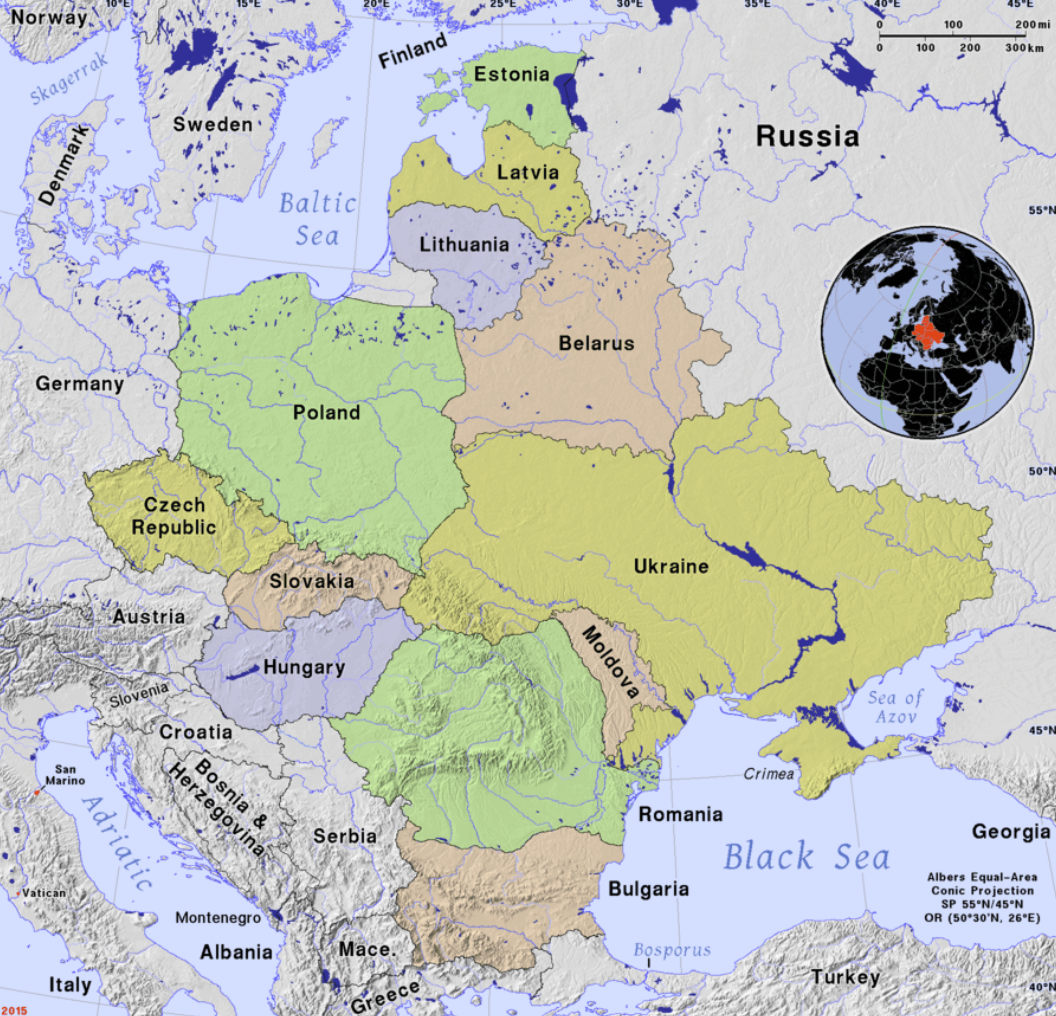
    moldova Just days after Russia’s invasion of Ukraine, Belarusian dictator Alexander Lukashenko appeared on TV.

    Pointing at a map of Ukraine split into four parts, the Putin ally directed attention toward Moldova, stoking fears that the former soviet republic could be next on Moscow’s list.

    One month later, Moldova applied for EU membership. In June 2022, EU leaders granted candidate status to the Republic of Moldova, noting that its reform agenda must continue until EU conditions are met.

    Harmonization With EU Copyright Law

    Under the EU-Moldova Association Agreement of 2014, Moldova was required to reform copyright law to meet EU standards. An EU assessment published early 2021 identified many areas in need of attention ( pdf ).

    According to an EU statement dated January 2022, Moldova’s State Agency for Intellectual Property ( AGEPI ) responded with a new draft transposing nine EU directives in full and four EU directives in part.

    The EU went on to stress the importance of ensuring transparency and balance “within the system governing the remuneration of authors and performers in a weak bargaining position.” The establishment of “an efficient system” for the collective management of copyright and related rights was also mentioned.

    Back in Moldova, rightsholder groups were moving ever closer to boiling point.

    AGEPI “Working Against Rightsholders”

    Last June, in an open letter to the government on behalf of more than 650 members, state-approved collective management organizations National Copyright Association (ANCO) and the National Association of Phonogram Producers and Performers ( ANPFI ) vented their anger in public.

    Accusing Moldova’s State Agency for Intellectual Property (AGEPI) of corruption, working against rightsholders, and misleading the government, the groups described the revised draft copyright law as “absolutely incompatible” with Moldova’s status as an EU candidate.

    On behalf of their members including artists, composers, and performers, ANCO and ANPFI called on Moldova’s parliament to postpone the approval of the draft until reports from international experts could be reviewed.

    Concerns were mounting that the draft undermined artists and collective management groups while granting “excessive powers” to the head of AGEPI to “decide on all key issues” related to collective management.

    Law Was Already Being Approved

    On July 3, 2022, ANPFI revealed that the law had been approved during a June 22 government meeting and again on July 1 in the first reading by parliament.

    “Regrettably, during the last 5 years, AGEPI acted only through attacks against authors, copyright holders and related rights, manifested by illegal decisions issued by AGEPI, which were later found to be illegal up to the Supreme Court of Justice,” the group told the government.

    “As a result of these attacks, the National Anticorruption Center/Anticorruption Prosecutor’s Office initiated a criminal investigation into the illegal acts of the decision-makers within AGEPI. AGEPI’s competence in the field of copyright and related rights was found by the Courts and qualified as ‘… defiance of the legal order…'”

    CISAC Asks Moldova’s Parliament Not to Pass Law

    In an astonishing series of published articles and open letters, including those addressed directly to the Prime Minister, ANPFI accused AGEPI of being “intoxicated with forgeries, manipulations and corruption.”

    On July 6, 2022, ANPFI published a letter sent by the International Confederation of Societies of Authors and Composers ( CISAC ), a global network of 227 collecting societies representing four million creators, to the Moldovan parliament.

    The full letter can be read here but suffice to say, CISAC wasn’t impressed with the draft.

    Following ANPFI pleas to the president of Moldova, the U.S. Amadassor to Moldova, and the European Union, a closed government discussion on July 27 led to Moldova’s new copyright law being passed by parliament a day later.

    ANPFI Warns of New Competition From Outside Moldova

    With the law set to come into force in the second week of October 2022, ANPFI accused AGEPI of lining up foreign-backed copyright management organizations to operate in Moldova.

    According to ANPFI and reports published earlier in the year, those organizations receive backing from RAO (Russian Authors’ Society) and VOIS (All-Russian Organization of Intellectual Property), who ANPFI accuse of benefiting from similar arrangements in Georgia, Azerbaijan and Kazakhstan .

    Whether those claims were investigated is unclear but on October 9, 2022, the new law was officially published by the government of Moldova and there was no turning back.
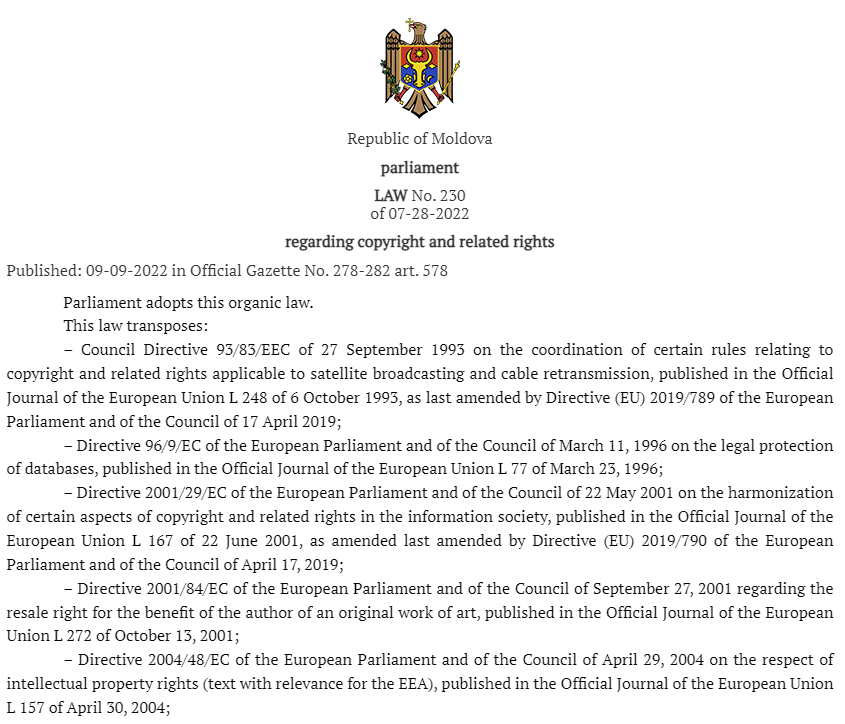
    In order to operate legally under the new law, ANPFI and ANCO were required to reapply for their status as approved collective management organizations. The same would’ve applied to any new applicants but if there have been approvals, they are yet to be reported.

    As a result, no collective rights management groups appear to be operating in Moldova. The country has continued to listen to music, of course, but since no group has received official approval, artists aren’t earning any money when music is played on the radio, on TV, in public places, or anywhere else. Even when people make copies of tracks under Moldova’s private copyright exception, nobody gets paid.

    With a smooth transition under the new law rendered impossible right from the start, AGEPI’s latest move appears to have turned artists’ rights into a dumpster fire.

    AGEPI Terminates Both ANPFI and ANCO

    Having scrutinized the provisions of the new ‘Law on Copyright and Related rights’ passed in October, the head of Moldova’s State Agency for Intellectual Property (AGEPI) determined that ANPFI and ANCO failed to meet the specified standards.

    As a result, ANCO’s work since 2013 and ANPFI’s work since 2019, came to an abrupt end last week when AGEPI terminated their status as collective management organizations.

    “The decision was issued in accordance with the provisions of the new Law on Copyright and Related rights, which entered into force on 09.10.2022,” AGEPI’s announcement reads.

    “We remind the associations interested in approval as a collective management organization (which have legal personality, being registered in accordance with the provisions of the legislation, and are based in the Republic of Moldova), about the need to cumulatively fulfill the conditions provided for in art. 84 para. (1) from Law no. 230/2022 regarding copyright and related rights.”

    “Three months after the entry into force of the new law, not a single public association has received approval from the AGEPI to operate as a collective management organization,” says ANCO chairman, Liviu Stirbu.

    “This means that the scope of copyright and related rights goes beyond the legal framework, and any use of musical works on radio and television is illegal.”

    Moldova’s law was introduced to ensure “a high degree of protection for authors and holders of copyright and related rights.”

    Map credit

    From: TF , for the latest news on copyright battles, piracy and more.

    • To chevron_right

      Under a New EU-Focused Copyright Law, Musical Artists Currently Earn *Nothing*

      news.movim.eu / TorrentFreak • 22 January 2023 • 5 minutes

    moldova Just days after Russia’s invasion of Ukraine, Belarusian dictator Alexander Lukashenko appeared on TV.

    Pointing at a map of Ukraine split into four parts, the Putin ally directed attention toward Moldova, stoking fears that the former soviet republic could be next on Moscow’s list.

    One month later, Moldova applied for EU membership. In June 2022, EU leaders granted candidate status to the Republic of Moldova, noting that its reform agenda must continue until EU conditions are met.

    Harmonization With EU Copyright Law

    Under the EU-Moldova Association Agreement of 2014, Moldova was required to reform copyright law to meet EU standards. An EU assessment published early 2021 identified many areas in need of attention ( pdf ).

    According to an EU statement dated January 2022, Moldova’s State Agency for Intellectual Property ( AGEPI ) responded with a new draft transposing nine EU directives in full and four EU directives in part.

    The EU went on to stress the importance of ensuring transparency and balance “within the system governing the remuneration of authors and performers in a weak bargaining position.” The establishment of “an efficient system” for the collective management of copyright and related rights was also mentioned.

    Back in Moldova, rightsholder groups were moving ever closer to boiling point.

    AGEPI “Working Against Rightsholders”

    Last June, in an open letter to the government on behalf of more than 650 members, state-approved collective management organizations National Copyright Association (ANCO) and the National Association of Phonogram Producers and Performers ( ANPFI ) vented their anger in public.

    Accusing Moldova’s State Agency for Intellectual Property (AGEPI) of corruption, working against rightsholders, and misleading the government, the groups described the revised draft copyright law as “absolutely incompatible” with Moldova’s status as an EU candidate.

    On behalf of their members including artists, composers, and performers, ANCO and ANPFI called on Moldova’s parliament to postpone the approval of the draft until reports from international experts could be reviewed.

    Concerns were mounting that the draft undermined artists and collective management groups while granting “excessive powers” to the head of AGEPI to “decide on all key issues” related to collective management.

    Law Was Already Being Approved

    On July 3, 2022, ANPFI revealed that the law had been approved during a June 22 government meeting and again on July 1 in the first reading by parliament.

    “Regrettably, during the last 5 years, AGEPI acted only through attacks against authors, copyright holders and related rights, manifested by illegal decisions issued by AGEPI, which were later found to be illegal up to the Supreme Court of Justice,” the group told the government.

    “As a result of these attacks, the National Anticorruption Center/Anticorruption Prosecutor’s Office initiated a criminal investigation into the illegal acts of the decision-makers within AGEPI. AGEPI’s competence in the field of copyright and related rights was found by the Courts and qualified as ‘… defiance of the legal order…'”

    CISAC Asks Moldova’s Parliament Not to Pass Law

    In an astonishing series of published articles and open letters, including those addressed directly to the Prime Minister, ANPFI accused AGEPI of being “intoxicated with forgeries, manipulations and corruption.”

    On July 6, 2022, ANPFI published a letter sent by the International Confederation of Societies of Authors and Composers ( CISAC ), a global network of 227 collecting societies representing four million creators, to the Moldovan parliament.

    The full letter can be read here but suffice to say, CISAC wasn’t impressed with the draft.

    Following ANPFI pleas to the president of Moldova, the U.S. Amadassor to Moldova, and the European Union, a closed government discussion on July 27 led to Moldova’s new copyright law being passed by parliament a day later.

    ANPFI Warns of New Competition From Outside Moldova

    With the law set to come into force in the second week of October 2022, ANPFI accused AGEPI of lining up foreign-backed copyright management organizations to operate in Moldova.

    According to ANPFI and reports published earlier in the year, those organizations receive backing from RAO (Russian Authors’ Society) and VOIS (All-Russian Organization of Intellectual Property), who ANPFI accuse of benefiting from similar arrangements in Georgia, Azerbaijan and Kazakhstan .

    Whether those claims were investigated is unclear but on October 9, 2022, the new law was officially published by the government of Moldova and there was no turning back.

    In order to operate legally under the new law, ANPFI and ANCO were required to reapply for their status as approved collective management organizations. The same would’ve applied to any new applicants but if there have been approvals, they are yet to be reported.

    As a result, no collective rights management groups appear to be operating in Moldova. The country has continued to listen to music, of course, but since no group has received official approval, artists aren’t earning any money when music is played on the radio, on TV, in public places, or anywhere else. Even when people make copies of tracks under Moldova’s private copyright exception, nobody gets paid.

    With a smooth transition under the new law rendered impossible right from the start, AGEPI’s latest move appears to have turned artists’ rights into a dumpster fire.

    AGEPI Terminates Both ANPFI and ANCO

    Having scrutinized the provisions of the new ‘Law on Copyright and Related rights’ passed in October, the head of Moldova’s State Agency for Intellectual Property (AGEPI) determined that ANPFI and ANCO failed to meet the specified standards.

    As a result, ANCO’s work since 2013 and ANPFI’s work since 2019, came to an abrupt end last week when AGEPI terminated their status as collective management organizations.

    “The decision was issued in accordance with the provisions of the new Law on Copyright and Related rights, which entered into force on 09.10.2022,” AGEPI’s announcement reads.

    “We remind the associations interested in approval as a collective management organization (which have legal personality, being registered in accordance with the provisions of the legislation, and are based in the Republic of Moldova), about the need to cumulatively fulfill the conditions provided for in art. 84 para. (1) from Law no. 230/2022 regarding copyright and related rights.”

    “Three months after the entry into force of the new law, not a single public association has received approval from the AGEPI to operate as a collective management organization,” says ANCO chairman, Liviu Stirbu.

    “This means that the scope of copyright and related rights goes beyond the legal framework, and any use of musical works on radio and television is illegal.”

    Moldova’s law was introduced to ensure “a high degree of protection for authors and holders of copyright and related rights.”

    Map credit

    From: TF , for the latest news on copyright battles, piracy and more.

    • To chevron_right

      Under a New EU-Focused Copyright Law, Musical Artists Currently Earn *Nothing*

      news.movim.eu / TorrentFreak • 22 January 2023 • 5 minutes

    moldova Just days after Russia’s invasion of Ukraine, Belarusian dictator Alexander Lukashenko appeared on TV.

    Pointing at a map of Ukraine split into four parts, the Putin ally directed attention toward Moldova, stoking fears that the former soviet republic could be next on Moscow’s list.

    One month later, Moldova applied for EU membership. In June 2022, EU leaders granted candidate status to the Republic of Moldova, noting that its reform agenda must continue until EU conditions are met.

    Harmonization With EU Copyright Law

    Under the EU-Moldova Association Agreement of 2014, Moldova was required to reform copyright law to meet EU standards. An EU assessment published early 2021 identified many areas in need of attention ( pdf ).

    According to an EU statement dated January 2022, Moldova’s State Agency for Intellectual Property ( AGEPI ) responded with a new draft transposing nine EU directives in full and four EU directives in part.

    The EU went on to stress the importance of ensuring transparency and balance “within the system governing the remuneration of authors and performers in a weak bargaining position.” The establishment of “an efficient system” for the collective management of copyright and related rights was also mentioned.

    Back in Moldova, rightsholder groups were moving ever closer to boiling point.

    AGEPI “Working Against Rightsholders”

    Last June, in an open letter to the government on behalf of more than 650 members, state-approved collective management organizations National Copyright Association (ANCO) and the National Association of Phonogram Producers and Performers ( ANPFI ) vented their anger in public.

    Accusing Moldova’s State Agency for Intellectual Property (AGEPI) of corruption, working against rightsholders, and misleading the government, the groups described the revised draft copyright law as “absolutely incompatible” with Moldova’s status as an EU candidate.

    On behalf of their members including artists, composers, and performers, ANCO and ANPFI called on Moldova’s parliament to postpone the approval of the draft until reports from international experts could be reviewed.

    Concerns were mounting that the draft undermined artists and collective management groups while granting “excessive powers” to the head of AGEPI to “decide on all key issues” related to collective management.

    Law Was Already Being Approved

    On July 3, 2022, ANPFI revealed that the law had been approved during a June 22 government meeting and again on July 1 in the first reading by parliament.

    “Regrettably, during the last 5 years, AGEPI acted only through attacks against authors, copyright holders and related rights, manifested by illegal decisions issued by AGEPI, which were later found to be illegal up to the Supreme Court of Justice,” the group told the government.

    “As a result of these attacks, the National Anticorruption Center/Anticorruption Prosecutor’s Office initiated a criminal investigation into the illegal acts of the decision-makers within AGEPI. AGEPI’s competence in the field of copyright and related rights was found by the Courts and qualified as ‘… defiance of the legal order…'”

    CISAC Asks Moldova’s Parliament Not to Pass Law

    In an astonishing series of published articles and open letters, including those addressed directly to the Prime Minister, ANPFI accused AGEPI of being “intoxicated with forgeries, manipulations and corruption.”

    On July 6, 2022, ANPFI published a letter sent by the International Confederation of Societies of Authors and Composers ( CISAC ), a global network of 227 collecting societies representing four million creators, to the Moldovan parliament.

    The full letter can be read here but suffice to say, CISAC wasn’t impressed with the draft.

    Following ANPFI pleas to the president of Moldova, the U.S. Amadassor to Moldova, and the European Union, a closed government discussion on July 27 led to Moldova’s new copyright law being passed by parliament a day later.

    ANPFI Warns of New Competition From Outside Moldova

    With the law set to come into force in the second week of October 2022, ANPFI accused AGEPI of lining up foreign-backed copyright management organizations to operate in Moldova.

    According to ANPFI and reports published earlier in the year, those organizations receive backing from RAO (Russian Authors’ Society) and VOIS (All-Russian Organization of Intellectual Property), who ANPFI accuse of benefiting from similar arrangements in Georgia, Azerbaijan and Kazakhstan .

    Whether those claims were investigated is unclear but on October 9, 2022, the new law was officially published by the government of Moldova and there was no turning back.

    In order to operate legally under the new law, ANPFI and ANCO were required to reapply for their status as approved collective management organizations. The same would’ve applied to any new applicants but if there have been approvals, they are yet to be reported.

    As a result, no collective rights management groups appear to be operating in Moldova. The country has continued to listen to music, of course, but since no group has received official approval, artists aren’t earning any money when music is played on the radio, on TV, in public places, or anywhere else. Even when people make copies of tracks under Moldova’s private copyright exception, nobody gets paid.

    With a smooth transition under the new law rendered impossible right from the start, AGEPI’s latest move appears to have turned artists’ rights into a dumpster fire.

    AGEPI Terminates Both ANPFI and ANCO

    Having scrutinized the provisions of the new ‘Law on Copyright and Related rights’ passed in October, the head of Moldova’s State Agency for Intellectual Property (AGEPI) determined that ANPFI and ANCO failed to meet the specified standards.

    As a result, ANCO’s work since 2013 and ANPFI’s work since 2019, came to an abrupt end last week when AGEPI terminated their status as collective management organizations.

    “The decision was issued in accordance with the provisions of the new Law on Copyright and Related rights, which entered into force on 09.10.2022,” AGEPI’s announcement reads.

    “We remind the associations interested in approval as a collective management organization (which have legal personality, being registered in accordance with the provisions of the legislation, and are based in the Republic of Moldova), about the need to cumulatively fulfill the conditions provided for in art. 84 para. (1) from Law no. 230/2022 regarding copyright and related rights.”

    “Three months after the entry into force of the new law, not a single public association has received approval from the AGEPI to operate as a collective management organization,” says ANCO chairman, Liviu Stirbu.

    “This means that the scope of copyright and related rights goes beyond the legal framework, and any use of musical works on radio and television is illegal.”

    Moldova’s law was introduced to ensure “a high degree of protection for authors and holders of copyright and related rights.”

    Map credit

    From: TF , for the latest news on copyright battles, piracy and more.

    • To chevron_right

      Report Urges Cloudflare to Terminate Accounts of Pirate Sites

      news.movim.eu / TorrentFreak • 21 January 2023 • 3 minutes

    cloudflare logo Popular Internet infrastructure service Cloudflare has come under a lot of pressure from copyright holders in recent years.

    The company offers its services to millions of sites. This includes multinationals, governments, but also some of the world’s leading pirate sites.

    These sites have proven to be quite a headache for the San Francisco-based tech company. Ideally, however, the company prefers not to be the arbiter of what content is allowed and what is not.

    The Curation Conundrum

    The company reiterated its position a few months ago. To shield itself from escalating removal demands, including plain censorship, Cloudflare said it would no longer terminate customers without a court order.

    Just days after taking this hardened approach, Cloudflare reversed its position. Citing an immediate threat to human life, CEO Matthew Prince justified blocking access to the controversial Kiwi Farms site.

    There’s no question that death threats are in a league of their own, but copyright holders would also like to see more cooperation from Cloudflare. This call is backed by a recent report from brand protection company Corsearch.

    Corsearch is no stranger to copyright issues. The company works with several of the largest rightsholders and its subsidiary Incopro has produced a wealth of piracy research , some in collaboration with governments. In this case, the research focuses on Cloudflare.

    Whirepaper: Cloudflare & Pirate Sites

    The overall tenor of the whitepaper is that when compared to other intermediaries, Cloudflare appears to be linked to a relatively high percentage of torrent sites. Of all the sites flagged by Corsearch, which are all demoted by Google as well, half use Cloudflare’s CDN service.

    “Cloudflare is not the host of these websites. However, the host is not readily identifiable and Cloudflare is most closely associated with 49% of websites notified for delisting by Corsearch,” the report notes.

    pirate cf

    There’s no denying that Cloudflare stands out but it should be noted that the company is not a hosting provider, like the others on the list. In addition to Cloudflare, these pirate sites may use Amazon or Google’s services as well, even though that’s not immediately visible.

    Besides pirate sites, the report also links Cloudflare to trademarking. Again, it is the most common online intermediary for these outlets.

    Technically, Cloudflare can’t take these sites offline, as they are hosted elsewhere. However, Corsearch believes that the company could and should do more to tackle the piracy problem. And it has some ideas on where to start.

    “Cloudflare is uniquely positioned to do more to protect rights holders and substantially to suppress the scourge of online piracy and counterfeiting,” the report reads.

    “We are asking Cloudflare to do more to support rights owners by voluntarily implementing certain measures. These measures are reasonable, proportionate and if adopted by Cloudflare will have a significant impact.”

    Recommendations

    Corsearch doesn’t have just one, but a whole list of suggestions for the CDN provider. Most of these boil down to terminating services to sites that others deem to be infringing. Those include the following;

    – Cloudflare should terminate accounts of sites that are demoted or deindexed by Google search.

    – Cloudflare should withdraw services to any site that’s deemed unlawful by a recognized law enforcement body or the ‘ Infringing Website List ’ (IWL).

    – Cloudflare should ban sites that are on the US Trade Representative’s annual notorious markets list .

    – Cloudflare should stop working with sites that are added to the European Union’s Counterfeit and Piracy Watchlist .

    What Can Go Wrong?

    While it’s understandable that rightsholders want Cloudflare to do more, these suggestions are not without issues of their own. The IWL, for example, is private and can’t be scrutinized by the public. As reported recently , this includes domains of organizations such as GitHub, Blogspot, and a Portuguese University.

    The USTR’s Notorious Market lists and the EU’s Piracy Watchlist also have various entries that deserve some nuance. These include the Chinese Wechat, which has over a billion users, as well as Russia’s largest social media platform VK.

    Up until recently, USTR even listed Amazon’s foreign online stores as “notorious markets” . Does that mean that these shouldn’t be allowed to operate?

    Given Cloudflare’s previous comments, it seems unlikely that the company will start banning accounts left and right. That being said, Corsearch also has some other suggestions that may be more realistic.

    The report proposes a robust “Know-Your-Client” policy, for example. In addition, it calls for a comprehensive transparency report where Cloudflare would disclose which domain names are flagged by rightsholders and how often.

    From: TF , for the latest news on copyright battles, piracy and more.

    • To chevron_right

      Report Urges Cloudflare to Terminate Accounts of Pirate Sites

      news.movim.eu / TorrentFreak • 21 January 2023 • 3 minutes

    cloudflare logo Popular Internet infrastructure service Cloudflare has come under a lot of pressure from copyright holders in recent years.

    The company offers its services to millions of sites. This includes multinationals, governments, but also some of the world’s leading pirate sites.

    These sites have proven to be quite a headache for the San Francisco-based tech company. Ideally, however, the company prefers not to be the arbiter of what content is allowed and what is not.

    The Curation Conundrum

    The company reiterated its position a few months ago. To shield itself from escalating removal demands, including plain censorship, Cloudflare said it would no longer terminate customers without a court order.

    Just days after taking this hardened approach, Cloudflare reversed its position. Citing an immediate threat to human life, CEO Matthew Prince justified blocking access to the controversial Kiwi Farms site.

    There’s no question that death threats are in a league of their own, but copyright holders would also like to see more cooperation from Cloudflare. This call is backed by a recent report from brand protection company Corsearch.

    Corsearch is no stranger to copyright issues. The company works with several of the largest rightsholders and its subsidiary Incopro has produced a wealth of piracy research , some in collaboration with governments. In this case, the research focuses on Cloudflare.

    Whirepaper: Cloudflare & Pirate Sites

    The overall tenor of the whitepaper is that when compared to other intermediaries, Cloudflare appears to be linked to a relatively high percentage of torrent sites. Of all the sites flagged by Corsearch, which are all demoted by Google as well, half use Cloudflare’s CDN service.

    “Cloudflare is not the host of these websites. However, the host is not readily identifiable and Cloudflare is most closely associated with 49% of websites notified for delisting by Corsearch,” the report notes.

    pirate cf

    There’s no denying that Cloudflare stands out but it should be noted that the company is not a hosting provider, like the others on the list. In addition to Cloudflare, these pirate sites may use Amazon or Google’s services as well, even though that’s not immediately visible.

    Besides pirate sites, the report also links Cloudflare to trademarking. Again, it is the most common online intermediary for these outlets.

    Technically, Cloudflare can’t take these sites offline, as they are hosted elsewhere. However, Corsearch believes that the company could and should do more to tackle the piracy problem. And it has some ideas on where to start.

    “Cloudflare is uniquely positioned to do more to protect rights holders and substantially to suppress the scourge of online piracy and counterfeiting,” the report reads.

    “We are asking Cloudflare to do more to support rights owners by voluntarily implementing certain measures. These measures are reasonable, proportionate and if adopted by Cloudflare will have a significant impact.”

    Recommendations

    Corsearch doesn’t have just one, but a whole list of suggestions for the CDN provider. Most of these boil down to terminating services to sites that others deem to be infringing. Those include the following;

    – Cloudflare should terminate accounts of sites that are demoted or deindexed by Google search.

    – Cloudflare should withdraw services to any site that’s deemed unlawful by a recognized law enforcement body or the ‘ Infringing Website List ’ (IWL).

    – Cloudflare should ban sites that are on the US Trade Representative’s annual notorious markets list .

    – Cloudflare should stop working with sites that are added to the European Union’s Counterfeit and Piracy Watchlist .

    What Can Go Wrong?

    While it’s understandable that rightsholders want Cloudflare to do more, these suggestions are not without issues of their own. The IWL, for example, is private and can’t be scrutinized by the public. As reported recently , this includes domains of organizations such as GitHub, Blogspot, and a Portuguese University.

    The USTR’s Notorious Market lists and the EU’s Piracy Watchlist also have various entries that deserve some nuance. These include the Chinese Wechat, which has over a billion users, as well as Russia’s largest social media platform VK.

    Up until recently, USTR even listed Amazon’s foreign online stores as “notorious markets” . Does that mean that these shouldn’t be allowed to operate?

    Given Cloudflare’s previous comments, it seems unlikely that the company will start banning accounts left and right. That being said, Corsearch also has some other suggestions that may be more realistic.

    The report proposes a robust “Know-Your-Client” policy, for example. In addition, it calls for a comprehensive transparency report where Cloudflare would disclose which domain names are flagged by rightsholders and how often.

    From: TF , for the latest news on copyright battles, piracy and more.

    • To chevron_right

      Report Urges Cloudflare to Terminate Accounts of Pirate Sites

      news.movim.eu / TorrentFreak • 21 January 2023 • 3 minutes

    cloudflare logo Popular Internet infrastructure service Cloudflare has come under a lot of pressure from copyright holders in recent years.
    The company offers its services to millions of sites. This includes multinationals, governments, but also some of the world’s leading pirate sites.

    These sites have proven to be quite a headache for the San Francisco-based tech company. Ideally, however, the company prefers not to be the arbiter of what content is allowed and what is not.

    The Curation Conundrum

    The company reiterated its position a few months ago. To shield itself from escalating removal demands, including plain censorship, Cloudflare said it would no longer terminate customers without a court order.

    Just days after taking this hardened approach, Cloudflare reversed its position. Citing an immediate threat to human life, CEO Matthew Prince justified blocking access to the controversial Kiwi Farms site.

    There’s no question that death threats are in a league of their own, but copyright holders would also like to see more cooperation from Cloudflare. This call is backed by a recent report from brand protection company Corsearch.

    Corsearch is no stranger to copyright issues. The company works with several of the largest rightsholders and its subsidiary Incopro has produced a wealth of piracy research , some in collaboration with governments. In this case, the research focuses on Cloudflare.

    Whirepaper: Cloudflare & Pirate Sites

    The overall tenor of the whitepaper is that when compared to other intermediaries, Cloudflare appears to be linked to a relatively high percentage of torrent sites. Of all the sites flagged by Corsearch, which are all demoted by Google as well, half use Cloudflare’s CDN service.

    “Cloudflare is not the host of these websites. However, the host is not readily identifiable and Cloudflare is most closely associated with 49% of websites notified for delisting by Corsearch,” the report notes.

    pirate cf

    There’s no denying that Cloudflare stands out but it should be noted that the company is not a hosting provider, like the others on the list. In addition to Cloudflare, these pirate sites may use Amazon or Google’s services as well, even though that’s not immediately visible.

    Besides pirate sites, the report also links Cloudflare to trademarking. Again, it is the most common online intermediary for these outlets.

    Technically, Cloudflare can’t take these sites offline, as they are hosted elsewhere. However, Corsearch believes that the company could and should do more to tackle the piracy problem. And it has some ideas on where to start.

    “Cloudflare is uniquely positioned to do more to protect rights holders and substantially to suppress the scourge of online piracy and counterfeiting,” the report reads.

    “We are asking Cloudflare to do more to support rights owners by voluntarily implementing certain measures. These measures are reasonable, proportionate and if adopted by Cloudflare will have a significant impact.”

    Recommendations

    Corsearch doesn’t have just one, but a whole list of suggestions for the CDN provider. Most of these boil down to terminating services to sites that others deem to be infringing. Those include the following;

    – Cloudflare should terminate accounts of sites that are demoted or deindexed by Google search.

    – Cloudflare should withdraw services to any site that’s deemed unlawful by a recognized law enforcement body or the ‘ Infringing Website List ’ (IWL).

    – Cloudflare should ban sites that are on the US Trade Representative’s annual notorious markets list .

    – Cloudflare should stop working with sites that are added to the European Union’s Counterfeit and Piracy Watchlist .

    What Can Go Wrong?

    While it’s understandable that rightsholders want Cloudflare to do more, these suggestions are not without issues of their own. The IWL, for example, is private and can’t be scrutinized by the public. As reported recently , this includes domains of organizations such as GitHub, Blogspot, and a Portuguese University.

    The USTR’s Notorious Market lists and the EU’s Piracy Watchlist also have various entries that deserve some nuance. These include the Chinese Wechat, which has over a billion users, as well as Russia’s largest social media platform VK.

    Up until recently, USTR even listed Amazon’s foreign online stores as “notorious markets” . Does that mean that these shouldn’t be allowed to operate?

    Given Cloudflare’s previous comments, it seems unlikely that the company will start banning accounts left and right. That being said, Corsearch also has some other suggestions that may be more realistic.

    The report proposes a robust “Know-Your-Client” policy, for example. In addition, it calls for a comprehensive transparency report where Cloudflare would disclose which domain names are flagged by rightsholders and how often.

    From: TF , for the latest news on copyright battles, piracy and more.

    • To chevron_right

      Hollywood’s Relentless Pursuit of Piracy Giant Cuevana3 Has No Obvious Effect

      news.movim.eu / TorrentFreak • 20 January 2023 • 4 minutes

    cuevana3-s Tomás Escobar is the CEO of Acámica, the Argentina-based tech education company he co-founded a decade ago.

    Escobar studied Computer Engineering at the National University of Córdoba and in 2014 appeared in MIT Technology Review’s ‘ Innovator Under 35 ‘ list. Before Acámica, however, Escobar also created a rather successful website; Cuevana.

    In 2011, just four years after its launch, Cuevana.tv was among the top 20 most-visited sites in Argentina. When audiences grew in Chile, Peru, Mexico, and beyond, it was clear that trouble lay ahead. In 2012, one of a rumored nine Cuevana administrators was arrested in Chile following a complaint by HBO.

    In a 2019 interview , in response to a question asking why he closed Cuevana, Escobar said that the site “grew a lot” in 2013. From there, discussions took place with the industry to see if a business could be developed. When that process encountered difficulties, Escobar decided on a new project – Acámica.

    What happened in the background with Cuevana is much less clear, but the bottom line was straightforward. By some mechanism or another, a site that looked like Cuevana carried on regardless.

    Not even an appearance on the U.S. Government’s list of most notorious pirate sites in 2015 made that much difference. Cuevana.tv as a domain eventually fell by the wayside, replaced by Cuevana2 and today’s Cuevana3 variants, many of which enjoy tens of millions of visits per month.

    In a more recent report to the USTR, the MPA said that in August 2022 alone, a handful of Cuevana-branded domains received 130 million visits. Hollywood had already reported some success after seizing domains a year earlier, but the destruction of the Cuevana movement remained elusive.

    Damaging Cuevana’s Domains

    Cuevana3.me, which first appeared in 2018, was enjoying ridiculous amounts of traffic last year after the site recovered from the seizure of its .io domain. In August 2022, the .me domain received 66.71 million visits and was ranked the 53rd and 68th most popular site in Argentina and Mexico, respectively.

    At some point, Cuevana3.me started utilizing subdomains, possibly to mitigate downranking by Google due to excessive volumes of DMCA notices. Of course, the strategy was spotted by rightsholders; Disney sent notices like this one which tackled Cuevana3.me subdomains and at the same time, those deployed by FMovies for the same reason.

    Cuevana3.me Comes Under Attack

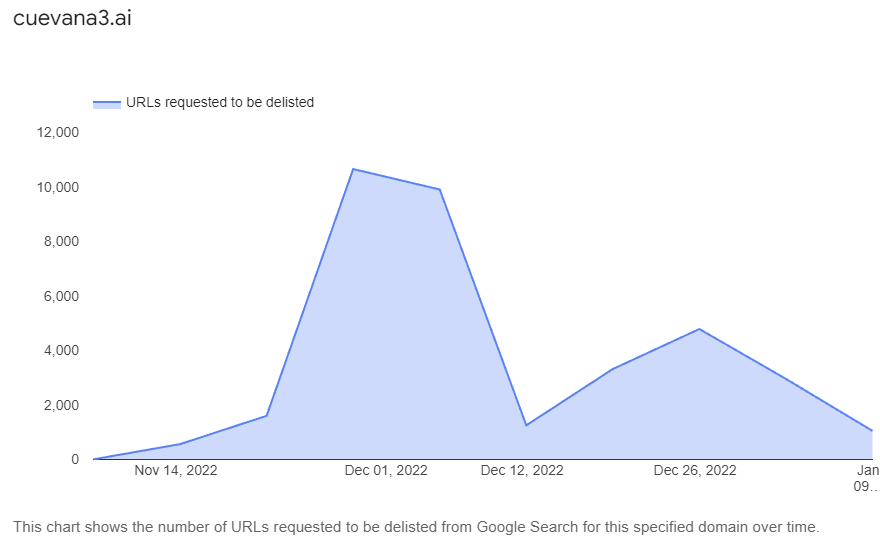
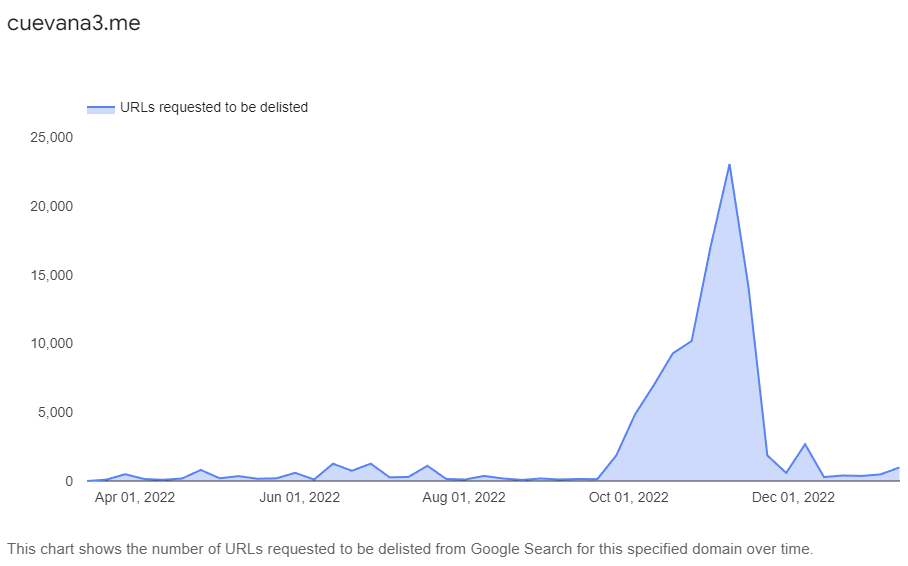
    Cuevana3-branded domains were also appearing on national ISP blacklists, including in Peru, courtesy of local government IP body INDECOPI . Then late September 2022, Cuevana3.me was suddenly reported to Google thousands of times over just a few weeks.

    By early December 2022, the peak had passed. Rightsholders no longer seemed interested in Cuevana3.me, but that was for good reason. In what may have been a tactic to avoid being tarred with the .me brush for too long at Google, Cuevana3.me began seamlessly redirecting users to Cuevana3.ai.

    Predictably, it didn’t take long for that to get noticed either.

    Cuevana3.ai Also Under Attack

    Once again, high volumes of DMCA notices were sent to Google in a short space of time. The names of the most prolific senders won’t come as a surprise since they’re all members of the Alliance for Creativity and Entertainment – Disney, Warner Bros., Amazon, Sony, Apple, NBCUniversal and Paramount.

    There were also signs that the studios sometimes used Smart Protection, a Spanish anti-piracy company that reportedly uses artificial intelligence to efficiently deal with infringing websites.

    New Domain, Rinse and Repeat?

    If AI really did lose interest in Cuevana3’s .ai domain in early January, that would’ve been quite fitting, albeit for an extremely predictable reason.

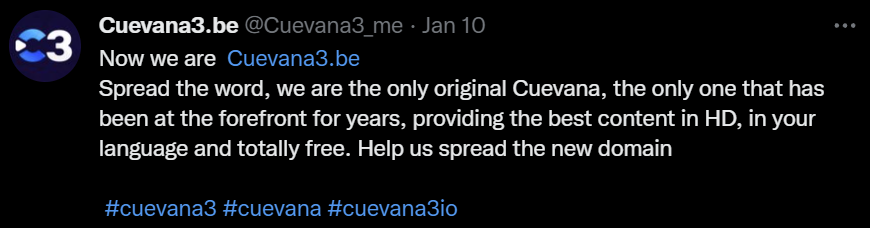
    A Twitter account previously associated with Cuevana3’s .io and .me domains announced the move to yet another new domain on January 10, 2023.

    “Now we are Cuevana3.be,” it began.

    “Spread the word, we are the only original Cuevana, the only one that has been at the forefront for years, providing the best content in HD, in your language and totally free. Help us spread the new domain.”

    Given that the old domains redirect, finding the new domain won’t be an issue for regular users. It wasn’t a problem for Warner Bros. either. The company sent a DMCA notice to Google targeting the site’s main content page on January 7, three days before the official announcement on Twitter.

    Are These Tactics Working?

    If we go back to the data cited by the MPA last year, the domain cuevana3.me received 66.71 million visits in August 2022 alone. That’s a big number that the MPA would’ve hoped to reduce with its DMCA notices and from various reports, the knock-on effects of Google downranking.

    Since then, the site has adopted (and then booted) cuevana3.ai and is now located at cuevana3.be. That should’ve had at least some effect on the site’s traffic.

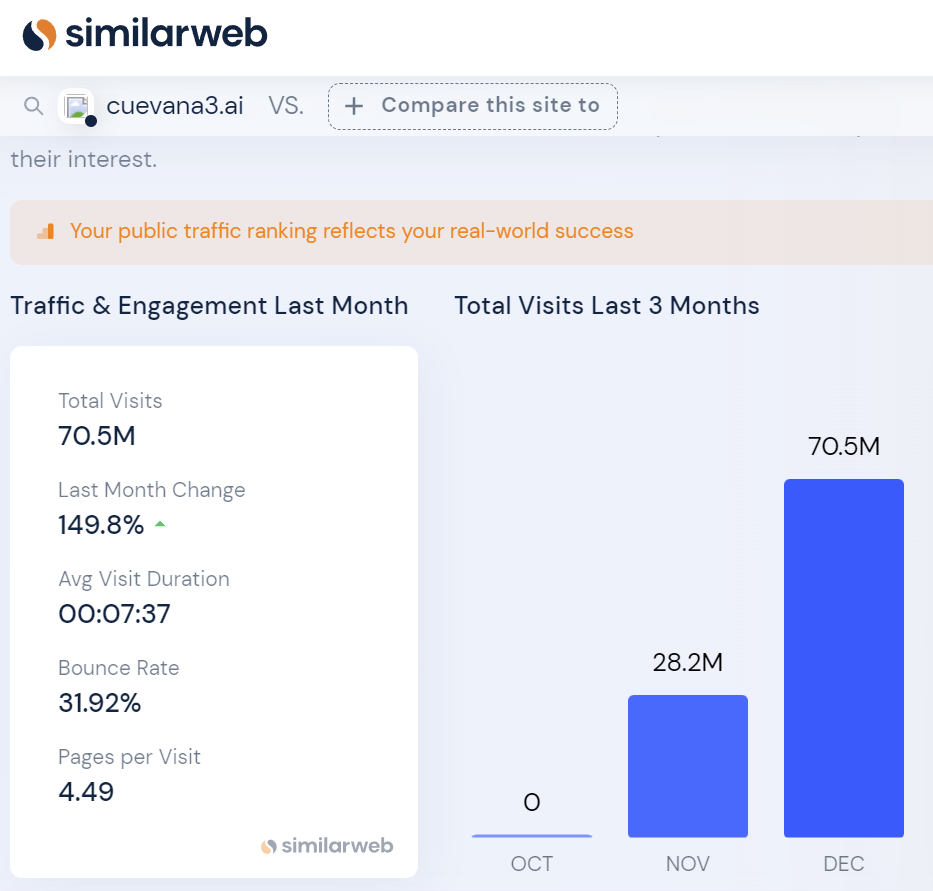
    According to SimilarWeb data, there is no obvious effect. Cuevana3 appears to have no problem adapting and has lost no traffic as a result. It even appears to have gained some.

    At the time of writing, Warner, Sony, Amazon, Apple, Paramount, Lionsgate, Netflix, MGM and dozens of others are sending DMCA notices targeting the new .be domain.

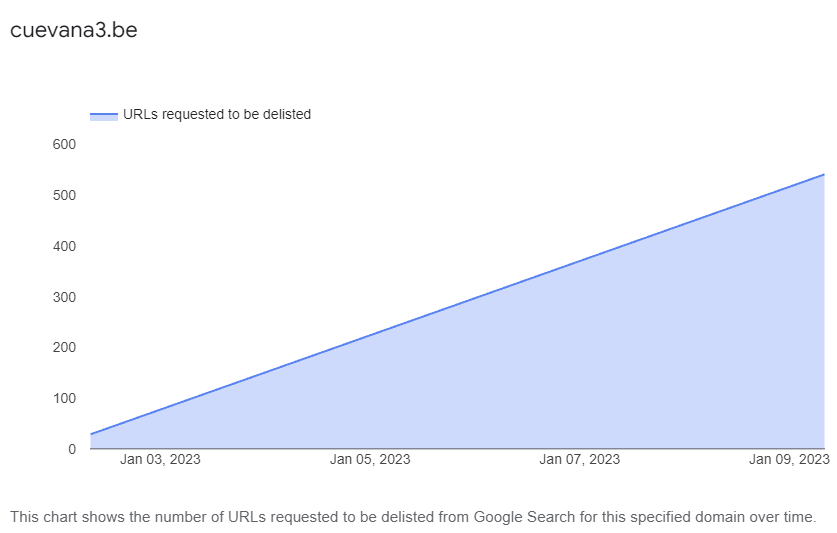
    A total of 194 individual requests have removed 885 URLs in 2023 but that number will dramatically increase in the weeks to come. At what point Cuevana3 will roll out yet another new domain is unclear, but as long as it keeps retaining the old ones, maintaining traffic won’t be a problem.

    From: TF , for the latest news on copyright battles, piracy and more.

    • To chevron_right

      Hollywood’s Relentless Pursuit of Piracy Giant Cuevana3 Has No Obvious Effect

      news.movim.eu / TorrentFreak • 20 January 2023 • 4 minutes

    cuevana3-s Tomás Escobar is the CEO of Acámica, the Argentina-based tech education company he co-founded a decade ago.

    Escobar studied Computer Engineering at the National University of Córdoba and in 2014 appeared in MIT Technology Review’s ‘ Innovator Under 35 ‘ list. Before Acámica, however, Escobar also created a rather successful website; Cuevana.

    In 2011, just four years after its launch, Cuevana.tv was among the top 20 most-visited sites in Argentina. When audiences grew in Chile, Peru, Mexico, and beyond, it was clear that trouble lay ahead. In 2012, one of a rumored nine Cuevana administrators was arrested in Chile following a complaint by HBO.

    In a 2019 interview , in response to a question asking why he closed Cuevana, Escobar said that the site “grew a lot” in 2013. From there, discussions took place with the industry to see if a business could be developed. When that process encountered difficulties, Escobar decided on a new project – Acámica.

    What happened in the background with Cuevana is much less clear, but the bottom line was straightforward. By some mechanism or another, a site that looked like Cuevana carried on regardless.

    Not even an appearance on the U.S. Government’s list of most notorious pirate sites in 2015 made that much difference. Cuevana.tv as a domain eventually fell by the wayside, replaced by Cuevana2 and today’s Cuevana3 variants, many of which enjoy tens of millions of visits per month.

    In a more recent report to the USTR, the MPA said that in August 2022 alone, a handful of Cuevana-branded domains received 130 million visits. Hollywood had already reported some success after seizing domains a year earlier, but the destruction of the Cuevana movement remained elusive.

    Damaging Cuevana’s Domains

    Cuevana3.me, which first appeared in 2018, was enjoying ridiculous amounts of traffic last year after the site recovered from the seizure of its .io domain. In August 2022, the .me domain received 66.71 million visits and was ranked the 53rd and 68th most popular site in Argentina and Mexico, respectively.

    At some point, Cuevana3.me started utilizing subdomains, possibly to mitigate downranking by Google due to excessive volumes of DMCA notices. Of course, the strategy was spotted by rightsholders; Disney sent notices like this one which tackled Cuevana3.me subdomains and at the same time, those deployed by FMovies for the same reason.

    Cuevana3.me Comes Under Attack

    Cuevana3-branded domains were also appearing on national ISP blacklists, including in Peru, courtesy of local government IP body INDECOPI . Then late September 2022, Cuevana3.me was suddenly reported to Google thousands of times over just a few weeks.

    By early December 2022, the peak had passed. Rightsholders no longer seemed interested in Cuevana3.me, but that was for good reason. In what may have been a tactic to avoid being tarred with the .me brush for too long at Google, Cuevana3.me began seamlessly redirecting users to Cuevana3.ai.

    Predictably, it didn’t take long for that to get noticed either.

    Cuevana3.ai Also Under Attack

    Once again, high volumes of DMCA notices were sent to Google in a short space of time. The names of the most prolific senders won’t come as a surprise since they’re all members of the Alliance for Creativity and Entertainment – Disney, Warner Bros., Amazon, Sony, Apple, NBCUniversal and Paramount.

    There were also signs that the studios sometimes used Smart Protection, a Spanish anti-piracy company that reportedly uses artificial intelligence to efficiently deal with infringing websites.

    New Domain, Rinse and Repeat?

    If AI really did lose interest in Cuevana3’s .ai domain in early January, that would’ve been quite fitting, albeit for an extremely predictable reason.

    A Twitter account previously associated with Cuevana3’s .io and .me domains announced the move to yet another new domain on January 10, 2023.

    “Now we are Cuevana3.be,” it began.

    “Spread the word, we are the only original Cuevana, the only one that has been at the forefront for years, providing the best content in HD, in your language and totally free. Help us spread the new domain.”

    Given that the old domains redirect, finding the new domain won’t be an issue for regular users. It wasn’t a problem for Warner Bros. either. The company sent a DMCA notice to Google targeting the site’s main content page on January 7, three days before the official announcement on Twitter.

    Are These Tactics Working?

    If we go back to the data cited by the MPA last year, the domain cuevana3.me received 66.71 million visits in August 2022 alone. That’s a big number that the MPA would’ve hoped to reduce with its DMCA notices and from various reports, the knock-on effects of Google downranking.

    Since then, the site has adopted (and then booted) cuevana3.ai and is now located at cuevana3.be. That should’ve had at least some effect on the site’s traffic.

    According to SimilarWeb data, there is no obvious effect. Cuevana3 appears to have no problem adapting and has lost no traffic as a result. It even appears to have gained some.

    At the time of writing, Warner, Sony, Amazon, Apple, Paramount, Lionsgate, Netflix, MGM and dozens of others are sending DMCA notices targeting the new .be domain.

    A total of 194 individual requests have removed 885 URLs in 2023 but that number will dramatically increase in the weeks to come. At what point Cuevana3 will roll out yet another new domain is unclear, but as long as it keeps retaining the old ones, maintaining traffic won’t be a problem.

    From: TF , for the latest news on copyright battles, piracy and more.

    • To chevron_right

      Hollywood’s Relentless Pursuit of Piracy Giant Cuevana3 Has No Obvious Effect

      news.movim.eu / TorrentFreak • 20 January 2023 • 4 minutes

    cuevana3-s Tomás Escobar is the CEO of Acámica, the Argentina-based tech education company he co-founded a decade ago.

    Escobar studied Computer Engineering at the National University of Córdoba and in 2014 appeared in MIT Technology Review’s ‘ Innovator Under 35 ‘ list. Before Acámica, however, Escobar also created a rather successful website; Cuevana.

    In 2011, just four years after its launch, Cuevana.tv was among the top 20 most-visited sites in Argentina. When audiences grew in Chile, Peru, Mexico, and beyond, it was clear that trouble lay ahead. In 2012, one of a rumored nine Cuevana administrators was arrested in Chile following a complaint by HBO.

    In a 2019 interview , in response to a question asking why he closed Cuevana, Escobar said that the site “grew a lot” in 2013. From there, discussions took place with the industry to see if a business could be developed. When that process encountered difficulties, Escobar decided on a new project – Acámica.

    What happened in the background with Cuevana is much less clear, but the bottom line was straightforward. By some mechanism or another, a site that looked like Cuevana carried on regardless.

    Not even an appearance on the U.S. Government’s list of most notorious pirate sites in 2015 made that much difference. Cuevana.tv as a domain eventually fell by the wayside, replaced by Cuevana2 and today’s Cuevana3 variants, many of which enjoy tens of millions of visits per month.

    In a more recent report to the USTR, the MPA said that in August 2022 alone, a handful of Cuevana-branded domains received 130 million visits. Hollywood had already reported some success after seizing domains a year earlier, but the destruction of the Cuevana movement remained elusive.

    Damaging Cuevana’s Domains

    Cuevana3.me, which first appeared in 2018, was enjoying ridiculous amounts of traffic last year after the site recovered from the seizure of its .io domain. In August 2022, the .me domain received 66.71 million visits and was ranked the 53rd and 68th most popular site in Argentina and Mexico, respectively.

    At some point, Cuevana3.me started utilizing subdomains, possibly to mitigate downranking by Google due to excessive volumes of DMCA notices. Of course, the strategy was spotted by rightsholders; Disney sent notices like this one which tackled Cuevana3.me subdomains and at the same time, those deployed by FMovies for the same reason.

    Cuevana3.me Comes Under Attack

    Cuevana3-branded domains were also appearing on national ISP blacklists, including in Peru, courtesy of local government IP body INDECOPI . Then late September 2022, Cuevana3.me was suddenly reported to Google thousands of times over just a few weeks.

    By early December 2022, the peak had passed. Rightsholders no longer seemed interested in Cuevana3.me, but that was for good reason. In what may have been a tactic to avoid being tarred with the .me brush for too long at Google, Cuevana3.me began seamlessly redirecting users to Cuevana3.ai.

    Predictably, it didn’t take long for that to get noticed either.

    Cuevana3.ai Also Under Attack

    Once again, high volumes of DMCA notices were sent to Google in a short space of time. The names of the most prolific senders won’t come as a surprise since they’re all members of the Alliance for Creativity and Entertainment – Disney, Warner Bros., Amazon, Sony, Apple, NBCUniversal and Paramount.

    There were also signs that the studios sometimes used Smart Protection, a Spanish anti-piracy company that reportedly uses artificial intelligence to efficiently deal with infringing websites.

    New Domain, Rinse and Repeat?

    If AI really did lose interest in Cuevana3’s .ai domain in early January, that would’ve been quite fitting, albeit for an extremely predictable reason.

    A Twitter account previously associated with Cuevana3’s .io and .me domains announced the move to yet another new domain on January 10, 2023.

    “Now we are Cuevana3.be,” it began.

    “Spread the word, we are the only original Cuevana, the only one that has been at the forefront for years, providing the best content in HD, in your language and totally free. Help us spread the new domain.”

    Given that the old domains redirect, finding the new domain won’t be an issue for regular users. It wasn’t a problem for Warner Bros. either. The company sent a DMCA notice to Google targeting the site’s main content page on January 7, three days before the official announcement on Twitter.

    Are These Tactics Working?

    If we go back to the data cited by the MPA last year, the domain cuevana3.me received 66.71 million visits in August 2022 alone. That’s a big number that the MPA would’ve hoped to reduce with its DMCA notices and from various reports, the knock-on effects of Google downranking.

    Since then, the site has adopted (and then booted) cuevana3.ai and is now located at cuevana3.be. That should’ve had at least some effect on the site’s traffic.

    According to SimilarWeb data, there is no obvious effect. Cuevana3 appears to have no problem adapting and has lost no traffic as a result. It even appears to have gained some.

    At the time of writing, Warner, Sony, Amazon, Apple, Paramount, Lionsgate, Netflix, MGM and dozens of others are sending DMCA notices targeting the new .be domain.

    A total of 194 individual requests have removed 885 URLs in 2023 but that number will dramatically increase in the weeks to come. At what point Cuevana3 will roll out yet another new domain is unclear, but as long as it keeps retaining the old ones, maintaining traffic won’t be a problem.

    From: TF , for the latest news on copyright battles, piracy and more.