• To chevron_right

      Pirate IPTV Owners Liable For $100m in Damages Fight House Seizure

      news.movim.eu / TorrentFreak • 30 January 2023 • 4 minutes

    iptv After being sued by DISH Network in 2021, former Nitro TV operators Alex Galindo, Anna Galindo, Martha Galindo, and Osvaldo Galindo, made no real attempt to fight the lawsuit.

    Why that decision was taken is still unknown, but court records suggest that throwing money away on a case that couldn’t be won might be one of the possibilities. The downside is that the plaintiffs went completely unchallenged, including when they requested and received a damages award in excess of $100 million last June .

    Cash Disappeared, House Remained

    After receiving the green light, DISH began searching for the defendants’ assets, including more than $10 million generated by the Nitro TV service.

    Four banks that had received deposits of more than $9 million complied with disclosure requests; two reported no active accounts, one confirmed a $49.00 balance, and the final account was in the red.

    Finding the cupboard bare, DISH moved in on the defendants’ house in Friendswood, Texas.

    Since the property might qualify for homestead protection, DISH presented evidence to the court to show that Nitro TV subscription revenue was used to pay for the house. With the defendants entirely absent from the legal process, the court ordered the United States Marshal Service to levy and sell the property.

    Out of nowhere, the defendants suddenly decided that wasn’t going to happen.

    The House is Off Limits

    In a motion to alter or amend the judgment “to prevent a clear error or manifest injustice,” counsel for Alex Galindo explained that his client bought the house in Friendswood in March 2020 and declared it his home.

    “The Texas Constitution provides special protections for the homestead separate and distinct from protections afforded other types of property,” the motion reads.

    “Because constitutional homestead rights protect citizens from losing their homes, statutes relating to homestead rights are liberally construed to protect the homestead.”

    DISH evidence linked 99% of the house purchase price to sales of illegal IPTV subscriptions. The company argued that homestead protection is not available when a property is purchased with wrongfully acquired funds.

    To support that claim, DISH cited another case – Deluxe Barber School, LLC and Bonifice I. Mbaka – but according to counsel for Galindo, an important detail means that his house still enjoys protection.

    No Money Was Stolen

    In a nutshell, Deluxe Barber involved a foreclosure on a property that was purchased with stolen cash. The strong suggestion here is that since the cash at issue in the Nitro case wasn’t stolen and wasn’t earned by DISH, Deluxe Barber is unhelpful to the broadcaster.

    “[T]hese funds were never possessed, or even earned, by the Plaintiffs. There is no evidence that such funds belonged to the Plaintiffs or that Defendants stole or wrongfully acquired funds directly from Plaintiffs,” the motion reads.

    The 99% figure is also important, the motion adds. It argues that since the account used to buy the property contained personal funds and money “potentially earned” from legitimate transactions, just one percent of legitimate funding would mean homestead rights under the Texas Constitution, especially since Texas courts “liberally construe statutes” relating to homestead rights.

    Predictably, DISH sees things quite differently.

    DISH: Don’t Undo The Correct Decision

    In calling for the motion to be dismissed, DISH cites the history of the lawsuit, using the Court’s own words to state its position. The defendants operated an “illegal streaming service called Nitro TV, through which the defendants pirated the plaintiffs’ television programming and sold that content to Nitro TV’s subscribers,” the court’s judgment reads.

    The Court also handed down a statutory damages award of $100,363,000 – the defendants didn’t challenge the award in June 2022, and they aren’t challenging it now, DISH adds. Furthermore, the defendants were served with a motion relating to the house in October 2022, and a month later after receiving no response, the Court found that the property does not warrant homestead protection.

    “Defendants moved the Fifth Circuit to stay the sale of the Friendswood Property – making essentially the same arguments raised here – and that motion was denied,” DISH notes.

    “Defendants’ motion for reconsideration should likewise be denied as there are no grounds warranting the extraordinary remedy of reconsideration and, even if reconsidered, the Court’s Order allowing the sale of the Friendswood Property is supported by the undisputed facts and well-established Texas law.”

    The Money Wasn’t Stolen But Fraud Works Too

    Addressing Galindo’s assertion that stolen money wasn’t used to buy the house, DISH draws attention to “analogous Florida laws” where homestead protection did not apply because funds were “fraudulently obtained.” Furthermore, if the house was indeed a homestead, it wasn’t designated as such for tax purposes.

    “Defendants fail to show entitlement to the extraordinary remedy of reconsideration. Defendants’ motion to alter or amend the Court’s Order authorizing the U.S. Marshal to levy and sell the Friendswood Property and apply the proceeds towards the satisfaction of Plaintiffs’ judgment should be denied in all respects,” DISH concludes.

    Galindo’s motion to alter/amend and the DISH response can be found here ( 1 , 2 , 3 pdf)

    From: TF , for the latest news on copyright battles, piracy and more.

    • To chevron_right

      Pirate IPTV Owners Liable For $100m in Damages Fight House Seizure

      news.movim.eu / TorrentFreak • 30 January 2023 • 4 minutes

    iptv After being sued by DISH Network in 2021, former Nitro TV operators Alex Galindo, Anna Galindo, Martha Galindo, and Osvaldo Galindo, made no real attempt to fight the lawsuit.

    Why that decision was taken is still unknown, but court records suggest that throwing money away on a case that couldn’t be won might be one of the possibilities. The downside is that the plaintiffs went completely unchallenged, including when they requested and received a damages award in excess of $100 million last June .

    Cash Disappeared, House Remained

    After receiving the green light, DISH began searching for the defendants’ assets, including more than $10 million generated by the Nitro TV service.

    Four banks that had received deposits of more than $9 million complied with disclosure requests; two reported no active accounts, one confirmed a $49.00 balance, and the final account was in the red.

    Finding the cupboard bare, DISH moved in on the defendants’ house in Friendswood, Texas.

    Since the property might qualify for homestead protection, DISH presented evidence to the court to show that Nitro TV subscription revenue was used to pay for the house. With the defendants entirely absent from the legal process, the court ordered the United States Marshal Service to levy and sell the property.

    Out of nowhere, the defendants suddenly decided that wasn’t going to happen.

    The House is Off Limits

    In a motion to alter or amend the judgment “to prevent a clear error or manifest injustice,” counsel for Alex Galindo explained that his client bought the house in Friendswood in March 2020 and declared it his home.

    “The Texas Constitution provides special protections for the homestead separate and distinct from protections afforded other types of property,” the motion reads.

    “Because constitutional homestead rights protect citizens from losing their homes, statutes relating to homestead rights are liberally construed to protect the homestead.”

    DISH evidence linked 99% of the house purchase price to sales of illegal IPTV subscriptions. The company argued that homestead protection is not available when a property is purchased with wrongfully acquired funds.

    To support that claim, DISH cited another case – Deluxe Barber School, LLC and Bonifice I. Mbaka – but according to counsel for Galindo, an important detail means that his house still enjoys protection.

    No Money Was Stolen

    In a nutshell, Deluxe Barber involved a foreclosure on a property that was purchased with stolen cash. The strong suggestion here is that since the cash at issue in the Nitro case wasn’t stolen and wasn’t earned by DISH, Deluxe Barber is unhelpful to the broadcaster.

    “[T]hese funds were never possessed, or even earned, by the Plaintiffs. There is no evidence that such funds belonged to the Plaintiffs or that Defendants stole or wrongfully acquired funds directly from Plaintiffs,” the motion reads.

    The 99% figure is also important, the motion adds. It argues that since the account used to buy the property contained personal funds and money “potentially earned” from legitimate transactions, just one percent of legitimate funding would mean homestead rights under the Texas Constitution, especially since Texas courts “liberally construe statutes” relating to homestead rights.

    Predictably, DISH sees things quite differently.

    DISH: Don’t Undo The Correct Decision

    In calling for the motion to be dismissed, DISH cites the history of the lawsuit, using the Court’s own words to state its position. The defendants operated an “illegal streaming service called Nitro TV, through which the defendants pirated the plaintiffs’ television programming and sold that content to Nitro TV’s subscribers,” the court’s judgment reads.

    The Court also handed down a statutory damages award of $100,363,000 – the defendants didn’t challenge the award in June 2022, and they aren’t challenging it now, DISH adds. Furthermore, the defendants were served with a motion relating to the house in October 2022, and a month later after receiving no response, the Court found that the property does not warrant homestead protection.

    “Defendants moved the Fifth Circuit to stay the sale of the Friendswood Property – making essentially the same arguments raised here – and that motion was denied,” DISH notes.

    “Defendants’ motion for reconsideration should likewise be denied as there are no grounds warranting the extraordinary remedy of reconsideration and, even if reconsidered, the Court’s Order allowing the sale of the Friendswood Property is supported by the undisputed facts and well-established Texas law.”

    The Money Wasn’t Stolen But Fraud Works Too

    Addressing Galindo’s assertion that stolen money wasn’t used to buy the house, DISH draws attention to “analogous Florida laws” where homestead protection did not apply because funds were “fraudulently obtained.” Furthermore, if the house was indeed a homestead, it wasn’t designated as such for tax purposes.

    “Defendants fail to show entitlement to the extraordinary remedy of reconsideration. Defendants’ motion to alter or amend the Court’s Order authorizing the U.S. Marshal to levy and sell the Friendswood Property and apply the proceeds towards the satisfaction of Plaintiffs’ judgment should be denied in all respects,” DISH concludes.

    Galindo’s motion to alter/amend and the DISH response can be found here ( 1 , 2 , 3 pdf)

    From: TF , for the latest news on copyright battles, piracy and more.
    • To chevron_right

      Pirate IPTV Owners Liable For $100m in Damages Fight House Seizure

      news.movim.eu / TorrentFreak • 30 January 2023 • 4 minutes

    iptv After being sued by DISH Network in 2021, former Nitro TV operators Alex Galindo, Anna Galindo, Martha Galindo, and Osvaldo Galindo, made no real attempt to fight the lawsuit.

    Why that decision was taken is still unknown, but court records suggest that throwing money away on a case that couldn’t be won might be one of the possibilities. The downside is that the plaintiffs went completely unchallenged, including when they requested and received a damages award in excess of $100 million last June .

    Cash Disappeared, House Remained

    After receiving the green light, DISH began searching for the defendants’ assets, including more than $10 million generated by the Nitro TV service.

    Four banks that had received deposits of more than $9 million complied with disclosure requests; two reported no active accounts, one confirmed a $49.00 balance, and the final account was in the red.

    Finding the cupboard bare, DISH moved in on the defendants’ house in Friendswood, Texas.

    Since the property might qualify for homestead protection, DISH presented evidence to the court to show that Nitro TV subscription revenue was used to pay for the house. With the defendants entirely absent from the legal process, the court ordered the United States Marshal Service to levy and sell the property.

    Out of nowhere, the defendants suddenly decided that wasn’t going to happen.

    The House is Off Limits

    In a motion to alter or amend the judgment “to prevent a clear error or manifest injustice,” counsel for Alex Galindo explained that his client bought the house in Friendswood in March 2020 and declared it his home.

    “The Texas Constitution provides special protections for the homestead separate and distinct from protections afforded other types of property,” the motion reads.

    “Because constitutional homestead rights protect citizens from losing their homes, statutes relating to homestead rights are liberally construed to protect the homestead.”

    DISH evidence linked 99% of the house purchase price to sales of illegal IPTV subscriptions. The company argued that homestead protection is not available when a property is purchased with wrongfully acquired funds.

    To support that claim, DISH cited another case – Deluxe Barber School, LLC and Bonifice I. Mbaka – but according to counsel for Galindo, an important detail means that his house still enjoys protection.

    No Money Was Stolen

    In a nutshell, Deluxe Barber involved a foreclosure on a property that was purchased with stolen cash. The strong suggestion here is that since the cash at issue in the Nitro case wasn’t stolen and wasn’t earned by DISH, Deluxe Barber is unhelpful to the broadcaster.

    “[T]hese funds were never possessed, or even earned, by the Plaintiffs. There is no evidence that such funds belonged to the Plaintiffs or that Defendants stole or wrongfully acquired funds directly from Plaintiffs,” the motion reads.

    The 99% figure is also important, the motion adds. It argues that since the account used to buy the property contained personal funds and money “potentially earned” from legitimate transactions, just one percent of legitimate funding would mean homestead rights under the Texas Constitution, especially since Texas courts “liberally construe statutes” relating to homestead rights.

    Predictably, DISH sees things quite differently.

    DISH: Don’t Undo The Correct Decision

    In calling for the motion to be dismissed, DISH cites the history of the lawsuit, using the Court’s own words to state its position. The defendants operated an “illegal streaming service called Nitro TV, through which the defendants pirated the plaintiffs’ television programming and sold that content to Nitro TV’s subscribers,” the court’s judgment reads.

    The Court also handed down a statutory damages award of $100,363,000 – the defendants didn’t challenge the award in June 2022, and they aren’t challenging it now, DISH adds. Furthermore, the defendants were served with a motion relating to the house in October 2022, and a month later after receiving no response, the Court found that the property does not warrant homestead protection.

    “Defendants moved the Fifth Circuit to stay the sale of the Friendswood Property – making essentially the same arguments raised here – and that motion was denied,” DISH notes.

    “Defendants’ motion for reconsideration should likewise be denied as there are no grounds warranting the extraordinary remedy of reconsideration and, even if reconsidered, the Court’s Order allowing the sale of the Friendswood Property is supported by the undisputed facts and well-established Texas law.”

    The Money Wasn’t Stolen But Fraud Works Too

    Addressing Galindo’s assertion that stolen money wasn’t used to buy the house, DISH draws attention to “analogous Florida laws” where homestead protection did not apply because funds were “fraudulently obtained.” Furthermore, if the house was indeed a homestead, it wasn’t designated as such for tax purposes.

    “Defendants fail to show entitlement to the extraordinary remedy of reconsideration. Defendants’ motion to alter or amend the Court’s Order authorizing the U.S. Marshal to levy and sell the Friendswood Property and apply the proceeds towards the satisfaction of Plaintiffs’ judgment should be denied in all respects,” DISH concludes.

    Galindo’s motion to alter/amend and the DISH response can be found here ( 1 , 2 , 3 pdf)

    From: TF , for the latest news on copyright battles, piracy and more.

    • To chevron_right

      Watching Pirate Streams in the UK is Illegal: Risk of Prosecution “Minimal”

      news.movim.eu / TorrentFreak • 29 January 2023 • 9 minutes

    football As outlined again only this month , people who simply watch pirate streams break UK law. If the content comes from an illegal source, it’s illegal to consume it under copyright law. That is a fact – there is no debate.

    The problem for rightsholders is that copyright cases are complex, difficult to prove, and won’t end in a prison sentence under civil law. A stronger, criminal angle might prove more persuasive.

    The Federation Against Copyright Theft, which acts for the Premier League, SKY, and BT Sport, came up with a solution – Section 11 of the Fraud Act 2006 , which criminalizes the act of obtaining any kind of service dishonestly.

    With a potential crime now part of the equation, the logical conclusion for Joe Public is that people risk being arrested in their own homes for watching an unlicensed stream. Of course, people also need to be persuaded that an underfunded police force doesn’t have bigger fish to fry.

    Press Hysteria

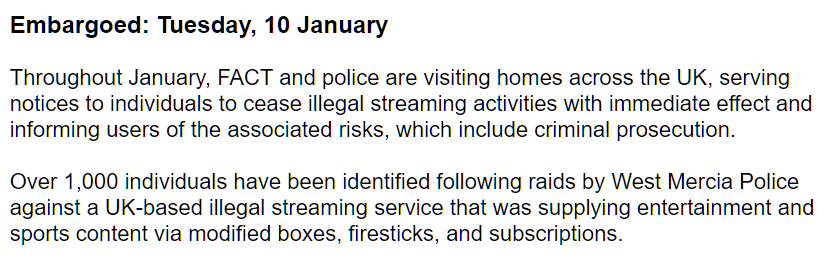
    Early January, FACT sent out a press release titled “Police visit homes across the UK to issue warnings to subscribers of illegal sports streaming services.” The image below shows the first two paragraphs;

    We’ll return to the first paragraph shortly, but as anyone can see, there are two distinct statements. One says that FACT and police will be visiting homes. The second says that 1,000 people were identified after a raid on a streaming service. Nowhere does it say that FACT and police will be visiting the homes of 1,000 people.

    Dozens of articles just like these perpetuated the idea of a massive crackdown but the truth is more mundane. Some people will indeed get a personal visit, but the rest will be contacted by email, as confirmed by FACT when TorrentFreak questioned the volume.

    Prison “For Watching Unauthorized Streams”

    Let’s get this absolutely clear. While it is illegal under both civil and criminal law, nobody has ever gone to prison for simply watching an unauthorized stream in the UK. That doesn’t mean it won’t eventually happen, but the snippet (below) from FACT’s press release shouldn’t have been reported in isolation.

    Important and relevant information about these men was made available by FACT at the same time but given no weight in popular media. That led to widespread misinformation that could’ve been avoided.

    The prospect of ordinary people going to prison for simply viewing an unlicensed stream is an extraordinary claim and it’s a journalist’s job to investigate extraordinary claims. If it’s true that simply viewing unlicensed streams will put UK internet users in prison for months, millions of families face the prospect of seeing loved ones behind bars.

    That’s the bigger story that needed to be investigated, and it would’ve been ridiculously easy too. Simply scrolling to the bottom of the FACT press release reveals that both jailed men were operators of illegal streaming services and both pleaded guilty to multiple copyright and fraud offenses.

    The prosecution in Millington’s trial alone estimated damages running to well over £10 million . Instead, the ‘news’ that two men were arrested and sent to jail for 16 months for simply watching streams went all around the world, almost completely unchallenged.

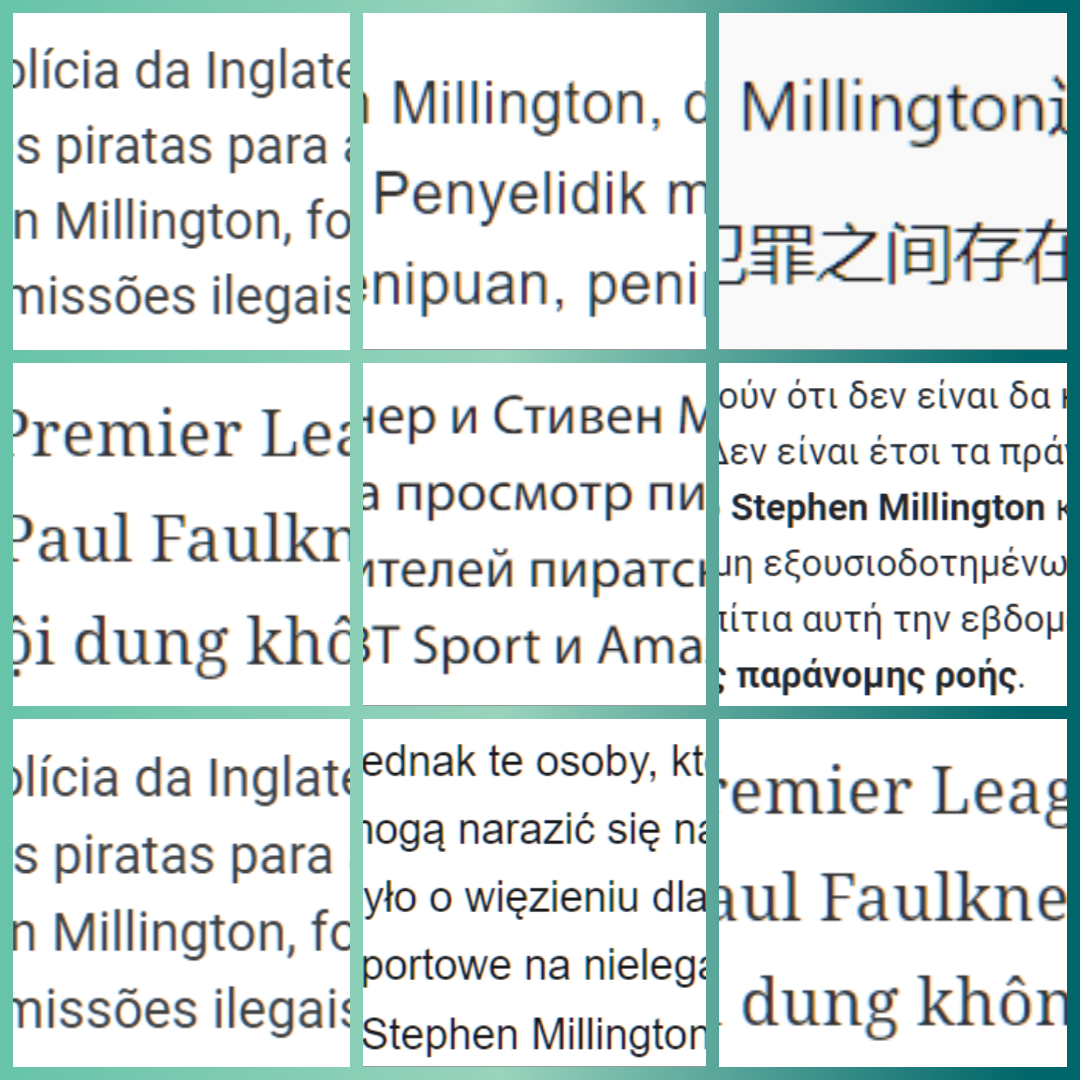
    As the snippets above show, news outlets in Brazil, Russia, Poland, China, Greece, Italy, Thailand, Spain, Indonesia and beyond, not only repeated the statement without any context, but helped to make it an established and uncontested ‘fact’ around the world.

    Now here’s what actually happened, to set the record straight.

    No Ordinary Pirate Stream Watcher

    The details in Millington’s case reveal that the opportunity for a “watching streams” conviction came gift-wrapped and tied up in gold ribbon.

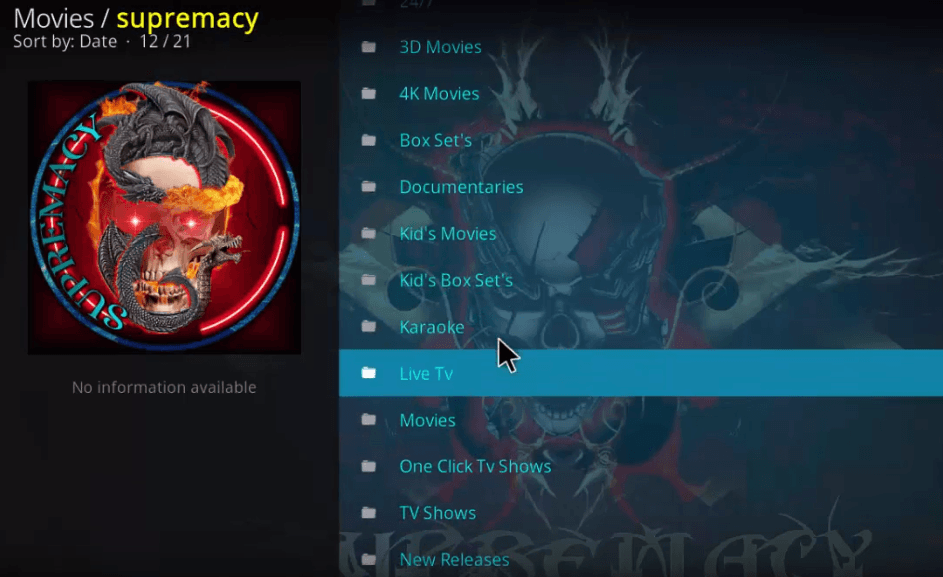
    The most serious charges against him related to his Kodi-based ‘stephen-builds’ software packages, which included the ‘Supremacy’ and ‘Supremacy Sports’ addons that provided his users with free access to illegal streams.

    For context, Supremacy was one of the most-used pirate addons on the entire planet and, according to the lawyer who prosecuted Millington, was responsible for causing more than £10 million in damages to rightsholders.

    Millington pleaded guilty to charges under Section 7 of the Fraud Act (making or supplying articles for use in fraud) and under the Copyright Act for distributing movies and other content via a Plex server.

    He also pleaded guilty to watching illegal streams under Section 11 of the Fraud Act (obtaining a service dishonestly) but the background shows this was no ordinary case.

    For several months after his home was raided, Millington’s defense was that the software and equipment he had accumulated existed for his own personal use. He was a keen gamer but also admitted that he used the equipment for viewing pirate streams via software he developed.

    Millington later changed his plea to guilty but there was a pivotal moment: To advertise his Kodi-related products online, Millington recorded a video of himself as he used his own pirate software to access illegal streams.

    That video was found on his phone during the investigation. The prosecution then took the opportunity to add a charge of viewing illegal streams to a case where the defendant ultimately had no choice but to plead guilty, due to a mountain of evidence. It’s still a conviction for watching unlicensed streams but in this case, context is everything.

    The source of this information is vitally important too.

    UK’s Leading Prosecutor of Streaming Pirates

    Ari Alibhai is the lawyer of choice when it comes to the private prosecution of pirates in the UK and his track record speaks for itself . Among many others, he’s conducted multiple successful pirate IPTV prosecutions on behalf of FACT, Premier League, BT Sport and SKY.

    It’s important to note that Mr Alibhai did not take part in the public announcements earlier this month, no reference was made to his work, and he has never claimed that Millington and Faulkner were sent to prison for simply viewing unlicensed streams. And he should know – he prosecuted both of them.

    Webinar Published on the Millington Case

    Late November 2021, Mr Alibhai conducted a webinar. The video of that presentation was posted more than a year ago on his company’s public website , together with other information on Millington’s case.

    Given the importance of the victory, the promotional value of the video is obvious and, as such, it’s still available today.

    For those who don’t have time to watch the entire video, discussion on the possibility of prosecuting people who simply watch unlicensed streams appears around 40 minutes into the 48-minute recording. It begins with a question from a man assisting Mr Alibhai from behind the camera.

    “You mentioned about the difficulty of prosecuting end-users,” he said. “Someone asked if there any reasonable risks of prosecution or penalty to the end-users, the ones watching the content?”

    Mr Alibhai’s response, as reported below, represents just a tiny fraction of a very informative presentation. In light of the reporting on this month’s events, and especially given the authoritative nature of the source, his opinion holds considerable value. In order to provide the most clarity, the response is cited verbatim.

    Ari Alibhai webinar on Millington/Supremacy prosecution

    Ari Alibhai: I’m assuming that question means, is there a risk to the user? So, is there a realistic risk to someone who’s watching TV that you will be prosecuted. Now, again, there’s an academic answer and then there’s a real answer.

    In theory you can be prosecuted for watching unlawful television. You can be prosecuted under the Copyright Act under section 297 (I think, I haven’t used it for a long time), but you can also be prosecuted under section 11 of the Fraud Act (obtaining services dishonestly). In fact, in the explanatory notes [of section 11] mention is made of illegal television viewing boxes being part-and-parcel of section 11.

    Section 11 carries a maximum penalty of five years in imprisonment so, you know, in theory you face imprisonment if you watch TV illegally.

    In practice, the idea of someone being prosecuted who isn’t also concerned in the trade, so they aren’t also concerned in supplying illicit television services, is minimal.

    This opinion from arguably the UK’s leading expert stands on its own two feet. Why overt public messaging sits in such stark contrast is puzzling to say the least.

    That being said, Mr Alibhai wasn’t quite done.

    Risk and Benefits of Viewer Prosecutions

    In follow-up comments, Mr Alibhai questioned whether the idea of NOT prosecuting viewers would be the right approach but then laid out the risks associated with that type of strategy.

    “I often feel that if you do you want to send a message out then maybe you’d have to take on pure prosecutions against end users. But clearly there is a reputation issue here, there’s a David and Goliath issue that’s going to come up for the broadcaster that takes that on. And there’s potential adverse press to consider,” he said during the webinar.

    “So in the round, I would say that it’s unrealistic to expect that, if anyone is watching it, then you’ll get prosecuted.”

    Scary Stories, Reputation, Animosity

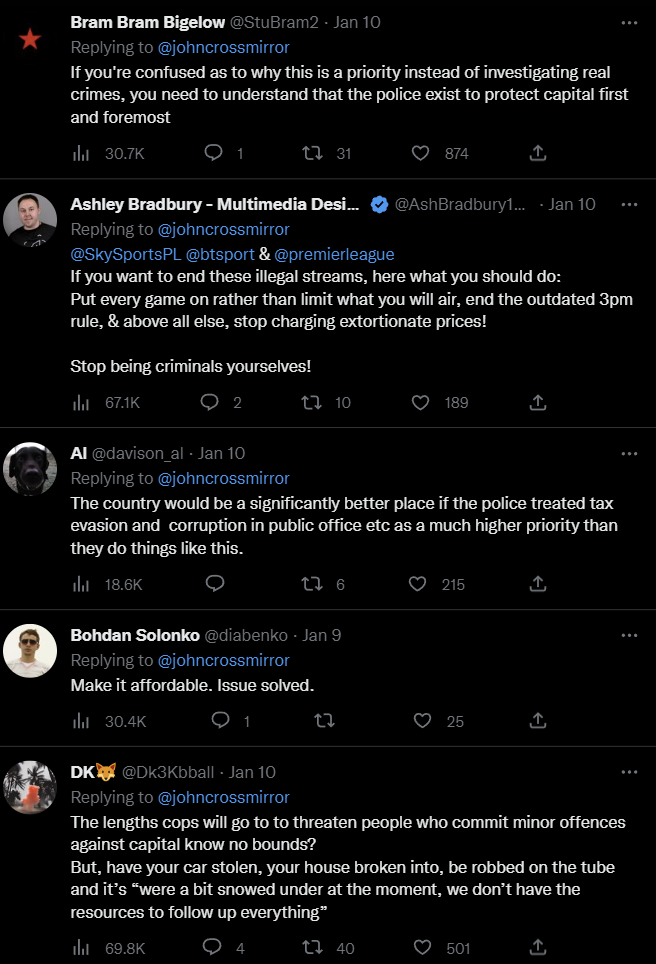
    Finally, on the matter of reputational issues, the Twitter thread linked here contains an article from UK tabloid The Mirror. It states quite clearly that 1,000 homes will be visited as part of a “major ongoing criminal investigation” and that two people “were sentenced to a total of 16 months for watching illegal streams in 2021.”

    At the time of writing it has been viewed 6.3m+ times but the overwhelming majority of the comments on the tweet are negative. They either put the blame at the feet of the Premier League and/or the broadcasters, or criticize the police for taking this on when so many other ‘real crimes’ go unsolved.

    The above may suggest that even when presented with the prospect of going to prison, the public response isn’t to hand over their cash. Instead they list their demands – better access to matches (including at 3pm on Saturdays) and – overwhelmingly – don’t expect normal working people to spend £100+ every month to see a limited number of matches.

    Universal access to football at a fair price? It might just work. A commercial solution to what is essentially a commercial problem seems reasonable. The problem for the Premier League is the prospect of devaluing a premium product in the mere hope of gaining enough subscribers to maintain its financial position.

    Given that pirate services won’t simply go away, the difficult bottom line seems almost inevitable. The risk of being prosecuted for simply watching pirate streams may be low today, but that will almost certainly change.

    If those who currently stream illegally can afford it, perhaps they might consider supporting the sport they love. For those who don’t have the resources to buy what is essentially a luxury product, millions will sympathize. If the decision is to continue with illegal streams regardless, rightsholders most definitely will not.

    From: TF , for the latest news on copyright battles, piracy and more.

    • To chevron_right

      Watching Pirate Streams in the UK is Illegal: Risk of Prosecution “Minimal”

      news.movim.eu / TorrentFreak • 29 January 2023 • 9 minutes

    football As outlined again only this month , people who simply watch pirate streams break UK law. If the content comes from an illegal source, it’s illegal to consume it under copyright law. That is a fact – there is no debate.

    The problem for rightsholders is that copyright cases are complex, difficult to prove, and won’t end in a prison sentence under civil law. A stronger, criminal angle might prove more persuasive.

    The Federation Against Copyright Theft, which acts for the Premier League, SKY, and BT Sport, came up with a solution – Section 11 of the Fraud Act 2006 , which criminalizes the act of obtaining any kind of service dishonestly.

    With a potential crime now part of the equation, the logical conclusion for Joe Public is that people risk being arrested in their own homes for watching an unlicensed stream. Of course, people also need to be persuaded that an underfunded police force doesn’t have bigger fish to fry.

    Press Hysteria

    Early January, FACT sent out a press release titled “Police visit homes across the UK to issue warnings to subscribers of illegal sports streaming services.” The image below shows the first two paragraphs;

    We’ll return to the first paragraph shortly, but as anyone can see, there are two distinct statements. One says that FACT and police will be visiting homes. The second says that 1,000 people were identified after a raid on a streaming service. Nowhere does it say that FACT and police will be visiting the homes of 1,000 people.

    Dozens of articles just like these perpetuated the idea of a massive crackdown but the truth is more mundane. Some people will indeed get a personal visit, but the rest will be contacted by email, as confirmed by FACT when TorrentFreak questioned the volume.

    Prison “For Watching Unauthorized Streams”

    Let’s get this absolutely clear. While it is illegal under both civil and criminal law, nobody has ever gone to prison for simply watching an unauthorized stream in the UK. That doesn’t mean it won’t eventually happen, but the snippet (below) from FACT’s press release shouldn’t have been reported in isolation.

    Important and relevant information about these men was made available by FACT at the same time but given no weight in popular media. That led to widespread misinformation that could’ve been avoided.

    The prospect of ordinary people going to prison for simply viewing an unlicensed stream is an extraordinary claim and it’s a journalist’s job to investigate extraordinary claims. If it’s true that simply viewing unlicensed streams will put UK internet users in prison for months, millions of families face the prospect of seeing loved ones behind bars.

    That’s the bigger story that needed to be investigated, and it would’ve been ridiculously easy too. Simply scrolling to the bottom of the FACT press release reveals that both jailed men were operators of illegal streaming services and both pleaded guilty to multiple copyright and fraud offenses.

    The prosecution in Millington’s trial alone estimated damages running to well over £10 million . Instead, the ‘news’ that two men were arrested and sent to jail for 16 months for simply watching streams went all around the world, almost completely unchallenged.

    As the snippets above show, news outlets in Brazil, Russia, Poland, China, Greece, Italy, Thailand, Spain, Indonesia and beyond, not only repeated the statement without any context, but helped to make it an established and uncontested ‘fact’ around the world.

    Now here’s what actually happened, to set the record straight.

    No Ordinary Pirate Stream Watcher

    The details in Millington’s case reveal that the opportunity for a “watching streams” conviction came gift-wrapped and tied up in gold ribbon.

    The most serious charges against him related to his Kodi-based ‘stephen-builds’ software packages, which included the ‘Supremacy’ and ‘Supremacy Sports’ addons that provided his users with free access to illegal streams.

    For context, Supremacy was one of the most-used pirate addons on the entire planet and, according to the lawyer who prosecuted Millington, was responsible for causing more than £10 million in damages to rightsholders.

    Millington pleaded guilty to charges under Section 7 of the Fraud Act (making or supplying articles for use in fraud) and under the Copyright Act for distributing movies and other content via a Plex server.

    He also pleaded guilty to watching illegal streams under Section 11 of the Fraud Act (obtaining a service dishonestly) but the background shows this was no ordinary case.

    For several months after his home was raided, Millington’s defense was that the software and equipment he had accumulated existed for his own personal use. He was a keen gamer but also admitted that he used the equipment for viewing pirate streams via software he developed.

    Millington later changed his plea to guilty but there was a pivotal moment: To advertise his Kodi-related products online, Millington recorded a video of himself as he used his own pirate software to access illegal streams.

    That video was found on his phone during the investigation. The prosecution then took the opportunity to add a charge of viewing illegal streams to a case where the defendant ultimately had no choice but to plead guilty, due to a mountain of evidence. It’s still a conviction for watching unlicensed streams but in this case, context is everything.

    The source of this information is vitally important too.

    UK’s Leading Prosecutor of Streaming Pirates

    Ari Alibhai is the lawyer of choice when it comes to the private prosecution of pirates in the UK and his track record speaks for itself . Among many others, he’s conducted multiple successful pirate IPTV prosecutions on behalf of FACT, Premier League, BT Sport and SKY.

    It’s important to note that Mr Alibhai did not take part in the public announcements earlier this month, no reference was made to his work, and he has never claimed that Millington and Faulkner were sent to prison for simply viewing unlicensed streams. And he should know – he prosecuted both of them.

    Webinar Published on the Millington Case

    Late November 2021, Mr Alibhai conducted a webinar. The video of that presentation was posted more than a year ago on his company’s public website , together with other information on Millington’s case.

    Given the importance of the victory, the promotional value of the video is obvious and, as such, it’s still available today.

    For those who don’t have time to watch the entire video, discussion on the possibility of prosecuting people who simply watch unlicensed streams appears around 40 minutes into the 48-minute recording. It begins with a question from a man assisting Mr Alibhai from behind the camera.

    “You mentioned about the difficulty of prosecuting end-users,” he said. “Someone asked if there any reasonable risks of prosecution or penalty to the end-users, the ones watching the content?”

    Mr Alibhai’s response, as reported below, represents just a tiny fraction of a very informative presentation. In light of the reporting on this month’s events, and especially given the authoritative nature of the source, his opinion holds considerable value. In order to provide the most clarity, the response is cited verbatim.

    Ari Alibhai webinar on Millington/Supremacy prosecution

    Ari Alibhai: I’m assuming that question means, is there a risk to the user? So, is there a realistic risk to someone who’s watching TV that you will be prosecuted. Now, again, there’s an academic answer and then there’s a real answer.

    In theory you can be prosecuted for watching unlawful television. You can be prosecuted under the Copyright Act under section 297 (I think, I haven’t used it for a long time), but you can also be prosecuted under section 11 of the Fraud Act (obtaining services dishonestly). In fact, in the explanatory notes [of section 11] mention is made of illegal television viewing boxes being part-and-parcel of section 11.

    Section 11 carries a maximum penalty of five years in imprisonment so, you know, in theory you face imprisonment if you watch TV illegally.

    In practice, the idea of someone being prosecuted who isn’t also concerned in the trade, so they aren’t also concerned in supplying illicit television services, is minimal.

    This opinion from arguably the UK’s leading expert stands on its own two feet. Why overt public messaging sits in such stark contrast is puzzling to say the least.

    That being said, Mr Alibhai wasn’t quite done.

    Risk and Benefits of Viewer Prosecutions

    In follow-up comments, Mr Alibhai questioned whether the idea of NOT prosecuting viewers would be the right approach but then laid out the risks associated with that type of strategy.

    “I often feel that if you do you want to send a message out then maybe you’d have to take on pure prosecutions against end users. But clearly there is a reputation issue here, there’s a David and Goliath issue that’s going to come up for the broadcaster that takes that on. And there’s potential adverse press to consider,” he said during the webinar.

    “So in the round, I would say that it’s unrealistic to expect that, if anyone is watching it, then you’ll get prosecuted.”

    Scary Stories, Reputation, Animosity

    Finally, on the matter of reputational issues, the Twitter thread linked here contains an article from UK tabloid The Mirror. It states quite clearly that 1,000 homes will be visited as part of a “major ongoing criminal investigation” and that two people “were sentenced to a total of 16 months for watching illegal streams in 2021.”

    At the time of writing it has been viewed 6.3m+ times but the overwhelming majority of the comments on the tweet are negative. They either put the blame at the feet of the Premier League and/or the broadcasters, or criticize the police for taking this on when so many other ‘real crimes’ go unsolved.

    The above may suggest that even when presented with the prospect of going to prison, the public response isn’t to hand over their cash. Instead they list their demands – better access to matches (including at 3pm on Saturdays) and – overwhelmingly – don’t expect normal working people to spend £100+ every month to see a limited number of matches.

    Universal access to football at a fair price? It might just work. A commercial solution to what is essentially a commercial problem seems reasonable. The problem for the Premier League is the prospect of devaluing a premium product in the mere hope of gaining enough subscribers to maintain its financial position.

    Given that pirate services won’t simply go away, the difficult bottom line seems almost inevitable. The risk of being prosecuted for simply watching pirate streams may be low today, but that will almost certainly change.

    If those who currently stream illegally can afford it, perhaps they might consider supporting the sport they love. For those who don’t have the resources to buy what is essentially a luxury product, millions will sympathize. If the decision is to continue with illegal streams regardless, rightsholders most definitely will not.

    From: TF , for the latest news on copyright battles, piracy and more.
    • To chevron_right

      Watching Pirate Streams in the UK is Illegal: Risk of Prosecution “Minimal”

      news.movim.eu / TorrentFreak • 29 January 2023 • 9 minutes

    football As outlined again only this month , people who simply watch pirate streams break UK law. If the content comes from an illegal source, it’s illegal to consume it under copyright law. That is a fact – there is no debate.

    The problem for rightsholders is that copyright cases are complex, difficult to prove, and won’t end in a prison sentence under civil law. A stronger, criminal angle might prove more persuasive.

    The Federation Against Copyright Theft, which acts for the Premier League, SKY, and BT Sport, came up with a solution – Section 11 of the Fraud Act 2006 , which criminalizes the act of obtaining any kind of service dishonestly.

    With a potential crime now part of the equation, the logical conclusion for Joe Public is that people risk being arrested in their own homes for watching an unlicensed stream. Of course, people also need to be persuaded that an underfunded police force doesn’t have bigger fish to fry.

    Press Hysteria

    Early January, FACT sent out a press release titled “Police visit homes across the UK to issue warnings to subscribers of illegal sports streaming services.” The image below shows the first two paragraphs;

    We’ll return to the first paragraph shortly, but as anyone can see, there are two distinct statements. One says that FACT and police will be visiting homes. The second says that 1,000 people were identified after a raid on a streaming service. Nowhere does it say that FACT and police will be visiting the homes of 1,000 people.

    Dozens of articles just like these perpetuated the idea of a massive crackdown but the truth is more mundane. Some people will indeed get a personal visit, but the rest will be contacted by email, as confirmed by FACT when TorrentFreak questioned the volume.

    Prison “For Watching Unauthorized Streams”

    Let’s get this absolutely clear. While it is illegal under both civil and criminal law, nobody has ever gone to prison for simply watching an unauthorized stream in the UK. That doesn’t mean it won’t eventually happen, but the snippet (below) from FACT’s press release shouldn’t have been reported in isolation.

    Important and relevant information about these men was made available by FACT at the same time but given no weight in popular media. That led to widespread misinformation that could’ve been avoided.

    The prospect of ordinary people going to prison for simply viewing an unlicensed stream is an extraordinary claim and it’s a journalist’s job to investigate extraordinary claims. If it’s true that simply viewing unlicensed streams will put UK internet users in prison for months, millions of families face the prospect of seeing loved ones behind bars.

    That’s the bigger story that needed to be investigated, and it would’ve been ridiculously easy too. Simply scrolling to the bottom of the FACT press release reveals that both jailed men were operators of illegal streaming services and both pleaded guilty to multiple copyright and fraud offenses.

    The prosecution in Millington’s trial alone estimated damages running to well over £10 million . Instead, the ‘news’ that two men were arrested and sent to jail for 16 months for simply watching streams went all around the world, almost completely unchallenged.

    As the snippets above show, news outlets in Brazil, Russia, Poland, China, Greece, Italy, Thailand, Spain, Indonesia and beyond, not only repeated the statement without any context, but helped to make it an established and uncontested ‘fact’ around the world.

    Now here’s what actually happened, to set the record straight.

    No Ordinary Pirate Stream Watcher

    The details in Millington’s case reveal that the opportunity for a “watching streams” conviction came gift-wrapped and tied up in gold ribbon.

    The most serious charges against him related to his Kodi-based ‘stephen-builds’ software packages, which included the ‘Supremacy’ and ‘Supremacy Sports’ addons that provided his users with free access to illegal streams.

    For context, Supremacy was one of the most-used pirate addons on the entire planet and, according to the lawyer who prosecuted Millington, was responsible for causing more than £10 million in damages to rightsholders.

    Millington pleaded guilty to charges under Section 7 of the Fraud Act (making or supplying articles for use in fraud) and under the Copyright Act for distributing movies and other content via a Plex server.

    He also pleaded guilty to watching illegal streams under Section 11 of the Fraud Act (obtaining a service dishonestly) but the background shows this was no ordinary case.

    For several months after his home was raided, Millington’s defense was that the software and equipment he had accumulated existed for his own personal use. He was a keen gamer but also admitted that he used the equipment for viewing pirate streams via software he developed.

    Millington later changed his plea to guilty but there was a pivotal moment: To advertise his Kodi-related products online, Millington recorded a video of himself as he used his own pirate software to access illegal streams.

    That video was found on his phone during the investigation. The prosecution then took the opportunity to add a charge of viewing illegal streams to a case where the defendant ultimately had no choice but to plead guilty, due to a mountain of evidence. It’s still a conviction for watching unlicensed streams but in this case, context is everything.

    The source of this information is vitally important too.

    UK’s Leading Prosecutor of Streaming Pirates

    Ari Alibhai is the lawyer of choice when it comes to the private prosecution of pirates in the UK and his track record speaks for itself . Among many others, he’s conducted multiple successful pirate IPTV prosecutions on behalf of FACT, Premier League, BT Sport and SKY.

    It’s important to note that Mr Alibhai did not take part in the public announcements earlier this month, no reference was made to his work, and he has never claimed that Millington and Faulkner were sent to prison for simply viewing unlicensed streams. And he should know – he prosecuted both of them.

    Webinar Published on the Millington Case

    Late November 2021, Mr Alibhai conducted a webinar. The video of that presentation was posted more than a year ago on his company’s public website , together with other information on Millington’s case.

    Given the importance of the victory, the promotional value of the video is obvious and, as such, it’s still available today.

    For those who don’t have time to watch the entire video, discussion on the possibility of prosecuting people who simply watch unlicensed streams appears around 40 minutes into the 48-minute recording. It begins with a question from a man assisting Mr Alibhai from behind the camera.

    “You mentioned about the difficulty of prosecuting end-users,” he said. “Someone asked if there any reasonable risks of prosecution or penalty to the end-users, the ones watching the content?”

    Mr Alibhai’s response, as reported below, represents just a tiny fraction of a very informative presentation. In light of the reporting on this month’s events, and especially given the authoritative nature of the source, his opinion holds considerable value. In order to provide the most clarity, the response is cited verbatim.

    Ari Alibhai webinar on Millington/Supremacy prosecution

    Ari Alibhai: I’m assuming that question means, is there a risk to the user? So, is there a realistic risk to someone who’s watching TV that you will be prosecuted. Now, again, there’s an academic answer and then there’s a real answer.

    In theory you can be prosecuted for watching unlawful television. You can be prosecuted under the Copyright Act under section 297 (I think, I haven’t used it for a long time), but you can also be prosecuted under section 11 of the Fraud Act (obtaining services dishonestly). In fact, in the explanatory notes [of section 11] mention is made of illegal television viewing boxes being part-and-parcel of section 11.

    Section 11 carries a maximum penalty of five years in imprisonment so, you know, in theory you face imprisonment if you watch TV illegally.

    In practice, the idea of someone being prosecuted who isn’t also concerned in the trade, so they aren’t also concerned in supplying illicit television services, is minimal.

    This opinion from arguably the UK’s leading expert stands on its own two feet. Why overt public messaging sits in such stark contrast is puzzling to say the least.

    That being said, Mr Alibhai wasn’t quite done.

    Risk and Benefits of Viewer Prosecutions

    In follow-up comments, Mr Alibhai questioned whether the idea of NOT prosecuting viewers would be the right approach but then laid out the risks associated with that type of strategy.

    “I often feel that if you do you want to send a message out then maybe you’d have to take on pure prosecutions against end users. But clearly there is a reputation issue here, there’s a David and Goliath issue that’s going to come up for the broadcaster that takes that on. And there’s potential adverse press to consider,” he said during the webinar.

    “So in the round, I would say that it’s unrealistic to expect that, if anyone is watching it, then you’ll get prosecuted.”

    Scary Stories, Reputation, Animosity

    Finally, on the matter of reputational issues, the Twitter thread linked here contains an article from UK tabloid The Mirror. It states quite clearly that 1,000 homes will be visited as part of a “major ongoing criminal investigation” and that two people “were sentenced to a total of 16 months for watching illegal streams in 2021.”

    At the time of writing it has been viewed 6.3m+ times but the overwhelming majority of the comments on the tweet are negative. They either put the blame at the feet of the Premier League and/or the broadcasters, or criticize the police for taking this on when so many other ‘real crimes’ go unsolved.

    The above may suggest that even when presented with the prospect of going to prison, the public response isn’t to hand over their cash. Instead they list their demands – better access to matches (including at 3pm on Saturdays) and – overwhelmingly – don’t expect normal working people to spend £100+ every month to see a limited number of matches.

    Universal access to football at a fair price? It might just work. A commercial solution to what is essentially a commercial problem seems reasonable. The problem for the Premier League is the prospect of devaluing a premium product in the mere hope of gaining enough subscribers to maintain its financial position.

    Given that pirate services won’t simply go away, the difficult bottom line seems almost inevitable. The risk of being prosecuted for simply watching pirate streams may be low today, but that will almost certainly change.

    If those who currently stream illegally can afford it, perhaps they might consider supporting the sport they love. For those who don’t have the resources to buy what is essentially a luxury product, millions will sympathize. If the decision is to continue with illegal streams regardless, rightsholders most definitely will not.

    From: TF , for the latest news on copyright battles, piracy and more.
    • To chevron_right

      Big Brother: TV Channel Staff Told to Report Password Sharers For Piracy

      news.movim.eu / TorrentFreak • 24 January 2023 • 3 minutes

    piracy encrypt First broadcast in the Netherlands back in 1999, reality TV show ‘Big Brother’ is now a global franchise spanning more than 60 countries.

    Big Brother Brazil (BBB) is one of the most successful regional variants. Right now, BBB23 is live on air, so millions of fans are tuning in at home to watch other people living in a different house for a bit while others watch.

    When BBB fans aren’t glued to their TVs waiting for the drama to unfold, many can be found on social media, usually speculating about what comes next, based on what they’ve just seen. To facilitate the discourse, fans often post images and video clips from the show, but for TV company Globo, which broadcasts the show 24/7 on pay-per-view, some fans go too far.

    Security Department’s Email Gets Leaked

    When Globo broadcast BBB22 last year, the company decided to loosen its copyright policy. Rather than being banned from Twitter for sharing clips of the show without permission, Globo said that fans could share a one-minute clip online for every hour of the show.

    According to an internal communication leaked to local media outlet TVPop , the position may have changed for BBB23.

    Reportedly issued by Globo’s Information Security department, new guidelines inform staff that digital piracy harms the show and as a result, harms the company.

    “Digital piracy causes several damages to the market and the entertainment industry is especially affected by it,” the translation reads.

    “Piracy Impacts Advertising”

    Reportedly sent to staff via an internal communications system, the new guidelines suggest that piracy harms Globo employees and has a negative effect on the advertising market.

    “The damage goes far beyond the loss of uniqueness and the dissemination of content without authorization. For example, there is an impact on the attractiveness of audiovisual products for the advertising market,” it reads.

    While the extent of any damage isn’t quantified, data shows that subscriptions to the Globoplay streaming platform increased by 79% in 2020 and by another 32% in 2021. A document published by Associação Brasileira das Administradorasde Consórcios ( pdf ) last September provides specifics on the BBB23 advertising program.

    “Advertising on Big Brother Brasil will become more expensive in 2023. 112 days before the start of the program, brands are rushing to secure a space in the most watched house in Brazil, even with sponsorship quotas for the [Globo] program costing up to 32% more than in previous series,” it reads.

    “According to program data, in 2022, more than 153 million people watched the program on Globo platforms. Although without breaking the 2021 audience record, according to the broadcaster, the public spent 13% more time watching the last series.”

    “Lots of Parties and Bullshit”

    Globo’s leaked communication initially celebrates the launch of BBB23 but quickly emphasizes the importance of clamping down on piracy.

    “The most watched house in the country is back and promises lots of parties, bullshit, exciting competitions, shacks and audience records. It’s a lot of good things together! But there are people wanting to take a ride on this success. Piracy generates several negative consequences for BBB and for the work of all of us,” it reads.

    So what can Globo staff do to help?

    To clamp down on social media users sharing images and videos of BBB23, staff are instructed to report them to Globo. The line between free advertising and piracy isn’t made clear, but when it comes to another modern-day scourge, facilitated by Globo’s paying customers, everything seems more cut and dried.

    “If you see pirated content out there or know of someone who is sharing the Globoplay login with other people, you already know: just report it by email,” the communication adds.

    According to TVPop, Globo appears to be taking down BBB videos dating back several years at the same time as taking down content from BBB23. Evidence of takedowns can be found on the Lumen Database, which lists dozens of DMCA takedown notices sent by Globo to Google.

    Whether this will be enough for Globo is unclear, but with headlines in local media asking, “What time do participants go to the secret room?” the pressure on fans to subscribe can’t be understated.

    From: TF , for the latest news on copyright battles, piracy and more.
    • To chevron_right

      Big Brother: TV Channel Staff Told to Report Password Sharers For Piracy

      news.movim.eu / TorrentFreak • 24 January 2023 • 3 minutes

    piracy encrypt First broadcast in the Netherlands back in 1999, reality TV show ‘Big Brother’ is now a global franchise spanning more than 60 countries.

    Big Brother Brazil (BBB) is one of the most successful regional variants. Right now, BBB23 is live on air, so millions of fans are tuning in at home to watch other people living in a different house for a bit while others watch.

    When BBB fans aren’t glued to their TVs waiting for the drama to unfold, many can be found on social media, usually speculating about what comes next, based on what they’ve just seen. To facilitate the discourse, fans often post images and video clips from the show, but for TV company Globo, which broadcasts the show 24/7 on pay-per-view, some fans go too far.

    Security Department’s Email Gets Leaked

    When Globo broadcast BBB22 last year, the company decided to loosen its copyright policy. Rather than being banned from Twitter for sharing clips of the show without permission, Globo said that fans could share a one-minute clip online for every hour of the show.

    According to an internal communication leaked to local media outlet TVPop , the position may have changed for BBB23.

    Reportedly issued by Globo’s Information Security department, new guidelines inform staff that digital piracy harms the show and as a result, harms the company.

    “Digital piracy causes several damages to the market and the entertainment industry is especially affected by it,” the translation reads.

    “Piracy Impacts Advertising”

    Reportedly sent to staff via an internal communications system, the new guidelines suggest that piracy harms Globo employees and has a negative effect on the advertising market.

    “The damage goes far beyond the loss of uniqueness and the dissemination of content without authorization. For example, there is an impact on the attractiveness of audiovisual products for the advertising market,” it reads.

    While the extent of any damage isn’t quantified, data shows that subscriptions to the Globoplay streaming platform increased by 79% in 2020 and by another 32% in 2021. A document published by Associação Brasileira das Administradorasde Consórcios ( pdf ) last September provides specifics on the BBB23 advertising program.

    “Advertising on Big Brother Brasil will become more expensive in 2023. 112 days before the start of the program, brands are rushing to secure a space in the most watched house in Brazil, even with sponsorship quotas for the [Globo] program costing up to 32% more than in previous series,” it reads.

    “According to program data, in 2022, more than 153 million people watched the program on Globo platforms. Although without breaking the 2021 audience record, according to the broadcaster, the public spent 13% more time watching the last series.”

    “Lots of Parties and Bullshit”

    Globo’s leaked communication initially celebrates the launch of BBB23 but quickly emphasizes the importance of clamping down on piracy.

    “The most watched house in the country is back and promises lots of parties, bullshit, exciting competitions, shacks and audience records. It’s a lot of good things together! But there are people wanting to take a ride on this success. Piracy generates several negative consequences for BBB and for the work of all of us,” it reads.

    So what can Globo staff do to help?

    To clamp down on social media users sharing images and videos of BBB23, staff are instructed to report them to Globo. The line between free advertising and piracy isn’t made clear, but when it comes to another modern-day scourge, facilitated by Globo’s paying customers, everything seems more cut and dried.

    “If you see pirated content out there or know of someone who is sharing the Globoplay login with other people, you already know: just report it by email,” the communication adds.

    According to TVPop, Globo appears to be taking down BBB videos dating back several years at the same time as taking down content from BBB23. Evidence of takedowns can be found on the Lumen Database, which lists dozens of DMCA takedown notices sent by Globo to Google.

    Whether this will be enough for Globo is unclear, but with headlines in local media asking, “What time do participants go to the secret room?” the pressure on fans to subscribe can’t be understated.

    From: TF , for the latest news on copyright battles, piracy and more.

    • To chevron_right

      Big Brother: TV Channel Staff Told to Report Password Sharers For Piracy

      news.movim.eu / TorrentFreak • 24 January 2023 • 3 minutes

    piracy encrypt First broadcast in the Netherlands back in 1999, reality TV show ‘Big Brother’ is now a global franchise spanning more than 60 countries.

    Big Brother Brazil (BBB) is one of the most successful regional variants. Right now, BBB23 is live on air, so millions of fans are tuning in at home to watch other people living in a different house for a bit while others watch.

    When BBB fans aren’t glued to their TVs waiting for the drama to unfold, many can be found on social media, usually speculating about what comes next, based on what they’ve just seen. To facilitate the discourse, fans often post images and video clips from the show, but for TV company Globo, which broadcasts the show 24/7 on pay-per-view, some fans go too far.

    Security Department’s Email Gets Leaked

    When Globo broadcast BBB22 last year, the company decided to loosen its copyright policy. Rather than being banned from Twitter for sharing clips of the show without permission, Globo said that fans could share a one-minute clip online for every hour of the show.

    According to an internal communication leaked to local media outlet TVPop , the position may have changed for BBB23.

    Reportedly issued by Globo’s Information Security department, new guidelines inform staff that digital piracy harms the show and as a result, harms the company.

    “Digital piracy causes several damages to the market and the entertainment industry is especially affected by it,” the translation reads.

    “Piracy Impacts Advertising”

    Reportedly sent to staff via an internal communications system, the new guidelines suggest that piracy harms Globo employees and has a negative effect on the advertising market.

    “The damage goes far beyond the loss of uniqueness and the dissemination of content without authorization. For example, there is an impact on the attractiveness of audiovisual products for the advertising market,” it reads.

    While the extent of any damage isn’t quantified, data shows that subscriptions to the Globoplay streaming platform increased by 79% in 2020 and by another 32% in 2021. A document published by Associação Brasileira das Administradorasde Consórcios ( pdf ) last September provides specifics on the BBB23 advertising program.

    “Advertising on Big Brother Brasil will become more expensive in 2023. 112 days before the start of the program, brands are rushing to secure a space in the most watched house in Brazil, even with sponsorship quotas for the [Globo] program costing up to 32% more than in previous series,” it reads.

    “According to program data, in 2022, more than 153 million people watched the program on Globo platforms. Although without breaking the 2021 audience record, according to the broadcaster, the public spent 13% more time watching the last series.”

    “Lots of Parties and Bullshit”

    Globo’s leaked communication initially celebrates the launch of BBB23 but quickly emphasizes the importance of clamping down on piracy.

    “The most watched house in the country is back and promises lots of parties, bullshit, exciting competitions, shacks and audience records. It’s a lot of good things together! But there are people wanting to take a ride on this success. Piracy generates several negative consequences for BBB and for the work of all of us,” it reads.

    So what can Globo staff do to help?

    To clamp down on social media users sharing images and videos of BBB23, staff are instructed to report them to Globo. The line between free advertising and piracy isn’t made clear, but when it comes to another modern-day scourge, facilitated by Globo’s paying customers, everything seems more cut and dried.

    “If you see pirated content out there or know of someone who is sharing the Globoplay login with other people, you already know: just report it by email,” the communication adds.

    According to TVPop, Globo appears to be taking down BBB videos dating back several years at the same time as taking down content from BBB23. Evidence of takedowns can be found on the Lumen Database, which lists dozens of DMCA takedown notices sent by Globo to Google.

    Whether this will be enough for Globo is unclear, but with headlines in local media asking, “What time do participants go to the secret room?” the pressure on fans to subscribe can’t be understated.

    From: TF , for the latest news on copyright battles, piracy and more.