• progress_activity cloud_sync

    Reconnection to the server…

    Movim cannot talk with the server, please try again later

  • back_to_tab fullscreen tile_small dialpad mic videocam switch_camera screen_share

    mic_none No sound detected from your microphone


    • Public subscriptions

    • chevron_right

      coopr8

    • chevron_right

      gabagoo

    • chevron_right

      kenu_demon

    • chevron_right

      coopr8

    • chevron_right

      gabagoo

    • chevron_right

      kenu_demon

    • chevron_right

      coopr8

    • chevron_right

      gabagoo

    • chevron_right

      kenu_demon

  • Register Login

    Movim

    movim.chatterboxtown.us


  • group_work rss_feed
    add Follow

    ArsTechnica

    • Ar chevron_right

      Intel says it’s rolling out laptop GPU drivers with 10% to 25% better performance

      news.movim.eu / ArsTechnica • 29 April 2025 • 1 minute

    Intel's oddball Core Ultra 200V laptop chips—codenamed Lunar Lake—will apparently be a one-off experiment, not to be replicated in future Intel laptop chips. They're Intel's only processors with memory integrated onto the CPU package; the only ones with a neural processing unit that meets Microsoft's Copilot+ performance requirements; and the only ones with Intel's best-performing integrated GPUs, the Intel Arc 130V and 140V.

    Today, Intel announced some updates to its graphics driver that specifically benefit those integrated GPUs, welcome news for anyone who bought one and is trying to get by with it as an entry-level gaming system. Intel says that version 32.0.101.6734 of its graphics driver can speed up average frame rates in some games by around 10 percent, and can speed up "1 percent low FPS" (that is, for any given frames per second measurement, whatever your frame rate is the slowest 1 percent of the time) by as much as 25 percent. This should, in theory, make games run better in general and ease some of the stuttering you notice when your game's performance dips down to that 1 percent level.
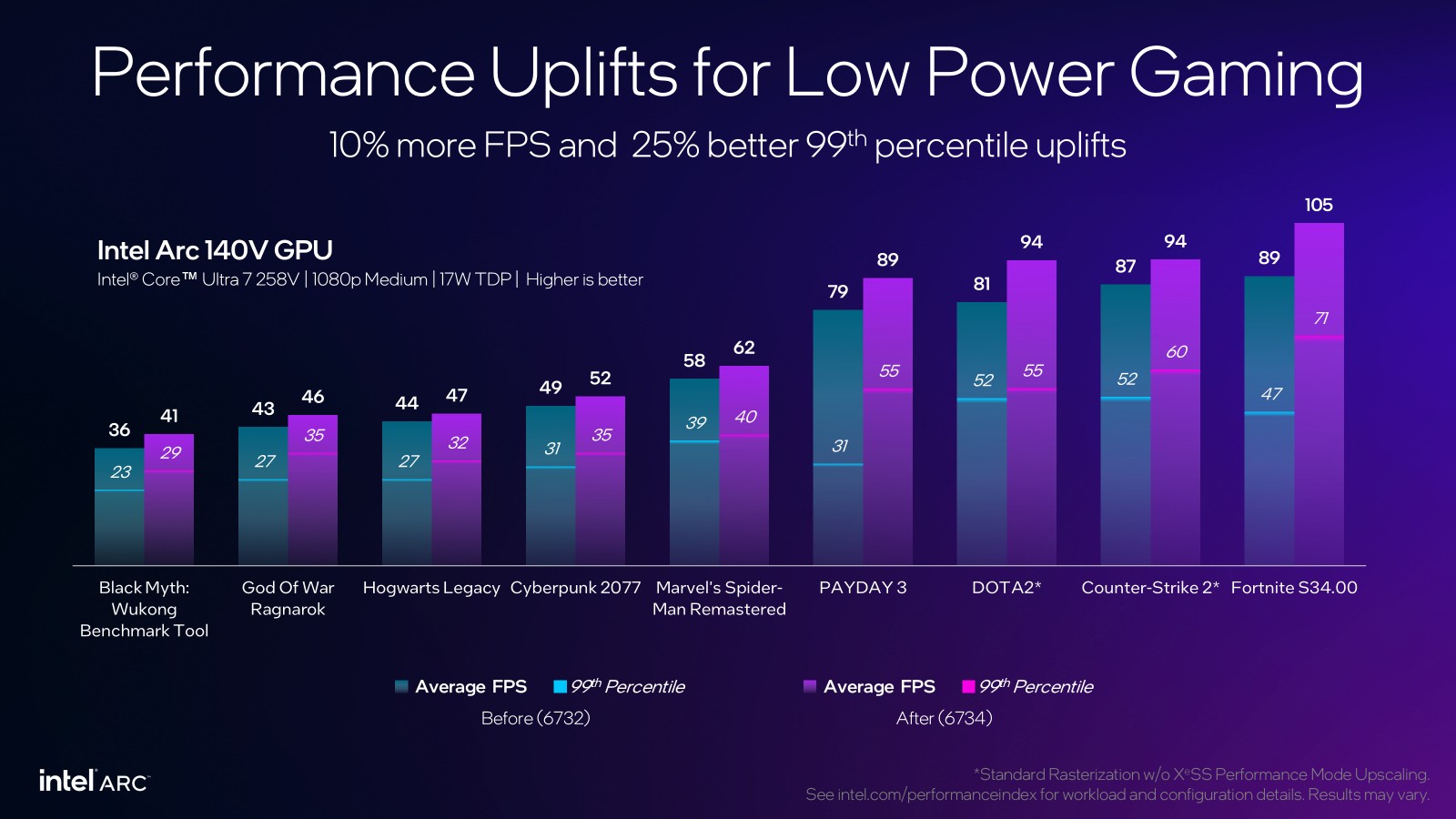
    Intel's performance numbers for its new GPU drivers on a laptop running at the "common default power level" of 17 W. Credit: Intel

    Intel's performance comparisons were made using an MSI Claw 7 AI+ using an Arc 140V GPU, and they compare the performance of driver version 32.0.101.6732 (released April 2) to version 32.0.101.6734 (released April 8). The two additional driver packages Intel has released since then will contain the improvements, too.

    Read full article

    Comments

    • tagtech tagtech tagtech tagintel tagintel tagintel tagtech tagtech tagtech tagintel tagintel tagintel tagtech tagtech tagtech tagintel tagintel tagintel

    • Pictures 3 image

    • visibility
    • visibility
    • visibility
    • Ar chevron_right

      Intel says it’s rolling out laptop GPU drivers with 10% to 25% better performance

      news.movim.eu / ArsTechnica • 29 April 2025 • 1 minute

    Intel's oddball Core Ultra 200V laptop chips—codenamed Lunar Lake—will apparently be a one-off experiment, not to be replicated in future Intel laptop chips. They're Intel's only processors with memory integrated onto the CPU package; the only ones with a neural processing unit that meets Microsoft's Copilot+ performance requirements; and the only ones with Intel's best-performing integrated GPUs, the Intel Arc 130V and 140V.

    Today, Intel announced some updates to its graphics driver that specifically benefit those integrated GPUs, welcome news for anyone who bought one and is trying to get by with it as an entry-level gaming system. Intel says that version 32.0.101.6734 of its graphics driver can speed up average frame rates in some games by around 10 percent, and can speed up "1 percent low FPS" (that is, for any given frames per second measurement, whatever your frame rate is the slowest 1 percent of the time) by as much as 25 percent. This should, in theory, make games run better in general and ease some of the stuttering you notice when your game's performance dips down to that 1 percent level.

    Intel's performance numbers for its new GPU drivers on a laptop running at the "common default power level" of 17 W. Credit: Intel

    Intel's performance comparisons were made using an MSI Claw 7 AI+ using an Arc 140V GPU, and they compare the performance of driver version 32.0.101.6732 (released April 2) to version 32.0.101.6734 (released April 8). The two additional driver packages Intel has released since then will contain the improvements, too.

    Read full article

    Comments

    • tagtech tagtech tagtech tagintel tagintel tagintel tagtech tagtech tagtech tagintel tagintel tagintel tagtech tagtech tagtech tagintel tagintel tagintel

    • Pictures 3 image

    • visibility
    • visibility
    • visibility
    • Ar chevron_right

      Intel says it’s rolling out laptop GPU drivers with 10% to 25% better performance

      news.movim.eu / ArsTechnica • 29 April 2025 • 1 minute

    Intel's oddball Core Ultra 200V laptop chips—codenamed Lunar Lake—will apparently be a one-off experiment, not to be replicated in future Intel laptop chips. They're Intel's only processors with memory integrated onto the CPU package; the only ones with a neural processing unit that meets Microsoft's Copilot+ performance requirements; and the only ones with Intel's best-performing integrated GPUs, the Intel Arc 130V and 140V.

    Today, Intel announced some updates to its graphics driver that specifically benefit those integrated GPUs, welcome news for anyone who bought one and is trying to get by with it as an entry-level gaming system. Intel says that version 32.0.101.6734 of its graphics driver can speed up average frame rates in some games by around 10 percent, and can speed up "1 percent low FPS" (that is, for any given frames per second measurement, whatever your frame rate is the slowest 1 percent of the time) by as much as 25 percent. This should, in theory, make games run better in general and ease some of the stuttering you notice when your game's performance dips down to that 1 percent level.

    Intel's performance numbers for its new GPU drivers on a laptop running at the "common default power level" of 17 W. Credit: Intel

    Intel's performance comparisons were made using an MSI Claw 7 AI+ using an Arc 140V GPU, and they compare the performance of driver version 32.0.101.6732 (released April 2) to version 32.0.101.6734 (released April 8). The two additional driver packages Intel has released since then will contain the improvements, too.

    Read full article

    Comments

    • tagtech tagtech tagtech tagintel tagintel tagintel tagtech tagtech tagtech tagintel tagintel tagintel tagtech tagtech tagtech tagintel tagintel tagintel

    • Pictures 3 image

    • visibility
    • visibility
    • visibility
    • Ar chevron_right

      OpenAI rolls back update that made ChatGPT a sycophantic mess

      news.movim.eu / ArsTechnica • 29 April 2025

    ChatGPT users have become frustrated with the AI model's tone, and OpenAI is taking action. After widespread mockery of the robot's relentlessly positive and complimentary output recently, OpenAI CEO Sam Altman confirms the company will roll back the latest update to GPT-4o. So get ready for a more reserved and less sycophantic chatbot, at least for now.

    GPT-4o is not a new model—OpenAI released it almost a year ago, and it remains the default when you access ChatGPT, but the company occasionally releases revised versions of existing models. As people interact with the chatbot, OpenAI gathers data on the responses people like more. Then, engineers revise the production model using a technique called reinforcement learning from human feedback (RLHF).

    Recently, however, that reinforcement learning went off the rails. The AI went from generally positive to the world's biggest suck-up. Users could present ChatGPT with completely terrible ideas or misguided claims, and it might respond, "Wow, you're a genius," and "This is on a whole different level."

    Read full article

    Comments

    • tagai tagai tagai tagartificial intelligence tagartificial intelligence tagartificial intelligence tagchatgpt tagchatgpt tagchatgpt tagopenai tagopenai tagopenai tagai tagai tagai tagartificial intelligence tagartificial intelligence tagartificial intelligence tagchatgpt tagchatgpt tagchatgpt tagopenai tagopenai tagopenai tagai tagai tagai tagartificial intelligence tagartificial intelligence tagartificial intelligence tagchatgpt tagchatgpt tagchatgpt tagopenai tagopenai tagopenai

    • Pictures 3 image

    • visibility
    • visibility
    • visibility
    • Ar chevron_right

      OpenAI rolls back update that made ChatGPT a sycophantic mess

      news.movim.eu / ArsTechnica • 29 April 2025

    ChatGPT users have become frustrated with the AI model's tone, and OpenAI is taking action. After widespread mockery of the robot's relentlessly positive and complimentary output recently, OpenAI CEO Sam Altman confirms the company will roll back the latest update to GPT-4o. So get ready for a more reserved and less sycophantic chatbot, at least for now.

    GPT-4o is not a new model—OpenAI released it almost a year ago, and it remains the default when you access ChatGPT, but the company occasionally releases revised versions of existing models. As people interact with the chatbot, OpenAI gathers data on the responses people like more. Then, engineers revise the production model using a technique called reinforcement learning from human feedback (RLHF).

    Recently, however, that reinforcement learning went off the rails. The AI went from generally positive to the world's biggest suck-up. Users could present ChatGPT with completely terrible ideas or misguided claims, and it might respond, "Wow, you're a genius," and "This is on a whole different level."

    Read full article

    Comments

    • tagai tagai tagai tagartificial intelligence tagartificial intelligence tagartificial intelligence tagchatgpt tagchatgpt tagchatgpt tagopenai tagopenai tagopenai tagai tagai tagai tagartificial intelligence tagartificial intelligence tagartificial intelligence tagchatgpt tagchatgpt tagchatgpt tagopenai tagopenai tagopenai tagai tagai tagai tagartificial intelligence tagartificial intelligence tagartificial intelligence tagchatgpt tagchatgpt tagchatgpt tagopenai tagopenai tagopenai

    • Pictures 3 image

    • visibility
    • visibility
    • visibility
    • Ar chevron_right

      OpenAI rolls back update that made ChatGPT a sycophantic mess

      news.movim.eu / ArsTechnica • 29 April 2025

    ChatGPT users have become frustrated with the AI model's tone, and OpenAI is taking action. After widespread mockery of the robot's relentlessly positive and complimentary output recently, OpenAI CEO Sam Altman confirms the company will roll back the latest update to GPT-4o. So get ready for a more reserved and less sycophantic chatbot, at least for now.

    GPT-4o is not a new model—OpenAI released it almost a year ago, and it remains the default when you access ChatGPT, but the company occasionally releases revised versions of existing models. As people interact with the chatbot, OpenAI gathers data on the responses people like more. Then, engineers revise the production model using a technique called reinforcement learning from human feedback (RLHF).

    Recently, however, that reinforcement learning went off the rails. The AI went from generally positive to the world's biggest suck-up. Users could present ChatGPT with completely terrible ideas or misguided claims, and it might respond, "Wow, you're a genius," and "This is on a whole different level."

    Read full article

    Comments

    • tagai tagai tagai tagartificial intelligence tagartificial intelligence tagartificial intelligence tagchatgpt tagchatgpt tagchatgpt tagopenai tagopenai tagopenai tagai tagai tagai tagartificial intelligence tagartificial intelligence tagartificial intelligence tagchatgpt tagchatgpt tagchatgpt tagopenai tagopenai tagopenai tagai tagai tagai tagartificial intelligence tagartificial intelligence tagartificial intelligence tagchatgpt tagchatgpt tagchatgpt tagopenai tagopenai tagopenai

    • Pictures 3 image

    • visibility
    • visibility
    • visibility
    • Ar chevron_right

      Google search’s made-up AI explanations for sayings no one ever said, explained

      news.movim.eu / ArsTechnica • 29 April 2025

    Last week, the phrase "You can't lick a badger twice" unexpectedly went viral on social media. The nonsense sentence—which was likely never uttered by a human before last week— had become the poster child for the newly discovered way Google search's AI Overviews makes up plausible-sounding explanations for made-up idioms.

    Google users quickly discovered that typing any concocted phrase into the search bar with the word "meaning" attached at the end would generate an AI Overview with a purported explanation of its idiomatic meaning. Even the most nonsensical attempts at new proverbs resulted in a confident explanation from Google's AI Overview, created right there on the spot.

    In the wake of the "lick a badger" post, countless users flocked to social media to share Google's AI interpretations of their own made-up idioms , often expressing horror or disbelief at Google's take on their nonsense. Those posts often highlight the overconfident way the AI Overview frames its idiomatic explanations and occasional problems with the model confabulating sources that don't exist.

    Read full article

    Comments

    • tagai tagai tagai taggoogle taggoogle taggoogle taggoogle ai taggoogle ai taggoogle ai taggoogle ai overviews taggoogle ai overviews taggoogle ai overviews tagai tagai tagai taggoogle taggoogle taggoogle taggoogle ai taggoogle ai taggoogle ai taggoogle ai overviews taggoogle ai overviews taggoogle ai overviews tagai tagai tagai taggoogle taggoogle taggoogle taggoogle ai taggoogle ai taggoogle ai taggoogle ai overviews taggoogle ai overviews taggoogle ai overviews

    • Pictures 3 image

    • visibility
    • visibility
    • visibility
    • Ar chevron_right

      Google search’s made-up AI explanations for sayings no one ever said, explained

      news.movim.eu / ArsTechnica • 29 April 2025

    Last week, the phrase "You can't lick a badger twice" unexpectedly went viral on social media. The nonsense sentence—which was likely never uttered by a human before last week— had become the poster child for the newly discovered way Google search's AI Overviews makes up plausible-sounding explanations for made-up idioms.

    Google users quickly discovered that typing any concocted phrase into the search bar with the word "meaning" attached at the end would generate an AI Overview with a purported explanation of its idiomatic meaning. Even the most nonsensical attempts at new proverbs resulted in a confident explanation from Google's AI Overview, created right there on the spot.

    In the wake of the "lick a badger" post, countless users flocked to social media to share Google's AI interpretations of their own made-up idioms , often expressing horror or disbelief at Google's take on their nonsense. Those posts often highlight the overconfident way the AI Overview frames its idiomatic explanations and occasional problems with the model confabulating sources that don't exist.

    Read full article

    Comments

    • tagai tagai tagai taggoogle taggoogle taggoogle taggoogle ai taggoogle ai taggoogle ai taggoogle ai overviews taggoogle ai overviews taggoogle ai overviews tagai tagai tagai taggoogle taggoogle taggoogle taggoogle ai taggoogle ai taggoogle ai taggoogle ai overviews taggoogle ai overviews taggoogle ai overviews tagai tagai tagai taggoogle taggoogle taggoogle taggoogle ai taggoogle ai taggoogle ai taggoogle ai overviews taggoogle ai overviews taggoogle ai overviews

    • Pictures 3 image

    • visibility
    • visibility
    • visibility
    • Ar chevron_right

      Google search’s made-up AI explanations for sayings no one ever said, explained

      news.movim.eu / ArsTechnica • 29 April 2025

    Last week, the phrase "You can't lick a badger twice" unexpectedly went viral on social media. The nonsense sentence—which was likely never uttered by a human before last week— had become the poster child for the newly discovered way Google search's AI Overviews makes up plausible-sounding explanations for made-up idioms.

    Google users quickly discovered that typing any concocted phrase into the search bar with the word "meaning" attached at the end would generate an AI Overview with a purported explanation of its idiomatic meaning. Even the most nonsensical attempts at new proverbs resulted in a confident explanation from Google's AI Overview, created right there on the spot.

    In the wake of the "lick a badger" post, countless users flocked to social media to share Google's AI interpretations of their own made-up idioms , often expressing horror or disbelief at Google's take on their nonsense. Those posts often highlight the overconfident way the AI Overview frames its idiomatic explanations and occasional problems with the model confabulating sources that don't exist.

    Read full article

    Comments

    • tagai tagai tagai taggoogle taggoogle taggoogle taggoogle ai taggoogle ai taggoogle ai taggoogle ai overviews taggoogle ai overviews taggoogle ai overviews tagai tagai tagai taggoogle taggoogle taggoogle taggoogle ai taggoogle ai taggoogle ai taggoogle ai overviews taggoogle ai overviews taggoogle ai overviews tagai tagai tagai taggoogle taggoogle taggoogle taggoogle ai taggoogle ai taggoogle ai taggoogle ai overviews taggoogle ai overviews taggoogle ai overviews

    • Pictures 3 image

    • visibility
    • visibility
    • visibility
  • history

    Get older posts

  • cloud_queue

    Powered by Movim